
Key takeaways
- Applications to set up a company in Hanoi are most often returned for amendment because the name is too similar to an existing one, the head office address uses former administrative units, or conditional business lines were not checked in advance.
- A valid application is processed by the Business Registration Office of the Hanoi Department of Finance within 3 working days, but the time spent preparing the file usually has a greater effect on the overall timetable.
- The enterprise registration certificate is only the starting point; within the first 30 days the company should complete publication of its registration details, its bank account, digital signature, e-invoicing and accounting arrangements.
- Charter capital must be fully contributed within 90 days; if it is not, the company must register an adjustment of its capital, and members who have not contributed remain liable up to the amount they committed.
- The business licence fee was abolished from 1 January 2026, but a new company must still file tax returns, register for social insurance and report its use of labour on time from the moment it hires its first employee.
Hanoi is among the localities with the highest number of newly registered enterprises in Vietnam, and registration is now carried out mainly online. Even so, many founders lose several weeks because their application has to be amended repeatedly, or discover after receiving the certificate that the company still cannot issue invoices, cannot receive capital contributions properly or does not yet meet the conditions for the business lines it has registered. These difficulties usually arise because enterprise registration is treated as a stand-alone formality, when it is in fact the first step in a chain of successive obligations.
This article analyses the sequence for setting up a limited liability company or a joint stock company with its head office in Hanoi under the Law on Enterprises 2020, as amended in 2025, and the decree on enterprise registration currently in force, from preparation and filing through to the tasks that must be completed in the first 90 days. It is written primarily for founders, the person tasked with handling the formalities and the accountant of the new company. Where a foreign investor contributes capital, the sequence includes additional steps concerning investment registration and the capital account, which are analysed in a separate Justeps article.
Decisions to settle before preparing the application
Before drafting any document, the founders should agree on five matters, namely the type of enterprise, the company name, the head office address, the business lines and the structure of the charter capital. All of this information appears on the Enterprise Registration Certificate (Certificate), so any later change requires registration of the change within 10 days of the date on which it occurs[1]. Settling these matters carefully at the outset helps the company avoid unnecessary changes in its first year of operation.
Type of enterprise and legal representative
A single-member limited liability company suits a business with only one owner, while a limited liability company with two or more members suits a small group of founders who know one another and wish to control transfers of capital contributions. A joint stock company is appropriate where the founders expect to raise capital from several investors or to issue shares to employees, but it requires a more elaborate governance structure and stricter internal procedures. Whichever type is chosen, the company must have at least one legal representative residing in Vietnam, and the charter may provide for several legal representatives with different scopes of authority[2]. The allocation of representative authority should be set out clearly in the charter from the start, so that banks and counterparties know who may sign which transactions.
Company name and head office address in Hanoi
The company name must not be identical or confusingly similar to the name of an enterprise already registered anywhere in Vietnam, and the distinctive element of the name must not use words that offend national cultural traditions or morals[3]. Founders should search the National Business Registration Portal and prepare two or three alternative names, and should also check whether the intended name conflicts with a trade mark already protected by another party. A name accepted for enterprise registration may still have to be changed if it infringes intellectual property rights.
The head office must have a specific address comprising the house number, alley, lane or street name, commune or ward, and province or city[4]. Since 1 July 2025, Hanoi has operated a two-tier system of local government and many communes and wards have been reorganised, so the address in the application must use the names of the new administrative units and must not refer to urban or rural districts. In addition, apartments in residential buildings built for housing may not be used as a company’s head office, so the company should check the permitted use of the building and keep the lease or other evidence of its right to use the premises for production if the tax authority carries out a verification.
Business lines and charter capital
Business lines are recorded by their four-digit code in the Vietnam Standard Industrial Classification, and the company may give further detail in the description. The point to review is which lines fall within the list of conditional business lines under the Law on Investment 2025[5], because for those lines the Certificate merely records the business line and does not in itself permit the company to start trading. The company may operate only once it satisfies the relevant conditions, which depending on the sector may include a licence, professional practising certificates held by its staff or a security deposit. Companies may consider Justeps’ business licence and conditional business line registration service to map these conditions before registering.
The members or shareholders decide the amount of charter capital themselves, except in sectors subject to a minimum legal capital or a deposit requirement. Charter capital is a time-bound commitment to contribute and also marks the limit of each person’s liability for the company’s debts, so a figure set too high relative to the founders’ ability to pay will lead to an obligation to register a reduction and a risk of penalties, while a figure set too low may make it difficult for the company to take part in tenders or borrow. A sensible approach is to set the capital by reference to actual spending needs in the first 6 to 12 months and the ability of each founder to transfer funds within 90 days.
Registration documents for each type of enterprise
The registration file for each type of enterprise is prescribed separately in the Law on Enterprises and the decree on enterprise registration[6][7]. Since 1 July 2025, founders declare their personal identification number and authenticate it through their electronic identification account instead of submitting copies of personal legal documents in most cases, so the file is shorter than before. The table below summarises the main documents and the points most often raised in requests for amendment:
| Type of enterprise | Main documents | Points often returned for amendment |
|---|---|---|
| Single-member limited liability company | Application for enterprise registration, company charter and information on the owner. | Where the owner is an organisation, a written appointment of the person representing its capital contribution is required. |
| Multi-member limited liability company | Application form, charter and list of members stating each member’s contribution and the time limit for contributing. | The charter lacks a member’s signature, or the ownership percentages in the list do not match the charter. |
| Joint stock company | Application form, charter, list of founding shareholders and list of foreign investor shareholders where applicable. | Founding shareholders have subscribed for less than 20% of the total ordinary shares authorised for offering. |
| All types | Information on beneficial owners and a letter of authorisation where another person files on the founders’ behalf. | Beneficial ownership information is incomplete, or the letter of authorisation does not state the scope of authority clearly. |
The charter is the most underestimated document in the file, because many founders use a ready-made template simply to file quickly. However, the charter is the basis for resolving almost every later internal dispute, such as the voting thresholds for important decisions, the pre-emption right over a departing member’s contribution, or how to deal with a member who fails to contribute in full. For a company with two or more members or shareholders, the founders should take the time to negotiate these provisions before signing, rather than waiting for a disagreement to arise before amending them.
Filing in Hanoi and processing time
The provincial business registration authority in Hanoi is the Business Registration Office of the city’s Department of Finance, except for enterprises located in a hi-tech park, whose applications are received by the hi-tech park management board[7]. Applications may be filed online through the National Business Registration Portal, in person or by post, and all applications are received and processed on the National Business Registration Information System. In practice, online filing is the fastest route because the company can track the status of its application and receive requests for amendment through the system. The sequence from preparation until the enterprise is published on the portal is shown in the diagram below.
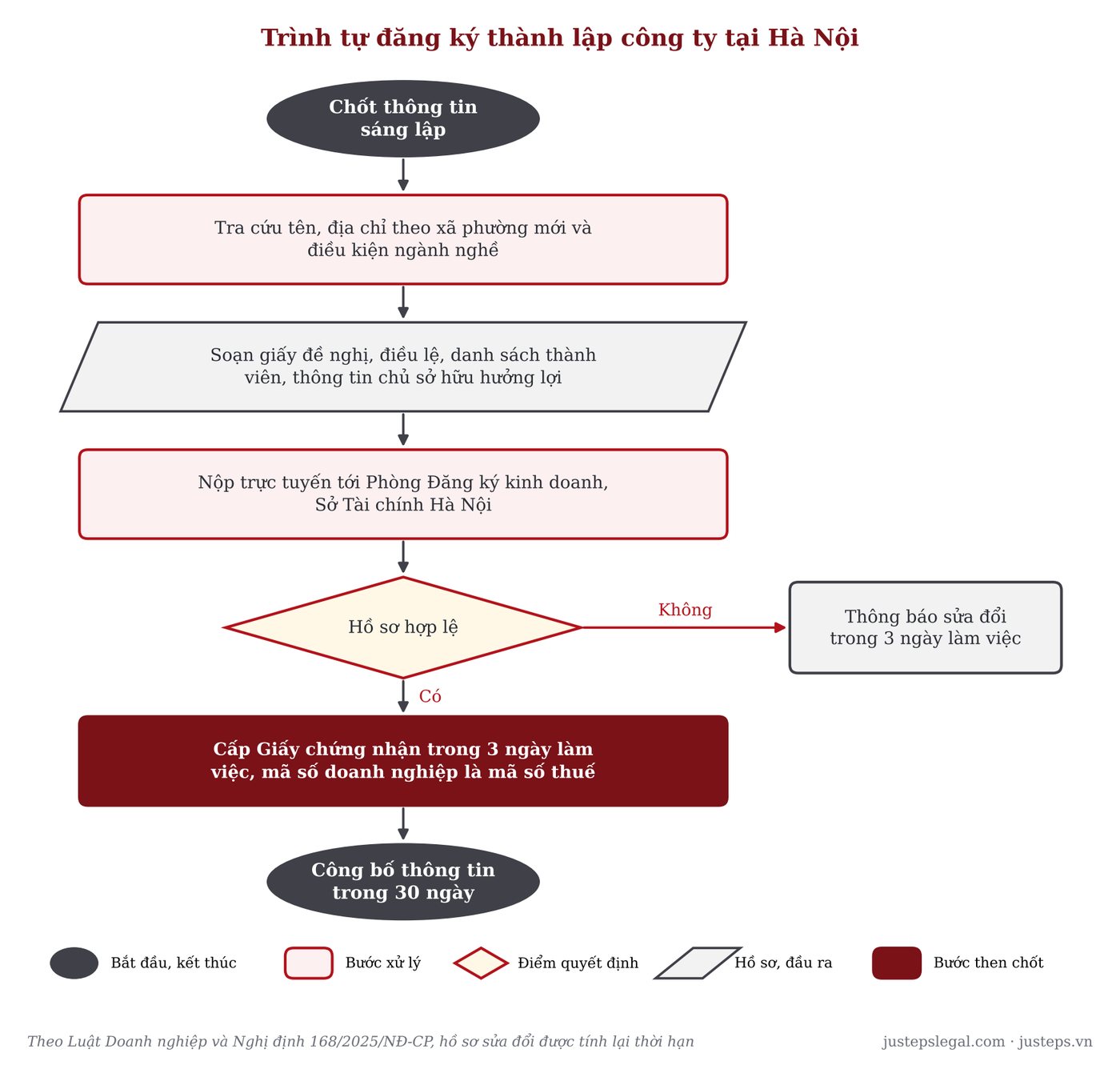
Sequence for registering a company with its head office in Hanoi
On receiving the application, the Business Registration Office examines its validity and issues the Certificate within 3 working days; if the application is not valid, the office notifies in writing, within the same time limit, what needs to be amended or supplemented[6]. Each time the application is amended, the 3-working-day period runs again from receipt of the amended file, so an application amended twice may take roughly two weeks longer. For this reason, the actual time needed to obtain the Certificate depends mainly on the quality of the application at first filing rather than on the statutory time limit. The enterprise code shown on the Certificate also serves as the tax code, so the company does not need to complete a separate tax registration[8].
While awaiting the Certificate, the founders may not sign sale contracts, office leases or employment contracts in the company’s name. If a contract must be signed for the purpose of establishing the company, such as a lease of the head office, it should state clearly that it is signed for that purpose and that the company will succeed to the rights and obligations under it once the Certificate is issued[9]. If the company is not established, the person who signed the contract is personally responsible for performing it.
Tasks to complete within the first 30 days after receiving the Certificate
Many companies regard receipt of the Certificate as the end of the formalities, only to find that the company cannot yet receive capital contributions, cannot invoice its first customer or has already missed a tax filing deadline. The tasks below need not be carried out in a fixed order, but they should be assigned to one person who is responsible for following them through to completion. Companies may use Justeps’ first 90 days operational set-up service to obtain a ready-made task list, templates and a person to track deadlines.
Publication of registration details, company seal and name at the head office
The company must publish its registration details on the National Business Registration Portal within 30 days of the date of issue of the Certificate and must pay the prescribed publication fee[10]. In many localities this fee is paid together with the registration application, so publication takes place automatically, but the person handling the formalities should still check the portal. The company decides for itself the type, number, form and content of its seals, and may use an electronic seal instead of an engraved one[11]. The company name must be displayed at the head office[3], so a name sign should be put up promptly, as this is the first thing the tax authority checks when verifying the address.
Bank account, digital signature and e-invoices
The company should open a payment account in its own name as soon as it receives the Certificate, as this is the channel through which members or shareholders contribute capital in cash and through which larger expenses are paid. Under the 2024 Law on Value Added Tax, goods and services purchased with a value of VND 5 million or more must be supported by non-cash payment documents for the input VAT to be deductible[12]. The legal representative should also register a digital signature and an electronic identification account for the organisation, because most dealings with the tax authority, the social insurance agency and banks are now conducted online.
Before selling goods or providing services for the first time, the company must register with the tax authority to use e-invoices through an e-invoicing service provider and may issue invoices only once its registration has been accepted[13]. Selling without issuing an invoice, or issuing an invoice at the wrong time, may attract penalties and late payment interest, so registration should proceed in parallel with signing the contract with the first customer. The accountant should also determine the method of calculating VAT and register with the tax authority if the company wishes to apply the credit method from the outset.
First tax filings
From 1 January 2026, the business licence fee has been abolished[14], so new companies no longer have to declare and pay it as they did previously. However, once it has a tax code, the company is a taxpayer and must file returns on time even if it has not yet generated any revenue. A newly established company files VAT returns quarterly, files personal income tax returns when it pays income to employees, and finalises corporate income tax at the end of the financial year[15]. Late filing of a return, even a nil return, still attracts penalties, so the accountant should prepare a filing calendar from the very first quarter.
Contribution of charter capital and beneficial ownership information
Members and shareholders must contribute in full and in the type of assets committed within 90 days of the date of issue of the Certificate, excluding the time needed to transport or import the contributed assets or to complete the transfer of their ownership[16]. Cash contributions should be transferred to the company’s account with a payment reference stating clearly that they are capital contributions, while contributions in other assets must be valued and their ownership transferred to the company. Once the capital has been received in full, a limited liability company must issue certificates of capital contribution to its members and update its register of members, while a joint stock company updates its register of shareholders.
If, at the end of the 90 days, any person has not contributed or has contributed only in part, the company must register a change of its charter capital and of the members’ ownership percentages to reflect the capital actually contributed within the following 30 days[16]. A person who has not contributed in full remains liable, up to the amount committed, for financial obligations arising before the date on which the company registers the change. Failure to register the capital adjustment on time is an administrative violation, and unclear capital records will cause difficulties when the company later raises capital, transfers interests or borrows from banks. The following chart brings together the statutory time limits running from the date of the Certificate that new companies often overlook.
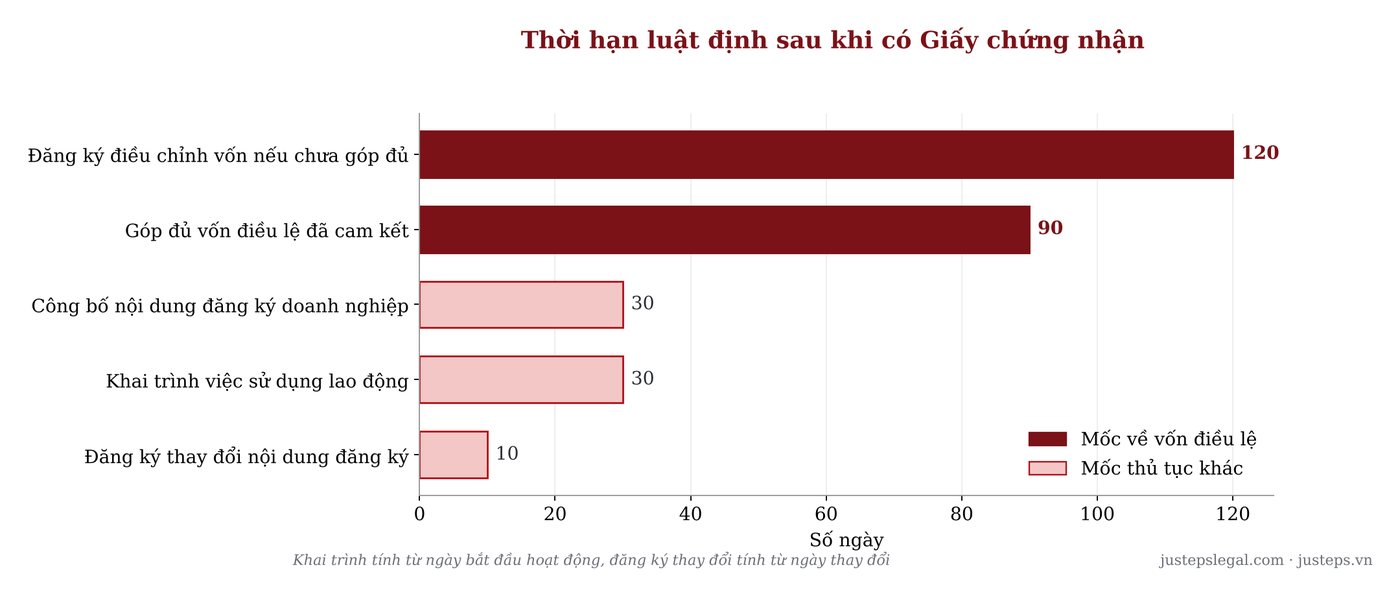
Statutory time limits running from the date of issue of the Enterprise Registration Certificate
The two 30-day deadlines for publishing registration details and reporting the use of labour arrive very early, when the company is still busy settling into its office and finding customers. The 90-day deadline for contributing capital has the most significant consequences, because after it the company has only 30 more days to register the capital adjustment, that is, until day 120 from the date of the Certificate. The 10-day period for registering changes runs afresh each time a change occurs, such as a change of address, of legal representative or a transfer of capital, so it must be monitored throughout the life of the company.
Since 1 July 2025, companies have also been required to collect, update and retain information on their beneficial owners, meaning individuals who actually own 25% or more of the charter capital or who have the power to control the company, and to provide this information to state authorities on request[17]. For a company whose members are all individuals holding their interests directly, identifying beneficial owners is fairly straightforward. Where a member is a legal entity or where interests are held by nominees, the company must trace the chain of ownership to the ultimate individual, and nominee arrangements may cause the information declared to be regarded as untruthful.
Organising accounting, employment and social insurance from the first day of operation
The company must organise its accounting function, appointing a chief accountant or a person in charge of accounting, or engaging a qualified accounting service provider, from the time it begins operating[18]. Documents from the establishment phase, such as the office lease, the cost of making seals and obtaining a digital signature and evidence of capital contributions, should be gathered from the start, because they form the basis for bookkeeping and for deductible expenses when finalising tax. Small companies often outsource all of this work to an external accounting provider, but the legal representative remains responsible for the accuracy of the figures.
When hiring its first employee, the company must enter into a written or electronic employment contract, keep a labour register and report its use of labour to the state labour authority within 30 days of commencing operation[19]. The employer must submit the application to register for compulsory social insurance within 30 days of the date on which the employment contract takes effect[20]. The wage stated in the contract must not be lower than the regional minimum wage; from 1 January 2027, the Region I rate is VND 5,700,000 per month[21], and the company should check the commune or ward where its head office is located against the list of areas to determine which region applies. Once it employs 10 or more workers, the company must have written internal labour rules and register them with the competent authority.
These tasks involve several people in a new company, and a task without a clearly assigned owner is usually the one that misses its deadline. The table below suggests how responsibilities may be divided so that none of these tasks is overlooked:
| Person responsible | Main tasks in the first 90 days | Records to keep |
|---|---|---|
| Legal representative | Signs the registration documents, opens the bank account, registers the digital signature and signs the first employment contracts. | The Certificate, the charter, account opening documents and any letters of authorisation. |
| Members or shareholders | Contribute the committed assets in full within 90 days and provide information for identifying beneficial owners. | Transfer receipts, valuation minutes and certificates of capital contribution. |
| Accountant | Registers for e-invoicing, prepares the tax filing calendar and records the establishment documents in the books. | Tax returns, the notice accepting e-invoice use and the accounting books. |
| HR officer | Reports the use of labour, registers social insurance and prepares internal labour rules once there are 10 employees. | Employment contracts, the labour register and social insurance records. |
A 90-day roadmap and the records the company must keep
The obligations analysed above can be arranged into a concrete roadmap so that the company does not have to deal with everything in a rush at the end of the period. The roadmap below is a suggestion for a small service company in Hanoi and may be shortened or extended depending on the business lines, the number of employees and the need for sector-specific licences.
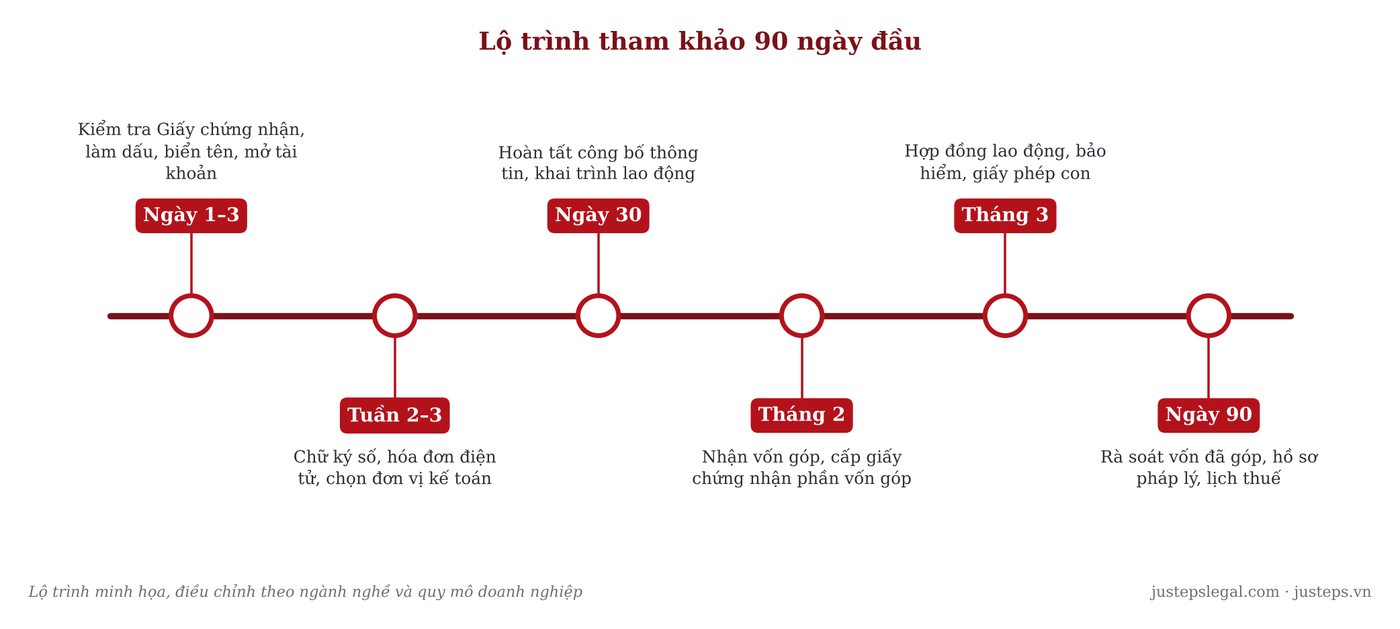
Indicative roadmap for the first 90 days after setting up a company in Hanoi
The first three days are spent checking the information on the Certificate, putting up the name sign, making the seal and opening the bank account, since every later task depends on them. The second and third weeks focus on the digital signature, e-invoicing and choosing an accountant, so that the company is ready to issue invoices as soon as it signs its first contract. From the second month, the focus shifts to capital contributions, employment records and sector-specific licences for any conditional business lines, followed by a full review before day 90.
In addition, the company must keep at its head office documents including the charter, the register of members or shareholders, the registration certificate, meeting minutes, resolutions, decisions and accounting records[22]. These documents are often neglected in the first year, yet they are the first things that banks, investors and the tax authority ask for when dealing with the company. The company should set up a legal records file from day one, noting the date of each document and where the original is kept, and update it whenever a change occurs.
How Justeps can help
Justeps supports founders in setting up a company in Hanoi and completing their post-registration obligations through the following services:
- Company formation and enterprise registration. Justeps advises on the choice of enterprise type, drafts the charter, and prepares and follows the registration application through to issue of the Certificate.
- Business licence and conditional business line registration. Justeps reviews the conditions for each business line and prepares applications for sector-specific licences before the company starts trading.
- First 90 days operational set-up. Justeps prepares a task list, a deadline calendar and a set of templates for capital contributions, employment and internal governance for new companies.
- Accounting function and documentation set-up. Justeps designs document and invoicing procedures and allocates accounting responsibilities to suit the size of a new company.
Frequently asked questions
How long does it take to set up a company in Hanoi?
A valid application results in the issue of the Certificate within 3 working days of receipt[6]. Including the time needed to settle the name, address and business lines and to draft the charter, most companies need about one to two weeks.
May an apartment be used as a company’s head office?
Apartments in buildings constructed for residential use may not be used as a company’s head office[4]. The company may instead lease space in an office building or in the commercial or service area of a mixed-use building.
Does a newly established company still have to pay the business licence fee?
The business licence fee was abolished from 1 January 2026[14]. The company must still file returns for other taxes on time, even before it generates any revenue.
What must be done if charter capital has not been fully contributed after 90 days?
The company must register a change of its charter capital and of the ownership percentages to reflect the capital actually contributed within the following 30 days[16]. Anyone who has not contributed in full remains liable, up to the amount committed, for obligations arising before the change is registered.
Can a company start trading in a conditional business line as soon as it has registered that line?
The Certificate merely records the business line, and the company may trade in a conditional line only once it satisfies all the conditions and holds any licence required by law[5]. Trading before the conditions are met may lead to penalties and suspension of the activity.
Must the company have a chief accountant from the outset?
The company must organise its accounting from the start of operations, and may appoint a chief accountant, a person in charge of accounting or engage an accounting service provider[18]. Micro-enterprises may apply a simplified regime but must still have someone responsible for the books.
Who must be declared as a beneficial owner?
A beneficial owner is an individual who actually owns, directly or indirectly, 25% or more of the charter capital, or who has the power to control the appointment of managers or amendments to the company’s charter[17]. Where a member is a legal entity, the company must trace the chain of ownership to the ultimate individual.
Related articles
- How to choose a business form between a household business, a limited liability company and a joint stock company
- Building a business conditions map to control conditional business lines before the launch date
- What a turnkey business operations set-up covers, in what order it should be done and how it should be signed off
- Setting up a foreign-invested company in Vietnam, from the investment registration certificate and capital account to post-licensing reporting
Notes
[1] Articles 30 and 31 of the Law on Enterprises No. 59/2020/QH14 dated 17 June 2020, as amended and supplemented by Law No. 76/2025/QH15.
[2] Article 12 of the Law on Enterprises No. 59/2020/QH14.
[3] Articles 37, 38 and 41 of the Law on Enterprises No. 59/2020/QH14.
[4] Article 42 of the Law on Enterprises No. 59/2020/QH14; Law on Housing No. 27/2023/QH15 dated 27 November 2023, on prohibited acts in the use of apartment buildings.
[5] Article 7 of and Appendix IV to the Law on Investment No. 143/2025/QH15, on conditional business lines, effective from 1 July 2026.
[6] Articles 21, 22, 23 and 26 of the Law on Enterprises No. 59/2020/QH14, as amended and supplemented by Law No. 76/2025/QH15.
[7] Government Decree No. 168/2025/ND-CP dated 30 June 2025 on enterprise registration, as amended and supplemented by Decree No. 296/2026/ND-CP.
[8] Article 29 of the Law on Enterprises No. 59/2020/QH14.
[9] Article 18 of the Law on Enterprises No. 59/2020/QH14, on contracts entered into before enterprise registration.
[10] Article 32 of the Law on Enterprises No. 59/2020/QH14.
[11] Article 43 of the Law on Enterprises No. 59/2020/QH14.
[12] Law on Value Added Tax No. 48/2024/QH15 dated 26 November 2024, on the conditions for deducting input VAT.
[13] Government Decree No. 123/2020/ND-CP dated 19 October 2020 on invoices and documents, as amended and supplemented by Decree No. 70/2025/ND-CP.
[14] Resolution No. 198/2025/QH15 of the National Assembly dated 17 May 2025 on special mechanisms and policies for the development of the private economy.
[15] Government Decree No. 126/2020/ND-CP dated 19 October 2020 detailing certain articles of the Law on Tax Administration, and its amending and supplementing instruments.
[16] Clauses 2 and 4 of Article 47, Clauses 2 and 4 of Article 75 and Article 113 of the Law on Enterprises No. 59/2020/QH14.
[17] Law No. 76/2025/QH15 amending and supplementing certain articles of the Law on Enterprises; Decree No. 168/2025/ND-CP on the criteria for identifying beneficial owners and beneficial ownership information.
[18] Law on Accounting No. 88/2015/QH13 dated 20 November 2015; Government Decree No. 174/2016/ND-CP dated 30 December 2016.
[19] Articles 12, 14 and 118 of the Labour Code No. 45/2019/QH14 dated 20 November 2019; Article 4 of Decree No. 145/2020/ND-CP dated 14 December 2020; Decree No. 337/2025/ND-CP on electronic employment contracts.
[20] Article 28 of the Law on Social Insurance No. 41/2024/QH15 dated 29 June 2024.
[21] Decree No. 399/2026/ND-CP on minimum wages for employees working under employment contracts, applicable from 1 January 2027.
[22] Article 11 of the Law on Enterprises No. 59/2020/QH14.
This article is for reference and reflects the regulations in force at the time of publication. Please consult Justeps for advice tailored to your company’s records and situation.
For further information, please contact:
📩 Email: info@justeps.vn
🌐 Website: https://justepslegal.com · https://justeps.vn
🌐 Page: Justeps
☎️ Hotline (Zalo): 096 172 2607
📍 Thanh Xuan Office: 12th Floor, Licogi 13 Tower, 164 Khuat Duy Tien Street, Thanh Xuan Ward, Hanoi, Vietnam
📍 Ha Dong Office: LK06B, No.10, Dong Dua Area, Ha Dong Ward, Hanoi, Vietnam
📍 Ho Chi Minh City Branch: 528 Le Van Sy, Ho Chi Minh City, Vietnam
📍 Hai Phong Office: Truong Thinh Village, Ha Dong Commune, Hai Phong, Vietnam
📍 Quang Ninh Office: Van Don Special Zone, Quang Ninh Province, Vietnam





