
Key takeaways
- Businesses must organise the receipt and resolution of consumers’ feedback, requests and complaints and acknowledge receipt within 3 working days.
- Businesses that manufacture, import or directly sell goods or provide services must publish their complaint handling procedure, except micro-enterprises and individuals not required to register a business.
- Classifying cases by value and impact, together with a commitment limit for each person, prevents front-line staff from making promises beyond their authority.
- When a consumer requests negotiation, the business must accept and negotiate within 7 working days; if it refuses, it must reply in writing stating the reasons.
- Each case needs a file reference, transaction documents, a written outcome and a root cause, so that the business can both demonstrate compliance and reduce repeat errors.
A customer posts a complaint on the business’s social media page but only receives a reply three days later, by which time the post has been widely shared. In another shop, a sales assistant promises to replace a product with a new one, whereas the business’s warranty policy only allows repair, so the technical team refuses and the customer comes back even more upset. There are also cases where a shift supervisor agrees a refund with a customer over the telephone without anyone recording it, and when the customer later writes to the regulator the business has no documents to check against. What these situations have in common is that the business has not clearly established who receives complaints, who may decide, within what time limit and where the records are kept.
This article analyses how to build a customer complaint handling procedure based on the 2023 Law on Protection of Consumers’ Rights, covering the legal obligations to receive complaints and publish the procedure, how to classify cases, the handling steps, negotiation and refusal, internal deadlines, records and data protection. It applies mainly to businesses selling goods or providing services directly to consumers, such as retail, e-commerce, food and beverage, tourism, education and beauty care. Businesses that only deal with corporate customers may still use this framework, although their specific obligations will mainly be governed by the contracts between the parties.
Legal obligations to receive and resolve complaints
The Law on Protection of Consumers’ Rights requires business organisations and individuals to organise the receipt and resolution of consumers’ feedback, requests and complaints, and to notify the consumer that it has been received within 3 working days of receipt[1]. The obligation to receive and reply applies to every business, regardless of size. Feedback, requests and complaints differ in degree, but operationally the business should route all three through the same intake channel so that minor feedback, which may later become a complaint, is not overlooked.
In addition to the general obligation, organisations and individuals that manufacture, import or directly sell goods or provide services to consumers must establish and publish a procedure for receiving and resolving complaints. The procedure must be displayed in a prominent place at the head office and business premises, and posted on the website or app if the business has one[1]. Micro-enterprises under the criteria of the law on support for small and medium-sized enterprises, and individuals who trade independently and regularly without being required to register a business, are not obliged to publish the procedure[2]. Even so, they must still receive and reply to consumers, so a simple internal procedure is still needed.
Vulnerable consumers
The Law provides special protection for vulnerable consumers, including older people, people with disabilities, children, ethnic minorities and people living in disadvantaged areas, women who are pregnant or raising children under 36 months old, people with serious illnesses and members of poor households[3]. When such customers submit a request with supporting evidence, the business must prioritise receiving and handling it and may not pass the request on to a third party, unless that third party has a related obligation. If the business refuses the request, it must reply in writing, clearly stating the legal basis[3]. The intake form should therefore include a box to flag priority customers, so that the handler knows to apply the appropriate deadline and form of reply.
The consequences of failing to meet these obligations go beyond the risk of administrative penalties in the field of consumer protection. Where the business does not reply or refuses to negotiate without a legitimate reason, the consumer has the right to ask the state management authority or a social organisation involved in consumer protection to assist with negotiation[4]. At that point, the matter turns from an exchange between the business and its customer into a file monitored by a third party, with much greater handling costs and reputational impact.
Classifying complaints and setting authority limits
Not every complaint needs a department head or director to handle it, nor can front-line staff be left to decide every case on their own. An effective approach is to classify complaints according to three criteria: the value to be refunded or exchanged, the degree of impact on the customer’s health or property, and the risk of the matter spreading outside the business, for example where the customer has already posted publicly or written to the regulator. Each level is linked to a responsible person, an internal reply deadline and a clear commitment limit.
The table below suggests a classification for a medium-sized retail or service business; the deadlines are internal targets and are shorter than the statutory time limits:
| Case level | Examples and handler | Internal reply deadline |
|---|---|---|
| Level 1, simple | Questions on use, missing accessories, wrong colour; handled by customer service staff. | Within 1 working day of receipt. |
| Level 2, standard | Defective product to be exchanged, refund within the limit; decided by the head of customer service. | Within 3 working days, extendable where a technical inspection is needed. |
| Level 3, complex | Compensation above the limit or the customer has posted publicly; the sales director works with the legal department. | Within 5 working days, updating the customer on progress before the deadline expires. |
| Level 4, serious | Impact on health or safety, or a complaint already sent to a state authority; led by the general director. | Handling meeting on the same day, contact with the customer within 24 hours. |
The refund, exchange and compensation limits for each job title should be set out in the business’s delegation of authority regulations, not just in the customer service procedure. Staff may only make commitments within their own limit; for cases above the limit, they tell the customer that the request has been passed to the competent level and state when a reply will be given. This avoids situations in which an employee promises a solution the business cannot deliver, because a promise made by staff during a sale or customer service is usually regarded by the customer as a commitment by the business.
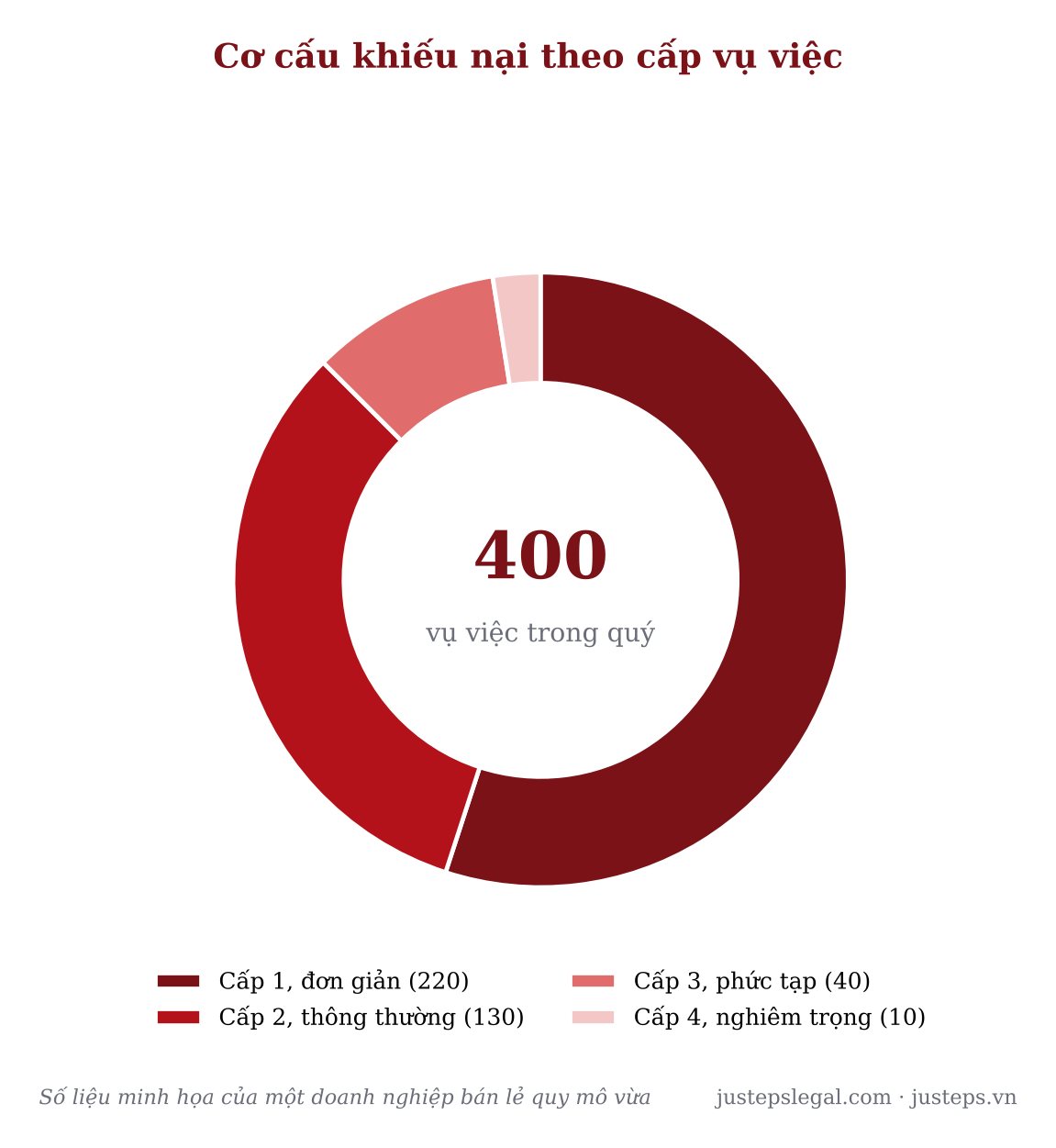
Breakdown of complaints by case level at a retail business
The chart illustrates the breakdown of complaints over one quarter at a retail business with around 400 cases. Most cases are at level 1 and level 2 and can be resolved immediately at the front line if staff are given clear limits and response scripts. Level 3 and level 4 cases account for only a small share but take up most of management’s time, so the procedure should focus resources on detecting these cases early and routing them to the correct level. Businesses should compile their own statistics in the same way after three months of operation to adjust the limits to reality.
The steps in the complaint handling procedure
A full procedure usually has seven steps, from the moment a customer submits a complaint through any channel until the file is closed and the root cause has been passed to the relevant department for correction. The flowchart below shows the order of the steps and two key decision points: classification, and whether the proposed solution falls within the handler’s limit.
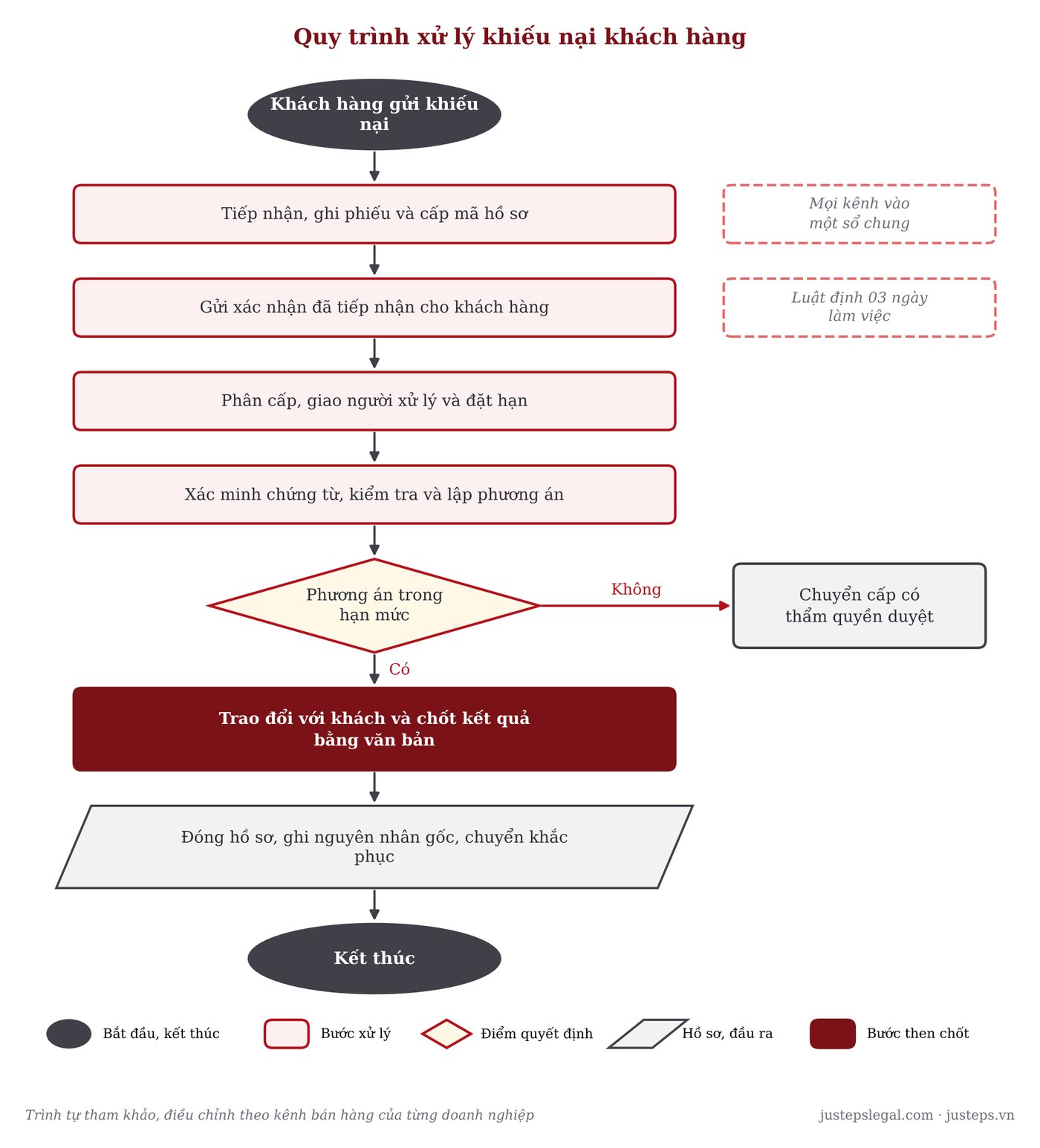
Seven steps in handling a complaint, from receipt to closing the file
The first step is receipt and logging, in which every complaint from shops, the call centre, email, social media or e-commerce marketplaces is entered into a single shared register and assigned a file reference. The second step is to send the customer an acknowledgement of receipt, stating the file reference, the person in charge and the expected deadline; the law allows 3 working days, but the business should do this on the same day. The third step is for the team leader to classify the case, assign a handler and set a completion deadline according to the classification table.
The fourth step is verification, including checking invoices, transaction documents, photographs, call recordings and technical inspection results where necessary, and then preparing a proposed solution. The fifth step is approval of the solution by the competent person; for a solution within the limit, the handler decides, while a solution above the limit must be escalated to a higher level. The sixth step is to discuss the matter with the customer and record the outcome in writing, which may be an email, a message with a retained record or a settlement record. The final step is to close the file, record the root cause, such as a manufacturing fault, a delivery fault, incorrect advice or unclear product information, and pass it to the department responsible for correction.
During verification, the business is obliged to provide the consumer with invoices, receipts and documents relating to the transaction as required by law or at the consumer’s request; for transactions in cyberspace, the business must enable the consumer to access, download, store and print these documents[5]. The sales system should therefore allow invoices to be looked up quickly by telephone number or order number, so that complaint handlers do not have to ask customers to resend documents the business already holds.
Negotiation, refusal and further methods of resolution
The Law provides four methods for resolving disputes between consumers and business organisations or individuals: negotiation, mediation, arbitration and the courts[6]. Most complaints are resolved within the internal procedure before they become disputes, but when a consumer sends a formal request for negotiation, the business must accept it and negotiate within 7 working days of receiving the request[7]. The procedure must therefore clearly specify who is assigned to negotiate, what they may decide and the template for recording the outcome.
The business has the right to refuse a customer’s request where it has no basis, for example where the warranty period has expired or the damage resulted from use contrary to the instructions. However, where it refuses to negotiate, the business must reply in writing and state the reasons within 7 working days[7]. A refusal given over the telephone or at the counter does not meet this requirement and leaves no evidence, so every refusal should be sent in writing, including by email with a retained record.
Where negotiation succeeds, the outcome must be recorded in writing unless the parties agree otherwise; the document states the parties, the time, the place, the content and the outcome of the negotiation, and bears the signatures or fingerprints of the parties[8]. If negotiation fails, the customer may choose mediation, arbitration where there is a valid arbitration agreement, or bring proceedings in court. At this stage, the business should compile the full case file, assess the grounds of both sides and consider mediation before handling costs and time increase.
Internal deadlines and escalation
The statutory time limits are the outer limit and should not be the operating target. Customers now often expect a response within a few hours, particularly when they complain via social media or e-commerce marketplaces, where the marketplace itself sets separate response deadlines for sellers. The business should therefore set internal deadlines that are considerably shorter and measure compliance with them every month.
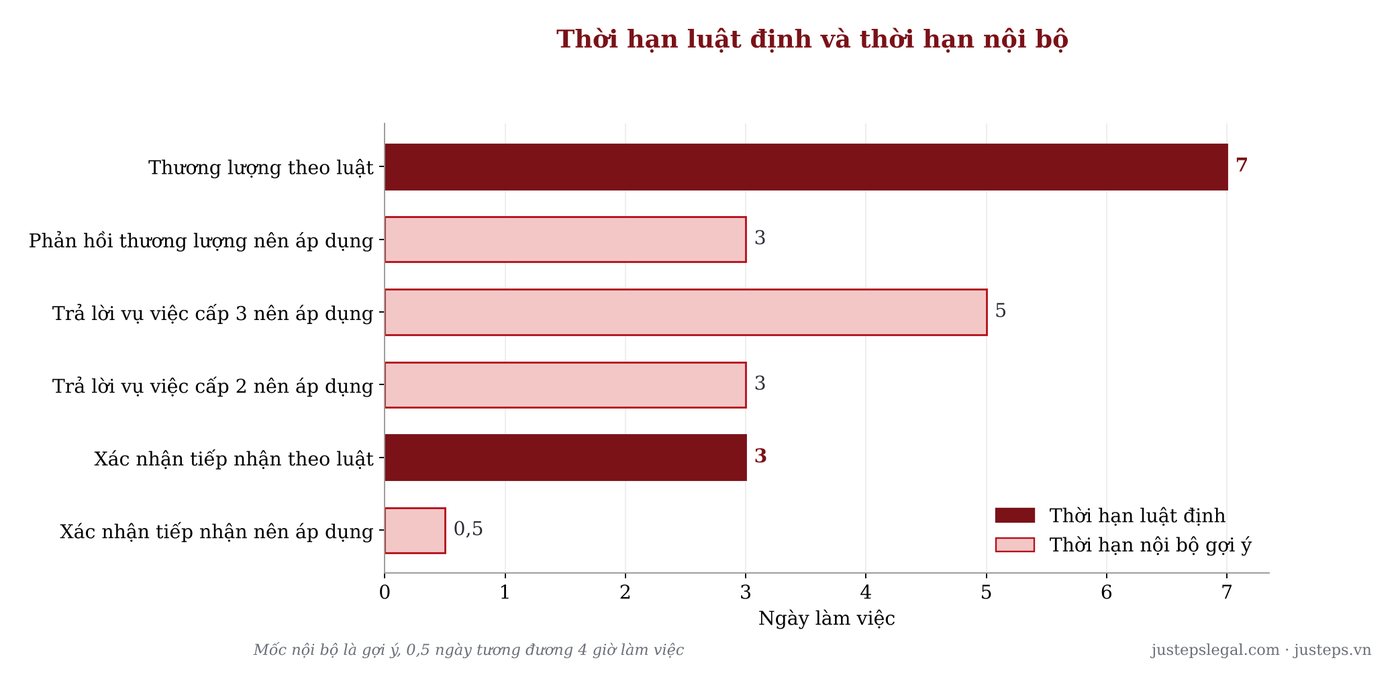
Statutory time limits compared with recommended internal deadlines
The chart compares the two statutory time limits with the internal deadlines that Justeps usually recommends. An acknowledgement should be sent within 4 working hours rather than waiting until the 3-working-day limit, and a formal request for negotiation should be answered within 3 working days rather than 7. For cases awaiting testing or a response from the manufacturer, the handler must inform the customer of the new deadline in writing before the old one expires, so that the customer does not feel ignored.
An automatic escalation mechanism ensures that cases are not forgotten when the handler is on leave or overloaded. Under this mechanism, a case that is 1 working day overdue is automatically escalated to the team leader, and one that is 3 working days overdue is reported to the director in charge. Businesses with fewer than about 50 cases a month can use a shared spreadsheet with a deadline column and conditional alerts, while those with higher volumes should use ticketing software with reminders and reporting functions.
Records, forms and protection of customer data
A procedure is only worth something if it leaves enough of a trail for the business to prove that it received, handled and replied on time. The minimum set of records usually comprises six forms, each linked to one step of the procedure:
- A complaint intake form recording the channel, customer details, content, transaction reference and priority customer group, if any.
- An acknowledgement letter stating the file reference, the person in charge and the expected reply date.
- A product or service inspection record stating the condition, the cause of the damage and the technical conclusion.
- A proposal and approval form for the solution stating the value, the applicable limit and the approver.
- A reply letter or settlement record setting out the final outcome, including any refusal with reasons.
- A monthly complaint summary showing the number of cases, handling time, on-time rate and root causes.
Complaint files contain a great deal of customers’ personal data, such as names, telephone numbers, addresses, call recordings, photographs and sometimes health information. The business should only collect information necessary for handling the complaint, grant access according to role, avoid sharing files through personal chat groups and set a reasonable retention period[9]. The Law amending and supplementing a number of articles of the Commercial Law, the Competition Law, the Law on Foreign Trade Management and the Law on Protection of Consumers’ Rights, passed by the National Assembly on 13 November 2026 and taking effect on 1 July 2027, continues to require businesses not to force consumers to provide information that is unnecessary for the transaction[10], so intake forms should be reviewed before that date.
The most common mistakes in implementation are receiving complaints through many channels without a central coordinator, staff making commitments beyond their limits, refusing verbally and closing files without recording the root cause. Each of these mistakes can be corrected with a form or a simple rule, provided that front-line staff are trained in the procedure and compliance is checked periodically. Businesses that need to review their warranty, returns and complaint policies under the new rules may refer to Justeps’ advertising, promotions and consumer protection advisory service; retail chains with many outlets may combine this with our internal procedures and regulations service for retail chains.
How Justeps can help
Justeps helps businesses build and run a customer complaint handling procedure that complies with the law through the following services:
- Advertising, promotions and consumer protection. Justeps reviews warranty and returns policies, displayed information and the complaint procedure under the Law on Protection of Consumers’ Rights.
- Internal procedures and regulations for retail chains. Justeps designs a unified intake channel for multiple shops, together with the classification table and authority limits for each job title.
- Internal procedures and regulations for e-commerce businesses. Justeps builds complaint handling procedures that fit marketplace policies and online sales channels.
- Sector compliance and personal data training. Justeps trains front-line staff on receiving and answering complaints and protecting customers’ personal data.
Frequently asked questions
How quickly must a business acknowledge a complaint?
The business must notify the consumer that it has received the feedback, request or complaint within 3 working days[1]. In practice, the business should send the acknowledgement on the same day to reduce the likelihood of the customer posting about the issue on social media.
Must a micro-enterprise display its complaint handling procedure?
A micro-enterprise is not required to publish its procedure for receiving and resolving complaints[1]. However, it must still organise the receipt and resolution of complaints and notify consumers that they have been received.
May a business refuse a customer’s request?
The business may refuse a request that has no basis, but if it refuses to negotiate it must reply in writing and state the reasons within 7 working days[7]. For vulnerable consumers, the refusal must also state the legal basis.
If a sales assistant promises an exchange beyond the policy, must the business honour it?
Customers usually understand a promise made by staff during a transaction as a commitment by the business, so the business is easily placed in a position where it must honour it or renegotiate. The preventive measure is to set the commitment limit for each job title in the delegation of authority regulations and to train staff to reply within their remit.
What should a business do when a customer asks a state authority to intervene?
Where the business does not reply or refuses to negotiate without a legitimate reason, the consumer may ask the state management authority or a social organisation to assist with negotiation[4]. The business should immediately prepare the case file, appoint a contact person and negotiate with the customer within the statutory time limit.
Should complaints be managed with a spreadsheet or with software?
A shared spreadsheet with a deadline column and alerts is usually sufficient for businesses with fewer than about 50 cases a month. Where volumes are higher or there are many intake channels, the business should use software with reminders, automatic escalation and role-based access to data.
Does the outcome of negotiation with a customer need to be recorded in writing?
A successful negotiation must be recorded in writing, unless the parties agree otherwise, and signed or fingerprinted by the parties[8]. This document is the basis for the business to perform the settlement and to prove that the matter has been resolved.
Related articles
- Selling on e-commerce marketplaces in Vietnam and the rules on invoices, tax, returns and complaints
- Building restaurant operating procedures from the organisational structure to every service shift
- The procedure for issuing internal documents in a company, from drafting to archiving and monitoring their validity
- Risk management for small and medium-sized enterprises through a risk register with named owners and a review schedule
Notes
[1] Article 31 of the Law on Protection of Consumers’ Rights No. 19/2023/QH15 dated 20 June 2023, effective from 1 July 2024.
[2] Clause 3 of Article 31 of the Law on Protection of Consumers’ Rights No. 19/2023/QH15; criteria for micro-enterprises under the Law on Support for Small and Medium-sized Enterprises No. 04/2017/QH14 and Government Decree No. 80/2021/ND-CP.
[3] Article 8 of the Law on Protection of Consumers’ Rights No. 19/2023/QH15.
[4] Clause 3 of Article 56 of the Law on Protection of Consumers’ Rights No. 19/2023/QH15.
[5] Article 29 of the Law on Protection of Consumers’ Rights No. 19/2023/QH15.
[6] Clause 1 of Article 54 of the Law on Protection of Consumers’ Rights No. 19/2023/QH15.
[7] Clauses 2 and 6 of Article 57 of the Law on Protection of Consumers’ Rights No. 19/2023/QH15.
[8] Article 60 of the Law on Protection of Consumers’ Rights No. 19/2023/QH15.
[9] The Law on Personal Data Protection No. 91/2025/QH15 and Decree No. 363/2026/ND-CP.
[10] The Law amending and supplementing a number of articles of the Commercial Law, the Competition Law, the Law on Foreign Trade Management and the Law on Protection of Consumers’ Rights, passed by the National Assembly on 13 November 2026 and effective from 1 July 2027.
This article is for reference and reflects the regulations in force at the time of publication. Please consult Justeps for advice tailored to your company’s records and situation.
For further information, please contact:
📩 Email: info@justeps.vn
🌐 Website: https://justepslegal.com · https://justeps.vn
🌐 Page: Justeps
☎️ Hotline (Zalo): 096 172 2607
📍 Thanh Xuan Office: 12th Floor, Licogi 13 Tower, 164 Khuat Duy Tien Street, Thanh Xuan Ward, Hanoi, Vietnam
📍 Ha Dong Office: LK06B, No.10, Dong Dua Area, Ha Dong Ward, Hanoi, Vietnam
📍 Ho Chi Minh City Branch: 528 Le Van Sy, Ho Chi Minh City, Vietnam
📍 Hai Phong Office: Truong Thinh Village, Ha Dong Commune, Hai Phong, Vietnam
📍 Quang Ninh Office: Van Don Special Zone, Quang Ninh Province, Vietnam





