
Key takeaways
- A business should classify its costs into four groups according to the value they create before cutting, because cutting the same percentage across all departments usually weakens the very units that generate revenue.
- The safe order is to remove costs that create no value, renegotiate with suppliers, set limits for administrative spending, improve processes, and restructure staff only when those four steps are not enough.
- Spending limits and payment methods should be linked to the conditions for deductible expenses, because any payment of five million dong or more must be supported by non-cash payment documents.
- When employees have to be dismissed because of structural change or economic reasons, the business must have a labour utilisation plan, consult the employee representative organisation, give advance notice and pay the job-loss allowance under the Labour Code.
- Every cut needs an indicator tracked for ninety days so that cuts that harm customers or drive away good people are detected in time.
A distribution company cut half of its marketing and customer service staff to save about eighty million dong a month, and six months later revenue from repeat customers had fallen by nearly a fifth. A printing works postponed machine maintenance to reduce costs in the quarter, and when the main machine broke down in the middle of the peak season it had to outsource production at twice the price. A service company cut the allowances of all its staff without prior discussion, and the first to leave were its best specialists, who could easily find new jobs. In all three cases there were legitimate reasons to reduce costs, but the cuts fell in the wrong place, so the organisation weakened faster than the money saved.
This article shares practical lessons on cutting operating costs in a safe order, including how to recognise when cuts are needed, how to classify costs, five steps of cost reduction by priority, how to keep the team stable and the legal requirements when staff reductions become unavoidable. The content suits small and medium-sized enterprises in trading, services and manufacturing with operating costs ranging from a few hundred million to a few billion dong a month. The main readers are business owners, managing directors, chief accountants and HR managers preparing next year’s cost plan.
When a business should start cutting costs
Cutting costs is a management decision that needs a basis and should not stem merely from a feeling that the company is spending too much. A programme that starts too late forces the business to cut hard and in haste, whereas one that starts too early or without a clear reason causes employees unnecessary anxiety. From Justeps’ advisory experience, a business should proactively review its costs when one or more of the following signs appear:
- Administrative and selling expenses have grown faster than revenue for two consecutive quarters without any investment plan to explain it.
- Cash and cash equivalents cover fixed costs for less than three months.
- Headcount has increased through several rounds of urgent hiring but has never been reviewed against the actual workload.
- The business has lost a major customer or its cost of goods has risen sharply without a corresponding adjustment in selling prices yet.
Once it has decided to cut, the business should set an overall target in money and time, such as reducing a certain amount per month within six months, rather than setting a percentage cut for each department from the start. An overall target allows the management to cut deeply in cost groups of little value and leave untouched the groups that generate revenue. The person in charge of the programme should be the managing director or the finance director, with the chief accountant providing data and department heads explaining each line of cost.
Classifying costs before cutting
The first step is to extract all operating costs for the past twelve months by supplier, by cost item and by department, then place each line in one of four groups according to the value the expense creates. The first group is costs that directly generate revenue, such as sales staff salaries, commissions, delivery costs and marketing with measurable results, which should be kept and only optimised. The second group is costs that maintain capability, such as machine maintenance, training, software licences and occupational safety, which can be spread out in a controlled way but must not be dropped. The third group is general administrative costs such as office rent, entertainment, business travel, stationery and telecommunications, which offer the greatest room for negotiation and spending limits. The fourth group is costs that create no value, including fees for services no longer used, duplicate subscriptions, software accounts of people who have left and habitual expenses for which nobody takes responsibility.
The chart below illustrates the structure of the four cost groups of a trading company with operating costs of about VND 1.2 billion a month, in millions of dong.
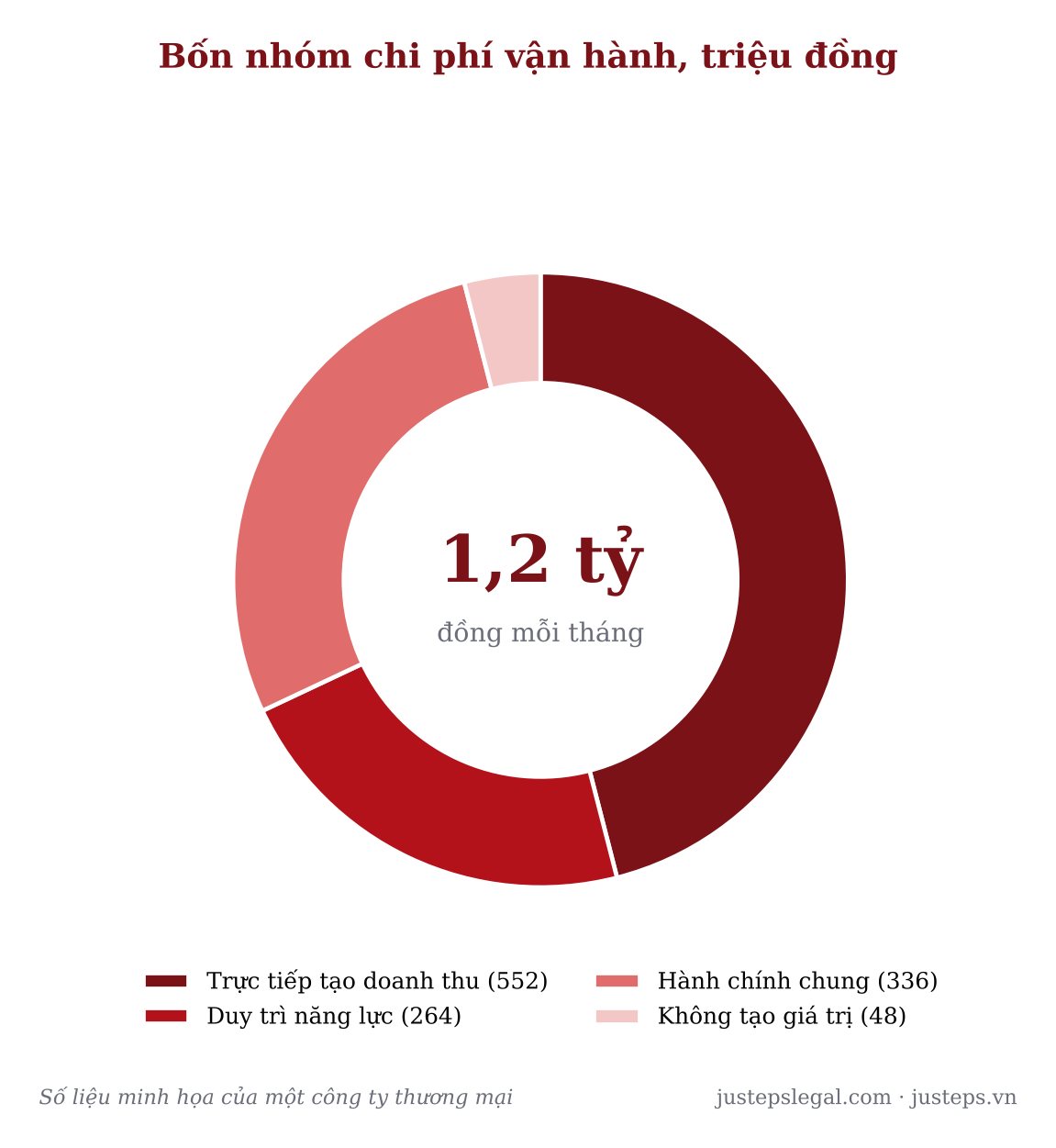
Structure of the four operating cost groups of a trading company
In the example, costs directly generating revenue amount to VND 552 million, or 46 per cent, costs maintaining capability VND 264 million, general administrative costs VND 336 million and costs creating no value VND 48 million a month. By removing the whole no-value group and reducing the general administrative group by ten to fifteen per cent, the business saves about VND 82 to 98 million a month, or about seven to eight per cent of total costs, without yet touching staff. Conversely, a uniform ten per cent cut across all departments would see almost half of the amount cut fall on the groups that generate revenue. The figures are illustrative, and the actual proportions differ significantly between trading, service and manufacturing businesses.
A five-step order of cuts
Justeps’ experience shows that cutting in order from the least risky items to the riskiest helps a business achieve most of its target before having to touch people. The flowchart below describes the five steps and the decision point on whether staff restructuring is needed.
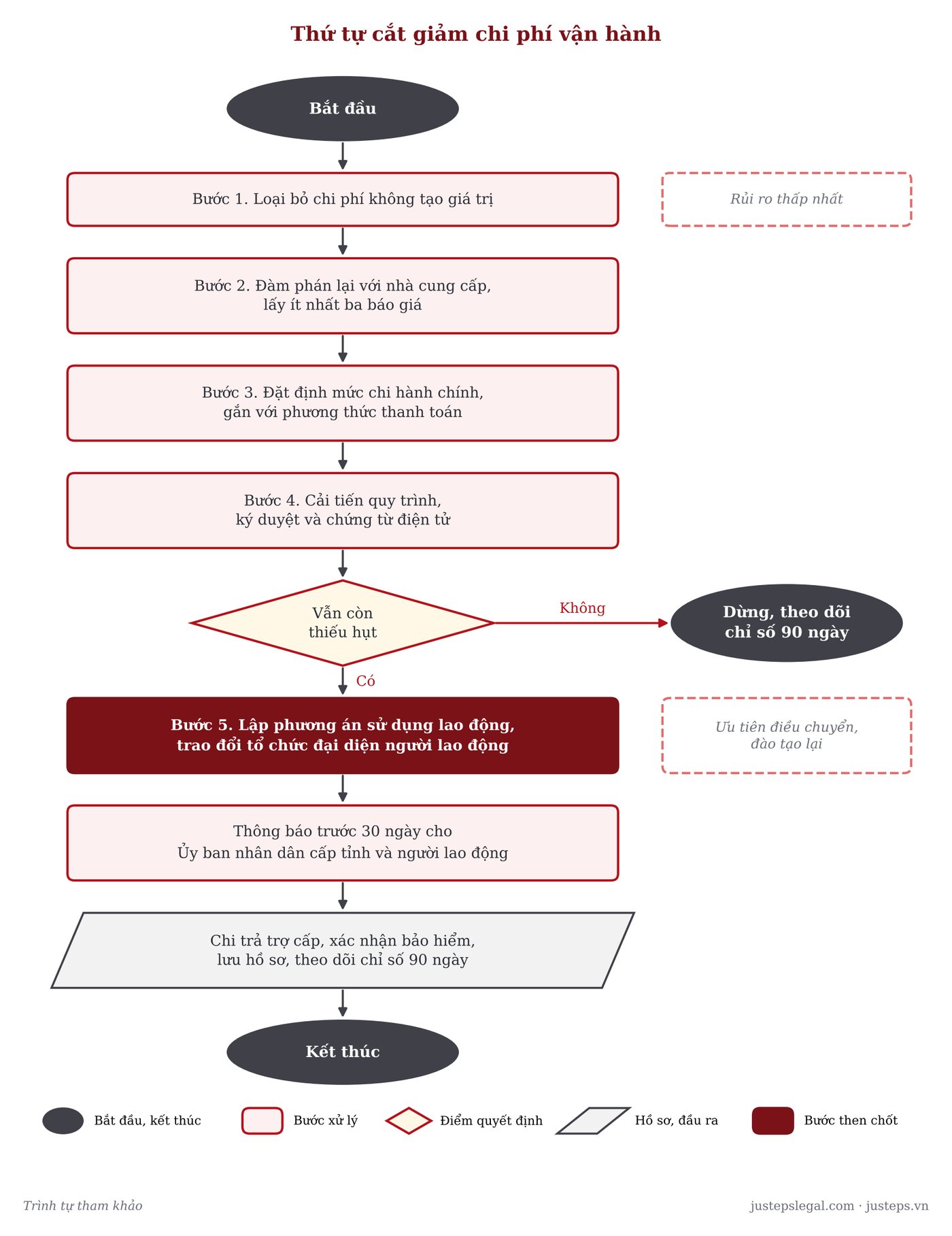
The five-step order for cutting operating costs
According to the flowchart, the business goes through the first four steps in turn, namely removing costs that create no value, renegotiating with suppliers, setting limits for administrative spending and improving processes. After these four steps, the management compares the amount saved with the target and the cash flow position, and if there is no remaining shortfall it stops and moves on to tracking results for ninety days. Only if a shortfall remains does the business move to the fifth step of restructuring staff, and this step must go through the mandatory procedures of labour law analysed later in this article.
Removing costs that create no value
Accounting draws up a list of recurring expenses over twelve months by supplier and asks each department head to confirm which are still needed, who uses them and what value they bring. Any item for which nobody takes responsibility within the set deadline is suspended, because if it is truly needed, the user will speak up immediately. At this step, businesses commonly discover duplicate software subscriptions, unused backup connections, surplus parking spaces or rented storage and service accounts of employees who have left.
Renegotiating with suppliers
Premises rent, transport, telecommunications, printing, security and cleaning often offer considerable room for negotiation, especially when contracts were signed years ago and renew automatically. For each large expense, the business should obtain at least three new quotations as a basis, then ask the current supplier to adjust the price, bundle services or extend the payment term. Before terminating an old contract, the responsible department must read the clauses on notice periods, penalties and compensation carefully, because the cost of early termination may exceed the first year’s savings.
Setting limits for administrative spending
Entertainment, business travel, telephone and stationery should have limits by job title written into the financial regulations or internal spending regulations, rather than being approved case by case. The limits should also specify the payment method, because any payment of five million dong or more must be supported by non-cash payment documents to be treated as a deductible expense in determining taxable income for corporate income tax[1]. An entertainment expense approved within the limit but paid in cash may still be excluded from deductible expenses, so the business both spends the money and has to pay more tax. A business that needs to build or update its spending limits may consider Justeps’ service of internal spending regulations and cost norms.
Improving processes
Many hidden costs lie in employees’ time, for example a payment request of two million dong that must pass through five levels of paper sign-off, or accountants re-entering invoice data that already exists in the system. The business should shorten approval routes by value threshold, allow approval in software and store documents electronically, because data messages are legally recognised and have the same value as written documents when they meet the statutory conditions[2]. Electronic invoices, when issued and managed in accordance with the rules on electronic invoices and electronic documents[3], can be connected directly to the accounting software to reduce manual data entry. When merging or combining positions to reduce headcount, the business must bear in mind that storekeepers, cashiers, persons buying and selling assets and managers or executives may not work as accountants, except in certain types of small business that are excluded[4][5].
Restructuring staff
Restructuring staff is the last step and should only be taken when the four previous steps have not met the target and the business has reassessed the workload of each department. Before considering dismissals, the business should weigh less disruptive options such as freezing new hiring, not replacing people who leave naturally, transferring people to understaffed departments and retraining them for new positions. These options save money more slowly but preserve experience and avoid the costs of allowances and of rehiring when business recovers.
Keeping the organisation stable during the cuts
The greatest risk of a cost-cutting programme is losing the people the business most wants to keep. The management should identify the core staff, usually about fifteen to twenty per cent of the workforce, whose departure would immediately affect the work of their department, and speak to them directly before announcing the plan. The conversation should explain why the business is cutting costs, their role in the coming period and what will not change, so that they do not have to guess and look for another job as a precaution.
If the business wishes to reduce salaries, allowances or working hours, it may not make the change unilaterally but must reach agreement with the employees, because these are terms of the employment contract. The Labour Code requires the party requesting an amendment or supplement to the contract to notify the other party at least three working days in advance, and if no agreement is reached the parties continue to perform the contract as concluded[6]. The Labour Code also allows employees to be temporarily transferred to work other than that stated in the contract in certain cases, such as dealing with the consequences of natural disasters or incidents or meeting production and business needs, but with limits on duration and salary[6]. Business leaders should cut their own benefits first, because employees will judge the fairness of the programme by who bears the loss first.
The cost-cutting plan should be announced at a general meeting, setting out the main figures, the reasons, the items that will not be cut and when the plan will be reassessed. A business with an employee representative organisation should consult it before the meeting, because this is both a legal requirement in certain cases and a way to make the plan easier for employees to accept. After the announcement, department heads need consistent answers to common questions, to avoid each person giving a different explanation and creating rumours.
Legal requirements when staff reductions are unavoidable
The Labour Code allows an employer to dismiss employees because of structural or technological change or for economic reasons, but subject to a chain of strict obligations[6]. Structural change includes changes to the organisational structure and reorganisation of labour, while economic reasons include crises, economic recession or the implementation of State policies when restructuring the economy. Where the change affects the jobs of many employees, the business must develop and implement a labour utilisation plan, giving priority to retraining employees for continued employment if new positions are available. The plan must be discussed with the grassroots employee representative organisation, if any, and must be made public to employees within fifteen days from the date it is adopted.
Dismissals may only proceed after consulting the grassroots employee representative organisation in respect of employees who are its members, and the business must give thirty days’ notice to the provincial People’s Committee and to the employees[6]. Employees who have worked regularly for twelve months or more and lose their jobs are entitled to a job-loss allowance of one month’s salary for each year of work, but at least two months’ salary, and the period used to calculate the allowance excludes time during which they participated in unemployment insurance[6]. The business must also settle all related payments in full, confirm the periods of social insurance and unemployment insurance contributions and return documents to employees within the statutory time limit, so that they can apply for unemployment insurance benefits under the law on employment[7]. Dismissal by verbal notice alone, without a plan or without full advance notice, may cause the termination to be held unlawful, and the cost of remedying it is then usually greater than the amount the business intended to save.
The Labour Code and the Law on Employment have just been amended and supplemented by a law passed by the National Assembly on 21 November 2026, effective from 1 March 2027, so a business planning staff restructuring in early 2027 needs to check the procedure against the new rules before proceeding. The records of a staff reduction should include the workload assessment report, the labour utilisation plan, minutes of consultation with the representative organisation, the notices to the State authority and to employees, the allowance calculation sheet and the payment vouchers. A business needing support in preparing the plan and the termination records may consider Justeps’ service of labour dispute management and contract termination.
Measuring results and common mistakes
Every cut can affect another part of the business, and that effect usually appears later than the savings. The matrix below suggests how strongly cutting each cost group affects revenue, service quality, staff retention and compliance obligations.
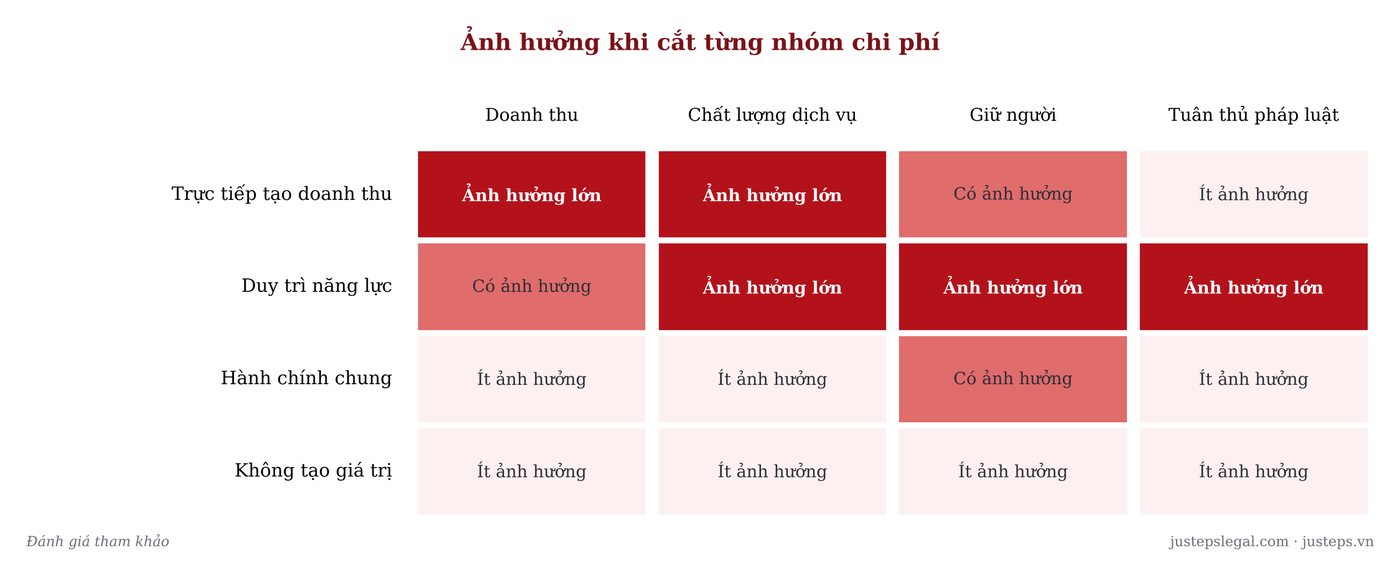
Degree of impact when cutting each cost group
According to the matrix, cutting costs that directly generate revenue strongly affects revenue and service quality, while cutting costs that maintain capability has a major effect on quality, staff retention and even compliance obligations such as occupational safety training or equipment maintenance. The general administrative group mainly affects employee morale if benefits they are used to are cut, while the no-value group has almost no adverse effect. The business should assign each cut a warning indicator, such as the customer complaint rate, delivery time, machine downtime hours and staff turnover rate, and reassess after ninety days.
Across the cost-cutting programmes that Justeps has helped businesses review, the following mistakes recur quite frequently and often cause costs to return after a few quarters:
- The business cuts the same percentage across all departments, weakening the very units that generate revenue.
- The plan is announced before speaking to core staff, so good people hand in their resignations in the very first week.
- The business dismisses employees by verbal notice, without a labour utilisation plan and without thirty days’ notice.
- Spending limits are issued without specifying payment methods, so part of the expenses is disallowed at the tax finalisation.
- There are no indicators tracked after the cuts, so a harmful cut is only discovered once customers have already left.
The minimum record set of a cost-cutting programme includes a summary of twelve months of costs divided into the four groups with the person responsible for each line, a monthly savings target, revised financial regulations with new spending limits and approval thresholds, a list of renegotiated contracts and a ninety-day tracking indicator sheet. If staff are restructured, the record set also includes the labour utilisation plan, minutes of consultation with the employee representative organisation, notices to the State authority and decisions terminating employment contracts. A fully documented programme lets the management know which cuts are effective and should be maintained and which should be restored when the business grows again.
How Justeps can help
Justeps helps businesses design and implement a safe and lawful programme for cutting operating costs through the following services:
- Internal spending regulations and cost norms. Justeps builds administrative spending limits by job title, linked to payment methods and the conditions for deductible expenses.
- Financial regulations and delegation of authority. Justeps shortens approval routes by value threshold and updates the financial regulations after the cuts.
- Strategic restructuring. Justeps reviews the organisational structure and workload and proposes options to merge or streamline departments where needed.
- Labour dispute management and contract termination. Justeps prepares the labour utilisation plan, consultation records, notices and allowance calculations when a business has to reduce staff.
- Review of deductible expenses and CIT finalisation. Justeps reviews documents and payment methods so that expenses after the cuts still meet the conditions for deductible expenses.
Frequently asked questions
What percentage should a business aim to cut?
A business should not set a percentage before classifying its costs. In Justeps’ experience, many small and medium-sized enterprises reduce operating costs by a few per cent up to about ten per cent through the first four steps alone, without touching staff.
Can salaries be reduced instead of headcount?
A business may not reduce salaries unilaterally because they are a term of the employment contract. To make a change, the requesting party must give at least three working days’ notice, and if no agreement is reached the existing contract continues to apply[6].
Must the State authority be notified of dismissals for economic reasons?
Yes, the business must give thirty days’ notice to the provincial People’s Committee and to the employees[6]. Before that, it must have a labour utilisation plan if the change affects many employees.
How is the job-loss allowance calculated?
One month’s salary is paid for each year of work, but at least two months’ salary[6]. The period used for the allowance excludes time during which the employee participated in unemployment insurance.
Are entertainment expenses paid in cash deductible for tax purposes?
Any payment of five million dong or more must be supported by non-cash payment documents to be treated as a deductible expense[1]. Entertainment limits should therefore also specify the payment method.
Can the storekeeper and accountant positions be merged to reduce headcount?
No, except in certain types of small business that are excluded, because a storekeeper may not work as an accountant[4][5]. The business can merge other positions or outsource part of the accounting work.
How long after the cuts should results be reassessed?
The business should track indicators monthly and carry out an overall assessment after ninety days. Any cut that increases complaints, slows deliveries or drives away good people should be considered for reversal.
Related articles
- Lawful workforce reductions on structural or technological change, procedure and required records
- Streamlining the organisation by merging or dissolving departments in the order required by labour law
- Estimating a new company’s operating costs in its first year and how to build a realistic budget
- Corporate restructuring combined with lawful tax optimisation, the options and the risks
Notes
[1] Point c, Clause 1, Article 9 of Government Decree No. 320/2025/ND-CP dated 15 December 2025 detailing and guiding the implementation of the Law on Corporate Income Tax.
[2] Articles 8 and 9 of the Law on Electronic Transactions No. 20/2023/QH15 dated 22 June 2023.
[3] Government Decree No. 254/2026/ND-CP dated 30 June 2026 on electronic invoices and electronic documents.
[4] The Law on Accounting No. 88/2015/QH13 (provisions on persons who may not work as accountants), as amended and supplemented by the law passed by the National Assembly in November 2026.
[5] Clause 3, Article 19 of Government Decree No. 174/2016/ND-CP dated 30 December 2016 detailing a number of articles of the Law on Accounting.
[6] Labour Code No. 45/2019/QH14 dated 20 November 2019 (provisions on amendment of employment contracts, temporary transfer to other work, dismissal due to structural or technological change or economic reasons, labour utilisation plans and the job-loss allowance), as amended and supplemented by the Law amending and supplementing a number of articles of the Labour Code and certain laws passed by the National Assembly on 21 November 2026.
[7] The Law on Employment No. 74/2025/QH15 dated 16 June 2025, as amended and supplemented by the law passed by the National Assembly on 21 November 2026.
This article is for reference and reflects the regulations in force at the time of publication. Please consult Justeps for advice tailored to your company’s records and situation.
For further information, please contact:
📩 Email: info@justeps.vn
🌐 Website: https://justepslegal.com · https://justeps.vn
🌐 Page: Justeps
☎️ Hotline (Zalo): 096 172 2607
📍 Thanh Xuan Office: 12th Floor, Licogi 13 Tower, 164 Khuat Duy Tien Street, Thanh Xuan Ward, Hanoi, Vietnam
📍 Ha Dong Office: LK06B, No.10, Dong Dua Area, Ha Dong Ward, Hanoi, Vietnam
📍 Ho Chi Minh City Branch: 528 Le Van Sy, Ho Chi Minh City, Vietnam
📍 Hai Phong Office: Truong Thinh Village, Ha Dong Commune, Hai Phong, Vietnam
📍 Quang Ninh Office: Van Don Special Zone, Quang Ninh Province, Vietnam





