
Key takeaways
- Appraisal results can only support termination of an employment contract once the employer has issued a regulation on the assessment of job completion, after consulting the employees’ representative organisation where one exists[2].
- Criteria must be linked to the work set out in the employment contract and job description and be announced before the appraisal period begins; criteria set after the period has ended are very hard to defend in a dispute.
- Performance appraisal is a management tool, separate from labour discipline; a business may not deduct wages or impose fines because an employee received a low rating[4].
- For underperforming employees, a business should apply a time-bound improvement plan before considering unilateral termination, and must observe the notice periods and the cases in which termination is prohibited.
Many businesses appraise their staff every quarter or every year, yet only when they need to use the results to award bonuses, adjust wages or terminate the contract of a poor performer do they discover that the results have no evidential value. Common causes are that the business has not issued an appraisal regulation, criteria were communicated only orally, appraisal forms bear no employee signature, or managers scored according to impressions rather than data. When an employee complains or brings a claim, the business finds it difficult to prove that it appraised objectively and followed the correct procedure.
This article analyses the legal framework for performance appraisal under the 2019 Labour Code, how to draw up the regulation, choose the cycle and design the criteria and rating scale, how to run an appraisal round, and the conditions for using the results for wages, bonuses and dealing with employees who do not meet requirements. It is intended for business owners, executive management, HR departments and the heads of department who score their teams directly, and applies to both domestic and foreign-invested enterprises.
The legal framework for performance appraisal
In principle, the employer has the right to recruit, assign, manage, direct and supervise employees and to reward them[1]. Performance appraisal forms part of this management right, so the law does not require a business to appraise according to a particular template or fixed cycle. However, where a business wishes to use appraisal results as the basis for decisions affecting employees’ interests, the appraisal must satisfy the conditions that the Labour Code sets for each such decision.
The most important condition relates to the ground for unilateral termination of an employment contract. The Labour Code permits the employer to terminate a contract unilaterally where the employee regularly fails to complete the assigned work, but such failure must be determined according to the criteria for assessing the level of job completion in the employer’s regulation. This regulation is issued by the employer, but the employer must consult the grassroots employees’ representative organisation where one exists[2]. Consequently, an appraisal system that exists only in an HR spreadsheet and has not been issued as a regulation is not a sufficient basis for terminating a contract.
Besides serving as a ground for termination, appraisal results are also used to award bonuses under the bonus policy, to grant grade or wage increases as agreed in the contract or provided in the business’s regulations, and to assess the outcome of probation[3]. Each of these purposes has its own requirements as to form and procedure, so the appraisal regulation should be designed from the outset to align with the pay and bonus policies and the internal labour rules. A fragmented appraisal system, applied differently in each department, often leads to two people with the same rating being treated differently, and this is the point on which employees are most likely to complain.
A clear distinction must be drawn between performance appraisal and labour discipline. Discipline applies to breaches of the internal labour rules, must follow a disciplinary meeting procedure involving the employees’ representative organisation, and may take only the forms of reprimand, extension of the period for wage increases, demotion or dismissal. The law prohibits fines and wage deductions in place of disciplinary action[4], so a business may not deduct wages on the ground that an employee received a low rating. A business may still pay a lower performance-related portion of wages or a smaller bonus to low performers, provided that the mechanism was agreed in the contract or set out in the pay and bonus policy in advance.
Drawing up and issuing the appraisal regulation
Minimum content of the regulation
An appraisal regulation that can be relied on in a dispute must clearly state who is appraised, who appraises, the appraisal cycle, the criteria and data sources used, how ratings are assigned and what the results are used for. The regulation should define specifically what constitutes failure to complete the work and what constitutes regular failure, for example the lowest rating in two consecutive quarters or in three quarters of one year. This definition must be specific enough for an outsider, such as a conciliator or a judge, to compare it with the appraisal forms and reach a conclusion independently.
In addition, the regulation should provide for the employee’s right to know the criteria at the start of the period, to carry out a self-assessment, to discuss the result directly with the manager and to lodge a complaint within a set time limit. For each position, the specific criteria may be set out in an annex or in an objective-setting form at the start of the period, but they must be traceable to the regulation and to the work agreed in the employment contract. If the contract only states a general title such as sales executive without a job description, the business should add a job description signed by the employee before applying the criteria.
Consultation, publication and record-keeping
Before issuing the regulation, the business should send the draft to the executive committee of the grassroots trade union or another employees’ representative organisation at the business for written comments. The law only requires consultation and does not require the representative organisation’s consent, but the business should keep the cover letter, the comments received and its explanation for any comments not adopted. Where a business has no employees’ representative organisation, this step is not mandatory, but the business should still seek employees’ views through workplace dialogue to improve acceptance.
Once signed and issued, the regulation must be published so that employees are aware of it, for example by posting it at the workplace, sending it by email with read confirmation or posting it on the internal HR system. The regulation should apply only from the appraisal period beginning after its publication and should not apply retrospectively to periods that have already passed. The records to keep include the issuing decision, the regulation itself, evidence of consultation and evidence of publication, because these are the first documents requested in any dispute over termination.
Choosing the cycle, criteria and rating scale
An appraisal cycle suited to the nature of the work
The appraisal cycle should be short enough to identify early those who need support, yet long enough for work results to become visible. In practice, many businesses combine three layers, namely brief monthly check-ins between manager and employee, formal quarterly appraisals with scoring, and an annual review based on the quarterly results. For probationary positions, the appraisal must be tied to the agreed probation period and the business must notify the employee of the result when the probation period ends[5].
The table below compares commonly used appraisal cycles, the groups of positions suited to each cycle and the points a business should consider when choosing a cycle for each department:
| Cycle | Suitable for | Points to note |
|---|---|---|
| Monthly | Sales, customer service and production roles with data measurable within the month. | The volume of paperwork is large, so it is better used for tracking and discussion than for formal rating. |
| Quarterly | Most office roles, middle managers and technical staff. | Provides enough data for rating and enough periods to establish regular failure to complete work within a year. |
| Half-yearly or annual | Highly specialised roles, long projects and senior management. | Identifies those needing support late, so should be combined with regular mid-period check-ins. |
| End of probation | New employees during their probation period. | The result must be notified when probation ends, and criteria should be assigned on the first day. |
Results criteria and competency criteria
An appraisal form usually has two parts. The results part measures what the employee produced during the period, comprising three to six weighted objectives with clear targets and data sources, for example sales from the sales software or the rate of files processed on time from the task management system. The competency and behaviour part measures how the employee works, such as compliance with procedures, cooperation and initiative in making improvements, with specific behavioural descriptions for each score level so that two different managers arrive at similar results.
A business may use key performance indicators (KPIs) for the results part, but should avoid assigning so many indicators that each carries only a very small weight. Targets must be within the employee’s control and commensurate with the agreed work; targets raised abruptly mid-period without notice, or set well above the level achieved by most people in the same position, are likely to be regarded as not objective. Where business conditions change significantly, the regulation should allow objectives to be adjusted mid-period in writing confirmed by both parties.
Rating scales and calibrating results across departments
A five-point scale is a popular choice, ranging from far exceeds requirements, exceeds requirements, meets requirements and needs improvement to does not meet requirements, with each level tied to a score range announced in advance. A common problem is that managers tend to cluster scores in the middle to avoid conflict, or that each department scores with a different degree of strictness. For this reason, after the heads of department have finished scoring, the business should hold a calibration meeting to compare results across departments and require explanations for cases where scores are unusually high or low relative to the data, before approval.
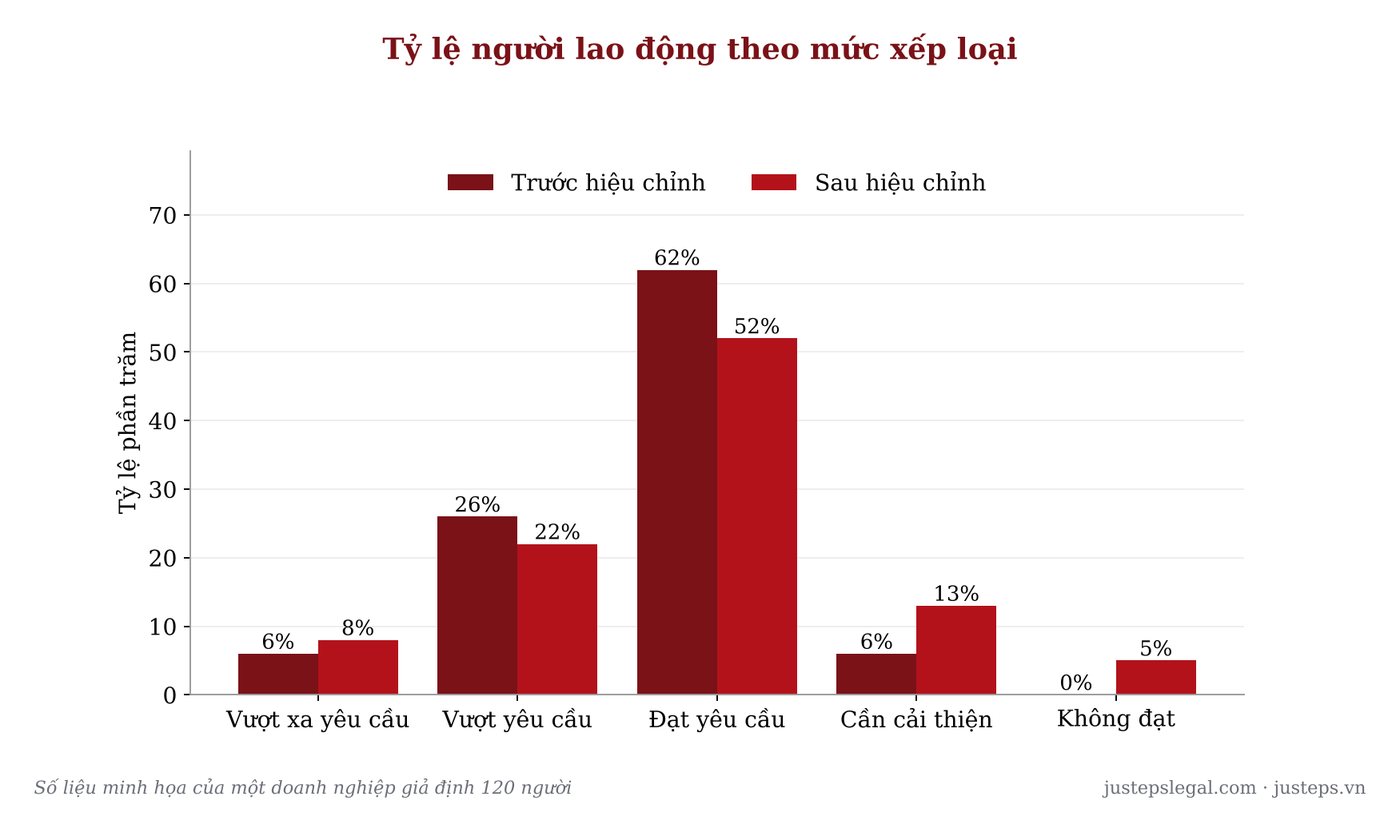
Example distribution of ratings at a business before and after the calibration meeting
In the example above, before calibration as many as 62% of employees were rated as meeting requirements and nobody was rated as not meeting them, even though the business results of several departments had clearly declined. After checking against the data, the proportions in the two highest and the two lowest levels both increased, showing that the results more closely reflect the actual differences between individuals. A business should not impose fixed quotas for each rating level, because forcing some people to receive a low rating merely to fill a distribution quota may be regarded as an appraisal not based on actual work results.
Running an appraisal round from setting objectives to announcing results
A well-organised appraisal round involves the employee, the direct manager, the HR department and executive management, each with its own tasks and deadlines. The sequence below is a reference sequence for a quarterly appraisal, which a business may shorten for small units or extend with additional steps for managerial positions.
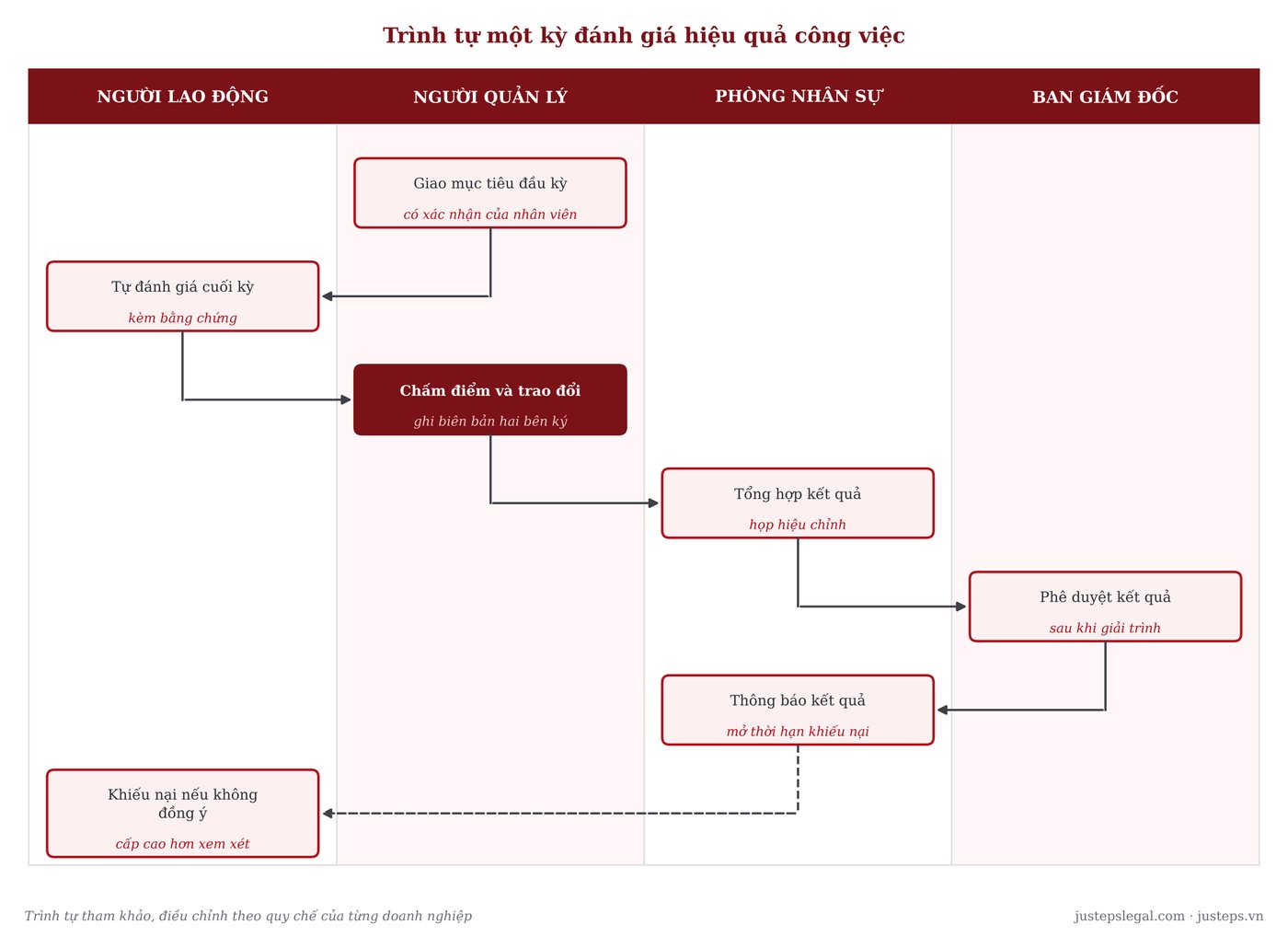
The sequence of a performance appraisal round and the tasks of each party
The appraisal round begins with objectives assigned in writing at the start of the period, signed or electronically confirmed by the employee, and not at the moment the scoring forms are handed out. At the end of the period, the employee completes a self-assessment with supporting evidence, the manager scores and discusses the result directly with each person, and the HR department then consolidates the results for the calibration meeting. Executive management approves only after unusual results have been explained, and the HR department then notifies each person of the result and opens the complaint window. Complaints should be reviewed by a more senior manager or a panel, not by the person who did the scoring.
The one-to-one discussion is the step most easily skipped, yet it is the most valuable for both management and evidential purposes. The manager should give specific examples of results and behaviour during the period, listen to the employee’s explanation, agree a development plan and record brief minutes signed by both parties. If the employee disagrees with the result, the minutes should record that disagreement rather than leave it blank, because an appraisal form that records a dissenting view still proves that the business gave the employee an opportunity to be heard.
The HR department should keep all objective-setting forms, self-assessment forms, scoring forms, discussion minutes, calibration meeting minutes, approval decisions and complaint files for each period. Where the business uses software, it must ensure that the software keeps an edit history and the time of each person’s confirmation. The retention period should be at least as long as the period within which an employee may request resolution of a dispute, plus a margin for periods connected with termination decisions.
Linking appraisal results to wages, bonuses and staff development
The Labour Code defines a bonus as an amount the employer awards to employees based on the results of production and business and the employee’s level of job completion. The bonus policy is decided by the employer and published at the workplace after consulting the grassroots employees’ representative organisation where one exists[3]. On that basis, a business may set different bonus coefficients for each rating level, provided that the calculation method has been announced before the period and is applied consistently to everyone at the same level.
As regards wages, the business develops wage scales and pay tables as the basis for agreeing wages and sets out the regime for grade and wage increases in the contract, collective labour agreement or its own regulations[6]. Appraisal results may be a condition for grade increases or for determining the range of annual pay rises, but reducing the wage agreed in the contract merely because of a low rating is inappropriate unless both parties sign an annex amending the contract. A business must also ensure equal pay without gender discrimination for employees performing work of equal value[7], so it should check ratings and pay rises by gender, age and maternity leave status before approval. To design these mechanisms coherently, businesses may refer to Justeps’ wage scales, pay tables and remuneration policies service.
Appraisal results also feed into training, succession planning and promotion. Consistently high performers should be placed on the succession list, while those with low competency scores in a particular group of criteria should be assigned corresponding training programmes. When results are used for staff development, employees see that appraisal also serves their own career path, and as a result they assess themselves more honestly and complain less.
Dealing with employees who do not meet requirements
Improvement plans and temporary transfers
When an employee is rated as not meeting requirements or as needing improvement, the business should apply a performance improvement plan for about 60 to 90 days, stating clearly the criteria not yet met, the targets to be reached, the support the business will provide and a schedule of regular check-ins. The law does not require this step, but it is evidence that the business gave the employee the opportunity to complete the work before reaching a termination decision. An improvement plan also helps to distinguish cases where the employee lacks capability from cases where the cause lies in unreasonable targets or a lack of resources.
In some cases, the business may temporarily assign the employee to work different from that in the contract. This may only be done in the event of unexpected difficulties or for production and business needs in the circumstances set out in the internal labour rules, for no more than 60 cumulative working days in a year if the employee does not agree, with at least 3 working days’ notice, and the employee must receive no less than 85% of the wage for the previous job[8]. Temporary transfer is therefore not a long-term solution for an underperforming employee; if the business wishes to move the employee permanently to another position, the parties must agree an amendment to the contract.
Unilateral termination for regular failure to complete work
If, after the improvement plan, the employee still does not meet requirements and this situation satisfies the definition of regular failure to complete work in the regulation, the business has the right to terminate the contract unilaterally. The business must give at least 45 days’ notice for an indefinite-term contract, 30 days for a fixed-term contract of 12 to 36 months and 3 working days for a fixed-term contract of less than 12 months[9]. The business may not exercise this right while the employee is ill or receiving treatment on medical advice, is on annual leave or approved personal leave, or is a female employee who is pregnant, on maternity leave or raising a child under 12 months of age[10].
After termination, the business pays a severance allowance to employees who have worked regularly for 12 months or more, at half a month’s wages for each year of service, excluding periods of unemployment insurance participation, and settles all amounts in full within 14 working days[11]. If the decision is found to be unlawful, the business must reinstate the employee, pay wages and insurance contributions for the days the employee was unable to work and pay at least 2 additional months’ wages, plus wages for the days by which the notice period was breached[12]. Disputes over unilateral termination do not have to go through a labour conciliator, and the employee has 1 year to bring the matter before a court[13], so appraisal records must be kept in full throughout this period.
The following flowchart summarises the checkpoints a business should pass through before deciding to terminate the contract of an employee who does not meet requirements.
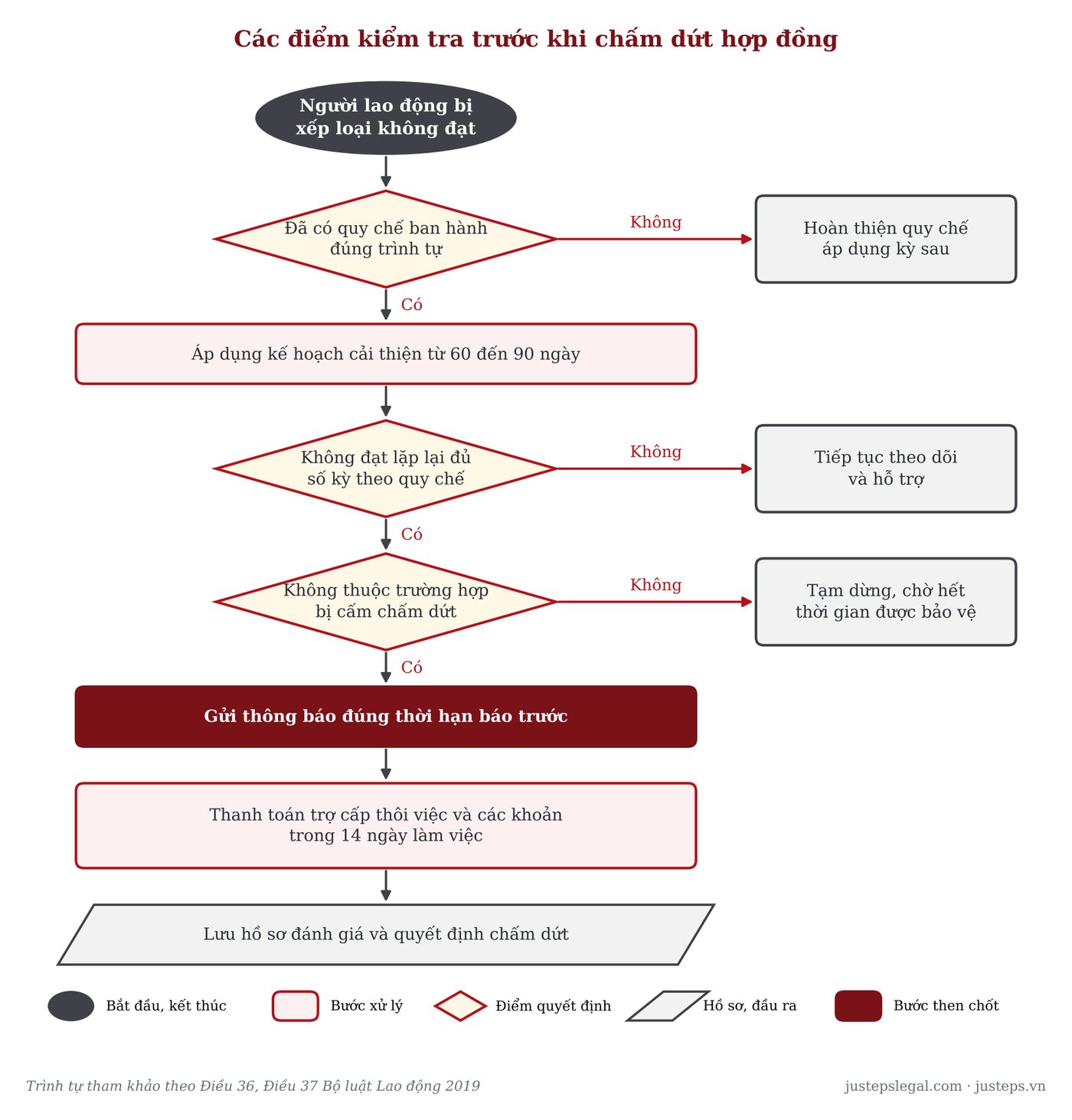
Checkpoints before terminating the contract of an employee who does not meet requirements
The first question is whether the business has an appraisal regulation issued in accordance with the proper procedure; if not, the business must finalise the regulation and apply it only to subsequent periods, and cannot rely on past results. Next, the failing result must recur for exactly the number of periods defined in the regulation, with an appraisal form and discussion minutes for each period. The business then checks whether the employee falls within a case in which termination is prohibited, and only then sends notice within the correct period and settles the amounts due on termination. At any step, if the records are incomplete, the safer option is to continue the improvement plan or to negotiate a mutual termination agreement with a reasonable support payment.
Protecting appraisal data and reviewing the system periodically
Appraisal forms, managers’ comments and ratings are employees’ personal data. Under the 2025 Law on Personal Data Protection, a business must inform employees of the purpose of processing, use the data only for the notified purpose, restrict access rights and apply appropriate protection measures[14]. In practice, appraisal results should be viewed only by the employee, the direct manager, the HR department and executive management; where appraisal software provided by a third party is used, or data is shared with a parent company abroad, the business needs a data processing agreement and must comply with the conditions for transferring data overseas.
The appraisal system should also be reviewed periodically, usually once a year after the annual review. Signs that the system needs to be redesigned include a proportion of employees rated as meeting requirements that is too high relative to business results, many complaints about the same criterion, targets that no longer fit after the business changes its model, or good employees leaving on the ground that appraisal is unfair. When amending the regulation, the business repeats the consultation and publication steps as when it was first issued.
The calendar below suggests how to schedule the main tasks of an appraisal year on a quarterly cycle, helping the HR department plan ahead and remind departments at the right time.
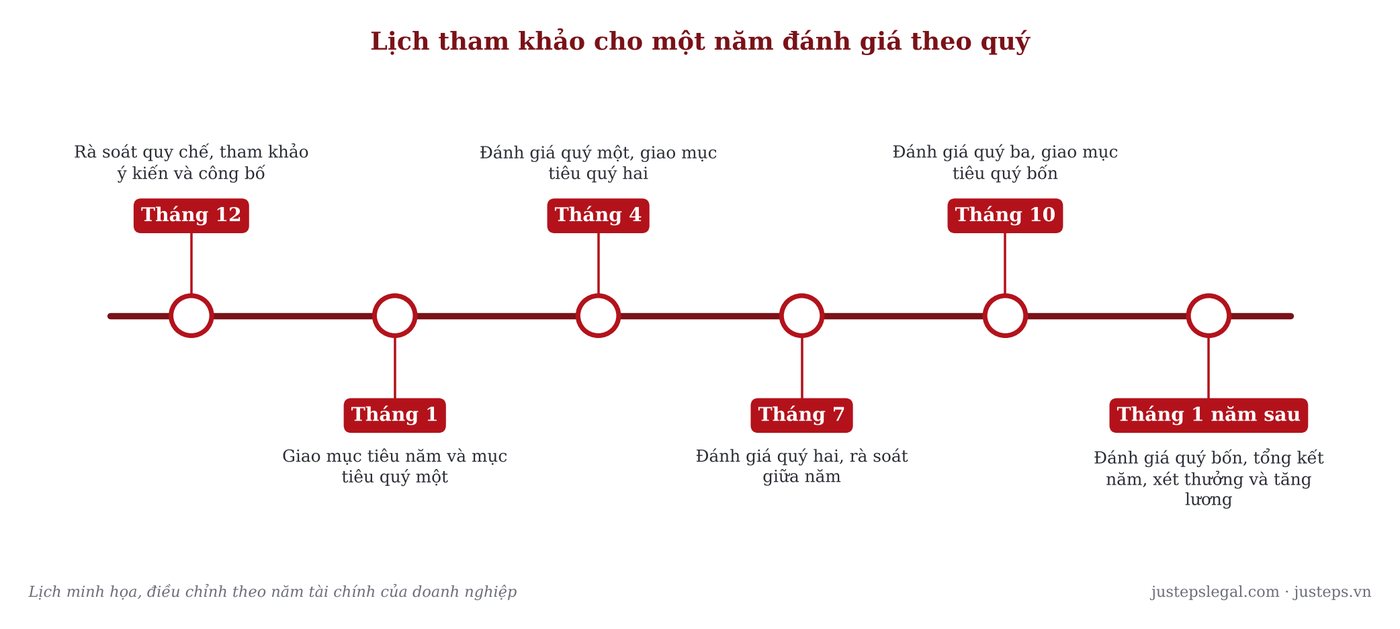
Reference calendar for an appraisal year on a quarterly cycle
Under this calendar, reviewing the regulation and consultation take place in December so that the new regulation can be published before the first period of the year begins. Each quarter ends with self-assessment, scoring, discussion and calibration in roughly the first two weeks of the following quarter, while the annual review combines the results of the four quarters to determine bonuses and pay rises. Businesses wishing to design the entire system, from criteria to forms, may refer to Justeps’ KPI and performance management system service.
How Justeps can help
Justeps helps businesses build and operate a periodic performance appraisal system through the following services:
- KPI and performance management system. Justeps designs criteria, rating scales, forms and appraisal procedures for each group of positions in the business.
- Wage scales, pay tables and remuneration policies. Justeps drafts policies on bonuses, grade and wage increases linked to appraisal results and checks the equal pay compliance of the pay mechanism.
- Internal labour rules and disciplinary procedures. Justeps reviews the internal labour rules to separate appraisal from discipline and adds the circumstances for temporary job transfers.
- Labour dispute management and contract termination. Justeps reviews appraisal records before termination, drafts notices and termination agreements and supports the business in negotiation and conciliation.
- KPI and performance management training for middle managers. Justeps trains heads of department to set objectives, score, discuss results and record minutes properly.
Frequently asked questions
Does a small business without a trade union need to consult anyone when issuing an appraisal regulation?
The duty to consult applies only where there is a grassroots employees’ representative organisation[2]. Even so, the business should still discuss the regulation with employees through workplace dialogue and must publish it before applying it.
Can results under an old template that was never issued as a regulation be used to terminate a contract?
The risk is very high, because regular failure to complete work must be determined according to the criteria in the employer’s regulation[2]. The business should issue and publish a regulation and apply it to subsequent periods, or negotiate a mutual termination agreement.
May a business deduct wages from an employee who receives a low rating?
A business may not deduct wages or impose fines in place of discipline[4]. It may only pay a lower performance-related portion of wages or a smaller bonus where that mechanism was agreed in the contract or set out in the pay and bonus policy in advance.
What should be done if an employee refuses to sign the appraisal form?
The manager records the refusal in minutes signed by a witness and sends the result to the employee by email or via an internal system that keeps a record. The employee still has the right to complain within the time limit set in the regulation.
Can a business terminate the contract of a female employee raising a child under 12 months of age for failure to complete her work?
The business may not terminate the contract unilaterally in this case[10]. It should continue to appraise her as normal, apply an improvement plan and consider other measures only after the protected period ends.
Should a business impose a mandatory distribution quota for each rating level?
Fixed quotas are not advisable, because forcing some people to take a low rating merely to meet the quota may be regarded as an appraisal not based on work results. The business should use a reference distribution combined with a data-based calibration meeting.
Does the probation appraisal have to follow the periodic appraisal regulation?
The business may use separate criteria for probation, but should assign them from the first day and must notify the result when the probation period ends[5]. If the employee meets the requirements, the parties continue to perform the employment contract already concluded or enter into an employment contract.
Related articles
- Designing KPIs for production workshops on productivity, quality and safety linked to piece-rate pay
- A monthly labour and payroll compliance checklist for the HR department
- Lawful workforce reductions due to structural or technological change, the procedure and the documents required
- Personal data protection in the HR department under the 2025 Law on Personal Data Protection
Notes
[1] Point a, Clause 1 of Article 6 of the Labour Code No. 45/2019/QH14.
[2] Point a, Clause 1 of Article 36 of the Labour Code No. 45/2019/QH14 dated 20 November 2019.
[3] Article 104 of the Labour Code No. 45/2019/QH14.
[4] Article 124 and Clause 2 of Article 127 of the Labour Code No. 45/2019/QH14.
[5] Articles 25 and 27 of the Labour Code No. 45/2019/QH14.
[6] Articles 93 and 103 of the Labour Code No. 45/2019/QH14.
[7] Clause 3 of Article 90 of the Labour Code No. 45/2019/QH14.
[8] Article 29 of the Labour Code No. 45/2019/QH14.
[9] Clause 2 of Article 36 of the Labour Code No. 45/2019/QH14.
[10] Article 37 of the Labour Code No. 45/2019/QH14.
[11] Articles 46 and 48 of the Labour Code No. 45/2019/QH14.
[12] Article 41 of the Labour Code No. 45/2019/QH14.
[13] Point a, Clause 1 of Article 188 and Clause 3 of Article 190 of the Labour Code No. 45/2019/QH14.
[14] Law on Personal Data Protection No. 91/2025/QH15 and Decree No. 363/2026/ND-CP.
This article is for reference and reflects the regulations in force at the time of publication. Please consult Justeps for advice tailored to your company’s records and situation.
For further information, please contact:
📩 Email: info@justeps.vn
🌐 Website: https://justepslegal.com · https://justeps.vn
🌐 Page: Justeps
☎️ Hotline (Zalo): 096 172 2607
📍 Thanh Xuan Office: 12th Floor, Licogi 13 Tower, 164 Khuat Duy Tien Street, Thanh Xuan Ward, Hanoi, Vietnam
📍 Ha Dong Office: LK06B, No.10, Dong Dua Area, Ha Dong Ward, Hanoi, Vietnam
📍 Ho Chi Minh City Branch: 528 Le Van Sy, Ho Chi Minh City, Vietnam
📍 Hai Phong Office: Truong Thinh Village, Ha Dong Commune, Hai Phong, Vietnam
📍 Quang Ninh Office: Van Don Special Zone, Quang Ninh Province, Vietnam





