
Key takeaways
- An employee who stops working without giving the statutory period of notice, outside the cases in which immediate resignation is allowed, has unlawfully terminated the contract unilaterally and must compensate the company.
- In the first 48 hours, the company should lock access to its systems, send a written request for handover and assign someone to cover the work temporarily, while keeping a record of every communication.
- The company may not withhold wages, impose fines or keep original documents to force the employee to return; amounts that the two sides owe each other must be reconciled and any set-off agreed in writing.
- Even while a dispute is ongoing, the company must still pay the undisputed amounts and complete the confirmation of the social insurance contribution period within the statutory time limit.
- The most effective prevention is to set out clearly the notice period and handover procedure, keep work files on a shared system and designate a back-up for each key position.
An accounts receivable clerk sends a message on Friday evening saying that she is leaving, does not come to the office on Monday morning, her computer is still password-locked and her mailbox continues to receive replies from customers. This situation is not unusual in small and medium-sized companies, particularly after the year-end bonus has been paid or when a competitor recruits at a higher salary. The first reaction of many business owners is to hold back the final month’s wages, refuse to close the social insurance book or post the leaver’s details on social media to put pressure on them. These responses can turn the company from the injured party into the party in breach and cost it its advantage when the two sides negotiate.
This article analyses how to deal with an employee who quits without notice in chronological order, covering whether the departure is unlawful, what to do in the first 48 hours, the choice of ground for terminating the contract, the compensation that the company may claim, the obligations to pay and close the file, the options when no agreement is reached and preventive measures. It is based on the Labour Code of 2019 and the implementing instruments currently in force and applies to employees working for a company under an employment contract. It is written mainly for business owners, directors, heads of HR and the direct line managers of employees who leave.
When quitting without notice amounts to unlawful unilateral termination
The Labour Code allows an employee to terminate the employment contract unilaterally without giving reasons, but the employee must give the employer a minimum period of notice that depends on the type of contract[1]. In everyday business usage, quitting without notice usually refers to an employee who leaves without giving notice or gives less notice than the law requires. If the employee has given the full period of notice, the departure is lawful even though the company has not yet found a replacement, and the company has no basis on which to claim compensation. The first step is therefore to compare the date on which the employee announced the departure, the date on which they actually stopped working and the type of contract being performed.
Notice periods by type of contract
The notice period is determined by the type of contract that the employee is performing at the time of leaving, not by the length of service with the company. The table below summarises the common notice periods that the HR department should check:
| Type of contract | Minimum notice period | Points to check |
|---|---|---|
| Indefinite term | At least 45 days before the leaving date. | This is the most common case for long-serving staff. |
| Fixed term of 12 to 36 months | At least 30 days before the leaving date. | Check any extension appendix to identify the type of contract that actually applies. |
| Fixed term of less than 12 months | At least 03 working days before the leaving date. | Working days follow the company’s working schedule and exclude weekly days off. |
| Special occupations and jobs | A separate period set by the Government. | Applies to certain jobs, such as aircraft crew members and enterprise managers, under specific rules. |
Cases in which the employee may leave immediately without notice
The law allows an employee to leave without notice in a number of cases, for example where the employee is not assigned the agreed work or workplace, is not paid in full or on time, is maltreated or sexually harassed, is a pregnant employee who must stop work on the instructions of a medical facility, or where the employer provided untruthful information that affects performance of the contract[2]. In these cases, leaving immediately is lawful and the company may not claim compensation. Before sending any document that claims compensation, the company should therefore check its own payment schedule, timesheets and the employee’s most recent complaints. If the company has paid wages late in the most recent month, even by a few days, the argument that the departure was unlawful will be weak in a dispute.
What the company should do in the first 48 hours
The period immediately after the company discovers that an employee has walked out determines whether it can preserve its data, its customers and its evidence. The steps at this stage are protective and do not yet amount to a decision to terminate the contract, so the company can take them at once regardless of whether it manages to contact the employee. The sequence below suggests how to divide the work between IT, HR and the direct line manager.
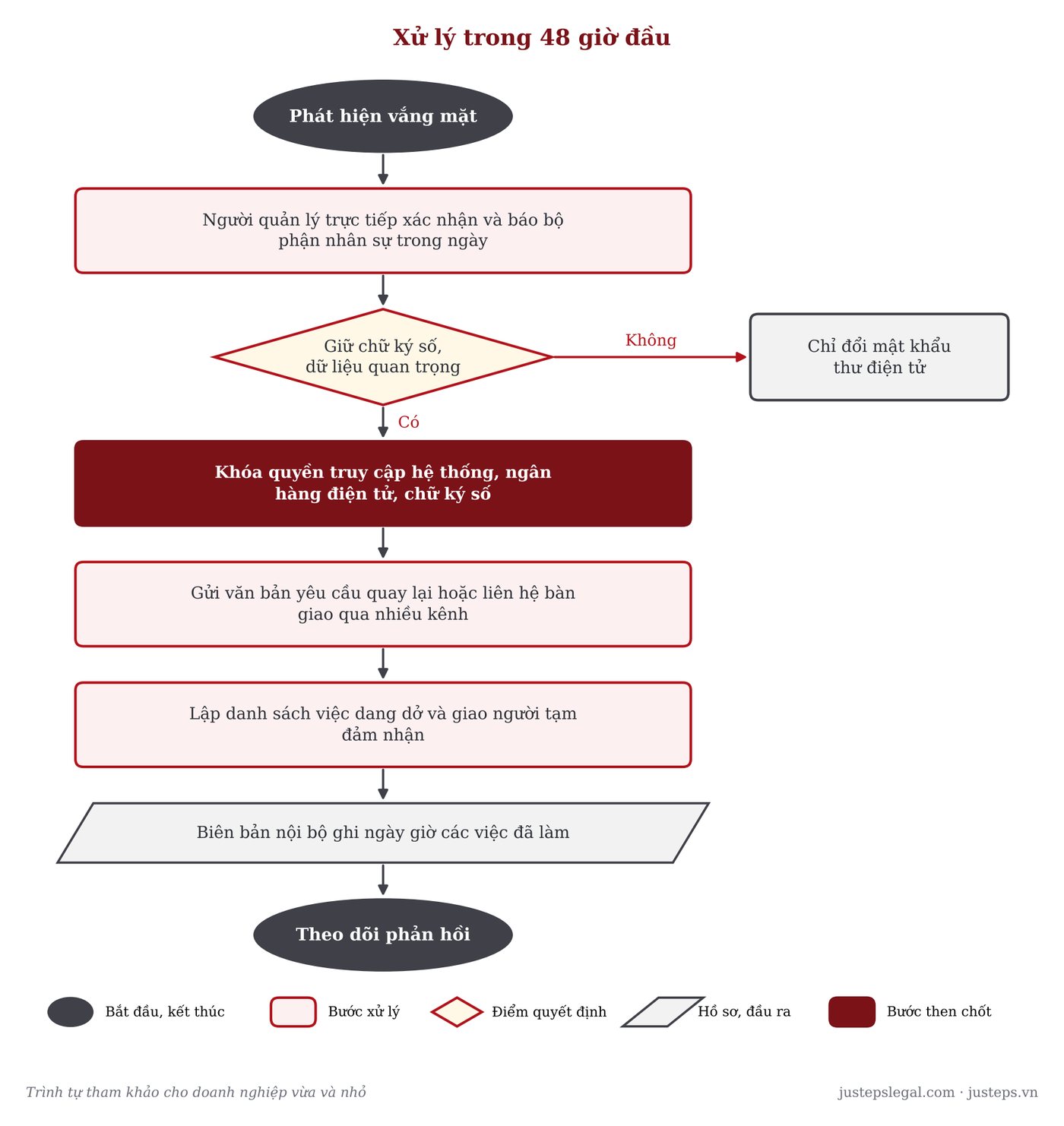
Sequence of steps in the first 48 hours after discovering that an employee has quit without notice
The sequence begins with the direct line manager confirming that the employee is absent without approved leave and reporting this to HR immediately. The IT department, or the person responsible for administering the systems in a small company, changes the passwords and temporarily suspends the employee’s access to email, accounting software, online banking and customer management applications. At the same time, HR sends a written request asking the employee to return to work or make contact to hand over, and the line manager lists the unfinished tasks so that they can be assigned to someone else temporarily. Everything done at this stage is recorded in a dated and timed internal record, which serves as the basis for the following steps.
Locking access and keeping data secure
Accounts, data and devices that the company provides to an employee for work are under the company’s control, so temporarily suspending access is a reasonable management measure. However, the work mailbox and devices may contain the employee’s own personal data, so the company should access them only to the extent needed to keep the work going and should state this purpose in advance in its internal regulations or IT policy[3]. The company should not delete data on the computer on its own initiative, because those files may be evidence that the employee copied documents externally or of the volume of unfinished work. For positions that hold the digital signature, online banking accounts or tax authority passwords, login details should be changed on the same day with the Director’s confirmation.
Contacting the employee in writing and keeping a record
The letter to the employee should state the date on which the employee stopped coming to work, ask the employee to return or make contact within a specific period, list the tasks and assets to be handed over and identify the person who will receive them. The letter should be sent at the same time to the personal email registered in the employee’s file, by text message and by registered post with proof of delivery to the residential address, so that the company can show it has given proper notice. The wording should be neutral, without threats to withhold wages or to make a complaint, because the letter may be examined if the dispute is brought before a labour conciliator or a court. All calls and replies from the employee should be captured and kept on file in chronological order.
Rebuilding the unfinished work
The direct line manager should list the tasks that the departing employee was handling, including customer files, payment deadlines, contracts awaiting signature and reports due to state authorities. Each task is assigned to a temporary owner with a completion date, and key customers are informed of the new contact person to avoid disruption to transactions. For an accounting position, the review should give priority to tax returns and social insurance reports that are about to fall due and to reconciling bank balances, because errors in these areas lead to immediate penalties for the company.
Choosing the appropriate ground for terminating the contract
Once the protective stage is over, the company must choose the legal ground on which to end the employment relationship, because each ground has a different procedure, consequences and level of risk. The choice depends on whether the employee has given notice of leaving, the number of days of absence, the company’s internal labour regulations and whether the two sides can still negotiate. The table below compares four common approaches:
| Approach | When it applies | Main consequences for the company |
|---|---|---|
| Termination by agreement | The employee makes contact again and the two sides agree on the termination date, the handover and the payments. | The lowest risk; compensation and any set-off are stated clearly in the written agreement. |
| Treating the departure as unlawful | The employee gave notice of leaving but not for the full period and does not fall within the cases allowing immediate resignation. | The company may claim compensation and the employee is not entitled to a severance allowance. |
| Unilateral termination by the company | The employee has been absent from work without a valid reason for 05 or more consecutive working days. | The company may terminate without notice but must issue a written notice of termination. |
| Disciplinary dismissal | The employee has been absent without a valid reason for a total of 05 days within 30 days or 20 days within 365 days. | A disciplinary meeting must be held following the correct procedure; a procedural error may cause the dismissal to be treated as unlawful. |
Where the employee has sent a letter or message announcing the departure, the employment relationship ends through unilateral termination by the employee, and if the notice given was insufficient the employee bears the obligations of a party that terminates unlawfully[4]. Where the employee disappears completely without sending any notice, the company may terminate the contract unilaterally once the employee has been absent from work without a valid reason for 05 or more consecutive working days, and no notice is required in this case[5]. The company must still notify the employee in writing of the termination of the contract[6]. In practice, views differ on whether an employee who walks out without any notice is at the same time treated as having terminated unlawfully and must therefore pay compensation, so a company that intends to claim compensation should assess its evidence carefully before choosing the ground.
Disciplinary dismissal should be used only where the company’s internal labour regulations define unauthorised absence and the reasons regarded as valid, because the company may not discipline an employee for conduct not provided for in the internal labour regulations, the employment contract or labour law[7]. When taking disciplinary action, the company must prove the employee’s fault, invite the grassroots employee representative organisation of which the employee is a member, ensure the employee’s right to defend themselves and keep minutes of the meeting, while observing the limitation period for disciplinary action[8]. The implementing decree allows the company to hold the meeting where the employee has been properly notified but does not confirm attendance or fails to attend, provided that the company can keep evidence of the notice[9]. If the company only needs to end the employment relationship, unilateral termination on the ground of 05 consecutive days of absence is usually simpler and carries less procedural risk than dismissal.
The compensation that the company may claim
An employee who terminates the contract unilaterally and unlawfully is not entitled to a severance allowance and must pay the employer compensation equal to half a month’s wages under the employment contract, plus an amount equal to the wages under the employment contract for the days on which notice was not given[4]. If the employee was sent on training funded by the company under a training contract, the employee must also reimburse the training costs as agreed[10]. These amounts are claims that the company may pursue; they are not automatically deducted from the wages that the company still owes the employee.
Compensation for lost or damaged assets
Where the employee does not return a computer, phone, access card or other asset entrusted to them, the company may claim compensation under the rules on material liability. An employee who loses the company’s assets must compensate in part or in full at the market price or as provided in the internal labour regulations, and where there is a liability agreement, compensation follows that agreement[11]. The company may deduct the employee’s wages to compensate for damage to assets only under this rule, the employee must be informed of the reason for the deduction, and the monthly deduction may not exceed 30% of the wages actually paid after social insurance contributions and personal income tax[12]. The asset handover record signed by the employee on joining is therefore the most important evidence for a compensation claim.
Reconciling amounts payable and receivable
In practice, when an employee walks out, each side usually still owes the other something. The company still owes wages for the days worked and pay for any annual leave not taken[13], while the employee may have to pay compensation for breaching the notice period and return the company’s assets. The chart below illustrates how to prepare a reconciliation for an employee earning VND 15 million a month under a 24-month fixed-term contract who leaves immediately without notice.
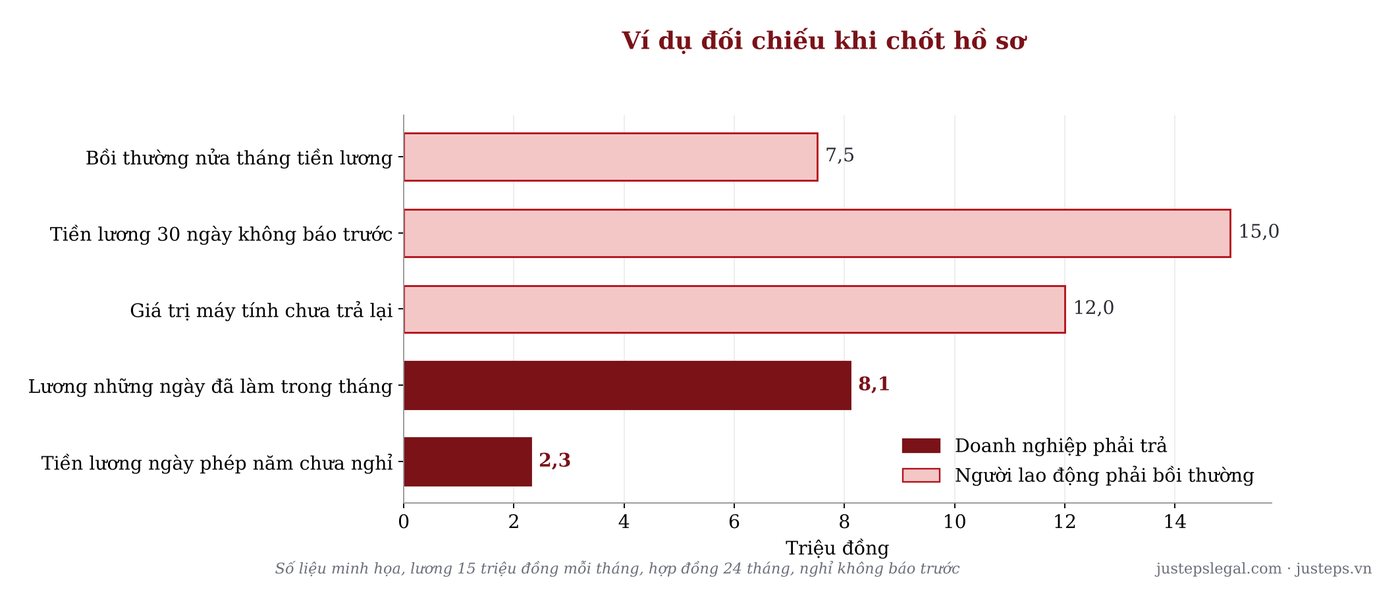
Example reconciliation of the amounts payable by the company and the compensation payable by the employee
In the example, the company still owes about VND 10.4 million in wages for the days worked and pay for untaken annual leave, while the employee must pay half a month’s wages, the wages for the 30 days of notice not given and the value of the unreturned computer. Compensation for breaching the notice period is not one of the cases in which wages may be deducted unilaterally, so the safe approach is to send the reconciliation to the employee and propose a written set-off agreement. If the employee does not agree, the company still pays the undisputed amount on time and pursues its compensation claim through a separate procedure. The figures in the example only illustrate how to prepare the table; the daily wage conversion must follow the contract and the pay regulations of each company.
Paying, returning documents and closing social insurance on time
Within 14 working days of the termination of the employment contract, both sides must settle in full all amounts relating to each side’s entitlements, and this period may be extended to no more than 30 days only in a number of special cases listed in the law[14]. The employer must also complete the confirmation of the period of social insurance and unemployment insurance contributions and return it together with any other original documents it holds for the employee. This obligation exists regardless of whether the employee is in breach, so the company cannot rely on the employee’s failure to hand over as a reason for delay.
Even if the employee left unlawfully and has not handed over the work, the company must still avoid the following ways of applying pressure, as each can lead to a penalty or weaken the company’s position:
- The company may not withhold the final month’s wages or cut wages as a penalty, because imposing fines or wage cuts in place of labour discipline is prohibited[18].
- The company may not keep the originals of the employee’s identity papers, degrees or certificates to force the employee to come back and hand over[19].
- The company may not delay the confirmation of the social insurance contribution period on the grounds that it is waiting for the employee to pay compensation.
- The company should not post images or personal information of the employee on social media or send them to business partners, as this may breach the rules on personal data protection and on the honour and dignity of individuals.
Breaches relating to payment on termination, retention of documents and payment of wages may attract administrative penalties under Decree No. 283/2026/ND-CP, effective from 10 September 2026, together with a remedial measure requiring full payment to the employee[15]. The practical consequences are greater than the fine, because a company that is in breach of its payment obligations will find it hard to demand compensation from the employee when the two sides confront each other. A timetable for closing the file should therefore be drawn up as soon as the termination date is determined and followed until everything is complete.
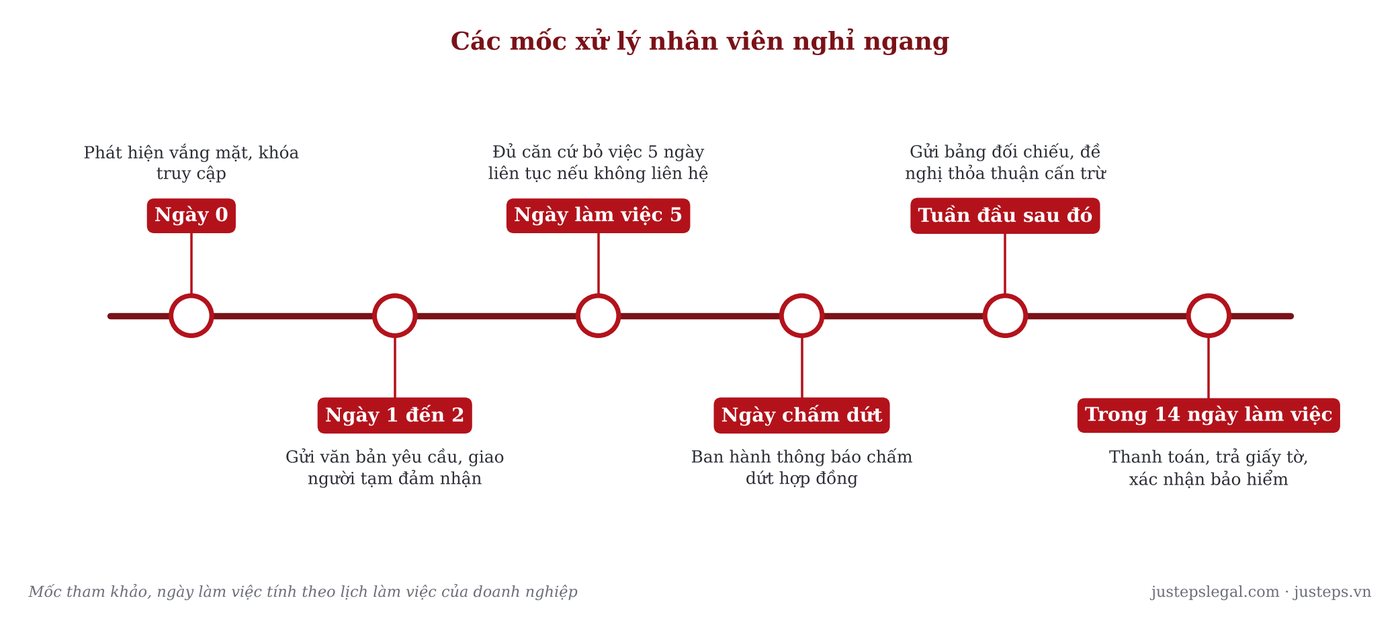
Key dates from the employee’s departure without notice to the completion of the file
Under these milestones, the company has about two days to secure its data and send its written request, and then monitors for at least five more working days before deciding on the termination ground if the employee does not make contact. From the termination date, the reconciliation should be sent within the first week to give the employee time to respond, and payment and social insurance confirmation must be completed before the 14 working days expire. If the two sides still have not agreed on compensation after this point, the company moves on to dispute resolution with a file that is already prepared.
Options when the two sides cannot reach agreement
A dispute over compensation on termination of an employment contract is an individual labour dispute and may be resolved through a labour conciliator, a Labour Arbitration Council or a court following the procedure set out in the Labour Code[16]. The limitation period for requesting a court to resolve an individual labour dispute is 01 year from the date on which the disputing party discovers the act that it considers to infringe its lawful rights and interests, so the company should consider its position early. Before starting any procedure, the company should compare the amount it may recover with the cost in time and staff and with the realistic likelihood that the employee has assets against which a judgment could be enforced.
Most cases of employees quitting without notice are resolved with a clear reconciliation and a face-to-face meeting with minutes, at which the company offers to reduce part of the compensation in return for a full handover of documents and assets. For cases of high value or involving customer data or trade secrets, the company should assess the evidence and its negotiating options before sending a formal demand. Justeps supports companies at this stage through its labour dispute and contract termination advisory service, which covers assessing the case, reviewing the evidence, drafting the demand letter and set-off agreement and preparing the file so that the company can act on its own or pass it to a practitioner of its choice.
Preventing walk-outs through contracts and internal regulations
A company cannot stop employees from leaving, but it can reduce the damage when someone leaves suddenly by preparing its documents and organising its work in advance. The following measures suit small and medium-sized companies and can be implemented within a few weeks:
- The employment contract clearly states the notice period, the obligation to hand over work, assets and documents and how compensation is calculated in the event of breach.
- The internal labour regulations define unauthorised absence, the reasons regarded as valid and the handover procedure on leaving, so that there is a basis for disciplinary action when needed.
- Employees with access to customer data, receivables or technology sign an agreement to protect business and technology secrets, setting out their benefits and the compensation payable in the event of breach[20].
- Work documents are stored on a shared system with access controls, not on personal computers or personal accounts.
- Every key position, such as accountant, cashier and system administrator, has a back-up who understands the work at least at a basic level.
- An asset handover record is made when the employee joins and updated whenever additional equipment is issued.
Apart from documentation, many walk-outs stem from employees not knowing how to resign or being reluctant to face their manager. The company can reduce this by having a simple resignation procedure with a standard form, a clearly designated recipient and a commitment to pay on time, together with a short exit conversation to understand the reasons for leaving. These points should be reviewed at the same time as the internal labour regulations are updated under the Law amending and supplementing the Labour Code passed by the National Assembly on 21 November 2026 and effective from 1 March 2027, which adds 27 July and 24 November as fully paid days off[17]. Companies that need help drafting or amending their internal labour regulations may refer to Justeps’ internal labour regulations and disciplinary procedure service.
How Justeps can help
Justeps helps companies deal with and prevent employees quitting without notice through the following services:
- Labour dispute and contract termination advisory. Justeps assesses the ground for termination, prepares the reconciliation and drafts the demand letter and set-off agreement for each case of an employee quitting without notice.
- Internal labour regulations and disciplinary procedure. Justeps drafts rules on unauthorised absence, valid reasons and the handover procedure and provides guidance on the documents for disciplinary meetings.
- Labour records and employment contracts. Justeps reviews employment contract templates, notice and handover clauses and asset handover records.
- Information security and conflict of interest. Justeps drafts confidentiality agreements and data access policies for positions with access to sensitive information.
Frequently asked questions
May the company withhold the wages of an employee who quit without notice until they hand over?
The company may not withhold or cut wages as a penalty, because this is prohibited[18]. The company must pay within 14 working days of the termination of the contract and pursue compensation through a set-off agreement or a separate procedure[14].
Is an employee who quits without notice entitled to a severance allowance?
An employee who terminates the contract unilaterally and unlawfully is not entitled to a severance allowance[4]. An employee whose contract is terminated for being absent without a valid reason for 05 or more consecutive working days is also not eligible for a severance allowance[21].
Must an employee who quits without notice compensate the company?
If the employee leaves without giving the full period of notice and does not fall within the cases allowing immediate resignation, the employee must pay half a month’s wages plus the wages for the days of notice not given[4]. The employee must also reimburse training costs if there is a training contract and compensate for assets not returned.
Must the company close the social insurance book while it is in dispute with the employee?
The company must still complete the confirmation of the social insurance and unemployment insurance contribution period within the statutory time limit[14]. The dispute over compensation is resolved separately and is not a reason to delay this obligation.
After how many days of absence may the company terminate the contract?
The company may terminate the contract unilaterally without notice when the employee has been absent without a valid reason for 05 or more consecutive working days[5]. For disciplinary dismissal, the threshold is a total of 05 days within 30 days or 20 days within 365 days, and the disciplinary procedure must be followed correctly[7].
May the company deduct the value of an unreturned computer from wages?
The company may deduct wages to compensate for lost or damaged assets, but it must inform the employee of the reason and may not deduct more than 30% of the wages actually paid each month[12]. Once the employee has left, a safer approach is to include this amount in the reconciliation and agree a set-off in writing.
Should the company bring a claim against an employee who quit without notice?
The company should compare the amount it may recover with the cost and time involved and with the realistic prospects of enforcement. Most cases are resolved through a reconciliation and a set-off agreement, while conciliation or court proceedings should be reserved for high-value cases[16].
Related articles
- How companies should organise internal labour dispute conciliation before a case reaches a labour conciliator
- A monthly labour and payroll compliance checklist for HR departments
- What companies must satisfy when moving to electronic employment contracts and how those contracts should be stored
- Lawful procedure and documentation for workforce reduction when a company changes its structure or technology
Notes
[1] Clause 1 of Article 35 of the Labour Code No. 45/2019/QH14 dated 20 November 2019; Article 7 of Decree No. 145/2020/ND-CP dated 14 December 2020 on notice periods for special occupations and jobs.
[2] Clause 2 of Article 35 of the Labour Code No. 45/2019/QH14.
[3] The Law on Personal Data Protection No. 91/2025/QH15 and Decree No. 363/2026/ND-CP.
[4] Article 40 of the Labour Code No. 45/2019/QH14.
[5] Point e of Clause 1 and Clause 2 of Article 36 of the Labour Code No. 45/2019/QH14.
[6] Article 45 of the Labour Code No. 45/2019/QH14.
[7] Clause 4 of Article 125 and Clause 3 of Article 127 of the Labour Code No. 45/2019/QH14.
[8] Articles 122 and 123 of the Labour Code No. 45/2019/QH14.
[9] Article 70 of Government Decree No. 145/2020/ND-CP dated 14 December 2020 detailing and guiding the implementation of a number of articles of the Labour Code on working conditions and labour relations.
[10] Article 62 of the Labour Code No. 45/2019/QH14 on vocational training contracts.
[11] Clause 2 of Article 129 of the Labour Code No. 45/2019/QH14.
[12] Article 102 of the Labour Code No. 45/2019/QH14.
[13] Clause 3 of Article 113 of the Labour Code No. 45/2019/QH14.
[14] Article 48 of the Labour Code No. 45/2019/QH14.
[15] Government Decree No. 283/2026/ND-CP dated 15 July 2026 on administrative penalties in the fields of labour and social insurance, effective from 10 September 2026.
[16] Articles 187, 188 and 190 of the Labour Code No. 45/2019/QH14 on the competence, procedure and limitation period for resolving individual labour disputes.
[17] The Law amending and supplementing a number of articles of the Labour Code, passed by the National Assembly on 21 November 2026 and effective from 1 March 2027.
[18] Clause 2 of Article 127 of the Labour Code No. 45/2019/QH14.
[19] Clause 1 of Article 17 of the Labour Code No. 45/2019/QH14.
[20] Clause 2 of Article 21 of the Labour Code No. 45/2019/QH14.
[21] Clause 1 of Article 46 of the Labour Code No. 45/2019/QH14.
This article is for reference and reflects the regulations in force at the time of publication. Please consult Justeps for advice tailored to your company’s records and situation.
For further information, please contact:
📩 Email: info@justeps.vn
🌐 Website: https://justepslegal.com · https://justeps.vn
🌐 Page: Justeps
☎️ Hotline (Zalo): 096 172 2607
📍 Thanh Xuan Office: 12th Floor, Licogi 13 Tower, 164 Khuat Duy Tien Street, Thanh Xuan Ward, Hanoi, Vietnam
📍 Ha Dong Office: LK06B, No.10, Dong Dua Area, Ha Dong Ward, Hanoi, Vietnam
📍 Ho Chi Minh City Branch: 528 Le Van Sy, Ho Chi Minh City, Vietnam
📍 Hai Phong Office: Truong Thinh Village, Ha Dong Commune, Hai Phong, Vietnam
📍 Quang Ninh Office: Van Don Special Zone, Quang Ninh Province, Vietnam





