
A private dental clinic usually starts lean: one owner-dentist, a few assistants and a receptionist who also handles payments. When the second location opens, the "owner does everything" model starts to break: appointments clash, cash at the counter is hard to reconcile, and patient records end up scattered across notebooks, phones and software.
This article proposes a practical organizational structure for clinics with one to three locations: who does what, who reports to whom, when to add an operations manager, a standard procedure for each patient visit, and how to keep records and patient data secure.
Separate two lines of management: clinical and operational
The most common mistake is running everything through one person. A clinic should clearly separate two lines. The clinical line covers the person in charge of professional matters, dentists, nurses and assistants, and is responsible for diagnosis, treatment plans, sterilization and treatment quality. The operational line covers reception and customer care, accounting, marketing and, later, an operations manager, and is responsible for appointments, cash flow, customer experience and data.
Licensing conditions, requirements for the person in charge of professional and technical matters, and the scope of practice are governed by the Law on Medical Examination and Treatment No. 15/2023/QH15 and its guiding documents. Organizationally, what matters is that each separately licensed location has a person in charge of professional matters appointed in writing and present during the registered hours, rather than someone whose name is on the paperwork but who does not actually manage clinical work.
Roles and responsibilities by size
The table below is a reference framework. Headcount depends on the number of dental chairs, opening hours and service mix, but reporting lines should be kept stable from the start so that expansion does not require reorganizing.
| Role | 1 location | 2 locations | 3 locations | Reports to |
|---|---|---|---|---|
| Person in charge of professional matters | Usually the owner, also the lead treating dentist | Each separately licensed location needs its own person in charge | One per location, with a clinical lead coordinating treatment protocols | Owner/Director |
| Treating dentists | 1–3 dentists working by appointment | Schedules split by location, clear shifts | Specialists (orthodontics, implants) rotating between locations | Person in charge of professional matters |
| Nurses/dental assistants | 1–2 per chair, also handling instrument sterilization | A designated person for sterilization and supplies | A shared head nurse standardizing supplies across locations | Person in charge of professional matters |
| Reception – customer care | One person handling bookings, cashier and reminders | On-site reception; central booking line | Central customer care team with scripts and response targets | Operations manager (or owner) |
| Accounting | Outsourced accounting service | Part-time in-house accountant, cashier at each location | In-house accountant; revenue reconciled by location | Owner/Director |
| Marketing | Owner or outsourced | One in-house staff working with an agency | Shared marketing team, budget by location | Operations manager (or owner) |
| Operations manager | Not yet needed | Recommended once the owner cannot be present at both locations | Necessary, with location heads reporting to it | Owner/Director |
In a single-location clinic, the owner usually holds both lines. That is acceptable if operational tasks are written down as procedures and someone else can perform them. At two locations, the owner should keep the clinical line and hand the operational line to a person with decision-making authority within delegated limits.
When to add an operations manager
There is no mandatory threshold, but several signs show it is time to hire or appoint an operations manager:
- the owner spends most of their time on staff rosters, complaints and cash reconciliation instead of treating patients;
- there are two or more locations and the owner cannot be regularly present at both;
- appointment cancellations and abandoned treatment plans are rising and nobody tracks them;
- gaps between revenue in the software and cash actually collected recur every month.
The operations manager needs a clear job description: managing the operational team's schedules, tracking metrics (number of visits, consultation-to-treatment conversion, recall rate), approving supply costs below a threshold and handling customer feedback. The operations manager does not interfere with clinical decisions; any clinical dispute goes to the person in charge of professional matters.
Standard procedure for each patient visit
The SOP for a visit should be short, posted at the front desk and included in onboarding for new staff. The flowchart below summarizes six basic steps.
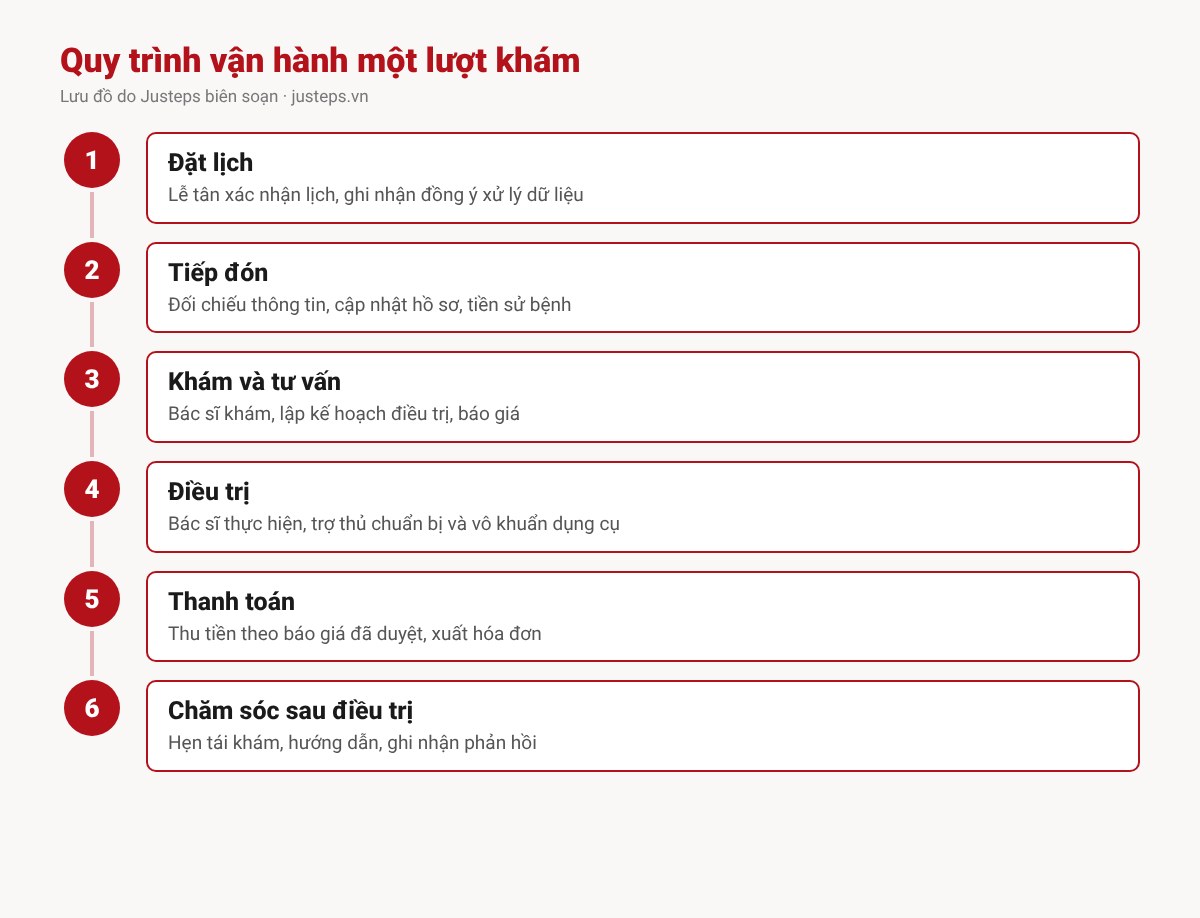
Operating procedure for one patient visit at a dental clinic, from booking to aftercare.
At booking, reception confirms the need, location, dentist and time, and informs the patient of the purpose of collecting their information. At check-in, reception verifies identity and updates medical history and allergies in the record before the patient is seated. The dentist examines the patient and explains the treatment plan and cost; for multi-visit or high-value treatment, there should be a written treatment plan with a quotation for the patient to sign.
During treatment, the assistant prepares sterilized instruments and records the supplies used. Payment is collected only according to the approved quotation; any discount outside the policy must be approved by an authorized person. At the end of the day, the cashier reconciles cash, bank transfers and card payments against the software and records any discrepancy. Aftercare includes recall reminders, follow-up calls after procedures and recording feedback for the relevant team.
Records and patient data protection
Dental records contain health information, X-ray images, facial photographs and payment details. This is personal data that must be strictly protected under the Law on Personal Data Protection No. 91/2025/QH15, effective from 1 January 2026. Operationally, the clinic should:
- use one shared clinic management system across locations and avoid keeping records on personal phones or chat groups;
- assign access by role: reception sees schedules and contact details, dentists see treatment records, accounting sees payment data;
- use standard notices and record patient consent when collecting information, especially when before-and-after photos are used for advertising;
- issue an internal personal data protection policy, designate a responsible person and have staff sign confidentiality undertakings;
- review contracts with software vendors and marketing agencies for data security obligations.
Marketing is an often overlooked risk point: treatment photos, care messages and customer lists used for ads are all personal data. Marketing should not pull data from the system without an approval procedure.
Controls when expanding to three locations
At three locations, the clinic should standardize three things: a common price list and discount policy; a supply catalogue and approved vendors; and a weekly metrics report for each location. Each location has a location head reporting to the operations manager, while each location's person in charge of professional matters continues to report along the clinical line. A written delegation of authority policy prevents location heads from deciding large expenses or setting their own pricing.
Legal basis
- Law on Medical Examination and Treatment No. 15/2023/QH15.
- Law on Personal Data Protection No. 91/2025/QH15, effective from 1 January 2026.
- Law on Data No. 60/2024/QH15.
How Justeps can help
- Designing organizational structures, reporting charts and job descriptions for multi-location clinics – Justeps.
- Building operating SOPs, delegation of authority policies and internal financial regulations – Justeps.
- Drafting personal data protection policies, notices and patient consent forms – Justeps.
- Reviewing employment contracts, contracts with visiting dentists, software vendors and marketing agencies – Justeps.
- Ongoing legal advisory for clinics during expansion – Justeps.
Frequently asked questions
Can the clinic owner be both the person in charge of professional matters and run the business?
Yes, and this is common at a single location. From two locations onward, operations should be handed to someone else so the owner can focus on clinical work and be present as required at the location they are responsible for.
Should reception have access to full medical records?
No. Reception only needs booking, contact and payment information. Access to treatment records should be limited to dentists, relevant assistants and authorized persons.
What should we watch for when using patients' before-and-after photos in advertising?
Obtain the patient's clear consent for advertising purposes, separate from treatment consent, keep evidence of it and allow the patient to withdraw consent. Marketing should only use approved photos.
How often should the organizational structure be reviewed?
Whenever a new location or specialist service is added, or at least once a year, together with a review of job descriptions and software access rights.
Does a small clinic need a written delegation of authority policy?
It should have one, even a short document of a few pages, stating who approves discounts, who approves supply spending and who signs vendor contracts. It is the basis for control when the owner is not on site.
Related articles
- Assessing new investment projects: internal appraisal and approval
- Controlling advertising content: a pre-publication approval process
- Decree No. 363/2026/ND-CP: building an internal data collection procedure to avoid fines
- Building KPIs for the B2B sales team of a small or medium software company
Contact Justeps
Email: info@justeps.vn · Hotline/Zalo: 096 172 2607 · Website: justeps.vn
Office network
- Thanh Xuan Office: 12th Floor, Licogi 13 Tower, 164 Khuat Duy Tien, Thanh Xuan Ward, Hanoi
- Ha Dong Office: LK06B, No.10, Dong Dua Area, Ha Dong Ward, Hanoi
- Ho Chi Minh City Branch: 528 Le Van Sy, Nhieu Loc Ward, HCMC (formerly Ward 14, District 3)
- Hai Phong Office: Truong Thinh Village, Ha Dong Commune, Hai Phong
- Quang Ninh Office: Van Don Special Zone, Quang Ninh





