
Key takeaways
- An engagement survey only produces reliable results when employees trust that their answers cannot be traced back to them and that the results will lead to real change.
- Answers linked to an email address or employee number, or detailed enough to identify the writer, are personal data, so the business must state the purpose and obtain separate consent for each purpose.
- Results should not be published for groups of fewer than 5 people, and free-text comments should be edited to remove names of people and projects before they are passed to department heads.
- Each department should choose only two or three priority issues and assign an owner, a deadline and a measure to re-test, rather than drawing up a long list that nobody follows up.
- Survey results are a suitable input for the periodic dialogue that the employer must hold at least once a year.
Many businesses have run surveys of employee engagement but been unable to use the results. One company required respondents to log in with their company email and achieved a very high response rate, yet almost every question received the top score, because employees feared their answers would be read by name. Another company published detailed results for each department, including a department of only three people, so anyone who wrote a comment criticising the manager could be identified almost immediately. In both cases, the money and time spent produced no information for decision-making, while employees’ trust declined.
This article examines how to organise an engagement survey in the order in which the work is done: setting the objectives and timing, designing the questionnaire, protecting respondents’ personal data, allocating roles for the roll-out, reading the results, drawing up an action plan and bringing the results into workplace dialogue. It applies to businesses with roughly 20 or more employees, particularly those with several departments or several work locations. It is written mainly for the board of directors, the HR department and the person responsible for legal affairs or personal data protection within the business.
Objectives and the right timing for an engagement survey
An engagement survey (the Survey) collects employees’ views on their work, their line manager, pay and benefits, development opportunities and how much they wish to stay with the business in the long term. Labour law does not require businesses to run surveys, so this is a management tool that each business decides on for itself. However, once a Survey is run, the collection and processing of answers must comply with the law on personal data protection, and the results may be used in mechanisms required by labour law, such as workplace dialogue.
Before drafting questions, the board of directors should write down which management question the Survey is meant to answer. For example, the business may want to know why voluntary turnover is rising in the sales team, how employees view the new bonus rules, or whether a change in organisational structure has made roles less clear. The more specific the objective, the shorter the questionnaire and the easier it is for those reading the results to decide what to do.
As to frequency, a common approach is one full survey each year and a short pulse survey of about 5 to 8 questions in the middle of the year to check progress on the action plan. Businesses should avoid peak production or sales periods and the period immediately after bonuses are announced, because short-lived emotions will skew the results. Outside the regular schedule, a Survey is also useful when voluntary turnover has risen markedly compared with the same period of the previous year, after a restructuring or merger of departments, and about one to two months before the periodic dialogue so that figures are available for its agenda.
Designing the questionnaire so that results can be compared year on year
Topic groups and number of questions
A good questionnaire usually has 25 to 35 questions, which employees can complete in about 10 to 15 minutes. If it is longer, the drop-out rate rises and the last questions are often answered at random just to finish. Questions should be arranged in fixed topic groups, and the business should keep most of the questions unchanged for at least three years so that trends can be compared, changing only a few questions when management objectives change. The table below suggests how to allocate them:
| Topic group | What to measure | Suggested number of questions |
|---|---|---|
| Work and objectives | Whether employees clearly understand their tasks, the evaluation criteria and how their work links to shared objectives. | 4 to 5 questions. |
| Line manager | Whether the manager assigns work clearly, gives timely feedback, treats people fairly and provides support when difficulties arise. | 5 to 6 questions. |
| Pay and recognition | How well employees understand and trust the way pay and bonuses are calculated, and whether they feel their contribution is recognised. | 3 to 4 questions. |
| Development and working conditions | Opportunities to learn and be promoted, work tools, safety and coordination between departments. | 6 to 8 questions. |
| Commitment | Intention to continue working and willingness to recommend the business to acquaintances. | 2 to 3 questions. |
| Open questions | One thing that should stay as it is and one thing that should change first in the coming year. | Two questions. |
Rating scale and how scores are calculated
Quantitative questions should use a 5-point scale from strongly disagree to strongly agree, and the main indicator for each question is the percentage of respondents choosing point 4 or 5. The agreement rate is easier to understand than an average score, because a department head can see at once that 6 out of 10 people agree with the statement, rather than having to interpret a figure of 3.4 out of 5. Questions should be written as single-idea statements, for example my line manager gives me feedback on my work at least once a month, and should not combine two ideas in one question, as respondents will not know which idea they are rating.
Many businesses also use the employee Net Promoter Score (eNPS), measured by asking how willing respondents are to recommend the business as a good place to work to people they know, on a scale from 0 to 10. The score is the percentage of people giving 9 or 10 minus the percentage giving 0 to 6, so it can be negative. This indicator is convenient for tracking over time but does not explain causes, so it must always be read together with the detailed question groups and open comments.
Information used to group respondents
Grouping information makes it possible to compare results between departments, but every additional field increases the chance that respondents can be identified. Usually, the business only needs to ask about department and length of service, with broad service bands such as under one year, one to three years and over three years. The business should not ask about age, gender, home province, marital status or health unless there is a specific analytical purpose stated clearly from the outset, because such information both increases the risk of identification and may fall within the category of sensitive personal data requiring stricter protection.
Anonymity, confidentiality and personal data protection obligations
Distinguishing anonymous and confidential surveys
An anonymous survey does not collect email addresses, employee numbers, computer addresses or any information that allows respondents to be identified. A confidential survey does collect identifying information, for example to send individual reminders to those who have not responded or to match answers with HR data, but only an independent party may view the raw data, while the business receives only aggregated reports. The most serious mistake is to announce an anonymous survey while still requiring a login with a company account, or to let a department head manage the form directly and view each answer.
Under the 2025 Law on Personal Data Protection, information associated with a specific person or that helps to identify a specific person is personal data[1]. Answers in a confidential survey are therefore personal data, and even an anonymous survey may contain personal data where open comments name colleagues or where an analysis group is so small that the respondent can be deduced. The business running the Survey is usually the party that decides the purposes and means of processing, that is the data controller, while the online survey platform provider is usually the data processor acting under a contract.
Notice of purpose and consent
The first page of the questionnaire should state clearly the purpose of the survey, the types of information collected, who may see the raw data, who may see only the aggregated report, the retention period and the rights of respondents. The data subject’s consent must be given separately for each purpose, must not be conditional on agreeing to another purpose, and silence or failure to respond is not treated as consent[2]. In practice, this means the business needs a clear consent tick box, and if it wishes to use answers for another purpose, such as assessing individual performance, it must ask separately, though it is best not to use them for that purpose at all.
The Law also contains specific provisions on personal data protection in recruitment and in the management and use of employees, under which employers may use monitoring tools only in compliance with the law and with employees’ knowledge[3]. Applied to the Survey, the business should not combine survey results with timekeeping data, performance appraisal data or device data of each individual without having given notice and having an appropriate legal basis for processing. The business should also not include questions on health, religion, political opinions or private life in the questionnaire, because these are sensitive data and are almost never needed to measure engagement.
Reporting thresholds, retention and contracts with platform providers
A widely applied principle is not to display results for any group with fewer than 5 respondents; smaller groups are merged into a larger group or reported only at company level. Open comments should be edited by an independent person to remove names of people, projects and customers and any details sufficient to identify the writer before they are passed to department heads. Raw data should be deleted after about 12 months or once the comparison with the next survey round is complete, keeping only the aggregated reports.
The contract with the platform provider should state the scope and purpose of processing, where the data is stored, security measures, a commitment that the provider will not use the data for its own purposes, notification of incidents and the obligation to delete data when the contract ends. In addition, the data controller must prepare and keep a personal data processing impact assessment and send it to the specialised authority within 60 days from the first day of processing[4]. The Law allows small enterprises and start-ups to choose whether or not to perform this obligation for 5 years from the date the Law takes effect, while micro-enterprises and household businesses are exempt, except where they provide data processing services, process sensitive data or process the data of a large number of data subjects[5]. Businesses needing to review these matters may consider Justeps’ service on personal data protection compliance.
Organising the roll-out and allocating roles within the business
A full Survey usually takes about six weeks from preparation to publication of results. The sequence below helps the business avoid skipping the personal data checks and ensures that results are published on time.
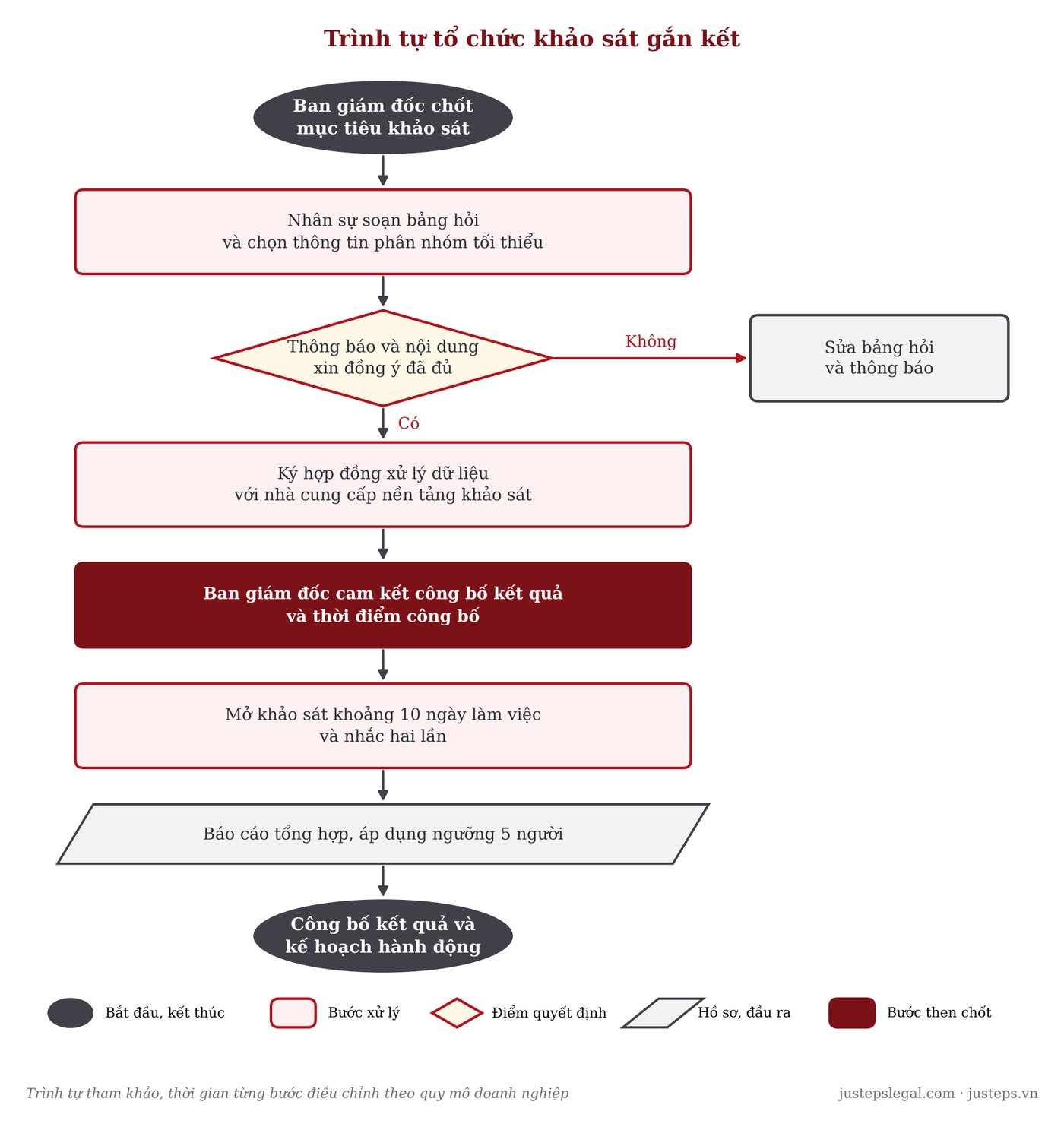
The sequence for running an engagement survey from preparation to publication of results
At the preparation stage, the HR department drafts the questionnaire according to the agreed objectives, and the person responsible for legal affairs or data protection reviews the notice page, the consent wording and the contract with the platform provider. If the questionnaire still collects unnecessary information or the notice is incomplete, it is returned for amendment before the survey opens. The critical step is for the board of directors to send an opening message committing to publish the results and stating when they will be published, because this is what determines whether employees answer honestly. The survey is usually open for about 10 working days with two reminders, and department heads may see only the response rate for their own department, not the list of people who have responded.
For production departments or employees who do not regularly use a computer, the business may set up tablet response points in rest areas, QR codes for personal phones, or paper forms placed in a sealed box. Where paper forms are used, data entry should be done by someone outside the department concerned so that handwriting cannot be recognised. A response rate of about 70% or more is usually enough for the results to reflect general opinion; a much lower rate is a sign that employees do not yet trust confidentiality or have not seen the results of previous rounds being used.
Reading the results and choosing priority issues
Results should be read in three layers. The first layer is the agreement rate for each topic group compared with the previous round, to see which issues have improved and which have worsened. The second layer is the comparison between departments that meet the reporting threshold, to see whether an issue is company-wide or concentrated in certain areas. The third layer is the open comments, classified by topic, which are used to explain the causes behind the figures. The following chart illustrates how to compare agreement rates by topic group between two survey rounds of a hypothetical business.
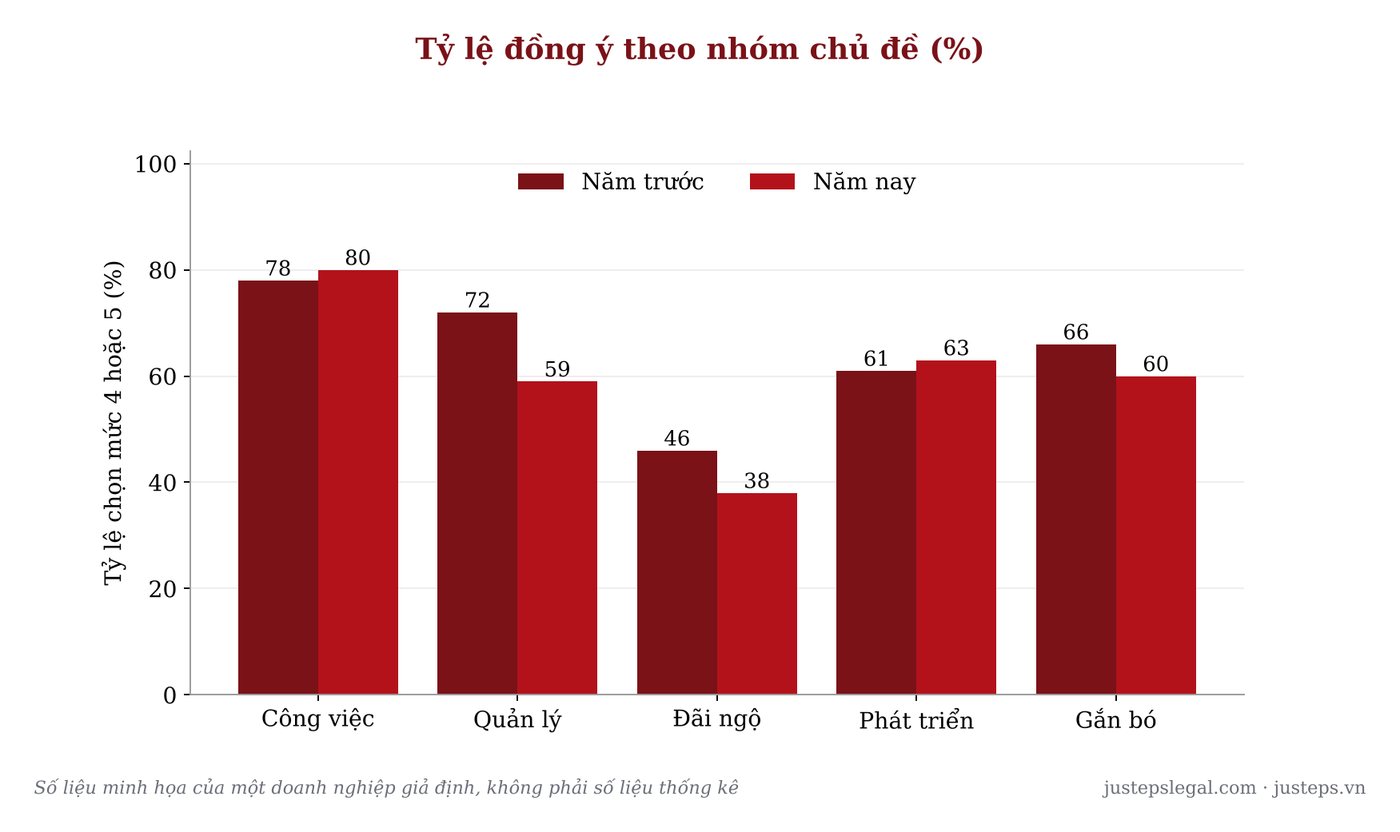
Agreement rates by topic group across two survey rounds, illustrative data
In this example, the pay and recognition group has the lowest agreement rate and has fallen further from the previous year, while the line manager group has dropped sharply although it remains at a moderate level. These two groups should be chosen as priority issues, while the work and objectives group is high and stable and only needs to be maintained. When reading the results, the business should avoid drawing conclusions from a single question or a few harsh open comments, and should cross-check against other data such as turnover, the number of days of unpaid leave or exit interview findings.
In businesses with about 20 to 50 people, departmental figures often do not meet the reporting threshold. In that case, results should be published only at company level, and the business should supplement them with small group discussions facilitated by someone from outside the department to understand the causes. This approach preserves confidentiality while still giving the board of directors enough information to make decisions.
Turning results into an action plan
After choosing priority issues, each department should set no more than two or three issues and, for each one, record the current agreement rate, one or two specific actions, the person responsible, the deadline and the measure that will be re-tested. Actions must be verifiable, such as publishing written bonus rules in the first quarter or holding monthly one-to-one meetings between managers and staff, rather than general commitments such as paying more attention to employees. The plan for the whole company and for each department should be published to employees at the same time as the survey results.
For example, a distribution business found that only 38% agreed with the statement I understand how my bonus is calculated. The plan it chose was to review and reissue the bonus rules with worked examples for each position, hold briefing sessions for each sales team, and re-run this question in a pulse survey after six months. When amending the bonus rules, the business should remember that bonus rules are decided by the employer and published at the workplace after consulting the grassroots employee representative organisation, if there is one[6].
An action plan only has value if it is monitored regularly. The HR department should compile progress every quarter and report to the board of directors, and also inform employees of what has been achieved, because this is the clearest evidence that will encourage employees to keep answering honestly in the next survey. The cycle of survey, planning, implementation and re-measurement is illustrated in the figure below.
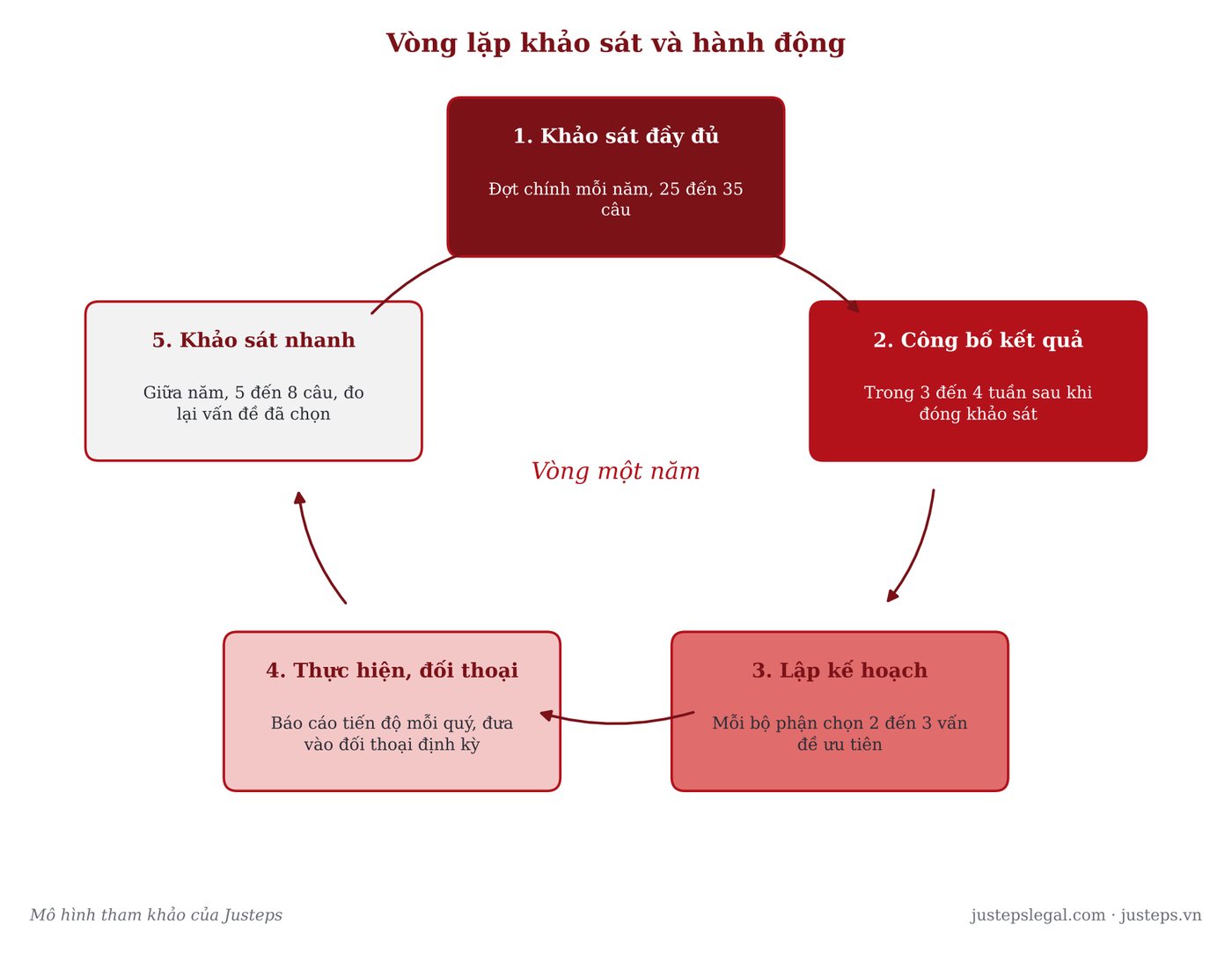
The one-year cycle of survey, planning, implementation and re-measurement
The cycle starts with the full survey, followed by publication of results about three to four weeks after the survey closes, after which each department draws up an action plan. During implementation, the business brings the results and progress into the periodic dialogue and then uses the mid-year pulse survey to check whether the chosen issues have improved. The outcome of this cycle becomes the starting point for the next year’s full survey, helping the business assess the real effectiveness of each action.
Bringing survey results into workplace dialogue
The Labour Code requires employers to hold periodic dialogue at the workplace at least once a year, in addition to dialogue at the request of either party or where an event specified by law occurs[7]. The content of dialogue may include the production and business situation, the performance of employment contracts, the collective labour agreement, internal rules and regulations, working conditions and the requests of employees and the employee representative organisation[8]. These are exactly the topics the Survey measures, so the aggregated results are a suitable document to include in the dialogue agenda.
Decree 145/2020/NĐ-CP guides how to organise dialogue, including determining the number and composition of participating representatives, sending the dialogue content to the parties in advance, taking minutes and communicating the main content of the dialogue to employees[9]. When Survey results are used, the documents sent in advance should be only the aggregated report applying the 5-person threshold, without raw data or unedited open comments. The minutes of the dialogue should record the agreed priority issues and the employer’s commitments to act, so that the next dialogue has a basis for checking progress.
Many businesses already have regulations on grassroots democracy at the workplace but have not set out how survey results are to be used. The business may add to these regulations, or to its internal HR rules, provisions on survey frequency, confidentiality principles, reporting thresholds and deadlines for publishing results, so that the practice does not depend on whoever is in charge at the time. The Law amending and supplementing a number of articles of the Labour Code was passed by the National Assembly on 21 November 2026 and takes effect from 1 March 2027[10], so when revising its regulations the business should check them against the amended provisions on dialogue and labour relations. Businesses needing a comprehensive review may consider Justeps’ service on labour and payroll compliance management.
Mistakes that cost the trust of employees
The most common mistake is promising anonymity while still collecting identifying information, or letting department heads manage the form. Once employees discover this, even only through rumour, the response rate and the honesty of later rounds will fall noticeably, and the business also faces the risk of breaching the rules on personal data protection. Another serious mistake is trying to identify the author of a negative comment, even when the original intention is only to offer support, because this destroys the whole value of the confidentiality commitment.
The third mistake is publishing results too late, in some cases after three months, or publishing only the positive parts. Employees will assume the results have been selectively edited and will answer carelessly in the next survey. The business should publish all topic groups in full, including those with low results, together with a specific plan to address them.
The fourth mistake is linking the engagement score to the bonus targets of department heads. This gives department heads an incentive to nudge staff towards high scores or to find out who gave low ones, which distorts the results. The business may assess department heads on whether they complete the post-survey action plan, rather than on the engagement figure itself.
How Justeps can help
Justeps helps businesses run engagement surveys in compliance with the rules on personal data and use the results effectively through the following services:
- Personal data protection compliance. Justeps reviews the questionnaire and drafts the data processing notice, the consent wording and the contract with the survey platform provider.
- Labour and payroll compliance management. Justeps develops grassroots democracy regulations, the periodic dialogue procedure and minute templates in line with the Labour Code.
- Wage scales and pay and bonus regulations. Justeps reviews and redrafts bonus rules when survey results show that employees do not understand or trust how bonuses are calculated.
- Organisational structure, functions and duties, and job descriptions. Justeps adjusts the structure, role allocation and job descriptions when the survey shows that roles are unclear or coordination is weak.
Frequently asked questions
Is a business required to run an engagement survey?
The law does not require businesses to run engagement surveys. However, the employer must hold periodic dialogue at the workplace at least once a year[7], and survey results are a good source of information for that dialogue.
Does an anonymous survey require employees’ consent?
If the survey genuinely collects no identifying information and the reporting groups are large enough, the personal data risk is much lower, but the business should still state clearly the purpose and how the results will be used. Where it collects email addresses, employee numbers or information sufficient to identify respondents, the business must obtain separate consent for each purpose, and silence is not treated as consent[2].
Should survey results be used to assess individual employees?
The business should not use survey results to assess individual respondents. Using data for a purpose other than the one notified requires a separate legal basis, and it also destroys trust, so later surveys lose their value.
How long after the survey closes should the results be published?
The business should publish the results about three to four weeks after the survey closes, together with the priority issues and the proposed response. Publishing too late easily leads employees to think that the results have been selectively edited.
Should a business of about 20 people run a survey?
A business of this size can still run a survey, but should report only at company level to keep the minimum threshold of 5 people per group. The results should be supplemented by small group discussions facilitated by someone from outside the department.
Does a small business have to prepare a personal data processing impact assessment for a survey?
As a general rule, the data controller must prepare an impact assessment[4]. Small enterprises and start-ups may choose whether or not to do so during the first 5 years, except in certain cases such as processing sensitive data[5].
How long should raw survey data be kept?
The business should set the retention period in the notice itself, usually about 12 months or until the comparison with the next round is complete. After that period, the raw data should be deleted, including copies held by the platform provider, and the business keeps only the aggregated reports.
Related articles
- What the HR department must do to protect employees’ personal data under the 2025 Law on Personal Data Protection
- How businesses should organise periodic performance appraisals that can be relied on for pay, bonuses and people management
- The procedure for issuing internal documents in a company, from drafting to archiving and monitoring their validity
- Building a remote work and flexible working hours policy that complies with the Labour Code
Notes
[1] Law on Personal Data Protection No. 91/2025/QH15, passed by the National Assembly on 26 June 2025 and effective from 1 January 2026, provisions on interpretation of terms.
[2] Article 9.4 of the Law on Personal Data Protection No. 91/2025/QH15.
[3] Article 25 of the Law on Personal Data Protection No. 91/2025/QH15.
[4] Article 21.1 of the Law on Personal Data Protection No. 91/2025/QH15.
[5] Article 38.2 and Article 38.3 of the Law on Personal Data Protection No. 91/2025/QH15.
[6] Article 104 of the Labour Code No. 45/2019/QH14 dated 20 November 2019.
[7] Article 63 of the Labour Code No. 45/2019/QH14 dated 20 November 2019.
[8] Article 64.2 of the Labour Code No. 45/2019/QH14.
[9] Decree No. 145/2020/NĐ-CP of the Government dated 14 December 2020 detailing and guiding the implementation of a number of articles of the Labour Code on working conditions and labour relations, provisions on dialogue at the workplace.
[10] Law amending and supplementing a number of articles of the Labour Code, passed by the National Assembly on 21 November 2026 and effective from 1 March 2027.
This article is for reference and reflects the regulations in force at the time of publication. Please consult Justeps for advice tailored to your company’s records and situation.
For further information, please contact:
📩 Email: info@justeps.vn
🌐 Website: https://justepslegal.com · https://justeps.vn
🌐 Page: Justeps
☎️ Hotline (Zalo): 096 172 2607
📍 Thanh Xuan Office: 12th Floor, Licogi 13 Tower, 164 Khuat Duy Tien Street, Thanh Xuan Ward, Hanoi, Vietnam
📍 Ha Dong Office: LK06B, No.10, Dong Dua Area, Ha Dong Ward, Hanoi, Vietnam
📍 Ho Chi Minh City Branch: 528 Le Van Sy, Ho Chi Minh City, Vietnam
📍 Hai Phong Office: Truong Thinh Village, Ha Dong Commune, Hai Phong, Vietnam
📍 Quang Ninh Office: Van Don Special Zone, Quang Ninh Province, Vietnam





