
Key takeaways
- A new company’s personnel costs do not stop at the agreed salary, because the business must also contribute about 23.5% on top of the salary used as the basis for insurance contributions and trade union fees.
- A company with no revenue yet must still file tax returns, prepare annual financial statements and finalise its taxes, so accounting costs are a fixed item from the very first month.
- Business licence fees ended on 1 January 2026, and newly established small and medium-sized enterprises may be exempt from corporate income tax for three years, but these incentives do not remove filing obligations.
- Contributed capital should be enough to cover fixed costs for at least six months in a scenario where revenue arrives late, plus deposits and a contingency fund.
- The first-year budget should be prepared by month, separating fixed and variable costs, with an alert threshold when cash covers only three months of spending.
Most newly established companies do not struggle for lack of business ideas but for lack of cash in the first months, when costs are being incurred regularly but revenue has not yet arrived. Founders usually account for office rent and the salaries agreed with staff, but overlook the insurance contributions the business must pay on top, accounting costs for tax filings, rental deposits and expenses that will not be deductible at tax finalisation. By the fifth or sixth month, the company has to borrow urgently from relatives, or the owner advances money personally without a loan agreement, creating tax and bookkeeping risks.
This article analyses the groups of operating costs of a new company in its first year, the legal obligations that generate costs even before there is revenue, and how to prepare a monthly budget in order to decide on a reasonable amount of contributed capital. The content applies mainly to small limited liability companies and joint stock companies established from 2026 onwards, with between one and about ten staff. The main readers are founders, directors and those in charge of accounting at new businesses.
Groups of operating costs of a new company in its first year
To estimate correctly, a business should divide its first-year costs into six groups by nature, namely incorporation and initial formalities, premises and infrastructure, personnel and payroll-related contributions, accounting and compliance, sales and marketing, and a contingency fund. This division helps distinguish one-off expenses from recurring monthly expenses, and also shows which items are tied to legal obligations that cannot be cut. One-off expenses are usually concentrated in the first month, while recurring items determine the minimum amount the company must have each month to keep operating.
Each cost group has its own estimation method and is tied to different legal obligations, so the person preparing the budget needs to know which items are flexible and which are mandatory. The table below summarises the nature of each group and the legal points to note:
| Cost group | Nature and estimation method | Legal points to note |
|---|---|---|
| Incorporation and initial formalities | One-off spending in the first month, covering the company seal, digital signature, e-invoices, bank account and service fees. | Registration and publication fees are low, and business licence fees are no longer collected from 1 January 2026. |
| Premises and infrastructure | Fixed monthly spending; the first month usually also requires a deposit and rent paid in advance. | The lease should clearly state the conditions for refunding the deposit and the landlord’s obligation to issue invoices. |
| Personnel and payroll contributions | The largest fixed cost, comprising salaries and the insurance and trade union contributions paid by the business. | Salaries must not be lower than the regional minimum wage, and insurance must be registered within the statutory time limit. |
| Accounting and compliance | Fixed monthly spending on an outsourced accountant or an in-house accountant and software. | Tax returns and annual financial statements must be filed even when there is no revenue. |
| Sales and marketing | Variable spending that can be capped monthly and tied to customer targets. | Payments of VND 5 million or more should be made through a bank to be deductible. |
| Contingency | Usually 10% to 15% of fixed costs, used only for unplanned expenses. | Should be provided for in the internal spending regulations with clear approval authority. |
For a service company with three staff and an office in a central urban district, the structure of first-year costs might look like the following chart. The figures are purely illustrative and vary considerably by industry, location and actual salary levels.
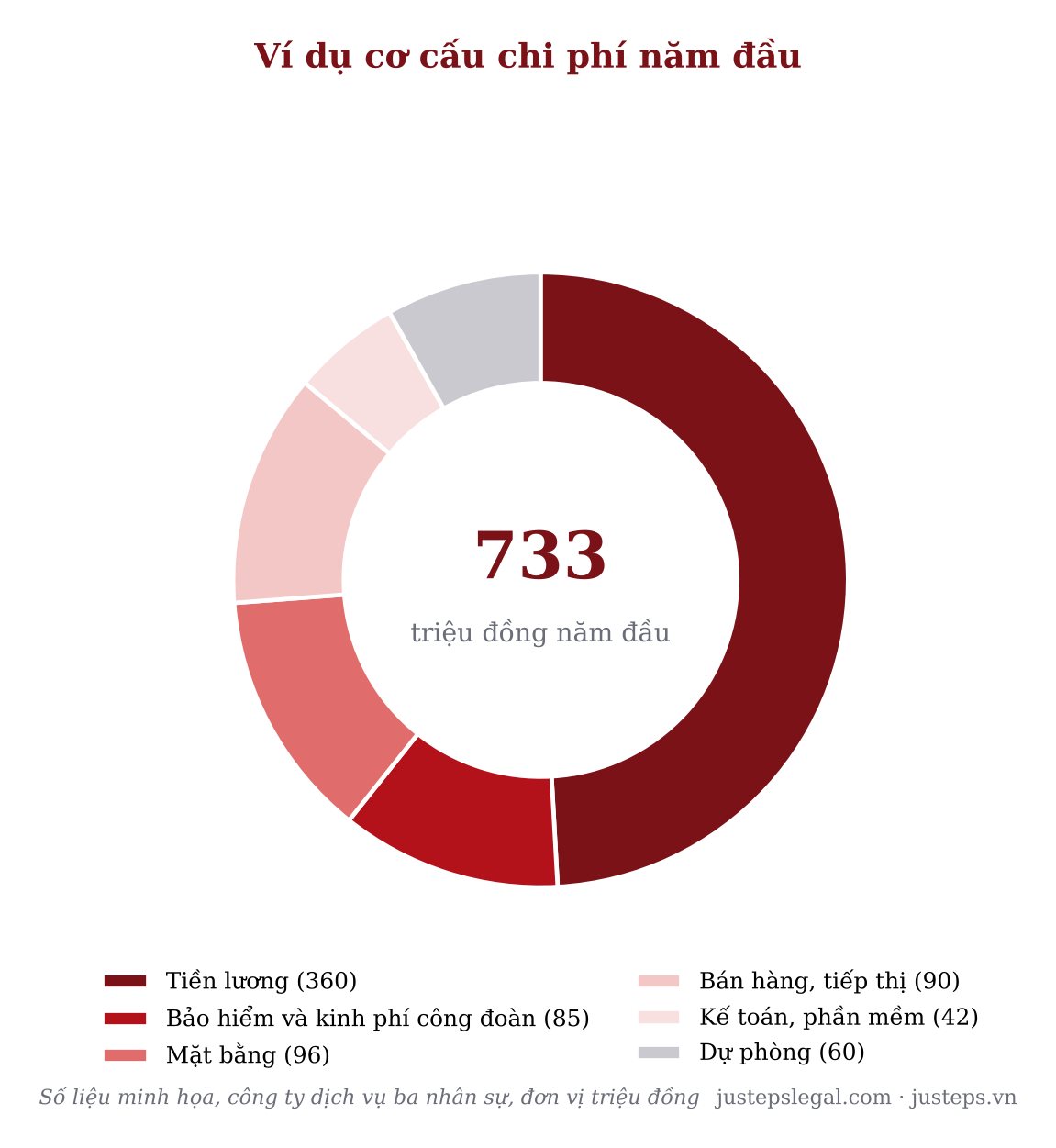
Example of the first-year cost structure of a service company with three staff
In this example, salaries and the contributions the business pays on salaries account for almost two thirds of total first-year costs, with premises in second place. This shows that the decision to hire one more person has a much greater impact on the budget than choosing software or an accounting service provider. The contingency fund is small but should be set aside separately from the outset, because new companies often face unexpected expenses such as office repairs, bank switching fees or legal costs when signing a major contract.
Incorporation costs, premises and the charter capital to be contributed
Incorporation costs and charges that have been abolished
The enterprise registration fee and the fee for publishing registration details are only a few hundred thousand dong, so the items more worth budgeting for are the company seal, digital signature, registration for e-invoicing, opening a bank account and service fees for preparing the application if the business engages an outside provider. The application file and registration procedure are currently governed by Decree 168/2025/ND-CP on enterprise registration[1]. From 1 January 2026, the collection and payment of business licence fees ended under Resolution 198/2025/QH15 of the National Assembly[2], so companies established from 2026 no longer bear the previous annual cost of VND 2 to 3 million.
After receiving its certificate, the business must register to use e-invoices before selling goods or providing services for the first time[3]. The cost of invoice packages and digital signatures is usually charged annually, so the business needs to record the renewal in the twelfth month of the budget to avoid any interruption in issuing invoices. When choosing a provider, the business should compare the all-in price for the whole year, because many low-priced packages include only a very small number of invoices.
Premises, deposits and the lease
Office landlords usually require a deposit of two to three months’ rent and payment of one quarter in advance, so in the first month the company may have to pay the equivalent of five to six months’ rent. A deposit is security for performance of the contract and will be returned when the contract has been performed unless the parties agree otherwise, but the tenant forfeits the deposit if it refuses to perform the contract[4]. Therefore, before signing a lease of two years or more, the business should consider a scenario in which it has to move early and agree on termination conditions, the notice period and the corresponding deposit refund.
A company with fewer than five people may consider a shared office or virtual office in its first year, because the cost is lower and no large deposit is required. However, the head office address must be identifiable and reachable, because the tax authority and the business registration authority will send notices to this address. Where the landlord is an individual, the lease should clearly state which party declares and pays tax on the rent, and which invoices or documents will be provided so that the company can treat the rent as a deductible expense.
Charter capital and the deadline for contribution
Members, owners or shareholders must contribute the full amount of capital they have committed within 90 days from the date of issue of the enterprise registration certificate, excluding the time for transporting or importing assets contributed as capital and completing ownership transfer procedures[5]. If the full amount is not contributed, the business must register an adjustment of its charter capital to the amount actually contributed, and the contributors are liable, in proportion to the capital they committed, for obligations arising before the date of registering the adjustment. For this reason, the amount of charter capital should be decided after the first-year budget has been prepared, not chosen as a round number or by reference to other businesses.
A common mistake is registering a low charter capital, after which the owner repeatedly transfers personal funds into the company’s account to pay expenses without a loan agreement or a decision to increase capital. In that situation, the accountant has no basis for recording the money as a liability or as equity, and the tax authority may question the source of funds during an inspection. The business should choose one of two approaches from the outset, either increasing charter capital through the proper procedure or signing a loan agreement stating the amount, interest rate, term and method of repayment.
Personnel costs and payroll-related contributions
Personnel costs are the largest fixed cost and also the item founders most often underestimate. The salary paid to an employee working full normal hours must not be lower than the regional minimum wage, currently VND 5,310,000 per month in Region I under Decree 293/2025/ND-CP, rising from 1 January 2027 to VND 5,700,000 in Region I, VND 5,080,000 in Region II, VND 4,450,000 in Region III and VND 4,040,000 in Region IV[6]. A company established in late 2026 should budget salaries at the new levels from the outset so that it does not have to make adjustments after a few months.
In addition to the salary paid to employees, the business must also pay its share of social insurance, health insurance, unemployment insurance and trade union fees calculated on the salary used as the basis for insurance contributions[7][8]. The salary used as the contribution basis comprises the wage rate, salary allowances and other supplementary amounts paid regularly and consistently, so the business cannot reduce insurance costs by splitting most of the income into fixed allowances. The rates paid by the business are summarised below:
| Contribution | Rate paid by the business | Notes |
|---|---|---|
| Social insurance | 17.5% of the salary used as the contribution basis. | Covers the retirement and survivorship fund, the sickness and maternity fund and the occupational accident and disease fund. |
| Health insurance | 3% of the salary used as the contribution basis. | The employee contributes a further 1.5%, which is deducted from salary. |
| Unemployment insurance | 1% of the salary used as the contribution basis. | The employee also contributes 1% on the same basis. |
| Trade union fees | 2% of the payroll used as the basis for insurance contributions. | The business pays even if no grassroots trade union has been established. |
| Total paid by the business | About 23.5% of the salary used as the contribution basis. | This amount is in addition to the salary the employee actually receives. |
Take the example of a company with three employees, each with a salary of VND 10 million per month used as the basis for insurance contributions. The additional amount paid by the business is about VND 7.05 million per month, or about VND 84.6 million per year, which is almost three months of one employee’s salary. In addition, the business must register employees for insurance within 30 days from the date the employment contract takes effect[7], and late payment incurs late payment interest calculated daily.
When preparing the budget, the business should calculate personnel costs as the employer’s total cost, including salary, insurance and trade union contributions, committed benefits such as lunch, parking and telephone allowances, and year-end bonuses if they are provided for in the contract or regulations. Bonuses and benefits are only deductible when they are specified in the employment contract, collective agreement or company regulations[9], so pay and bonus regulations need to be in place before payments are made. Businesses may refer to Justeps’ development of salary scales and pay and bonus regulations service to determine a salary structure that is both lawful and affordable in the first year.
Accounting, tax and compliance obligations arising from the first month
Filing obligations do not depend on revenue
Many founders assume that a company that has not yet sold anything does not need an accountant, but tax filing obligations arise from the moment the business is issued a tax code. The business must still submit periodic value added tax returns and personal income tax withholding returns when paying salaries, and at year end it must prepare financial statements and finalise corporate income tax no later than the last day of the third month after the end of the financial year[10]. New businesses usually file value added tax quarterly, but they should confirm the filing period with the tax authority managing them immediately after obtaining a tax code. Late filing, even of a return showing no tax payable, may still attract administrative penalties.
The first annual accounting period runs from the date of issue of the enterprise registration certificate to the last day of the financial year, and if this period is shorter than 90 days it may be added to the following year’s accounting period, provided the total does not exceed 15 months[11]. This rule means that a company established in October or November may prepare a single set of financial statements for the period up to the end of the following year. Even so, the business must still file tax returns for each period during this time, so accounting costs remain a monthly expense.
Tax incentives for new businesses and their limits
Under the 2025 Law on Corporate Income Tax, businesses with total annual revenue not exceeding VND 3 billion apply a tax rate of 15%, and businesses with revenue above VND 3 billion and not exceeding VND 50 billion apply a rate of 17%[12]. In addition, Resolution 198/2025/QH15 allows small and medium-sized enterprises to be exempt from corporate income tax for three years from the date of first issue of the enterprise registration certificate[2]. This incentive does not apply automatically in every case, because the business must meet the criteria for a small or medium-sized enterprise and must not fall within the exclusions set out in the guiding documents, such as a business established through a demerger or conversion from a business that was already operating.
It should be noted that exemption from corporate income tax does not remove the obligations to file and pay value added tax, withhold employees’ personal income tax and prepare financial statements. The exempted tax is also only meaningful when the company is profitable, whereas most new companies make a loss in their first year. The first-year budget should therefore not count on savings from tax incentives in advance, but treat them only as a factor that helps improve cash flow in the second and third years.
Documents and payment methods determine deductible expenses
An expense is only deductible when it is related to business activities and supported by lawful invoices and documents, and for individual payments of VND 5 million or more there must be evidence of non-cash payment[9]. A similar condition applies to the deduction of input value added tax[13]. New companies often pay cash for office renovation, equipment purchases or services from individuals, only to discover at finalisation that these expenses are disallowed, increasing taxable profit in later years once the incentive has ended.
The business should open a bank account in the company’s name immediately after incorporation, make all large payments through this account and not mix it with the founders’ personal accounts. Separating accounts helps the accountant determine actual costs correctly and creates clear evidence when the owner contributes capital or lends money to the company. Advances to employees should be settled with invoices within the time limit set by the internal spending regulations.
Preparing the first-year budget by month
A first-year budget is valuable when it is prepared month by month rather than as a single figure for the whole year, because a new company’s costs and revenue are very unevenly distributed. The first month is dominated by deposits, equipment and incorporation costs, while revenue usually begins in the third month or later, and actual cash receipts lag further still if customers are given 30 to 60 days to pay. The sequence below helps the business move from a list of costs to a decision on the amount of capital it needs.
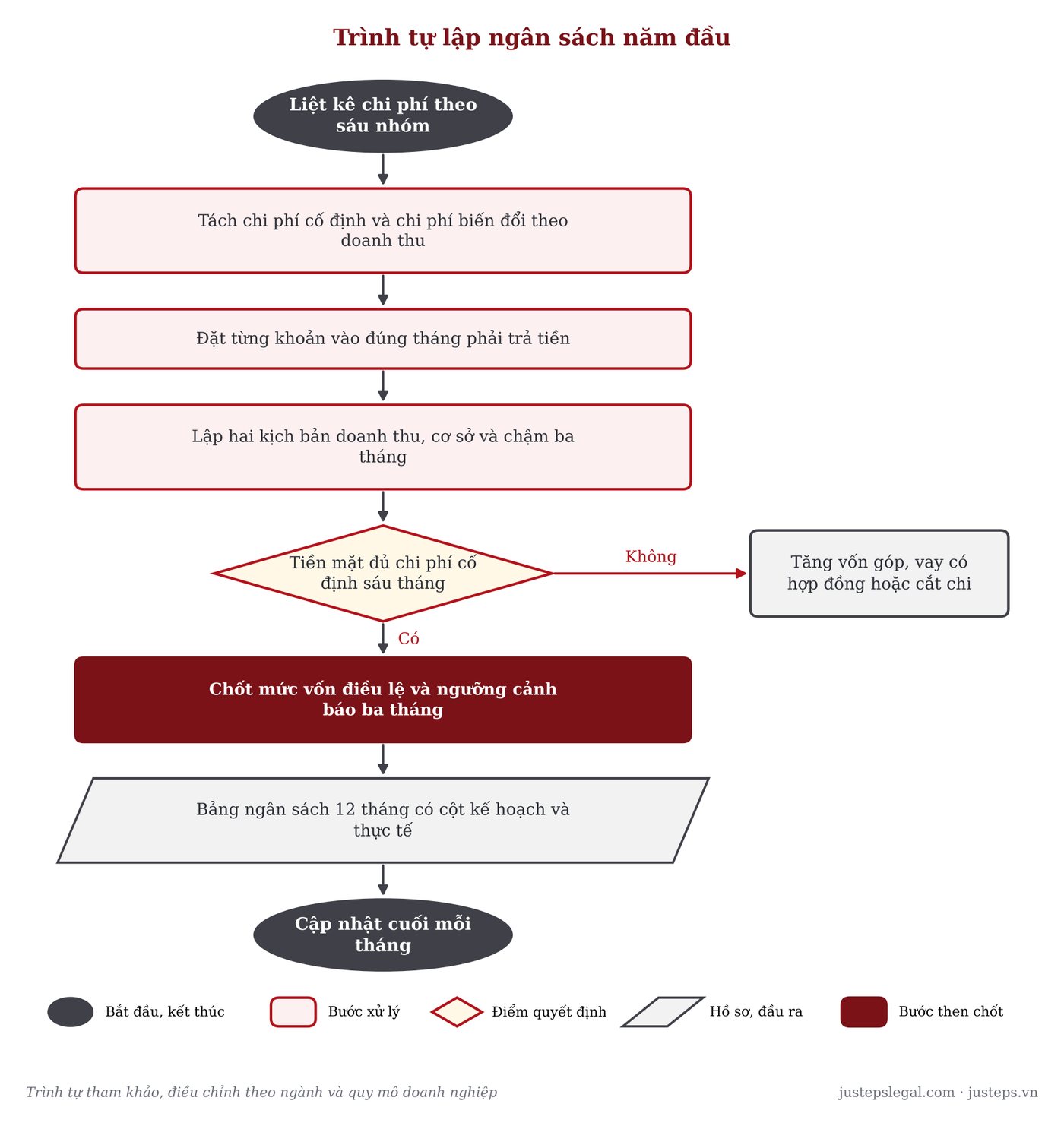
Sequence for preparing the first-year budget and checking the capital required
The first step is to list all expenses under the six groups described above, then separate fixed costs from costs that vary with revenue. Next, the business places each item in the month in which it will actually be paid, such as the deposit in the first month, insurance monthly and value added tax quarterly. On the revenue side, the business prepares two scenarios, a base scenario and a scenario in which revenue arrives three months late. The decisive question is whether cash in the late scenario is enough to cover fixed costs for at least six months, and if not, the business must increase contributed capital, arrange a documented loan or cut fixed costs before starting.
Take the example of a company with contributed capital of VND 600 million, fixed costs of about VND 61 million per month and an additional VND 40 million spent on deposits and equipment in the first month. The following chart compares the cash remaining at the end of each month under the two revenue scenarios.
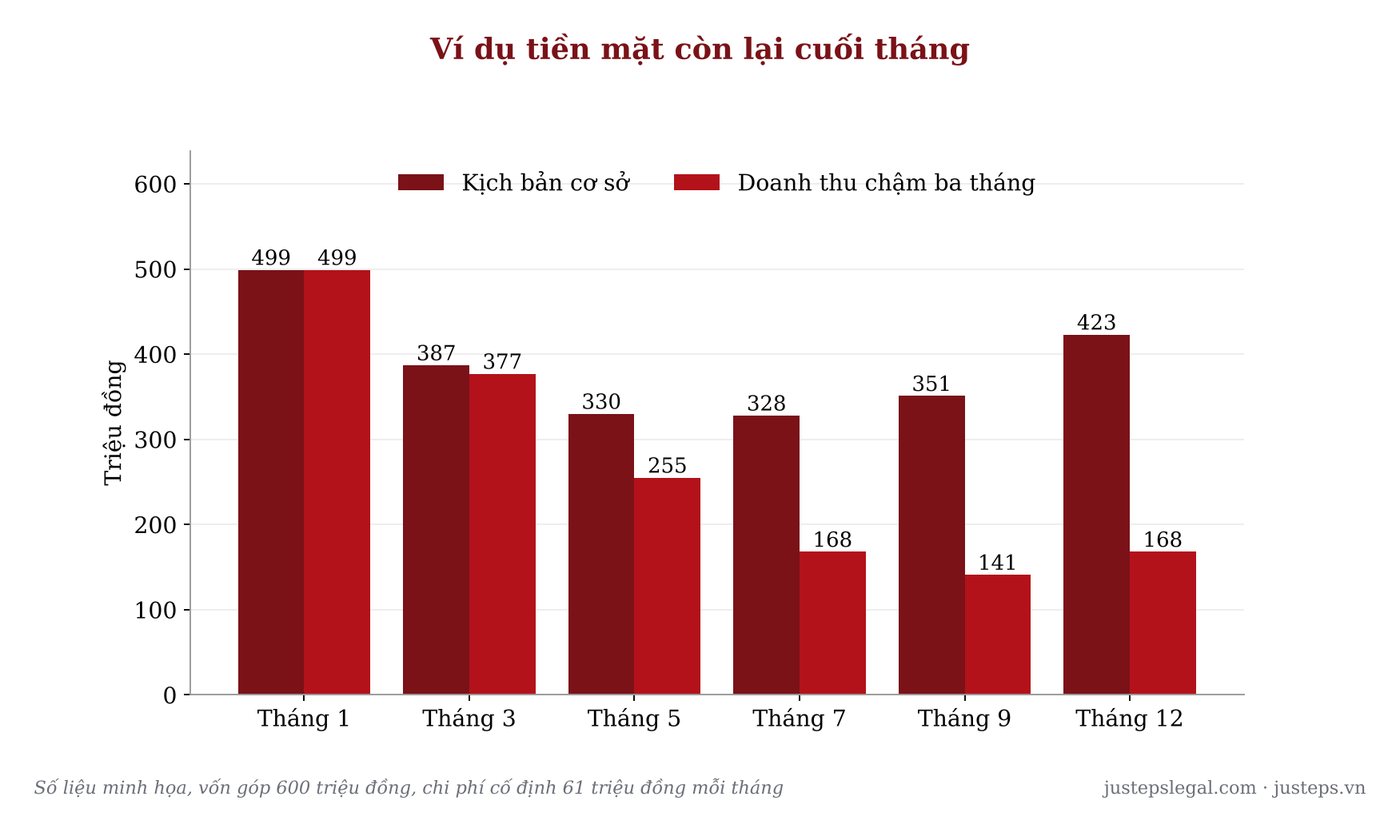
Example of cash remaining at month end under the base scenario and the scenario with revenue three months late
In the base scenario, cash falls until around the seventh month and then rises again as revenue exceeds fixed costs. In the scenario with revenue three months late, cash falls continuously to about VND 141 million in the ninth month, enough to cover only a little over two months of fixed costs. If the company sets its alert threshold at three months of fixed costs, about VND 183 million, the board of management would have had to act from around the sixth month by cutting marketing spending, postponing recruitment or preparing a capital increase. The value of the budget lies in helping managers see this point several months ahead, rather than discovering it when the account is nearly empty.
The budget should be updated at the end of each month with two columns for budget and actual, together with explanations of significant variances. The business should also maintain a weekly cash flow tracker recording receivables and payables over the next four weeks, as this is the tool for detecting late-paying customers early. When actual revenue differs from the budget by more than 20% for two consecutive months, the founder should re-prepare the budget for the remaining months rather than continuing to compare against the old figures.
Controlling costs through regulations and a compliance calendar
A budget only works when spending within the company follows clear rules, especially as the number of people authorised to spend increases. A new company should issue internal spending regulations early, setting out the spending limits approved at each level, the documents required for each type of expense, the advance limits and the deadline for settling advances. These regulations are also the basis for proving that expenses serve business activities when the tax authority carries out an inspection. Justeps helps businesses develop internal spending regulations and cost norms suited to a small scale, not overly complex but sufficient for control.
Alongside the regulations, the business needs a calendar of recurring obligations for the whole year, clearly showing the deadline for capital contribution, the deadline for registering employees for insurance, periodic tax filing deadlines, renewal dates for digital signatures and e-invoices, lease expiry dates and the year-end finalisation deadline. Each milestone should have a person responsible and the corresponding amount entered in the budget for the right month. The main milestones of the first year are shown on the timeline below.
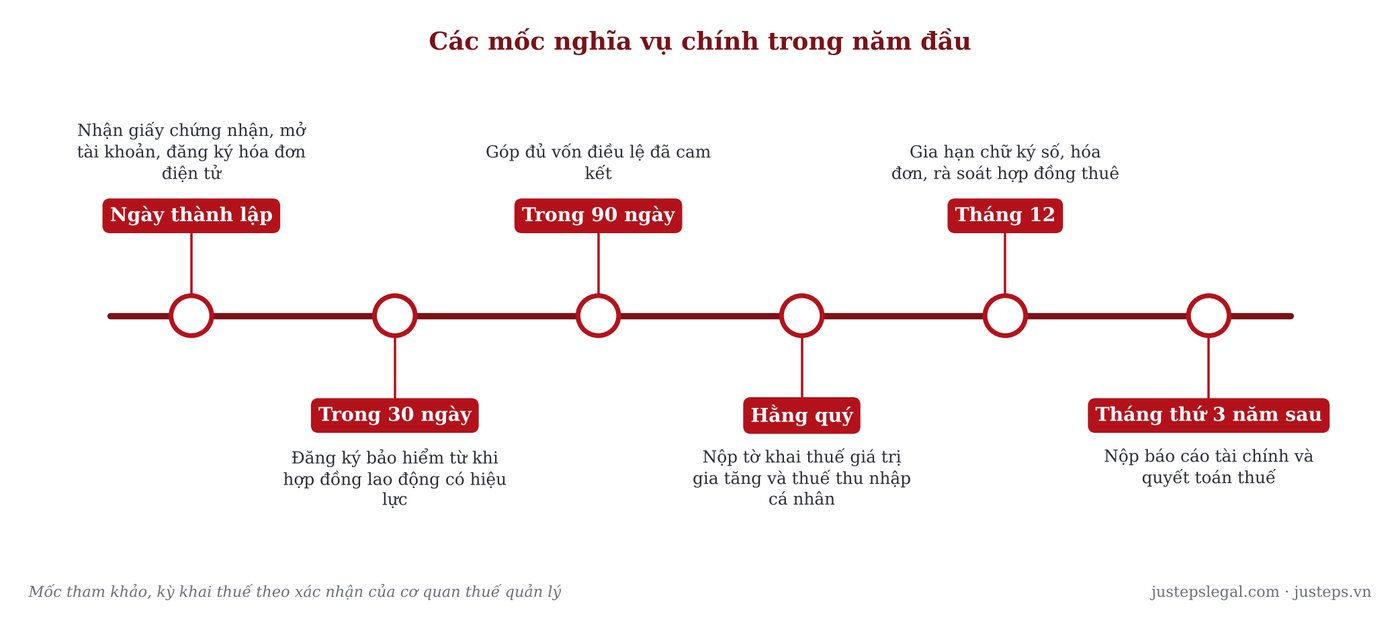
Main compliance milestones in the first year of a new company
The nearest milestone is the 90-day deadline for contributing the full charter capital, followed by the 30-day deadline for registering insurance from the date the employment contract takes effect. During the year, the business files value added tax and personal income tax returns for each period, no later than the last day of the first month of the following quarter if filing quarterly. After the end of the financial year, the business has until the end of the third month to submit financial statements and finalise its taxes, so accounting costs from January to March of the following year are usually higher than in other months.
Several other mistakes also commonly cause the first-year budget to diverge from reality. Founders often calculate salaries based on the amount employees actually take home and forget the additional contributions paid by the business, or treat the tax exemption as an exemption from all obligations and do not hire an accountant in the first months. Some businesses sign long-term leases before they are sure of their scale, or sign contracts with major customers on 90-day payment terms without accounting for the resulting cash flow gap. Each of these mistakes can be detected early if the budget is prepared monthly and reviewed by an accountant or advisory specialist before the business decides on the amount of capital to contribute.
How Justeps can help
Justeps helps new companies estimate costs, decide on capital and control spending in their first year through the following services:
- Company formation and enterprise registration. Justeps advises on the type of entity and a charter capital level suited to the first-year budget, and prepares the enterprise registration application.
- Internal spending regulations and cost norms. Justeps drafts spending regulations, approval limits and documentation requirements so that costs are controlled and qualify as deductible expenses.
- Development of salary scales and pay and bonus regulations. Justeps designs the structure of salaries, allowances and bonuses and calculates total personnel costs, including insurance, for each option.
- Ongoing legal advisory services for start-ups and innovative start-up businesses. Justeps reviews leases and contracts with customers and suppliers and provides reminders of recurring obligations during the first year.
Frequently asked questions
Does a company established in 2026 have to pay the business licence fee?
The company does not have to pay it, because the collection and payment of business licence fees ended on 1 January 2026[2]. Other tax filing obligations remain unchanged.
Does a company with no revenue yet have to file tax returns and prepare financial statements?
The company must still submit periodic tax returns, even when no tax is payable, and prepare annual financial statements[10]. Late filing may attract administrative penalties.
Is a new business automatically exempt from corporate income tax for three years?
The incentive applies only to small and medium-sized enterprises registering for the first time that do not fall within the exclusions set out in the guiding documents[2]. The business must determine its own eligibility and must still file and finalise its taxes in full.
How much insurance must the business pay for each employee?
The business’s share comprises 17.5% for social insurance, 3% for health insurance, 1% for unemployment insurance and 2% for trade union fees, a total of about 23.5% of the salary used as the contribution basis[7][8]. This amount is in addition to the salary the employee receives.
How much charter capital should a new company register?
Charter capital should be enough to cover fixed costs for at least six months in a scenario where revenue arrives late, plus deposits and a contingency fund. The registered capital must be contributed in full within 90 days from the date of issue of the certificate[5].
What documents are needed when the owner transfers personal funds into the company to pay expenses?
The owner should sign a loan agreement with the company stating the amount, interest rate and term, or complete the procedure to increase charter capital. Without documents, the money is difficult to record correctly and is likely to be questioned during a tax inspection.
Do cash payments affect deductible expenses?
Individual payments of VND 5 million or more must be supported by evidence of non-cash payment to be deductible[9]. The business should make large payments through a bank account in the company’s name.
Related articles
- Setting up a company in Hanoi, documents, timing and what to do immediately after receiving the registration certificate
- Household business, limited liability company or joint stock company, comparing operations, tax and fundraising
- Building internal financial regulations for a limited liability company, spending norms, approvals, advances and settlement
- Turnkey business operations setup, workstreams, implementation sequence and acceptance criteria
Notes
[1] Government Decree No. 168/2025/ND-CP on enterprise registration, as amended and supplemented by Decree No. 296/2026/ND-CP.
[2] Article 10 of Resolution No. 198/2025/QH15 dated 17 May 2025 of the National Assembly on certain special mechanisms and policies for developing the private economy.
[3] Decree No. 254/2026/ND-CP dated 30 June 2026 of the Government on electronic invoices and electronic documents, effective from 1 July 2026, replacing Decree No. 123/2020/ND-CP and Decree No. 70/2025/ND-CP.
[4] Article 328 of the Civil Code No. 91/2015/QH13 dated 24 November 2015.
[5] Clause 2 of Article 47, Clause 2 of Article 75 and Clause 1 of Article 113 of the Law on Enterprises No. 59/2020/QH14 dated 17 June 2020, as amended and supplemented by Law No. 76/2025/QH15.
[6] Decree No. 293/2025/ND-CP on minimum wages for employees working under employment contracts; Decree No. 399/2026/ND-CP on minimum wages applicable from 1 January 2027.
[7] Law on Social Insurance No. 41/2024/QH15 dated 29 June 2024; Law on Health Insurance No. 25/2008/QH12, as amended and supplemented; Law on Employment No. 74/2025/QH15.
[8] Law on Trade Unions No. 50/2024/QH15 dated 27 November 2024.
[9] Law on Corporate Income Tax No. 67/2025/QH15 and Government Decree No. 320/2025/ND-CP detailing and guiding its implementation, provisions on deductible and non-deductible expenses.
[10] Law on Tax Administration No. 108/2025/QH15, effective from 1 July 2026, and Decree No. 252/2026/ND-CP guiding its implementation.
[11] Article 12 of the Law on Accounting No. 88/2015/QH13 dated 20 November 2015.
[12] Clause 2 of Article 10 of the Law on Corporate Income Tax No. 67/2025/QH15 dated 14 June 2025.
[13] Article 14 of the Law on Value Added Tax No. 48/2024/QH15 dated 26 November 2024.
This article is for reference and reflects the regulations in force at the time of publication. Please consult Justeps for advice tailored to your company’s records and situation.
For further information, please contact:
📩 Email: info@justeps.vn
🌐 Website: https://justepslegal.com · https://justeps.vn
🌐 Page: Justeps
☎️ Hotline (Zalo): 096 172 2607
📍 Thanh Xuan Office: 12th Floor, Licogi 13 Tower, 164 Khuat Duy Tien Street, Thanh Xuan Ward, Hanoi, Vietnam
📍 Ha Dong Office: LK06B, No.10, Dong Dua Area, Ha Dong Ward, Hanoi, Vietnam
📍 Ho Chi Minh City Branch: 528 Le Van Sy, Ho Chi Minh City, Vietnam
📍 Hai Phong Office: Truong Thinh Village, Ha Dong Commune, Hai Phong, Vietnam
📍 Quang Ninh Office: Van Don Special Zone, Quang Ninh Province, Vietnam





