
Key takeaways
- Premises on the list subject to fire safety management must keep records prepared, managed and updated by the head of the premises, and certain documents such as self-inspection records and performance reports must be kept for at least 05 years.
- The premises' fire fighting, rescue and relief plan is prepared and approved by the head of the premises and must be drilled periodically at least once a year.
- Premises with 20 or more people working regularly must set up an on-site fire prevention, fighting and rescue team, while smaller premises must assign a person in charge in writing.
- The annual calendar revolves around regular self-inspections at least once a month, periodic self-inspections, reports before 15 June and 15 December, plan drills and tracking compulsory fire and explosion insurance.
- The Law on Fire Prevention, Fighting and Rescue was amended by the National Assembly on 20 November 2026, so businesses should assign someone to follow the new implementing documents and update their records promptly.
A trading company leases two office floors and a warehouse of about 1,500 m² on the outskirts, with around 60 employees in total. When the police announce a periodic inspection, the company discovers that the warehouse's fire fighting plan is still the version prepared three years earlier, the evacuation diagram is no longer accurate after a mezzanine was added, the fire team list includes two people who have left the company and nobody can find the record of the most recent annual drill. The equipment still works well, but the records cannot show that the company has fulfilled its periodic obligations.
This article guides business premises in preparing and updating fire prevention and fighting records and organising the tasks to be carried out every year under the 2024 Law on Fire Prevention, Fighting and Rescue and Decree 105/2025/ND-CP guiding that law, in the order of determining whether the premises are subject to management, the contents of the records, internal rules and on-site forces, training, the fire fighting plan and drills, self-inspection, reporting, compulsory fire and explosion insurance and the allocation of roles within the business. The main readers are directors, heads of administration and managers of warehouses, factories and stores of small and medium-sized enterprises. The article does not cover design appraisal and acceptance procedures for new construction, which are the responsibility of the project owner and the designer.
Which premises must keep fire safety records
The 2024 Law on Fire Prevention, Fighting and Rescue took effect on 1 July 2025 and is detailed by Decree 105/2025/ND-CP[1][2]. The decree classifies premises in annexes, of which Annex I lists premises subject to fire safety management, Annex II lists premises with fire and explosion hazards requiring stricter management, and Annex VII lists premises that must purchase compulsory fire and explosion insurance[3]. The first task for a business is to check each operating location, including offices, warehouses, workshops and stores, against these annexes, because record obligations, self-inspection frequency and the insurance obligation depend on the group to which the location belongs.
The outcome may differ between locations of the same business. A small office in a building may not be on the list, while a warehouse holding combustible goods, a production workshop or a store of large area or volume may fall under Annex I or Annex II. Premises not on the management list must still ensure fire safety under the general rules, such as providing suitable equipment, keeping escape routes clear and explaining what to do in case of fire. Businesses should keep a summary table of locations showing the annex group, the head of the premises and the person assigned, and review it whenever a location is opened, relocated or renovated.
It should be noted that the National Assembly passed a law amending and supplementing the Law on Fire Prevention, Fighting and Rescue on 20 November 2026, while Decree 105/2025/ND-CP has also been partly amended by Decree 347/2026/ND-CP, effective from 15 September 2026[4]. The obligations analysed in this article are based on the documents applicable at the end of 2026, so businesses need to check again when the amending law takes effect and new guiding decrees are issued.
Contents of the records and how to keep them
The head of the premises is responsible for preparing, managing and updating the premises' fire prevention, fighting and rescue records, which may be kept on paper, electronically or both[5]. The records comprise several groups of documents arising at different times, some prepared once when the premises begin operation and others added periodically during the year. The table below arranges the main documents by group so that businesses can assign and check the work easily.
| Document group | Main documents | When to update |
|---|---|---|
| Premises information | Premises information sheet, design appraisal and acceptance documents, as-built drawings where available. | On commencement of operation and whenever renovated or its use changed. |
| Internal rules | Internal fire safety rules and the decision establishing the team or the written assignment of a person in charge. | When the layout, personnel or head of the premises changes. |
| Plan | The premises' fire fighting, rescue and relief plan and the results of each drill. | At least once a year and whenever actual conditions change. |
| Inspection, reporting | Self-inspection records, performance reports and inspection records of the authorities. | After each inspection and before the reporting deadlines in the year. |
| Equipment, insurance | Register of fire prevention and fighting equipment and the compulsory fire and explosion insurance certificate. | On maintenance or replacement of equipment and on renewal of the insurance contract. |
| Incidents, sanctions | Notices of fire investigation results and records and decisions on handling violations, if any. | As soon as they arise. |
Certain documents, such as self-inspection records and fire safety performance reports, must be kept for at least 05 years from the year they were prepared or issued[5]. Because the records span many years and many people in charge, Justeps recommends placing an index on the first page showing the document name, date, preparer and storage location of the electronic copy. Each location should have its own file kept on site, while the administration department keeps a consolidated electronic copy to track the status of all locations. When the head of the premises or the person in charge changes, the handover of records should be minuted so that the new person knows exactly which documents are missing.
Internal rules, on-site forces and training
Internal fire safety rules
The premises' internal fire prevention, fighting and rescue rules must contain basic provisions on managing and using electricity, sources of fire and heat and flammable and explosive substances, on managing fire prevention and fighting equipment and on handling fires, explosions and incidents[6]. The rules are issued by the head of the premises and must be disseminated and posted in a visible place[6]. The rules should be written separately for each type of location, because the rules for a warehouse with forklifts, battery charging and goods in cardboard cartons are very different from those for an office. When the business includes these rules in its internal labour regulations, conduct such as smoking in the warehouse or blocking escape routes can be disciplined under the procedure of labour law.
On-site fire team
Premises under Annex I with 20 or more people working regularly must set up an on-site fire prevention, fighting and rescue team; premises with fewer than 20 people are not required to set up a team but must assign persons to perform fire prevention, fighting and rescue duties in writing[7]. The decision establishing the team should state the team leader, deputy, members and their respective duties, and assign members across shifts so that a trained person is always present. The team list must be updated as soon as a member leaves or is transferred, because an outdated list, as in the case at the start of this article, is very common in businesses with high staff turnover.
Training and refresher courses
The head of the premises and members of the on-site fire prevention, fighting and rescue team are among those who must receive professional training[8]. Initial training lasts 08 to 12 hours for the head of the premises and 16 to 24 hours for on-site team members; training is repeated every 05 years, while refresher courses are held annually[9]. The chart below compares the initial training time of these two groups.
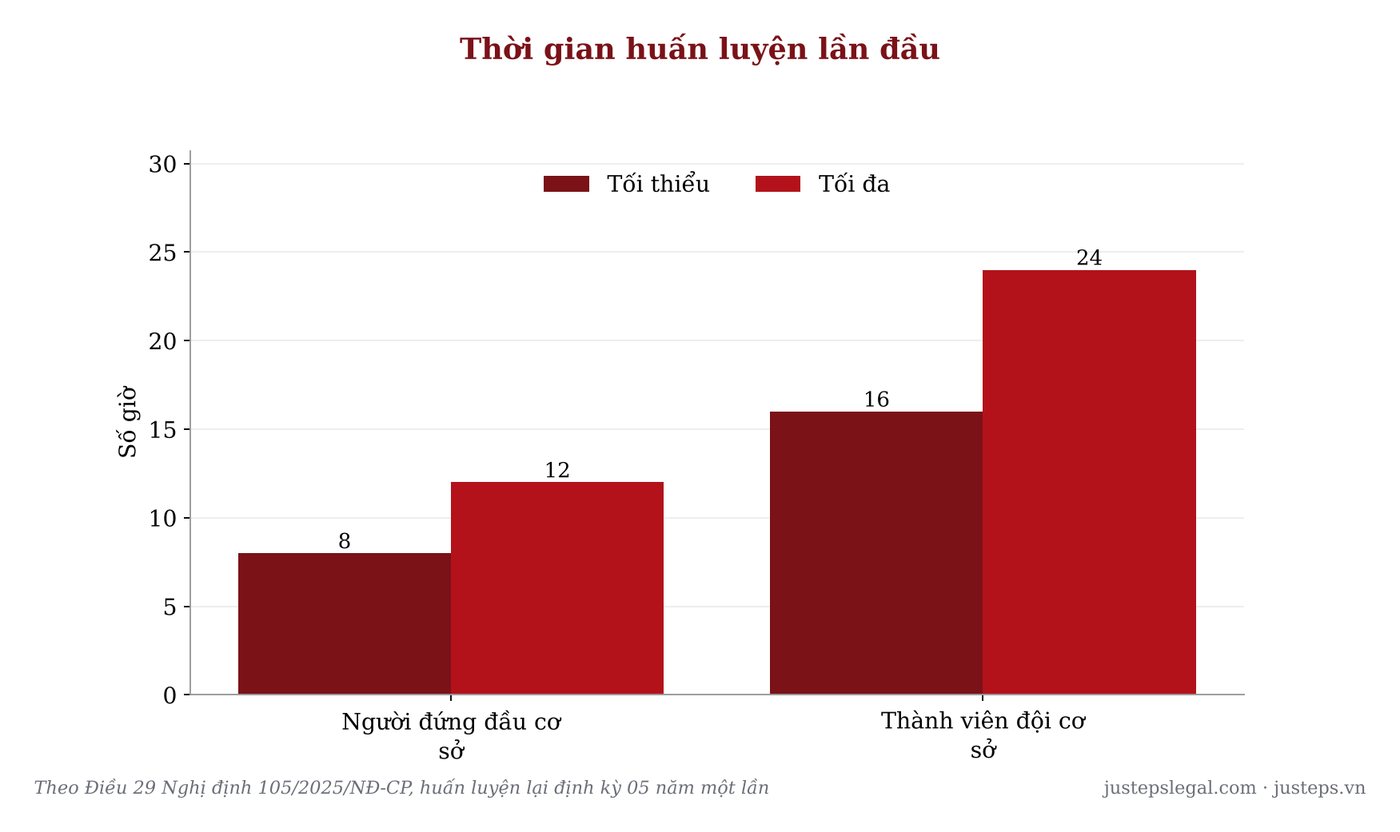
Initial training time by participant group
As the chart shows, on-site team members need twice as much training as the head of the premises, with a minimum of 16 hours against 08 hours and a maximum of 24 hours against 12 hours, because they directly operate equipment and lead the initial fire response. Businesses should plan training for new staff added to the team during the year, track the end of each person's 05-year cycle and combine the annual refresher content with the plan drill to save time. Certificates of training results should be kept in both the premises file and each person's personnel file.
The fire fighting plan and plan drills
The head of the premises organises the preparation and approval of the premises' fire fighting, rescue and relief plan using the prescribed form; for premises with fire and explosion hazards, the plan is prepared and approved by the police in accordance with their delegated authority[10]. The plan covers information on the premises, the nature of fire and explosion hazards, the site plan and escape routes, assumed fire scenarios and how on-site forces should respond. A plan is only useful if it reflects reality, so each time the premises change the warehouse layout, add a mezzanine, change the type of goods stored or alter walkways, the business needs to update the diagrams and scenarios in the plan.
The plan must be drilled periodically at least once a year and may be drilled unannounced at the request of the competent authority[11]. A drill should simulate a realistic scenario for the premises, for example a fire at the forklift charging area during the evening shift when only half of the team is present, rather than merely demonstrating the use of an extinguisher in the yard. The drill results, shortcomings and corrective measures should be minuted, included in the periodic report and used to revise the plan. Businesses leasing space in a building should coordinate with the building management so that their drill fits the building's overall plan, especially escape routes and assembly points.
Self-inspection, periodic reporting and inspection by the authorities
Premises must carry out regular self-inspections at a frequency decided by the head of the premises, but at least once a month[12]. In addition, premises conduct periodic self-inspections every 06 months for premises under Annex II and once a year for other premises under Annex I, and then send a report on the results using the prescribed form or update the data on the system before 15 June and before 15 December each year[12]. The self-inspection record should state the items checked, the shortcomings found, the person responsible for correcting them and the deadline, so that the next inspection has a basis for comparison.
The flowchart below describes the steps of a single self-inspection at the premises, including a decision point on whether the shortcomings can be corrected immediately.
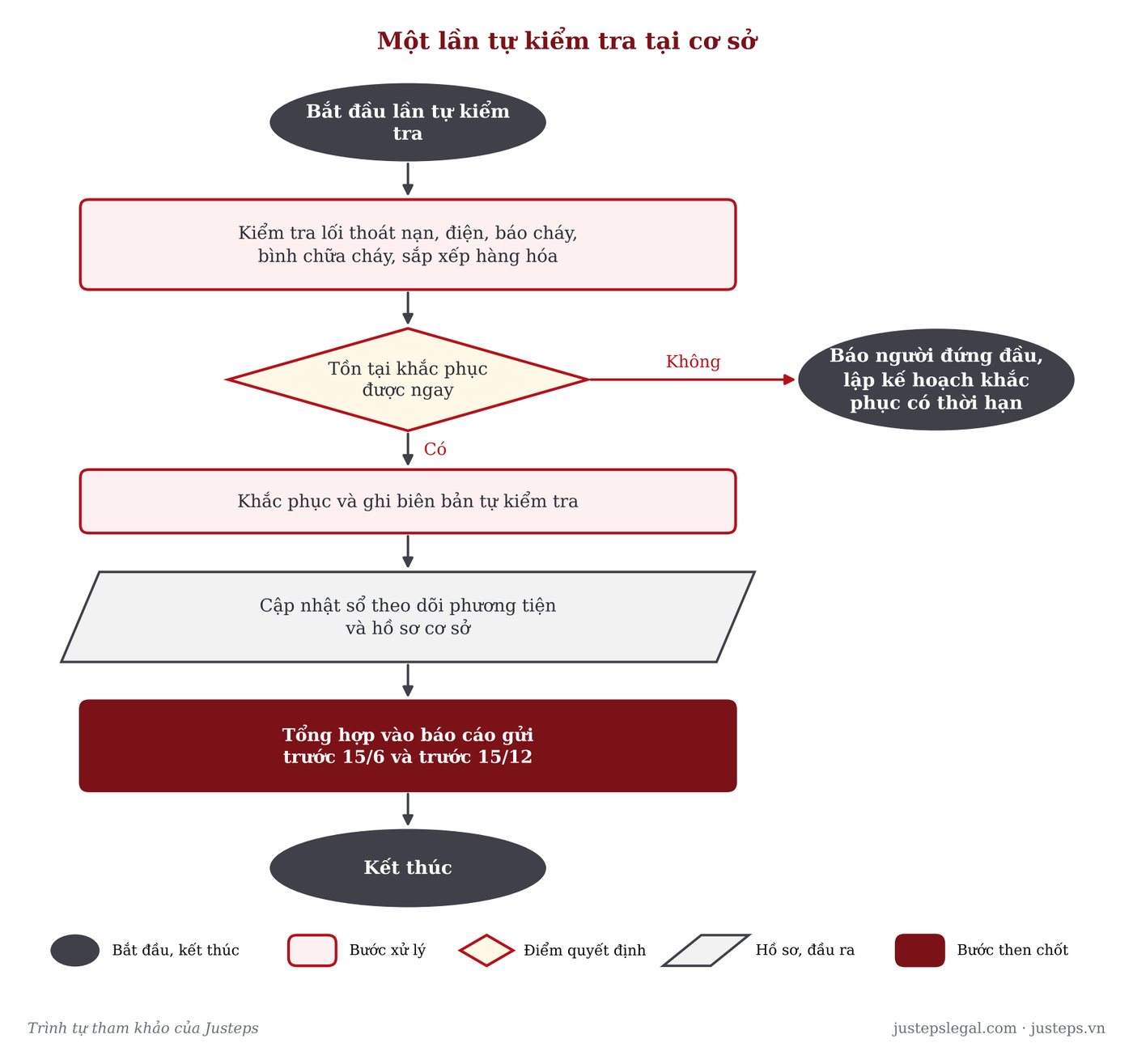
Steps of a single fire safety self-inspection at the premises
Following the flowchart, the assigned person checks against an agreed list covering escape routes, the electrical system, fire alarms, extinguishers, the arrangement of goods and compliance with internal rules. If a shortcoming cannot be corrected immediately, for example the fire alarm system needs replacing or the warehouse needs large-scale rearrangement, the inspector reports to the head of the premises to draw up a time-bound corrective plan with a budget, and the inspection ends there. If it can be corrected immediately, the inspector deals with it, completes the record, updates the equipment register and includes the results in the periodic report before the 15 June and 15 December deadlines.
As regards inspections by the authorities, the police, the specialised construction agency and the commune-level People's Committee, according to their delegated authority, draw up the periodic inspection plan for the following year before 15 December each year, notify the premises in writing 03 working days in advance of the time, content and composition of the team, and record the results in the prescribed form[4]. Three working days is far too short to supplement records, so the records must always be ready rather than prepared only when notice arrives. The representative of the premises should read the record carefully before signing, note any disagreement and file the record together with the corrective plan. Fire safety violations may be subject to administrative penalties under the specialised penalty decree[13], and recommendations not yet implemented will be checked again at the next inspection.
Compulsory fire and explosion insurance and changes when renovating premises
Premises listed in Annex VII of Decree 105/2025/ND-CP must purchase compulsory fire and explosion insurance[3], and the conditions, premiums and minimum sums insured are set out in the decree on compulsory insurance in insurance business, which has been amended to align with the new law[14]. Under the amendments effective from 15 September 2026, insurers may refuse to sell compulsory fire and explosion insurance to premises that require fire safety design appraisal but have no appraisal document[4]. The legal records on the design and acceptance of the building therefore directly affect the ability to purchase insurance, in addition to their role as documents to be produced during inspections.
The administration department should track the expiry date of each compulsory fire and explosion insurance contract for each location, renew it before expiry and file the insurance certificate. When making declarations to the insurer, information on area, type of goods and asset value must reflect reality, because incorrect declarations may affect compensation in the event of a loss. Recommendations of the inspection team that have not been implemented should also be fully resolved and the corrective records kept, because when a loss occurs the insurer usually considers whether the premises complied with safety requirements.
When the business renovates or changes the use of part of the premises, such as converting office space into storage, adding a mezzanine or installing a new production line, the works may require fire safety design appraisal before construction. A business leasing premises should agree in advance with the landlord on who carries out the procedure, who bears the cost and who keeps the records, and set this out in the lease. After the renovation, the premises records, fire fighting plan, internal rules and insurance declarations must all be updated accordingly.
Annual task calendar and allocation of roles within the business
The obligations described above are only carried out consistently when the business places them in a fixed calendar and assigns specific persons to be responsible. The timeline below suggests how to arrange the main tasks over a year for premises under Annex I without fire and explosion hazards.
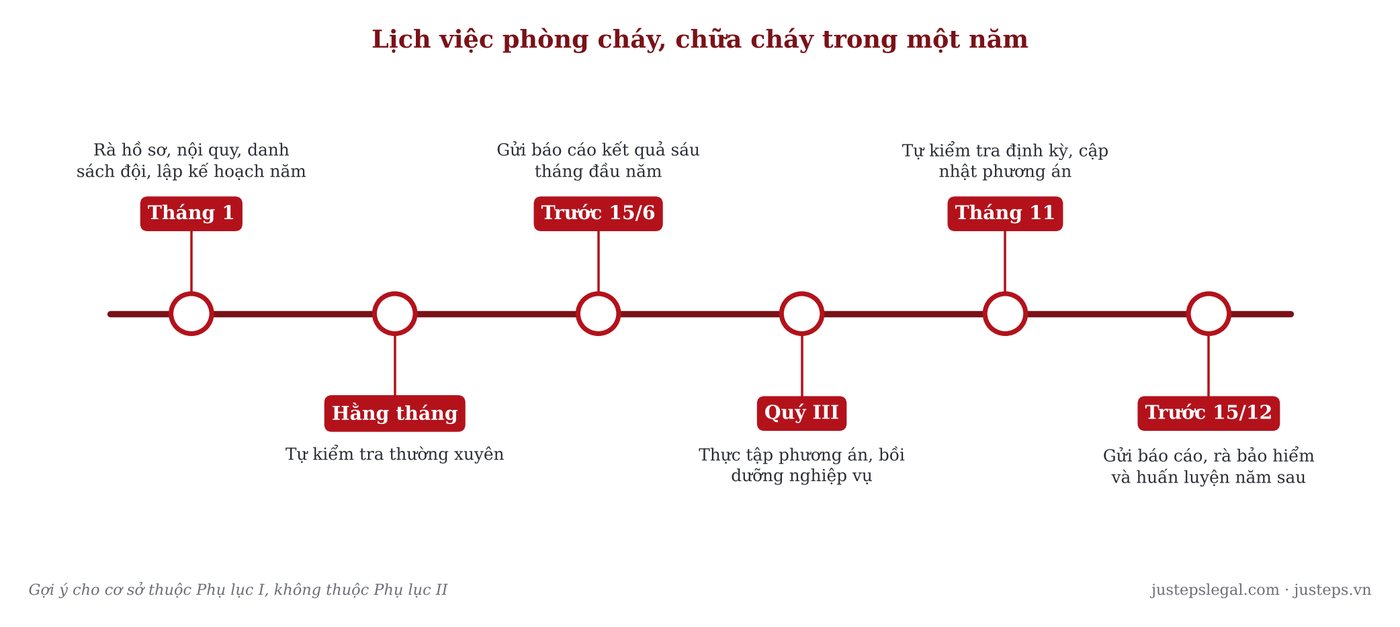
Annual fire safety task calendar
Under this calendar, at the start of the year the business reviews the records, internal rules and team list and draws up the annual plan; each month it carries out regular self-inspections; and before 15 June it submits the report for the first six months. The third quarter is a suitable time to drill the plan combined with refresher training, before the year-end peak season for goods; in November the business conducts the periodic self-inspection and updates the plan, and before 15 December it submits the report while reviewing the insurance renewal date and training needs for the following year. Premises under Annex II need to add a further periodic self-inspection in the middle of the year.
As for roles, the head of the premises bears overall responsibility, approves the internal rules and plan and allocates the budget; the administration or safety department is the focal point for keeping records, tracking the calendar and preparing reports; warehouse heads, workshop supervisors and store managers carry out self-inspections in the areas they manage; and the on-site team takes part in training, drills and initial incident response. Businesses with many locations should include fire safety obligations in their overall compliance calendar alongside tax, labour and licensing obligations, and may refer to Justeps' periodic legal review service for regular reviews. Building and office park managers needing coordination procedures with tenants may refer to the internal process and regulation development for building and urban area management businesses service.
How Justeps can help
Justeps helps businesses organise fire safety records and annual tasks within their overall compliance system through the following services:
- Periodic legal review. Justeps checks each location against the management lists, reviews fire safety records and insurance and prepares an annual obligation calendar.
- Internal process and regulation development for building and urban area management businesses. Justeps drafts fire safety coordination procedures between building management and tenants, covering plan drills, self-inspection and handover of records.
- Internal process and regulation development for logistics, warehousing and freight transport businesses. Justeps develops warehouse rules, goods arrangement rules, charging area rules and self-inspection lists suited to warehouse operations.
- Legal risk identification and prevention. Justeps assesses risks when leased premises are renovated or their use changed and proposes clauses allocating responsibilities in the lease.
- In-house training on request. Justeps runs training sessions for premises managers on records, the task calendar and legal responsibilities relating to fire safety.
Frequently asked questions
Does a small office of about 15 people need fire safety records?
The business needs to check the location against Annex I of Decree 105/2025/ND-CP. If it is not on the list, the office must still ensure fire safety; if it is on the list but has fewer than 20 people, a team is not required but a person in charge must be assigned in writing[7].
How often must the fire fighting plan be drilled?
The plan must be drilled periodically at least once a year and may be drilled unannounced at the request of the competent authority[11]. Drill results should be recorded and used to update the plan.
Who approves the premises' fire fighting plan?
The head of the premises organises the preparation and approval of the plan; for premises with fire and explosion hazards, the police prepare and approve it according to their delegated authority[10].
When must fire safety performance reports be submitted?
After the periodic self-inspections, premises send the report using the prescribed form or update the data on the system before 15 June and before 15 December each year[12].
How much training do on-site team members need?
Initial training lasts 16 to 24 hours, is repeated every 05 years and is supplemented by annual refresher courses[9]. Businesses should track each member's cycle because team membership changes frequently.
Who is responsible for the records when the business leases its premises?
The head of the premises is responsible for preparing and updating the premises' records[5]. For common areas of the building and procedures for renovation, the parties should allocate responsibilities clearly in the lease.
Does failing to implement the inspection team's recommendations affect insurance?
Unimplemented recommendations may be taken into account when claims are settled, so businesses should resolve them fully and keep corrective records. Insurers may also refuse to sell insurance to premises that require design appraisal but have no appraisal document[4].
Related articles
- Building an occupational safety and health system for a factory, from the responsible unit to training and monitoring
- Preparing food safety documents for a restaurant before opening day on a twelve-week roadmap
- Building a tracking calendar for sub-licences for businesses with many branches
- A minimum set of internal governance regulations for businesses with 50 to 200 employees
Notes
[1] The Law on Fire Prevention, Fighting and Rescue No. 55/2024/QH15, effective from 1 July 2025, as amended and supplemented by the law passed by the National Assembly on 20 November 2026.
[2] Government Decree No. 105/2025/ND-CP dated 15 May 2025 detailing a number of articles of and measures to implement the Law on Fire Prevention, Fighting and Rescue, effective from 1 July 2025 (Article 45).
[3] Clause 1, Article 35 and Article 2 of Government Decree No. 105/2025/ND-CP dated 15 May 2025 detailing a number of articles of and measures to implement the Law on Fire Prevention, Fighting and Rescue (Annexes I, II and VII).
[4] Government Decree No. 347/2026/ND-CP dated 8 September 2026, effective from 15 September 2026, amending and supplementing Clause 3, Article 14 of Decree No. 105/2025/ND-CP and a number of related decrees, including provisions on compulsory fire and explosion insurance.
[5] Article 4 of Government Decree No. 105/2025/ND-CP dated 15 May 2025 detailing a number of articles of and measures to implement the Law on Fire Prevention, Fighting and Rescue.
[6] Clauses 1 and 3, Article 3 of Government Decree No. 105/2025/ND-CP dated 15 May 2025 detailing a number of articles of and measures to implement the Law on Fire Prevention, Fighting and Rescue.
[7] Clause 2, Article 20 of Government Decree No. 105/2025/ND-CP dated 15 May 2025 detailing a number of articles of and measures to implement the Law on Fire Prevention, Fighting and Rescue.
[8] Points c and d, Clause 5, Article 28 of Government Decree No. 105/2025/ND-CP dated 15 May 2025 detailing a number of articles of and measures to implement the Law on Fire Prevention, Fighting and Rescue.
[9] Article 29 of Government Decree No. 105/2025/ND-CP dated 15 May 2025 detailing a number of articles of and measures to implement the Law on Fire Prevention, Fighting and Rescue (Clauses 1 and 2 on initial training time; Clause 4 on the periodic cycle).
[10] Clauses 1 and 3, Article 15 of Government Decree No. 105/2025/ND-CP dated 15 May 2025 detailing a number of articles of and measures to implement the Law on Fire Prevention, Fighting and Rescue.
[11] Point a, Clause 1, Article 16 of Government Decree No. 105/2025/ND-CP dated 15 May 2025 detailing a number of articles of and measures to implement the Law on Fire Prevention, Fighting and Rescue.
[12] Clauses 1 and 2, Article 14 of Government Decree No. 105/2025/ND-CP dated 15 May 2025 detailing a number of articles of and measures to implement the Law on Fire Prevention, Fighting and Rescue.
[13] Government Decree No. 106/2025/ND-CP on administrative penalties for violations relating to fire prevention, fighting and rescue, as amended and supplemented by Decree No. 347/2026/ND-CP.
[14] Government Decree No. 67/2023/ND-CP on compulsory civil liability insurance of motor vehicle owners, compulsory fire and explosion insurance and compulsory insurance in construction investment, as amended and supplemented by Clause 1, Article 44 of Government Decree No. 105/2025/ND-CP dated 15 May 2025 detailing a number of articles of and measures to implement the Law on Fire Prevention, Fighting and Rescue and Decree No. 347/2026/ND-CP.
This article is for reference and reflects the regulations in force at the time of publication. Please consult Justeps for advice tailored to your company’s records and situation.
For further information, please contact:
📩 Email: info@justeps.vn
🌐 Website: https://justepslegal.com · https://justeps.vn
🌐 Page: Justeps
☎️ Hotline (Zalo): 096 172 2607
📍 Thanh Xuan Office: 12th Floor, Licogi 13 Tower, 164 Khuat Duy Tien Street, Thanh Xuan Ward, Hanoi, Vietnam
📍 Ha Dong Office: LK06B, No.10, Dong Dua Area, Ha Dong Ward, Hanoi, Vietnam
📍 Ho Chi Minh City Branch: 528 Le Van Sy, Ho Chi Minh City, Vietnam
📍 Hai Phong Office: Truong Thinh Village, Ha Dong Commune, Hai Phong, Vietnam
📍 Quang Ninh Office: Van Don Special Zone, Quang Ninh Province, Vietnam





