
Key takeaways
- A company should open its first position once a recurring task has been done by the founder long enough to be described and is taking time away from customers or the product.
- A sensible hiring order is usually a revenue-generating role first, then delivery or operations, and internal administration last, while accounting and legal work are best outsourced in the first year.
- A person who works for a wage under the company’s management is an employee even if the contract is called a collaborator or piecework agreement, so the company must sign an employment contract and pay insurance as required by law.
- Probation may be agreed only once for a given job, must not exceed the statutory limit, and probationary pay must be at least 85% of the wage for that job.
- The first employee’s file becomes the template for later hires, so the job description, contract template, labour management register and insurance file should be prepared properly from the outset.
In the first months after receiving its enterprise registration certificate, most of the work in a new company is done by the founder. The founder looks for customers, delivers goods, receives invoices and answers the tax authority, so the decision to hire the first employee usually comes at a time of overload and is made in haste. A common result is that the company hires one person to do everything without clear objectives, signs a collaborator agreement instead of an employment contract, and a few months later has to deal with productivity, wages and social insurance all at once.
This article analyses how a new company should hire its first employees in the order in which the work is done, covering when to hire, the order of positions, how to assign work before departments exist, the legal requirements on recruitment, contracts, probation, wages and social insurance, as well as common mistakes and the minimum set of records. It applies to limited liability companies and joint stock companies in their first year of operation that employ Vietnamese workers. Where a company recruits foreign nationals, it must also meet the conditions on work permits, which fall outside the scope of this article.
When to open the first position
As a rule, a company should hire once it has identified a group of recurring tasks that can be described as specific duties and handed to someone else after a short period of guidance. A simple test is for the founder to record the time spent on each type of work for two to four weeks. If tasks that another person could perform after one day of guidance take up about 15 hours a week or more, the company has grounds to open its first position, because that time should be spent on customers, the product or fundraising.
Besides the workload, the company needs to consider whether it can afford the position for at least six months. The cost of an employee does not stop at the agreed wage; it also includes the employer’s share of social insurance, health insurance, unemployment insurance and trade union fees, the cost of work equipment and the time the founder spends on guidance. Where cash flow is not yet stable, the company may start with a fixed-term employment contract or part-time work, but it must still comply fully with the rules on contracts and insurance as it would for a full-time employee.
The chart below illustrates the total monthly cost to the company compared with the agreed wage, assuming that the entire wage is used as the basis for insurance contributions.
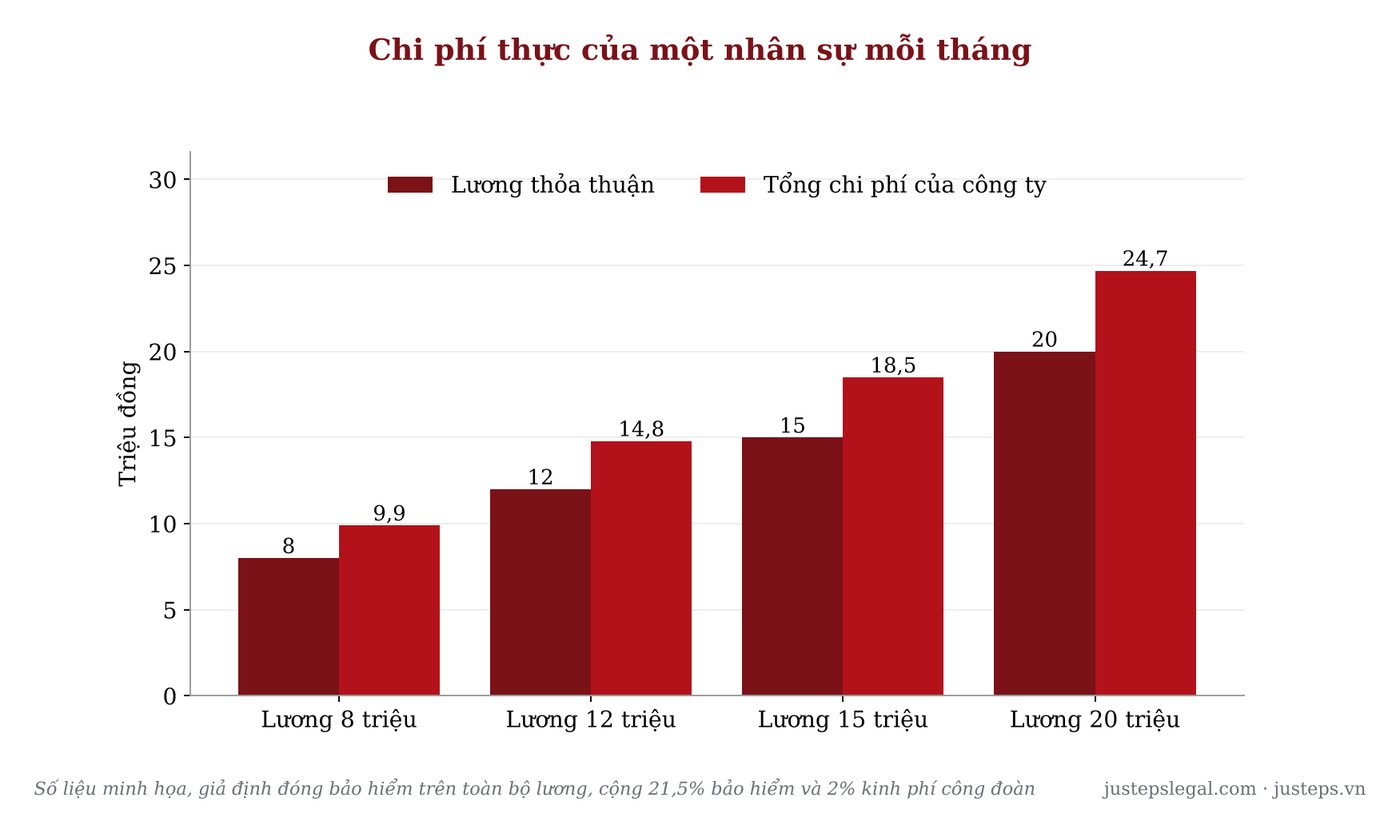
Total monthly cost to the company compared with the agreed wage at four wage levels
At each wage level, the company must pay about 23.5% more than the figure stated in the contract, comprising about 21.5% for social insurance, health insurance and unemployment insurance and 2% for trade union fees. For a wage of VND 12 million, the actual total cost to the company is about VND 14.8 million a month, before equipment and guidance costs. The employee’s share, about 10.5% of the wage, is deducted from pay and is not an additional cost to the company. The hiring budget should therefore be built on this total cost rather than on the agreed wage, so that the company does not run out of money after a few months.
The order of positions before departments exist
For most trading and service businesses, the position to fill first is someone who directly generates revenue, such as a sales or customer service employee. The reason is that founders are often strong on the product but lack the time to follow up consistently with each customer, while revenue is the condition for sustaining every other position. Next comes the person who delivers goods, performs the service or runs operations, once the number of orders grows to the point where the founder can no longer keep up. An administrative and HR position is usually needed only when the company has about five to seven people, when timekeeping, payroll and record-keeping arise on a regular basis.
This order may vary by sector. In a manufacturing business, technical workers or the person in charge of production may need to be hired before sales staff, because the product must exist before it can be sold. In a technology business, the first position is usually a product development engineer, while the founder handles sales in the early stage. The matrix below suggests the priority of each group of positions in three common types of business.
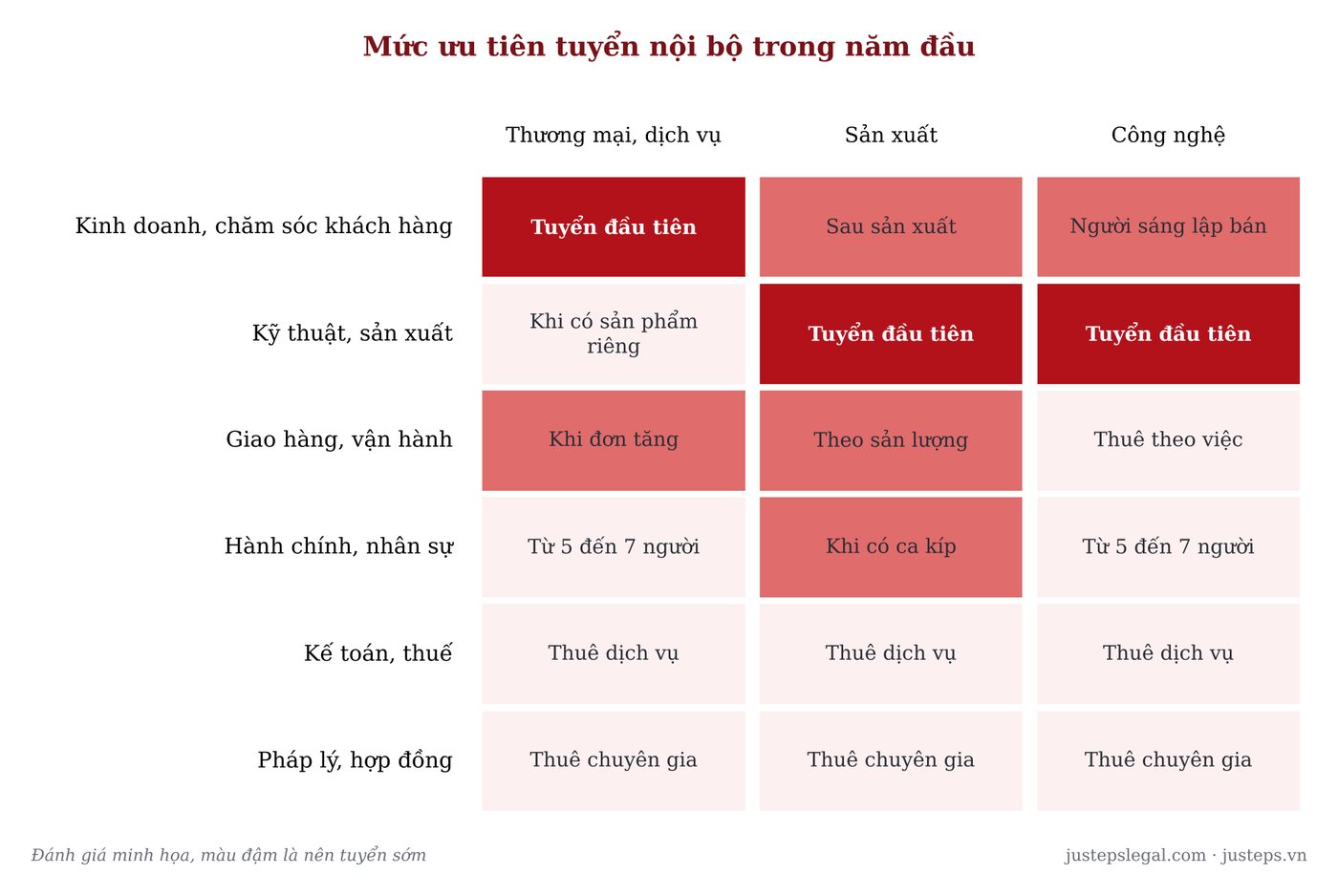
Hiring priority for each group of positions by type of business
In all three types, tax accounting and contract legal work have a low priority for in-house hiring, because a new company has few transactions and can engage outside services at a lower cost. The Law on Accounting allows enterprises to engage accounting services or chief accountant services[1], but the company still needs someone in-house to keep the original documents and send materials to the service provider on time. The clearest difference between the types lies in technical and production positions, which have a high priority in manufacturing and technology businesses but a lower one in trading businesses. Founders should use this matrix as a starting point and then adjust it to their own strengths, because the position to fill first is the one that compensates for what the founder does least effectively.
From the matrix above, the company can draw up a hiring roadmap for its whole first year so that it can plan the budget and the time needed to find people. The following table summarises a typical roadmap for a small trading or service company:
| Stage | Priority position | Suggested arrangement |
|---|---|---|
| Months 1 to 3 | Sales or customer service employee. | Full-time employment contract with clear sales and collection targets. |
| Months 1 to 3 | Accounting and tax filing. | Engage an accounting service and assign one in-house person to keep the original documents. |
| Months 3 to 6 | Delivery, technical or service staff. | Hire according to volume, possibly on fixed-term contracts. |
| Months 6 to 12 | Administration and HR. | Hire when timekeeping, payroll and record-keeping arise regularly. |
Assigning work to new staff with a job description and 90-day objectives
A one-page job description
In a company without departments, new staff are often given work verbally and take on extra tasks as needs arise from day to day. This leaves employees unsure of the results on which they will be assessed, and leaves the company without a basis when it has to conclude on the outcome of probation. A one-page job description should state the purpose of the position, three to five main duties, a measurable result for each duty, the person to whom the position reports and the scope for independent decisions, for example the maximum discount that may be offered to customers.
The job description is also the basis for describing the work in the employment contract, because the work to be performed is one of the main contents of the contract[2]. If the contract states only something general such as office employee, the company will have difficulty assessing the degree of job completion or resolving a dispute about additional duties. The company should review the job description every quarter during the first year, because the duties of the first employees change quickly as the company grows. Companies wishing to standardise this content may consider Justeps’ organisational structure, functions, duties and job description service.
Objectives at 30, 60 and 90 days
In addition to the job description, the company should agree with the new employee on objectives at three milestones of 30, 60 and 90 days. In the first 30 days, the new employee should learn the product, the main customers and the company’s working procedures. By day 60, the new employee should handle most of the main work independently without daily monitoring by the founder. By day 90, the new employee should be responsible for the results of the position and propose at least one improvement to the current way of working.
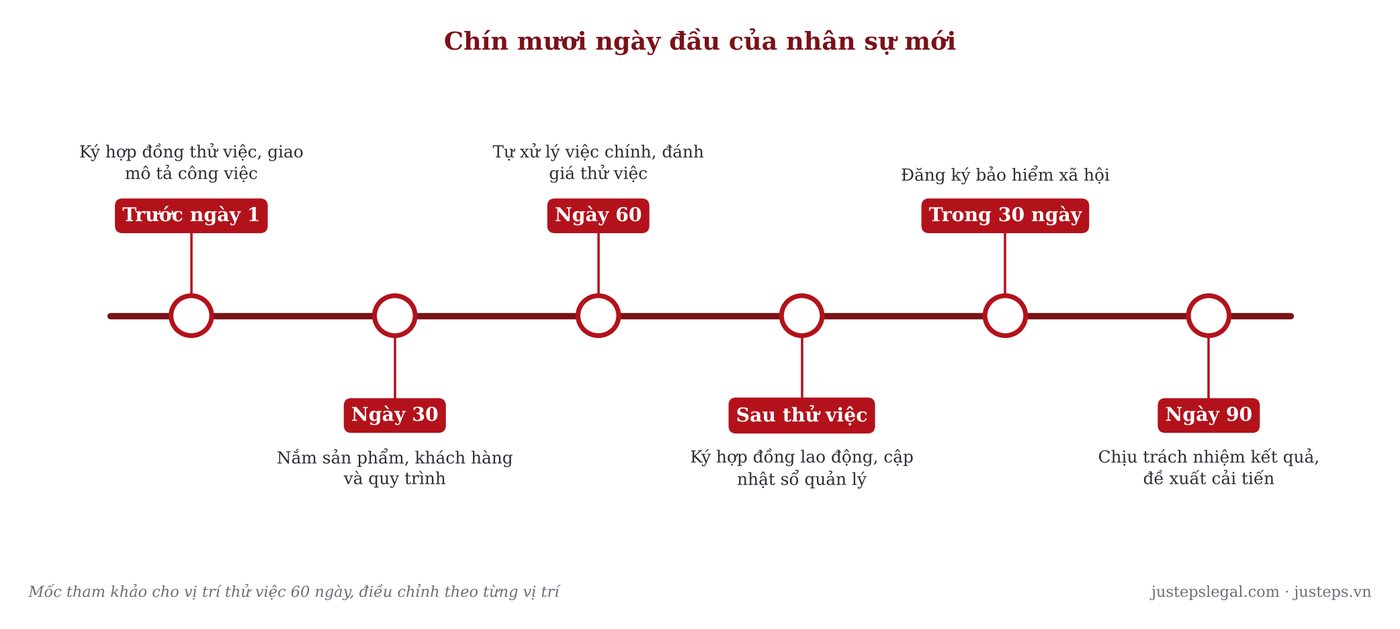
Milestones for assigning work, assessment and legal formalities in a new employee’s first 90 days
These milestones are directly linked to legal formalities. The probation contract, or an employment contract containing a probation clause, must be signed before the first working day, and the result of probation must be notified when the probation period ends. If the company uses a 60-day probation period for a position requiring a college degree or higher, the day-60 assessment is also when the company decides whether to sign an employment contract or end the probation. Immediately after signing an employment contract of one month or more, the company registers the employee for social insurance and updates the labour management register.
Legal requirements for recruitment and entering into contracts
Recruitment and candidate information
An employer may recruit directly or through an employment service organisation, and employees do not have to pay recruitment costs[3]. Job advertisements and interviews must not discriminate on grounds of gender, age, marital status, disability or other grounds prohibited by law[4]. The company also may not keep the originals of employees’ identity papers, diplomas or certificates, and may not require employees to pay a deposit in cash or property to secure performance of the contract[5]. These are requirements that inexperienced founders often breach, believing that holding original diplomas will help retain employees.
Candidate information is personal data and must be processed in accordance with the Law on Personal Data Protection. Accordingly, the company may ask candidates only for information that directly serves the purpose of recruitment, and where a candidate is not hired, the information collected must be deleted or destroyed unless otherwise agreed with the candidate[6]. In small companies, candidate files are often scattered across the founder’s inbox and chat groups. A safer approach is to use a single recruitment folder with access controls, record the date each application was received and schedule the deletion of unsuccessful applications after the recruitment round ends.
Employment contracts and the risk of collaborator agreements
Before taking an employee on, the company must enter into an employment contract with that person[7]. An employment contract must be made in writing, except for contracts with a term of less than one month as provided by law, and may be concluded electronically in the form of a data message[8]. There are only two types of contract, namely an indefinite-term contract and a fixed-term contract of no more than 36 months[9]. For the first employees, many companies choose a 12-month fixed-term contract to allow time for assessment, which is a lawful choice if clearly stated in the contract.
The most common risk is that the company signs a collaborator agreement or service contract with a person who works full time, takes instructions, has fixed working hours and receives a monthly payment. The Labour Code provides that where the parties use a different name but the content shows paid work, wages and the management, direction and supervision of one party, the agreement is still deemed an employment contract[10]. In that case, the company may be required to pay social insurance arrears for the entire period of work, together with late-payment interest and an administrative penalty. A collaborator agreement is appropriate only for a person who performs independent work, decides how and when to do it and is paid by results.
Failing to enter into a written employment contract where the law requires one may attract an administrative penalty under Decree No. 283/2026/ND-CP, with fines rising according to the number of employees affected and fines for organisations set at twice those for individuals[11]. The fine is usually small compared with the cost of insurance arrears, but the violation will be on record the next time the labour authority carries out an inspection. The company should therefore prepare a standard contract template from the first employee and reuse it for later hires.
Probation, wages and social insurance
Probation period and probationary pay
The company and the employee may agree on probation within the employment contract or enter into a separate probation contract, but probation may not be applied to an employment contract with a term of less than one month[12]. The probation period is agreed by the parties, probation may take place only once for a given job, and it may not exceed 180 days for the work of an enterprise manager, 60 days for work requiring a college degree or higher, 30 days for work requiring intermediate vocational qualifications or for technical workers and professional staff, and 6 working days for other work. Probationary pay is agreed by the parties but must be at least 85% of the wage for that job[13].
At the end of the probation period, the company must notify the employee of the result. If probation is satisfactory and the parties signed a separate probation contract, the company must enter into an employment contract, whereas if probation is part of the employment contract, the contract simply continues[14]. During probation, either party may cancel the probation agreement without prior notice and without compensation. A common mistake is for the company to impose a second probation for the same job because it is still unsure of the employee’s ability, or to let the employee keep working after probation ends without signing a contract.
Minimum wages and wage rules
The wage paid to an employee who works full normal hours must not be lower than the regional minimum wage where the company operates. The monthly minimum wage in Region I is currently VND 5,310,000 and rises to VND 5,700,000 from 1 January 2027, alongside VND 5,080,000 in Region II, VND 4,450,000 in Region III and VND 4,040,000 in Region IV[15]. A company hiring at the end of 2026 should set the wage in the contract with the new rates already taken into account, so that it does not have to sign an adjustment annex shortly afterwards. Besides the wage, the contract should clearly state allowances, other supplements and the method and timing of payment, as these are all main contents of an employment contract[2].
Labour use declaration and social insurance
A person working under an employment contract of one month or more is subject to compulsory social insurance[16]. The company must register the employee for social insurance within 30 days of signing the contract, and must also keep a labour management register and declare its use of labour to the labour authority within 30 days of commencing operations[17]. For a person on probation under a separate probation contract, the obligation to pay compulsory social insurance usually does not yet arise, but it arises as soon as the parties sign an employment contract. If the founder holds the position of director and receives a salary, the company must also register the founder for social insurance as an enterprise manager receiving a salary.
In addition to insurance, the company must withhold personal income tax from wages under the 2025 Law on Personal Income Tax and its implementing regulations, even where the employee does not yet earn enough to pay tax. The company should register a personal tax code for employees who do not have one and keep the declaration or documents on dependants if the employee registers for family deductions. These formalities may be delegated to an accounting service provider, but the person in charge of personnel records in the company must check the list of employees each month before the provider prepares the returns.
Common mistakes and how to avoid them
From its experience supporting new companies, Justeps has found that mistakes when hiring the first employees tend to recur in a few forms. Most do not stem from an intention to avoid obligations, but from founders not having time to study the rules and reusing another company’s templates. Common mistakes include:
- The company uses a collaborator agreement or service contract for a person who works full time under the company’s management and direction.
- The company keeps an employee on probation beyond the statutory limit or imposes several probation periods for the same job.
- The company forgets to register social insurance in the first month after signing the employment contract, and later has to pay arrears with late-payment charges.
- The company keeps original diplomas or requires employees to pay a deposit to ensure they do not resign.
- The company assigns one person to purchase goods, hold cash and keep the books at the same time, leaving no mechanism for cross-checking.
The most effective way to avoid these mistakes is to keep a short checklist for each hire, covering the steps from advertising the position to registering insurance, and to make one person responsible for ticking off each step. The flowchart below shows the sequence for filling a position, from identifying the need to signing a formal employment contract.
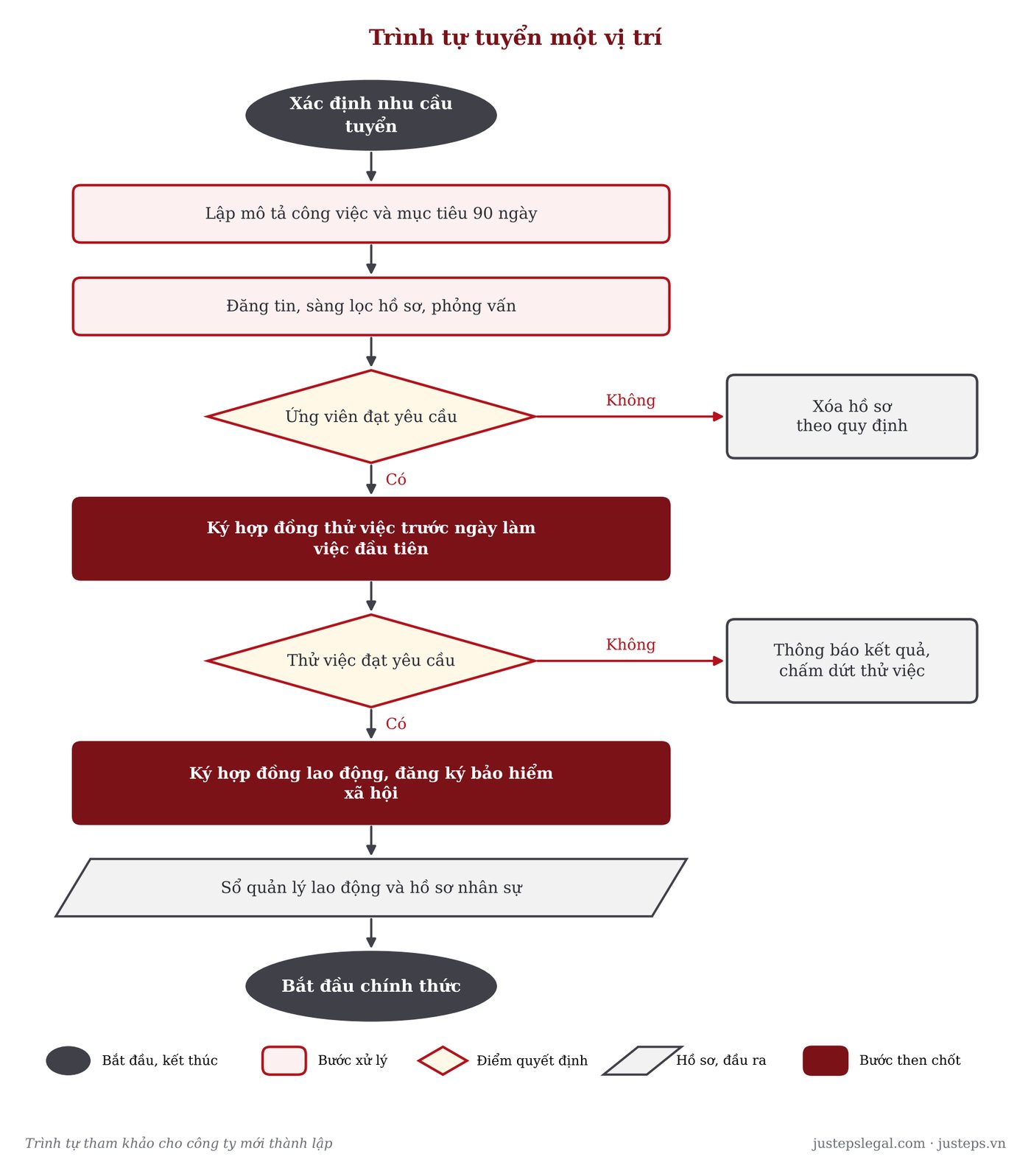
Sequence for filling a position from identifying the need to signing an employment contract
The sequence begins when the founder identifies the need and prepares a job description, then advertises the position and screens applications against the stated criteria. The first decision point is whether the candidate meets the requirements after interview; if not, the file is deleted in accordance with the rules on personal data. The key step is signing the probation contract or employment contract before the first working day. The second decision point comes at the end of probation, when the company notifies the result and, if successful, signs the employment contract, registers insurance and updates the labour management register.
The minimum set of records for the first employee
The first employee’s records will become the template for later hires, so the company should invest in preparing them properly from the outset rather than filling gaps when an inspection comes. The following table lists the minimum records and when each should be completed:
| Record | Main content | When to complete |
|---|---|---|
| Job description | Purpose of the position, main duties, measurable results and 30, 60 and 90-day objectives. | Before advertising the position. |
| Probation contract | Work, probation period, probationary pay and assessment criteria. | Before the first working day. |
| Employment contract | All main contents required by law, with a confidentiality agreement where needed. | As soon as probation ends satisfactorily. |
| Labour management register | Employee details, contract, wage, insurance and any changes. | Within 30 days of commencing operations. |
| Insurance file | Registration form and the payroll used as the contribution basis. | Within 30 days of signing the employment contract. |
| Internal rules | Working hours, leave, confidentiality and basic discipline. | Before the first working day, upgraded to internal labour rules at 10 employees. |
The short internal rules in the last row cannot replace internal labour rules. Once a company employs 10 or more workers, its internal labour rules must be made in writing and registered with the provincial labour authority[18]. The Law amending and supplementing the Labour Code, passed by the National Assembly on 21 November 2026 and effective from 1 March 2027, adds 27 July and 24 November as fully paid days off[19], so leave rules drafted during this period should anticipate that change. Companies may delegate the entire drafting of templates and review of records to Justeps through its labour records and employment contracts service.
How Justeps can help
Justeps helps new companies hire their first employees in the right order, with clear responsibilities and complete legal records, through the following services:
- Organisational structure design for start-ups and innovative businesses. Justeps identifies the functions needed, the order in which to open positions and how roles can be combined in a new company.
- Organisational structure, functions, duties and job descriptions. Justeps drafts one-page job descriptions and 30, 60 and 90-day objectives for each of the first positions.
- Labour records and employment contracts. Justeps drafts probation contract, employment contract and confidentiality agreement templates and the labour management register.
- Labour, payroll and insurance services for start-ups and innovative businesses. Justeps guides the company through labour use declarations, social insurance registration and wage rules.
- Internal labour rules and disciplinary procedures. Justeps drafts internal labour rules and prepares the registration file once the company employs 10 or more workers.
Frequently asked questions
Must a new company hire an accountant straight away?
Enterprises must organise their accounting, but they may engage an accounting service instead of hiring staff[1]. Small companies usually outsource in the first year and assign one in-house person to keep original documents and track receipts and payments.
Must social insurance be paid for an employee on probation?
If probation is under a separate probation contract, the obligation to pay compulsory social insurance usually does not yet arise. Once the parties sign an employment contract of one month or more, the company must register the employee for social insurance[16].
Can a collaborator agreement be used for the first employee?
If that person works for a wage under the management, direction and supervision of the company, the relationship is an employment relationship even if the contract has a different name[10]. A collaborator agreement is suitable only for independent work paid by results.
How long may probation last for a new sales employee with a university degree?
For work requiring a college degree or higher, probation may not exceed 60 days and may take place only once for that job[12]. Probationary pay must be at least 85% of the wage for the job[13].
May the company keep an employee’s original diploma?
No. An employer may not keep the originals of employees’ identity papers, diplomas or certificates and may not require a deposit to secure performance of the contract[5]. The company should accept only copies and compare them with the originals when necessary.
What should be done with the files of unsuccessful candidates?
The company must delete or destroy the personal information collected from candidates who are not hired, unless otherwise agreed with the candidate[6]. If it wishes to keep a file for a future round, the company should obtain the candidate’s consent in writing or by email.
At what headcount must a new company have internal labour rules?
Internal labour rules must be made in writing and registered once the company employs 10 or more workers[18]. Before that point, the company should still have short rules on working hours, leave and confidentiality so that they are applied consistently.
Related articles
- Setting up the organisation of a newly incorporated company with fewer than 10 staff so that roles, authority and cash flow are under control
- What to do in the first 90 days after setting up a business so that no obligation or deadline is missed
- Estimating a new company’s operating costs in its first year and how to build a realistic budget
- A monthly labour and payroll compliance checklist for HR departments
Notes
[1] Law on Accounting No. 88/2015/QH13 dated 20 November 2015 and Government Decree No. 174/2016/ND-CP dated 30 December 2016 detailing certain articles of the Law on Accounting.
[2] Clause 1 of Article 21 of the Labour Code No. 45/2019/QH14 dated 20 November 2019.
[3] Article 11 of the Labour Code No. 45/2019/QH14.
[4] Clause 1 of Article 8 of the Labour Code No. 45/2019/QH14; Law on Employment No. 74/2025/QH15.
[5] Article 17 of the Labour Code No. 45/2019/QH14.
[6] Article 25 of the Law on Personal Data Protection No. 91/2025/QH15, effective from 1 January 2026.
[7] Clause 2 of Article 13 of the Labour Code No. 45/2019/QH14.
[8] Article 14 of the Labour Code No. 45/2019/QH14; Decree No. 337/2025/ND-CP on electronic employment contracts.
[9] Clause 1 of Article 20 of the Labour Code No. 45/2019/QH14.
[10] Clause 1 of Article 13 of the Labour Code No. 45/2019/QH14.
[11] Government Decree No. 283/2026/ND-CP on administrative penalties in the fields of labour and social insurance.
[12] Articles 24 and 25 of the Labour Code No. 45/2019/QH14.
[13] Article 26 of the Labour Code No. 45/2019/QH14.
[14] Article 27 of the Labour Code No. 45/2019/QH14.
[15] Decree No. 293/2025/ND-CP on minimum wages applicable until 31 December 2026; Decree No. 399/2026/ND-CP on minimum wages applicable from 1 January 2027.
[16] Point a, Clause 1 of Article 2 of the Law on Social Insurance No. 41/2024/QH15 dated 29 June 2024.
[17] Article 12 of the Labour Code No. 45/2019/QH14; Law on Social Insurance No. 41/2024/QH15 on the time limit for social insurance registration.
[18] Articles 118 and 119 of the Labour Code No. 45/2019/QH14.
[19] Law amending and supplementing certain articles of the Labour Code, passed by the National Assembly on 21 November 2026, effective from 1 March 2027.
This article is for reference and reflects the regulations in force at the time of publication. Please consult Justeps for advice tailored to your company’s records and situation.
For further information, please contact:
📩 Email: info@justeps.vn
🌐 Website: https://justepslegal.com · https://justeps.vn
🌐 Page: Justeps
☎️ Hotline (Zalo): 096 172 2607
📍 Thanh Xuan Office: 12th Floor, Licogi 13 Tower, 164 Khuat Duy Tien Street, Thanh Xuan Ward, Hanoi, Vietnam
📍 Ha Dong Office: LK06B, No.10, Dong Dua Area, Ha Dong Ward, Hanoi, Vietnam
📍 Ho Chi Minh City Branch: 528 Le Van Sy, Ho Chi Minh City, Vietnam
📍 Hai Phong Office: Truong Thinh Village, Ha Dong Commune, Hai Phong, Vietnam
📍 Quang Ninh Office: Van Don Special Zone, Quang Ninh Province, Vietnam





