
Key takeaways
- The Law on Enterprises has no specific provisions on executive committees, so a committee’s authority can only derive from the Board of Directors, the Members’ Council or the Director under the charter.
- An executive committee is an advisory and coordinating mechanism, while the final decision rests with the Director or General Director, who remains personally responsible for that decision.
- A company should consider setting up a committee when five or more department heads report directly to the Director and many major decisions affect several departments at once.
- The threshold for referral to the committee must be lower than the threshold within the authority of the Board of Directors or the Members’ Council, and the committee must not be given matters that the law reserves to those bodies.
- A committee works only when it has written rules, a meeting calendar linked to the annual plan, papers circulated in advance and minutes that clearly record decisions, owners and deadlines.
When a company grows beyond a few dozen people, many important decisions are still made in the old way, with the Director discussing matters separately with each department head and then deciding. At a manufacturing company of about 150 people, an investment of several billion dong in a production line may be agreed over the telephone, the finance department learns of it only when the invoice arrives, and the Board of Directors finds out only when reading the quarterly report. To address this, many businesses set up an executive committee or specialised committees, but without proper design these mechanisms easily become just another progress meeting or, worse, decide matters beyond the authority set by the charter.
This article analyses the legal position of executive committees and specialised committees within the governance structure, the signs that a company needs them, and how to design their membership, authority, approval thresholds, decision-making, operation and records. It applies to multi-member limited liability companies and unlisted joint stock companies with roughly 50 to 300 employees. Public companies must also comply with specific corporate governance rules under securities law, which are touched on briefly in the section on specialised committees.
The position of the executive committee in the governance structure
The Law on Enterprises sets out the management structure for each type of company but contains no specific provision on executive committees or committees set up by management. An executive committee is therefore not a management body under the law, is not registered with the business registration authority and has no authority of its own. All of the committee’s powers must be conferred by a body or office that already holds authority under the law and the charter, and may not be wider than the authority of the body or office conferring them.
In a multi-member limited liability company, the Members’ Council decides on the company’s management structure and approves contracts of high value according to the thresholds in the law or the charter[1]. The Director or General Director organises the implementation of the business plan and issues internal management rules, unless the charter provides otherwise[2]. In a joint stock company, the Board of Directors decides on the organisational structure and internal management rules and approves contracts and transactions with a value of 35% or more of total assets stated in the most recent financial statements, unless the charter provides for a different ratio or value[3]. The Director or General Director runs the day-to-day business and is accountable to the Board of Directors[4].
On that basis, an executive committee can be designed in one of two ways. In the first, the committee is set up by the Director to advise and coordinate between departments, and the Director remains the final decision-maker. In the second, the committee is given specific powers by the Board of Directors or the Members’ Council within the scope of those bodies’ authority, in which case the delegation must be made by resolution or decision and may not go beyond what the law allows to be delegated. Most mid-sized companies should choose the first approach, as it is simpler and does not blur the personal responsibility of the executive.
The figure below shows how specialised committees and the executive committee rest on a foundation of authority allocated by the law and the charter.
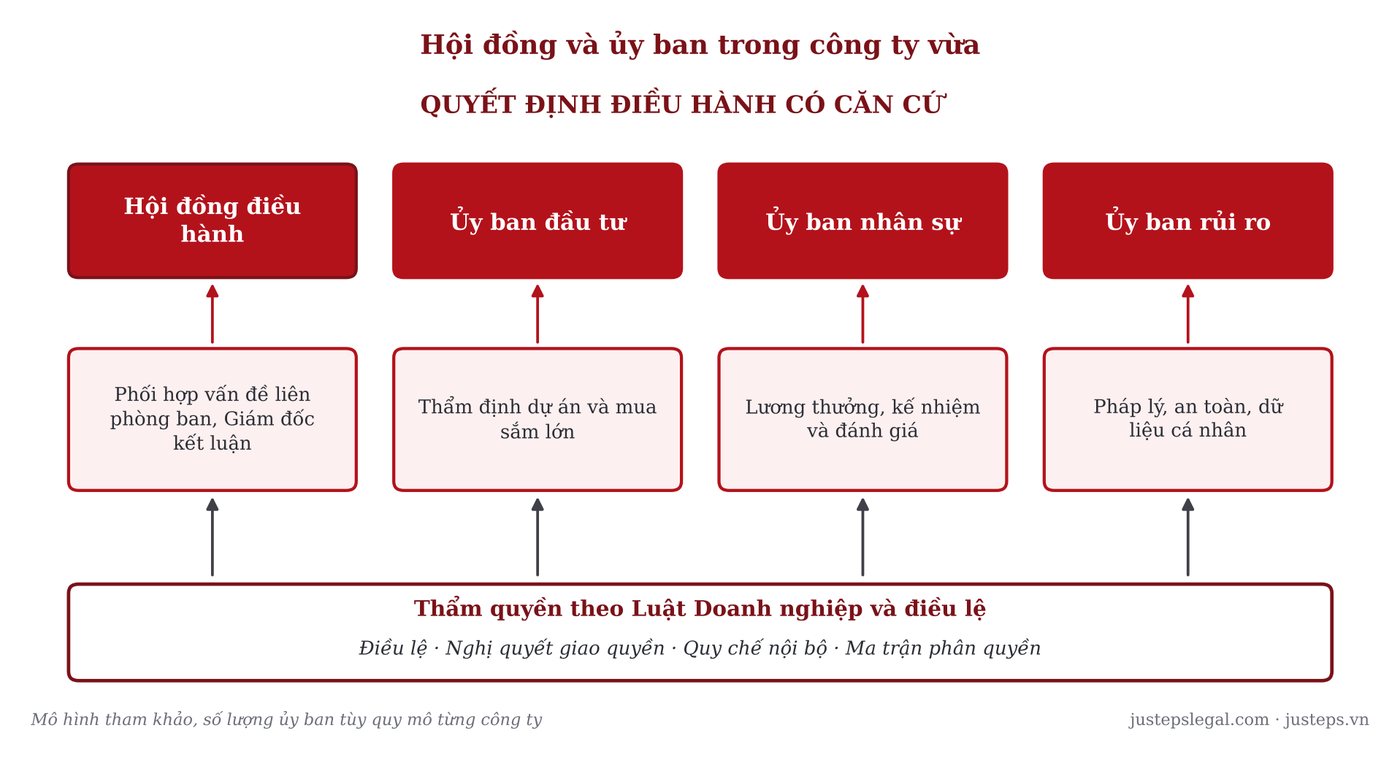
The executive committee and specialised committees resting on authority allocated by the law and the charter
The four mechanisms in the top row share a common aim, which is to ensure that executive decisions are well founded and coordinated across departments. The executive committee deals with cross-departmental matters, while each committee focuses on one area such as investment, HR and remuneration, or risk and compliance. The foundation at the bottom represents a mandatory condition, namely that every mechanism must operate within the authority allocated by the Law on Enterprises, the charter and the internal rules. If that foundation is unclear, for instance because the charter does not set a transaction threshold or does not allocate the power to issue internal rules, the company should amend the charter before setting up a committee.
Signs that a company needs an executive committee
Headcount is an indicator, but not the only criterion. The clearest sign is that five or more department heads report directly to the Director, while many decisions such as equipment investment, senior hires, entering new markets or changing pricing policy affect sales, production, finance and HR at the same time. When department heads learn of each other’s decisions only from the results, the company typically finds that purchasing does not match the sales plan, hiring does not match the budget, or the same issue is handled in two different ways.
Another group of signs comes from outside. When a company is preparing to receive investment, take out a large bank loan or become a public company, the parties concerned usually ask it to show that important decisions are considered systematically, documented and owned by someone accountable. An executive committee and committees with complete minutes are good evidence for this requirement. The following table suggests a suitable structure by size; it reflects practical experience rather than a legal requirement:
| Size | Suggested structure | Meeting frequency |
|---|---|---|
| Fewer than 50 people | The Director works directly with department heads, and no committee is needed yet. | Weekly progress meetings. |
| 50 to 150 people | An executive committee of 4 to 7 members chaired by the Director. | Meetings every two weeks. |
| 150 to 300 people | An executive committee together with one or two specialised committees. | The committee meets monthly, and specialised committees meet as needed. |
| With outside investors | Add committees under the Board of Directors such as audit and remuneration. | Quarterly meetings linked to the reporting cycle. |
A company should not set up a committee merely to have a structure resembling that of a large enterprise. If there are still few cross-departmental decisions each month and the Director still has a full view of the information, a progress meeting with short minutes is enough. A committee with a bloated membership but no real business to discuss will quickly lose credibility, and when the company genuinely needs it, that credibility is very hard to restore.
Designing membership, authority and decision-making
Membership
An executive committee usually has 4 to 7 members, chaired by the Director or General Director, together with the heads of finance, sales, operations or production and HR. Not every department head should be a member, because an overly large committee turns into a forum for reporting instead of discussion. Heads of other departments may be invited when the committee discusses matters concerning them. The committee needs a permanent secretary, usually from the Director’s office or the legal department, who is responsible for preparing papers, taking minutes and tracking implementation.
Authority and referral thresholds
The committee’s rules must list specifically the matters that must be referred to the committee before the Director decides, such as the annual business plan and budget before submission to the Board of Directors, investments or purchases above a certain amount, the hiring and appointment of middle managers and above, pricing and discount policies, and framework contracts with strategic customers or suppliers. The referral threshold must be lower than the threshold within the authority of the Board of Directors or the Members’ Council, for example investments of VND 500 million or more are referred to the executive committee, while for amounts at or above the level set in the charter the committee only gives its opinion so that the Director can submit the matter to the competent body.
A point that is often overlooked is related-party transactions. Contracts and transactions between the company and its members, major shareholders, managers or their related persons must be approved by the Members’ Council, the Board of Directors or the General Meeting of Shareholders under a specific procedure[5], so the executive committee’s rules should state clearly that such transactions fall outside the decision-making authority of both the committee and the Director. The matrix below illustrates how roles can be divided between the levels for a number of common matters.
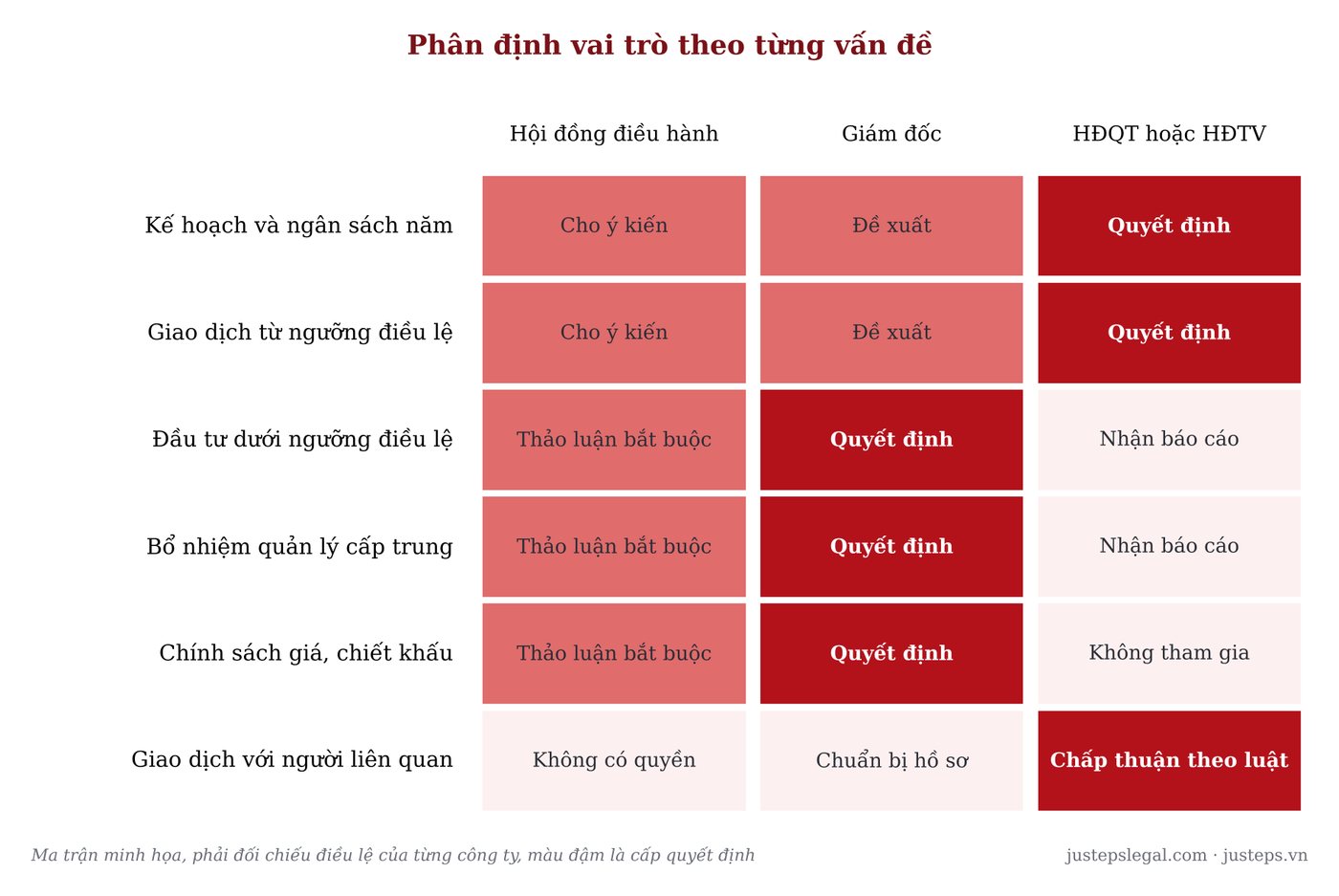
Matrix dividing roles between the executive committee, the Director and the Board of Directors
For matters such as the annual plan or major transactions, the executive committee only discusses and gives its opinion, the Director makes the proposal, and the power to decide rests with the Board of Directors or the Members’ Council. For investments below the charter threshold, the hiring of middle managers or pricing policy, the committee is a mandatory forum for discussion, but the Director remains the decision-maker. For related-party transactions, neither the committee nor the Director has the power to decide, and the Director only prepares the file for submission to the competent body. The company should draw up a similar matrix for its full list of matters and check it against the charter before issuing it, which can be done alongside Justeps’ financial regulations and delegation of authority service.
Decision-making
An executive committee should not vote by majority to replace the Director’s decision. The appropriate approach is for each member to state an opinion, including any dissent, which is recorded in the minutes, after which the Director concludes and takes responsibility for that conclusion. The reason is that the law places duties of honesty, prudence and acting in the best interests of the company on each manager individually[6], and a collective resolution of a mechanism with no statutory authority does not reduce that personal responsibility. Conversely, minutes that fully record the information considered and the differing opinions are evidence that the Director decided with due care.
Common specialised committees
A specialised committee may report to the Board of Directors or to management, depending on the nature of its work. Of all the types of committee, the Law on Enterprises specifically regulates only the Audit Committee under the Board of Directors, which applies to joint stock companies organised under the model without a Supervisory Board, in which at least 20% of the members of the Board of Directors are independent members[7]. The Audit Committee has two or more members, its chair must be an independent member of the Board of Directors, and it is responsible for overseeing financial statements, the internal control system and risk management[8].
Other committees are designed by the company itself. An investment committee, usually reporting to the Director, appraises projects and major purchases and comprises the heads of finance, operations and sales. An HR and remuneration committee may report to the Board of Directors or to the Director and proposes remuneration policy, succession plans and the evaluation of senior managers. A risk and compliance committee monitors legal risk, occupational safety and personal data and reports periodically to the Director or the Board of Directors. For public companies, the establishment of committees under the Board of Directors and the qualifications of their members must also follow the corporate governance rules applicable to public companies[9].
A mid-sized company should not set up several committees at once. A sensible approach is to start with the executive committee and then split off a committee when one group of matters takes up too much of the committee’s time or requires deep expertise, such as an investment committee when the company enters a phase of factory expansion. Each committee needs its own rules or a chapter in the common rules, stating which body set it up and its duties, membership, reporting arrangements and term of operation if it is a temporary committee.
Running the committee so that it does not become a progress meeting
An executive committee is effective only when its agenda focuses on matters requiring a decision or coordination, rather than status reports from each department. The company should set a meeting calendar for the whole year linked to governance milestones such as planning, budgeting, pay reviews and mid-year appraisals, so that department heads can prepare in advance. Papers should be circulated at least two working days in advance, and each proposal should include a one-page summary setting out the issue, the options, the recommendation and the financial impact. The flowchart below shows the sequence by which a matter passes through the executive committee.
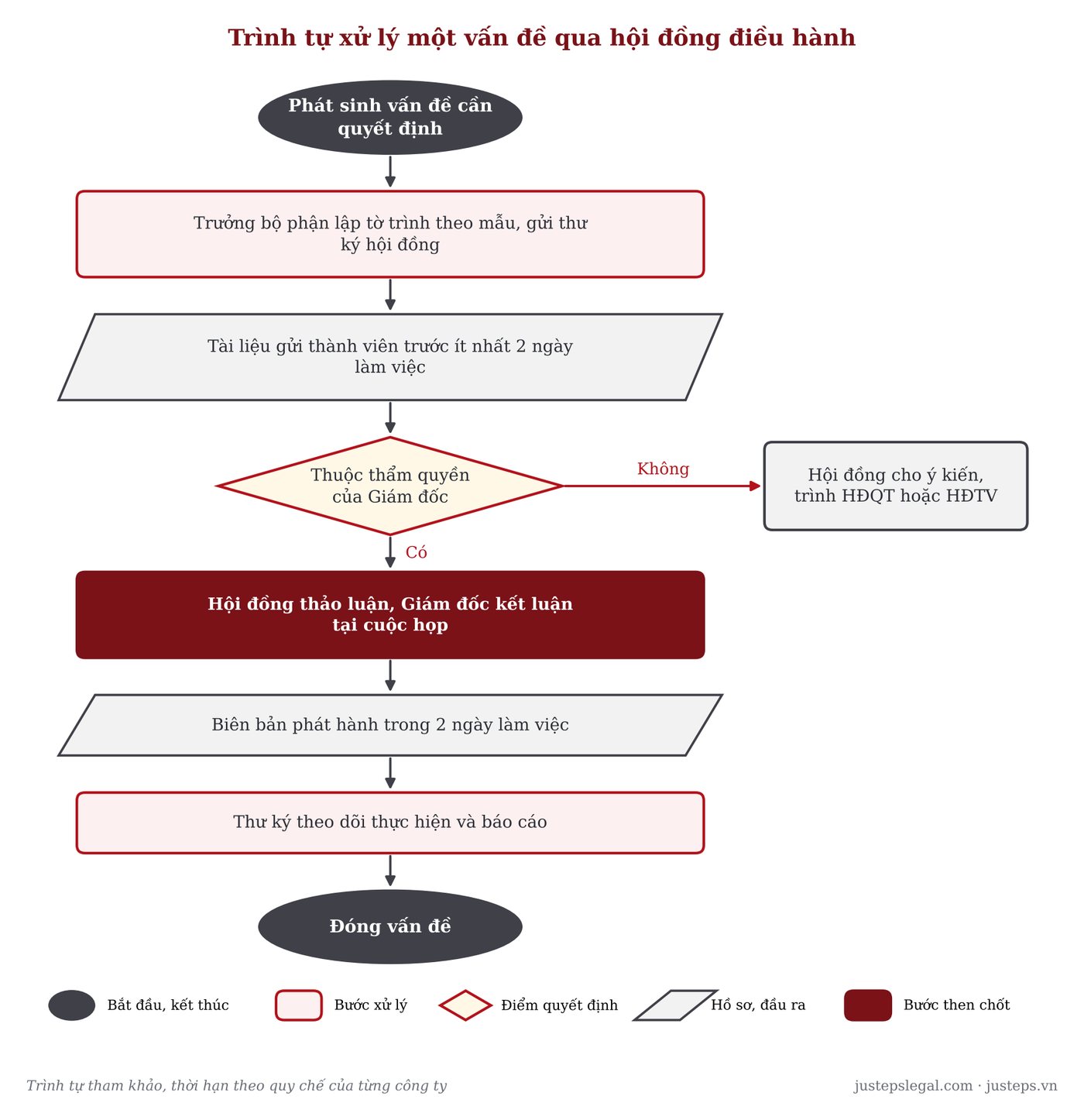
Sequence for bringing a matter to the executive committee and following up implementation
The sequence begins when a department head prepares a proposal using the template and sends it to the committee secretary. The first decision point is whether the matter falls within the Director’s authority; if it goes beyond that authority, the committee only gives its opinion and the Director prepares a file for submission to the Board of Directors or the Members’ Council. For matters within that authority, the committee discusses them, records the opinions and the Director concludes at the meeting, which is the key step in the sequence. The minutes are issued within two working days, recording the decision, the owner and the deadline, after which the secretary updates the follow-up log so that progress can be reported at the next meeting.
In addition to this sequence, the company needs to agree on how to handle urgent matters arising between meetings. The rules may allow members’ opinions to be collected by email within a short deadline, after which the Director decides and reports back at the next meeting. When the Director is absent, a person authorised by the Director in writing may chair the meeting, but the scope of the authorisation must be stated clearly and the authorised person may act only within that scope[10].
Common mistakes and the records required
From its governance structure projects, Justeps has found that mistakes in setting up executive committees and other committees usually stem from copying another business’s model without checking it against the company’s own charter. Common mistakes include:
- The executive committee is given decisions on matters that the law or the charter reserves to the Board of Directors, the Members’ Council or the General Meeting of Shareholders.
- The Director uses a committee vote to shift personal responsibility onto the group.
- The committee operates for years without written rules, so it is impossible to determine which matters must be referred to it.
- The referral threshold in the committee’s rules conflicts with the threshold in the charter or the financial regulations.
- The minutes record only the discussion and not the decision, the owner and the deadline.
To avoid these mistakes, the company should prepare a complete set of records before the committee holds its first meeting. The set comprises the establishment decision issued by the level with authority under the charter, the committee’s rules of organisation and operation, a delegation matrix consistent with the charter and other internal rules, and templates for proposals, minutes and the decision log. When the charter is amended, for example to align with the Law on Enterprises as amended and supplemented by Law No. 76/2025/QH15[11], the company should review the committee’s rules and the delegation matrix so that they remain consistent. Companies needing the full set of records drafted may consider Justeps’ internal governance rules and procedures service.
How Justeps can help
Justeps helps mid-sized companies design executive committees and specialised committees that stay within their authority and operate effectively through the following services:
- Internal governance rules and procedures. Justeps drafts the rules of organisation and operation of the executive committee and other committees, together with templates for proposals and minutes.
- Financial regulations and delegation of authority. Justeps prepares a delegation matrix that is consistent across the charter, the financial regulations and the committee’s rules.
- Compliance framework and internal governance. Justeps designs a risk and compliance committee and periodic reporting arrangements for management.
- Legal liability of enterprise managers. Justeps assesses the responsibility of the Director and committee members when decisions are made through a collective mechanism.
- Organising meetings, minutes and resolutions under the Law on Enterprises. Justeps trains secretaries and committee members on preparing papers, taking minutes and tracking decisions.
Frequently asked questions
Must an executive committee be registered with the business registration authority?
No. An executive committee is an internal mechanism, not a management body under the Law on Enterprises, so it is not part of the enterprise registration details. The company only needs to issue an establishment decision and operating rules in accordance with the authority set out in the charter.
May the executive committee vote in place of the Director?
The company should not design it that way, because the Director is the manager personally responsible for executive decisions[6]. The committee should discuss and record opinions, while the Director concludes and takes responsibility.
Must a small joint stock company set up an Audit Committee?
An Audit Committee applies only when a joint stock company chooses the model without a Supervisory Board, in which at least 20% of the members of the Board of Directors are independent members[7]. A company with a Supervisory Board does not need to set up an Audit Committee.
Who has the power to issue the executive committee’s rules?
In a joint stock company, the Board of Directors decides on the organisational structure and internal management rules[3], while in a limited liability company the Director issues internal management rules unless the charter provides otherwise[2]. The company should check its charter to identify the correct issuing level.
May the executive committee approve a transaction with a company owned by a capital-contributing member?
No. Transactions between the company and its members, major shareholders, managers or their related persons must be approved by the competent body under the specific procedure in the Law on Enterprises[5]. The executive committee may only review the file before it is submitted.
How often should the committee’s rules be reviewed?
The company should review them once a year, at the time of annual planning, and immediately whenever the charter or the financial regulations change. The review should focus on the list of matters that must be referred, the value thresholds and the committee’s membership.
Related articles
- The authority of the General Director and how to delegate executive powers within the limits of the charter and internal rules
- Which documents make up the minimum set of internal governance rules for a company with 50 to 200 staff
- How far the legal liability of directors, members of the Board of Directors and chief accountants extends within a company
- How to write department functions and duties so that every task in a business has someone accountable for it
Notes
[1] Clause 2 of Article 55 of the Law on Enterprises No. 59/2020/QH14 dated 17 June 2020.
[2] Clause 2 of Article 63 of the Law on Enterprises No. 59/2020/QH14.
[3] Clause 2 of Article 153 of the Law on Enterprises No. 59/2020/QH14.
[4] Article 162 of the Law on Enterprises No. 59/2020/QH14.
[5] Articles 67 and 167 of the Law on Enterprises No. 59/2020/QH14.
[6] Articles 71 and 165 of the Law on Enterprises No. 59/2020/QH14.
[7] Point b, Clause 1 of Article 137 of the Law on Enterprises No. 59/2020/QH14.
[8] Article 161 of the Law on Enterprises No. 59/2020/QH14.
[9] Government Decree No. 155/2020/ND-CP dated 31 December 2020 detailing the implementation of certain articles of the Law on Securities, the part on corporate governance applicable to public companies.
[10] Articles 138 and 141 of the Civil Code No. 91/2015/QH13 dated 24 November 2015.
[11] Law No. 76/2025/QH15 amending and supplementing certain articles of the Law on Enterprises.
This article is for reference and reflects the regulations in force at the time of publication. Please consult Justeps for advice tailored to your company’s records and situation.
For further information, please contact:
📩 Email: info@justeps.vn
🌐 Website: https://justepslegal.com · https://justeps.vn
🌐 Page: Justeps
☎️ Hotline (Zalo): 096 172 2607
📍 Thanh Xuan Office: 12th Floor, Licogi 13 Tower, 164 Khuat Duy Tien Street, Thanh Xuan Ward, Hanoi, Vietnam
📍 Ha Dong Office: LK06B, No.10, Dong Dua Area, Ha Dong Ward, Hanoi, Vietnam
📍 Ho Chi Minh City Branch: 528 Le Van Sy, Ho Chi Minh City, Vietnam
📍 Hai Phong Office: Truong Thinh Village, Ha Dong Commune, Hai Phong, Vietnam
📍 Quang Ninh Office: Van Don Special Zone, Quang Ninh Province, Vietnam





