
Key takeaways
- An exclusive distribution agreement is a contract for the sale of goods with an exclusivity commitment attached, so the parties must agree every term themselves because the law has no dedicated chapter governing this type of contract.
- If the agreement is drafted so that the supplier sets resale prices and retains title to the goods, the relationship may be characterised as a commercial agency, bringing with it notice and compensation obligations on termination.
- Sales targets should be tied to commercial consequences such as loss of exclusivity or a smaller territory; where a contractual penalty is agreed, it may not exceed 8% of the value of the breached part of the obligation.
- Exclusivity commitments, territorial allocation and fixed resale prices may be scrutinised under the Law on Competition where they have a significant restrictive effect on competition.
- The inventory clause should set out in advance the buy-back option, the pricing method, the sell-off period and the handover of product files to avoid disputes after termination.
When bringing goods into the Vietnamese market or expanding into a new province or region, many manufacturers and importers choose to grant exclusive distribution rights to a local company that already has warehousing, a sales force and relationships with retail chains. The relationship often begins with a short contract that records only prices, the territory and the expected sales level, while difficult questions such as missed targets, selling into another territory or dealing with stock left in the warehouse when the parties part ways are left to be discussed when they arise. Most distribution disputes that companies encounter stem from precisely those gaps.
This article analyses the core clauses of an exclusive distribution agreement in the order of the life cycle of the distribution relationship, from establishing the nature of the contract, the scope of exclusivity and the territory, and sales targets, through to termination and the treatment of inventory. It is written mainly for the boards of directors, sales teams and in-house legal teams of manufacturers and importers, and for companies that hold or are about to receive exclusive distribution rights, including where one party is a foreign trader.
The legal nature of an exclusive distribution agreement
Vietnamese law has no dedicated chapter on distribution agreements. In principle, under an ordinary distribution model the distributor buys goods from the supplier, becomes the owner of those goods and resells them to agents, retailers or consumers at prices it sets itself, earning the margin between purchase and resale prices. The relationship between the parties is therefore governed mainly by the rules on the sale of goods in the Commercial Law[1] and the general rules on contracts in the Civil Code[2]. Exclusivity commitments, sales targets, marketing support and the right to buy back inventory are all additional terms that the parties must write themselves, as there is no default rule to fill the gaps for them.
This model must be distinguished from commercial agency. In an agency relationship, the agent buys and sells goods in its own name for the principal in return for remuneration, while title to the goods remains with the principal[3]. The Commercial Law recognises exclusive agency, under which, within a given geographical area, the principal appoints only one agent to buy and sell one or more lines of goods[3]. The name given to the contract does not determine the nature of the relationship, because in a dispute the deciding body will look at who owns the goods, who sets the selling price and whether the intermediary earns a margin or a fee.
The table below compares the two models on the points that directly affect how the clauses on price, title, risk and termination should be drafted:
| Item | Buy-sell distribution model | Commercial agency |
|---|---|---|
| Title to goods | Passes to the distributor on delivery, unless the parties agree a retention of title. | Remains with the principal until the goods are sold to the customer. |
| Resale price | Set by the distributor, with the supplier only allowed to issue recommended prices. | The principal has the right to fix the purchase and selling prices for customers. |
| Intermediary’s income | The margin between purchase and resale prices, plus discounts or volume bonuses where applicable. | Remuneration in the form of commission or a price margin as agreed. |
| Risk of unsold or damaged stock | Borne by the distributor, unless the agreement includes a buy-back or exchange commitment. | In principle borne by the principal, since the goods still belong to it. |
| Termination | As agreed by the parties and under the general rules on contracts. | Specific rules apply on the notice period and compensation for the agent. |
In light of this comparison, the supplier should choose one consistent model and draft the price, title and payment clauses in line with that model. A contract called a distribution agreement that nevertheless lets the supplier set retail prices, keeps title with the supplier until the goods are sold and pays the distributor a fixed percentage is very likely to be characterised as an agency contract. In that case, the specific rules on terminating an agency contract will apply, as analysed later in this article.
Where the distributor is a foreign-invested economic organisation, buying goods for resale is also subject to conditions on distribution rights. Under current regulations, such an organisation must hold a business licence to exercise retail distribution rights and to carry out wholesale distribution of certain groups of goods[4]. Before signing, the supplier should therefore ask the distributor to demonstrate that it meets the business conditions for the exact goods and the exact distribution method stated in the agreement.
Scope of exclusivity and distribution territory
One-way or two-way exclusivity
The exclusivity clause must state clearly who is bound and what they are bound to do. One-way exclusivity only prevents the supplier from appointing another distributor in the territory, whereas two-way exclusivity additionally prevents the distributor from dealing in competing products during the term of the agreement. The agreement should also answer three questions that the parties often overlook, namely whether the supplier may sell directly to customers in the territory, whether newly launched products automatically fall within the exclusivity, and whether acquiring a competing brand would put the distributor in breach of its commitment.
The territory should be described by reference to specific administrative units and updated to reflect the new administrative boundaries following the reorganisation of provinces and communes, together with a list of the sales channels and customer groups allocated. Sales through e-commerce platforms, social media and to retail chains with nationwide store networks are three points that readily give rise to disputes, because an order may originate in one distributor’s territory but be delivered into another’s. A common solution is to distinguish between actively marketing and offering goods into another territory and fulfilling orders from customers who approach the distributor on their own initiative, while reserving large chain customers to the supplier or to a designated distributor.
The limits set by competition law
Exclusive distribution is an agreement between businesses at different stages of the same distribution chain, so it may fall within the scope of the Law on Competition. Agreements such as fixing resale prices, sharing consumer markets, refusing to deal with parties outside the agreement or restricting the supply of goods are prohibited where they have, or are likely to have, a significant restrictive effect on competition in the market[5]. The level of risk depends mainly on the market shares of the supplier and the distributor in the relevant market, as well as on the number of competing distributors that remain.
For a prohibited anti-competitive agreement, the maximum fine is 10% of the infringing company’s total turnover in the relevant market in the financial year immediately preceding the year of the infringement[6]. A supplier with a large market share should therefore use recommended retail prices instead of mandatory resale prices, limit the duration of any non-compete commitment and avoid an absolute ban on selling to customers from other areas who approach the distributor on their own initiative. On 13 November 2026, the National Assembly passed a law amending and supplementing a number of articles of the Commercial Law, the Law on Competition and two other laws, so companies should follow the implementing guidance once that law takes effect.
Sales targets and minimum purchase commitments
Sales targets are the tool that lets the supplier ensure that exclusivity comes with actual business results. The agreement must distinguish between two mechanisms. A sales target is an objective which, if missed, triggers the agreed commercial consequences, whereas a minimum purchase commitment is a contractual obligation under which the distributor must buy a set quantity of goods in each period whether or not it can sell them. Unclear labelling will lead to arguments over whether the distributor merely loses exclusivity or must also compensate for the shortfall.
A workable target should be set by quarter or by year, calculated on purchases from the supplier or on sales with data that can be cross-checked, and should include an adjustment mechanism where the supplier delivers late, changes prices or discontinues a product line. Targets for the second year onwards should be agreed by the parties in an appendix before the new year begins, together with a fallback rule for when they cannot agree, for example keeping the previous year’s target plus a fixed growth rate. The following chart illustrates how targets can be tracked by quarter against the consequence thresholds.
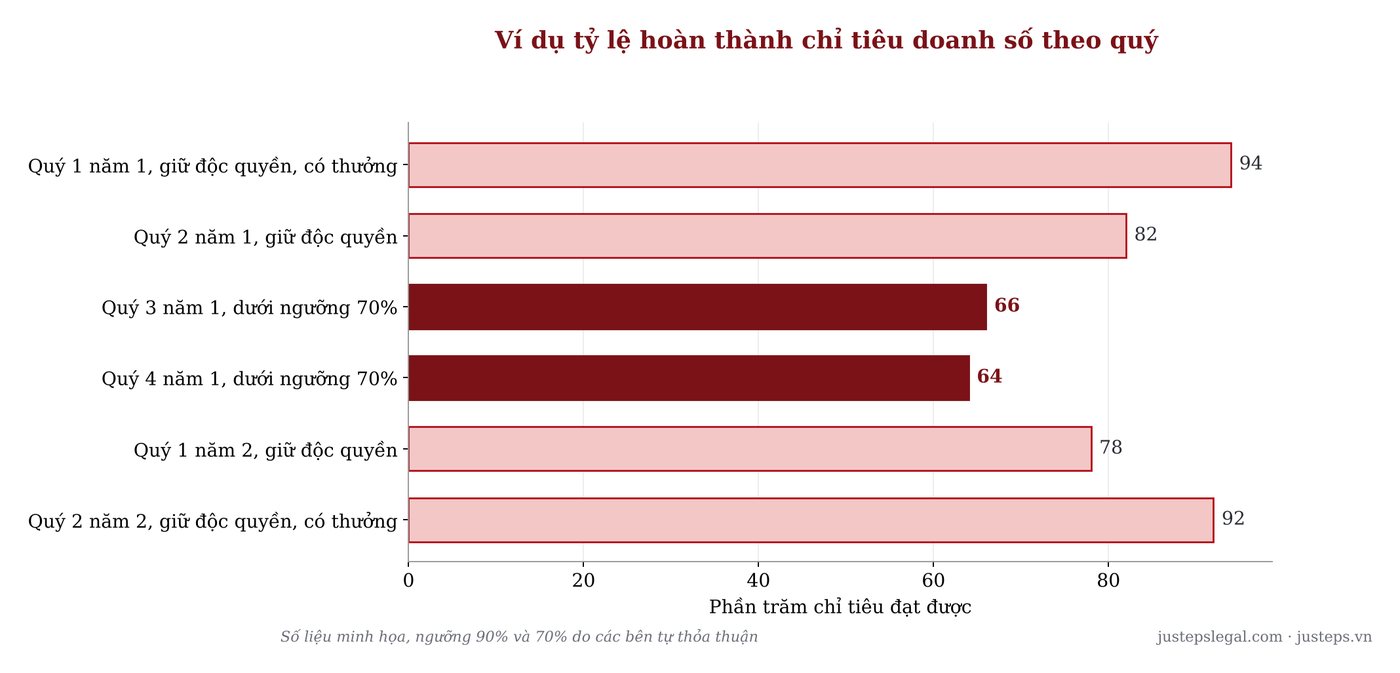
Example of quarterly sales target achievement against the agreed consequence thresholds
In this example, the agreement sets three thresholds. A distributor achieving 90% or more of the target keeps its exclusivity and earns a volume bonus, one achieving between 70% and under 90% keeps its exclusivity without a bonus, and two consecutive quarters below 70% give the supplier the right to switch to non-exclusive distribution. The third and fourth quarters of year one are both below 70%, so the supplier acquires the right to switch, even though the full-year achievement rate remains acceptable. Tiered thresholds give both parties time to put things right and avoid terminating the whole agreement because of a single poor trading period.
Consequences of missing the target
The most common consequences are loss of exclusivity, a smaller territory, reduced discounts or termination of the agreement. If the parties wish to apply a contractual penalty to the shortfall under a minimum purchase commitment, the penalty, or the aggregate penalty for multiple breaches, may not exceed 8% of the value of the part of the contractual obligation that has been breached[7]. Beyond the penalty, the aggrieved party may recover damages only if it proves actual and direct loss and a causal link with the breach, and the two remedies may be applied together where the agreement provides for a penalty[8].
The distributor should ask for the agreement to set out the cases in which targets are waived or reduced, such as force majeure events, short deliveries by the supplier, or products being recalled or suspended from circulation. Where a fundamental change of circumstances makes meeting the target seriously harmful to one party, that party has the right to request renegotiation of the contract under the Civil Code[9], but this right is difficult to invoke and takes time to prove. A target adjustment clause written in from the outset is always more effective than relying on the general rules.
Price, payment, title and trademarks
Under the buy-sell model, the price charged to the distributor is usually set by a price list issued by the supplier, which may be revised after a period of notice. The agreement should state clearly that confirmed purchase orders remain at the old price, and should set out how discounts, volume bonuses and marketing support are calculated and when the parties reconcile their accounts. Marketing support should be subject to conditions on supporting documents and permitted use to avoid disputes at the year-end settlement.
Where the supplier sells on credit, a retention of title clause allows the supplier to retain ownership of the goods until it has been paid in full[10]. This measure must be made in writing and becomes enforceable against third parties only once it has been registered under the rules on registration of security interests. For goods that the distributor has already resold in the ordinary course of business, the supplier’s right to recover them is very limited, so this measure should be combined with credit limits, bank guarantees or deposits.
The distributor is usually permitted to use the supplier’s trademarks, images and marketing materials within the territory. The agreement should state the scope of use, require prior approval of advertising content, and oblige the distributor to stop using the trademarks and to take down domain names and social media accounts bearing them when the agreement ends. The supplier should also not allow the distributor to register the supplier’s trademark in Vietnam in its own name, because recovering it later can be very costly. To review these clauses before signing, companies may consider Justeps’ contract term review and risk control services.
Terminating an exclusive distribution agreement
The agreement should list all grounds for termination in full, including expiry without renewal, mutual agreement, a material breach by one party that is not remedied within the notified period, failure to meet targets under the agreed thresholds, a change of control of the distributor and the insolvency of either party. Under the Commercial Law, the aggrieved party may suspend performance of or rescind the contract where a breach occurs that the parties have agreed is a condition for doing so, or where one party commits a fundamental breach of its contractual obligations[11]. A fundamental breach is one that causes the other party such loss that it fails to achieve the purpose for which the contract was entered into, so the parties should themselves list the breaches regarded as serious rather than leaving the dispute resolution body to assess them.
The terminating party must notify the other party immediately and, if failure to notify causes loss, must compensate for it[2]. The notice should be sent in writing to the address and by the method stated in the agreement, specifying the ground for termination, the termination date and the activation of the clauses on inventory, outstanding balances and trademarks. During the notice period, the supplier should continue to deliver confirmed orders so as not to be regarded as the first party in breach.
The risk of the agreement being characterised as agency
If the relationship is characterised as a commercial agency, then, absent any other agreement, the agency term ends only after a reasonable period, which may not be less than 60 days from the date on which one party gives written notice. Where the principal terminates on its own initiative, the agent is entitled to claim compensation equal to one month’s average agency remuneration for each year of agency, or one month’s average remuneration if the agency lasted less than a year[12]. Distributors often run this argument when they are terminated after many years, so the supplier should keep records proving that the distributor bought the goods outright, set its own prices and bore its own risk.
The following flowchart summarises the steps that the supplier should take from considering termination through to completing the handover.
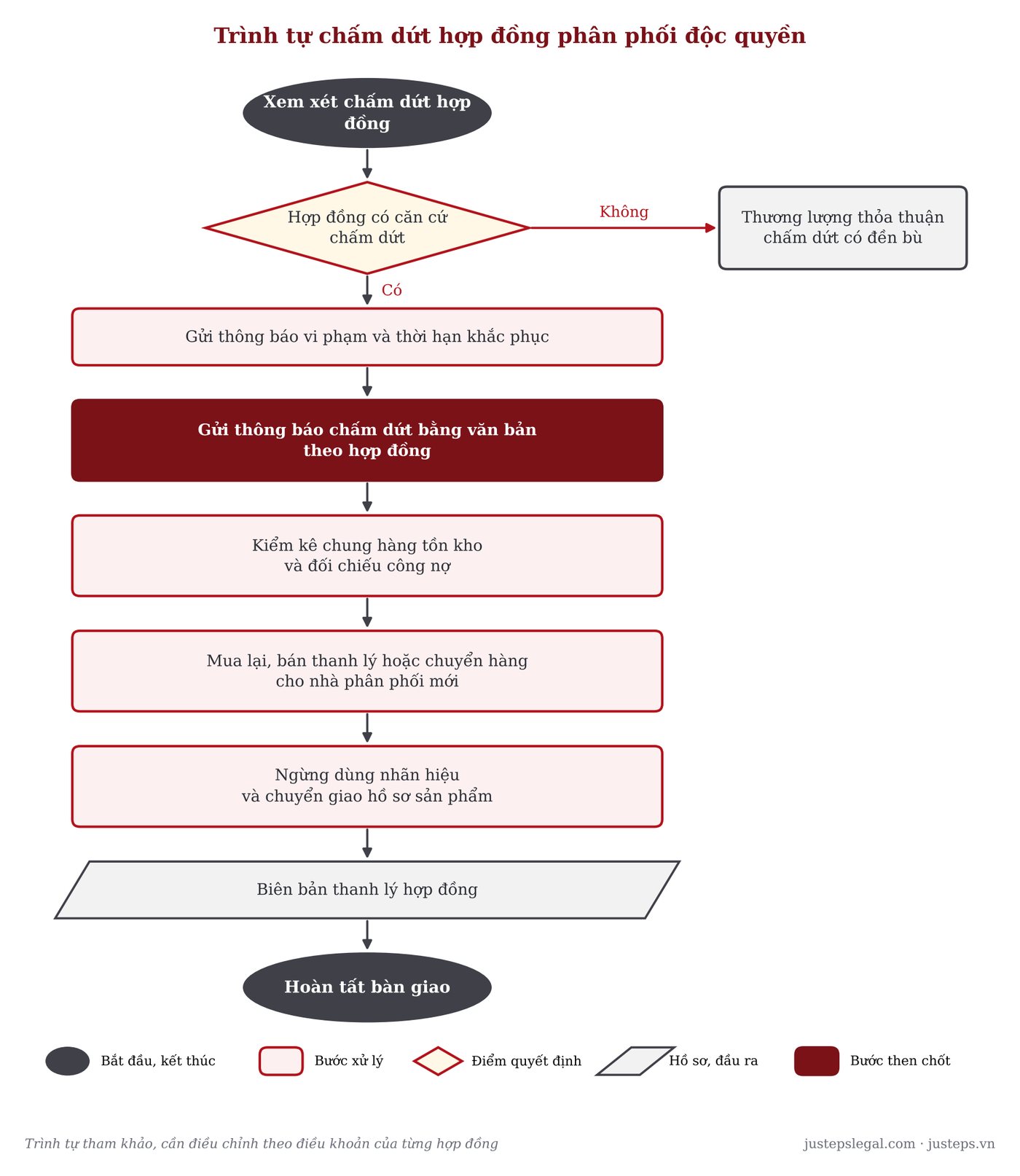
Sequence for terminating an exclusive distribution agreement and dealing with inventory
The first question is whether the agreement already contains a ground for termination. If it does not, for example where the supplier simply wants to switch to another distributor part-way through the term, the safe course is to negotiate a termination agreement with reasonable compensation rather than terminating unilaterally. If a ground exists, the supplier sends a notice of breach with a period to remedy it, and sends a termination notice only if the breach continues after that period expires. From the termination date, the parties take stock of the inventory, reconcile outstanding balances, exercise the buy-back option or carry out the sell-off, and then sign a contract liquidation record confirming the obligations that have been fulfilled.
Dealing with inventory when the agreement ends
Inventory is the biggest point of dispute at the end of a distribution relationship, because the distributor wants to shift the risk of unsold goods to the supplier, while the supplier is concerned that old stock dumped at low prices will harm the new distributor. Since title has passed to the distributor, the supplier has no obligation to buy the goods back unless the agreement provides otherwise. The agreement should set out one of the following options in advance, or combine them depending on the reason for termination:
- The supplier has the right, or the obligation, to buy back all or part of the goods that remain in their original sealed packaging and within their shelf life at a percentage of the original purchase price.
- The distributor may continue to sell the remaining stock during a set sell-off period, at prices not below a level agreed by the parties and only within the former territory.
- The remaining stock is transferred to the new distributor at a price and on terms agreed by all three parties, together with a list of product codes, batch numbers and expiry dates.
- Goods close to expiry, damaged goods or goods whose labels no longer comply with regulations are destroyed in accordance with the law, at the cost of the party at fault for the termination.
The buy-back price is usually calculated by reference to the age of the goods and the reason for termination. Where the supplier terminates for its own convenience, the distributor has grounds to demand a higher buy-back price, whereas where the distributor is in breach, the supplier should commit only to a buy-back option rather than a buy-back obligation. The following chart illustrates a buy-back price scale based on remaining shelf life.
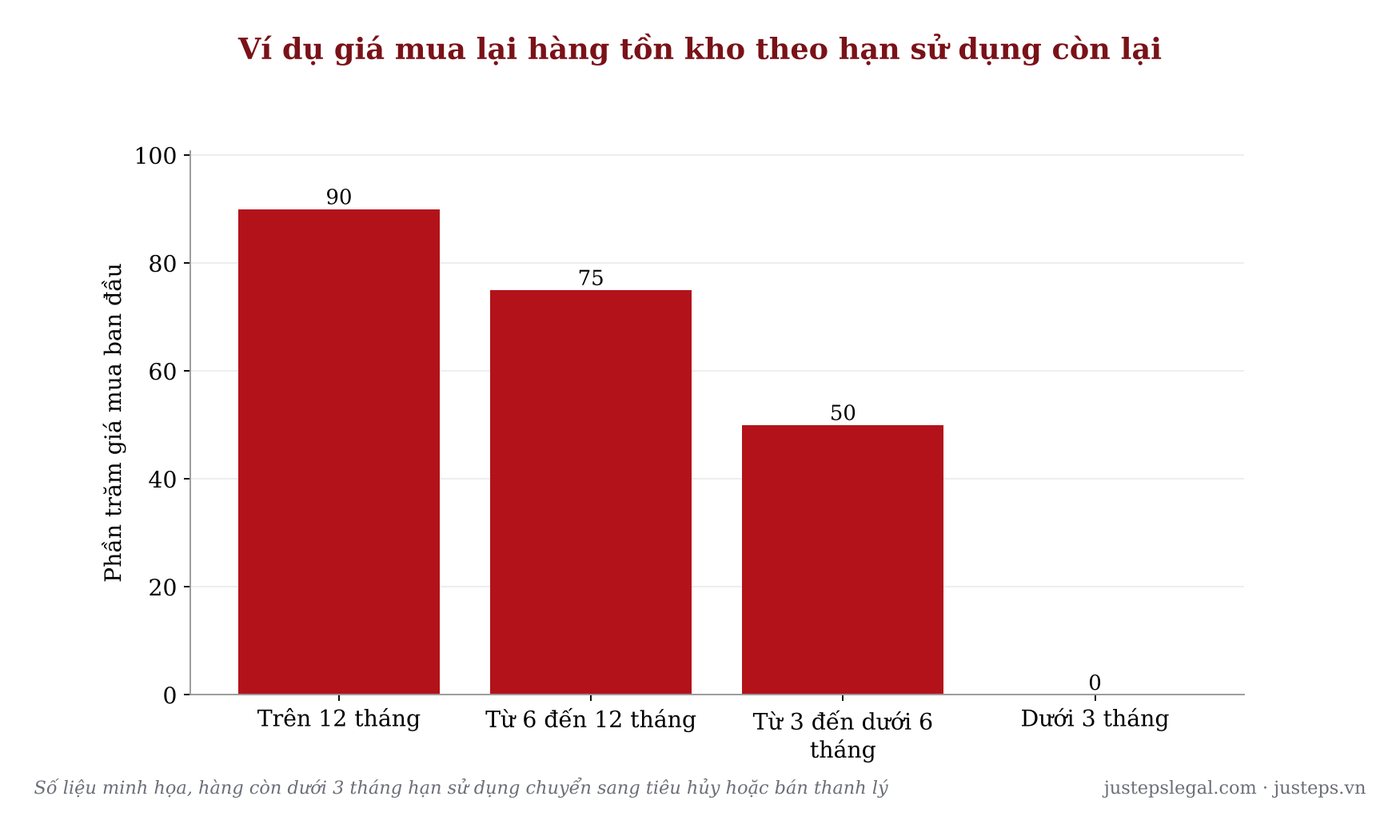
Example of buy-back price rates for inventory by remaining shelf life
In this example, goods with more than 12 months of shelf life remaining are bought back at 90% of the original purchase price, the rate falls as the remaining shelf life shortens, and goods with less than 3 months remaining are not bought back but are destroyed or sold off. The price scale should come with conditions on packaging, labelling and storage, and with the supplier’s right to inspect the warehouse before taking the goods back. The parties should also agree a deadline for sending the stock list, a deadline for the joint stocktake and a payment period for the buy-back price so that termination is not drawn out.
When the supplier buys back goods, this is a new sale by the distributor, so the distributor must issue an electronic invoice under the rules on invoices and documents[13]. If the products are subject to declaration or registration for circulation, or must show the name of the responsible organisation on the label, the agreement must provide a transitional period for the new distributor to complete the formalities and for labels on goods still in circulation to remain compliant with the rules on goods labelling[14]. The former distributor should also be obliged to continue cooperating on warranty, complaint handling and recall of defective products already sold for a reasonable period after termination.
Drafting, negotiating and managing the agreement
A good exclusive distribution agreement usually consists of general terms that remain stable for several years and appendices updated annually on the product list, price list, territory and targets. The sales team should be responsible for proposing the commercial terms, while the in-house legal team or an external adviser reviews the clauses on exclusivity, competition, termination and inventory before the agreement is submitted to the authorised signatory. Companies may use Justeps’ commercial contract drafting and review services to build template agreements and appendices for use across their entire distribution network.
For agreements with a foreign element, the parties may choose the governing law[15], but mandatory Vietnamese rules on competition, goods labelling, invoicing and business conditions still apply to distribution activities in Vietnam. The dispute resolution clause should give priority to negotiation and mediation for a set period before referral to commercial arbitration or the courts, and if arbitration is chosen, the clause must correctly name the arbitration centre, the procedural rules and the seat[16]. After signing, companies should keep a tracking sheet of the expiry date, the renewal deadline, the target review periods and the notice deadlines so as not to miss any key dates.
How Justeps can help
Justeps supports suppliers and distributors in building, negotiating and managing exclusive distribution agreements through the following services:
- Commercial contract drafting and review. Justeps drafts template exclusive distribution agreements and appendices on products, prices, territory and targets that match the company’s business model.
- Contract term review and risk control. Justeps reviews agreements already in use, identifies clauses at risk of being characterised as agency or of breaching competition law and proposes amendments.
- Negotiation strategy and handling contractual breaches. Justeps prepares notices of breach and negotiated termination options and calculates inventory buy-back amounts.
- Internal process and policy development for trading and import-export companies. Justeps builds procedures for selecting, assessing and managing distributors, including tracking targets and contract renewal dates.
- Commercial contract drafting skills training. Justeps trains sales and in-house legal teams on how to read and negotiate exclusivity, target and termination clauses.
Frequently asked questions
Must an exclusive distribution agreement be made in writing?
The Commercial Law allows a contract for the sale of goods to be made orally, in writing or by specific conduct, unless the law requires written form[1]. Even so, for terms on exclusivity, targets and inventory, companies should put the agreement in writing so that they have evidence if a dispute arises.
May the supplier fix the retail price for its exclusive distributor?
Under the buy-sell model, the distributor has the right to set its own resale prices, so the supplier should only issue recommended prices. An agreement fixing resale prices may be prohibited under the Law on Competition if it has a significant restrictive effect on competition[5], and it also increases the risk of the relationship being characterised as agency.
May the distributor be charged a penalty of 20% of the sales shortfall?
If the shortfall is treated as a breach of a contractual obligation, the penalty may not exceed 8% of the value of the breached part of the obligation[7]. The parties should instead use commercial consequences such as loss of exclusivity, reduced discounts or a smaller territory rather than a high penalty.
Is the distributor entitled to compensation if the supplier does not renew the agreement?
When a distribution agreement expires and the parties do not renew it, no compensation obligation arises in principle unless the agreement provides otherwise. The risk arises only if the relationship is characterised as agency, because the agent may then claim compensation based on its years of agency[12].
Is the supplier obliged to buy back inventory when the agreement ends?
The supplier is not obliged to buy back inventory unless the agreement so provides, because the goods already belong to the distributor. The buy-back clause should therefore be agreed from the outset, covering the condition of the goods, the pricing method and the time frame.
May an exclusive distributor sell on e-commerce platforms to customers in other provinces?
This depends on what has been agreed on territory and sales channels. The agreement should distinguish between actively marketing into another territory and fulfilling orders from customers who come of their own accord, because an absolute ban may be scrutinised under competition law[5].
May a distribution agreement with a foreign trader choose foreign law and foreign arbitration?
The parties may choose the governing law for contracts with a foreign element[15] and may choose arbitration in Vietnam or abroad[16]. However, mandatory Vietnamese rules on competition, goods labelling and business conditions still apply to distribution activities in Vietnam.
Related articles
- How a company should respond to a counterparty’s breach of contract before taking the dispute to court or arbitration
- Drafting warehousing contracts and logistics service agreements to allocate responsibility for goods clearly in warehouse operations
- Selling on e-commerce marketplaces in Vietnam and the rules on invoices, tax, returns and complaints
- Trade mark management in business, from searching, filing and renewal to dealing with infringement
Notes
[1] Clause 8 of Article 3 and Article 24 of the Commercial Law No. 36/2005/QH11 dated 14 June 2005.
[2] Articles 398, 422 and 428 of the Civil Code No. 91/2015/QH13 dated 24 November 2015.
[3] Articles 166, 169 and 170 of the Commercial Law No. 36/2005/QH11.
[4] Government Decree No. 09/2018/ND-CP dated 15 January 2018 detailing the Commercial Law and the Law on Foreign Trade Management regarding the sale and purchase of goods and activities directly related to the sale and purchase of goods by foreign investors and foreign-invested economic organisations in Vietnam.
[5] Article 11 and Clause 3 of Article 12 of the Law on Competition No. 23/2018/QH14 dated 12 June 2018.
[6] Clause 1 of Article 111 of the Law on Competition No. 23/2018/QH14.
[7] Articles 300 and 301 of the Commercial Law No. 36/2005/QH11.
[8] Articles 302, 303 and 307 of the Commercial Law No. 36/2005/QH11.
[9] Article 420 of the Civil Code No. 91/2015/QH13.
[10] Articles 331, 332 and 333 of the Civil Code No. 91/2015/QH13 on retention of title.
[11] Clause 13 of Article 3, Articles 310 and 312 of the Commercial Law No. 36/2005/QH11.
[12] Article 177 of the Commercial Law No. 36/2005/QH11.
[13] Government Decree No. 123/2020/ND-CP dated 19 October 2020 on invoices and documents, as amended and supplemented by Decree No. 70/2025/ND-CP.
[14] Government Decree No. 43/2017/ND-CP dated 14 April 2017 on goods labelling, as amended and supplemented by Decree No. 111/2021/ND-CP.
[15] Article 683 of the Civil Code No. 91/2015/QH13.
[16] Law on Commercial Arbitration No. 54/2010/QH12 dated 17 June 2010.
This article is for reference and reflects the regulations in force at the time of publication. Please consult Justeps for advice tailored to your company’s records and situation.
For further information, please contact:
📩 Email: info@justeps.vn
🌐 Website: https://justepslegal.com · https://justeps.vn
🌐 Page: Justeps
☎️ Hotline (Zalo): 096 172 2607
📍 Thanh Xuan Office: 12th Floor, Licogi 13 Tower, 164 Khuat Duy Tien Street, Thanh Xuan Ward, Hanoi, Vietnam
📍 Ha Dong Office: LK06B, No.10, Dong Dua Area, Ha Dong Ward, Hanoi, Vietnam
📍 Ho Chi Minh City Branch: 528 Le Van Sy, Ho Chi Minh City, Vietnam
📍 Hai Phong Office: Truong Thinh Village, Ha Dong Commune, Hai Phong, Vietnam
📍 Quang Ninh Office: Van Don Special Zone, Quang Ninh Province, Vietnam





