
Most disputes over a software development contract are not about price. They arise from three questions left open at signing: what counts as "done", who fixes defects found after delivery and how fast, and who ultimately owns the source code. When these points are drafted vaguely, the customer often ends up unable to accept the product and unable to switch vendors.
This article takes an operational view: which annexes the customer (or the software house) must prepare, who inside the business is responsible for acceptance, which events trigger each payment, and how to control source code handover so the company does not depend on a single development team.
What kind of contract is a software development contract
In substance it is a service contract under Article 513 of the Civil Code No. 91/2015/QH13, combined with the creation of a protected work: a computer program is subject matter of copyright under the Law on Intellectual Property No. 50/2005/QH11 (as amended). Where both parties are traders, the contract is also governed by the Commercial Law No. 36/2005/QH11, under which a contractual penalty may not exceed 8% of the value of the breached obligation (Article 301 of the Commercial Law).
In practice, the law only provides a general frame. Acceptance criteria, the testing procedure, warranty scope and the transfer of rights in the source code depend almost entirely on what the parties agree. The thinner the technical annexes, the more likely the dispute becomes a matter of opinion.
The annexes you must have
The main body of the contract should be short; the outcome is decided in the annexes. Businesses should treat the documents below as conditions for signing, not as something to "finish later".
| Annex | Main content | Prepared by | Approved by |
|---|---|---|---|
| Requirements specification | Functions, business flows, non-functional requirements (speed, security, concurrent users) | Vendor with the customer | Head of the business unit |
| Acceptance criteria | Test scenarios, defect severity levels, acceptable defect thresholds | Customer | Project owner |
| Schedule and payment milestones | Delivery milestones, payment triggers, retention rate | Both parties | Chief accountant, Director |
| Deliverables list | Source code, technical documents, admin accounts, deployment guide | Vendor | IT department |
| Warranty service commitment | Response and resolution times by severity | Vendor | IT department |
| Change request procedure | Change form, pricing method, signing authority | Both parties | Authorized person |
The change request form is the most commonly skipped item. Without it, every "just one more small screen" request sent by chat can be billed by the vendor as extra work, or treated by the customer as within scope.
Software acceptance, turning "done" into measurable criteria
A good acceptance clause answers four points: how long testing lasts, which defects block acceptance, how many fix rounds are allowed, and what silence means. A common approach is three severity levels. Critical defects (system down, wrong financial figures, data exposure) block acceptance absolutely. Major defects are tolerated in small numbers with a commitment to fix within a deadline. Minor defects (layout, spelling) do not block acceptance and move to the warranty list.
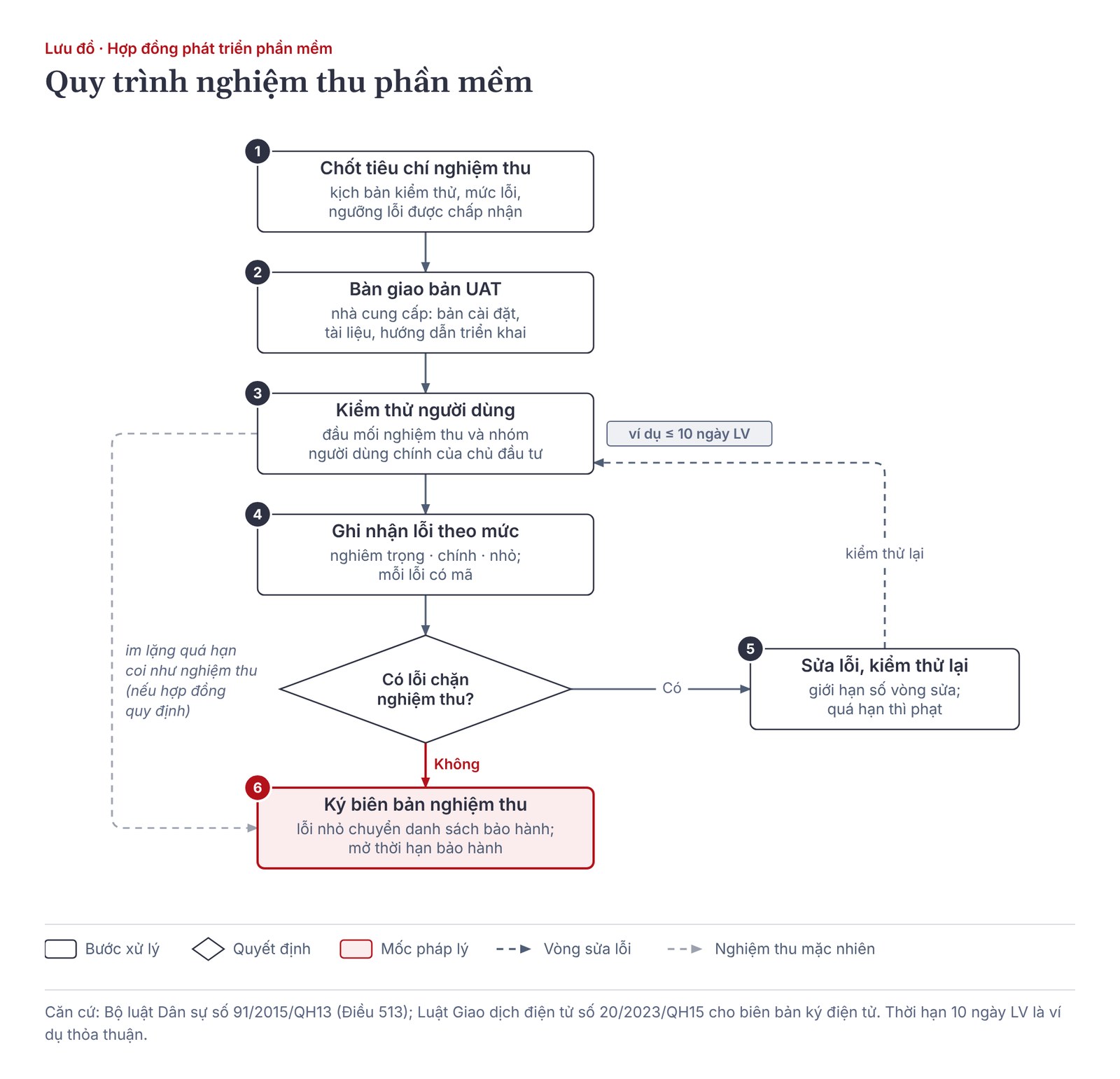
Figure 01. Software acceptance process
Basis: Civil Code No. 91/2015/QH13; Law on E-Transactions No. 20/2023/QH15 | Testing period is an example
While blocking defects remain, the flow loops back through fixing and retesting (dashed line on the right). The grey branch on the left warns that, if the contract treats silence as consent, an expired test window counts as acceptance.
On the customer side, appoint in writing one acceptance lead and a group of key users to run UAT. If the contract says "if Party A gives no comments within 10 working days after delivery, acceptance is deemed given", the business units must know it; otherwise the system may be deemed accepted before anyone has actually tested it. Acceptance records, defect lists and confirmation emails may be made and signed electronically under the Law on Electronic Transactions No. 20/2023/QH15; what matters is central, versioned storage.
Milestone payments and retention
Payments should not be tied to time ("30% in month three") but to documented events: design approval, UAT build delivery, final acceptance. Part of the price, typically 5–10%, should be retained until the warranty period ends or replaced by a bank warranty guarantee.
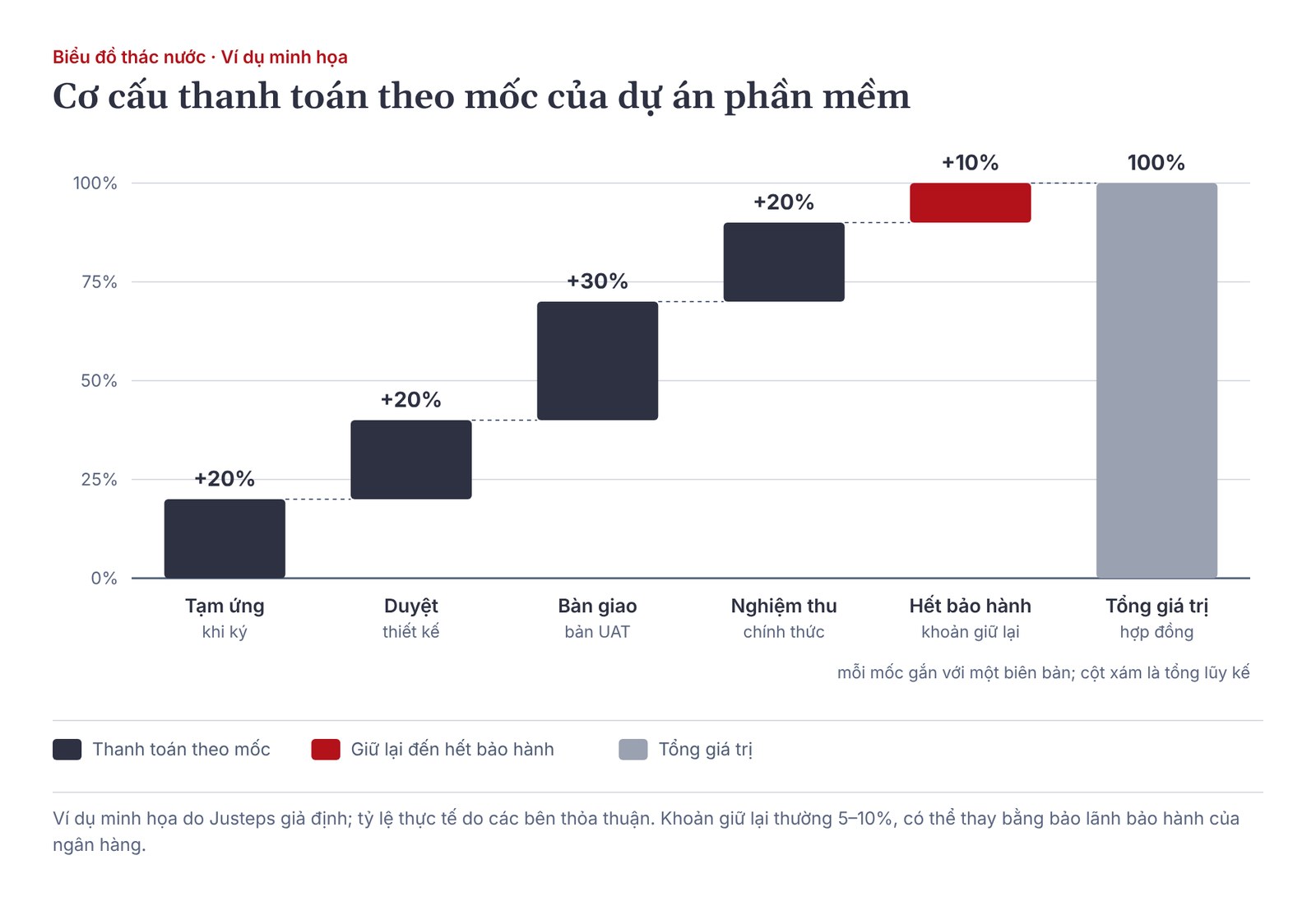
Figure 02. Milestone payment structure of a software project
Illustrative example, assumed percentages
Each column is a payment tied to a milestone record, accumulating to 100% of the contract value. The red column is the 10% retained until the warranty period ends.
Accounting should only pay when the payment request is accompanied by the record for the relevant milestone. It is a simple control, but it stops payment before the product meets the standard.
Warranty and maintenance, keep the two apart
Warranty is the obligation to fix defects caused by the vendor, free of charge, for a set period (usually 6–12 months after acceptance). Maintenance is a paid service: updates for operating system changes, library upgrades, operational support. The contract should set response and resolution times for each severity level, for example a two-hour response and a 24-hour workaround for critical defects.
Exclusions should be explicit: defects caused by the customer editing the code, by server infrastructure managed by the customer, or by a third-party system changing its interface. In return, the customer should require the vendor to warrant that there is no malware, backdoor or time lock.
Source code ownership and the points to lock down
A computer program is protected by copyright from the moment it is created. So the question is not "is it protected" but "who holds the economic rights". The contract should state that all economic rights in the source code, object code and design documents created for the project belong to the customer upon full payment of each milestone, and that the vendor warrants it has agreements with its own developers allowing the transfer.
Three points often cause disputes. First, the vendor's pre-existing components (libraries, product frameworks used for many clients): the vendor may keep the rights but should grant the customer a perpetual, non-exclusive licence with the right to modify. Second, open-source software: require a list of the open-source licences used and avoid licences that would force disclosure of the whole system's code. Third, repository access: the repository account should be owned by the customer from day one, with the vendor only given contributor rights.
If the software processes personal data of customers or employees, add a data processing annex that defines each party's role under the Law on Personal Data Protection No. 91/2025/QH15, governs the use of real data in test environments, and requires deletion on termination.
Internal control when managing a software development contract
The customer should appoint a contract manager (usually in IT) who keeps a log of milestones, signed records, approved change requests, open defects and unpaid retention. Legal reviews any change request that raises the contract value above the delegated limit. Three months before the warranty ends, the manager compiles outstanding defects to demand resolution before the retention is released. At closing, check that access rights of vendor staff have been revoked.
Legal basis and sources
- Civil Code No. 91/2015/QH13, effective from 1 January 2017 (Article 513 on service contracts).
- Commercial Law No. 36/2005/QH11, effective from 1 January 2006 (Article 301 on penalty limits).
- Law on Intellectual Property No. 50/2005/QH11, as amended in 2009, 2019 and 2022.
- Law on Electronic Transactions No. 20/2023/QH15, effective from 1 July 2024.
- Law on Personal Data Protection No. 91/2025/QH15, effective from 1 January 2026.
How Justeps supports businesses
- Drafting and reviewing software development contracts, acceptance annexes and warranty service commitments from the customer's or vendor's side, under our Advisory and regulatory compliance services.
- Setting up a technology contract management process and signing authority for change requests and acceptance records in our Operations setup package.
- Reviewing source code ownership, open-source licences and IP assignment agreements with developers before fundraising or a sale, with our Corporate and M&A team.
- In-house training for IT and procurement teams on managing software contracts through our In-house training programme.
Contact Justeps for advice on your specific project.
Frequently asked questions
If the customer stays silent after delivery, is the software deemed accepted?
Only if the contract contains a deemed acceptance clause. The customer should therefore check the response deadline and assign testers as soon as the delivery is received.
Once paid in full, does the source code automatically belong to the customer?
Do not assume so. Economic rights in a computer program must be clearly agreed in the contract, together with a list of the source code and documents to be handed over.
What is the maximum penalty for delay?
Between traders, a contractual penalty may not exceed 8% of the value of the breached obligation under Article 301 of the Commercial Law. In addition, the injured party may claim actual damages if it can prove them.
What is a reasonable software warranty period?
The law does not fix one. In practice it is 6 to 12 months after acceptance, long enough for the system to run through at least one quarterly closing or a peak business season.
Should real data be used for testing?
Keep it to a minimum. If it must be used, mask or pseudonymise personal data and set out confidentiality and post-test deletion obligations in the contract.
Related articles
- Warehousing and logistics contracts: liability for goods and warehouse operating structure
- Managing subcontractors in a construction company: selection, contracts, acceptance and payment
- Fintech legal compliance in Vietnam: eKYC, data and partnering with banks
This article is for reference and reflects the regulations in force at the time of publication. Please consult Justeps for advice tailored to your company’s records and situation.
For further information, please contact:
📩 Email: info@justeps.vn
🌐 Website: https://justepslegal.com · https://justeps.vn
🌐 Page: Justeps
☎️ Hotline (Zalo): 096 172 2607
📍 Thanh Xuan Office: 12th Floor, Licogi 13 Tower, 164 Khuat Duy Tien Street, Thanh Xuan Ward, Hanoi, Vietnam
📍 Ha Dong Office: LK06B, No.10, Dong Dua Area, Ha Dong Ward, Hanoi, Vietnam
📍 Ho Chi Minh City Branch: 528 Le Van Sy, Ho Chi Minh City, Vietnam
📍 Hai Phong Office: Truong Thinh Village, Ha Dong Commune, Hai Phong, Vietnam
📍 Quang Ninh Office: Van Don Special Zone, Quang Ninh Province, Vietnam





