
Key takeaways
- The payroll budget should be prepared by component, each with its own owner, namely pay under the salary scales, allowances, bonuses, overtime, the insurance contributions paid by the business and a contingency.
- The right starting point is the monthly headcount for each position, not the December payroll multiplied by twelve, because a person hired from July generates only six months of pay in the year.
- The 2027 budget must reflect the new regional minimum wage applicable from 1 January 2027 and the two additional public holidays from 1 March 2027, which affect the lowest pay grades and the cost of working on public holidays.
- The social insurance, health insurance, unemployment insurance and trade union fee contributions paid by the business amount to about twenty-three and a half per cent of the wages used as the contribution basis, so every additional fixed allowance also drives up insurance costs.
- The accountant should compare the budget with actual spending every month, and any component deviating beyond the agreed threshold, for example five per cent, must be explained by the responsible department.
A manufacturing business with about one hundred and twenty employees prepared its annual payroll budget by taking the December payroll, multiplying it by twelve and adding ten per cent for pay rises. By mid-year, actual spending had exceeded the budget by about fifteen per cent, because the spreadsheet omitted the Tet bonus, peak season overtime, the insurance contributions paid by the business on fixed allowances and the increase in the regional minimum wage from January. The board of management had to suspend recruitment for three approved positions, while the heads of department could not explain who was responsible for the overrun.
This article guides businesses in preparing their annual payroll budget in the order in which it is carried out, covering the structure of the budget, how to build a monthly headcount, how to calculate pay from the salary scales and the regional minimum wage, allowances, bonuses and overtime, the insurance contributions and trade union fee paid by the business, the approval and monthly monitoring process, and common mistakes. The main readers are directors, chief accountants, HR managers and heads of department of businesses with several dozen employees or more. The examples and figures in the article apply to 2027, a year with many changes to the minimum wage and public holidays that directly affect staff costs.
What a payroll budget consists of
The payroll budget is the total cost that the business expects to spend on employees during the year, including both amounts paid directly to employees and the contributions the business pays on their behalf into the insurance funds. An effective approach is to divide the budget into components with different natures and calculation methods, each with a department responsible for estimating and explaining it. Pay under the salary scales is calculated by HR based on headcount, allowances and bonuses are calculated by HR based on the regulations, overtime is estimated by heads of department based on the production plan, and insurance contributions and the trade union fee are calculated by the accountant based on the wages used as the contribution basis. A small contingency, usually one to two per cent of the total budget, covers unforeseen changes such as urgent replacement hiring or policy adjustments.
The chart below illustrates the structure of the 2027 payroll budget of a business with about one hundred and twenty employees, with a total budget of twenty-five point nine billion dong.
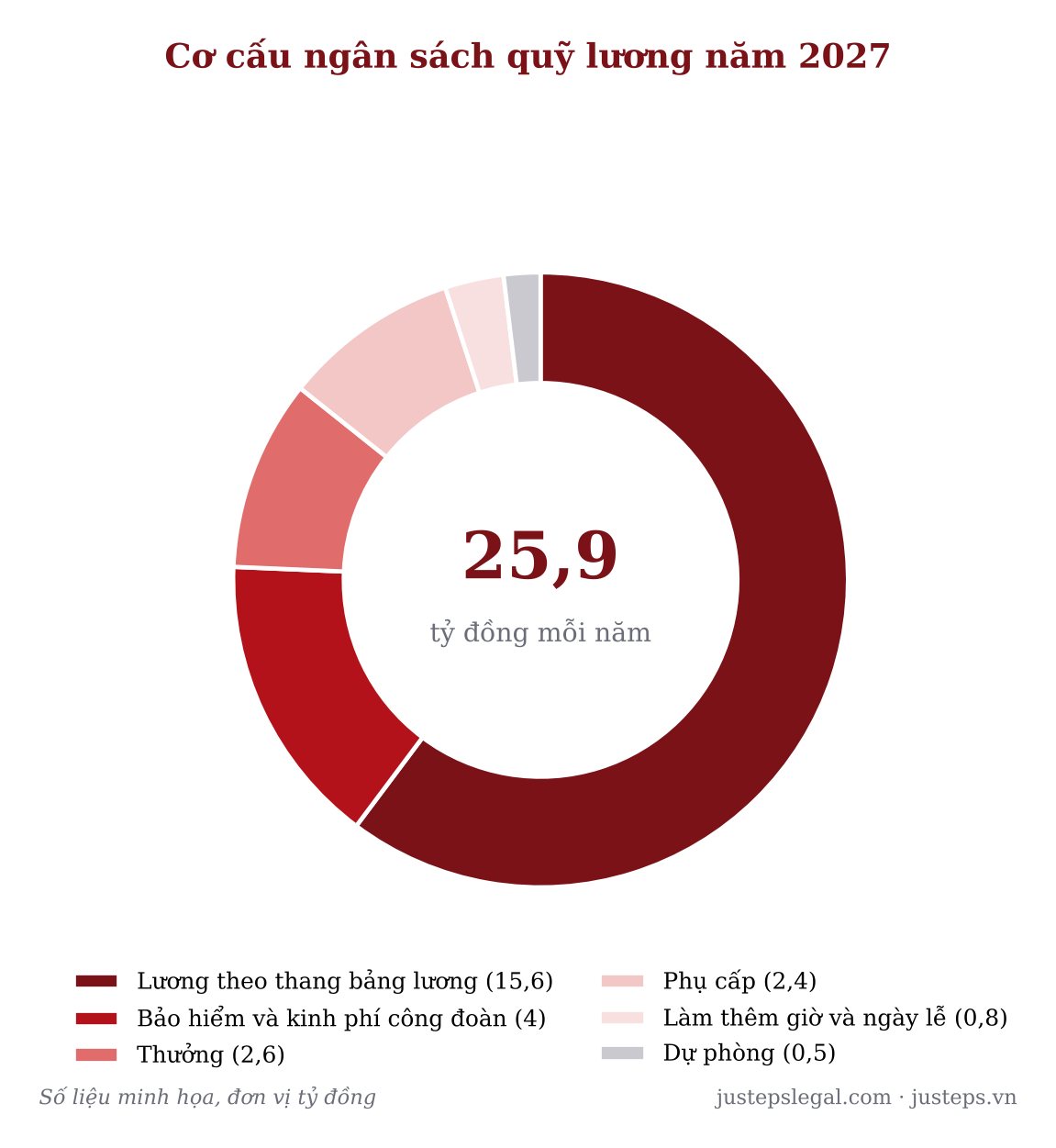
Structure of the 2027 payroll budget of a business with about 120 employees
In the example, pay under the salary scales is the largest component at fifteen point six billion dong, the insurance contributions and trade union fee paid by the business come second at four billion dong, followed by bonuses at two point six billion dong, allowances at two point four billion dong, overtime and public holiday work at zero point eight billion dong and the contingency at zero point five billion dong. The insurance contributions and trade union fee are calculated on a contribution basis of about seventeen billion dong, comprising all pay under the salary scales and one point four billion dong of fixed allowances, which makes this a large cost item that hastily prepared spreadsheets often omit. The figures are illustrative; the actual proportions depend on the industry, the bonus policy and the level of overtime in each business.
Starting from a monthly headcount
Headcount is the number of employees in each position that the business expects to use during the year, and it is the foundation of every figure in the payroll budget. HR should prepare the headcount month by month for each position, clearly stating who is currently employed, who is expected to retire, reach the end of their contract or take maternity leave, and the new positions to be recruited together with the expected start month. A position filled from July generates only six months of pay in the year, while one filled from March generates ten months, so recording the correct start month brings the budget much closer to actual spending than multiplying by twelve. For employees on maternity leave, the business does not pay wages during the leave because the employee receives benefits from the social insurance fund, but it may need to budget for a replacement.
The headcount needs to be linked to the annual business plan approved by the competent body, because payroll is the largest cost of many service and trading businesses. Under the Law on Enterprises, the Members’ Council of a multi-member limited liability company decides on the annual business plan[1], the owner of a single-member limited liability company decides on the annual business plan[2], and the Board of Directors of a joint stock company decides on the company’s annual business plan[3]. The payroll budget should therefore be submitted together with the business plan, so that the approving body can see the relationship between expected revenue, headcount and staff costs.
Calculating pay from the salary scales and the regional minimum wage
The employer must develop salary scales, pay tables and labour norms as the basis for recruiting and using employees, agreeing the wage stated in the employment contract and paying wages to employees, consulting the employees’ representative organisation at the grassroots level where there is one and publishing them at the workplace before implementation[4]. A business that fails to develop or publish salary scales and pay tables or fails to pay wages equally may be subject to administrative penalties[5]. When preparing the budget, each person’s pay is taken from their current grade in the salary scale, plus the expected grade increase under the regulations, for example one grade every two years, calculated from the month the employee becomes eligible.
2027 brings one change that must be built into the budget. From 1 January 2027, the monthly minimum wage rises to five million seven hundred thousand dong in Region I, five million eighty thousand dong in Region II, four million four hundred and fifty thousand dong in Region III and four million forty thousand dong in Region IV[6]. The wage for an employee’s job or title may not be lower than the minimum wage[4], so the business must review the lower grades of its salary scales, raise grades that fall below the new level and consider maintaining reasonable gaps between grades so that new hires do not earn almost as much as long-serving staff. The difference must be calculated from January and also drives up the insurance contributions paid by the business, since the wages used as the contribution basis also increase.
For businesses with branches or production sites in several localities, the minimum wage applies according to the locality where the employee works, so the spreadsheet needs to split the headcount by locality. Businesses should also recheck their localities after the reorganisation of administrative units, because the list of communes and wards in each region is set out in the appendix to the decree on the minimum wage. Businesses needing to review or rebuild their salary scales before the budgeting period may consider Justeps’ salary scales and pay and bonus regulations service.
Allowances, bonuses, overtime and public holidays
Allowances and bonuses
Allowances are estimated by the number of recipients of each type, such as responsibility allowances, hazardous work allowances, travel allowances and mid-shift meals, multiplied by the rate of each type and the number of months received. When preparing the budget, the business should separate allowances into two groups, namely fixed allowances paid regularly with each pay period and support payments made as incurred, because the first group is usually part of the wages used as the insurance contribution basis while the second may not be. A decision to increase the responsibility allowance for team leaders from mid-year therefore increases both the cost of allowances and the cost of insurance, and the spreadsheet needs to reflect both.
A bonus is an amount decided by the employer on the basis of business results and the employee’s level of work performance, under bonus regulations issued after consulting the employees’ representative organisation where there is one[7]. Because bonuses depend on business results, Justeps recommends preparing two scenarios, a base scenario in which the business meets its plan and a scenario in which it exceeds the plan, each stating the total bonus pool and the month of payment. The Tet bonus and the thirteenth-month salary are usually paid in January or February, so they must be included in the budget of the year of payment; this is the item most often omitted when businesses budget by calendar year.
Overtime and working on public holidays
Overtime costs should be estimated by department and by season, based on the actual overtime hours of the previous year and the production plan for the coming year. Under labour law, employees working overtime are paid at least one hundred and fifty per cent on ordinary days, two hundred per cent on weekly days off and three hundred per cent on public holidays, Tet and paid days off, not counting the holiday pay for employees paid by the day, as well as the night work allowance[8]. Overtime hours are also capped by month and by year, so a production plan requiring overtime beyond the limits signals that the business should consider hiring more people rather than simply increasing the overtime budget.
The Law amending and supplementing a number of articles of the Labour Code passed by the National Assembly on 21 November 2026 adds two fully paid public holidays, 27 July and 24 November, with effect from 1 March 2027[9]. For businesses with continuous production or services operating on public holidays, these two days increase the cost of holiday pay, while for businesses that close according to the calendar they reduce the number of working days and may create a need for overtime to make up output. The 2027 budget should calculate the impact of these two holidays separately for each department and follow the competent authority’s announcements on the specific days off where a holiday falls on a weekly day off.
The insurance contributions and trade union fee paid by the business
The wages used as the basis for compulsory social insurance contributions comprise the wage for the job or title, wage allowances and other supplementary amounts agreed to be paid regularly and stably in each pay period, with a minimum equal to the reference level and a maximum of twenty times the reference level[10]. On this basis, the business contributes seventeen point five per cent to the social insurance fund, comprising fourteen per cent to the retirement and survivorship fund, three per cent to the sickness and maternity fund and zero point five per cent to the occupational accident and disease insurance fund[10], plus three per cent for health insurance[11] and one per cent for unemployment insurance on the wage fund of those participating in unemployment insurance[12]. The total insurance contribution paid by the business is therefore twenty-one point five per cent, not counting the employee’s share deducted from wages.
In addition to insurance, the business pays a trade union fee equal to two per cent of the wage fund used as the basis for employees’ social insurance contributions, under the Law on Trade Unions[13]. Thus each additional one million dong of wages used as the contribution basis costs the business about two hundred and thirty-five thousand dong more in insurance and trade union fees. This is why the spreadsheet must calculate insurance per person and per month, applying the ceiling for high earners, rather than multiplying a fixed rate by the total payroll. The business should also note that foreign employees, people working under short-term contracts and people who have reached retirement age may be subject to different contribution rules, so each case needs to be checked.
The process for preparing, approving and monitoring the budget
The payroll budget should be prepared between October and December of the preceding year, in parallel with the business plan, so that it can be applied from January. The process needs to involve HR, heads of department, the accountant and the approving body, with a round of adjustments where the total budget exceeds affordability under the revenue plan. The flowchart below describes the sequence that Justeps usually applies when supporting businesses in preparing their payroll budget.
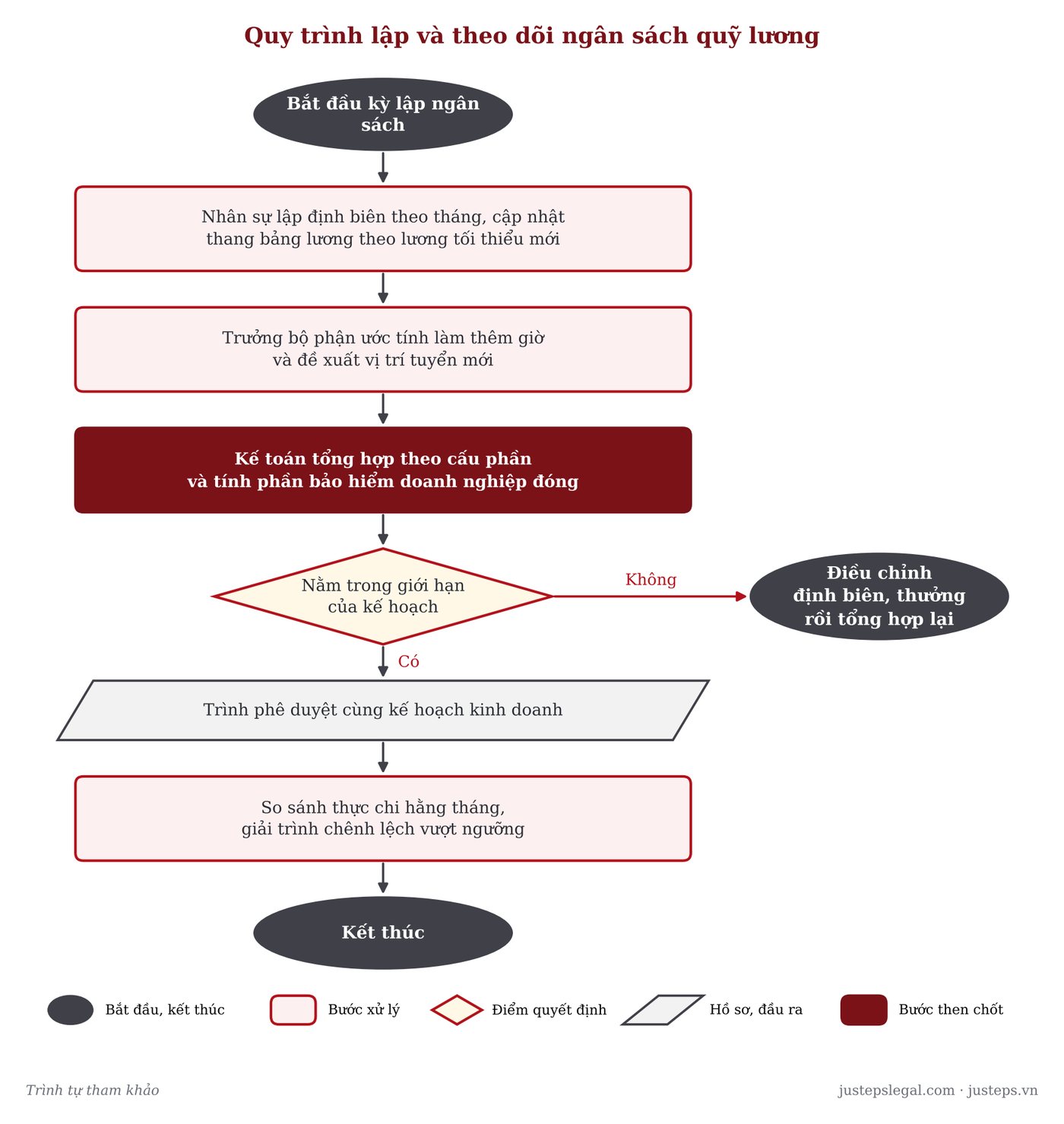
The process for preparing, approving and monitoring the payroll budget
According to the flowchart, HR prepares the monthly headcount and updates the salary scales to the new minimum wage, heads of department estimate overtime and propose new hires, and the accountant consolidates the budget by component and calculates the insurance contributions. If the total budget exceeds the staff cost allowed by the business plan, the budgeting team adjusts the headcount, the timing of hires or the bonus policy and then consolidates again, and the current round of calculation ends there. If it falls within the limit, the budget is submitted to the competent body for approval together with the business plan and is broken down by month for monitoring. Once approved, any decision to hire, raise pay or add allowances outside the budget requires a separate proposal and an offsetting source.
During the year, the accountant compares the budget with actual spending by component and by department every month, immediately after the payroll is closed. The business should agree on a variance threshold, for example five per cent against the plan for the month, above which the department responsible for that component must explain the cause and propose measures. The monitoring report should also show year-to-date cumulative figures, because small monthly variances can add up to a large amount by the end of the year. Businesses wishing to integrate the payroll budget into their overall budgeting and management reporting system may consider Justeps’ budgeting, cash flow and management reporting service.
As regards tax, wages, salaries and other amounts accounted for as expenses for employees but not actually paid or lacking payment documents as required are not deductible when determining income subject to corporate income tax[14]. The budget and actual wage payments therefore need to match the employment contracts, the salary scales, the pay and bonus regulations and the payment documents. Businesses wishing to set aside a wage reserve fund at year-end need to check the conditions, the maximum amount and the payment deadline under the current guidance of corporate income tax law before including it in the budget.
Common mistakes in preparing the payroll budget
Returning to the example at the beginning of the article, the chart below compares the budget and actual spending for the first six months of the year by component for the manufacturing business of about one hundred and twenty employees that prepared its budget by multiplying the December payroll.
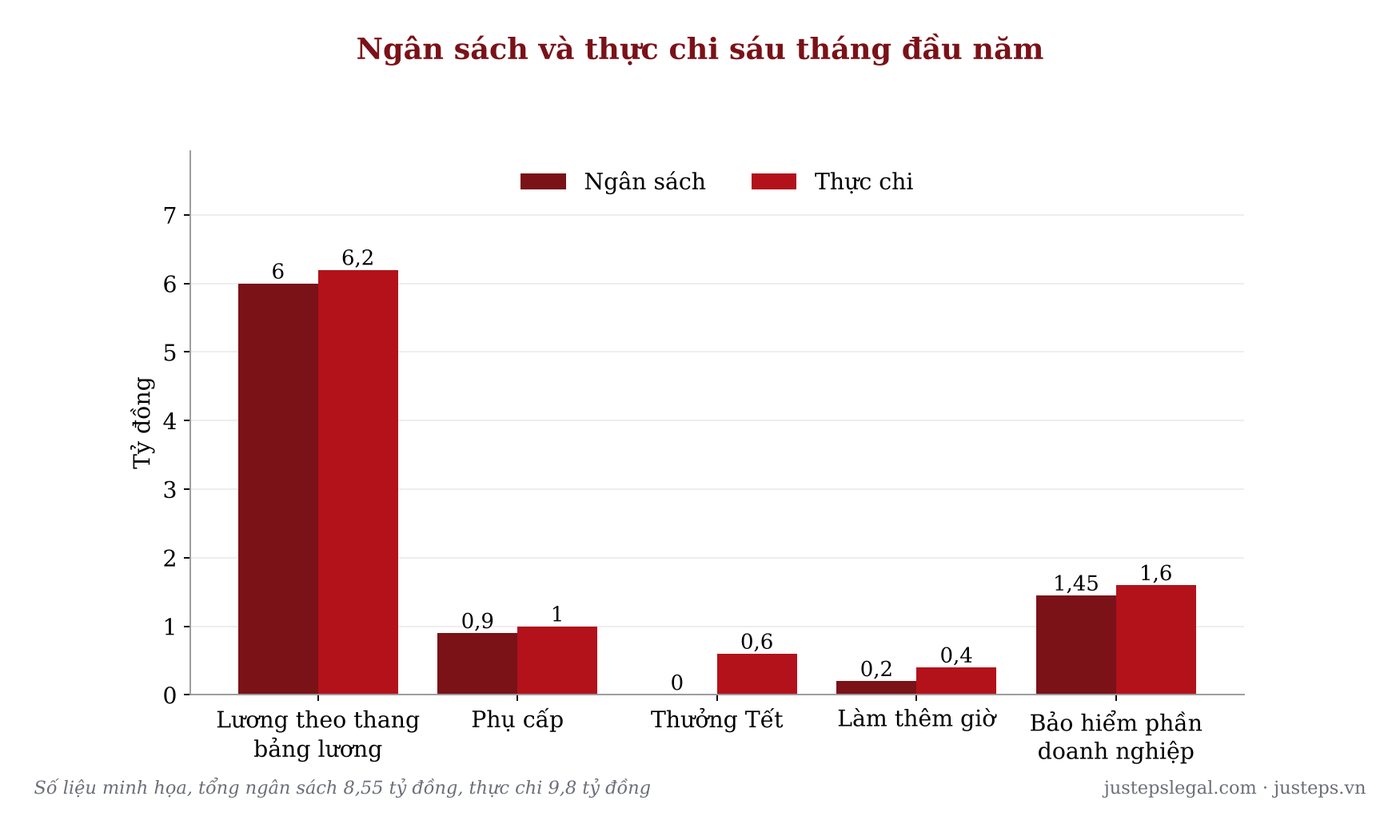
Budget and actual spending for the first six months by component
In the example, the total six-month budget was eight point five five billion dong but actual spending was nine point eight billion dong, an overrun of one point two five billion dong, or about fifteen per cent. The largest overrun was the Tet bonus of zero point six billion dong, which was entirely absent from the budget, followed by peak season overtime of zero point four billion dong against an expected zero point two billion dong. Pay under the salary scales exceeded the budget by zero point two billion dong because the lower grades had to be raised to the regional minimum wage from January, insurance exceeded it by zero point one five billion dong because of fixed allowances and higher pay, and allowances exceeded it by zero point one billion dong. The figures are illustrative, but the pattern of these overruns is very close to what Justeps commonly finds when reviewing businesses’ staff cost budgets.
From similar cases, the recurring mistakes that businesses should check before submitting the payroll budget for approval can be summarised as follows:
- Multiplying the December payroll by twelve without preparing a monthly headcount, so that new hires, leavers and employees on maternity leave are not reflected.
- Omitting the Tet bonus, the thirteenth-month salary or the plan achievement bonus paid at the beginning of the following year.
- Failing to calculate the insurance contributions and trade union fee paid by the business on fixed allowances.
- Failing to update the new regional minimum wage and the impact of the two additional public holidays in 2027.
- Failing to break the budget down by month and by department, so that it is unclear where an overrun arises and who is responsible for it.
Once these mistakes are remedied, the payroll budget becomes a tool for the board of management to make decisions on hiring, pay rises and bonuses during the year, rather than a figure that is only revisited at year-end. The business should keep the budget spreadsheet, the assumptions and the approval minutes with the business plan records, so that the next year’s budgeting has comparative data and so that it can explain wage costs when the competent authority carries out an inspection.
How Justeps can help
Justeps supports businesses in preparing their payroll budget and the related wage policies through the following services:
- Salary scales and pay and bonus regulations. Justeps reviews pay grades against the regional minimum wage applicable from 1 January 2027 and designs bonus regulations as the basis for budgeting.
- Budgeting, cash flow and management reporting. Justeps builds a payroll budget model by component and by month, together with a template report comparing actual monthly spending.
- Compulsory social insurance advisory. Justeps determines the wages used as the contribution basis and which allowances are or are not subject to contributions for each group of employees.
- Working hours, overtime and timekeeping. Justeps reviews the overtime plan, the 2027 public holiday calendar and the calculation of overtime and holiday pay.
- Review of deductible expenses and corporate income tax finalisation. Justeps cross-checks wage and bonus payment documents against contracts and regulations to ensure that wage costs are deductible at finalisation.
Frequently asked questions
When in the year should the payroll budget be prepared?
It should be prepared between October and December of the preceding year, at the same time as the business plan. This gives the business time to update the new regional minimum wage and obtain approval before applying it from January.
What is the regional minimum wage for 2027?
From 1 January 2027, the monthly minimum wage is VND 5,700,000 in Region I, VND 5,080,000 in Region II, VND 4,450,000 in Region III and VND 4,040,000 in Region IV[6]. Businesses apply it according to the locality where the employee works.
Which allowances must be included in the insurance contribution when budgeting?
Wage allowances and supplementary amounts agreed to be paid regularly and stably in each pay period form part of the wages used as the basis for social insurance contributions[10]. Support payments made as incurred need to be considered case by case.
Is it mandatory to include the Tet bonus in the budget?
The law does not require businesses to pay a Tet bonus, because bonuses are decided by the employer according to business results and the bonus regulations[7]. However, if the business has a practice or commitment to pay a bonus, this amount must be included in the budget of the year of payment.
How do the two new public holidays affect the 2027 budget?
27 July and 24 November become fully paid public holidays from 2027[9]. Businesses operating continuously must budget for additional holiday pay, while businesses closing according to the calendar need to account for overtime to make up output.
What variance threshold requires an explanation?
The law does not set this threshold; the business determines it in its budget regulations. Five per cent against the monthly plan is a common threshold, combined with monitoring of year-to-date cumulative figures.
Are wages recorded but not yet paid deductible expenses?
Wages not actually paid or lacking payment documents as required are not deductible expenses[14]. The business needs to check the conditions for setting aside a wage reserve fund under the current guidance if it wishes to recognise amounts not yet paid.
Related articles
- The annual pay review process, from criteria, budget and merit matrix to records and employee notification
- Annual budget planning for small and medium-sized enterprises, from assumptions and payroll to cash flow and control
- Reviewing wages, employment contracts and social insurance before the regional minimum wage rises on 1 January 2027
- The monthly social insurance management process within a business
Notes
[1] Point a, Clause 2, Article 55 of the Law on Enterprises No. 59/2020/QH14 dated 17 June 2020.
[2] Point b, Clause 1, Article 76 of the Law on Enterprises No. 59/2020/QH14 dated 17 June 2020.
[3] Point a, Clause 2, Article 153 of the Law on Enterprises No. 59/2020/QH14 dated 17 June 2020.
[4] The Labour Code No. 45/2019/QH14 dated 20 November 2019, as amended and supplemented by the Law amending and supplementing a number of articles of the Labour Code and certain laws passed by the National Assembly on 21 November 2026 (provisions on wages not being lower than the minimum wage and on developing salary scales, pay tables and labour norms).
[5] Clause 1, Article 23 of Government Decree No. 283/2026/ND-CP dated 15 July 2026 on administrative penalties in the fields of labour and social insurance.
[6] Government Decree No. 399/2026/ND-CP on the minimum wage for employees working under employment contracts, applicable from 1 January 2027.
[7] The Labour Code No. 45/2019/QH14 dated 20 November 2019, as amended and supplemented by the Law amending and supplementing a number of articles of the Labour Code and certain laws passed by the National Assembly on 21 November 2026 (provisions on bonuses and bonus regulations).
[8] The Labour Code No. 45/2019/QH14 dated 20 November 2019, as amended and supplemented by the Law amending and supplementing a number of articles of the Labour Code and certain laws passed by the National Assembly on 21 November 2026 (provisions on pay for overtime and night work and on the limits on overtime hours).
[9] The Labour Code No. 45/2019/QH14 dated 20 November 2019, as amended and supplemented by the Law amending and supplementing a number of articles of the Labour Code and certain laws passed by the National Assembly on 21 November 2026 (provisions on public holidays and Tet; effective from 1 March 2027).
[10] The Law on Social Insurance No. 41/2024/QH15 dated 29 June 2024, as amended and supplemented by the Law amending and supplementing a number of articles of the Law on Social Insurance passed by the National Assembly on 21 November 2026 (provisions on the wages used as the contribution basis and the employer’s contribution rates).
[11] The Law on Health Insurance No. 25/2008/QH12 and the amending and supplementing laws (provisions on the health insurance contribution rates of employees and employers).
[12] Clause 2, Article 4 of Government Decree No. 374/2025/ND-CP dated 31 December 2025 detailing the Law on Employment regarding unemployment insurance.
[13] The Law on Trade Unions No. 50/2024/QH15 dated 27 November 2024 (provisions on trade union fees).
[14] The Law on Corporate Income Tax No. 67/2025/QH15 dated 14 June 2025 and the amending and supplementing documents (provisions on wage and salary expenses that are not deductible).
This article is for reference and reflects the regulations in force at the time of publication. Please consult Justeps for advice tailored to your company’s records and situation.
For further information, please contact:
📩 Email: info@justeps.vn
🌐 Website: https://justepslegal.com · https://justeps.vn
🌐 Page: Justeps
☎️ Hotline (Zalo): 096 172 2607
📍 Thanh Xuan Office: 12th Floor, Licogi 13 Tower, 164 Khuat Duy Tien Street, Thanh Xuan Ward, Hanoi, Vietnam
📍 Ha Dong Office: LK06B, No.10, Dong Dua Area, Ha Dong Ward, Hanoi, Vietnam
📍 Ho Chi Minh City Branch: 528 Le Van Sy, Ho Chi Minh City, Vietnam
📍 Hai Phong Office: Truong Thinh Village, Ha Dong Commune, Hai Phong, Vietnam
📍 Quang Ninh Office: Van Don Special Zone, Quang Ninh Province, Vietnam





