
Key takeaways
- Exit interviews only yield honest information when the interviewer is independent of the leaver’s line manager and taking part is entirely voluntary.
- Paying the amounts relating to the employee’s entitlements, confirming the period of insurance contributions and returning documents are obligations of the business and must not depend on whether the leaver takes part in an interview.
- Interview notes are personal data and often contain comments about other people, so they require a consent form, restricted access and anonymisation when results are compiled.
- Reasons for leaving should be coded against a fixed list and read by department, because the real cause often lies within a particular team or with a particular manager.
- Each quarter, the business should choose no more than three priority actions, each with an owner, a deadline and a tracking indicator, and then report back to current staff.
In many businesses, exit interviews are either skipped altogether or reduced to a box-ticking exercise. In some, the leaver’s own head of department asks a few questions on the afternoon of the last working day; in others, a survey form is handed out with the final payment paperwork and the leaver fills it in just to get paid. The results are almost identical in every case, with leavers saying that the pay was not right or that they want to look for new opportunities, while the management reads the report and concludes that the problem lies in the labour market. Meanwhile, the real causes, such as the way a team leader manages or the workload piling up in one department, keep pushing more people out of the door.
This article shares practical lessons on organising exit interviews to obtain reliable information, covering how to choose the interviewer and the timing, separating the interview from the termination procedure, personal data protection requirements, how to analyse the results and how to turn them into retention actions. It applies to businesses with several dozen employees or more, where the number of leavers each year is large enough to reveal trends. It is written mainly for heads of HR, specialists in charge of employee relations and members of the management who monitor HR indicators.
Why exit interviews often fail to produce honest information
The first reason is that leavers have an incentive to say what is safe. At the time of the interview, the leaver is usually still waiting for wages and payment for untaken annual leave, may need the business to confirm their employment history or may need their former manager as a referee for the new employer. In these circumstances, citing pay or personal reasons is the least risky choice, whereas frank comments about the manager may be seen as making trouble. As long as leavers feel that their answers may affect their entitlements, the information obtained will remain distorted.
The second reason is that the questions are too general. Questions such as whether the employee is satisfied with the company or what made them leave tend to draw general answers that are not detailed enough to act on. The third reason is that the results are not used: current employees see colleagues leaving one after another for the same reason without anything changing, so they too lose faith in internal feedback channels. These three causes show that improving exit interviews requires changing the interviewer, the way questions are asked and the way the results are used, all at the same time.
Organising the exit interview
A worthwhile exit interview needs to be prepared according to a clear sequence, from receipt of the resignation to the point at which the notes are filed and anonymised. The sequence below is a reference framework for businesses with their own HR department.
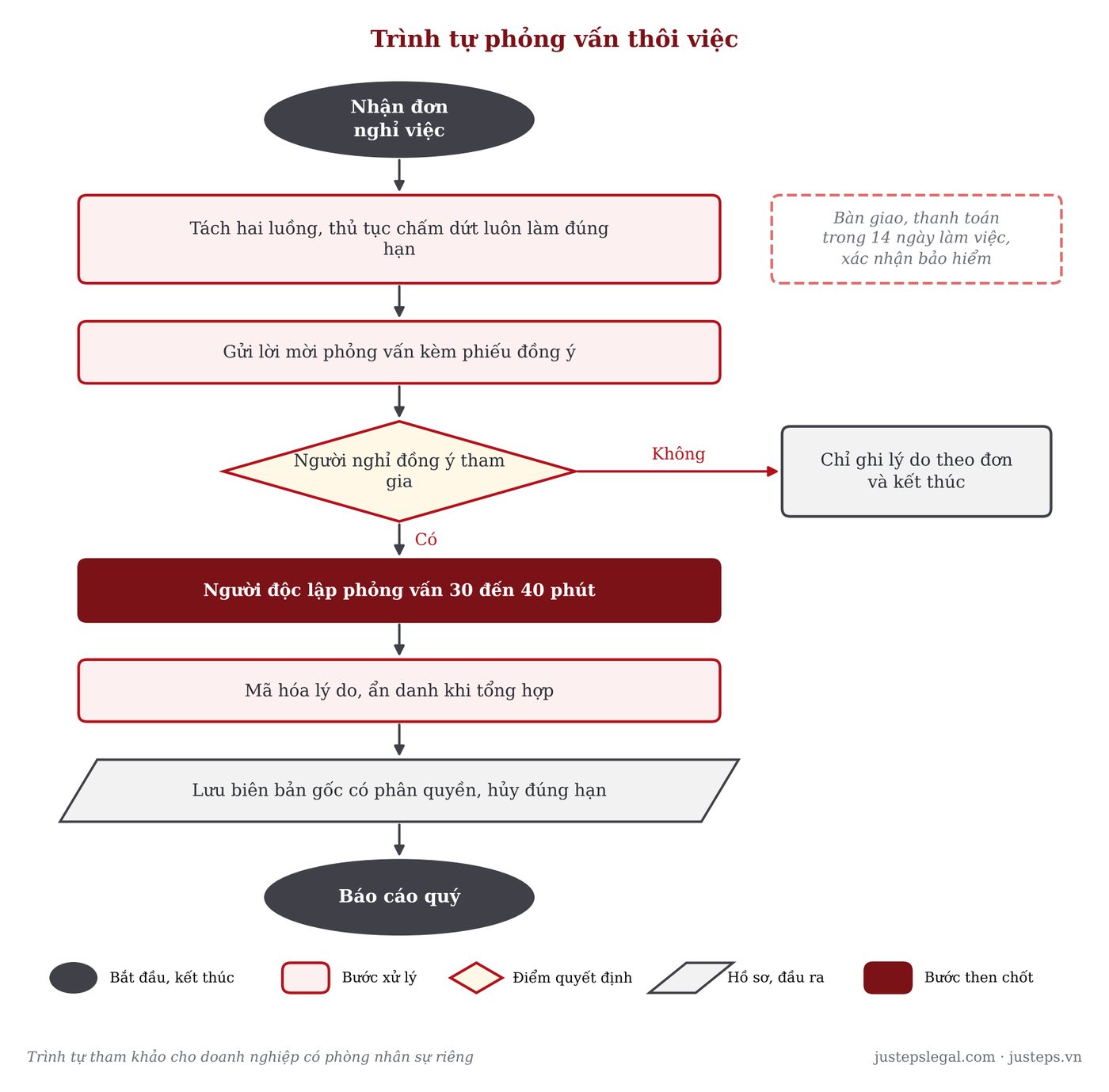
Sequence for organising exit interviews separately from final payments
The sequence begins when the business receives a resignation and the HR department splits the file into two independent streams. The first stream is the termination procedure, comprising handover, calculation of payments and confirmation of insurance, which is always completed on time. The second stream is the invitation to an interview together with a consent form for personal data processing; if the leaver does not consent, the HR department simply records the reason for leaving stated in the resignation and closes the file. The decisive step is an interview conducted by an independent person, after which the reasons in the notes are coded, anonymised when included in reports, and the original notes are kept only for the period stated on the consent form.
Choosing the interviewer
The interviewer should be the HR specialist responsible for the division or a manager with no direct reporting relationship with the leaver. The line manager should not conduct the interview personally, because the leaver will find it hard to speak honestly about the person sitting opposite and because managers tend to explain and argue rather than listen. For leavers at middle management level and above, the HR director or a member of the management should conduct the interview personally, as information from this group often concerns strategy and organisational structure.
Choosing the timing
The right time is after the leaver has handed over most of their work and around two to three days before their last working day, when work pressure has eased but the leaver still feels part of the team. The interview should not be held on the last day, when the leaver is busy saying goodbye and completing formalities. In addition to the face-to-face interview, the business may send a short survey around 30 to 60 days after the employee has left, as former employees who have settled in a new job tend to answer more frankly.
Questions and note-taking
The interview should last 30 to 40 minutes with around ten open questions, moving from the general to the specific. Questions should focus on events, for example when the employee first started thinking about leaving and what happened at that time, or what one thing they would change in their daily work if they could. The interviewer records the main points, avoids noting colleagues’ names where unnecessary and reads the main points back at the end so that the leaver can confirm or correct them. If the leaver reports conduct that may amount to a violation, such as sexual harassment or discrimination, the interviewer should ask whether the leaver wishes to file a formal complaint and refer the matter to the handling procedure under the internal labour regulations[1], rather than leaving the information only in the statistical report.
Separating the interview from the termination procedure
The exit interview is a voluntary activity; the law does not require employees to take part and does not allow the business to use the termination procedure to compel them. Within 14 working days from the termination of the employment contract, both parties are responsible for paying in full the amounts relating to each party’s entitlements, and this period may be extended to no more than 30 days only in certain cases prescribed by law[2]. The employer is also responsible for completing the procedure to confirm the period of social insurance and unemployment insurance contributions and for returning it together with the originals of any other documents it has kept from the employee[3]. Therefore, withholding the termination decision, the insurance book or the final month’s wages until the leaver takes part in an interview is a breach of the business’s obligations.
From the point of recruitment, the business is also prohibited from keeping the originals of employees’ identity papers, diplomas or certificates[4]. If the business still holds such documents from earlier, termination is the time to return them in full, independently of any survey activity. Breaches of the time limits for payment or for returning documents may attract administrative penalties under the decree on penalties in the labour field[5] and are a frequent cause of complaints and disputes after the employee leaves.
To avoid confusion between the two streams, the HR department should keep a separate termination checklist recording milestones such as the date the resignation was received, the notice period the employee must observe when unilaterally terminating the contract[6], the handover date, the payment date and the date documents are returned. The checklist should list the amounts payable, such as wages for days worked, payment for untaken annual leave and severance allowance where the employee is eligible[7]. The interview invitation is sent separately by letter or message, stating clearly that participation is voluntary and does not affect any entitlement. Where the leaver is in disagreement with the business over payments or the grounds for termination, the interview should be postponed and the matter should first be resolved through negotiation and mediation; businesses may refer to Justeps’ labour disputes and termination of contracts service.
Allocating roles and protecting personal data in exit interviews
Exit interview notes are the leaver’s personal data and often also contain comments about colleagues and managers, so the risk of leakage is much higher than with an ordinary survey form. The Law on Personal Data Protection 2025 requires the data subject’s consent to be given voluntarily, on the basis of a clear understanding of the purpose of processing, the type of data and the processing party, and silence or non-response is not treated as consent[8]. The Law also contains specific provisions on protecting personal data in recruitment and in the management and employment of workers, under which data must be retained for the statutory period or as agreed and must be deleted or destroyed on termination of the contract, save as otherwise provided[9].
On that basis, the consent form should state clearly that the purpose of the interview is to improve the working environment, who may see the original notes, that the results will be anonymised when compiled and how long the original notes will be kept. The leaver has the right to refuse the whole interview or to decline to answer some questions without giving reasons. The following chart suggests the level of access each position should have to the three types of documents arising from exit interviews.
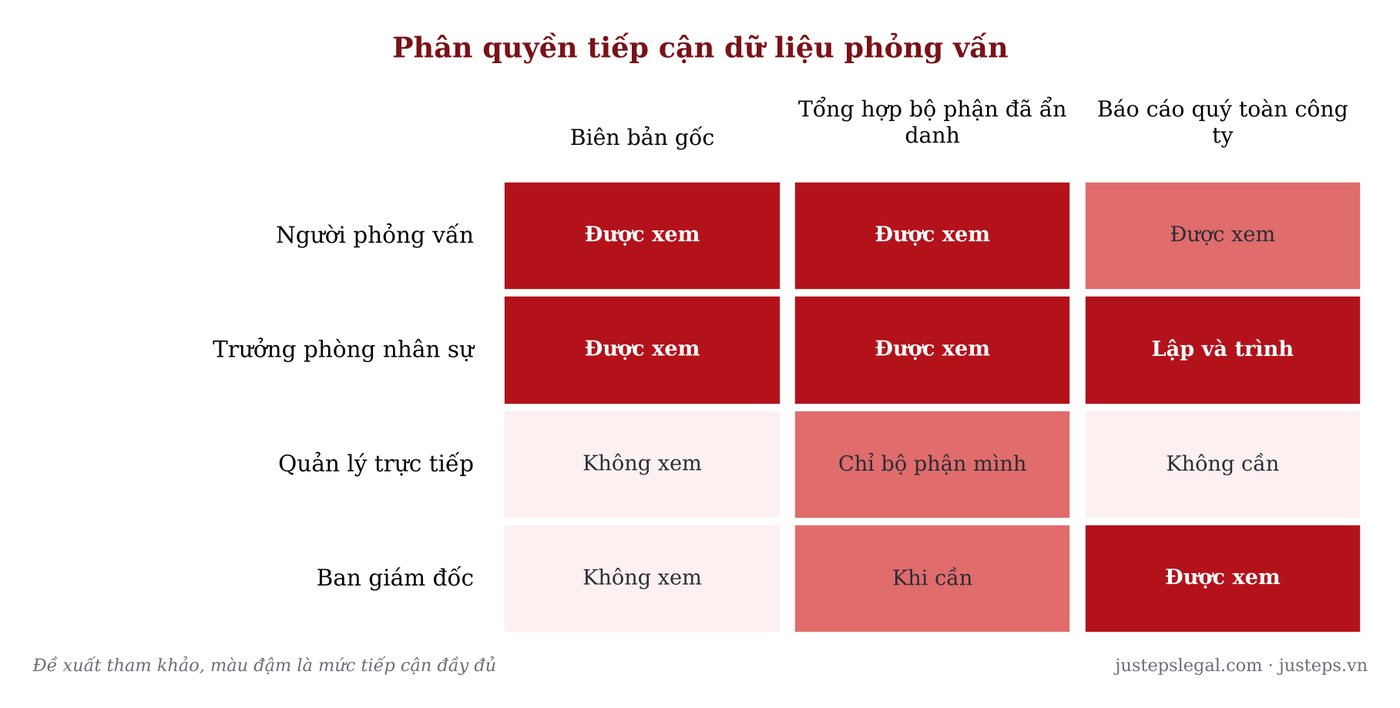
Level of access to exit interview data by position
Only the interviewer and the head of HR may read the original notes, as they are the people who need to understand the full context in order to code the reasons and handle any complaints. The line manager of the department concerned sees only the anonymised summary for their own department, while the management sees the quarterly report for the whole business. This allocation of access reassures leavers that their comments will not find their way back to their former department word for word. The business should anonymise content as soon as it is compiled, store the original notes in a folder with access controls and destroy them on time; the handling of HR data can be reviewed through Justeps’ personal data protection and cybersecurity service.
For departments of only a few people, removing names is not enough to protect leavers, because colleagues can guess who said what from the time of leaving and the position held. In such cases, the HR department should combine the results of small departments into a larger group or aggregate them by year before sending them to managers. Decree No. 363/2026/ND-CP provides detailed guidance on personal data protection[10], so the business should also check the requirements on data processing records when designing the procedure.
Analysing the results and using them to retain employees
Coding reasons for leaving against a fixed list
Each set of notes should be tagged with one or two main reasons from a fixed list, such as pay, the line manager, workload, development opportunities, working conditions and personal reasons. A fixed list allows comparisons between quarters and between departments, which is impossible if each interviewer names the reasons in their own way. Coders should rely on the events that the leaver described, not on the first answer to the question of why they are leaving, because the first answer is usually the safe one.
Reading the figures by department
Take the example of a distribution business with 120 staff, of whom 18 left during the year. Looking only at the overall figures, the line manager was cited in 7 cases, pay in 4 cases and workload in 4 cases, so the management might think that all heads of department need management skills training. When the figures are broken down by department, however, a different picture emerges.
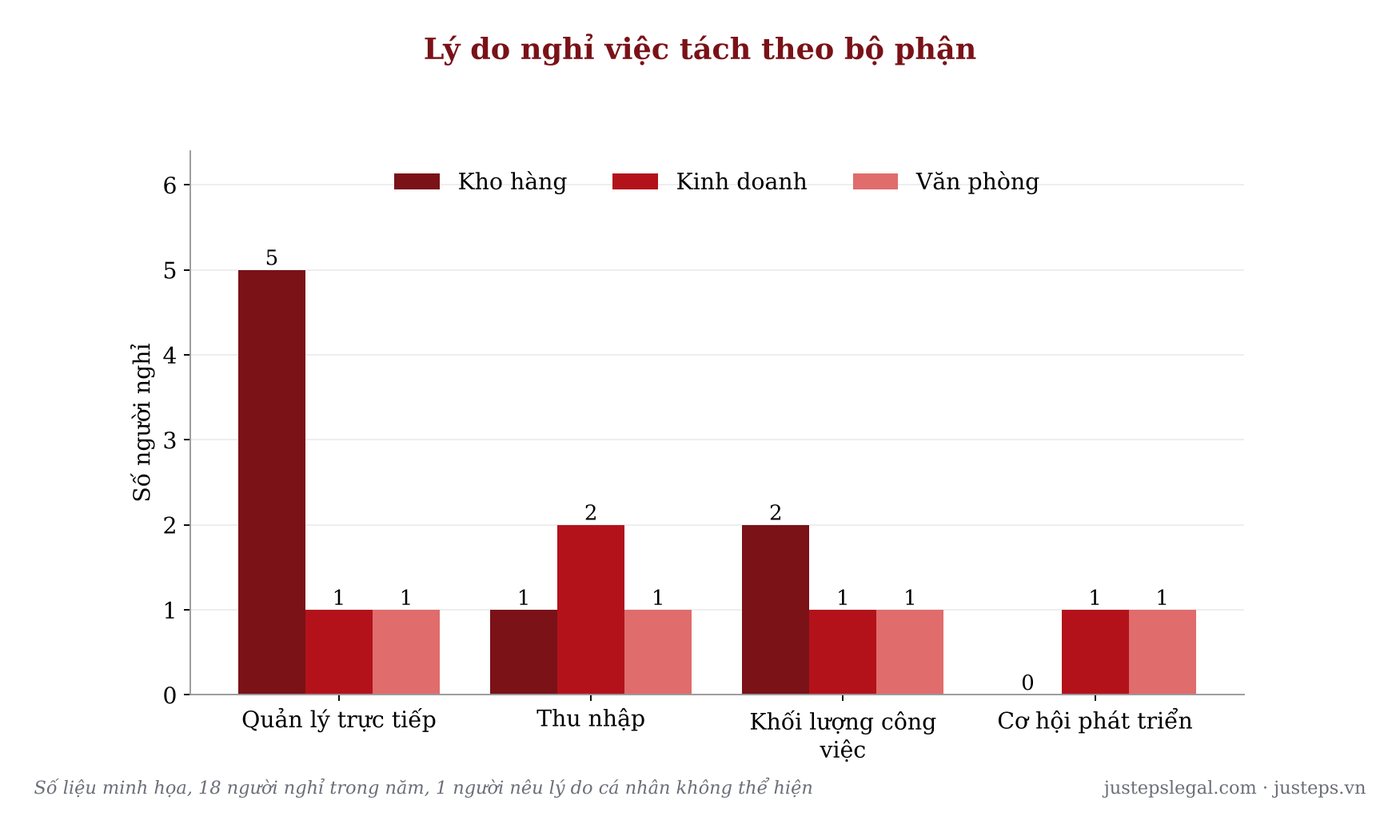
Reasons for leaving of 18 people in one year broken down by department, illustrative figures
Of the 7 cases citing the line manager, 5 came from the same warehouse, which means the problem lies in the management style of one particular warehouse manager rather than in the management team as a whole. Pay, on the other hand, was spread evenly across departments, so an across-the-board pay rise would hardly resolve most of the departures. A reasonable threshold for action is when the same reason recurs three or more times in the same department within one year. For businesses with fewer than 100 people, the figures should be aggregated by year; those with 100 or more may read them by quarter but should still compare them with the same period of the previous year.
Turning results into action
Each quarter, the head of HR should present no more than three priority actions to the management, each with an owner, a deadline and a tracking indicator. In the example above, suitable actions might be to reassess shift scheduling and task allocation at the warehouse, arrange coaching for the warehouse manager and monitor the warehouse’s attrition rate over the next two quarters. Exit interview results should be compared with engagement surveys of current employees, because problems that appear in both sources are usually genuine and the most worth investing in.
The step most often skipped is informing current employees of the changes made as a result of feedback. The communication does not need to say who gave the feedback; it need only state the problem identified and what the business has done, for example adjusting the warehouse shift schedule or clarifying the procedure for pay rises. When employees see that feedback leads to real change, they are willing to speak up earlier during their employment, giving the business a chance to address problems before more people hand in their resignations.
Common mistakes and the forms a business needs
From its HR consulting projects, Justeps frequently encounters four mistakes that make exit interviews both worthless and a source of legal risk for the business:
- The line manager interviews the leaver personally, so information about management style is almost never raised.
- The business withholds the termination decision, the insurance book or the final month’s wages until the leaver takes part in an interview.
- Verbatim notes are passed to the former department, so the leaver is identified by colleagues and those who remain lose trust.
- The business has no consent form for data processing and sets no period for retaining and destroying the original notes.
For the programme to run smoothly, the business should issue five forms to be used consistently. The set comprises a one-page procedure stating who is covered, who interviews and when; a consent form for personal data processing; a standard question set by group of positions together with a template for the notes; a quarterly report template with attrition figures, main reasons and no more than three proposals; and a termination checklist with the 14-working-day payment milestone, kept separate from the interview. These forms should be reviewed every year and whenever the rules on labour or personal data change.
Several changes in the law need to be taken into account when updating the procedure. The Law amending and supplementing a number of articles of the Labour Code, passed by the National Assembly on 21 November 2026 and effective from 1 March 2027, adds 27 July and 24 November as fully paid public holidays[11], so the way working-day time limits are counted in the termination checklist must be adjusted accordingly. The HR department should state the effective date of each version of the forms to avoid mixing old and new versions.
How Justeps can help
Justeps supports businesses in building exit interview procedures, standardising termination procedures and protecting HR data through the following services:
- Labour disputes and termination of contracts. Justeps standardises termination procedures, calculates the amounts payable and supports negotiation and mediation where disagreements arise.
- Personal data protection and cybersecurity. Justeps drafts consent forms and rules on access rights and retention periods for exit interview notes.
- Salary scales and pay and bonus regulations. Justeps reviews pay and bonus policies where interview results show that pay is a recurring reason for leaving.
- Labour and payroll compliance management. Justeps assesses HR procedures, including resignation procedures and record keeping, to identify risks before complaints arise.
Frequently asked questions
Are employees required to take part in an exit interview?
No. The exit interview is voluntary, and the business must still pay the amounts relating to the employee’s entitlements within the statutory time limit even if the employee does not take part[2].
Should employees dismissed by the business be interviewed?
The business may invite them, but the results should be analysed separately from those of voluntary leavers. If there is a disagreement over the grounds for termination or the payments, the interview should be postponed to avoid complicating the matter further.
Who should conduct exit interviews?
The interviewer should be an HR specialist or a manager with no direct reporting relationship with the leaver. For leavers at middle management level and above, the HR director or a member of the management should conduct the interview personally.
Is the leaver’s consent needed before notes are taken?
Yes. The notes are personal data, so the business needs the leaver’s voluntary consent based on a clear understanding of the purpose and of who will see the notes[8]. Silence or non-response is not treated as consent.
How long should exit interview notes be kept?
The business sets its own retention period for the original notes, states it on the consent form and then destroys them on time[9]. Anonymised data used for statistics may be kept longer to allow comparisons over the years.
How many sets of notes are needed before drawing conclusions?
Small businesses should aggregate results by year, while businesses with 100 or more people may read them by quarter. A reason recurring three or more times in the same department is a sign worth acting on.
How should a report of harassment made during an exit interview be handled?
The interviewer should ask whether the leaver wishes to file a formal complaint and refer the matter to the handling procedure under the internal labour regulations[1]. This information should not be recorded merely as a reason for leaving in the statistical report.
Related articles
- Lessons on running employee engagement surveys and turning the results into action plans
- Practical guidance on dealing with an employee who quits without notice or handover while staying within labour law
- What the HR department must do to protect employees’ personal data under the 2025 Law on Personal Data Protection
- Lawful procedure and documentation for workforce reduction when a company changes its structure or technology
Notes
[1] Article 118 of the Labour Code No. 45/2019/QH14 dated 20 November 2019 on internal labour regulations, including provisions on the prevention of sexual harassment in the workplace.
[2] Clause 1 of Article 48 of the Labour Code No. 45/2019/QH14.
[3] Point a of Clause 3 of Article 48 of the Labour Code No. 45/2019/QH14.
[4] Clause 1 of Article 17 of the Labour Code No. 45/2019/QH14.
[5] Government Decree No. 283/2026/ND-CP on administrative penalties in the fields of labour and social insurance.
[6] Article 35 of the Labour Code No. 45/2019/QH14.
[7] Article 46 of the Labour Code No. 45/2019/QH14.
[8] Article 9 of the Law on Personal Data Protection No. 91/2025/QH15 dated 26 June 2025, effective from 1 January 2026.
[9] Article 25 of the Law on Personal Data Protection No. 91/2025/QH15.
[10] Government Decree No. 363/2026/ND-CP detailing a number of articles of the Law on Personal Data Protection.
[11] The Law amending and supplementing a number of articles of the Labour Code, passed by the National Assembly on 21 November 2026 and effective from 1 March 2027.
This article is for reference and reflects the regulations in force at the time of publication. Please consult Justeps for advice tailored to your company’s records and situation.
For further information, please contact:
📩 Email: info@justeps.vn
🌐 Website: https://justepslegal.com · https://justeps.vn
🌐 Page: Justeps
☎️ Hotline (Zalo): 096 172 2607
📍 Thanh Xuan Office: 12th Floor, Licogi 13 Tower, 164 Khuat Duy Tien Street, Thanh Xuan Ward, Hanoi, Vietnam
📍 Ha Dong Office: LK06B, No.10, Dong Dua Area, Ha Dong Ward, Hanoi, Vietnam
📍 Ho Chi Minh City Branch: 528 Le Van Sy, Ho Chi Minh City, Vietnam
📍 Hai Phong Office: Truong Thinh Village, Ha Dong Commune, Hai Phong, Vietnam
📍 Quang Ninh Office: Van Don Special Zone, Quang Ninh Province, Vietnam





