
Key takeaways
- Accounts receivable should be managed under a written credit policy in which each customer has a grade, a maximum outstanding balance and a payment term approved by a person with the relevant authority.
- The payment clause in the contract should state the payment term, late payment interest, the right to suspend deliveries and the schedule for reconciling balances, as these form the basis for recovery when a customer pays late.
- A monthly ageing report is only of value when each ageing band is linked to a specific action, such as blocking new orders or transferring the file to the legal function.
- A balance confirmation signed by the customer is both the main evidence in a dispute and capable of restarting the limitation period for bringing a claim, so it should be signed at least once a quarter.
- Businesses may not engage debt collection services, because debt collection is a business line in which investment is prohibited; recovery must follow the steps of negotiation, mediation or legal action undertaken by the business itself.
When a business sells on credit, revenue is recognised immediately but cash arrives only when the customer pays, and the gap between those two moments determines the health of its cash flow. In many small and medium-sized enterprises, credit terms are promised to customers by individual salespeople, invoices are issued whenever the accountant has time, and balances are reconciled only at year end when the auditors ask for it. The usual consequence is that sales rise but the business still has to borrow short term to pay wages, and a few large debts are forgotten until the limitation period for bringing a claim has almost expired.
This article analyses how a business should organise the management of accounts receivable in the order in which the work is carried out, covering the credit policy, the payment clause, the allocation of roles between departments, ageing monitoring, reconciliation of balances and the handling of overdue debts. It applies to trading, manufacturing and services businesses that sell to corporate customers, and the main legal bases are the Civil Code, the Commercial Law and the rules on tax and invoices. It is written mainly for directors, chief accountants, heads of sales and the people responsible for legal affairs.
When a business needs to standardise the management of accounts receivable
In legal terms, a receivable is a right to require the customer to perform its obligation to pay under the contract, and that obligation must be performed in full, on time, at the place and by the method agreed[1]. The right has real value only when the business can prove that the obligation has arisen, has fallen due and has not been performed. Managing receivables therefore goes beyond bookkeeping and includes keeping sufficient evidence so that the right can be enforced when the customer fails to pay.
A business should issue written receivables rules when any of the following signs appears. First, the average collection period exceeds the payment term stated in the contract by 15 days or more. Second, overdue debts exceed about 10% of total receivables for three consecutive months. Third, salespeople decide on their own to give customers extra time to pay without anyone approving it. Fourth, the business is preparing to borrow from a bank or to bring in an investor, at which point the quality of its receivables will be examined closely.
The receivables rules need not be long, but they must answer four questions, namely who may be granted credit, how much and for how long, who monitors balances and chases payment, and what the business does at each milestone once a customer is overdue. The following sections analyse each of these questions in turn, together with the relevant legal bases.
Building a customer credit policy
Grading customers and setting credit limits
A credit policy is a document setting out the conditions under which a customer may buy on credit, the maximum outstanding balance and the payment term applicable to that customer. The safe principle is that a new customer pays in advance or on delivery for its first few transactions and is only then considered for credit, on the basis of its payment history, size and legal status. Before granting a limit, the accountant or the legal function should check the customer’s operating status on the national enterprise registration portal and the status of its tax code, because selling on credit to a business that has suspended operations or whose tax code has been closed almost certainly leads to a bad debt.
A common approach is to classify customers into three or four grades and attach a set of conditions to each grade. The following table is an illustrative example, and each business should adjust the specific levels to its own margins and capital turnover:
| Customer grade | Grading criteria | Credit limit and payment term |
|---|---|---|
| New customer | No trading history, or trading for less than three months. | Payment in advance or on delivery, with no outstanding balance permitted yet. |
| Grade A | Regular trading for over a year and never more than 15 days overdue. | A limit of about two months’ average sales, with a payment term of up to 45 days. |
| Grade B | Stable trading, but sometimes 15 to 30 days late in paying. | A limit of about one month’s average sales, with a payment term of up to 30 days. |
| Grade C | Has been more than 30 days overdue or shows signs of financial difficulty. | Partial payment in advance, a small outstanding balance and a term of no more than 15 days. |
Customer grades should be reviewed every quarter on the basis of the ageing report rather than fixed for the whole year. Any case of exceeding the limit or extending the term must be approved by the head of department or the director, in writing or in the software, in accordance with the delegated authority that has been issued. If salespeople are left to decide for themselves, the credit policy will be eroded by small exceptions repeated at the end of every month as they chase sales targets.
Security for large credit sales
For customers with large outstanding balances or long-term contracts, the credit limit should be backed by a specific form of security rather than by reputation alone. The options commonly used are a bank payment guarantee, a deposit or escrow of part of the value, and a retention of title arrangement under which ownership of the goods passes to the buyer only once payment has been made in full[2]. Retention of title suits machinery and equipment with chassis or serial numbers, but is of little use for fast-moving consumer goods, which have been resold or used before the business can reclaim them. When choosing a form of security, the business should weigh the registration cost, how easily it can be enforced in practice and how far customers will accept it.
The payment clause in contracts and orders
Many debts become hard to recover not because the customer has no money, but because the contract does not state clearly when the obligation to pay arises. At a minimum, the payment clause should specify the point from which the term runs, for example 30 days from the date on which the buyer signs the delivery record and receives a valid invoice, together with a single bank account for receiving payment and the contact details of each party’s person in charge of balances. For customers who buy through repeat orders, the business should sign a framework agreement containing all the payment conditions, so that each order need only state the quantity, price and delivery date.
The late payment interest clause is the most important tool for encouraging customers to pay on time. Under the Commercial Law, where the buyer is late in paying, the seller is entitled to claim interest on the overdue amount at the average market rate for overdue debts at the time of payment, unless otherwise agreed or provided by law[3]. For contracts governed by the Civil Code, interest on late payment is set by agreement but may not exceed the statutory cap, and where there is no agreement a rate of 10% per year applies[4]. The contract should therefore state a specific rate of interest to avoid arguments over how the market rate is to be determined.
In addition to late payment interest, the parties may agree on a contractual penalty for late payment, but for commercial contracts the total penalty may not exceed 8% of the value of the part of the obligation breached[5]. The contract should also state clearly the seller’s right to suspend deliveries when the customer is overdue, because the right to suspend performance of a contract can only be relied on safely where it has been agreed or where the other party’s breach is fundamental[6]. Businesses that need their standard sales contracts reviewed may consider Justeps’ service on drafting and reviewing commercial contracts.
The payment clause is also directly connected with the customer’s own tax position. From 15 December 2025, expenditure on goods and services of VND 5 million or more per transaction is deductible for corporate income tax purposes only if it is supported by non-cash payment documents[7], and input value added tax on goods and services purchased for VND 5 million or more is likewise creditable only with non-cash payment documents[8]. When persuading customers to pay on time by bank transfer into the registered account, the business can point out this benefit, while keeping cash collection by staff at the point of delivery to an absolute minimum.
Allocating roles between sales, accounting and the legal function
Accounts receivable are the shared responsibility of several departments, so the rules must state clearly which task belongs to whom to avoid gaps. The sales department proposes the grade and limit for each customer, monitors payment and chases customers directly, because it is the department with the customer relationship. The accounting department issues invoices at the correct time, records receipts, prepares the ageing report and sends out balance confirmations. The legal function or an outside consultant approves the contract templates, drafts formal notices when a debt has been overdue for a long time and assesses the options for recovery.
The diagram below shows how the three departments work together in a single cycle, from receiving an order to the money arriving and the debt being closed in the books.
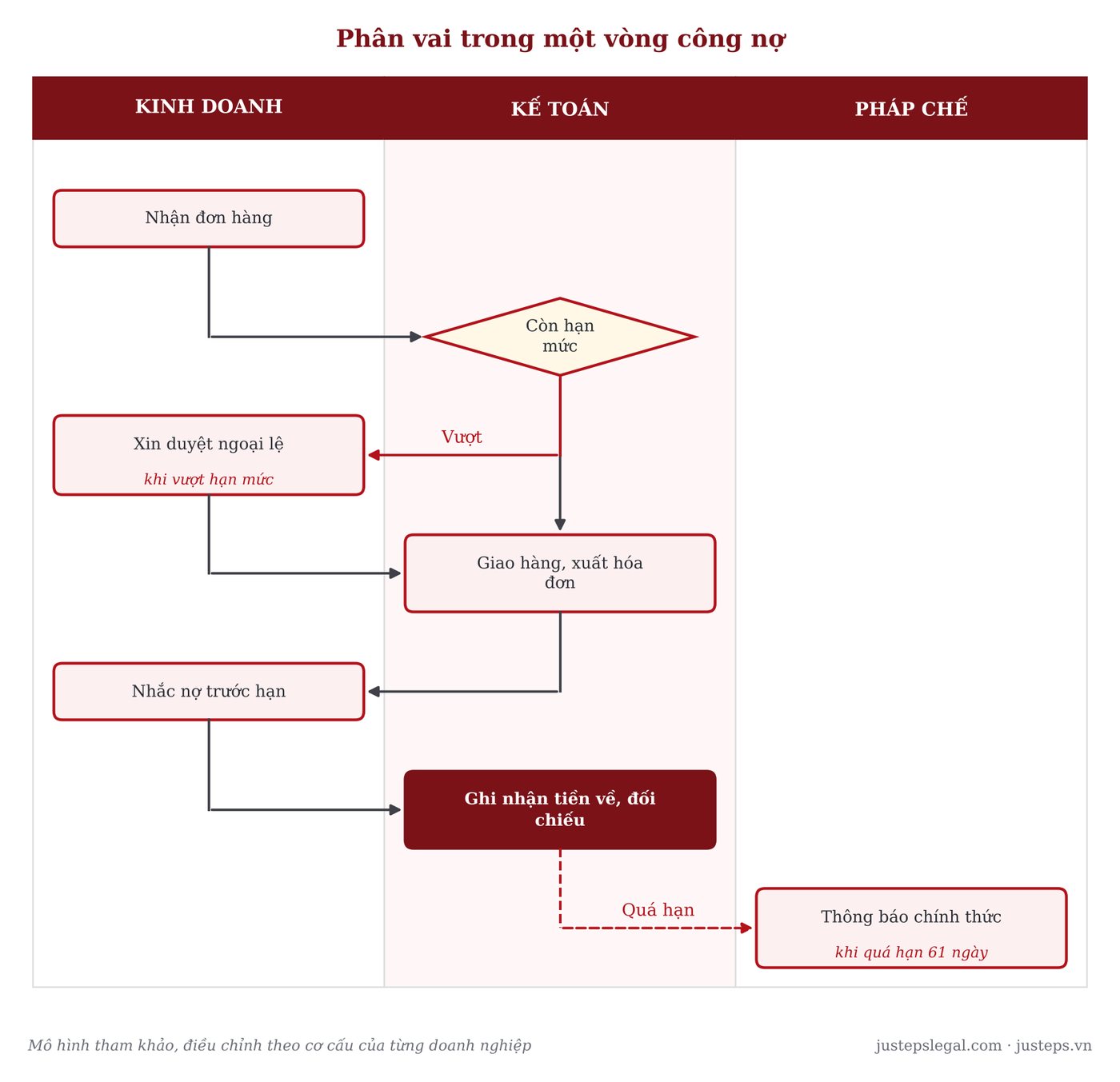
Coordination between sales, accounting and the legal function in one receivables cycle
The cycle begins when sales receives an order and accounting checks the customer’s remaining credit limit before confirming delivery. If the order would take the balance over the limit, it must wait for approval of an exception rather than being delivered first and approved afterwards. After delivery, accounting issues the invoice at the correct time and adds the debt to the ageing report, while sales reminds the customer a few days before the payment date. When an overdue debt reaches the set milestone, the file is transferred to the legal function, which sends a formal notice and prepares a negotiation plan.
The timing of invoicing must be observed strictly, because for goods the invoice must in principle be issued when ownership or the right to use the goods is transferred to the buyer, regardless of whether payment has been received[9]. Late invoicing both exposes the business to penalties relating to invoices and pushes back the date from which the customer’s payment term starts to run. A further control principle is that the person who collects cash directly from customers must not also keep the receivables ledger, so as to limit the risk of money being collected but not paid into the cash fund.
The bonus policy for the sales department should be tied to cash actually collected rather than to invoiced sales. A sensible approach is to calculate bonuses only on sales for which payment has been received, and to deduct a small percentage for debts more than 90 days overdue for which the salesperson is responsible. When bonuses are tied to cash flow, salespeople will think carefully before proposing a higher limit for a customer showing signs of paying late.
The ageing report and the indicators to monitor
An ageing report classifies receivables by the number of days since they fell due, usually into the bands not yet due, up to 30 days overdue, 31 to 60 days, 61 to 90 days and over 90 days. The report is useful only when each ageing band is linked to a mandatory action and a named person responsible for it, rather than serving merely as a report to the director. The following table suggests how actions may be linked to each band:
| Ageing band | Mandatory action | Person responsible |
|---|---|---|
| Not yet due | Remind the customer 3 to 5 days before the due date and confirm that the invoice has been received. | The salesperson in charge of the customer. |
| Up to 30 days overdue | Telephone and send a reminder letter with a statement and a proposed payment schedule. | The salesperson, with the receivables accountant preparing the statement. |
| 31 to 60 days | Block new orders, with the head of department dealing directly with the customer. | The head of sales, with accounting locking the limit in the software. |
| 61 to 90 days | Stop deliveries, send a formal demand for payment and charge late payment interest. | The legal function drafts the notice and the director signs it. |
| Over 90 days | Assess recovery options and prepare the file for negotiation, mediation or legal action. | The legal function leads and the director decides on the option. |
In addition to the ageing report, three indicators should be monitored every month, namely the average collection period, overdue debts as a percentage of total receivables and the on-time collection rate. The average collection period is calculated by dividing the average receivables balance by credit sales for the period and multiplying by the number of days in the period, and it should be compared with the average payment term in the contracts. If this indicator keeps rising while contract terms remain unchanged, it is a sign that customers are extending the term themselves and the business has not yet responded.
The chart below compares the ageing profile of a hypothetical distribution business at two points in time, before and after six months of applying receivables rules.
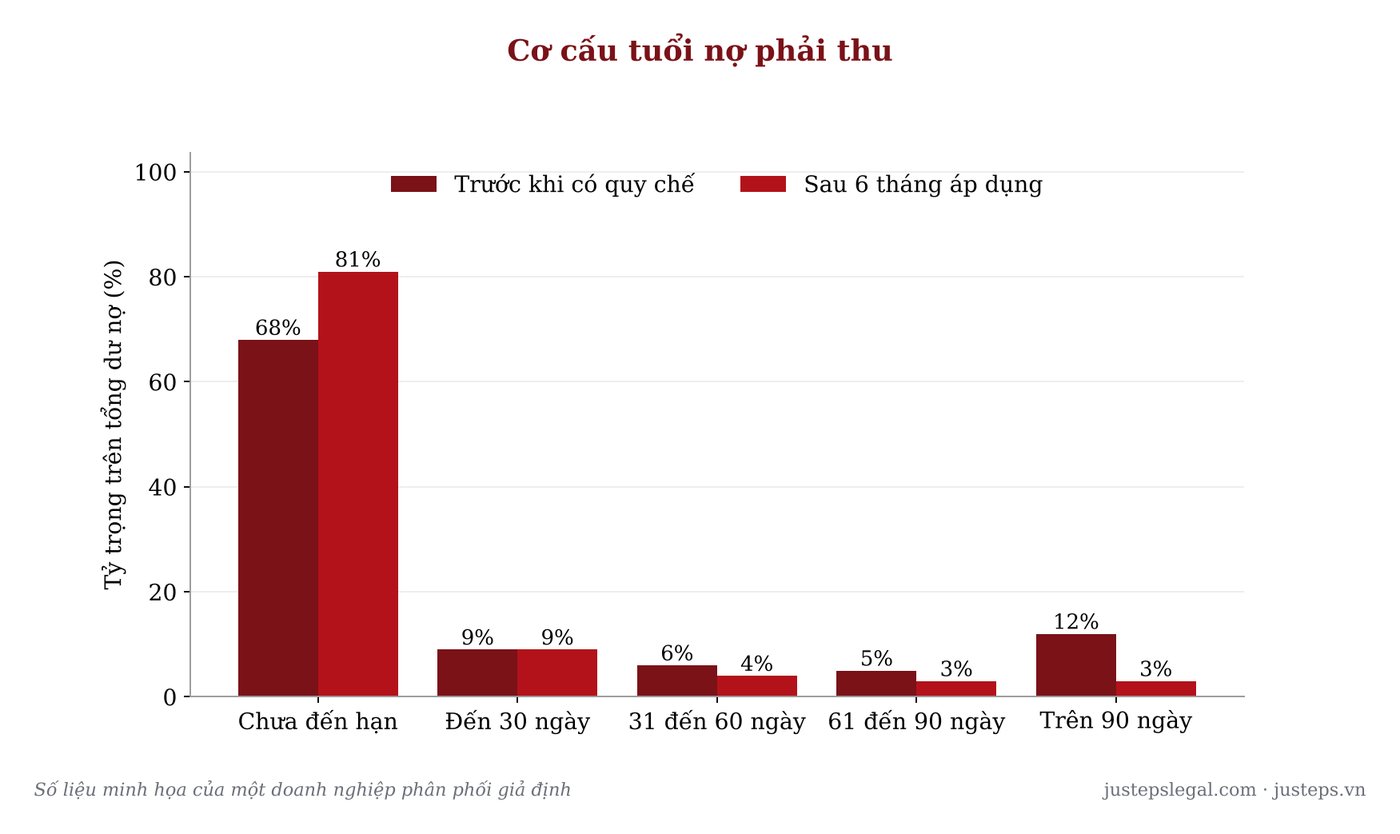
Ageing profile before and after applying receivables rules, illustrative figures
Before the rules were introduced, almost a third of receivables were overdue, and the band over 90 days alone accounted for 12% of the total balance. After six months of grading customers, blocking orders at the 31-day mark and reconciling balances every quarter, the share of debts not yet due rose to 81%, while the band over 90 days fell to 3%. The improvement came mainly from stopping short overdue debts early before they moved into the doubtful band, rather than from collecting old debts.
For debts that have been overdue for a long time, the business must make a provision for doubtful receivables in accordance with the guidance of the Ministry of Finance, at rates that increase with the length of time overdue, from 30% of the value for debts overdue from six months to less than one year up to 100% for debts overdue for three years or more[10]. Provisions must be based on records proving the debt, such as the contract, balance confirmations and collection documents, so incomplete receivables records also make it difficult for the business to make provisions and to deal with losses later on.
Periodic reconciliation of balances and the records to keep
A balance confirmation is a document in which both parties confirm the outstanding balance at a given date, together with details of the unpaid invoices. It is the most important evidence in a dispute, because it shows that the customer has acknowledged the obligation without each transaction having to be proved again. Under the Civil Code, the limitation period for bringing a claim starts again when the obligor has acknowledged part or all of its obligation to the claimant[11]. A balance confirmation signed by a person with proper authority therefore has the effect of extending the time during which the business can still bring a claim.
The limitation period for commercial disputes under the Commercial Law is two years from the time when the lawful rights and interests are infringed, while the limitation period for claims to resolve contractual disputes under the Civil Code is three years[12]. Because which period applies depends on the specific contractual relationship, the business should use the two-year mark as its internal management limit and transfer the file to the legal function at least six months before that date. A file transferred with only a few weeks left usually leaves too little time to negotiate, send notices and prepare a statement of claim.
The frequency of reconciliation should depend on the size of the customer, namely monthly for large customers or those with balances close to their limit, quarterly for other customers and in all cases at the closing date of the financial year. The person signing the confirmation on the customer’s side must be the legal representative or an authorised person, and the confirmation should bear the customer’s seal or digital signature. A confirmation signed only by the accountants of the two parties without authorisation is often challenged by the other party in a dispute.
The records for each receivable should be filed by customer code and order code, and should include the contract or framework agreement, the purchase order, the delivery record signed by the recipient, the invoice, the payment receipts, the reminder letters and the balance confirmations. Where the customer is an individual, the receivables records contain personal data such as identity card numbers, telephone numbers and addresses, so the business may use these data only for the notified purpose of debt collection and must restrict who has access to them[13]. The business must never publish lists of debtors on social media or send information about debts to a customer’s relatives or colleagues.
Handling overdue debts step by step
When a debt becomes overdue, the business should deal with it in escalating steps, each with a clear time limit and decision maker, so as to preserve the customer relationship while not losing the right to bring a claim. The following flowchart describes an illustrative sequence from the moment a debt becomes overdue to the point at which the business decides on its final course of action.
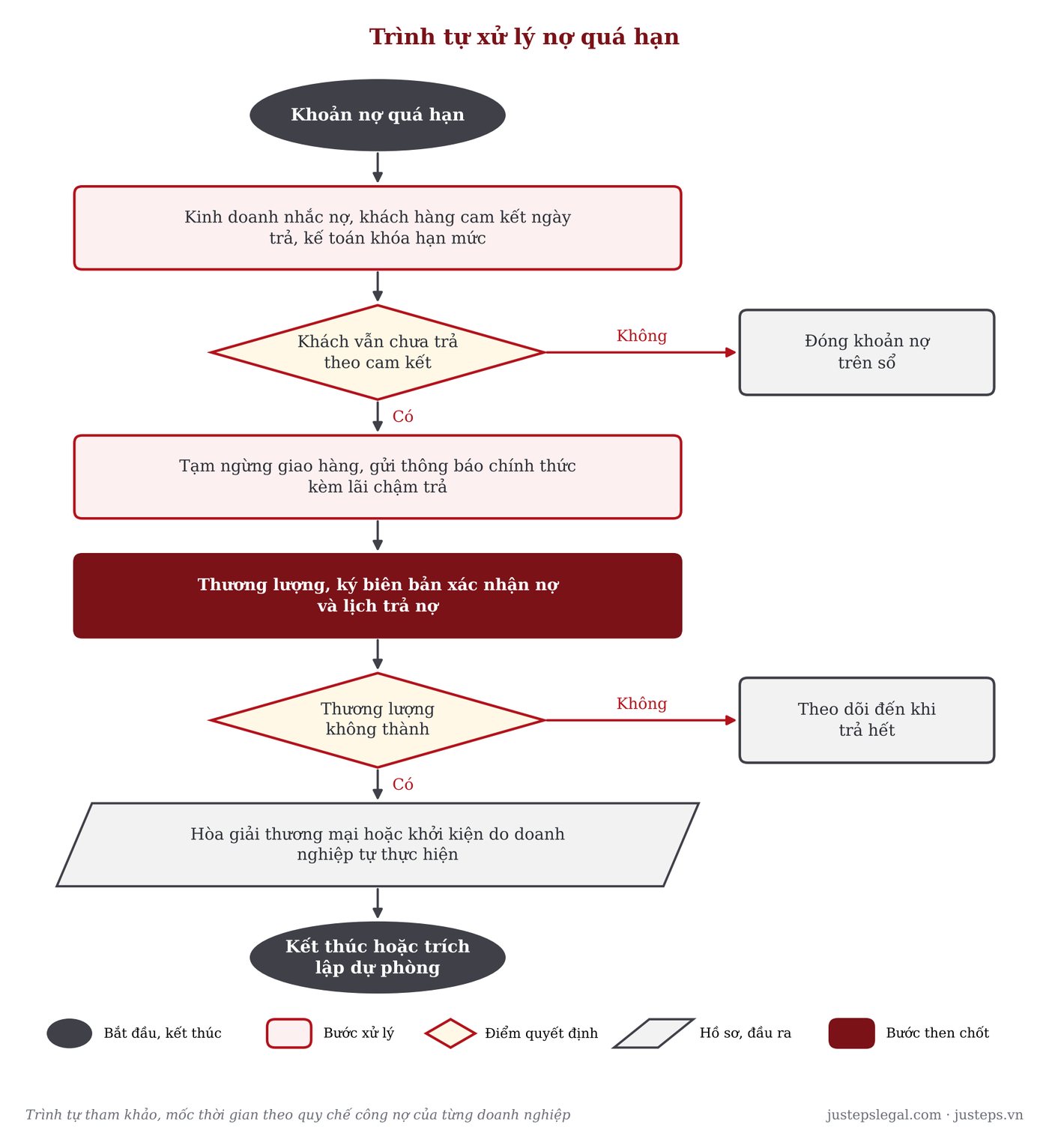
Step-by-step sequence for handling an overdue debt
At the first step, the salesperson reminds the customer and asks it to commit to a payment date, while accounting locks the credit limit so that no new debt arises. If the customer does not pay as committed, the business suspends deliveries under the contract and sends a formal notice signed by the director, stating the principal, the late payment interest and the final deadline. The key step is to negotiate so that the customer signs a debt acknowledgement and repayment schedule, because this document both forms the basis for recovery and restarts the limitation period. If negotiation fails, the business considers commercial mediation through a mediator, or bringing a claim before a court or, where the contract contains an arbitration agreement, an arbitral tribunal[14].
Some businesses turn to organisations that present themselves as debt recovery services, but debt collection services are a business line in which investment is prohibited[15]. Engaging such organisations may make the business jointly implicated in threats or infringements of the debtor’s honour and privacy, and weakens the business’s own position when the dispute is brought before the competent authority. The safe course is for the business to carry out the negotiation and mediation steps itself, or to authorise a duly licensed practising organisation when legal action is needed.
Justeps assists at the pre-litigation stages, including assessing the receivables file, drafting payment demands, debt acknowledgements and repayment restructuring plans, advising on negotiation and mediation, and preparing the file for the business to bring a claim itself or to pass to a practising organisation of its own choosing. To limit bad debts at their source, the business can combine its receivables rules with Justeps’ service on financial internal control systems, in which credit limits, approval of exceptions and reconciliation are built into a single system of delegated authority.
How Justeps can help
Justeps helps businesses build and operate a system for managing accounts receivable through the following services:
- Financial internal control systems. Justeps drafts receivables rules, the credit policy, the table of authority for approving limits and the periodic reconciliation procedure.
- Drafting and reviewing commercial contracts. Justeps reviews standard sales contracts to add clauses on payment, late payment interest, suspension of deliveries and security.
- Negotiation strategy and handling breaches. Justeps assesses overdue debt files, drafts notices and debt acknowledgements and advises on negotiation and mediation with customers.
- Financial regulations and delegation of authority. Justeps builds the authority to approve credit limits, extend payment terms and write off debts into the business’s general financial regulations.
Frequently asked questions
Is a business required to reconcile balances with its customers?
The law does not set a single mandatory frequency for all businesses, but reconciliation is the only way to confirm the outstanding balance with the customer. A balance confirmation signed by the customer can also restart the limitation period for bringing a claim[11], so the business should reconcile at least once a quarter and at the year-end closing date.
Can a business claim interest if the contract does not provide for late payment interest?
The business is still entitled to claim interest on the overdue amount under the Commercial Law or the Civil Code[3]. However, determining the applicable rate easily gives rise to argument, so the contract should state a specific rate from the outset.
May a business stop deliveries while a customer still has overdue debts?
The business may suspend deliveries if this has been agreed in the contract or where the customer has committed a fundamental breach of its payment obligation[6]. To avoid being treated as being in breach itself, the business should set out this right clearly in the contract and give written notice before stopping deliveries.
What is the limitation period for a claim to recover a commercial debt?
The Commercial Law sets a limitation period of two years for commercial disputes, while the Civil Code sets three years for contractual disputes[12]. The business should manage its receivables against the two-year mark and transfer the file to the legal function at least six months before that date.
May a business engage a debt collection company to recover debts on its behalf?
Debt collection services are a business line in which investment is prohibited[15], so businesses should not engage organisations of this kind. The business may negotiate itself, propose commercial mediation or bring a claim, and ask a consulting company to prepare the documents for each of those steps.
When must a provision for doubtful receivables be made?
Debts overdue for six months or more, or debts owed by customers that have gone bankrupt, been dissolved or absconded, fall to be considered for provision[10]. Provisions require records proving the debt, so the receivables file should be kept complete from the moment the debt arises.
Should salespeople be paid bonuses based on invoiced sales?
Bonuses based on invoiced sales tend to encourage selling on credit to high-risk customers. The business should calculate bonuses on sales for which payment has been received and make deductions where debts handled by the salesperson are more than 90 days overdue.
Related articles
- Building internal financial regulations for a limited liability company, from approval authority to advances and their settlement
- How a company should respond to a counterparty’s breach of contract before taking the dispute to court or arbitration
- Annual budget planning for small and medium-sized enterprises, from assumptions and payroll to cash flow and control
- Risk management for small and medium-sized enterprises through a risk register with named owners and a review schedule
Notes
[1] Article 280 of the Civil Code No. 91/2015/QH13 dated 24 November 2015.
[2] Articles 331 and 332 of the Civil Code No. 91/2015/QH13 on retention of title.
[3] Article 306 of the Commercial Law No. 36/2005/QH11 dated 14 June 2005.
[4] Articles 357 and 468 of the Civil Code No. 91/2015/QH13.
[5] Articles 300 and 301 of the Commercial Law No. 36/2005/QH11.
[6] Article 308 of the Commercial Law No. 36/2005/QH11; Article 411 of the Civil Code No. 91/2015/QH13.
[7] Point c of Clause 1 of Article 9 of Government Decree No. 320/2025/ND-CP dated 15 December 2025 detailing the Law on Corporate Income Tax.
[8] Article 26 of Government Decree No. 181/2025/ND-CP dated 1 July 2025 detailing the Law on Value Added Tax.
[9] Article 9 of Decree No. 254/2026/ND-CP dated 30 June 2026 of the Government on electronic invoices and electronic documents, effective from 1 July 2026, replacing Decree No. 123/2020/ND-CP and Decree No. 70/2025/ND-CP.
[10] Circular No. 48/2019/TT-BTC of the Ministry of Finance dated 8 August 2019 guiding the making and handling of provisions, as amended and supplemented.
[11] Article 157 of the Civil Code No. 91/2015/QH13.
[12] Article 319 of the Commercial Law No. 36/2005/QH11; Article 429 of the Civil Code No. 91/2015/QH13.
[13] The Law on Personal Data Protection No. 91/2025/QH15 and Decree No. 363/2026/ND-CP.
[14] Government Decree No. 22/2017/ND-CP dated 24 February 2017 on commercial mediation.
[15] Clause 1 of Article 6 of the Law on Investment No. 143/2025/QH15, effective from 1 March 2026.
This article is for reference and reflects the regulations in force at the time of publication. Please consult Justeps for advice tailored to your company’s records and situation.
For further information, please contact:
📩 Email: info@justeps.vn
🌐 Website: https://justepslegal.com · https://justeps.vn
🌐 Page: Justeps
☎️ Hotline (Zalo): 096 172 2607
📍 Thanh Xuan Office: 12th Floor, Licogi 13 Tower, 164 Khuat Duy Tien Street, Thanh Xuan Ward, Hanoi, Vietnam
📍 Ha Dong Office: LK06B, No.10, Dong Dua Area, Ha Dong Ward, Hanoi, Vietnam
📍 Ho Chi Minh City Branch: 528 Le Van Sy, Ho Chi Minh City, Vietnam
📍 Hai Phong Office: Truong Thinh Village, Ha Dong Commune, Hai Phong, Vietnam
📍 Quang Ninh Office: Van Don Special Zone, Quang Ninh Province, Vietnam





