
Key takeaways
- A matrix structure suits a business when most of its revenue comes from contracts with their own scope, schedule and budget, each contract needs three or more specialist departments and many projects run in parallel.
- The business must make a clear choice between a weak, balanced or strong matrix or a pure project structure, because each degree divides the power to decide on staff and budgets between project managers and department heads in a different way.
- Redrawing the organisation chart without amending the regulations on delegation of authority leaves project managers accountable without authority, so the RACI chart and project spending limits must be issued at the same time.
- Employees who report to two managers need to be evaluated on both project results and professional expertise, and the project bonus regulation must be made public at the workplace.
- Moving staff between projects should be based on job descriptions by professional title, the labour contract and the internal labour regulations, so as not to run into the limits on temporarily assigning employees to other work.
An engineering consultancy with about 80 employees is organised into design, cost estimation, supervision and administration departments. As the number of contracts grows, each contract needs people from all three specialist departments, and clients want a single point of contact responsible for everything. The company appoints several project managers, but the power to assign work and score performance remains with department heads, so engineers receive two different instructions on the same day and do not know whom to prioritise. A highly skilled specialist is assigned to four projects at once and all four fall behind schedule, and when a project ends nobody is sure where its team will go.
This article analyses when a business should adopt a project or matrix organisational structure, the degrees of the matrix structure, how to allocate authority and responsibility, how to coordinate resources across projects, how to evaluate and reward employees who report to two managers, labour contract considerations when moving staff, and the transition roadmap and set of documents to be issued. The content is suitable for consulting, design, construction, technology and event management businesses, as well as make-to-order manufacturers, with about 30 or more employees. It is written mainly for boards of management, heads of specialist departments, project managers and the people in charge of human resources.
When a functional structure is no longer enough
A functional structure, in which each department is responsible for one specialism and reports to the director, suits repetitive and stable work. Its advantages are that expertise is built up in one place, professional standards are consistent and responsibility for managing people is clear. However, when the core work of the business consists of contracts with their own scope, schedule and budget, every coordination issue between departments has to be escalated to the director, slowing decisions down and leaving nobody fully accountable to the client. A business should consider moving to a project or matrix structure when the following signs appear:
- More than half of revenue comes from contracts with their own scope, schedule and budget rather than from repeat sales of goods or services.
- Each contract requires the involvement of three or more specialist departments throughout its performance.
- The business regularly runs three or more projects in parallel, and some specialists have to divide their time among several projects.
- Clients require one person to be responsible for the whole project, from schedule and quality to cost.
Conversely, a business with fewer than 30 employees running only one or two projects at a time usually does not yet need a full matrix. At this size, keeping the functional structure and appointing a project coordinator with the authority to monitor, chase up tasks and report directly to the director is usually sufficient, at a much lower management cost. Moving too early adds an extra layer of management and many meetings that the volume of work does not yet require.
The four degrees of the matrix structure
The matrix structure comes in several degrees, which differ in how the power to decide on staff, budgets and evaluation is divided between project managers and functional department heads. In a weak matrix, department heads retain authority over staff and budgets, while the project coordinator mainly monitors progress and reports. In a balanced matrix, the project manager decides on scope, schedule and spending within approved limits, while the department head assigns people and ensures professional quality. In a strong matrix, the project manager holds the main authority over project staff, budget and evaluation, while functional departments mainly provide resources and professional standards. In a pure project structure, each project is almost an independent unit with its own staff, budget and support functions.
| Degree | Who decides on staff and budget | Suitable for |
|---|---|---|
| Weak matrix | The department head decides, while the project coordinator monitors and reports. | Businesses new to project work, with small and short projects. |
| Balanced matrix | The project manager decides on spending within limits, while the department head assigns people. | Mid-sized consulting, design and technology businesses with many parallel projects. |
| Strong matrix | The project manager makes the main decisions, while functional departments provide resources. | Large, long projects with demanding schedule and cost requirements. |
| Pure project | The project director has full authority within the allocated budget. | Very large works and projects lasting several years with little resource sharing. |
The chart below illustrates the share of decision-making power held by project managers and functional department heads at each degree. The shares are estimated across three groups of decisions, namely staff assignment, project spending and employee evaluation.
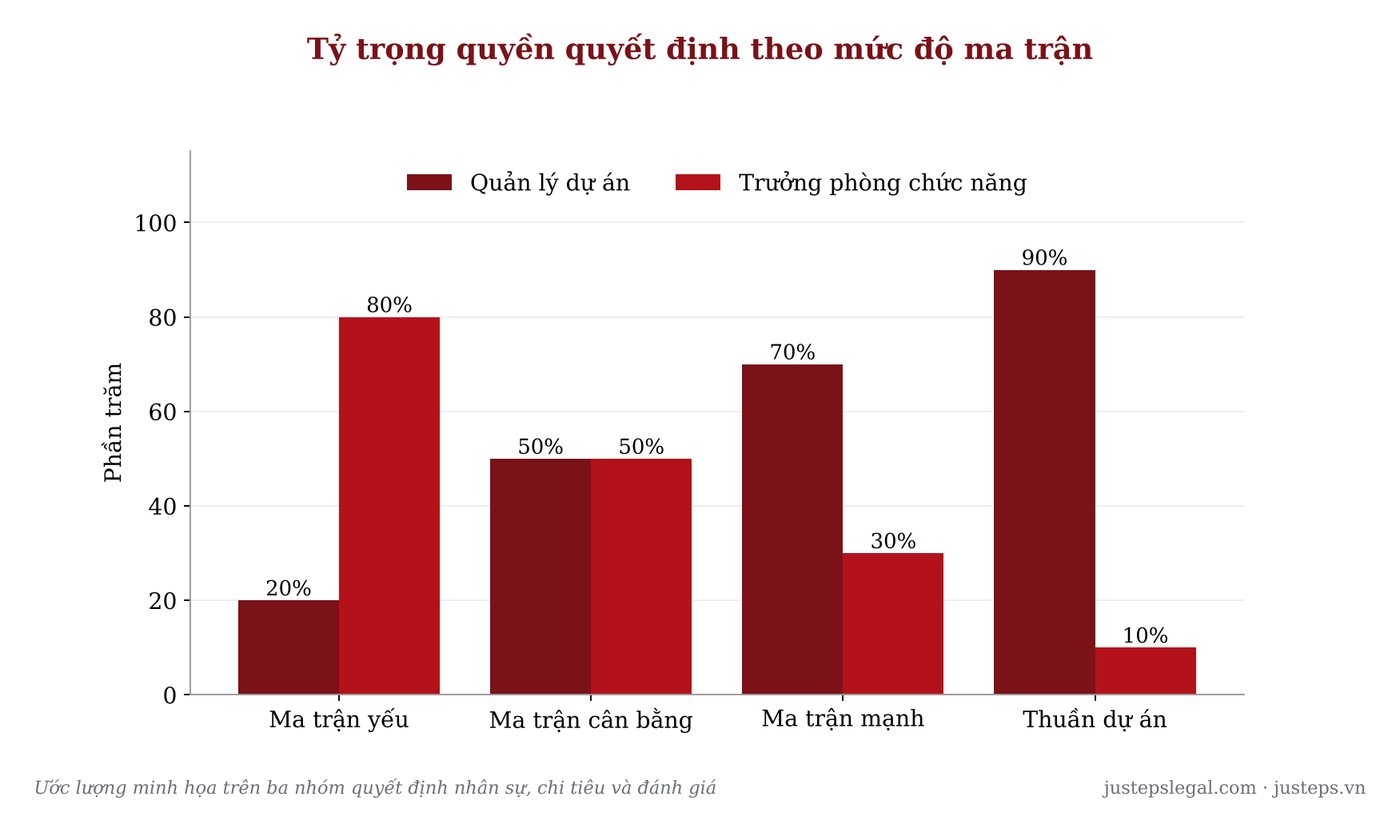
Share of decision-making power of project managers and department heads by degree of matrix
Moving from a weak matrix to a pure project structure, decision-making power gradually shifts from department heads to project managers. No degree is better in absolute terms, because the more power project managers have, the faster projects move, but the more easily resources are duplicated and the harder it becomes to maintain common professional standards. Most mid-sized businesses should start with a balanced or weak matrix and adjust it once they have data on the performance of the first projects. What must be avoided is failing to choose any degree at all, because each department head and project manager will then interpret their own authority in a different way.
Allocating authority and responsibility with a RACI chart
In a matrix structure, each employee has two managers, so every important decision needs to state clearly who carries it out, who is ultimately accountable, who is consulted and who is informed. The tool commonly used is a role allocation chart based on these four roles, known as a RACI chart after the initial letters of the four roles in English. The following table is an example for a balanced matrix:
| Decision | Project manager | Functional department head |
|---|---|---|
| Scope and schedule | Ultimately accountable and directly responsible for carrying it out. | Consulted on the department’s capacity to deliver. |
| Staff assignment | Proposes requirements for headcount and skills. | Ultimately accountable for assigning specific people. |
| Project spending | Decides within the limits approved by the director. | Informed of spending relating to the department. |
| Professional standards | Consulted where standards affect the schedule. | Ultimately accountable for technical procedures and quality. |
| Individual evaluation | Scores the contribution to project results. | Scores professional expertise and consolidates the annual result. |
A RACI chart is only meaningful when it is linked to the regulation on delegation of authority. If the project manager is recorded as the person deciding on spending but every payment request still has to be signed by the department head, then in practice authority remains with the department head. The project manager’s spending limit, the right to sign purchase requests and the right to approve project members’ working time therefore need to be amended at the same time in the financial regulations and the human resources regulations. Businesses that need to redesign their organisation chart, departmental functions and job descriptions along these lines may refer to Justeps’ service on organisational structure, functions and duties and job descriptions.
A mechanism for resolving disagreements
Disagreements between project managers and department heads are certain to arise in a matrix structure, usually over withdrawing people from a project, priorities between two projects or product quality versus schedule. The regulation should state clearly which level decides and within what time, for example the two sides discuss the matter within two working days and, failing agreement, the chief executive or the executive committee decides within the following three working days. Without such a mechanism, disagreements drag on for weeks and the employee caught in the middle bears the greatest pressure.
Coordinating resources across projects
The most common mistake in a matrix structure is assigning people to projects without anyone seeing the total workload of each person. The business should hold a resource allocation meeting every week or every two weeks between department heads and project managers, based on an allocation sheet recording the share of each person’s time devoted to each project. Experience shows that a specialist should not take part in more than three projects at the same time, because the time spent switching between projects significantly reduces productivity. The chart below illustrates the allocation of a group of specialists in a peak month.
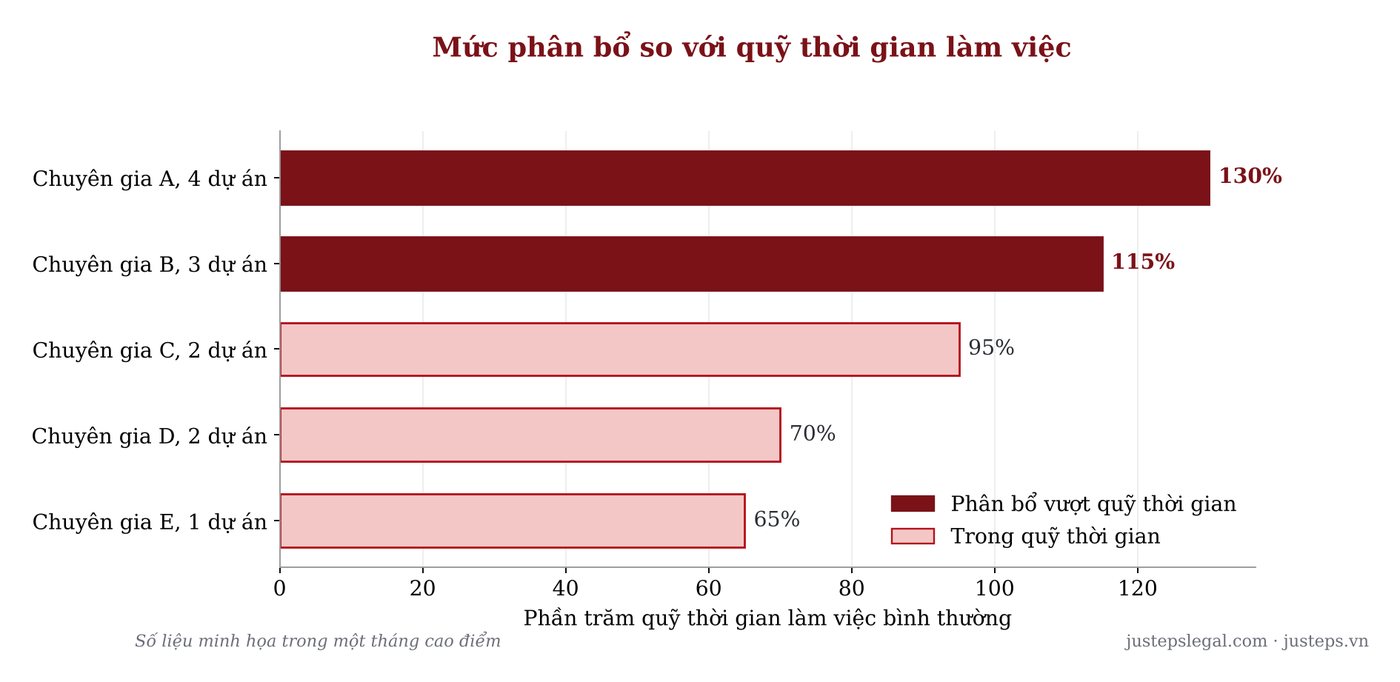
Time allocation of each specialist compared with normal working time
In this example, two specialists are allocated more than their normal working time, which means they can only finish by working overtime or by letting one project slip. Overtime requires the employee’s consent and is capped, with total overtime not exceeding 40 hours a month[1], so persistent over-allocation cannot be solved through overtime. Meanwhile, some other specialists are allocated only about two thirds of their time, which shows that the allocation meeting should redistribute work before assigning new projects. The allocation sheet also provides the basis for the director to decide whether to recruit more staff or decline additional contracts.
Two-way performance evaluation and rewards
If only the department head scores performance at the end of the year, employees will prioritise departmental work and neglect project objectives; if only the project manager scores it, professional standards and staff development are easily overlooked. The appropriate approach combines both directions, with the project manager evaluating the contribution to the results of each project in which the employee takes part, and the department head evaluating professional expertise, compliance with procedures and consolidating the annual result. In a balanced matrix, the weighting commonly used is 60% for project results and 40% for professional expertise, and the project weighting increases as the business moves towards a strong matrix. Businesses should note that the regulation on evaluating the level of work performance is the basis for determining cases in which an employee regularly fails to complete their work, and this regulation must be issued after consulting the grassroots employee representative organisation, if any[2].
As regards project bonuses, the bonus regulation is decided by the employer and made public at the workplace after consulting the grassroots employee representative organisation where such an organisation exists[3]. The regulation should state clearly how the bonus pool for each project is formed, for example as a percentage of the project’s gross profit, who proposes the allocation, who approves it and how cases where an employee leaves a project midway are handled. Bonuses that are not announced in advance easily become a source of complaints, especially when two people work on the same project but belong to two departments with different methods of calculation. Businesses that need to build a set of indicators and a two-way evaluation process may refer to Justeps’ service on KPI systems and performance evaluation.
Moving staff between projects and the labour contract
In a matrix structure, employees still sign their labour contracts with the business, while which project they belong to and whom they report to are matters of internal assignment. A labour contract must contain provisions on the job and the place of work[4], so if the contract is drafted too narrowly, for example as design engineer for project A in Hanoi, moving that person to another project in another province may be regarded as a change to the contents of the contract. The appropriate approach is to describe the job by professional title, state in the job description that the employee may be assigned to different projects, and specify the place of work as the head office together with project locations as assigned, where the nature of the work so requires.
Where it is necessary to temporarily assign an employee to work other than that in the contract due to production or business needs, the employer may do so for no more than 60 cumulative working days in a year, unless the employee agrees in writing[5]. The cases in which the business may temporarily assign employees to other work due to production or business needs must be specified in the internal labour regulations[5], and the internal labour regulations must contain provisions on temporarily assigning employees to work other than that in the contract[6]. Assignment between projects within the same professional title is therefore normal, but moving an engineer to administrative work while waiting for a new project is a temporary reassignment and must comply with the above limit.
When a project ends and no new project is available, the project team returns to its functional department and is assigned the department’s professional tasks, such as standardising documentation, training or preparing tender documents. The end of a project is not in itself a ground for terminating labour contracts. If the business genuinely needs to reduce headcount because of a change in structure, termination must follow the procedure for changes in structure or technology or for economic reasons, including preparing a labour utilisation plan and giving prior notice as required[7].
The transition roadmap and the set of documents to be issued
The authority to decide on organisational structure and issue internal regulations depends on the type of enterprise. In a limited liability company with two or more members, the Members’ Council decides on the company’s management structure[8], while the Director or General Director issues the internal management regulations, unless the company charter provides otherwise[9]. In a joint stock company, the Board of Directors decides on the company’s organisational structure and internal management regulations[10]. The decision to move to a matrix structure should therefore be approved in writing by the competent body, specifying the degree of matrix chosen, rather than merely being announced at a routine management meeting.
Converting the entire business at once usually causes major disruption, so the business should first pilot the model with two or three projects, measure the results and only then extend it. It usually takes six to nine months for a matrix structure to operate steadily. The sequence below suggests the steps of the transition.
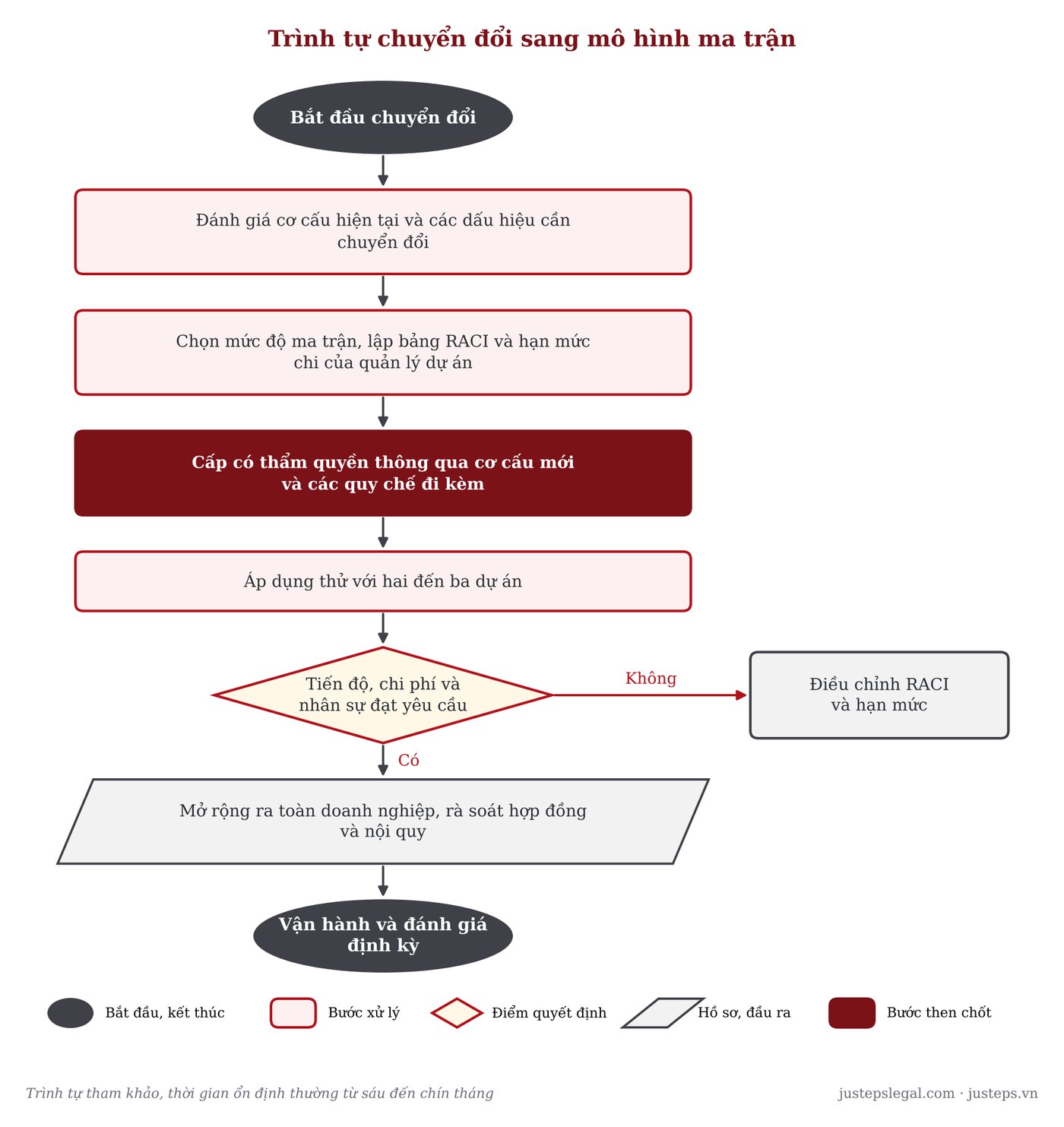
Sequence for moving to a matrix structure
The sequence begins with an assessment of the current structure and the signs that a change is needed, after which the board of management chooses the degree of matrix and prepares the RACI chart and the project managers’ spending limits. The critical step is for the competent body to approve the new structure and the accompanying regulations before the pilot, so that project managers have real authority from the outset. After piloting with two or three projects, the business evaluates schedule, cost and employee satisfaction; if the results are not yet satisfactory, it adjusts the RACI chart and limits before extending the model. The minimum set of documents to be issued comprises the following:
- A decision issuing the new organisational structure, specifying the degree of matrix and the date of application.
- A project management regulation governing project initiation, appointment of project managers, reporting and project closure.
- A RACI chart for the main decisions and the spending limits of project managers.
- A resource allocation procedure with a template sheet showing each person’s time allocation.
- A two-way evaluation regulation and a project bonus regulation that have been made public.
- A mechanism for resolving disagreements that states the deciding level and the time limit.
In addition to the new documents, the business needs to review its template labour contracts, job descriptions and internal labour regulations to ensure that assignments between projects have a proper basis. Common mistakes during the transition include redrawing the chart without amending the regulations on delegation of authority, having no time allocation sheet so that specialists become overloaded, having no one to arbitrate when project managers and department heads disagree, and leaving year-end scoring solely to department heads so that employees pay no attention to project objectives.
How Justeps can help
Justeps supports businesses in designing and operating project and matrix organisational structures through the following services:
- Organisational structure, functions and duties and job descriptions. Justeps assesses the current structure and proposes the degree of matrix, the organisation chart, the RACI chart and job descriptions by professional title.
- Developing internal governance regulations and procedures. Justeps drafts the project management regulation, the resource allocation procedure and the disagreement resolution mechanism, together with the issuance file.
- KPI systems and performance evaluation. Justeps designs the set of indicators and the two-way evaluation process between project managers and department heads.
- Salary scales and pay and bonus regulations. Justeps develops the project bonus regulation and the procedures for consultation and public announcement.
- Organisational restructuring and workforce streamlining. Justeps prepares the transition roadmap and the labour utilisation plan, and reviews labour contracts when the organisation is restructured.
Frequently asked questions
Should a small business adopt a matrix structure?
A business with fewer than 30 employees running only one or two projects at a time usually does not yet need a full matrix. Appointing a project coordinator within the functional structure is usually sufficient.
With whom do employees in a matrix sign their contracts?
Employees still sign their labour contracts with the business. Which project they belong to and whom they report to are matters of internal assignment recorded in job descriptions and regulations, so the contract should describe the job by professional title[4].
Must a change in organisational structure be registered with the business registration authority?
Usually not, because the structure of departments and projects is not part of the enterprise registration details. However, the decision must be approved by the competent body in accordance with the Law on Enterprises and the charter[10].
May an engineer be moved to other work while waiting for a new project?
A temporary reassignment is permitted if the internal labour regulations provide for this case, but for no more than 60 cumulative working days in a year, unless the employee agrees in writing[5]. Assigning the department’s professional tasks is not subject to this limit.
What should the weighting between project results and professional expertise be?
In a balanced matrix, the weighting commonly used is 60% for project results and 40% for professional expertise. The project weighting increases as the business moves towards a strong matrix.
How long does it take for a matrix structure to operate steadily?
Usually six to nine months. The business should pilot the model with two or three projects before extending it to the whole organisation.
When a project ends, may the business terminate the contracts of the project staff?
The end of a project is not in itself a ground for terminating labour contracts. If headcount needs to be reduced because of a change in structure, the business must follow the statutory procedure, including preparing a labour utilisation plan and giving prior notice[7].
Related articles
- How to choose an organisation chart model that fits the size of a business and the way it generates revenue
- How to write department functions and duties so that every task in a business has someone accountable for it
- When a mid-sized company needs an executive committee and specialised committees, and how to design them without exceeding authority
- Building KPIs for support departments such as accounting, human resources and administration
Notes
[1] Article 107 of the Labour Code No. 45/2019/QH14 dated 20 November 2019.
[2] Point a, Clause 1 of Article 36 of the Labour Code No. 45/2019/QH14.
[3] Clause 2 of Article 104 of the Labour Code No. 45/2019/QH14.
[4] Point c, Clause 1 of Article 21 of the Labour Code No. 45/2019/QH14.
[5] Clause 1 of Article 29 of the Labour Code No. 45/2019/QH14.
[6] Clause 2 of Article 118 of the Labour Code No. 45/2019/QH14.
[7] Articles 42 and 44 of the Labour Code No. 45/2019/QH14.
[8] Clause 2 of Article 55 of the Law on Enterprises No. 59/2020/QH14 dated 17 June 2020.
[9] Point d, Clause 2 of Article 63 of the Law on Enterprises No. 59/2020/QH14.
[10] Clause 2 of Article 153 of the Law on Enterprises No. 59/2020/QH14.
This article is for reference and reflects the regulations in force at the time of publication. Please consult Justeps for advice tailored to your company’s records and situation.
For further information, please contact:
📩 Email: info@justeps.vn
🌐 Website: https://justepslegal.com · https://justeps.vn
🌐 Page: Justeps
☎️ Hotline (Zalo): 096 172 2607
📍 Thanh Xuan Office: 12th Floor, Licogi 13 Tower, 164 Khuat Duy Tien Street, Thanh Xuan Ward, Hanoi, Vietnam
📍 Ha Dong Office: LK06B, No.10, Dong Dua Area, Ha Dong Ward, Hanoi, Vietnam
📍 Ho Chi Minh City Branch: 528 Le Van Sy, Ho Chi Minh City, Vietnam
📍 Hai Phong Office: Truong Thinh Village, Ha Dong Commune, Hai Phong, Vietnam
📍 Quang Ninh Office: Van Don Special Zone, Quang Ninh Province, Vietnam





