
Key takeaways
- An enterprise registration certificate listing a business line does not by itself permit the company to carry on a conditional business line; the company may operate only once it fully satisfies the conditions and must maintain them throughout its operations.
- The list of conditional business lines is changing quickly: Appendix IV to the 2025 Law on Investment will be replaced by a list of 137 business lines from 1 March 2027, so the conditions map must be reviewed each time the list changes.
- A good business conditions map breaks the business model down into individual activities and records, for each activity, the conditions, the form of approval, the competent authority, the expected time and the person responsible.
- The launch date should be fixed only after the company has identified the item with the longest lead time and scheduled backwards from that item.
- Conditions are often lost after launch because the holder of a practising certificate resigns, the premises are relocated or a licence expires, so someone must be assigned to monitor them under a periodic review schedule.
Many companies fix an opening date, sign a lease and start advertising before discovering that part of their activities falls within a conditional business line and that they still lack a licence, a certificate or a qualified professional manager. At that point, the company must either postpone the launch and bear the rent during the waiting period, or accept trading while completing its applications, at the risk of penalties and suspension. The usual cause is that information on business conditions is scattered across many legal instruments, each department knows only part of it and no one is assigned to oversee the whole picture.
This article explains how to build a business conditions map (Conditions Map), meaning a consolidated table of every legal condition that each of the company’s activities must satisfy, together with the form of approval, the competent authority, the timing and the person responsible. It applies to newly established companies and to companies launching a new product line, opening a new branch or a new business location, including foreign-invested enterprises. It is written mainly for the board of management, the legal function, the business development team and whoever is tasked with preparing for the launch date.
How conditional business lines are determined under the current legal framework
As a general principle, a company is free to carry on any business that the law does not prohibit, but where it carries on a conditional business line it must fully satisfy the applicable conditions and ensure that it continues to satisfy them throughout its operations[1]. The Law on Investment No. 143/2025/QH15 defines a conditional business line as one in which business activities must meet the conditions necessary for reasons of national defence, security, social order and safety, social morality or public health, and lists these lines in Appendix IV[2]. The provisions on conditional business lines and Appendix IV of that law took effect on 1 July 2026, later than the rest of the law.
The list continues to evolve. Law No. 24/2026/QH16 amending and supplementing the Law on Investment replaces Appendix IV with a new list of 137 business lines, effective from 1 March 2027[3]. For business lines removed from the list, companies may continue trading without having to meet investment and business conditions, licences already issued remain usable until they expire, and applications still being processed will be returned. Companies preparing to launch between now and early 2027 should therefore check both the list currently in force and the list about to take effect, so that they neither prepare an application for a condition about to be abolished nor overlook a newly added condition.
Business conditions differ from technical standards and regulations
The Law on Investment defines investment and business conditions as the conditions that organisations and individuals must satisfy when carrying on a conditional business line, and they do not include standards, technical regulations or rules on the quality of products and services issued by competent authorities[4]. This distinction matters in practice, because a product may have to comply with a technical regulation or a declaration procedure even though the business line of producing or trading it is not in Appendix IV. The Conditions Map must therefore cover both groups; otherwise the company may hold a business licence while its product is still not permitted to be placed on the market.
Business conditions may be prescribed only in laws, resolutions of the National Assembly, ordinances, resolutions of the Standing Committee of the National Assembly, Government decrees and international treaties to which Vietnam is a party; ministries, ministerial-level agencies and local authorities may not impose additional conditions of their own. Conditions may take the form of licences, certificates, practising certificates, written confirmations or approvals, or of requirements that the company must meet itself without written confirmation from a state authority[5]. The list of conditional business lines and the specific conditions must be published on the National Business Registration Portal, which is the first source to consult when building the map. Where a requirement appears only in ministerial or provincial guidance, the company should check its basis in a higher-ranking instrument before treating it as mandatory.
Recording a business line in the enterprise registration does not mean the company may trade
On enterprise registration, business lines are recorded using level-four codes of the Vietnam Standard Industrial Classification, currently issued with Decision No. 36/2025/QD-TTg and applicable from 15 November 2025[6]. For domestic companies, the business registration authority does not assess business conditions when recording a business line, so an enterprise registration certificate that lists a conditional business line does not mean that the company is already permitted to operate in that line. When adding or changing business lines, the company must notify the business registration authority within the statutory time limit[7], and this is usually the quickest step on the map.
A common mistake is to treat the industry code as the whole of the obligation, whereas conditions attach to the activity actually carried on rather than to the name of the code. For example, a company registered under a general retail code that in fact also sells medicines, organises tours for customers or operates a platform on which other sellers list products may trigger separate conditions for each of those activities. The Conditions Map must therefore start from a description of the business model, not from the list of codes on the certificate.
The layers of a business conditions map
To avoid omissions, a company should divide the conditions into five layers, each answering a different question about the activity being launched. This structure lets whoever builds the map work through the same set of questions for every product line and every location, rather than relying on the memory of individual departments.
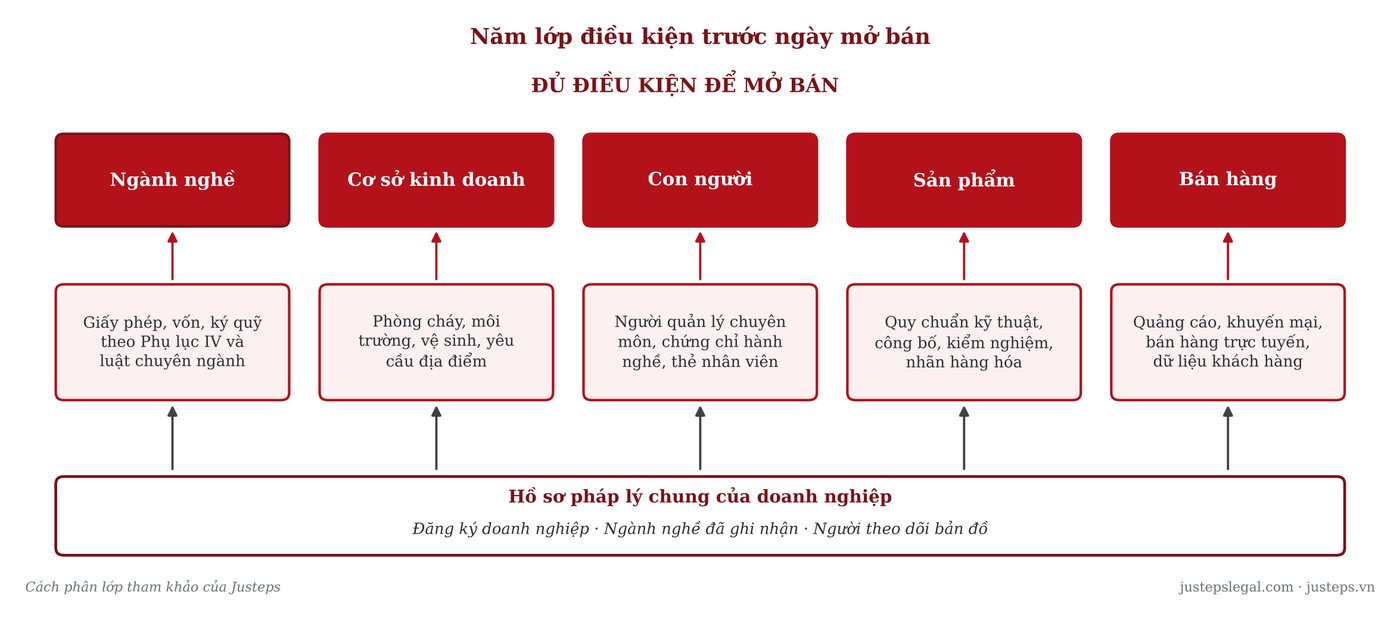
The five layers of conditions a company must satisfy before the launch date
The first layer covers the conditions of the business line itself under Appendix IV and sector-specific legislation, such as licences, capital or deposits. The second covers the conditions of the business premises, including fire prevention and fighting, environmental protection, hygiene and location requirements. The third covers personnel, such as a professional manager holding a practising certificate or staff who must be trained and issued with cards. The fourth covers products and services, including technical regulations, declarations and goods labelling, while the fifth covers sales and marketing activities such as advertising, promotions, online sales and the handling of customer data. All five layers rest on the company’s general legal file, namely its enterprise registration, the business lines recorded and the person responsible for monitoring.
The premises layer is often underestimated because it does not appear in the list of conditional business lines. However, the 2024 Law on Fire Prevention, Fire Fighting and Rescue sets out specific requirements for facilities under its management, and for many types of facility the fire safety design approval and acceptance must be completed before the building is put into use[8]. Where the premises need renovation, the time for design, construction and acceptance may exceed the time needed to obtain the business licence, so this layer should be included in the map from the moment a location is chosen.
The sales and marketing layer is also easily overlooked because the marketing team often prepares it late, close to the launch date. For some products the advertising content must be confirmed before advertising begins, promotional programmes may need to be notified or registered, and the collection of customer information must comply with the Law on Personal Data Protection[9]. The table below suggests the questions to be answered and who should take primary responsibility for each layer.
| Layer of conditions | Question to be answered | Primary owner |
|---|---|---|
| Business line | Whether the activity falls within Appendix IV or sector-specific legislation, and which licence, deposit or minimum capital it requires. | The legal function or the person in charge of registrations and licences. |
| Business premises | Whether the location meets fire safety, environmental, hygiene and land use planning requirements, and which approvals or acceptances are needed. | The administration or construction team together with the design consultant. |
| Personnel | Whether the activity requires a professional manager, a practising certificate or staff who must be issued with cards. | The HR department working with the legal function. |
| Products and services | Which regulations the product must meet, and whether it requires declaration, testing or special labelling. | The product, quality or purchasing team. |
| Sales and marketing | Which procedures advertising, promotions, online sales and customer data collection require before they start. | The marketing and sales teams, with sign-off by the legal function. |
How to build a conditions map for each business activity
The Conditions Map should be built following a fixed sequence so that the result can be checked and updated when the business model changes. The sequence below runs from the description of the actual activity to the final control point before the launch date.
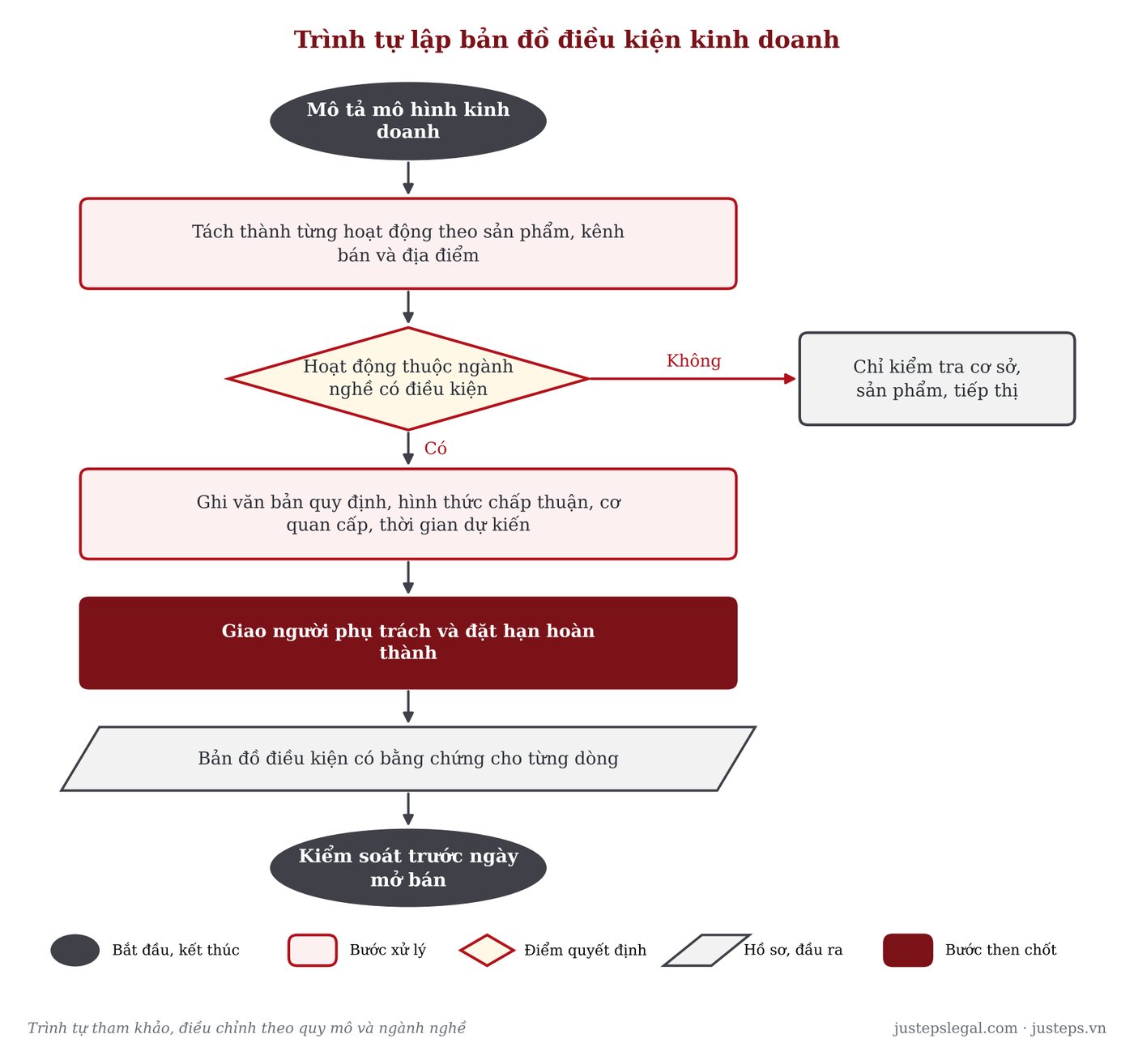
Sequence for building a business conditions map for one activity
The company starts by describing its business model in plain words, covering what it sells, to whom, where, through which channels and who delivers the service directly, and then breaks that model down into separate activities. For each activity, the person building the map checks it against Appendix IV and sector-specific legislation; if the activity is not conditional, only the remaining layers such as premises, products and marketing need to be checked. If it is conditional, the person records the governing instrument, the form of approval, the issuing authority and the expected time, then assigns an owner and sets a completion date. Every branch ends at a common control point before the launch date, where the board of management confirms that each line is supported by evidence of compliance.
Breaking the business model down into individual activities
The step of separating activities determines the quality of the whole map. A single shop may sell on site, deliver goods, sell through its own website and sell on an e-commerce platform, and each channel may bring different obligations. Similarly, a service company may provide its main service while also sub-letting space and collecting payments on behalf of partners. Whoever builds the map should interview the heads of sales and operations directly, because additional activities are often mentioned only in the business plan and do not appear in the registration documents.
Recording complete information on each line of the map
Each line of the map should contain, at a minimum, columns for the activity, the condition, the governing instrument, the form of approval, the competent authority, the statutory processing time and the realistic expected time, the documents to be prepared, the owner, the completion date, the validity period of the document and its current status. The realistic expected time should include the time for preparing the application and for supplementing it when the authority so requests, not merely the processing time stated in the regulations. The validity column allows the map to remain in use after launch, when the company has to renew or obtain re-issued documents. Companies may refer to Justeps’ business licence and conditional business line registration services when they need to identify conditions and prepare applications for each line.
Setting control points backwards from the launch date
Only once the map is in place does the company have enough information to fix the launch date. The sensible approach is to identify the item with the longest lead time, treat it as the critical path and work backwards from the intended launch date to find the latest date on which each item must begin. The chart below illustrates the lead times of the items in a hypothetical project to open a business facility.
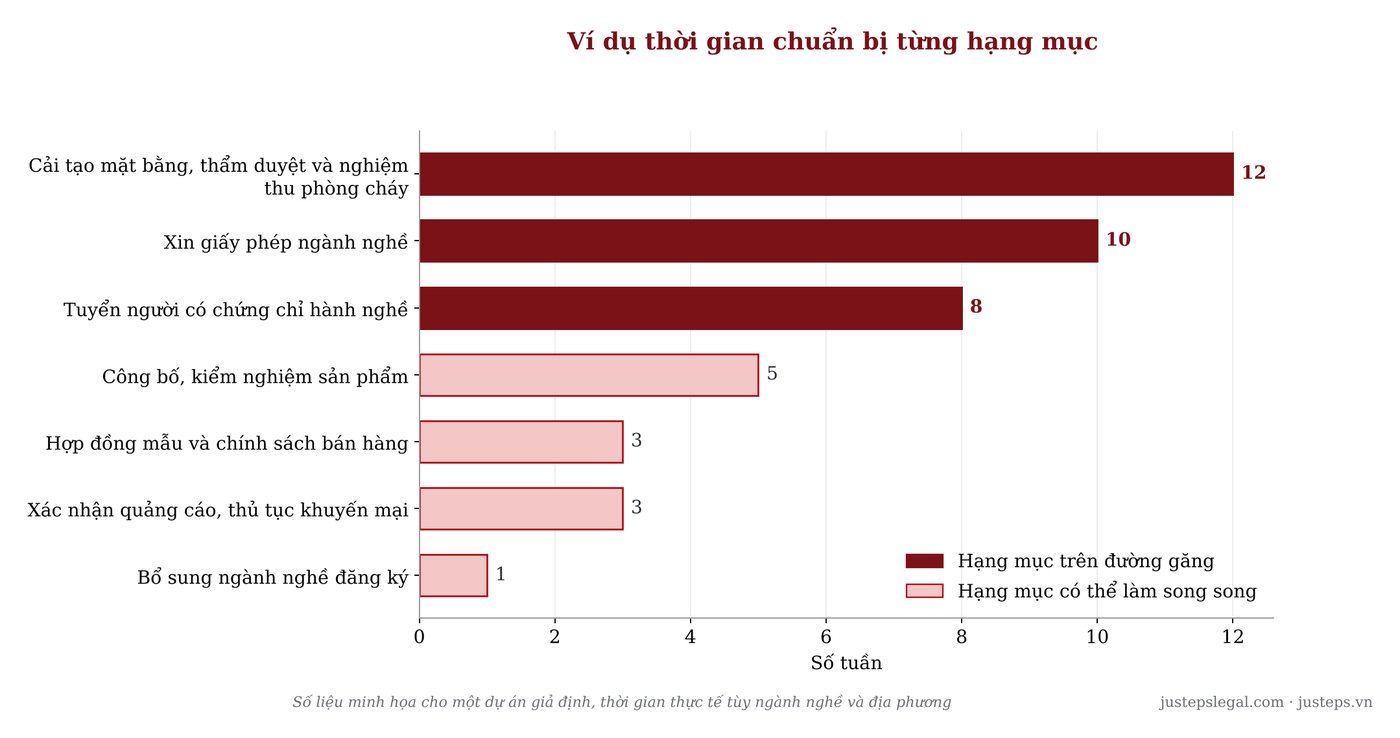
Example of the number of weeks needed to complete each item before the launch date
In this example, renovating the premises together with fire safety design approval and acceptance takes about 12 weeks and obtaining the business licence takes about 10 weeks, whereas adding a business line to the enterprise registration takes only about one week. Because a business licence usually requires the premises to meet the conditions already, these two longest items cannot run entirely in parallel, so the actual total time may exceed four months. Recruiting a professional manager with a practising certificate also takes about eight weeks and must be completed before the licence application is filed, as the application usually requires that person’s name and certificate. If the company has already signed a lease and announced its opening date before knowing these figures, the gap becomes rent that generates no revenue.
From the critical path, the company should set three control points. The first comes before signing the lease, when the map must confirm that the location is capable of meeting the premises conditions. The second comes before the launch date is announced publicly, when all applications with long lead times must already have been filed. The third comes a few days before the launch date, when the owner presents the map with evidence for each line so that the board of management can decide whether to launch in full, launch in part or postpone.
A partial launch is a reasonable option where a few activities do not yet meet the conditions but can be separated, for example a shop that starts selling ordinary products while awaiting a licence for a group of conditional products. In that case, the company must ensure that the products not yet meeting the conditions are genuinely not displayed, offered for sale or advertised, including through online channels. The decision to launch in part should be recorded in writing, stating clearly which activities may begin and which must wait.
Maintaining conditions after the launch date
The obligation to maintain all conditions throughout operations means that the Conditions Map does not end on opening day[1]. After launch, conditions may be lost without the company noticing, for instance when the professional manager resigns, when the premises are renovated or relocated, or when a licence or certificate expires. In addition, the list of business lines and the detailed conditions change with new legislation, as in the case of the list of 137 business lines applying from 1 March 2027[3].
The matrix below ranks the events that most often cause a company to lose its conditions according to their likelihood and their impact on operations.
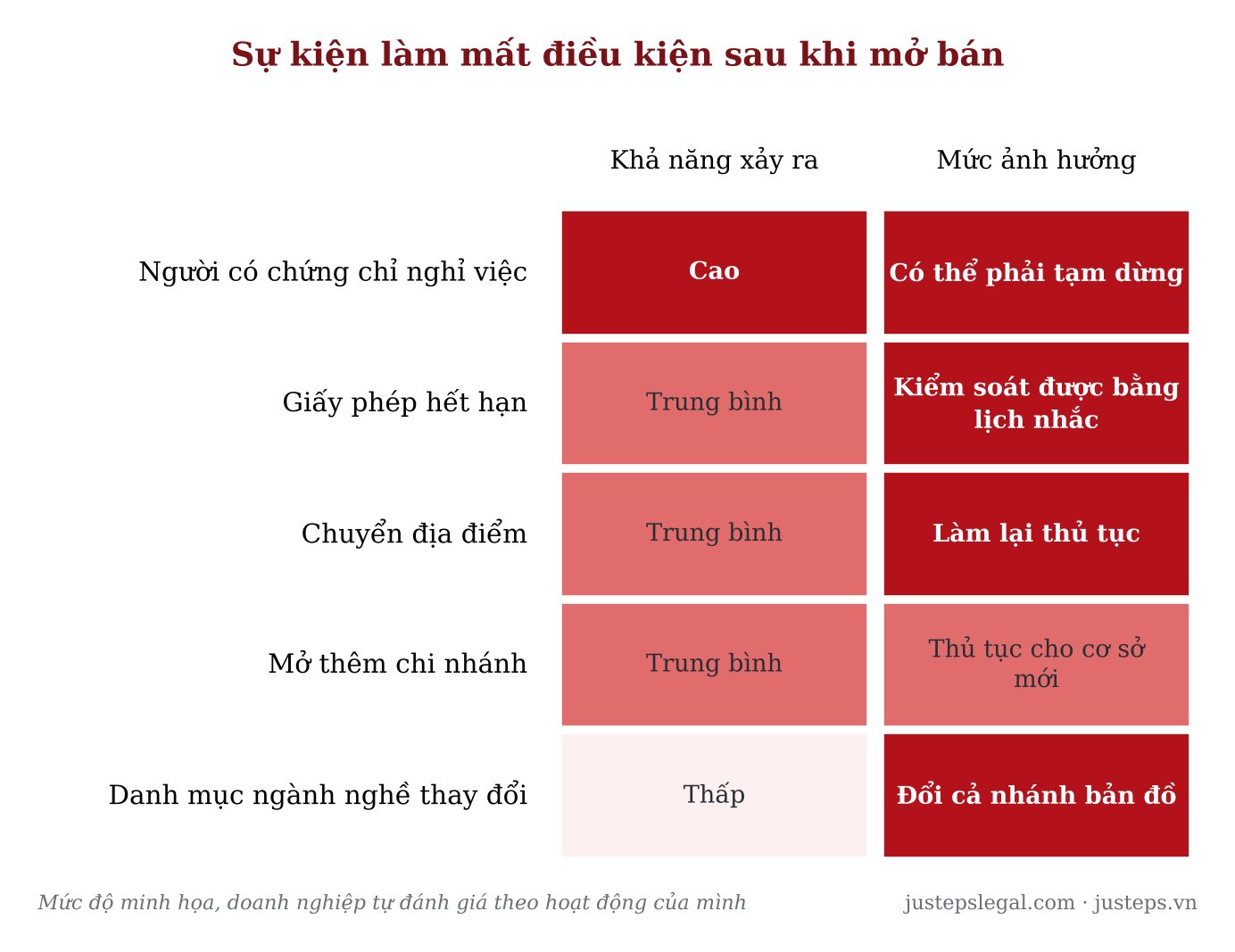
Events that cause loss of business conditions, ranked by likelihood and impact
The resignation of the holder of a practising certificate is both highly likely and highly disruptive, because the company may have to suspend the related activity until a qualified replacement is in place. An expired licence has a high impact but is entirely controllable if the map includes a validity column and advance reminders. Relocating premises or opening a new branch usually triggers new procedures, because many conditions are granted per facility, while a change to the list of business lines is less likely but may alter an entire branch of the map. High-rated events should have contingency arrangements prepared in advance, such as appointing a second certificate holder or requiring a longer notice period for the professional manager position.
To maintain compliance, the company should appoint a single point of contact responsible for updating the map and reviewing it in full at least once a quarter and whenever new legislation is issued in its sector. Internal changes that may cause the loss of conditions, such as releasing the professional manager, signing a lease for a new location or launching a new product, should be required to pass through this contact before being implemented. This practice should be written into the company’s internal regulations, for example as part of Justeps’ compliance framework and internal governance services, so that it does not depend on a single individual.
Foreign-invested companies and multi-site chains
For foreign investors, in addition to the conditions of the business line, the company must also satisfy market access conditions, such as ownership ratios, forms of investment, scope of activities or participating partners, under investment legislation and Vietnam’s international commitments[10]. Market access conditions are usually examined at the stage of issuing the investment registration certificate or approving a capital contribution or share acquisition, so a discrepancy in the description of activities in the investment file may delay the whole project. The Conditions Map of a foreign-invested company should therefore include an additional column for market access conditions and for the project objectives recorded.
For a chain with several shops or branches, the company should split the map into two parts. The common part records the conditions attached to the legal entity, such as business lines, capital, deposits or licences issued to the company, while a separate part for each location records the conditions attached to the facility, such as fire safety, hygiene, on-site management and certificates issued per facility. When opening a new location, the project team need only copy the location-specific part and fill in the details, which gives a more accurate estimate of preparation time and avoids missing procedures that earlier locations have already completed.
Consequences of launching before conditions are met and allocating roles within the company
Carrying on a conditional business line without fully meeting the conditions is penalised under the decree on administrative penalties for the relevant sector. In addition to fines, the company may be subject to suspension of operations for a fixed period, withdrawal of the right to use its licence and remedial measures such as having to surrender any unlawful gains obtained from the violation[11]. In some sectors, trading without a licence also affects contracts with customers and partners, because the other party may refuse to pay or claim compensation where the service was not lawfully provided.
The indirect damage is usually greater than the fine. A suspension order may force the company to close in the middle of its peak season and damage its reputation with distributors, e-commerce platforms or investors conducting due diligence on the company. For a company raising capital or preparing to sell shares, records showing that it has traded without meeting the conditions often lead to demands for indemnities or a reduction in the transaction value.
To avoid this, the company should allocate roles clearly during launch preparations. The board of management decides the launch date on the basis of the map, the legal function or the person in charge of licences builds and updates the map, and each department is responsible for completing the lines in its own layer as set out in the table above. The marketing team should announce the opening date, run advertising or open pre-orders only after the map owner has confirmed that the second control point has been passed.
How Justeps can help
Justeps helps companies identify, satisfy and maintain business conditions before and after the launch date through the following services:
- Business licence and conditional business line registration. Justeps builds a conditions map for each activity and prepares applications to add business lines and to obtain licences and certificates.
- Compliance framework and internal governance. Justeps develops rules allocating roles, pre-launch control points and procedures for updating the conditions map.
- Establishment of foreign-invested companies. Justeps checks market access conditions and the description of project objectives so that the investment file matches the actual activities.
- Periodic corporate legal review. Justeps periodically reviews licence validity, practising certificate holders and changes to the list of conditional business lines.
Frequently asked questions
If the enterprise registration certificate already lists a conditional business line, may the company start trading immediately?
No, it may not start immediately. Recording a business line in the enterprise registration does not replace meeting the conditions, and the company may operate only once it fully satisfies the conditions of that business line[1].
Where can a company look up the list of conditional business lines?
The list is set out in Appendix IV to the Law on Investment No. 143/2025/QH15 and must be published on the National Business Registration Portal[5]. From 1 March 2027, the new list of 137 business lines under Law No. 24/2026/QH16 will apply[3].
What happens to licences already issued for business lines removed from the list from 1 March 2027?
The company may continue trading without having to meet the investment and business conditions of that line, and licences already issued remain usable until they expire[3]. The ministry in charge of the sector may issue an alternative management approach, so companies should still follow the implementing guidance.
May a provincial department or provincial People’s Committee impose additional business conditions?
These authorities may not impose additional conditions, because business conditions may be prescribed only in laws, resolutions of the National Assembly, ordinances, resolutions of the Standing Committee of the National Assembly, decrees and international treaties[5]. Where a requirement appears only in a lower-ranking instrument, the company should check its basis in a higher-ranking instrument.
What should a company do if its professional manager holding a practising certificate resigns?
The company must appoint a qualified replacement and complete any notification or licence amendment procedure required by sector-specific legislation. Until a replacement is in place, the activity requiring that person may have to be suspended to avoid breaching the obligation to maintain conditions[1].
Are product standards and technical regulations business conditions?
Under the Law on Investment, investment and business conditions do not include standards, technical regulations or rules on the quality of products and services[4]. Even so, products must meet these requirements before being placed on the market, so they still need to be included in the conditions map.
Does opening a new branch require the licence to be obtained again?
Conditions attached to the legal entity usually need not be repeated, but conditions attached to the facility, such as fire safety, hygiene or certificates issued per facility, usually have to be satisfied separately for the new location. The company should use the location-specific part of the map to check them.
Related articles
- Setting up a company in Hanoi: documents required, processing time and what to do immediately after registration
- Setting up a foreign-invested company in Vietnam, from the investment registration certificate and capital account to post-licensing reporting
- How sales promotion procedures have changed in 2026 after Decree 239/2026/ND-CP and what businesses need to do
- An annual periodic legal review covering 12 areas that companies should check themselves
Notes
[1] Clause 1 of Article 7 and Clause 1 of Article 8 of the Law on Enterprises No. 59/2020/QH14 dated 17 June 2020, as amended and supplemented by Law No. 76/2025/QH15.
[2] Article 7 and Appendix IV of the Law on Investment No. 143/2025/QH15; Article 7 and Appendix IV take effect from 1 July 2026 under Clause 2 of Article 51 of that Law.
[3] Law No. 24/2026/QH16 amending and supplementing a number of articles of the Law on Investment, effective from 1 March 2027, including the new Appendix IV and the transitional provisions in Article 3.
[4] Clause 9 of Article 3 of the Law on Investment No. 143/2025/QH15.
[5] Clauses 2, 5 and 7 of Article 7 of the Law on Investment No. 143/2025/QH15.
[6] Decision No. 36/2025/QD-TTg of the Prime Minister promulgating the Vietnam Standard Industrial Classification, applicable from 15 November 2025; Decree No. 168/2025/ND-CP on enterprise registration, as amended and supplemented by Decree No. 296/2026/ND-CP.
[7] Article 31 of the Law on Enterprises No. 59/2020/QH14, as amended and supplemented by Law No. 76/2025/QH15.
[8] The Law on Fire Prevention, Fire Fighting and Rescue No. 55/2024/QH15 and its implementing instruments.
[9] The Law on Personal Data Protection No. 91/2025/QH15 and Decree No. 363/2026/ND-CP.
[10] The Law on Investment No. 143/2025/QH15 and the list of business lines subject to restricted market access for foreign investors issued by the Government.
[11] Articles 21 and 28 of the Law on Handling of Administrative Violations No. 15/2012/QH13, as amended and supplemented.
This article is for reference and reflects the regulations in force at the time of publication. Please consult Justeps for advice tailored to your company’s records and situation.
For further information, please contact:
📩 Email: info@justeps.vn
🌐 Website: https://justepslegal.com · https://justeps.vn
🌐 Page: Justeps
☎️ Hotline (Zalo): 096 172 2607
📍 Thanh Xuan Office: 12th Floor, Licogi 13 Tower, 164 Khuat Duy Tien Street, Thanh Xuan Ward, Hanoi, Vietnam
📍 Ha Dong Office: LK06B, No.10, Dong Dua Area, Ha Dong Ward, Hanoi, Vietnam
📍 Ho Chi Minh City Branch: 528 Le Van Sy, Ho Chi Minh City, Vietnam
📍 Hai Phong Office: Truong Thinh Village, Ha Dong Commune, Hai Phong, Vietnam
📍 Quang Ninh Office: Van Don Special Zone, Quang Ninh Province, Vietnam





