
From 15 November 2026, Decree No. 392/2026/ND-CP takes effect, amending many rules on procedures and security and order (ANTT) conditions in Decree No. 96/2016/ND-CP. For owners of hotels, homestays, karaoke venues, massage businesses and pawnshops, the changes that matter are very concrete: where to file, which fire prevention and fighting (PCCC) documents to attach, and what the premises must check and record every day.
This article follows the order in which a business actually works: identify the authority that issues the certificate of eligibility for security and order, prepare the fire safety documents, draw up the ANTT assurance plan, and then organise guest ID checks and internal records once licensed.
Which businesses still need a certificate of eligibility for security and order
After the amendment, the list of business lines subject to security and order conditions has 15 groups (under Article 3 of Decree No. 96/2016/ND-CP as amended by Decree No. 392/2026/ND-CP). Accommodation services remain on the list, but Clause 14 now excludes houses leased under contracts for living, studying or working. In other words, renting rooms long term to students or workers under a lease contract is not treated as an accommodation establishment under this decree.
This boundary should be settled at the outset, because many models sit in between. A serviced apartment rented by the night or week through booking platforms is still accommodation. A building leased on 6- or 12-month contracts for living falls under the exclusion. Businesses running both models in one building should separate areas, contracts and logs, so inspectors do not treat the whole building as an unlicensed accommodation business.
Filing with commune-level or provincial police
Authority to issue the certificate has been reallocated by size and type (under Article 24 of Decree No. 96/2016/ND-CP as amended by Decree No. 392/2026/ND-CP). Commune-level police issue certificates to karaoke, massage, pawnshop and printing businesses and to accommodation establishments with 29 rooms or fewer. Provincial police issue them to accommodation establishments with 30 rooms or more.
The 29/30-room threshold sounds simple but causes mistakes in practice. Count the rooms actually put into business, consistent with the fire safety file and floor plan, not planned expansion. When a property grows from under 30 to 30 rooms or more, the issuing authority changes, so managers must treat renovation or adding rooms as a licensing event, not just a construction matter.
| Business type | Issuing authority | Documents to watch |
|---|---|---|
| Hotels, guesthouses, homestays with 29 rooms or fewer | Commune-level police where the premises are located | Fire safety inspection record; ANTT assurance plan if the line is listed in Clause 1, Article 8 of Decree No. 96/2016/ND-CP (as amended); other documents under Article 19 |
| Hotels and accommodation establishments with 30 rooms or more | Provincial police | As above; files are usually heavier because of room count, technical areas and storage |
| Karaoke | Commune-level police | Fire safety inspection record by the competent authority; ANTT assurance plan if required |
| Massage services | Commune-level police | Fire safety inspection record; ANTT assurance plan if required |
| Pawnshops | Commune-level police | Fire safety inspection record; if no own warehouse, a lease for a warehouse meeting fire safety conditions |
Fire safety documents: what to submit and when you are exempt
The fire safety documents in the file have been redefined (under Article 4 of Decree No. 392/2026/ND-CP amending Clause 3, Article 19 of Decree No. 96/2016/ND-CP). The business submits the fire safety inspection record issued by the competent authority. Where the line needs storage but the business has no warehouse of its own, it submits a lease for a warehouse that meets fire safety conditions. If the fire safety data has already been connected and shared electronically between agencies, the business does not need to submit these documents again.
Operationally, whoever handles the file should do three things. First, book the fire safety inspection early, since it is usually the slowest step. Second, check that the address, name, floor area and room count on the fire safety record match the ANTT application. Third, for pawnshops keeping pledged assets in a leased warehouse, keep a valid copy of the lease and track its expiry, because once it lapses without renewal the declared condition is no longer true.
The ANTT assurance plan: who prepares it and what it covers
Ten business lines must have a security and order assurance plan (under Clause 1, Article 8 of Decree No. 96/2016/ND-CP as amended by Decree No. 392/2026/ND-CP). Check your line against this list before filing. If you are covered, the plan should not be a copied template; police on site will compare it with how the premises actually run.
A workable plan answers these questions: who is responsible for security and order at the premises and who stands in when that person is absent; how shifts, cameras and restricted areas are arranged; how staff handle disruptive guests, guests without ID, or assets suspected to be evidence of a crime; how to contact the local commune-level police; and how guest data is stored and protected. The legal representative should sign and issue the plan and brief reception and shift managers, with signed acknowledgement.
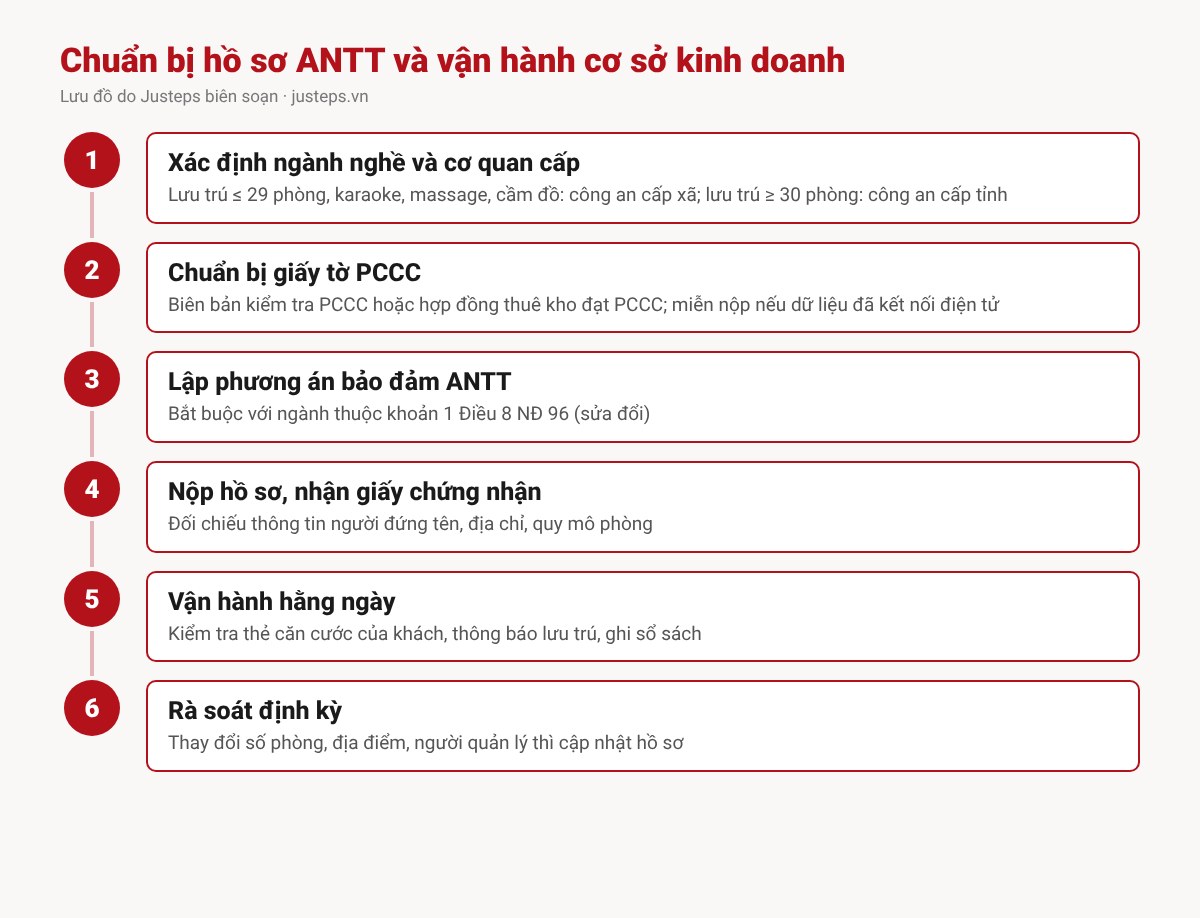
Process for preparing the ANTT file and running accommodation, karaoke, massage and pawnshop premises under Decree No. 392/2026/ND-CP.
Checking guests' identity with the ID card
For accommodation establishments, the amended decree updates guest ID checks to the citizen ID card (thẻ căn cước) and no longer refers to the old identity card (CMND). Front-desk processes should be updated accordingly: guest registration forms, property management software and staff instructions should drop the "CMND number" field and use the personal identification number, document type and date of issue.
Photographing and storing copies of guests' ID cards is processing of personal data, governed by the Law on Personal Data Protection No. 91/2025/QH15. Collect only what is needed for residence notification and guest management, define who may access the data, how long it is kept, and delete it when the purpose ends. Many small homestays miss this: guests' ID photos sit on the owner's personal phone or in chat groups, which is very hard to control if something goes wrong.
Internal records the premises should keep
During routine or surprise police inspections, a business is judged by what it can produce immediately. A minimum set kept at reception or the manager's office should include:
- the original or a copy of the certificate of eligibility for security and order and the enterprise or household business registration certificate;
- the fire safety inspection record, the warehouse lease (if any) and the fire equipment maintenance log;
- the issued ANTT assurance plan and the list of staff who have been briefed;
- the guest register or data and residence notification records (for accommodation);
- pawn contracts, the register of pledged assets, and records of return or liquidation (for pawnshops);
- the staff list, employment contracts and shift rosters (especially for karaoke and massage).
Businesses with several locations should assign one legal or administrative contact to track issue dates, certificate details and changes that must be updated, such as a new responsible person, a new address or more rooms.
Common operational risks
The most frequent mistake is continuing to operate after the facts have diverged from the certificate: the manager has left, rooms have been added, the warehouse lease has expired. The second is night-shift staff accepting guests without ID because they are "regulars". The third is wrongly assuming the exclusion applies, for example renting apartments by the night while calling it "housing lease". All three can be handled with a quarterly checklist and clearly defined shift-manager responsibilities.
Legal basis
- Decree No. 392/2026/ND-CP dated 20 October 2026 amending decrees on administrative procedures and investment and business conditions on security and order; effective 15 November 2026.
- Decree No. 96/2016/ND-CP on security and order conditions for certain conditional business lines (as amended and supplemented).
- Law on Identification No. 26/2023/QH15, effective 1 July 2024.
- Law on Residence No. 68/2020/QH14, effective 1 July 2021.
- Law on Personal Data Protection No. 91/2025/QH15, effective 1 January 2026.
How Justeps can help
- Reviewing your business model to confirm whether an ANTT certificate is required and which authority is competent, through the advisory services of Justeps.
- Preparing and reviewing applications for issuance or re-issuance of the certificate, cross-checked against fire safety files.
- Drafting the ANTT assurance plan, front-desk guest ID procedures and guest personal data protection rules.
- Ongoing legal support for hotel, homestay, karaoke and pawnshop chains, including periodic licence review schedules.
Frequently asked questions
Where does a 12-room homestay file its ANTT application?
Accommodation establishments with 29 rooms or fewer file with the commune-level police where the premises are located, under Article 24 of Decree No. 96/2016/ND-CP as amended by Decree No. 392/2026/ND-CP.
Does renting rooms on 12-month leases require an ANTT certificate?
Houses leased under contracts for living, studying or working are excluded from accommodation services under Clause 14, Article 3 of Decree No. 96/2016/ND-CP (as amended). However, if the same building rents rooms by the night, that part is still accommodation.
If fire safety data is already in the system, must we submit the inspection record?
No, if the data has been connected and shared electronically, under Article 4 of Decree No. 392/2026/ND-CP. Keep a copy anyway to show during on-site inspections.
What if a guest only has an old identity card (CMND)?
The amended rules point to checks using the ID card. Reception should ask the guest for the ID card or another valid identity document and escalate to the shift manager if the guest has no suitable document, rather than deciding alone.
We are going from 25 to 32 rooms. Is our existing certificate still valid?
Once you pass 30 rooms, the issuing authority becomes the provincial police. Work with the police before putting new rooms into service to update or re-issue the certificate.
Related articles
- Fire safety records for business premises under the new law: annual tasks
- Building a sub-licence tracker for businesses with many branches
- Checklist for opening a Da Nang branch of a Hanoi-based company
- Decree No. 363/2026/ND-CP: building an internal data collection procedure to avoid fines
Contact Justeps
Email: info@justeps.vn · Hotline/Zalo: 096 172 2607 · Website: justeps.vn
Office network
- Thanh Xuan Office: 12th Floor, Licogi 13 Tower, 164 Khuat Duy Tien, Thanh Xuan Ward, Hanoi
- Ha Dong Office: LK06B, No.10, Dong Dua Area, Ha Dong Ward, Hanoi
- Ho Chi Minh City Branch: 528 Le Van Sy, Nhieu Loc Ward, HCMC (formerly Ward 14, District 3)
- Hai Phong Office: Truong Thinh Village, Ha Dong Commune, Hai Phong
- Quang Ninh Office: Van Don Special Zone, Quang Ninh





