
Key takeaways
- A company’s first accounting period begins on the date its Enterprise Registration Certificate is issued, so the accounting regime, software and bookkeeper should be decided within the first week.
- A company incorporated in the last quarter of the year may combine its first annual accounting period with the following year if the odd period does not exceed three months, provided that the combined period does not exceed 15 months.
- A company that has not yet appointed a chief accountant may assign a person in charge of accounting or engage a chief accountant service, but the legal representative remains responsible for organising the accounting function.
- Every purchase of VND 5 million or more should be paid by bank transfer from the company’s own account; otherwise the expense may be disallowed for corporate income tax purposes.
- Documents used for bookkeeping, accounting books and annual financial statements must be kept for at least 10 years, even where the company outsources all of its bookkeeping.
In most newly incorporated companies, accounting only really begins when the first tax return falls due. Until then, purchase invoices sit in the Director’s drawer, an advance of several tens of millions of dong is recorded only in a text message, and sales receipts are sometimes paid into the company’s account and sometimes into the founder’s personal account. By the time an outsourced accountant receives the files at the end of the quarter, many documents no longer provide a sufficient basis for bookkeeping, and part of the actual expenditure cannot be treated as deductible.
This article analyses how to organise accounting in the first year of operation, covering the decisions that must be settled immediately after the certificate is issued, the choice of accounting model, the requirements for the chief accountant and for accounting staff, how to set up document flows, the reporting calendar, and record retention and handover. It applies mainly to small private-sector limited liability companies and joint stock companies with no state capital. It is written chiefly for founders, directors and the people assigned to monitor finances in the first months of a business.
Accounting decisions to settle immediately after the certificate is issued
Under the Law on Accounting, the first accounting period of a newly established enterprise runs from the date on which its Enterprise Registration Certificate is issued[1]. This means that every expense arising from that date, including office rent, the purchase of computers and bank account opening fees, must be supported by documents and recorded in the company’s books. For that reason, a company should not wait until it has revenue before organising its accounting, but should settle three matters in the first week, namely the applicable accounting regime, how the first annual accounting period is determined and who is responsible for bookkeeping.
Choosing an accounting regime suited to the company’s size
Small and medium-sized enterprises may currently apply the accounting regime under Circular 133/2016/TT-BTC, or elect to apply the general enterprise accounting regime under Circular 99/2025/TT-BTC, which applies from 1 January 2026[2]. Where it elects the general enterprise accounting regime, the company must apply it consistently for at least one financial year and may not change it part-way through a period. Micro enterprises have the further option of applying the accounting regime under Circular 58/2026/TT-BTC, effective from 1 July 2026, which has a simpler set of financial statements and allows a person in charge of accounting to be assigned instead of a chief accountant[3].
The choice should depend not only on the company’s current size but also on its development plans for the next two to three years. A company that expects to raise capital from investors, take out a large bank loan or become a subsidiary of a group should usually choose the general enterprise accounting regime from the outset, to avoid having to convert its chart of accounts and restate its financial statements as it grows. Conversely, a small services company with few transactions may choose the regime for small and medium-sized enterprises or for micro enterprises to reduce the volume of bookkeeping. Whichever option it chooses, the company should use accounting software that allows the chart of accounts to be converted, because the Ministry of Finance is reviewing and gradually replacing the circulars that set out the accounting regimes.
Determining the first annual accounting period
An annual accounting period is normally twelve months following the calendar year, unless the company chooses a different financial year and notifies the tax authority. Where the first annual accounting period does not exceed three consecutive monthly accounting periods, the company may add it to the following annual accounting period and treat the two as one period, provided that the combined period does not exceed 15 months[1]. For example, a company whose certificate is issued on 15 October 2026 may prepare its first financial statements for the period from 15 October 2026 to 31 December 2027, rather than a separate set for just over two months at the end of 2026.
Combining periods saves one round of preparing and filing financial statements, but it does not remove the obligation to file monthly or quarterly tax returns during that time. The company should also consider how the statements will be used, because banks, counterparties or tender documents may ask for financial statements for the first year. The decision on whether or not to combine periods should be recorded in writing within the first month, so that the accounting software is set up for the correct period and the accounting service provider knows when to close the books.
Choosing an accounting model for the first year
The Law on Accounting allows an enterprise to organise its own accounting department or to sign a contract engaging an accounting services enterprise or household business to perform accounting or act as chief accountant[4]. For a new company, three models are common, and each suits a different level of transactions. The number of transactions per month is a more practical criterion than headcount, because a five-person trading company can generate more documents than a twenty-person consultancy.
| Model | Suitable when | Points to control |
|---|---|---|
| Fully outsourced service | The company has fewer than about 50 transactions a month and does not yet need weekly management figures. | Documents tend to arrive late, so the company needs an internal contact person to send files on a fixed schedule. |
| In-house accountant with outsourced chief accountant | The company has roughly 50 to 300 transactions a month or holds inventory. | Roles must be clearly divided between the person keeping the daily books and the person who reviews and signs the statements. |
| Full in-house accounting department | The company has several warehouses or business locations or needs weekly management reports. | Staff costs are high in the first year, and internal control rules are needed from the moment of hiring. |
The transaction thresholds in the table are practical suggestions rather than legal requirements, and the company should use them as a reference point when comparing costs. The chart below compares the three models against four criteria that founders usually weigh in the first year.
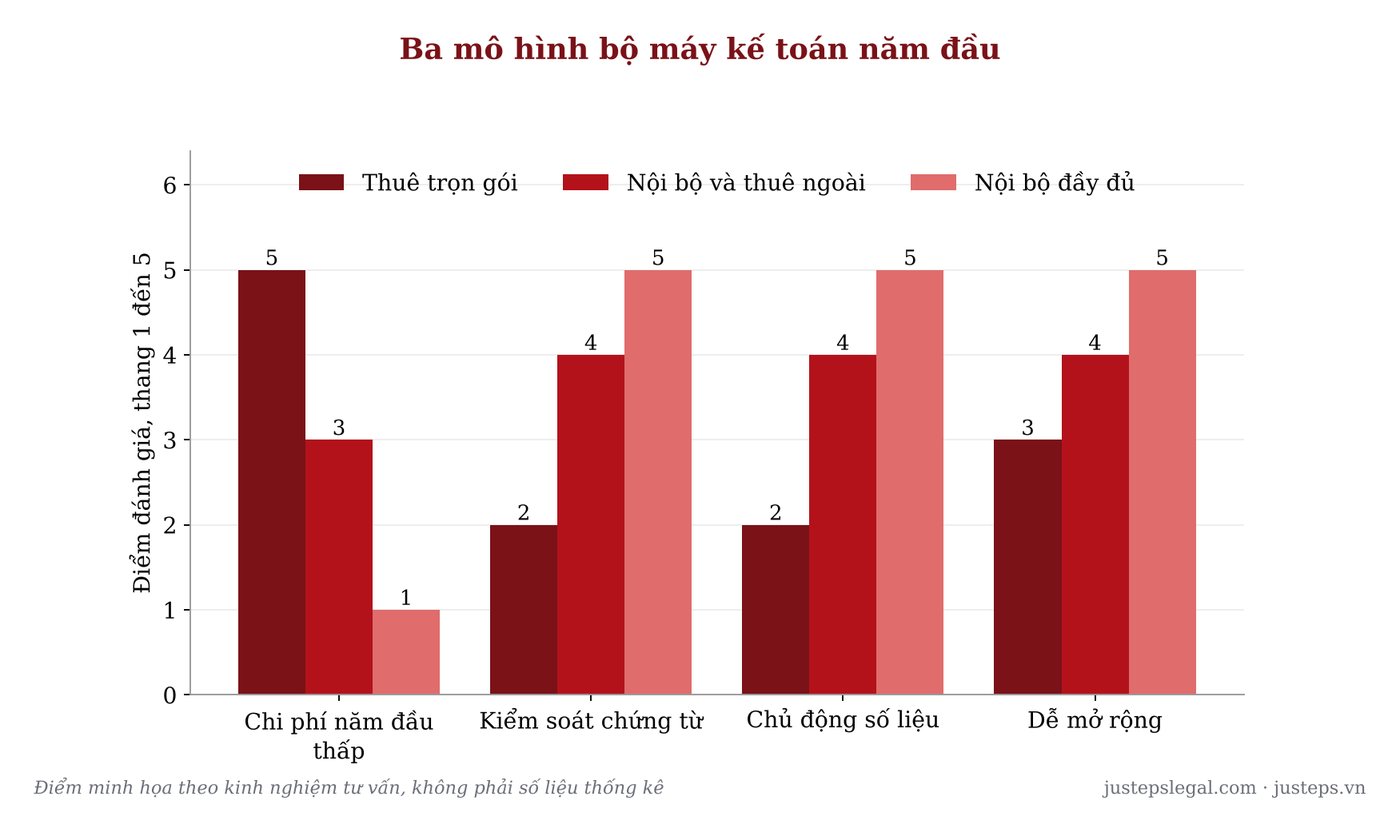
Comparison of three accounting models against four criteria
The fully outsourced model has the clearest cost advantage, but it scores low on control over documents and on access to figures, because the company only receives figures after the service provider has written up the books. The combined model of an in-house accountant and an outsourced chief accountant is more balanced, since a person inside the company keeps the books daily while a qualified professional reviews the statements and takes responsibility for them. A full in-house department scores highest on control and scalability, but it is usually only justified once the company has stable revenue. Many companies start with the first model, move to the second when transactions exceed about 50 a month, and only build a full department in the second or third year.
The chief accountant, the person in charge of accounting and those who may not work as accountants
The chief accountant heads the accounting function, assists the legal representative in organising the accounting work and acts under that representative’s direction[5]. The appointee must hold an accounting qualification at intermediate level or above, hold a chief accountant training certificate, and have at least 2 years of practical accounting experience if they hold a university degree or higher, or at least 3 years if they hold an intermediate or college qualification. In a new company, a person who meets all of these standards usually commands a salary that is high relative to the first-year workload, so appointing a full-time chief accountant straight away is rarely cost-effective.
To fill this gap, the law allows an enterprise that has not yet appointed a chief accountant to assign a person in charge of accounting or to engage a chief accountant service for up to 12 months, after which it must appoint a chief accountant[6]. Micro enterprises may assign a person in charge of accounting without being required to appoint a chief accountant. Whichever route is taken, the legal representative remains responsible for organising the accounting function and for engaging the service, so the decision assigning the person in charge, or the service contract, should be made in writing and kept with the accounting records.
People who may not work as accountants in the same company
The Law on Accounting prohibits certain people from working as accountants in the same entity in order to ensure the independence of the bookkeeper. The natural or adoptive father or mother, spouse, natural or adopted child, or sibling of the legal representative, the Director or the chief accountant may not work as an accountant in the same company. A person who is a manager or executive, a storekeeper or cashier, or who is regularly tasked with buying and selling assets, may not concurrently work as an accountant either[7]. These two rules do not apply to private enterprises, limited liability companies owned by a single individual or certain other cases prescribed by the Government.
In practice, the most common breach is for a joint stock company or a limited liability company with two members to have the Director’s wife or sibling keep the accounts, on the grounds of trust. This arrangement does not comply with the law and also weakens the control value of the figures if the other members fall into dispute with the Director. If the company wants a relative to hold cash or monitor spending, that person should be placed in the position of cashier or administrative assistant, while bookkeeping and the preparation of statements are entrusted to an independent person or a service provider.
Setting up document flows from the first month
Every economic or financial transaction must be supported by an accounting document, and only one document may be prepared for each transaction. Documents must be clear, free of erasures and abbreviations, and the persons who prepare, approve and sign a document are responsible for its content[8]. For a new company, the greatest risk lies not in using the wrong document template but in documents not passing through a fixed sequence, so that invoices, contracts and payment documents do not match.
A company should set up at least four document flows, each with a preparer, an approver and a deadline for passing documents to the accountant:
- The purchasing and payments flow starts with a purchase request accompanied by a quotation, passes through approval within the relevant limit and receipt of goods with a delivery note, continues with receipt of the e-invoice and ends with a bank transfer order.
- The sales and receipts flow ensures that the contract or purchase order, the delivery note and the e-invoice match in quantity, unit price and invoice date.
- The advances flow requires a signed and approved advance request stating the purpose and the settlement deadline, together with an advance settlement sheet supported by original documents.
- The payroll flow comprises timesheets, a payroll sheet signed by its preparer and approver, employment contracts and salary transfer records, all filed month by month.
The purchasing and payments flow deserves the most attention because it bears directly on deductible expenses for corporate income tax purposes. The flowchart below sets out a suggested sequence for a purchase in a new company.
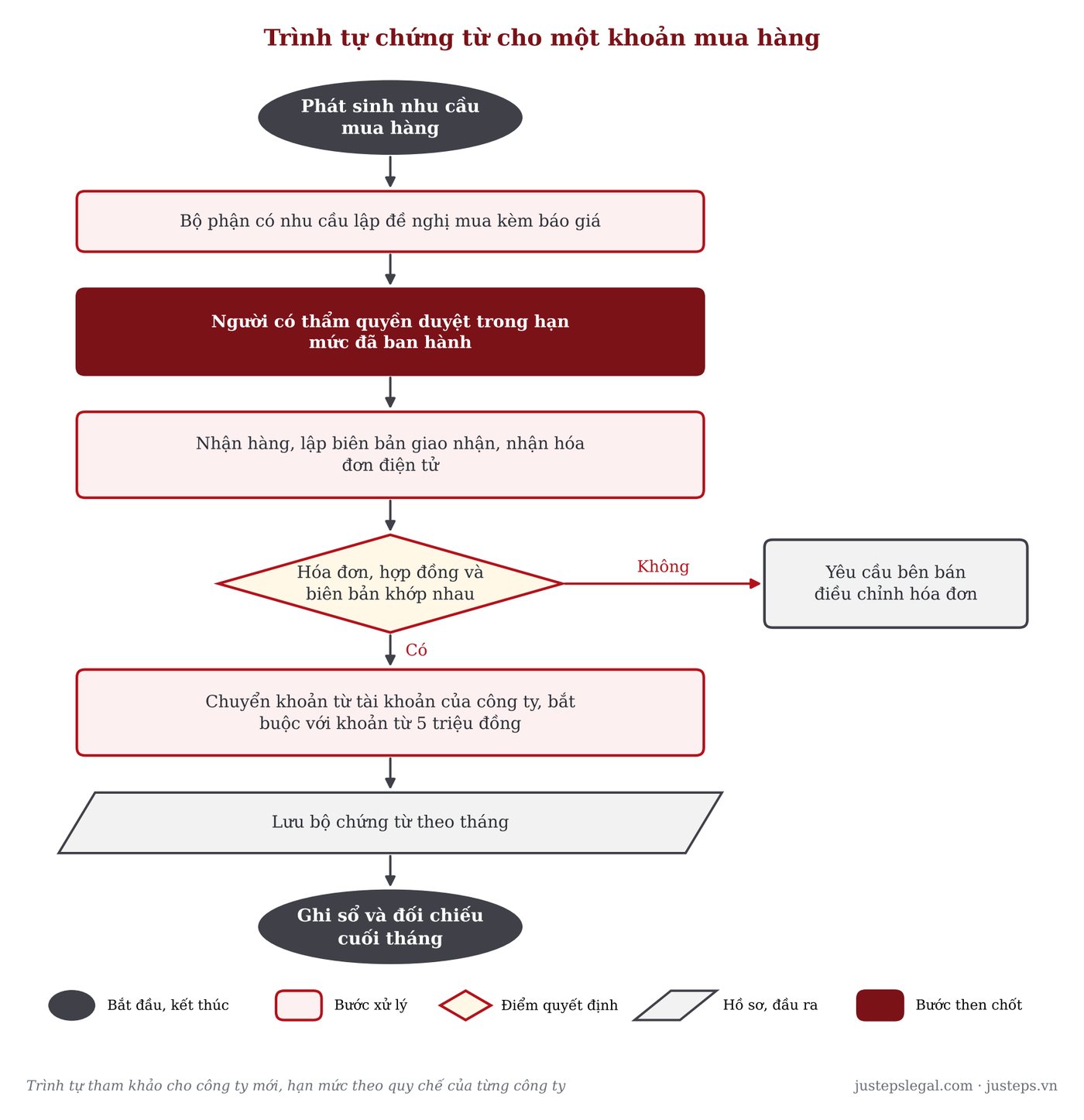
Sequence for preparing and checking documents for a purchase
The sequence begins when the department with the need prepares a purchase request with a quotation and the authorised person approves it within the limits already issued. After the goods are received, the recipient prepares a delivery note and passes it to the accountant with the seller’s e-invoice, so that the accountant can reconcile the three documents for quantity, unit price and description of goods. If the three documents do not match, the accountant asks the seller to adjust the invoice before payment, because adjustments sought after payment tend to drag on and are hard to obtain. For purchases of VND 5 million or more, the company pays by bank transfer from its own account and then files the full set of documents by month for bookkeeping and reconciliation.
The rules on deductible expenses require each purchase of goods or services worth VND 5 million or more to be supported by a non-cash payment document[9]. A payment made to a supplier from the Director’s personal account is not automatically treated as a payment by the company, so the company may easily have the expense disallowed at tax finalisation. E-invoices must also be issued at the correct time and with the correct buyer details under the rules on invoices and documents[10]. The company should give its tax code, name and correct address to all suppliers in the first week, because invoices with wrong buyer details are the most common error made by new businesses.
The payroll flow also involves employees’ personal data, such as identity card numbers, bank account numbers and salaries. Payroll sheets and personnel files should be shared only with those who need them, and the transfer of such data to the accounting service provider should be recorded in the contract in line with the rules on personal data protection[11]. Businesses that need help designing document flows, forms and approval limits may refer to the Justeps service organising the accounting function and documentation.
Reporting calendar and closing the books in the first year
In addition to periodic tax filing, the company must prepare annual financial statements and submit them to the competent state authority within 90 days of the end of the annual accounting period[12]. For a new company, the difficulty lies not in the filing deadline but in having to rebuild a whole year’s figures from scattered documents at the end of the period. Monthly closing and reconciliation of bank balances, receivables, payables and inventory should therefore become routine from the first month, even while transactions are few.
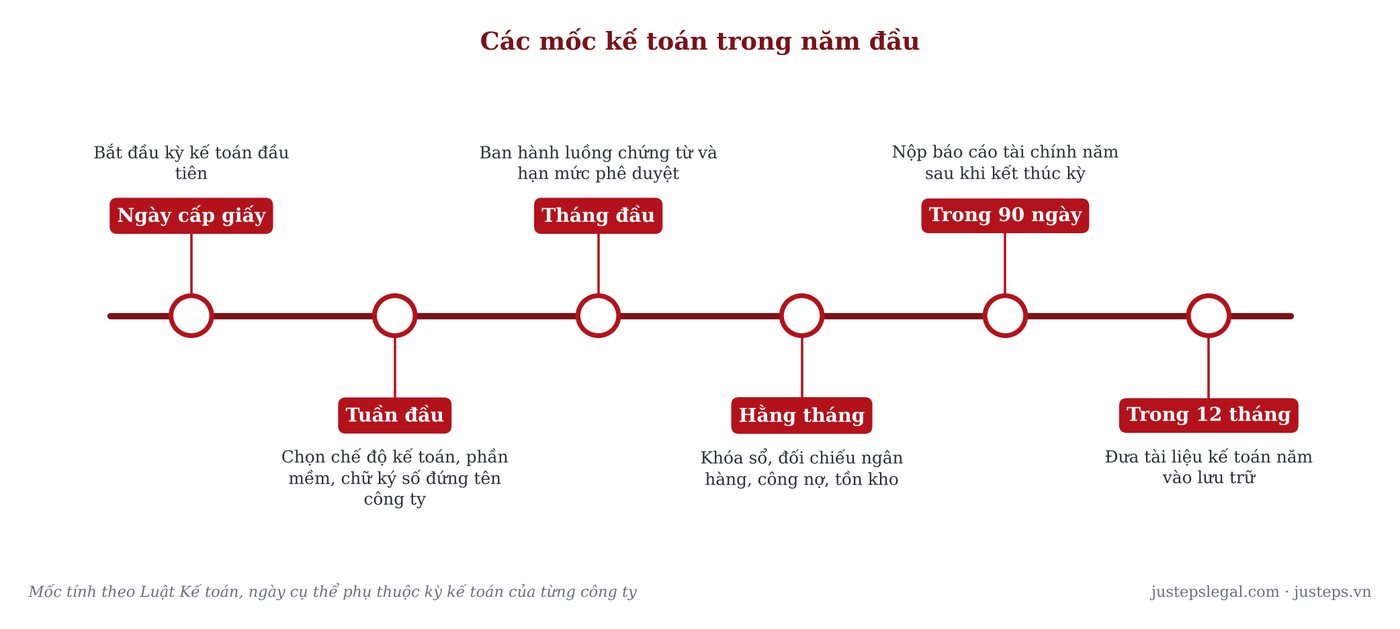
Accounting milestones in a new company’s first year
The timeline starts on the date the certificate is issued, which marks the beginning of the first accounting period. In the first week, the company chooses its accounting regime and software and registers a digital signature in the company’s name, and in the first month it should issue its document flows and approval limits. From the second month, closing and reconciliation take place monthly, so that by the end of the annual accounting period the financial statements are prepared from figures that have already been checked rather than rebuilt from scratch. After filing the statements, the company places all of the year’s accounting records into storage within 12 months of the end of the annual accounting period.
The simplest way to organise closing is to fix a set day, for example the 5th of each month, on which the internal contact person sends all of the previous month’s documents to the accountant, and the 15th on which the accountant returns a flash report covering cash balances, receivables, payables and expenses by category. The Director should read this report within a week, mark any unclear items and ask for explanations before the next closing date. This routine helps the company detect expenses lacking documents early, while also providing a basis for assessing the performance of the accounting service provider, if there is one.
Retaining accounting records and handing over when staff change
Accounting documents used directly for bookkeeping and the preparation of financial statements, accounting books and annual financial statements must be kept for at least 10 years, unless otherwise provided by other laws. Accounting records must be placed into storage within 12 months of the end of the annual accounting period, and the legal representative is responsible for organising their preservation and storage[13]. The Law on Enterprises also requires enterprises to keep accounting books, accounting documents and annual financial statements at the head office or another location specified in the company charter[14].
Electronic documents do not have to be printed on paper, but they must be kept safe and secure and remain retrievable throughout the retention period[8]. E-invoices, bank statements and accounting software data should therefore be stored on systems managed by the company, with regular back-ups, rather than sitting only in the accountant’s mailbox or on the service provider’s server. The accounting software account, the digital signature and the e-tax account must be in the company’s name, with the administrator password held by the Director or owner, and the service provider should only be granted user rights.
Handover on a change of the person in charge of accounting is the point at which a company is most likely to lose data. When the chief accountant or the person in charge of accounting is replaced, the outgoing person must hand over the work and the accounting records to the incoming person, and the company must notify the relevant parties of the change, including the bank where its account is held[6]. The handover minutes should list documents month by month, account balances at the handover date, work in progress and the list of access accounts for the software and the digital signature, with confirmation that passwords have been changed. If the company uses an accounting service, the contract should clearly require the provider to hand over all data and original documents on termination, a point analysed in detail in the article on choosing accounting and legal service partners for a new company.
Common errors and how to prevent them
From its experience of reviewing the accounting records of companies in their first year, Justeps has found certain errors that recur in many businesses regardless of their sector. Most of these errors cost little to prevent, provided that they are identified and assigned to a responsible person from the outset.
- The Director uses a personal account to receive sales proceeds or pay suppliers, so the company’s revenue and expenses do not match its bank statements and are easily subject to assessment by the tax authority.
- A manager or cashier also keeps the accounts in a joint stock company or a limited liability company with two or more members, contrary to the rules on who may not work as an accountant.
- The accounting service contract does not specify the scope of work, the deadline for delivering documents or responsibility when the company is penalised for late filing or incorrect declarations.
- Advances have no settlement deadline, so advance balances remain open for months and it is impossible to tell which amounts were actually spent on the company’s behalf.
- The company does not close its books monthly and only discovers at year end that input invoices are missing, by which time the supplier has ceased trading or can no longer be contacted.
As a preventive measure, the company should issue a short document on the organisation of its accounting function, stating the accounting regime applied, the accounting period, the person in charge, the document flows, the approval limits and the closing calendar. This document need not be long, but it must be signed and issued by the Director and communicated to everyone involved in receiving and paying money. After six months of operation, the company should review whether the document flows are being followed and adjust the limits or the accounting model as appropriate. Businesses wishing to build fuller controls as they grow may refer to the Justeps service internal financial control systems.
How Justeps can help
Justeps helps newly incorporated companies organise a lean, compliant and easily controlled accounting function through the following services:
- Organising the accounting function and documentation. Justeps advises on the choice of accounting regime and model, drafts the decision assigning the person in charge and designs document flows for the first year.
- Financial regulations and delegation of authority. Justeps drafts spending approval limits, rules on advances and their settlement, and the access rights arrangements for online banking.
- Internal financial control systems. Justeps designs the separation between preparer, approver and bookkeeper and the reconciliation calendar as the company expands.
- Review of deductible expenses and corporate income tax finalisation. Justeps reviews first-year documents to limit disallowed expenses before the company finalises its tax.
- Finance, accounting and internal control training for managers. Justeps trains founders and directors to read flash reports, check documents and supervise accounting service providers.
Frequently asked questions
Must a new company appoint a chief accountant immediately?
A company that has not yet appointed a chief accountant may assign a person in charge of accounting or engage a chief accountant service for up to 12 months[6]. Micro enterprises may assign a person in charge of accounting without being required to have a chief accountant.
May the Director of a single-member limited liability company keep the accounts personally?
If the company is owned by a single individual, it falls within the exception, and the manager may also keep the accounts[7]. However, the Director should still engage a qualified person to check tax returns and financial statements to limit errors.
Must a company incorporated in November prepare financial statements for that year?
If the first annual accounting period does not exceed three consecutive monthly periods, the company may add it to the following annual period, provided that the total does not exceed 15 months[1]. The company must still file periodic tax returns during that time.
Do electronic documents need to be printed for storage?
The law does not require printing, but electronic documents must be kept safe and secure and remain retrievable throughout the retention period[8]. The company should store them on a system it manages and back them up regularly.
If the company engages an accounting service, is it still responsible for the figures?
Yes. The service provider is responsible for information and figures as agreed in the contract[4], but the company’s legal representative remains responsible for organising the accounting function and retaining records[13]. The contract should clearly allocate each party’s responsibility if penalties arise.
May a company pay suppliers in cash?
The company may still pay in cash, but any single purchase of VND 5 million or more without a non-cash payment document will not be treated as a deductible expense[9]. The company should pay by transfer from its own account for any purchase of significant value.
May the Director’s sibling keep the accounts in a joint stock company?
No, unless the company falls within an exception prescribed by the Government, because a person closely related by blood to the legal representative or the Director may not work as an accountant in the same entity[7]. A relative may take on another role, such as cashier or administrative assistant.
Related articles
- Lessons in choosing accounting and legal service partners for a newly incorporated company
- Setting up the organisation of a newly incorporated company with fewer than 10 staff so that roles, authority and cash flow are under control
- What to do in the first 90 days after setting up a business so that no obligation or deadline is missed
- Building internal financial regulations for a limited liability company, from approval authority to advances and their settlement
Notes
[1] Clauses 2 and 4 of Article 12 of the Law on Accounting No. 88/2015/QH13 dated 20 November 2015, as amended and supplemented by Law No. 56/2024/QH15.
[2] Article 2 of Circular No. 133/2016/TT-BTC dated 26 August 2016 of the Ministry of Finance guiding the accounting regime for small and medium-sized enterprises; Circular No. 99/2025/TT-BTC of the Ministry of Finance guiding the enterprise accounting regime, applicable from 1 January 2026.
[3] Circular No. 58/2026/TT-BTC of the Ministry of Finance guiding the accounting regime for micro enterprises, effective from 1 July 2026.
[4] Article 56 of the Law on Accounting No. 88/2015/QH13.
[5] Article 53 and Clause 1 of Article 54 of the Law on Accounting No. 88/2015/QH13.
[6] Article 20 of Government Decree No. 174/2016/ND-CP dated 30 December 2016 detailing a number of articles of the Law on Accounting, as amended and supplemented by Decree No. 151/2018/ND-CP.
[7] Clauses 3 and 4 of Article 52 of the Law on Accounting No. 88/2015/QH13.
[8] Article 18 of the Law on Accounting No. 88/2015/QH13.
[9] Point c of Clause 1 of Article 9 of Government Decree No. 320/2025/ND-CP detailing the Law on Corporate Income Tax No. 67/2025/QH15.
[10] Decree No. 254/2026/ND-CP dated 30 June 2026 of the Government on electronic invoices and electronic documents, effective from 1 July 2026, replacing Decree No. 123/2020/ND-CP and Decree No. 70/2025/ND-CP.
[11] The Law on Personal Data Protection No. 91/2025/QH15 and Decree No. 363/2026/ND-CP.
[12] Article 29 of the Law on Accounting No. 88/2015/QH13.
[13] Clauses 3, 4 and 5 of Article 41 of the Law on Accounting No. 88/2015/QH13.
[14] Article 11 of the Law on Enterprises No. 59/2020/QH14 dated 17 June 2020, as amended and supplemented by Law No. 76/2025/QH15.
This article is for reference and reflects the regulations in force at the time of publication. Please consult Justeps for advice tailored to your company’s records and situation.
For further information, please contact:
📩 Email: info@justeps.vn
🌐 Website: https://justepslegal.com · https://justeps.vn
🌐 Page: Justeps
☎️ Hotline (Zalo): 096 172 2607
📍 Thanh Xuan Office: 12th Floor, Licogi 13 Tower, 164 Khuat Duy Tien Street, Thanh Xuan Ward, Hanoi, Vietnam
📍 Ha Dong Office: LK06B, No.10, Dong Dua Area, Ha Dong Ward, Hanoi, Vietnam
📍 Ho Chi Minh City Branch: 528 Le Van Sy, Ho Chi Minh City, Vietnam
📍 Hai Phong Office: Truong Thinh Village, Ha Dong Commune, Hai Phong, Vietnam
📍 Quang Ninh Office: Van Don Special Zone, Quang Ninh Province, Vietnam





