
Key takeaways
- From 1 January 2027, the monthly minimum wage rises to VND 5,700,000 in Region I, VND 5,080,000 in Region II, VND 4,450,000 in Region III and VND 4,040,000 in Region IV.
- The wage for the job or title of a person doing the simplest work under normal conditions may not be lower than the new rate, and allowances or bonuses may not be used to make up the shortfall.
- The applicable region is determined by where the business or branch actually operates, so a business with several locations must check each one against the new list of areas.
- When the lowest step rises, the salary scale usually has to be widened at the higher steps, and amending the salary scale requires consulting the employee representative organisation and publishing it before it is applied.
- Businesses have about five weeks left to complete contract annexes and update their payroll software and social insurance contributions from January 2027.
Each time the regional minimum wage changes, many businesses simply change the figure in their payroll software in the last week of December and consider the job done. Only when the labour authority carries out an inspection or an employee complains does the business discover that the contracts still show the old wage, the salary scale has not been amended, a branch in an area with a higher rate is still applying the head office rate, and the wage used for social insurance contributions is still declared at the previous level. These discrepancies are usually small for each individual, but added up across the whole year and the whole business they can become a significant amount of arrears together with a risk of penalties. This year the review is more complicated still, because many areas have been renamed or merged following the reorganisation of administrative units.
This article guides businesses on reviewing their wages before 1 January 2027, when the new minimum wage under Decree No. 399/2026/ND-CP begins to apply. The content follows the order of implementation, from identifying the region for each location and checking each person's wage to amending the salary scale, the payroll table and the pay regulations, signing contract annexes, and adjusting insurance contributions and budgeting costs. The article suits every business that employs people under employment contracts, especially manufacturing, retail and service businesses with many employees on wages close to the minimum. Its main readers are HR managers, payroll accountants and the directors responsible for approving the wage budget.
The new minimum wage and how to identify the applicable region
Decree No. 399/2026/ND-CP sets the monthly minimum wage and the hourly minimum wage for four regions, applicable to employees working under employment contracts[1]. The decree takes effect from 1 January 2027 and replaces Decree No. 293/2025/ND-CP, which applies during 2026[2]. The table below compares the old and new rates for quick reference.
| Region | Monthly rate in 2026 | Monthly rate from 1 January 2027 | Hourly rate from 1 January 2027 |
|---|---|---|---|
| Region I | VND 5,310,000 | VND 5,700,000 | VND 27,400 |
| Region II | VND 4,730,000 | VND 5,080,000 | VND 24,400 |
| Region III | VND 4,140,000 | VND 4,450,000 | VND 21,400 |
| Region IV | VND 3,700,000 | VND 4,040,000 | VND 19,400 |
The monthly rate for 2026 is the rate under Decree No. 293/2025/ND-CP[3], and the rate from 1 January 2027 is the rate under Decree No. 399/2026/ND-CP. The chart below shows the absolute increase for each region, with Region IV having the highest percentage increase at about nine per cent, while the other three regions rise by about seven per cent.
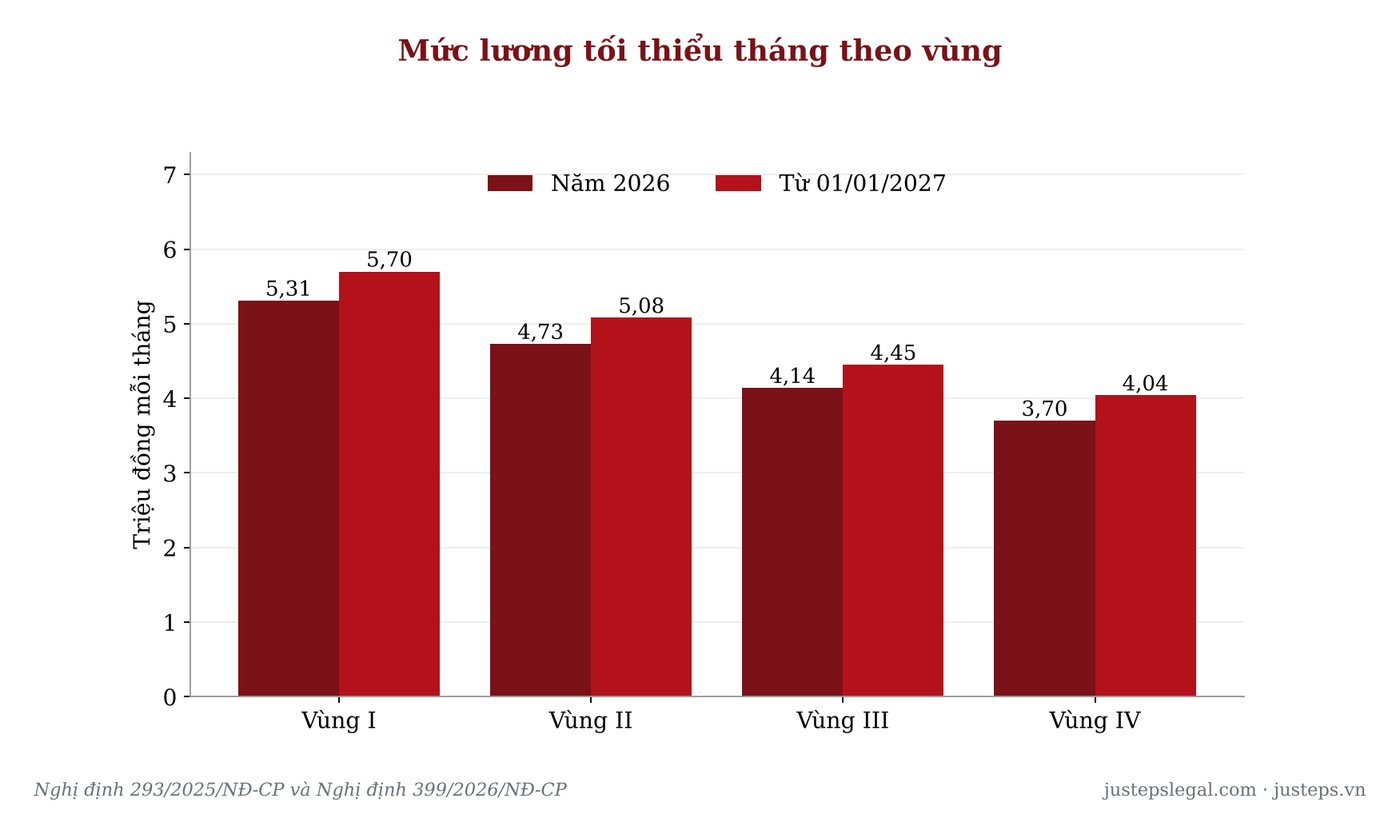
Monthly minimum wage in 2026 and from 1 January 2027 by region
A difference of three hundred and ten thousand to three hundred and ninety thousand dong a month may look small, but a business with hundreds of employees on wages close to the minimum will feel a large impact, because the increase also raises insurance contributions and usually pushes up the higher wage steps as well. Businesses in Region IV need to pay particular attention, because the highest percentage increase usually falls on factories that employ many unskilled workers.
The applicable region is determined by the area in which the business operates, not by where its head office is registered. Where a business has units or branches operating in different areas, each unit or branch applies the rate of the area in which it operates, and a business in an industrial park or export processing zone that lies across several areas with different rates applies the highest rate[4]. The decree also deals with changes to areas, under which an area that is renamed or divided temporarily keeps the rate it had before the change, while a new area formed from areas with different rates applies the highest rate until the Government issues new regulations[4]. Following the reorganisation of administrative units in 2025, many addresses on contracts and registration certificates have changed, so businesses need to check each actual workplace against the list of areas in the appendix to Decree No. 399/2026/ND-CP rather than relying on the old regional classification.
The wage components that must not fall below the minimum
The wage for the job or title
Under the Labour Code, the wage for the job or title stated in the contract may not be lower than the minimum wage[5]. The monthly minimum wage is the lowest level used as the basis for agreeing and paying wages to employees paid monthly, ensuring that the wage for the job or title of a person who works full normal working hours in the month and completes the agreed labour norms or work is not lower than this level[6]. The business therefore compares the minimum rate with the wage for the job or title, not with total income including allowances, attendance bonuses, other bonuses or overtime pay. An employee in Region II on a basic wage of VND 4,900,000 plus an attendance allowance of VND 500,000 must still have their basic wage raised to at least VND 5,080,000, even though their total income already exceeds the new rate.
Hourly, daily and piece-rate wages and probationary wages
Employees paid by the hour must be paid no less than the hourly minimum wage, and weekly, daily, piece-rate or lump-sum wages, when converted to a monthly or hourly basis, may not be lower than the corresponding rate either[6]. A weekly wage is converted to a monthly wage by multiplying it by fifty-two and dividing by twelve, and a daily wage is converted by multiplying it by the number of normal working days in the month[6]. Businesses with part-time staff, short-term contract workers under employment contracts or workers on piece rates therefore need to recalculate unit rates on the basis of the new minimum, not merely amend monthly wages.
The probationary wage is agreed between the parties but must be at least eighty-five per cent of the wage for the job concerned[5]. When a business raises the wage for a job to meet the new minimum, the probationary wage of anyone whose probation runs past 1 January 2027 must also be rechecked against this percentage. Likewise, payments calculated on the basis of the minimum wage, such as wages for work stoppages for objective reasons in certain cases, also rise automatically with the new rate, so the pay regulations should refer to the minimum wage in force rather than state a fixed figure.
More favourable agreements continue to apply
Decree No. 399/2026/ND-CP requires employers to review employment contracts, collective bargaining agreements and internal regulations in order to bring them into line, and prohibits them from abolishing or reducing wage entitlements for overtime work, night work, in-kind allowances and other entitlements under labour law[7]. More favourable terms that have already been agreed, such as paying at least seven per cent above the minimum to employees who have completed vocational training, continue to apply unless the parties agree otherwise[7]. Businesses should therefore not use the adjustment as an opportunity to merge or cut existing allowances, because doing so is both unlawful and likely to provoke a reaction from the workforce.
Updating the salary scale, payroll table and pay regulations
When the lowest wage step rises, the steps immediately above it are often squeezed close together or even fall below the step beneath, which defeats the purpose of step increases. A business may choose to raise only those currently below the new rate, to raise step one and keep the gaps between steps, or to adjust the whole salary scale by a common percentage. Each option has a different cost, and the chart below illustrates the additional monthly cost of the three options at a business with eighty employees in Region II.
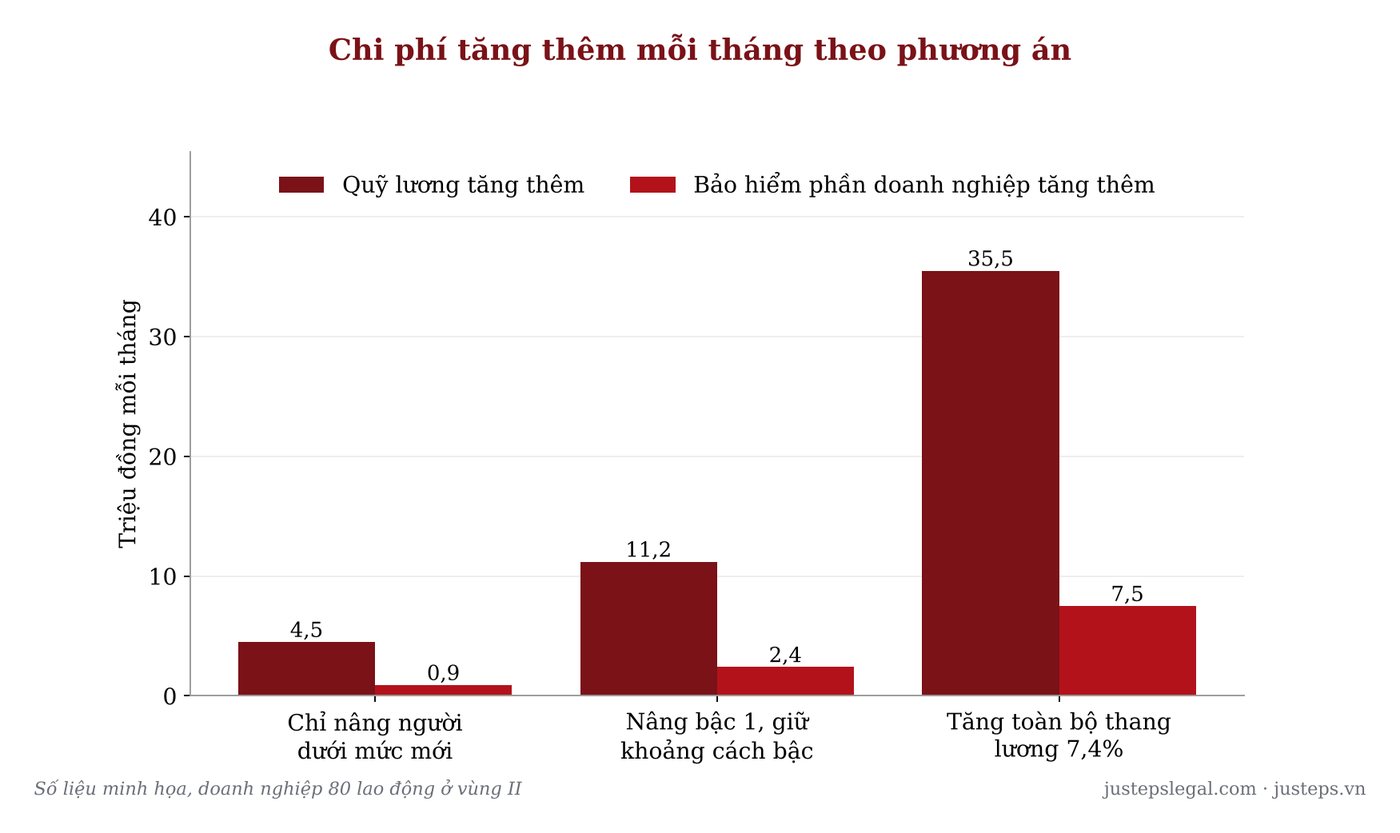
Additional monthly cost under three options for adjusting the salary scale
In this example, the option of raising only the twenty-five people currently on VND 4,900,000 to exactly VND 5,080,000 increases the wage bill by about VND 4.5 million a month, but leaves steps one and two almost equal. The option of raising step one and keeping a five per cent gap between steps affects sixty people and increases the wage bill by about VND 11.2 million a month, while raising the whole salary scale by 7.4 per cent costs about VND 35.5 million. The compulsory insurance paid by the business is calculated at an indicative rate of about twenty-one per cent of the wage increase. The figures are illustrative, and businesses should run all three options on their actual payroll data before submitting them to the director for approval.
The Labour Code requires employers to establish salary scales, payroll tables and labour norms as the basis for recruitment, agreeing wages and paying wages, to consult the grassroots employee representative organisation where one exists, and to publish them at the workplace before implementation[5]. The decree guiding labour relations also places salary scales and payroll tables among the matters that the employer must make public and on which employees have the right to give their views when they are drawn up or amended[8]. Salary scales and payroll tables do not have to be registered with a state authority, but the business should keep the published version, the minutes or written comments of the representative organisation and evidence of posting so that it can produce them during an inspection. A business wishing to redesign its salary scale by position and competence rather than simply adding the difference may refer to the Justeps service salary scales and pay and bonus regulations.
The pay and bonus regulations also need to be reviewed at the same time, especially provisions that calculate allowances, attendance bonuses or piece rates as a percentage of the minimum wage. In addition, on 21 November 2026 the National Assembly passed a law amending and supplementing the Labour Code which adds two public holidays on full pay, 27 July and 24 November, with effect from 1 March 2027[9]. Businesses preparing their 2027 wage budget should include the cost of these two holidays, particularly the cost of overtime on public holidays for departments that must operate continuously.
Amending employment contracts by annex
A change to the wage stated in a contract must be made by a contract annex or a new contract, because the Labour Code provides that an annex has the same effect as the contract and is used to amend or supplement the contents of the contract, except for its term[5]. The party requesting an amendment or supplement to the contract must notify the other party of the proposed changes at least three working days in advance[5]. Businesses should therefore send wage adjustment notices before 20 December 2026 and finish signing annexes before 31 December 2026, so that from the January 2027 pay period the records and the payroll match.
The annex should clearly state the provision being amended, the new wage for the job or title, whether allowances remain unchanged or are altered, and an effective date of 1 January 2027. Where an employee on maternity leave, long-term sick leave or a business trip cannot sign before 1 January 2027, the business must still pay wages at the new rate from that date and have the annex signed when the employee returns, stating that it takes effect from 1 January 2027. Businesses already using electronic employment contracts may sign annexes on an electronic platform, provided that the signing and storage process meets the regulations on electronic employment contracts.
To complete these tasks on time, the business should assign specific responsibilities to each department and set each milestone in December. The diagram below suggests how the HR department, payroll accounting, the director and the employee representative organisation should coordinate.
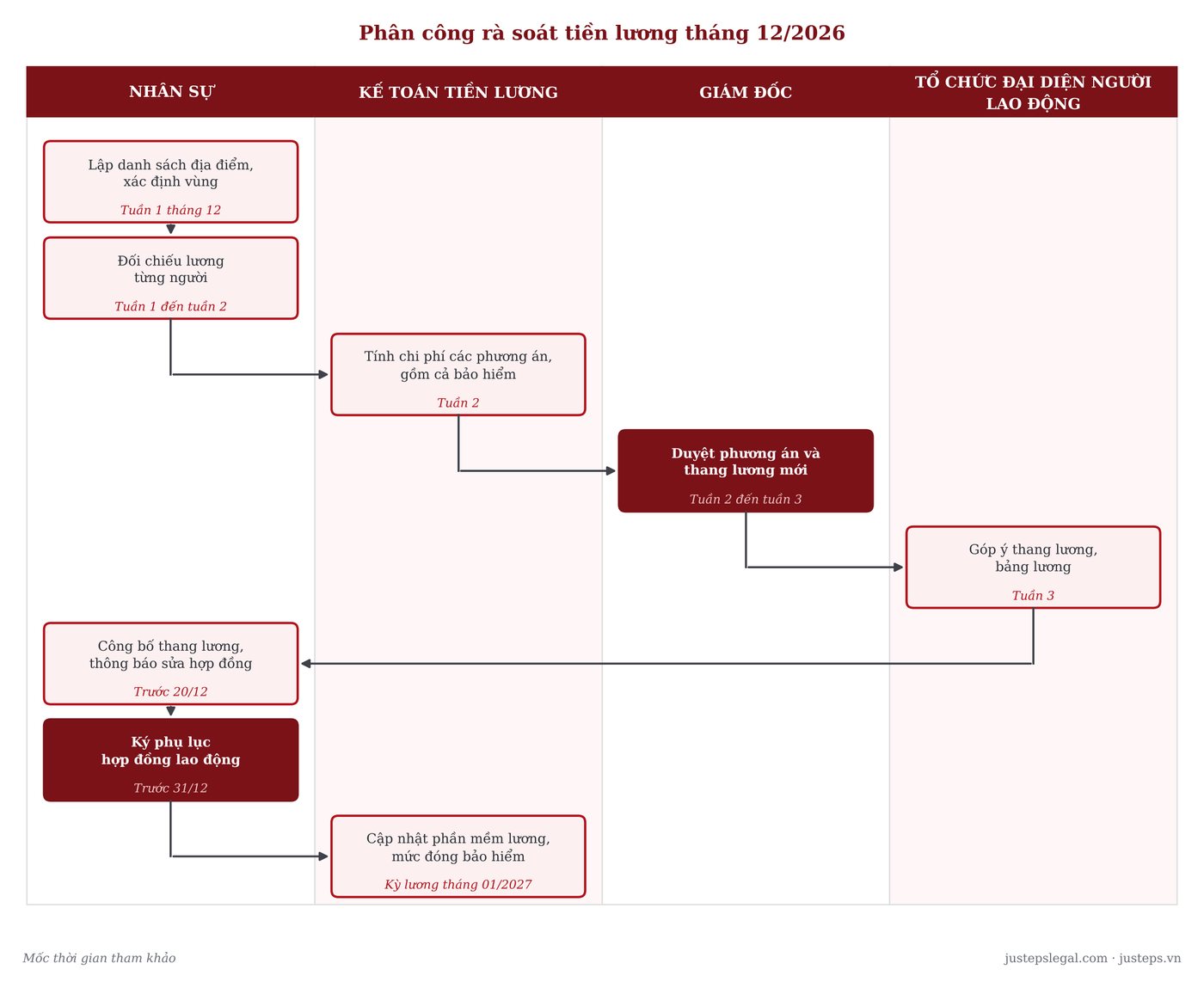
Allocation of tasks and milestones for the payroll review in December 2026
The HR department begins with a list of workplaces and a table comparing each person's wage in the first week of December, after which payroll accounting calculates the cost of the options, including the insurance paid by the business. The director approves the option and the new salary scale in the second or third week, so that the employee representative organisation has time to comment before publication. Sending notices and signing annexes is the critical step because it is tied to the three-working-day notice period, while updating the payroll software and insurance contributions is done in the January 2027 pay period. A business without a grassroots employee representative organisation should still consult employees under the rules on workplace democracy before publication.
Adjusting insurance contributions and budgeting costs
Under the Law on Social Insurance, for employees whose wages are decided by the employer, the monthly wage used for compulsory social insurance contributions comprises the wage for the job or title, wage allowances and other additional amounts agreed to be paid regularly and consistently in each pay period[10]. The lowest wage for contribution purposes equals the reference level and the highest equals twenty times the reference level at the time of contribution[10]. When the wage for the job rises to meet the new minimum, the employee's contribution wage rises accordingly from January 2027, and the business must declare the adjustment to the social insurance authority rather than keep the old contribution level.
Employees contribute eight per cent to the retirement and survivorship fund, while employers contribute three per cent to the sickness and maternity fund and fourteen per cent to the retirement and survivorship fund, calculated on the monthly wage used for social insurance contributions[11]. In addition, the business also pays health insurance, unemployment insurance, occupational accident and disease insurance and trade union fees at rates set by the relevant specialised laws, so the total additional cost to the business is always greater than the wage increase itself. In the example of twenty-five people in Region II each receiving an increase of VND 180,000 a month, the wage bill rises by VND 4,500,000 a month, or VND 54 million a year, before the insurance and trade union fees calculated on that increase. A business that needs to review the contribution levels of each group of employees may refer to the Justeps service compulsory social insurance advisory.
Alongside insurance, accounting needs to update the monthly personal income tax withheld for employees whose taxable income increases, the wage costs expected to be deductible for corporate income tax purposes, and the 2027 wage budget. Businesses with fixed-price service or processing contracts with customers should review the price adjustment clauses that apply when labour costs change, because the cost increase can significantly reduce the margins on long-term contracts.
Common mistakes and the risk of penalties
In the payroll reviews Justeps has carried out for businesses, the following mistakes appear most frequently whenever the regional minimum wage changes:
- The business increases allowances or attendance bonuses instead of the wage for the job, so the wage stated in the contract remains below the minimum.
- A branch or store located in an area with a higher rate continues to apply the minimum wage of the area where the head office is located.
- The payroll team has changed the wage in the software but no annex has been signed, so the contract and the payroll do not match.
- The business forgets to recalculate the hourly rates of part-time staff and the probationary wages of those on probation.
- From January 2027 the business continues to declare the contribution wage at the old level, resulting in arrears and late payment interest.
- The new salary scale is applied without evidence that the representative organisation was consulted and the scale was published.
Paying wages below the minimum wage and failing to establish or publish salary scales and payroll tables are breaches penalised under Decree No. 283/2026/ND-CP on administrative penalties in the fields of labour and social insurance, and the fine for an organisation is twice the fine for an individual[12]. In addition to the fine, the business is required to pay employees the outstanding wages in full and may be required to pay the corresponding insurance arrears. In many cases, the cost of dealing with the consequences is far greater than the cost of adjusting wages on time, especially when the error continues for many months and affects many people.
The review file should include a list of workplaces with their applicable regions, a table comparing each person's wage with the new rate, cost calculations for the options, the amended salary scale and payroll table with the written comments of the representative organisation, the wage adjustment decision, notices of contract amendment, the signed annexes and the documents adjusting insurance contributions. These documents should be kept together by year so that the business can easily explain its position during an inspection or when an employee queries their wage.
How Justeps can help
Justeps supports businesses in reviewing wages and preparing for the new minimum wage through the following services:
- Salary scales and pay and bonus regulations. Justeps redesigns the salary scale, payroll table and pay and bonus regulations in line with the new minimum, together with the consultation and publication records.
- Labour and payroll compliance management. Justeps reviews the contracts, annexes and payroll of each location to identify wages below the minimum before 1 January 2027.
- Compulsory social insurance and employee benefits advisory. Justeps determines the contribution wage after adjustment and guides the documents for adjusting contributions with the social insurance authority.
- Training on salary scales and pay and bonus regulations. Justeps trains HR and payroll staff to calculate adjustment options and prepare salary scale records in accordance with the regulations.
Frequently asked questions
May a business sign the annex after 1 January 2027?
The business must still pay wages at the new rate from 1 January 2027[2]. An annex signed late should clearly state that it takes effect from that date so that the contract matches the payroll.
Is it compulsory to raise the wages of those already paid above the minimum?
The law only requires that the wage for the job is not lower than the minimum[6]. Raising other steps is a management decision, but the business may not cut existing entitlements and more favourable agreements[7].
Can allowances be counted towards the minimum wage?
No. The minimum rate is compared with the wage for the job or title of a person who works full normal working hours[6], not with total income.
Does a branch in another province apply the head office rate or the rate of the area where it is located?
The branch applies the rate of the area in which it operates[4]. If that area has a higher rate than the head office, the business must apply the higher rate to employees working at the branch.
Does the amended salary scale have to be submitted to a state authority?
Salary scales and payroll tables do not have to be registered, but the employee representative organisation must be consulted where one exists and the scale must be published before implementation[5]. The business should keep the published version and the written comments so that it can produce them during an inspection.
Do social insurance contributions rise automatically with the minimum wage?
Not automatically. The business must declare an adjustment of the contribution wage according to the new wage and allowances[10] from January 2027.
What is the minimum that must be paid to employees working by the hour?
From 1 January 2027, the hourly minimum wage is VND 27,400 in Region I, VND 24,400 in Region II, VND 21,400 in Region III and VND 19,400 in Region IV[1].
Related articles
- The annual pay review process, from criteria, budget and merit matrix to records and employee notification
- The monthly social insurance management process within a business
- Monthly labour and payroll compliance checklist for the HR department
- Five common pay models and how a business can choose the right one for each group of positions
Notes
[1] Clause 1, Article 3 of Decree No. 399/2026/ND-CP dated 2 November 2026 of the Government on the minimum wage for employees working under employment contracts.
[2] Clauses 1 and 2, Article 5 of Decree No. 399/2026/ND-CP.
[3] Article 3 of Decree No. 293/2025/ND-CP dated 10 November 2025 of the Government on the minimum wage for employees working under employment contracts.
[4] Clause 3, Article 3 of Decree No. 399/2026/ND-CP.
[5] Labour Code No. 45/2019/QH14 dated 20 November 2019 (provisions on employment contracts, contract annexes, probation, wages, salary scales and payroll tables), as amended and supplemented by the law passed by the National Assembly on 21 November 2026.
[6] Article 4 of Decree No. 399/2026/ND-CP.
[7] Clause 3, Article 5 of Decree No. 399/2026/ND-CP.
[8] Point b, Clause 1, Article 43 and Point b, Clause 1, Article 44 of Decree No. 145/2020/ND-CP dated 14 December 2020 of the Government detailing and guiding the implementation of a number of articles of the Labour Code on working conditions and labour relations.
[9] Law amending and supplementing a number of articles of the Labour Code, the Law on Archives, the Law on Gender Equality, the Law on Red Cross Activities and the Law on Employment, passed by the National Assembly on 21 November 2026 and effective from 1 March 2027.
[10] Points b and dd, Clause 1, Article 31 of the Law on Social Insurance No. 41/2024/QH15 dated 29 June 2024.
[11] Articles 33 and 34 of the Law on Social Insurance No. 41/2024/QH15.
[12] Clause 1, Article 7 of Decree No. 283/2026/ND-CP dated 15 July 2026 on administrative penalties in the fields of labour and social insurance, and the provisions of that decree on wage-related breaches.
This article is for reference and reflects the regulations in force at the time of publication. Please consult Justeps for advice tailored to your company’s records and situation.
For further information, please contact:
📩 Email: info@justeps.vn
🌐 Website: https://justepslegal.com · https://justeps.vn
🌐 Page: Justeps
☎️ Hotline (Zalo): 096 172 2607
📍 Thanh Xuan Office: 12th Floor, Licogi 13 Tower, 164 Khuat Duy Tien Street, Thanh Xuan Ward, Hanoi, Vietnam
📍 Ha Dong Office: LK06B, No.10, Dong Dua Area, Ha Dong Ward, Hanoi, Vietnam
📍 Ho Chi Minh City Branch: 528 Le Van Sy, Ho Chi Minh City, Vietnam
📍 Hai Phong Office: Truong Thinh Village, Ha Dong Commune, Hai Phong, Vietnam
📍 Quang Ninh Office: Van Don Special Zone, Quang Ninh Province, Vietnam





