The HR department holds more personal data than any other part of a company: ID numbers, bank accounts, health records, facial images for time clocks, even information about employees' families for personal tax deductions. From 01/01/2026, Law on Personal Data Protection No. 91/2025/QH15 is in force and sets clearer requirements on how companies collect, use and retain this data.
This article explains how to organise personal data protection in HR along the lifecycle of an employee file, how to assign responsibilities and which forms are needed.
What personal data the HR department processes
The first step is a data map: list each type of data, where it comes from, which system stores it, who can see it and with whom it is shared. Many companies are surprised to find the same ID card copy in five places: the recruitment mailbox, a shared drive, the HR software, the paper file and the accountant's computer.
| Data category | HR examples | Level | Minimum control |
|---|---|---|---|
| Identification and contact data | Full name, date of birth, ID number, address, phone | Basic | Role-based access |
| Financial data | Bank account, salary, tax withholding | Needs strong protection | Access limited to payroll and accounting |
| Health data | Health certificates, sickness, maternity and occupational accident records | Sensitive | Stored separately, access logged |
| Biometric data | Fingerprints and faces used for time clocks | Sensitive | Alternative option, impact assessment |
| Monitoring data | CCTV, system access logs, location of company devices | Depends on purpose | Prior notice, limited retention |
| Unsuccessful candidate data | CVs, interview results | Basic | Delete after the notified period |
Health and biometric data are sensitive personal data under the Law on Personal Data Protection and require a higher level of protection. For facial or fingerprint time clocks, companies should consider an alternative such as access cards for employees who do not consent, and keep biometric templates only as long as necessary.
Legal grounds for processing employee personal data
Not all HR data requires separate consent. Part of the data is collected to enter into and perform the employment contract; employees must provide truthful information on their name, date of birth, gender, residence, qualifications, vocational skills and health status when entering into a contract (under Article 16 of Labor Code No. 45/2019/QH14)[4]. Another part is collected to fulfil legal obligations such as social insurance contributions and personal income tax withholding.
By contrast, purposes outside the contract and legal obligations, such as using employee photos in marketing or sharing a list with a voluntary health insurer, usually require clear consent that can be withdrawn. Companies should separate these purposes into individual consent boxes rather than bundling them into the employment contract.
Organising personal data protection in HR along the file lifecycle
The easiest approach is to follow the lifecycle of an employee file, with forms and an owner for each stage.
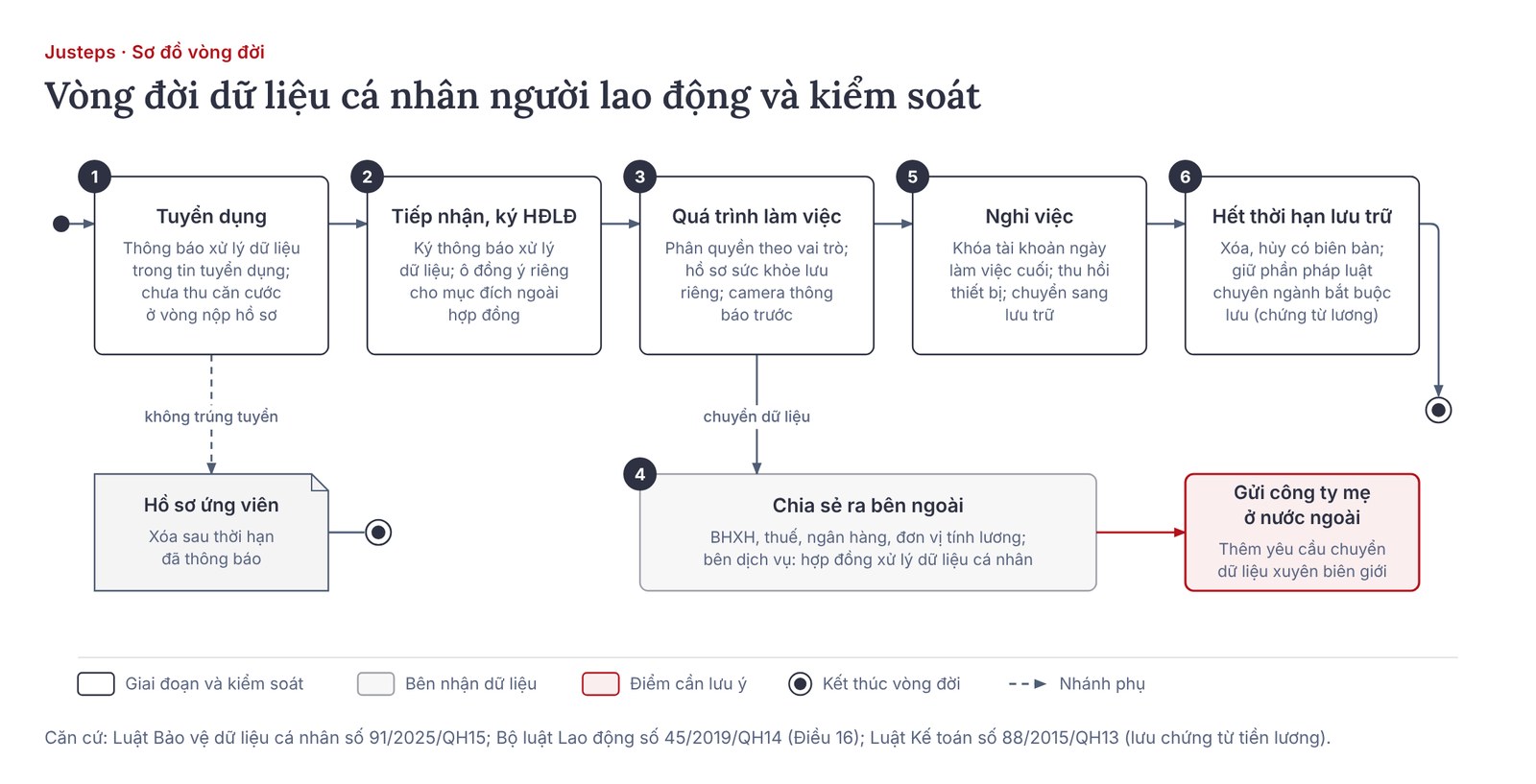
Figure 01. Lifecycle of employee personal data and controls at each stage
Basis: Personal Data Protection Law No. 91/2025/QH15; Labour Code No. 45/2019/QH14 (Article 16); Accounting Law No. 88/2015/QH13
The top band shows the five main stages of an employee file, each with minimum controls; the lower band shows side branches. The red box flags transfers to an overseas parent company.
Recruitment
Job postings and application forms should include a data processing notice: purpose, retention period for candidate files and the right to request deletion. Do not ask candidates for ID copies or health certificates at the application stage when they are not yet needed.
Onboarding and employment
At onboarding, employees sign a personal data processing notice and any separate consent boxes. During employment, access is role-based: line managers can see performance reviews but not colleagues' salaries; recruiters do not need access to health records. Workplace CCTV must be notified in advance and must not be installed in private areas.
Sharing with third parties
Data is transferred to the social insurance agency, tax authority, payroll bank, payroll service provider and health insurer. With service providers, a contract or personal data processing annex should set out the scope, protection measures and the return or deletion of data on termination. If data is sent to a parent company abroad, for example to calculate group bonuses, the company must also meet the Law's requirements on cross-border transfer of personal data.
Departure and end of retention
When an employee leaves, lock accounts on the last working day, recover devices and move the file to archive status with restricted access. Some records must be kept under sector-specific law, such as payroll accounting documents under Law on Accounting No. 88/2015/QH13. Data with no remaining basis for retention should be deleted or destroyed with a record.
Assigning responsibility for personal data protection in the company
Personal data protection in HR is not only the HR department's job. A practical allocation for a mid-sized company:
- Management issues the personal data protection policy and appoints a person in charge.
- HR leads the HR data map and notice forms, and handles employee requests to access, correct or delete data.
- IT manages system permissions, backups, access logs and incident handling.
- Legal or an external adviser reviews contracts with data processors, impact assessments and cross-border transfers.
The Law on Personal Data Protection requires a personal data processing impact assessment in many cases, while providing exemptions or deferrals of some obligations for small and start-up enterprises for a certain period. Companies should check whether they qualify, especially if they process sensitive data such as health or biometric data.
Sanctions and the data collection procedure
Alongside sanctions under personal data protection law, Decree No. 363/2026/ND-CP on administrative penalties in the field of data took effect on 11/11/2026. Under Clause 1, Article 8 of this Decree, failing to issue a data collection procedure or to apply data protection measures is fined VND 20–40 million, and organisations are fined double the amount for individuals. The Decree does not apply to acts already covered by the decree on penalties for cybersecurity and personal data protection, but it is a reminder that a written data collection procedure is a minimum requirement.
Minimum documentation the HR department should have
- The company's personal data protection policy, with a section for employees and candidates.
- An HR data map and a retention schedule for each type of record.
- Data processing notice templates for candidates and employees, with separate consent boxes.
- Personal data processing annexes in contracts with payroll, insurance and HR software providers.
- A procedure for data subject requests and a procedure for data breach or loss incidents.
- A personal data processing impact assessment where required.
Legal basis and sources
- Law on Personal Data Protection No. 91/2025/QH15, effective from 01/01/2026.
- Law on Data No. 60/2024/QH15.
- Decree No. 363/2026/ND-CP on administrative penalties in the field of data, issued on 19/9/2026, effective from 11/11/2026.
- Labor Code No. 45/2019/QH14, effective from 01/01/2021.
- Law on Accounting No. 88/2015/QH13.
How Justeps supports businesses
- Advisory and regulatory compliance: personal data protection policy, notice templates and consent forms for candidates and employees.
- Governance standardisation: HR data mapping, access rights, retention schedule.
- Operational setup: procedures for employee data requests and data incidents.
- In-house training: personal data protection training for HR and line managers.
Contact Justeps for a review of your company's HR data practices.
Frequently asked questions
Is employee consent needed to pay social insurance?
Data used for social insurance and tax withholding serves legal obligations and the employment contract, so a clear notice of purpose is normally enough. Separate consent is for purposes beyond that scope.
Can facial recognition time clocks be used?
Yes, but this is biometric data in the sensitive category. Companies should give clear notice, protect it strictly, offer an alternative and consider an impact assessment.
How long should unsuccessful candidates' files be kept?
For the period notified to candidates, usually 6 to 12 months if the company wants to keep them for future rounds. After that, delete them unless the candidate agrees to an extension.
Are there issues with sending payroll to a parent company abroad?
This is a cross-border transfer of personal data, so the company must meet the Law on Personal Data Protection's requirements on cross-border transfers and should send only necessary data, preferably aggregated.
Who in the company is primarily responsible for HR personal data protection?
The legal representative bears overall responsibility. The company should appoint a person or unit in charge of personal data protection, with HR leading on employee data.
Related articles
- A minimum set of internal governance regulations for companies with 50–200 employees
- Outsourced legal counsel: when to use it, what to assign and how to measure results
- Corporate restructuring and lawful tax optimisation: options and risks
This article is for reference and reflects the regulations in force at the time of publication. Please consult Justeps for advice tailored to your company’s records and situation.
For further information, please contact:
📩 Email: info@justeps.vn
🌐 Website: https://justepslegal.com · https://justeps.vn
🌐 Page: Justeps
☎️ Hotline (Zalo): 096 172 2607
📍 Thanh Xuan Office: 12th Floor, Licogi 13 Tower, 164 Khuat Duy Tien Street, Thanh Xuan Ward, Hanoi, Vietnam
📍 Ha Dong Office: LK06B, No.10, Dong Dua Area, Ha Dong Ward, Hanoi, Vietnam
📍 Ho Chi Minh City Branch: 528 Le Van Sy, Ho Chi Minh City, Vietnam
📍 Hai Phong Office: Truong Thinh Village, Ha Dong Commune, Hai Phong, Vietnam
📍 Quang Ninh Office: Van Don Special Zone, Quang Ninh Province, Vietnam