
Key takeaways
- The real cost of an in-house legal officer is usually about half as much again as the agreed salary, because the business also pays insurance contributions, the trade union fee, a thirteenth-month salary, office space, research tools and recruitment costs.
- The comparison should start from the actual number of hours of legal work each month and the share of repetitive work, rather than from revenue or headcount.
- On the assumptions in this article, ongoing legal advice is the cheapest option below about 38 hours a month, a hybrid model makes sense between about 38 and 56 hours, and an in-house legal officer becomes cost-effective when demand is consistently above that level.
- Whichever model is chosen, the business still needs outside expertise for tax, investment, disputes and major transactions, and managers remain responsible for their own decisions.
- Advisory fees of VND 5 million or more are deductible only where there is a contract, a valid invoice and evidence of non-cash payment.
As the number of contracts, personnel decisions and legal questions grows, the board of management usually has to choose between two directions. The first is to hire a legal officer who works full time at the company; the second is to sign an ongoing legal advice contract with an outside provider. Many businesses decide on instinct, for example believing that having someone in the office is more convenient, or that outsourcing is cheaper, and only realise the choice was unsuitable when they face a major transaction or a complex matter.
This article proposes a way of comparing three options, namely an in-house legal function, ongoing legal advice and a hybrid model, based on the actual hours of legal work and costs calculated in full under the insurance and tax rules currently in force. The figures in the article are illustrative assumptions for a business of about 80 staff in Hanoi, and readers should replace them with their own data. The article is written for owners, general directors, chief financial officers and heads of human resources of private businesses, including foreign-invested enterprises.
Does the law require a private business to have a legal department
As a rule, current law does not require businesses outside the state sector to set up a legal department or to hire a dedicated legal officer. The rules on legal units apply mainly to state agencies and state-owned enterprises[1], while private businesses are free to decide how to organise their legal work. Some regulated sectors, such as securities, banking and insurance, have their own requirements for a compliance control function, so businesses in these sectors should check the sector-specific legislation before choosing a model.
The absence of a requirement does not mean that legal responsibility is any lighter. Managers of a business must still exercise their rights and perform their obligations honestly, prudently and in compliance with the law, and are personally liable if they cause loss to the company[2]. The opinion of a legal officer or an advisory firm is only a basis on which managers make decisions; it does not replace those decisions. The board of management should therefore choose the model that gives the company legal input early enough and in enough depth at a reasonable cost, since ultimate responsibility rests with the decision-maker whether the opinion comes from inside or outside the company.
Measuring the actual legal workload before comparing options
The first step is to log every legal request that arises over at least three months, preferably six, so that the peak season is included. Each request should be recorded on one line showing the requesting department, the type of work, the time taken and the person who handled it, including short questions answered by message. A business that does not yet have a legal officer can ask the chief accountant or the management secretary to keep the log, and estimate time from the hours billed by the advisory firm or as reported by the person handling the request.
In the illustrative business, with about 80 staff and annual revenue of about VND 120 billion, total recorded demand was about 50 hours a month, broken down as follows.
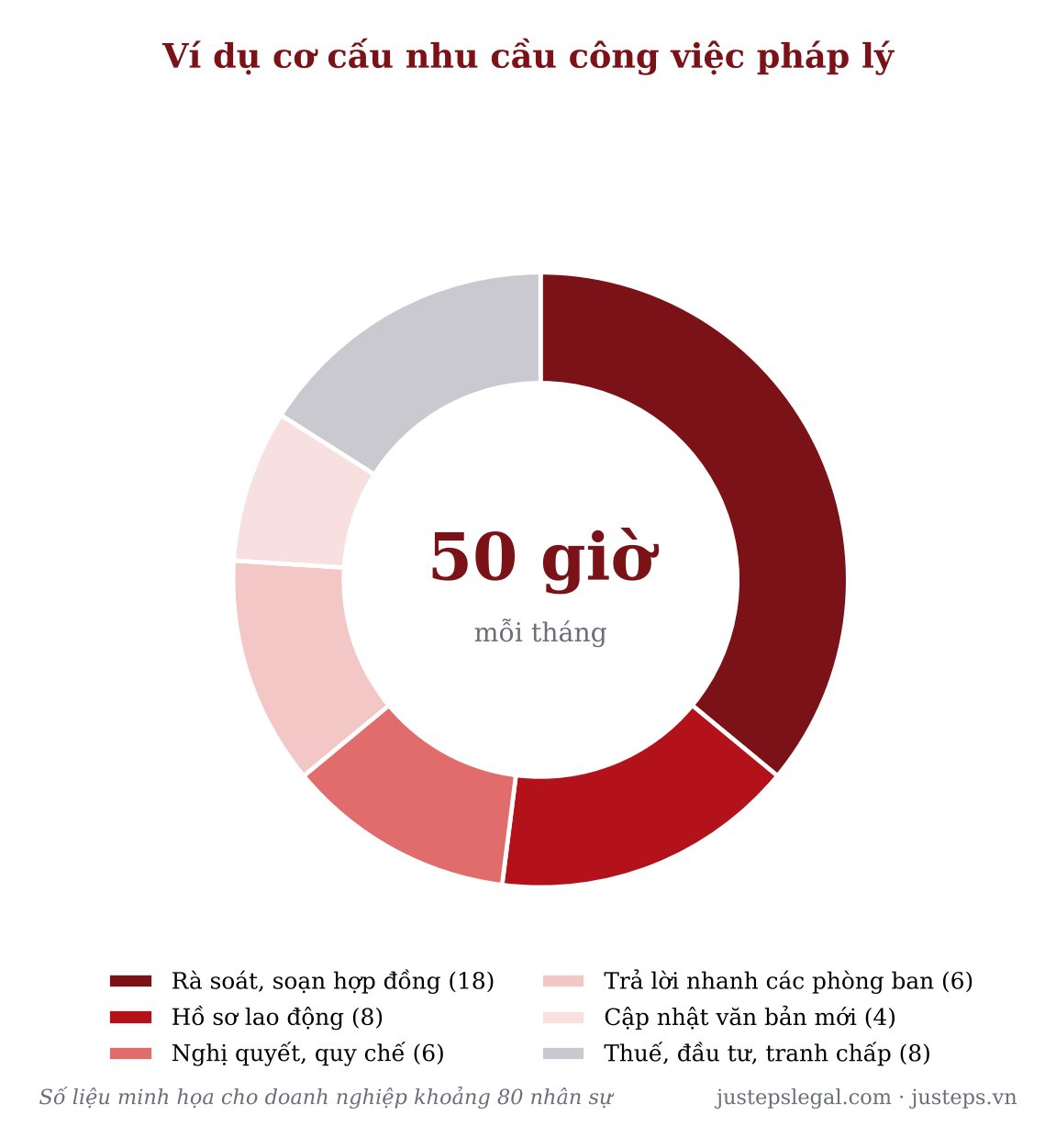
Example breakdown of 50 hours of legal work a month in a business of about 80 staff
Reviewing and drafting contracts accounts for the largest share at 18 hours, equivalent to about 12 contracts a month, followed by employment documents such as labour contracts, transfer decisions and disciplinary matters at 8 hours. Resolutions, internal rules and quick answers to departments each take about 6 hours, keeping up with new legislation takes about 4 hours, and the remaining 8 hours go to specialist work such as tax, investment, intellectual property and disputes. About two thirds of the hours are repetitive work that can be standardised with templates and procedures, while the rest requires specialist knowledge across many different fields.
The ratio between repetitive and specialist work matters more than revenue when choosing a model. A business with large revenue that signs only a few framework contracts a year may need fewer hours than a smaller business that signs dozens of service contracts every month. Conversely, a business that is raising capital, has foreign shareholders or operates in a conditional business line usually has a great deal of specialist work, which a junior in-house officer will struggle to handle.
Calculating the full cost of an in-house legal officer
The cost of an in-house legal officer is often underestimated because the board of management looks only at the agreed salary. In practice, the business must pay social insurance, health insurance and unemployment insurance contributions at a combined rate of 21.5% of the salary used as the contribution base[3], pay the trade union fee at 2% of the payroll fund[4], and bear further items such as a thirteenth-month salary, office space and legal research tools. The table below calculates the annual cost of a legal specialist with three to five years’ experience in Hanoi, assuming the entire salary is subject to insurance contributions.
| Item | Assumption | Annual cost |
|---|---|---|
| Salary | Salary of VND 20 million a month, paid for 12 months. | VND 240 million |
| Compulsory insurance | Employer’s share of 21.5% of the salary used as the contribution base. | VND 51.6 million |
| Trade union fee | Employer pays 2% of the payroll fund used as the insurance contribution base. | VND 4.8 million |
| Thirteenth-month salary | Year-end bonus equal to one month’s salary under the business’s usual practice. | VND 20 million |
| Tools and training | Legal research software, refresher courses and specialist books. | VND 20 million |
| Workspace | Office space, computer and equipment allocated to one person. | VND 24 million |
| Recruitment | Advertising fees and interview time, spread over the expected period of employment. | VND 10 million |
In total, the annual cost is about VND 370 million, or roughly VND 31 million a month, about 55% higher than the agreed salary. The business still has to buy specialist advice on tax, investment and disputes that one person can hardly cover, assumed here at about VND 5 million a month, so the in-house model costs about VND 36 million a month. This amount is almost entirely fixed, which means the business still pays it in full in months when demand is low.
Besides the cash cost, the in-house model also has a time cost. The probation period for work requiring a college qualification or above is at most 60 days[5], and a new hire usually needs several more months to understand the company’s products, customers and ways of working. When that person resigns, they need give only 45 days’ notice under an indefinite-term contract or 30 days’ notice under a fixed-term contract[6], so the business may lose all the accumulated knowledge unless it has a handover procedure and a shared library of document templates.
The cost of ongoing legal advice and of a hybrid model
An ongoing legal advice contract is usually structured as a monthly package of hours, with an hourly rate for any hours above the package. This article assumes a 15-hour package at VND 12 million a month and an excess rate of VND 800,000 an hour, so that cost rises in line with demand and the business does not pay for unused time beyond the minimum package. The advantage of this structure is that the business gains access to a team of specialists in many fields through a single point of contact, for example through Justeps’ annual ongoing legal advice package service.
The hybrid model consists of a legal administration officer on a salary of about VND 12 million, with a full cost of about VND 18 million a month, who handles around 60% of the repetitive work such as managing template contracts, employment records and the archive of resolutions. The specialist work, around 40% of the hours, is passed to an advisory firm under a 10-hour package at VND 8 million a month with the same excess rate. The chart below compares the monthly cost of the three options at four different levels of demand.
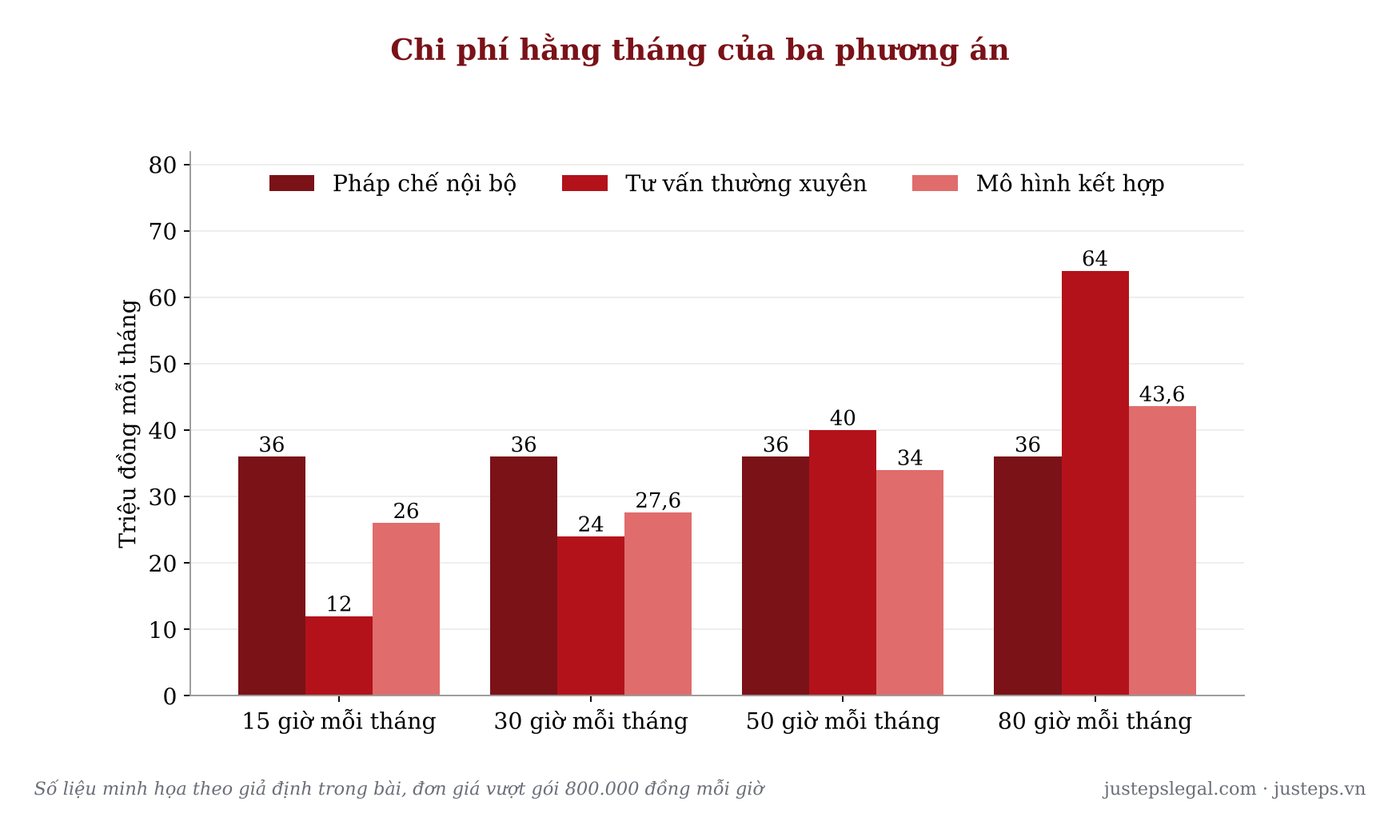
Monthly cost of the three options by hours of legal work, illustrative figures
At 15 and 30 hours, ongoing legal advice is the cheapest at VND 12 million and VND 24 million, while the in-house function still costs about VND 36 million even though the officer is not fully used. At 50 hours, the hybrid model has the lowest cost at about VND 34 million, while ongoing legal advice has risen to VND 40 million because of the excess hours. At 80 hours, the in-house function becomes the cheapest option, although one person would struggle to handle that volume well once meetings, studying new legislation and supporting departments are taken into account.
The break-even points between the three options
On the assumptions above, the cost of ongoing legal advice equals the cost of an in-house function at about 45 hours a month. The hybrid model becomes cheaper than ongoing legal advice from about 38 hours and remains cheaper than an in-house function up to about 56 hours. Therefore, below 38 hours of demand, ongoing legal advice is the most economical choice; between 38 and 56 hours a hybrid model should be considered; and above 56 hours an in-house function is more cost-effective, provided demand is steady throughout the year.
The break-even points are quite sensitive to the excess hourly rate and to market salaries. If the excess rate falls to VND 600,000 an hour, the break-even point between ongoing legal advice and an in-house function moves up to about 55 hours, and if the business recruits in Ho Chi Minh City at a higher salary, this point rises as well. Businesses should build a spreadsheet with their own figures and recalculate it every year, rather than relying on the thresholds in this article.
Benefits that do not appear on the cost sheet
Each model has strengths and weaknesses that a cost table cannot capture. An in-house officer understands the company’s products, people and transaction history in depth, can join meetings on the same day and knows about issues that have never been put in writing. However, one person can hardly have depth in every field, and because they are paid by the very board of management they advise, they may sometimes find it difficult to challenge openly a decision that the leadership already wants to make.
An outside advisory firm has the advantage of specialist depth, continuity when an individual leaves and the ability to add people for major transactions such as fundraising or mergers and acquisitions. Its opinions are also more independent, since they do not depend on internal reporting lines. The drawback is that the advisory firm needs time to understand the business, and without an internal point of contact, requests arrive piecemeal and without background information, which slows down response times.
A hybrid model takes advantage of both sides when the roles are clearly divided. The internal officer holds the information, receives and screens requests and prepares the files, while the advisory firm provides specialist opinions and reviews high-value documents. When providing personnel files and customer contracts to an outside provider, the business should sign a confidentiality undertaking and clearly define the roles in processing personal data under the personal data protection legislation[7], and should also require the advisory firm to confirm that it has no conflict of interest with the business’s counterparties.
Choosing a model according to the stage of growth and the level of risk
Headcount is not the only criterion, but it can serve as a starting point for estimating demand before logged data is available. The table below suggests a suitable model for each stage of a typical private business.
| Stage | Typical demand | Suggested model |
|---|---|---|
| Fewer than 30 staff | About 10 to 20 hours a month, mainly template contracts and employment documents. | Ongoing legal advice, with the accountant or management secretary as the point of contact. |
| 30 to 100 staff | About 20 to 50 hours a month, with internal rules and major transactions beginning to appear. | Ongoing legal advice, moving gradually to a hybrid model once demand exceeds 38 hours. |
| 100 to 300 staff | About 50 to 100 hours a month, with many contracts and repetitive personnel matters. | A hybrid model or an in-house function, together with a specialist advisory contract. |
| More than 300 staff or a group of companies | More than 100 hours a month, with several legal entities and intra-group transactions. | A legal department of two or more people, with advisers engaged project by project. |
The level of risk may change these suggestions. A business that operates in a conditional business line, has foreign investment, has many related-party transactions or is preparing to raise capital should retain outside expertise under any model, because mistakes in these areas usually have consequences far greater than the cost of advice. The flowchart below summarises the decision sequence based on logged data.
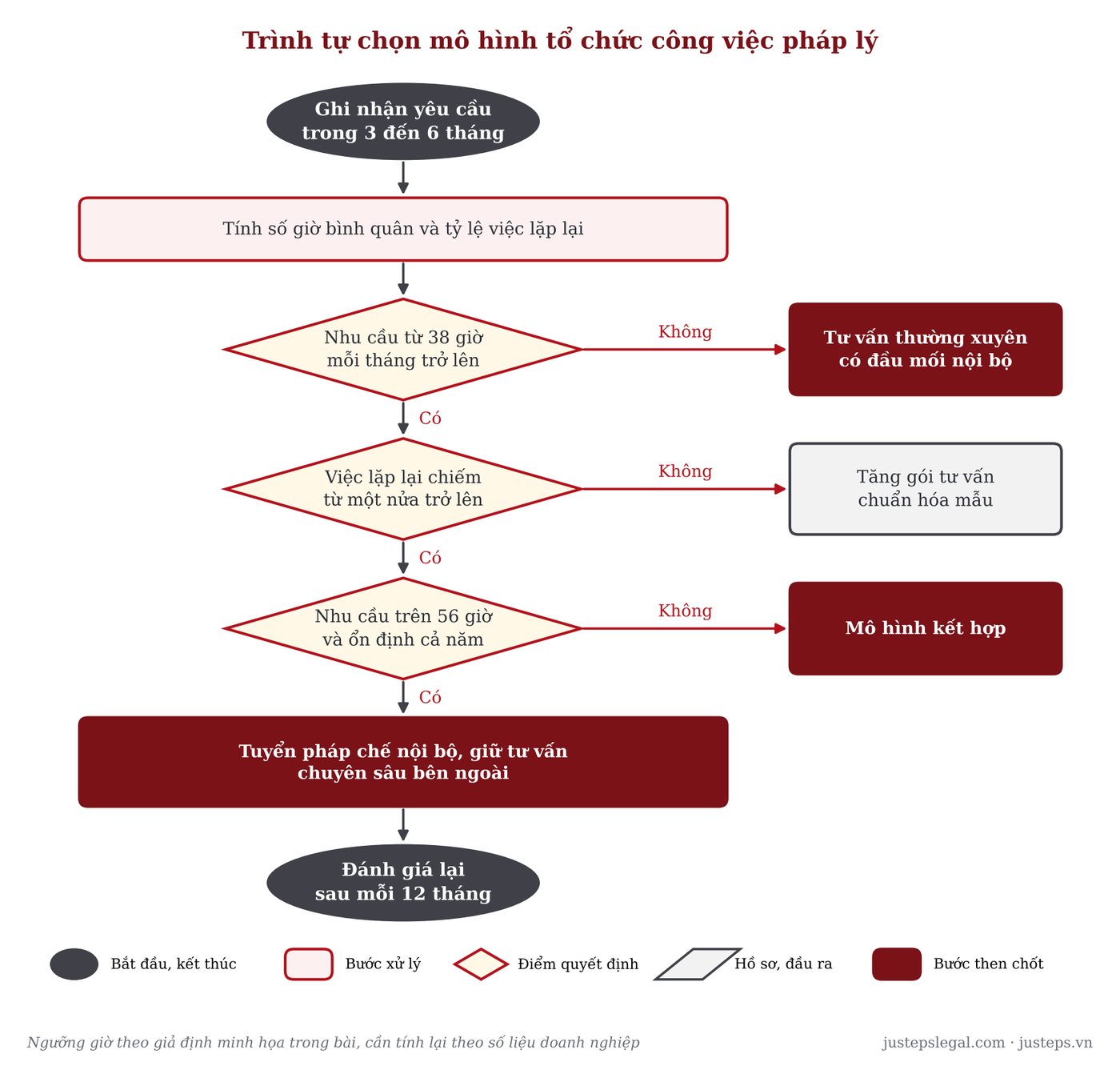
Sequence for choosing how to organise legal work based on measured demand
The business starts by logging requests for three to six months and then calculates the average number of hours a month. If demand is below 38 hours, ongoing legal advice is sufficient, and the business only needs to appoint someone in the company as the point of contact. If demand is higher but repetitive work accounts for less than half, the business should prioritise a larger advisory package and standardised document templates, because an internal employee would not have enough suitable work. Where repetitive work makes up the majority, the business chooses a hybrid model if demand is below 56 hours, or hires an in-house legal officer if demand is higher and steady, and in both cases reassesses the choice every year.
Putting the chosen model into practice
For ongoing legal advice, the contract should clearly state the scope of work included in the package, the number of hours, the excess rate, the response time for each type of request, confidentiality obligations and how the hours used are reported each month. The business should appoint a single internal point of contact to collect requests, provide full background information and follow up on the results. If, after six months, the hours used regularly exceed the package by more than 30%, the business should negotiate a larger package or consider moving to a hybrid model.
For an in-house legal function, the job description should clearly set the contract value threshold above which legal review is mandatory, the right of access to information and a direct reporting line to the general director or the board of directors when a major risk is identified. The business should build a library of reviewed template contracts and personnel decisions, as well as a handover rule for when the officer leaves. Where the business needs to reorganise its legal work but is not yet ready to recruit, it may consider Justeps’ outsourced corporate legal function service to have a fixed point of contact during the transition.
For tax purposes, advisory fees are a deductible expense when they relate to the business’s operations and are supported by invoices and documents. Payments of VND 5 million or more must be supported by evidence of non-cash payment to be deductible[8], and electronic invoices must comply with the new invoicing rules applicable from 1 July 2026[9]. Small and medium-sized enterprises may apply for partial support for legal advice costs under the State’s legal assistance programme, with the level of support depending on the size of the enterprise[10]. Finally, whichever model is chosen, the person or unit in charge of legal matters should send the board of management a quarterly report on open matters, newly emerging risks and new legislation affecting the business.
How Justeps can help
Justeps helps businesses measure demand and organise their legal work under a suitable model through the following services:
- Annual ongoing legal advice package. Justeps provides a fixed point of contact, committed response times and a monthly report on the hours used by the business.
- Outsourced corporate legal function. Justeps acts as the legal department, from reviewing contracts and employment documents to periodic risk reports for the board of management.
- Drafting and reviewing commercial contracts. Justeps builds a library of template contracts and a review procedure based on value thresholds for internal staff to apply.
- Periodic corporate legal review. Justeps periodically reviews legal, employment and contract files to identify early any matters that internal staff have not yet dealt with.
- In-house training. Justeps trains legal administration staff and department heads to recognise which matters should be passed to specialists.
Frequently asked questions
Must a private business have a legal department?
An ordinary private business is not required to have a legal department; the rules on legal units apply mainly to state agencies and state-owned enterprises[1]. Some sectors, such as securities, banking and insurance, have their own compliance control requirements, so the sector-specific legislation should be checked.
Are legal advisory fees deductible for corporate income tax purposes?
Advisory fees are deductible when they relate to the business’s operations and are supported by a contract and a valid invoice. For payments of VND 5 million or more, the business must pay by non-cash means[8].
How can a business tell whether its ongoing advice package is too large or too small?
The business should compare the hours actually used with the package over at least six months. If usage regularly exceeds the package by more than 30%, it should increase the package or move to a hybrid model; if it regularly uses less than half, it should reduce the package.
Can the accountant also handle legal work?
In a small business, the accountant can act as the point of contact for requests, keep the files and manage template contracts. However, the review of high-value contracts and disciplinary decisions should still involve someone with legal expertise.
Does a business that hires an in-house legal officer still need an outside advisory firm?
In most cases it does, because one person can hardly have depth in tax, investment, intellectual property and disputes at the same time. The business should set aside a budget for specialist advice as soon as it budgets for the in-house model.
Does providing personnel files to an advisory firm breach the personal data rules?
The business may provide them where it has a lawful basis, limits disclosure to what is necessary and clearly defines the advisory firm’s data processing role in the contract[7]. It should sign a confidentiality undertaking and redact unnecessary information before sending the files.
Can small businesses obtain State support for legal advice costs?
Small and medium-sized enterprises may receive partial support for legal advice costs under the legal assistance programme, with the level of support depending on the size of the enterprise[10]. The business should check the conditions and the level of support applicable at the time of application.
Related articles
- When a company should use an outsourced legal function, what to delegate and how to measure performance
- How should a business choose an annual retainer for ongoing legal advice, and how can it get the most out of it
- An annual periodic legal review covering 12 areas that companies should check themselves
- How to design an annual in-house legal training programme for a company
Notes
[1] Government Decree No. 55/2011/ND-CP dated 4 July 2011 on the functions, duties, powers and organisational structure of legal units.
[2] Article 165 of the Law on Enterprises No. 59/2020/QH14 dated 17 June 2020, as amended and supplemented by Law No. 76/2025/QH15.
[3] Law on Social Insurance No. 41/2024/QH15 dated 29 June 2024; Law on Health Insurance No. 25/2008/QH12, as amended and supplemented; Law on Employment No. 74/2025/QH15; Law on Occupational Safety and Hygiene No. 84/2015/QH13.
[4] Law on Trade Unions No. 50/2024/QH15 dated 27 November 2024.
[5] Article 25 of the Labour Code No. 45/2019/QH14 dated 20 November 2019.
[6] Clause 1 of Article 35 of the Labour Code No. 45/2019/QH14 dated 20 November 2019.
[7] Law on Personal Data Protection No. 91/2025/QH15 and Decree No. 363/2026/ND-CP.
[8] Point c of Clause 1 of Article 9 of Government Decree No. 320/2025/ND-CP dated 15 December 2025 detailing the Law on Corporate Income Tax No. 67/2025/QH15.
[9] Government Decree No. 254/2026/ND-CP dated 30 June 2026 on electronic invoices and electronic documents, effective from 1 July 2026, replacing Decree No. 123/2020/ND-CP and Decree No. 70/2025/ND-CP.
[10] Government Decree No. 55/2019/ND-CP dated 24 June 2019 on legal assistance for small and medium-sized enterprises; Decree No. 80/2021/ND-CP dated 26 August 2021 on criteria for determining enterprise size.
This article is for reference and reflects the regulations in force at the time of publication. Please consult Justeps for advice tailored to your company’s records and situation.
For further information, please contact:
📩 Email: info@justeps.vn
🌐 Website: https://justepslegal.com · https://justeps.vn
🌐 Page: Justeps
☎️ Hotline (Zalo): 096 172 2607
📍 Thanh Xuan Office: 12th Floor, Licogi 13 Tower, 164 Khuat Duy Tien Street, Thanh Xuan Ward, Hanoi, Vietnam
📍 Ha Dong Office: LK06B, No.10, Dong Dua Area, Ha Dong Ward, Hanoi, Vietnam
📍 Ho Chi Minh City Branch: 528 Le Van Sy, Ho Chi Minh City, Vietnam
📍 Hai Phong Office: Truong Thinh Village, Ha Dong Commune, Hai Phong, Vietnam
📍 Quang Ninh Office: Van Don Special Zone, Quang Ninh Province, Vietnam





