
Key takeaways
- The first task is to determine whether the restaurant is required to obtain a certificate of eligibility for food safety, because the answer determines the roadmap and the preparation time.
- Decree 46/2026/ND-CP has been suspended, so the procedure is still carried out under the 2010 Law on Food Safety and Decree 15/2018/ND-CP until the amended law and its implementing decree take effect.
- A one-way kitchen layout must be decided at the design drawing stage, because altering a kitchen after construction costs far more than adjusting the drawings.
- The certificate application should be submitted early, because the competent authority must still carry out an on-site inspection after receiving a complete file, and the certificate is valid for three years.
- The three-step food check log, retained food samples, documents on the origin of ingredients and the health and training records of kitchen staff are the documents inspection teams usually ask for first.
A hotpot restaurant with about two hundred seats had fixed its opening day, printed its menus and been running advertisements for a month. Only in the final week did the owner submit the application for a certificate of eligibility for food safety, and it then emerged that the seafood preparation area had been placed right next to the area for plating cooked dishes, two chefs had no health certificates, and the arrangement with the beef supplier consisted only of a price quotation sent by text message. The restaurant had to rebuild the kitchen partitions, postpone its opening by two weeks and bear the cost of rent and staff wages during the waiting period.
This article guides restaurant owners in preparing food safety documents in the order in which the work is done, covering whether the restaurant is required to obtain a certificate, the conditions for the kitchen and facilities, the conditions for persons directly preparing food, the application file and time limits for the certificate, the daily operating records, and a twelve-week roadmap together with related procedures that must be completed before opening day. The main readers are owners of restaurants, eateries and wedding banquet venues, and project managers responsible for opening new outlets in food and beverage chains. The article does not deal with collective kitchens, facilities producing pre-packaged food or street food businesses, which are subject to separate requirements.
The applicable legislation and which restaurants need a certificate
The applicable legislation
The legal framework for food safety is in a transitional period, so restaurant owners need to know which legislation applies before preparing their files. Decree 46/2026/ND-CP detailing the Law on Food Safety was issued at the beginning of 2026 but was subsequently suspended by the Government, and during the suspension, Decree 15/2018/ND-CP and its guiding documents continue to apply until the amended Law on Food Safety and its implementing decree take effect[1]. The draft amended Law on Food Safety was discussed by the National Assembly at its November 2026 session but was not passed at that session, so restaurants opening in the coming period should still prepare their files under the current regulations and follow developments once the new law is enacted.
Which restaurants need a certificate
The Law on Food Safety requires food production and trading establishments, including food service establishments, to hold a certificate of eligibility for food safety when operating, except in exempt cases[2]. Decree 15/2018/ND-CP lists the establishments that are not required to obtain a certificate; those directly relevant to food service are restaurants in hotels, collective kitchens without a registered food business line, street food businesses, and establishments holding a valid certificate such as good manufacturing practice (GMP), hazard analysis and critical control points (HACCP), ISO 22000 or equivalent[3]. Accordingly, most independent restaurants, registered eateries and outlets of food and beverage chains are required to obtain a certificate before they begin operating.
Establishments that are not required to obtain a certificate must still fully comply with the corresponding food safety conditions and remain subject to inspection by the regulatory authorities[3]. Some localities also require these establishments to sign a food safety commitment, so owners of restaurants in hotels or establishments already holding HACCP certification should ask the local regulatory authority about the specific requirements. Authority to issue certificates to food service establishments is allocated under the regulations of the Ministry of Health and of the provincial People’s Committee, and following the reorganisation into a two-tier local government, the authority receiving the file may differ from before, so restaurants should check the provincial public service portal before submitting. The flowchart below summarises how to determine the course of action.
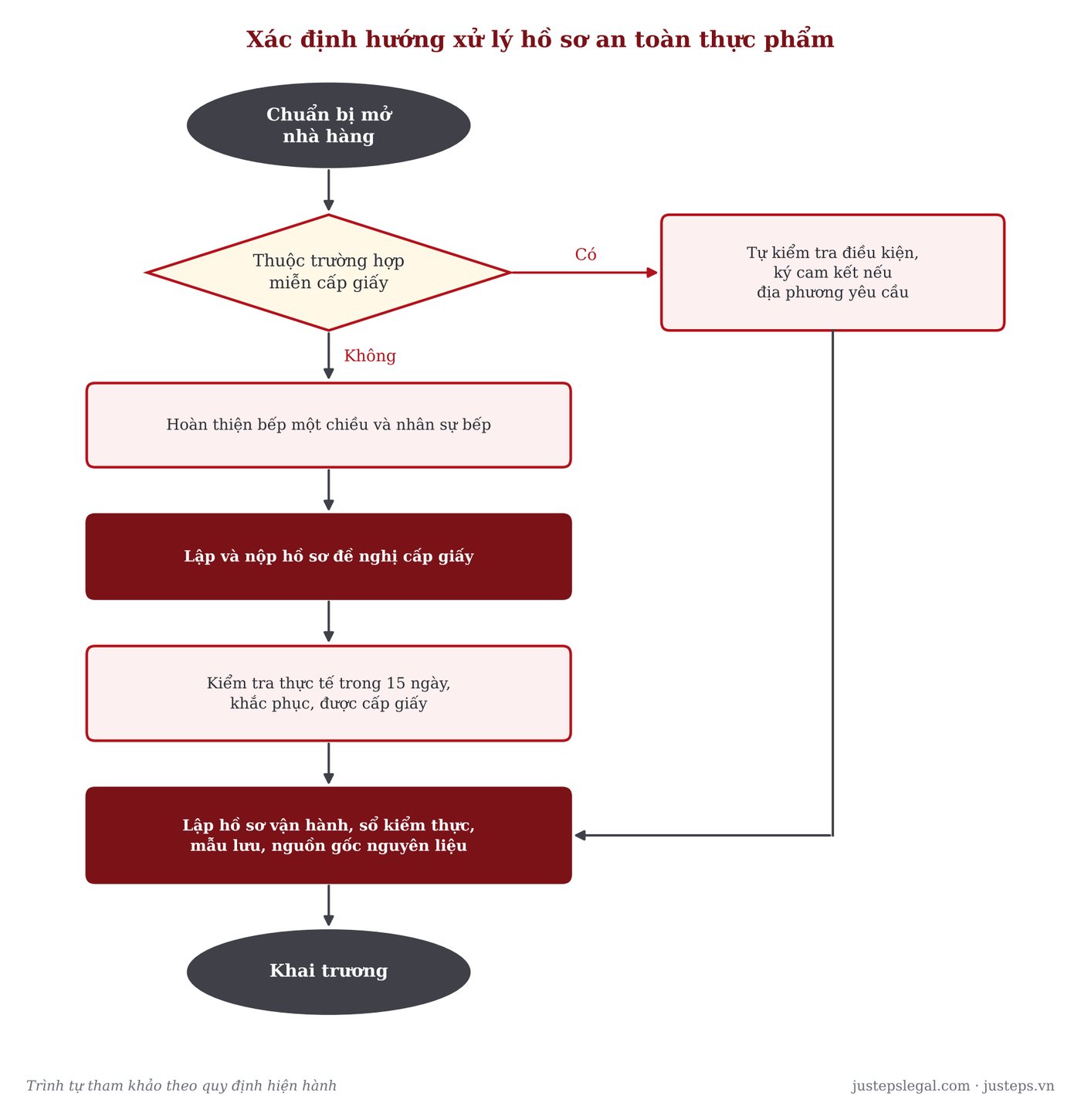
How to determine whether a restaurant must apply for a certificate
According to the flowchart, the restaurant owner first checks whether the restaurant falls within one of the cases not requiring a certificate, such as a restaurant in a hotel or an establishment with valid HACCP or ISO 22000 certification. If it does, the restaurant does not apply for a certificate but still checks the conditions itself, signs a commitment if the locality requires it, and then moves on to preparing its operating records. If it is not exempt, the restaurant completes the kitchen and staffing, prepares the certificate application, submits it to the competent authority and prepares for the on-site inspection. The two branches meet again at the step of preparing daily operating records, because every restaurant, whether or not it holds a certificate, must maintain the food check log, retained samples and documents on the origin of ingredients.
Kitchen layout and conditions for facilities
The Law on Food Safety sets out conditions for places where food services are prepared and provided, for food service establishments, and for the preparation and storage of food[4]. The core requirements are that the kitchen is laid out to prevent cross-contamination between unprocessed and processed food, has sufficient water meeting technical regulations for preparation and cleaning, has covered containers for collecting and holding waste and free-flowing drains, and has measures to prevent insects and harmful animals. Cooking and preparation utensils must be safe and hygienic, and food storage areas must meet the temperature and humidity conditions required for each type of ingredient.
In practice, the requirement to prevent cross-contamination is expressed through the one-way kitchen principle, meaning that ingredients move in one direction from the receiving area, storeroom, preparation, cooking and plating to the service area, without moving backwards. The area for preparing raw meat and seafood should be separate from the vegetable preparation area and the cooked food plating area, chopping boards, knives and cloths should be colour-coded by ingredient group, and the route for waste and dirty dishes should not cross the route of prepared dishes. The dry store uses shelving raised off the floor, chillers and freezers have thermometers so that temperatures can be recorded daily, and the handwashing station for kitchen staff must have soap and be located at the entrance to the preparation area. These requirements must be built into the design drawings from the outset, because relocating drainage pipes, sinks or partitions after construction is costly and delays the opening.
Restaurant owners should require the kitchen designer to provide a diagram of the flow of ingredients, staff and waste, because this diagram serves both as a basis for checking the design and as a document that should be included in the description of facilities when submitting the file. Before accepting the construction work, the kitchen manager should walk through the diagram to check each position, record any points that do not meet the requirements and ask the contractor to fix them before handover. For leased premises, the lease should state clearly that the tenant may renovate the kitchen and install extraction and drainage systems, and set out each party’s responsibilities when the premises are returned.
Persons directly preparing food and kitchen management
Persons directly producing and trading in food must meet health requirements and have food safety knowledge and practice[5]. Under the Law on Food Safety, the certificate application includes documents proving that the owner of the establishment and the persons directly producing or trading in food are in good health and have been trained in food safety knowledge[6], while the specific form of these documents is guided by subordinate legislation and the requirements of the receiving authority. Persons suffering from infectious diseases on the list issued by the Ministry of Health may not directly prepare food while ill, so the kitchen manager needs a mechanism for staff to report symptoms proactively.
Because kitchen staff for a new restaurant are usually recruited all at once in the one or two months before opening, the HR department should immediately set up a tracking sheet showing each person’s name, position, date of health check, date of training, expiry date and the person responsible for reminders. The employment contract or internal rules should state clearly the obligation to comply with personal hygiene rules, such as wearing protective clothing, caps and face masks, not wearing jewellery and keeping fingernails short when working in the preparation area. The restaurant should also designate one person responsible for food safety on each shift, usually the head chef or sous chef, to sign the food check log and deal with the inspection team when the owner is absent. The cost of health checks and training for the first kitchen team should be included in the pre-opening budget together with the cost of equipment and ingredients for trial runs.
The certificate application and time limits
Under the Law on Food Safety, the application for a certificate of eligibility for food safety comprises an application form, a copy of the business registration certificate, a description of the facilities, equipment and utensils, and the health and food safety training documents of the owner and persons directly preparing food[6]. Within fifteen days of receiving a complete and valid file, the competent authority must carry out an on-site inspection of food safety conditions at the establishment; if the conditions are met, it issues the certificate, and if it refuses, it must reply in writing stating the reasons[6]. This time limit does not include the time for supplementing the file and for the restaurant to remedy any shortcomings found during the inspection, so in practice restaurant owners should allow four to six weeks.
The certificate of eligibility for food safety is valid for three years, and an establishment wishing to continue trading must submit an application for re-issuance six months before the expiry date[7]. The restaurant should enter the expiry date and the deadline for submitting the re-issuance application into the business’s general compliance calendar as soon as it receives the certificate. For chains with many outlets, each business location has its own certificate, so the legal or administration department needs a summary table of the validity of certificates for all outlets. When the restaurant relocates, makes major changes to the kitchen or expands its preparation capacity, the owner should ask the issuing authority whether a new procedure is required before making the change.
For the on-site inspection to go smoothly, the restaurant should carry out its own check about a week in advance, covering exactly the items stated in the description of facilities. The chart below illustrates the results of a pre-opening review that Justeps carried out for a restaurant, showing the number of outstanding items in each group of documents.
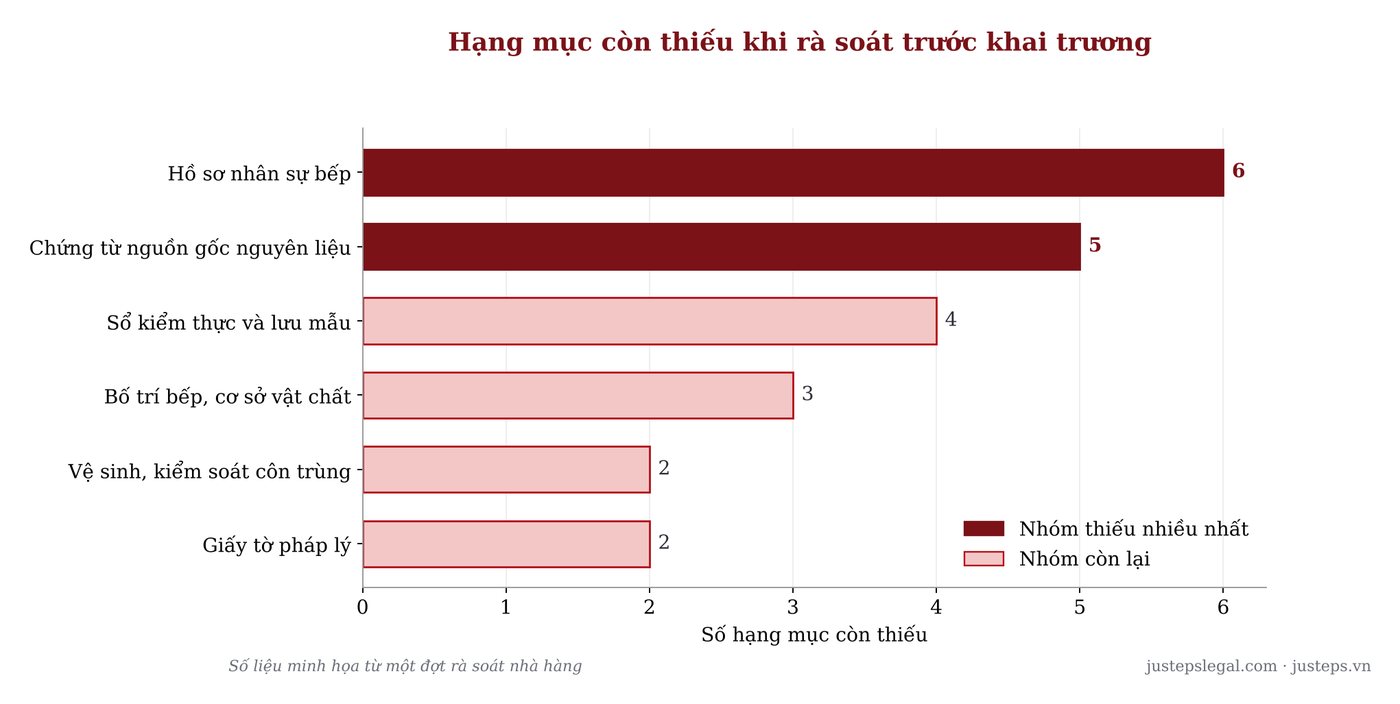
Number of outstanding items by document group in a pre-opening review
In the example, kitchen staff records had the most outstanding items, with six, mainly health certificates and training confirmations for newly recruited staff. Documents on the origin of ingredients came second with five items, because many new suppliers had only sent price quotations by text message and had not yet signed contracts or provided food safety documents. The food check log and retained samples were missing four items, the kitchen layout three, and hygiene, pest control and legal documents two items each. The figures are illustrative but reflect the general tendency for facilities to be better prepared than documents relating to people and ingredients.
Daily operating records that inspection teams usually request
The certificate only confirms that the establishment met the conditions at the time of inspection; throughout its operation, the restaurant must prove that it maintains those conditions through its operating records. The Ministry of Health has issued guidance on the three-step food check and food sample retention regime for food service establishments[8], under which the establishment checks ingredients before receiving them, checks during preparation and checks before serving, recording each step in a log using the prescribed form. Food samples are kept in covered containers, refrigerated and retained for the period stated in the guidance, usually twenty-four hours, for use in investigation if an incident occurs. The table below summarises the main operating records, the persons who prepare them and the frequency of updates.
| Record | Prepared and signed by | Update frequency |
|---|---|---|
| Supplier contracts, invoices and documents | The purchasing manager collects them and the accountant files them by supplier. | When a new contract is signed and when a supplier’s documents expire. |
| Three-step food check log | The person receiving goods and the shift head chef record and sign each step. | Each time ingredients are received and for each meal and service shift. |
| Food sample retention and disposal log | The shift head chef takes the sample, labels it and signs for disposal after the retention period. | Each meal with pre-prepared dishes or each pre-booked banquet. |
| Chiller and freezer temperature log | Storeroom or kitchen staff record the thermometer readings. | At least twice a day, at the start and end of each shift. |
| Cleaning and pest control plan | The restaurant manager prepares it, and the service provider signs a record after each treatment. | Cleaning daily, pest control on a periodic schedule. |
| Staff health and training records | The HR department keeps a tracking sheet and copies of documents. | On recruitment and before the expiry date. |
The origin of ingredients is the item that inspection teams focus on most, because if food poisoning occurs, the authorities will trace back from the dish to the batch of ingredients and the supplier. The restaurant should sign written contracts with its main suppliers, require them to provide food safety documents for both the establishment and the products, and require an invoice to be issued for each delivery. For vegetables and meat bought at wholesale markets, the restaurant should choose stalls with clear information and record the seller’s name and address in step one of the food check log. All records should be kept at the restaurant or on an electronic system accessible to shift managers, because the inspection team may arrive without notice when the owner is absent.
The twelve-week roadmap and related procedures
Food safety documents are only part of the list of tasks to be completed before opening day, and many tasks depend on one another. The restaurant must have an enterprise registration certificate or household business registration covering food services before submitting its food safety file, must complete the kitchen before the on-site inspection, and must recruit kitchen staff and arrange their health checks and training before listing staff in the file. The timeline below is the roadmap that Justeps recommends for a medium-sized restaurant, counting backwards from opening day.
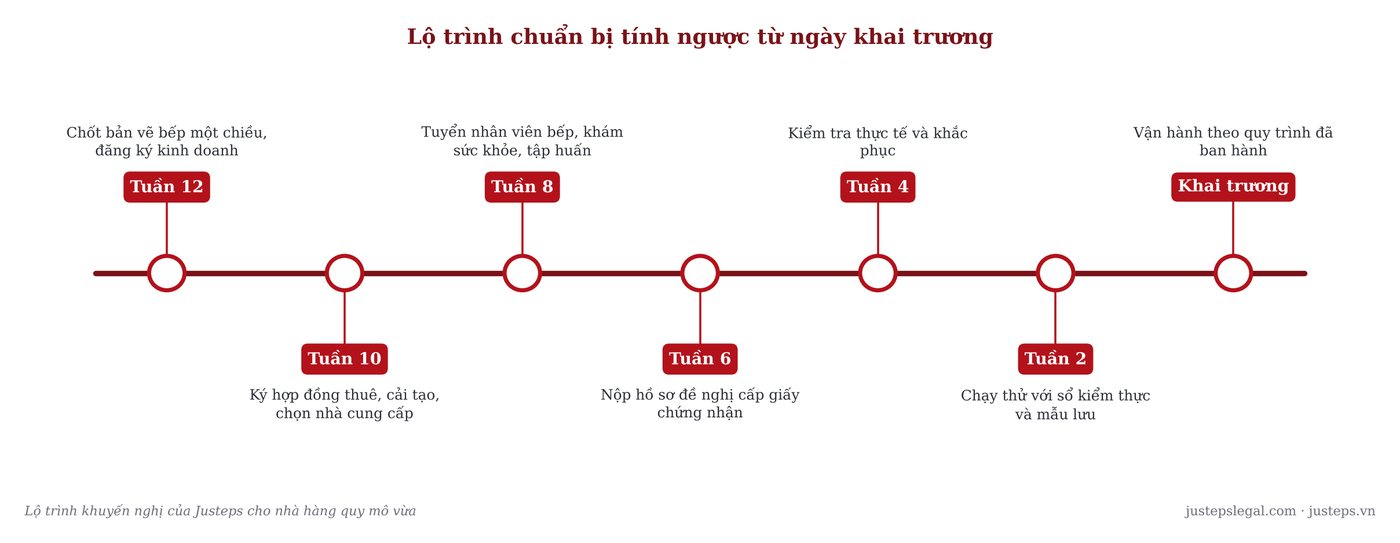
Roadmap for preparing food safety documents before opening day
According to the roadmap, twelve weeks before opening is the time to finalise the one-way kitchen drawings and complete business registration, while week ten is the time to sign the lease, carry out renovation and select the main suppliers. From week eight, the restaurant recruits kitchen staff and organises health checks and training, and then submits the certificate application around week six once construction of the kitchen is complete. Week four is set aside for the on-site inspection and remedial work, and week two for trial runs using the food check log, retained samples and temperature log as in real operation. This roadmap gives the restaurant about two weeks of contingency in case the competent authority requests additional documents or a re-inspection.
In parallel with the food safety file, the restaurant needs to complete other procedures directly related to its operation. Regarding fire prevention and fighting, restaurants with gas or charcoal stoves and large numbers of customers must meet the safety conditions under the law on fire prevention, fire fighting and rescue, and depending on their size, the premises may be subject to fire safety design appraisal and acceptance[9]. Regarding tax, the restaurant must register to use electronic invoices and issue invoices to customers under the current regulations on invoices and documents[10], and must display the prices of food and drinks clearly under the law on prices[11]. Businesses that need a single point of contact to track all these procedures for a new restaurant or an entire chain may refer to Justeps’ service of ongoing legal advisory for restaurants, cafés and F&B chains.
After opening day, the restaurant may be subject to periodic or unannounced inspections by the authorities. Operating a food service without a certificate when one is required, failing to ensure the conditions for facilities or employing persons who do not meet health requirements may result in administrative penalties under the decree on penalties in the field of food safety[12], and in serious cases the restaurant may also have its operation suspended. For this reason, the documents prepared before opening should be turned into operating procedures with designated persons in charge, a monthly internal inspection schedule and a method for handling cases where customers suspect food poisoning. Restaurants that need to standardise these procedures into a set of operating documents may refer to Justeps’ service of building internal procedures and regulations for restaurants.
How Justeps can help
Justeps helps restaurants and food and beverage chains prepare food safety documents and pre-opening procedures through the following services:
- Ongoing legal advisory for restaurants, cafés and F&B chains. Justeps reviews food safety documents, sets up a compliance calendar for each outlet and provides support when inspections take place.
- Internal procedures and regulations for restaurants. Justeps drafts procedures for receiving goods, three-step food checks, sample retention, hygiene and handling food poisoning incidents, together with forms.
- Business registration and sector-specific licences. Justeps prepares the business registration file and the application for a certificate of eligibility for food safety.
- Labour, wages and insurance services for restaurants. Justeps sets up contracts, internal rules and tracking sheets for health checks and training of kitchen staff.
Frequently asked questions
Does a small restaurant registered as a household business need a food safety certificate?
Most food service establishments with a business registration are required to hold a certificate[2], except in exempt cases such as street food businesses[3]. Owners who are unsure which group they belong to should ask the local regulatory authority.
Does a restaurant in a hotel need its own certificate?
Restaurants in hotels fall within the cases not requiring a certificate[3]. Nevertheless, the restaurant must still fully meet the food safety conditions and maintain the food check log and retained samples.
Is Decree 46/2026/ND-CP currently in force?
No. This decree has been suspended, and Decree 15/2018/ND-CP continues to apply until the amended Law on Food Safety and its implementing decree take effect[1].
How long is a certificate of eligibility for food safety valid?
The certificate is valid for three years, and the establishment must submit an application for re-issuance six months before the expiry date if it continues trading[7].
May a restaurant open while waiting for its certificate?
A restaurant required to hold a certificate should only serve customers after the certificate has been issued, because operating without one may result in penalties[12]. The file should therefore be submitted early according to the roadmap so that the opening does not have to be postponed.
How long must food samples be retained?
Under the Ministry of Health guidance on three-step food checks and food sample retention[8], samples are usually retained for twenty-four hours under refrigeration. The restaurant should label each sample fully with the name of the dish, the time of sampling and the person who took the sample.
Which records does the inspection team usually examine first?
The records usually requested first are the certificate, the three-step food check log, retained food samples, documents on the origin of ingredients and the health and training records of kitchen staff. These records should be kept at the restaurant so that the shift manager can produce them.
Related articles
- Building restaurant operating procedures from the organisational structure to every service shift
- Internal procedures and regulations for restaurant, café and F&B chain businesses, from goods receipt to shift close
- Ongoing legal advisory for restaurant, café and F&B chain businesses on premises, trade marks and partners
- Self-declaration of food products and an internal procedure to avoid selling before declaration
Notes
[1] Government Resolution No. 15/2026/NQ-CP dated 6 April 2026 suspending Decree No. 46/2026/ND-CP dated 26 January 2026 and Resolution No. 66.13/2026/NQ-CP dated 27 January 2026; during the suspension, Government Decree No. 15/2018/ND-CP dated 2 February 2018 and its guiding documents continue to apply.
[2] Article 34 of the Law on Food Safety No. 55/2010/QH12 dated 17 June 2010, as amended and supplemented.
[3] Article 12 of Government Decree No. 15/2018/ND-CP dated 2 February 2018 detailing a number of articles of the Law on Food Safety.
[4] Articles 28, 29 and 30 of the Law on Food Safety No. 55/2010/QH12 dated 17 June 2010, as amended and supplemented.
[5] Article 19 of the Law on Food Safety No. 55/2010/QH12 dated 17 June 2010, as amended and supplemented.
[6] Article 36 of the Law on Food Safety No. 55/2010/QH12 dated 17 June 2010, as amended and supplemented.
[7] Article 37 of the Law on Food Safety No. 55/2010/QH12 dated 17 June 2010, as amended and supplemented.
[8] Decision No. 1246/QD-BYT dated 31 March 2017 of the Minister of Health issuing guidance on the three-step food check and food sample retention regime for food service establishments.
[9] Law on Fire Prevention, Fire Fighting and Rescue No. 55/2024/QH15 dated 29 November 2024, effective from 1 July 2025, and Government Decree No. 105/2025/ND-CP detailing it.
[10] Government Decree No. 254/2026/ND-CP dated 30 June 2026 on electronic invoices and electronic documents, effective from 1 July 2026.
[11] Law on Prices No. 16/2023/QH15 dated 19 June 2023 (provisions on price listing).
[12] Government Decree No. 115/2018/ND-CP dated 4 September 2018 on administrative penalties for food safety violations, as amended and supplemented by Decree No. 124/2021/ND-CP.
This article is for reference and reflects the regulations in force at the time of publication. Please consult Justeps for advice tailored to your company’s records and situation.
For further information, please contact:
📩 Email: info@justeps.vn
🌐 Website: https://justepslegal.com · https://justeps.vn
🌐 Page: Justeps
☎️ Hotline (Zalo): 096 172 2607
📍 Thanh Xuan Office: 12th Floor, Licogi 13 Tower, 164 Khuat Duy Tien Street, Thanh Xuan Ward, Hanoi, Vietnam
📍 Ha Dong Office: LK06B, No.10, Dong Dua Area, Ha Dong Ward, Hanoi, Vietnam
📍 Ho Chi Minh City Branch: 528 Le Van Sy, Ho Chi Minh City, Vietnam
📍 Hai Phong Office: Truong Thinh Village, Ha Dong Commune, Hai Phong, Vietnam
📍 Quang Ninh Office: Van Don Special Zone, Quang Ninh Province, Vietnam





