
Key takeaways
- Branches and representative offices do not have legal personality, so every transaction entered into by their head within the scope of authority binds the business.
- The letter of authorisation given to the head of a dependent unit must state the types of tasks, value limits and duration; a general letter of authorisation is the source of most disputes with counterparties.
- A representative office only performs representation, liaison and market research functions; it does not sign sales contracts or collect sales proceeds on behalf of the business.
- The head office should control branches through cash flows visible in online banking, reports in a uniform template and unannounced checks, rather than relying on the physical presence of senior management.
- When the head, address or scope of activities changes, the business must register the change within 10 days from the date of the change.
When a business expands into another province, management at the head office often faces situations that are hard to deal with. A branch director signs a three-year warehouse lease without the head office knowing, a representative office receives a customer’s deposit into an employee’s personal account, or a branch has moved to new premises months ago without completing the change procedure. Most of these cases do not stem from bad intentions on the part of the unit head, but from the business never having designed a way to manage a distant unit that management cannot visit regularly.
This article examines how to manage branches, representative offices and business locations remotely in the order in which the arrangements are set up: defining the correct function of each type of unit, delegating authority to the unit head, managing seals and digital signatures, establishing a reporting rhythm, controlling cash flow and staff, and updating registration when changes occur. It applies to limited liability companies and joint stock companies established under the Law on Enterprises that have one or more dependent units in areas other than the head office. Representative offices of foreign traders in Vietnam are governed by separate rules and fall outside the scope of this article.
The legal function of branches, representative offices and business locations
The Law on Enterprises distinguishes three types of dependent unit. A branch is a dependent unit tasked with performing all or part of the functions of the business, including the function of authorised representation, and the branch’s business lines must correspond to those of the business. A representative office is only tasked with acting as authorised representative for the interests of the business and protecting those interests, and does not perform business functions. A business location is a place where the business carries out a specific business activity[1].
The most important feature they share is that none of the three types of unit has legal personality. The Civil Code provides that the head of a branch or representative office performs tasks under the authorisation of the legal entity within the scope and duration of that authorisation, and that the legal entity has the rights and obligations arising from transactions entered into and performed by the branch or representative office[2]. Consequently, a flawed contract signed by a branch director is still an obligation of the business towards the counterparty, and the business cannot refuse it merely because the head office was unaware of it. Remote management must therefore start by clearly limiting what each unit is allowed to do.
The table below suggests how to allocate tasks that are and are not appropriate for each type of unit, as a basis for the letter of authorisation and the operating regulations:
| Unit | Suitable tasks | Tasks that should not be delegated |
|---|---|---|
| Branch | Sales, provision of services, signing ordinary contracts within limits, recruiting and managing local staff. | Deciding on its own to invest in major assets, borrow, give guarantees, pledge assets or sign contracts above its limits. |
| Representative office | Market research, liaison, customer and partner care, and promotion of contracts signed by the head office. | Signing sales or service contracts, issuing invoices or collecting sales proceeds on behalf of the business. |
| Business location | Operating a shop, warehouse or workshop under the direction of the head office or the managing branch. | Entering into contracts in the name of the business where the person in charge has no specific authorisation. |
The choice of unit type also affects how it is managed. If the business only needs someone locally to meet customers and gather market information, a representative office is sufficient and carries lower risk. When the unit starts selling, signing contracts and collecting money locally, the business should move to a branch or business location model so that it operates within the correct function, rather than allowing the representative office to exceed its remit.
Delegating authority to the head of a dependent unit
Appointment decision and letter of authorisation
The head of a branch or representative office is usually appointed by a decision of the person with authority under the charter and authorised by a written letter of authorisation from the legal representative. The letter of authorisation should list specifically the types of tasks permitted, the types of contracts that may be signed, the value limit for each transaction, the duration of the authorisation and whether sub-delegation is allowed. Phrases such as full authority to run all activities of the branch should be avoided, because if a dispute arises, the counterparty will cite this very document to argue that the signatory had authority.
The Civil Code provides that a transaction entered into by a representative beyond the scope of representation does not give rise to obligations of the represented party in respect of the excess, unless the represented party consents, knows of it and does not object within a reasonable time, or is at fault in causing the other party not to know that the representative was exceeding their authority[3]. The last exception shows that a letter of authorisation only protects the business if it is clearly communicated to counterparties and banks. The business should attach a copy of the letter of authorisation to the signing documents for major contracts and ask counterparties to check the limits before signing.
Authority matrix by value limits
The authority matrix determines who may decide which type of matter at which value, and it is the central tool of remote management. Limits should be set according to the actual transaction sizes of each branch and be consistent with the authority that the charter and internal regulations confer on the Director or General Director and on the board of directors or members’ council. The table below is an illustrative example for a distribution business with a branch whose revenue is several tens of billions of dong a year:
| Type of matter | Head of branch | Approval by head office |
|---|---|---|
| Sales contracts | Signs contracts on the standard template with a value below VND 500 million and prices not below the published price list. | Contracts of VND 500 million or more, contracts with amended templates or discounts outside the policy. |
| Purchasing and leasing assets | Buys routine supplies and services below VND 100 million per purchase. | Long-term leases of premises and warehouses and purchases of fixed assets of any value. |
| Personnel | Recruits within the approved headcount and signs employment contracts on the standard template. | Recruitment beyond headcount, appointment of managers, and pay outside the wage scale. |
| Finance | Routine spending within the monthly budget and cash on hand within the set limit. | Borrowing, guarantees, lending, pledging assets and spending outside the budget. |
The thresholds in the table are only examples and should be adjusted to the size, sector and level of trust placed in the head of each branch. What must be ensured is that every contract above the limit has written approval from the head office before signing, and that this approval is filed with the contract. Businesses needing to develop or review such a matrix may consider Justeps’ service on financial regulations and delegation of authority.
The process for handling a contract arising at a branch is illustrated below, with the decision point being whether the contract falls within the delegated limit.
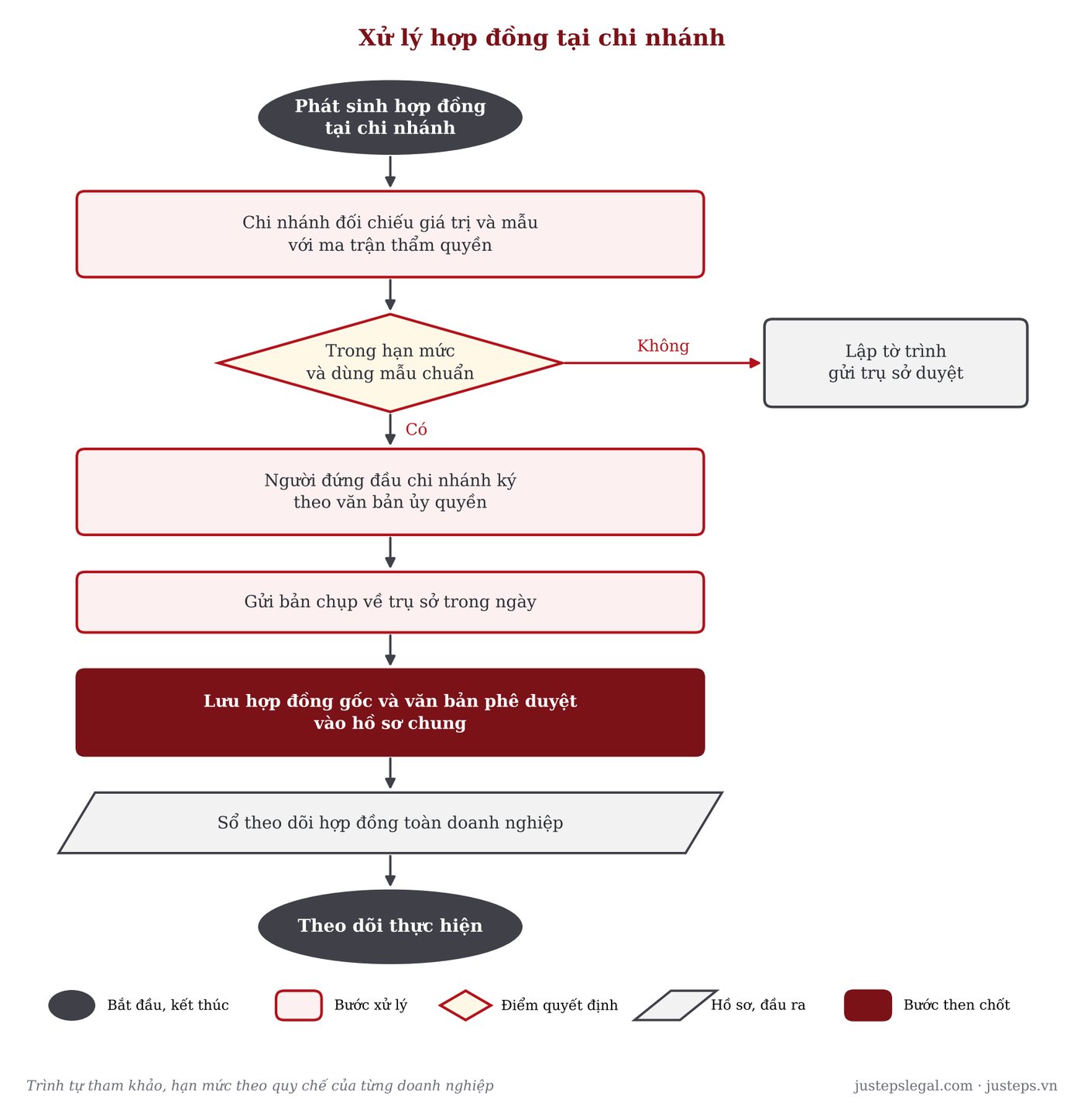
The process for handling a contract arising at a branch under the authority matrix
Where the contract is within the limit and uses the standard template, the head of the branch signs it and only needs to send a scanned copy to the head office on the same day to update the contract register. Where the contract exceeds the limit or amends the template, the branch prepares a request to the head office, the legal department or the designated person reviews the terms, and the person with authority gives written approval before the branch signs. The critical step is filing the original contract and the approval document in the shared records, because this is how the head office knows all the obligations binding the business in each locality.
Seals and digital signatures of dependent units
The business decides for itself the type, number, form and content of the seals of the business, its branches and its representative offices, and the management and safekeeping of seals follow the charter or regulations issued by the business[4]. The regulations should designate the person who keeps the seal at the branch, a log of seal use, the types of documents that may not bear the branch seal and the procedure for recovering the seal when the branch closes. For digital signatures, online banking accounts and accounts on public service portals, the business needs a list of authorised users and a procedure to revoke access on the same day that a person leaves or is transferred.
Establishing a regular reporting rhythm
The principle of remote reporting is that reports should be short, regular and in the same template for every branch, so that the head office can compare units and periods. The business should agree the list of indicators to monitor before choosing software, because software is only useful once the input data has been standardised. A common reporting rhythm has four tiers, as described below.
The daily report covers revenue, cash received, cash on hand and stock of the main items; it is sent by the branch accountant before a fixed time, and the head office accountant reconciles it immediately against the bank statement. The weekly report covers sales against plan, new customers, overdue receivables and issues requiring head office support, and the person in charge of sales at the head office responds within the week. The monthly report covers the branch’s profit and loss, receivables by ageing, staff movements and costs against budget. The quarterly report is a compliance self-assessment covering contracts, labour records, licences and registration, on the basis of which the legal department draws up a list of items to remedy.
Reports only have an effect if the head office reads them and responds. The business should specify who receives each type of report, the response time and what happens when a branch reports late or the figures are unusual. The monthly report should be the main item at the regular online meeting between the board of directors and branch heads, so that issues are resolved in the meeting rather than through scattered message exchanges.
Controls that do not require on-site presence
Controlling cash flow and segregating duties
Cash flow is where risk is most concentrated at a distant unit. The head office should have online viewing rights over every bank account of the branch, apply two-level approval in online banking for payments above the limit, set a cash-on-hand limit and carry out surprise cash counts. Customers should be instructed to pay into the account of the business or the branch, and never into a personal account, and this information should be stated clearly on contracts, invoices and quotations.
In addition, the person who sells, the person who collects money and the person who keeps the books should be three different people, even at a small branch. Where there are not enough staff, the business can move one function to the head office, for example by having the head office accountant record the branch’s entries directly in shared software. This segregation helps detect early any discrepancies between goods dispatched, cash collected and receivables, which are common signs of fraud at a distant unit.
Periodic and unannounced inspections
Each branch should be inspected in person at least once a year, combined with unannounced inspections of branches with large revenues or with warning signs such as rapidly rising overdue receivables, stock discrepancies or mass resignations. Unannounced inspections are more effective as a deterrent than scheduled ones, because branch staff have no time to rearrange records. Inspections should follow a fixed checklist covering cash on hand, stock, signed contracts, labour records, the seal log and the registration status of the branch.
The three groups of measures, namely limited delegation, regular reporting and independent control, form the foundation of remote management, as described in the figure below.
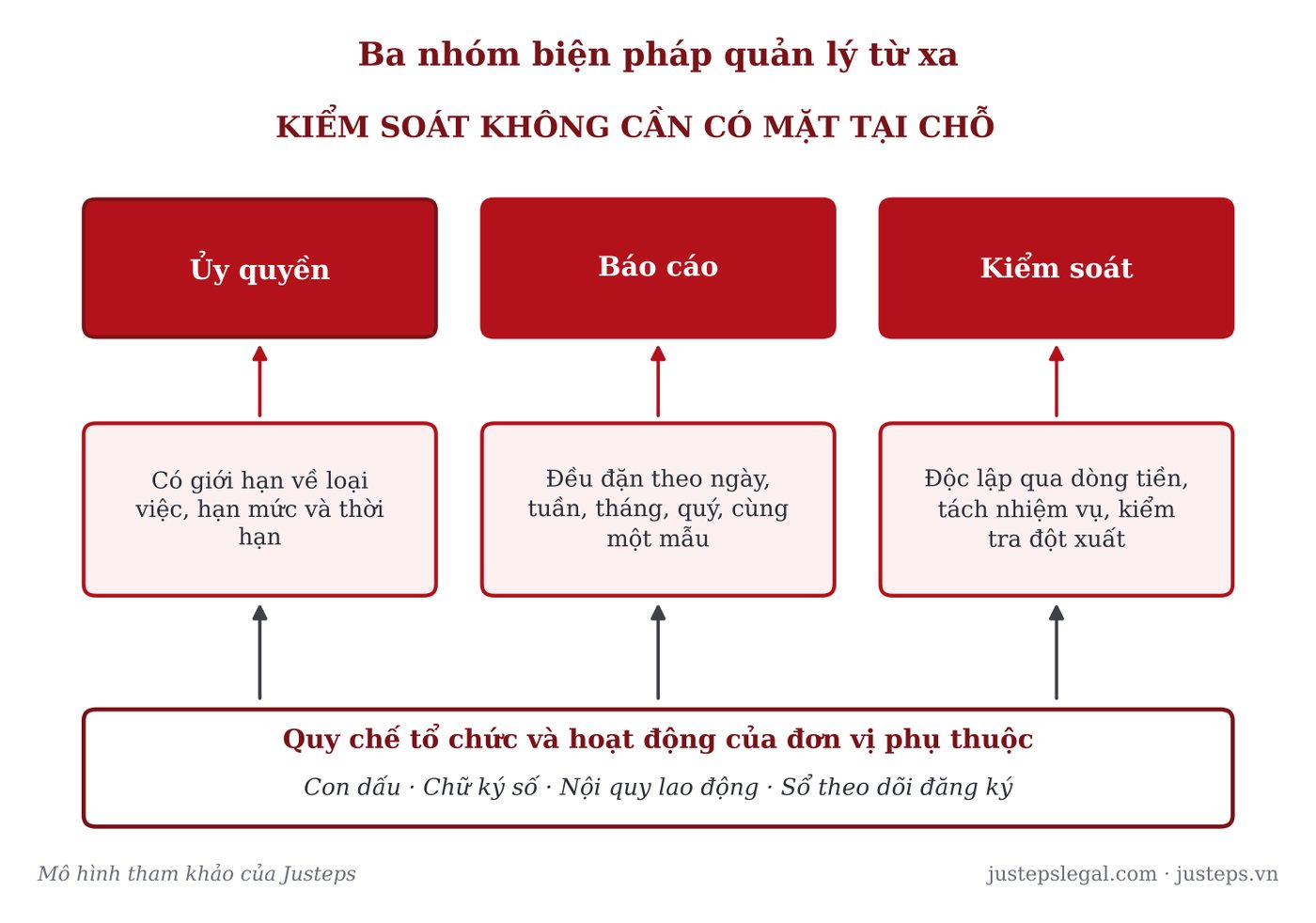
Three groups of measures for managing dependent units remotely
Limited delegation determines in advance what the branch may do, regular reporting tells the head office what the branch has done, and independent control verifies whether the reports are accurate. Without any one of the three groups, the other two lose most of their effect; for instance, clear delegation without reporting leaves the head office unaware of whether the branch has exceeded its authority. All three groups rest on the branch’s organisation and operating regulations, which must have been issued and communicated to local staff.
Managing staff at the branch
Employees working at a branch still have an employment relationship with the business, so the business’s internal labour rules, pay and bonus regulations and HR policies apply at the branch. Where the business has a branch in another province, the registered internal labour rules must be sent to the provincial labour authority where the branch is located[5]. The minimum wage applies according to the area where the unit or branch operates, and from 1 January 2027 new minimum wages apply in all four regions[6], so HR at the head office should review the wage scale of each branch separately.
The priority given to each control measure should vary by type of unit, because the risks of a sales branch differ from those of a representative office. The following chart suggests the priority of several measures for each type of unit.
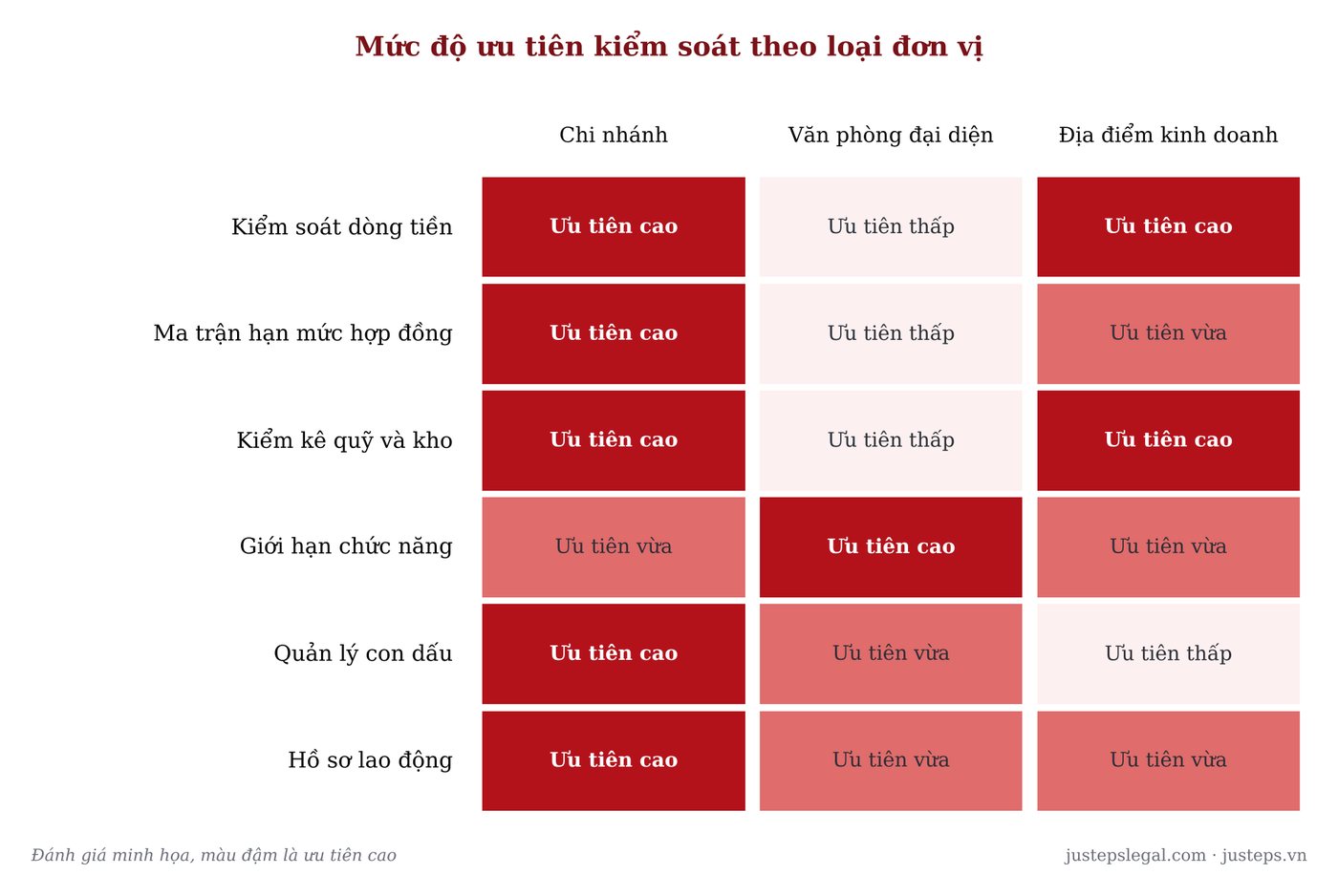
Priority of control measures by type of dependent unit
For a branch, cash flow control, the contract limit matrix and stocktaking are all high priority because the branch sells, collects money and holds goods directly. For a representative office, the top priority is ensuring that the office does not sign contracts, does not collect money and does not exceed its function, while cash and stock controls are of low priority. For a business location, the focus is on cash on hand and stock at the shop or warehouse, while signing authority is usually retained by the head office or the managing branch.
Updating registration when a dependent unit changes
When the registered details of a branch, representative office or business location change, such as a new head, a new address or a change in activities, the business must file the application with the provincial business registration authority within 10 days from the date of the change. Where the address moves to another province, the application is filed with the business registration authority where the unit intends to relocate[7]. Failure to register a change on time or making untruthful declarations may result in an administrative penalty under Decree 122/2021/NĐ-CP as amended and supplemented by Decree 288/2026/NĐ-CP[8].
To avoid omissions, the business should keep a register of its dependent units recording the code, address, head, duration of authorisation, premises lease and registration status. Every decision to change the head or relocate should be sent immediately to the person handling procedures, together with the 10-day deadline in the business’s compliance calendar. The previous head’s letter of authorisation must be terminated in writing and notified to banks and key counterparties, to prevent a person who has left from continuing to sign transactions in the branch’s name.
When closing a branch, the business should settle its tax obligations, terminate the lease, terminate or transfer employment contracts and recover seals and digital signatures before filing the application to terminate operations under the rules on enterprise registration[9]. This order helps avoid a situation where the branch is closed on the registration system but still has unresolved tax obligations or debts. Businesses needing support with procedures to establish, change or close dependent units may consider Justeps’ service on setting up branches, representative offices and business locations.
Common mistakes in managing distant units
The most common mistake is granting authority without value or time limits, allowing the head of a branch to sign any contract in the name of the business. The second mistake is allowing a representative office to sign contracts or collect money on behalf of the business, which both exceeds its legal function and creates invoicing and tax issues. Both can be remedied with a specific letter of authorisation and operating regulations that state clearly what the unit may not do.
The third mistake is letting each branch report in its own format, so the head office cannot compare them or detect a unit with irregularities. The fourth mistake is failing to complete procedures when the location or head changes, and the fifth is failing to recover seals, digital signatures and banking access when staff leave. Once remote management is written into regulations and operated consistently, control over branches no longer depends on whether management is physically present.
How Justeps can help
Justeps helps businesses set up arrangements for managing branches and representative offices remotely through the following services:
- Internal governance rules and procedures. Justeps drafts the organisation and operating regulations for branches and representative offices, together with a set of daily, weekly, monthly and quarterly report templates.
- Financial regulations and delegation of authority. Justeps develops the authority matrix, appointment decision templates and limited letters of authorisation for unit heads.
- Internal financial control system. Justeps designs cash flow controls, segregation of duties and an unannounced inspection checklist for branches.
- Setting up branches, representative offices and business locations. Justeps carries out the procedures to establish dependent units, register changes and terminate their operations.
Frequently asked questions
May a representative office sign sales contracts with customers?
A representative office does not perform business functions[1], so sales contracts must be signed by the business or a branch. A representative office should only handle liaison, introductions and customer care for contracts signed by the head office.
Does the head of a branch need a separate letter of authorisation for each contract?
No, provided the general letter of authorisation clearly states the types of contracts, value limits and duration. Contracts above the limit must have separate written approval from the head office before signing.
Is the business liable for a contract signed by a branch director beyond their authority?
In principle, the business incurs no obligation in respect of the part exceeding the scope of representation, unless it consents, knows of it and does not object, or is at fault in causing the counterparty not to know that authority was exceeded[3]. The letter of authorisation should therefore be clearly communicated to counterparties and banks.
May a branch use its own seal?
Yes. The business decides for itself the type, number, form and content of the branch seal[4]. The regulations should specify who keeps the seal, the log of its use and the procedure for recovering it.
How long does a business have to complete the procedure when the branch director changes?
The business must file the application to register the change within 10 days from the date of the change[7]. At the same time, the business should terminate the previous head’s letter of authorisation and notify banks and key counterparties.
How often should a branch be inspected in person?
Each branch should be inspected in person at least once a year. Branches with large revenues or warning signs should also be subject to unannounced inspections.
Must the internal labour rules be sent to the labour authority where the branch is located?
A business with a branch in another province must send its registered internal labour rules to the provincial labour authority where the branch is located[5]. The branch should also post the internal labour rules at the workplace so that employees are aware of them.
Related articles
- Should a business set up a new company or open a branch when it develops a new business line
- The authority of the General Director and how to delegate executive powers within the limits of the charter and internal rules
- Risk management for small and medium-sized enterprises through a risk register with named owners and a review schedule
- An annual legal compliance calendar for businesses covering tax, reporting and annual meeting deadlines and the people responsible
Notes
[1] Article 44 of the Law on Enterprises No. 59/2020/QH14 dated 17 June 2020, as amended and supplemented by Law No. 76/2025/QH15.
[2] Article 84 of the Civil Code No. 91/2015/QH13 dated 24 November 2015.
[3] Article 141 and Article 143 of the Civil Code No. 91/2015/QH13.
[4] Article 43.2 and Article 43.3 of the Law on Enterprises No. 59/2020/QH14.
[5] Article 119 of the Labour Code No. 45/2019/QH14 dated 20 November 2019.
[6] Decree No. 399/2026/NĐ-CP of the Government on minimum wages for employees working under employment contracts, applicable from 1 January 2027.
[7] Article 56 of Decree No. 168/2025/NĐ-CP of the Government dated 30 June 2025 on enterprise registration.
[8] Decree No. 122/2021/NĐ-CP of the Government dated 28 December 2021 on administrative penalties in the field of planning and investment, as amended and supplemented by Decree No. 288/2026/NĐ-CP.
[9] Decree No. 168/2025/NĐ-CP on enterprise registration, as amended and supplemented by Decree No. 296/2026/NĐ-CP, provisions on terminating the operation of branches, representative offices and business locations.
This article is for reference and reflects the regulations in force at the time of publication. Please consult Justeps for advice tailored to your company’s records and situation.
For further information, please contact:
📩 Email: info@justeps.vn
🌐 Website: https://justepslegal.com · https://justeps.vn
🌐 Page: Justeps
☎️ Hotline (Zalo): 096 172 2607
📍 Thanh Xuan Office: 12th Floor, Licogi 13 Tower, 164 Khuat Duy Tien Street, Thanh Xuan Ward, Hanoi, Vietnam
📍 Ha Dong Office: LK06B, No.10, Dong Dua Area, Ha Dong Ward, Hanoi, Vietnam
📍 Ho Chi Minh City Branch: 528 Le Van Sy, Ho Chi Minh City, Vietnam
📍 Hai Phong Office: Truong Thinh Village, Ha Dong Commune, Hai Phong, Vietnam
📍 Quang Ninh Office: Van Don Special Zone, Quang Ninh Province, Vietnam





