
Key takeaways
- Authority to issue internal management rules is determined by the Law on Enterprises and the charter, so a company should read its charter and draw up an authority table before standardising the procedure.
- Internal labour regulations, wage scales, payrolls and bonus regulations require consultation with the grassroots employee representative organisation where one exists, and internal labour regulations must be registered once the company employs 10 or more workers.
- Every document should pass through six fixed steps, namely assignment of a lead unit, drafting from a template, consultation and review, signing, release and communication, and monitoring of validity.
- A document can only really be applied when it has a number and an effective date, states which document it replaces and is supported by evidence that it has been communicated to the people who must comply with it.
- A document register and an access-controlled digital folder are enough for a small or medium-sized company to know which version is in force and to find the original when needed.
In many companies, internal documents are drafted whenever a need arises, circulated through chat groups and signed by whoever happens to be in the office. After a few years, the same subject, such as travel allowances or spending approval limits, exists in three different versions, nobody is sure which one applies, and the signed original cannot be found when a bank or an inspection team asks for it. The consequences go beyond inconvenience, because rules issued without proper authority or never communicated may not be usable as a basis when the company takes disciplinary action, refuses to pay an expense or explains its position to the tax authority.
This article analyses the procedure for issuing internal documents in the order in which it is carried out, covering the classification of documents and signing authority, the documents that require consultation with employees or registration, the six steps of issuance, the division of roles between departments, form and validity, archiving and periodic review, and common mistakes. It applies to limited liability companies and joint stock companies established under the Law on Enterprises of 2020 as amended in 2025, and not to state bodies. It is written mainly for directors and for the people responsible for administration, legal affairs, HR and records management in companies.
The system of internal documents and authority to issue them
A company’s internal documents can be divided into four groups according to how binding they are. The highest group consists of the charter and the governance rules adopted by the company’s highest management body, such as the internal corporate governance rules or the operating rules of the Board of Directors. Next come executive rules, regulations and procedures, such as the financial regulations, the pay and bonus regulations and the purchasing procedure. The third group comprises individual decisions, such as decisions on appointment, pay rises and discipline, and the last group consists of notices, official letters and submissions that provide information or make proposals.
Who may issue each group depends on the type of company and on its charter. In a multi-member limited liability company, the Director or General Director may issue internal management rules unless the charter provides otherwise; in a joint stock company, the Board of Directors decides on internal management rules, while the Director or General Director proposes the organisational structure and internal management rules[1]. In a single-member limited liability company, the owner usually retains the power to approve important rules and delegates the rest to the Director under the charter. Before standardising the procedure, a company should therefore read its charter and draw up a short authority table such as the example below:
| Type of document | Common examples | Usual signatory |
|---|---|---|
| Governance rules | Internal corporate governance rules and the operating rules of the Board of Directors and the Supervisory Board. | The General Meeting of Shareholders, the Board of Directors, the Members’ Council or the owner, as provided in the charter. |
| Executive rules | Financial regulations, pay and bonus regulations, rules on managing the company seal and internal labour regulations. | The Director or the Board of Directors, depending on the type of company and the charter. |
| Regulations and procedures | Purchasing procedure, recruitment procedure and travel allowance regulations. | The Director or a person authorised by the Director under a letter of authorisation. |
| Individual decisions | Decisions on appointment, transfer, pay rises, commendation and discipline. | The person with authority under the delegation rules, usually the Director. |
| Notices and submissions | Holiday schedule notices, submissions for purchase approval and official letters to partners. | The head of department or the person designated under the records management rules. |
The authority table should also cover signing on behalf of and signing under authorisation, because these are the areas where disputes about the validity of a document most often arise. Where the Director authorises a Deputy Director to sign a group of documents, the letter of authorisation should state the scope, the term and that the authorised person may not sub-delegate. This allows the records clerk to refuse to affix the seal to documents signed without authority from the outset, rather than discovering the problem after the document has been released.
Documents that require consultation with employees or registration
For most internal documents, the company decides its own issuance procedure, but certain documents that directly affect employees’ interests must follow the specific procedure laid down in labour law. Skipping that procedure may mean that the document does not take effect or cannot be relied upon in a dispute, even if its content is reasonable.
Internal labour regulations
Employers must issue internal labour regulations, and where they employ 10 or more workers the regulations must be in writing[2]. Before issuing or amending them, the company must consult the grassroots employee representative organisation where one exists, and after issuance it must notify the employees and post the main contents in the necessary places at the workplace. A company employing 10 or more workers must submit the registration file for its internal labour regulations to the specialised labour agency of the provincial People’s Committee within 10 days of issuance[3]. The regulations take effect 15 days after that agency receives a complete file, while a company with fewer than 10 workers that issues written internal labour regulations decides the effective date in the regulations themselves[4].
Wage scales, payrolls and bonus regulations
When developing wage scales, payrolls and labour norms, the employer must consult the grassroots employee representative organisation where one exists and must publish them at the workplace before applying them[5]. Bonus regulations are decided by the employer but must also be subject to consultation with the grassroots employee representative organisation where one exists and be published[6]. In addition, the law on grassroots democracy sets out the matters that employees have the right to know about and to comment on at the workplace, so the issuance procedure should include a step for consulting employees on documents within that scope[7]. The company should keep the minutes or written comments with the issuance file, because they are the only evidence that the consultation procedure was carried out.
Six steps for issuing an internal document
An effective issuance procedure does not need many steps, but each step must have a responsible person and a clear output. The flowchart below shows six steps that apply to rules, regulations and procedures, while individual decisions and notices may use a shortened consultation step.
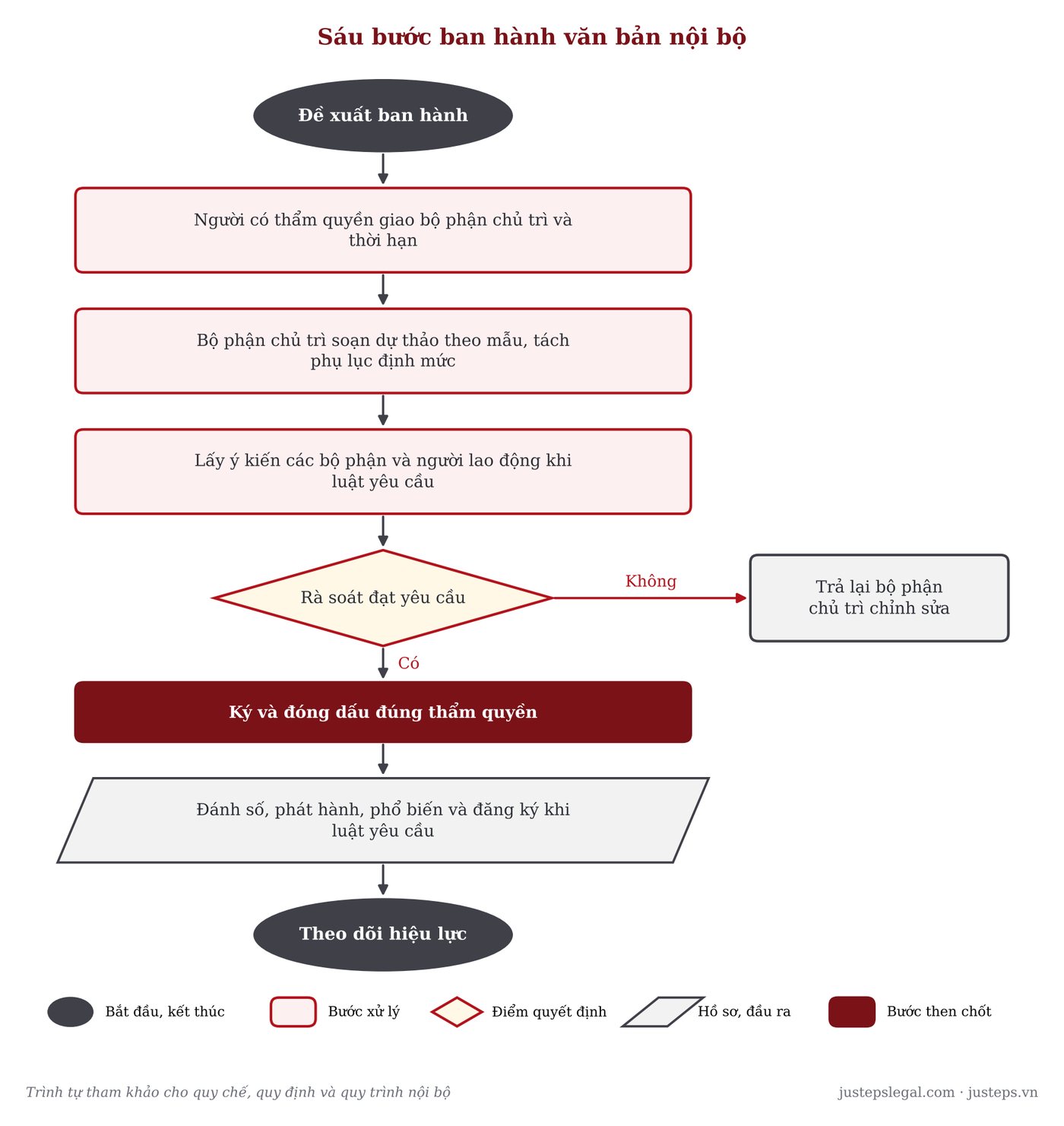
Six steps for issuing internal rules, regulations or procedures
The procedure starts with a proposal from the department that needs the document and ends with the document being added to the list of documents whose validity is monitored. The key control point comes after consultation, when the legal department or the designated reviewer confirms that the document is lawful, consistent with higher-ranking documents and signed by the right person; if it is not, the draft goes back to the lead unit for revision. For documents that require consultation with employees or registration, those formalities are built into the consultation step and the release step.
Proposal and assignment of a lead unit
The department that needs the document prepares a short proposal stating the reason for issuing it, the scope of application, related documents currently in force and when it needs to apply. The Director or the person with authority decides whether to issue it and assigns a lead unit to draft it, with a deadline for submitting the draft. Assigning the lead unit in writing or by email avoids the situation in which two departments draft the same regulation with different content.
Drafting from a standard template
The draft is prepared using the company’s standard template, which comprises the legal basis for issuance, the scope and persons covered, the main content divided into chapters, articles and clauses, and the implementation provisions. Figures that change often, such as spending norms, approval limits and bonus amounts, should be placed in appendices so that only a new appendix has to be issued when they change, rather than amending the whole set of rules. The implementation provisions should state the effective date and the name and number of any document that is replaced or repealed.
Consultation and review
The draft is sent to the relevant departments for comment within a fixed period, usually 5 to 7 working days, and the lead unit consolidates the comments and explains why any are not taken on board. The legal department or an external consultant then reviews the draft for legality, consistency with the charter and other rules, and signing authority. The review note should be kept with the file submitted for signature so that the person with authority knows which risks remain before deciding.
Signing, sealing and release
The person with authority signs the document after checking the submission and the review note, and the records clerk affixes the seal only where the signature is within the authority shown in the approved table. The company decides the type, number, form and content of its seals, and the management and use of seals follow the charter or rules issued by the company[8]. The records clerk enters the number and date in the register, releases the document to its recipients and arranges for it to be communicated, together with evidence that employees have received it or been notified.
Monitoring validity
After release, the document is added to the list of documents in force, with its effective date, the person responsible and the date of the next review. The company should review the whole list at least once a year and immediately whenever the relevant law changes, for example when regional minimum wages change or a new public holiday is introduced. Documents that have ceased to be in force are moved to an archive folder rather than deleted, so that they can still be consulted when the company needs to explain its position for an earlier period.
Division of roles between departments
A common organisational mistake is to give the whole issuance process to the administration department, which then drafts specialist content outside its own field, reviews its own work and affixes the seal itself. A sensible division of roles is for the department with the expertise to lead the drafting, the legal department or a designated person to carry out an independent review, the person with authority to sign, and the records clerk to manage the register, the seal and the archive. The diagram below shows how the departments work together at each step.
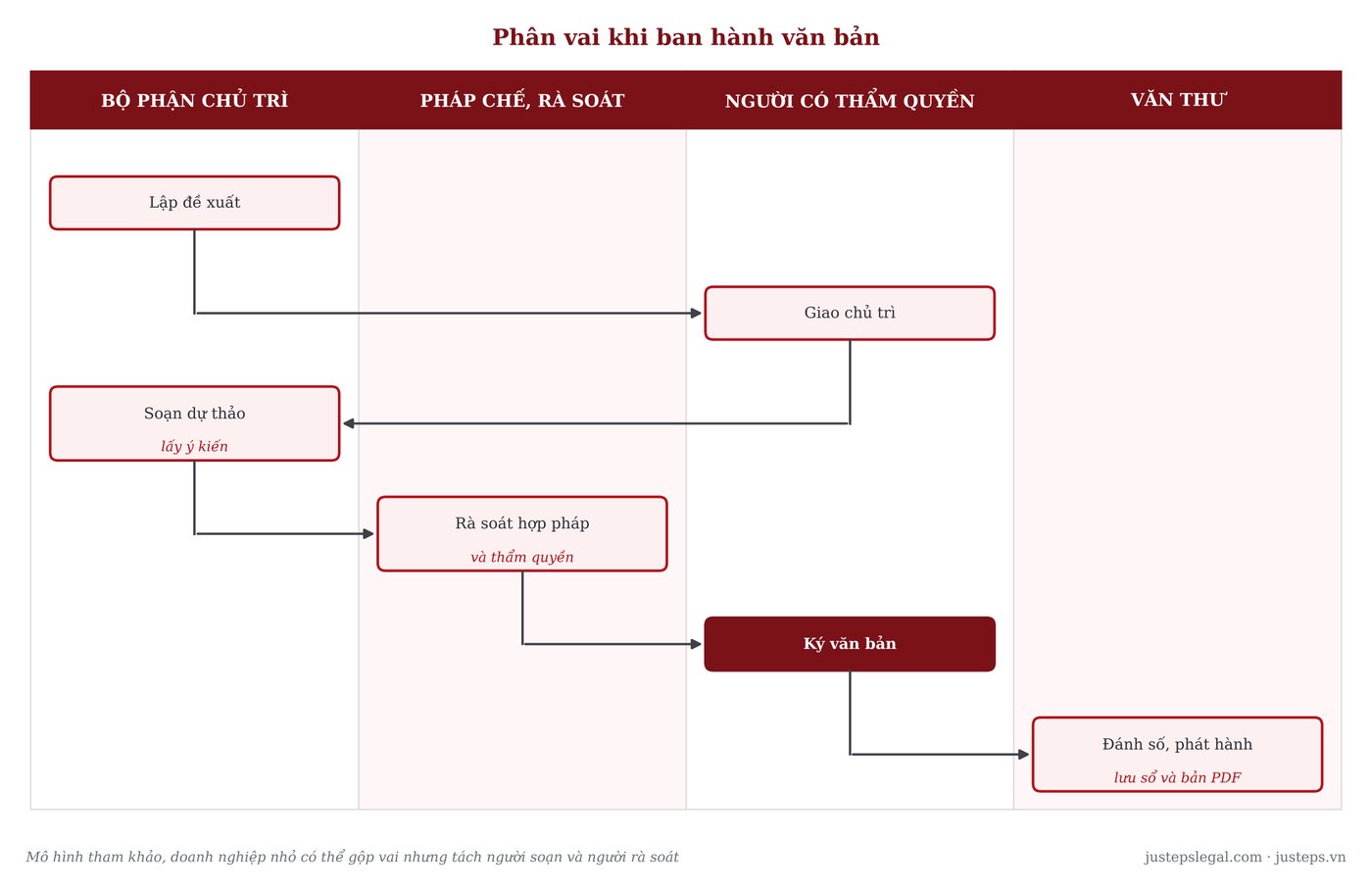
Division of roles between the lead unit, the reviewer, the signatory and the records clerk
Under this model, the lead unit is responsible for the content from the proposal until the draft is finalised, including taking employees’ comments on board. The reviewer may return the draft but does not rewrite the specialist content itself, so that the control step remains independent. The person with authority signs only when the submission includes the draft, the cover submission and the review comments, and the records clerk is the last person to check the form before affixing the seal and releasing the document. In a small company, one person may take on two roles, but the person who drafts the document should not also be its final reviewer.
Form, numbering and validity of documents
Decree No. 30/2020/ND-CP on records management is mandatory for state bodies and organisations and for state-owned enterprises, while other companies may use it as a reference when drawing up their own records management rules[9]. Private companies are not required to follow the exact format of this Decree, but they should retain the basic elements, namely the company name, the number and reference code, the place and date, the type of document and a summary of its subject, the content, the position and signature of the person with authority, the seal and the list of recipients. Documents should be numbered consecutively by year, starting from 01 on the first day of the year, with a code identifying the type of document, such as QC for rules and QĐ for decisions.
Internal documents may be digitally signed and released in electronic form, because the law on electronic transactions recognises the legal validity of data messages and electronic signatures that meet the statutory conditions[10]. To do this, the records management rules should specify which types of document may be digitally signed, which digital signature certificate is used, how electronic copies are stored and how the original is identified. For internal labour regulations and other documents that must be communicated to employees, the company should still post a paper copy or ensure that employees can access the electronic version at the workplace.
Where a document needs time to be communicated or must be registered, its effective date should be stated as a specific date rather than simply as the date of signature. The company should also avoid issuing documents with retroactive effect on employees’ entitlements, because applying rules backwards in time easily leads to disputes. When new rules replace old ones, the implementation provisions must identify the rules being replaced and explain how matters still in progress under the old rules are to be handled.
Archiving documents and monitoring the list of documents in force
The Law on Enterprises requires companies to keep their charter, internal management rules, register of members or register of shareholders, meeting minutes, resolutions, decisions and other documents at the head office or another place specified in the charter[11]. Accounting records such as vouchers, accounting books and financial statements must be kept for at least 10 years[12], so decisions relating to receipts and payments should be stored with the vouchers or clearly cross-referenced to them. For a small or medium-sized company, the archiving system needs only three components, namely a document register, paper files organised by type and year, and an access-controlled digital folder.
The document register can be kept in a spreadsheet with columns for the number, reference code, date of issue, effective date, summary, signatory, document replaced, status and a link to the PDF copy. PDF files are named using a structure of year, type, number and summary and stored in a folder that is read-only for most staff. Documents containing personal data, such as decisions on pay, discipline and appointments, are accessible only to those whose duties require it, in line with the company’s personal data protection obligations[13]. The chart below suggests indicative timings for each step to help the company plan when it needs to issue new rules.
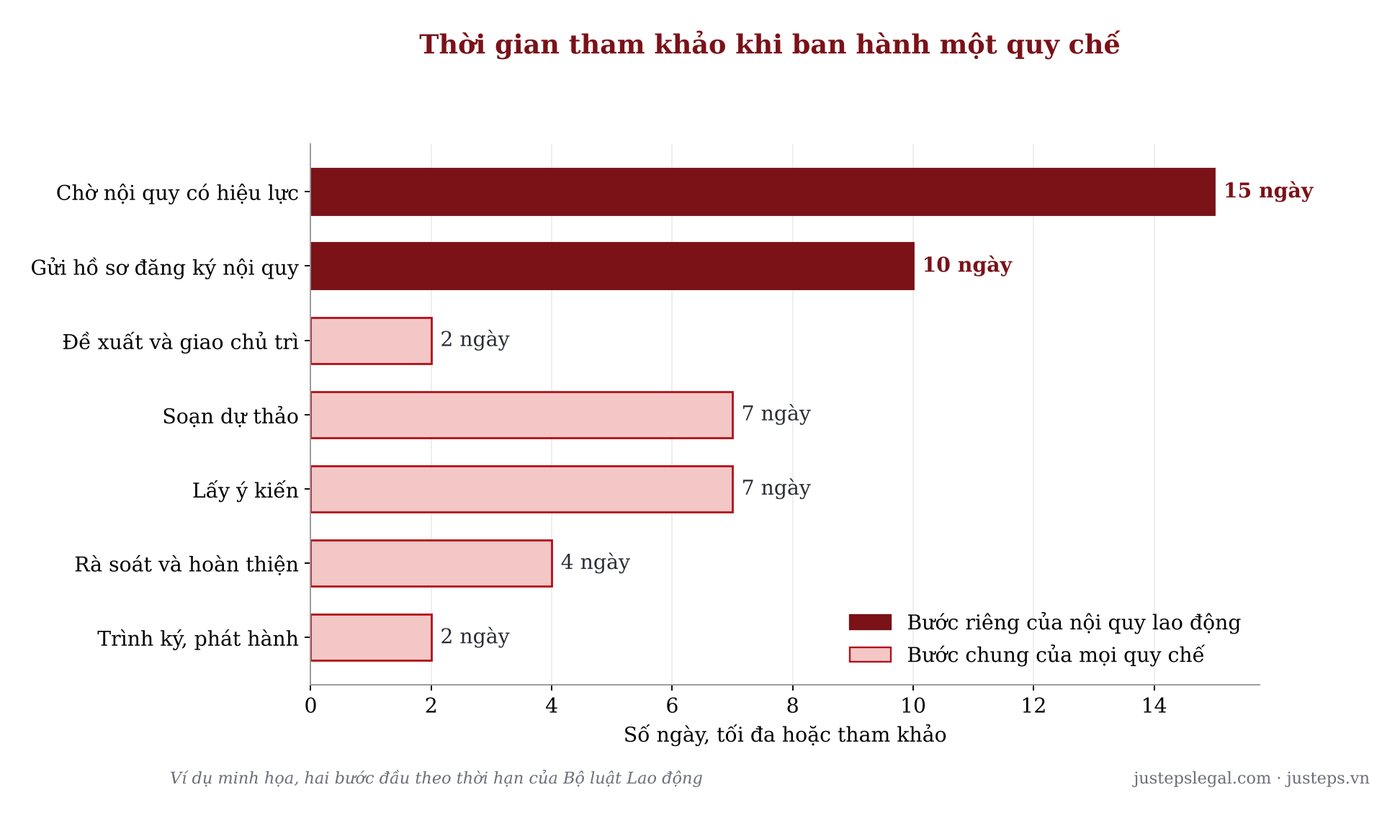
Indicative timing for each step when issuing rules that must be registered
For ordinary rules, the whole procedure takes about three to four weeks, with drafting and consultation taking the most time. If the document is a set of internal labour regulations that must be registered, the company needs to add the deadline for submitting the file and the 15-day waiting period before they take effect, so the total time may reach six or seven weeks. Documents that must apply from a fixed date, such as internal labour regulations updated for the new public holidays under the Law amending and supplementing the Labour Code effective from 1 March 2027[14], should therefore be started early. The numbers of days in the chart are indicative examples and vary with the size of the company and the number of departments involved.
Common mistakes when issuing internal documents
Reviews of companies’ internal document systems reveal a number of mistakes that recur in many organisations, whatever their size or sector. These mistakes usually go unnoticed until the document is relied upon in a specific case:
- A document is signed by a person who lacks authority under the charter, for example where the Director of a joint stock company issues rules that fall within the authority of the Board of Directors.
- A document has no effective date or does not identify the document it replaces, so that two sets of rules with conflicting content exist at the same time.
- Amounts, norms and limits are written into the body of the rules, so the whole document has to be reissued every time a figure changes.
- A document is sent only by text message or chat group, leaving no evidence that employees were informed of it when it is needed for disciplinary action.
- Internal labour regulations, wage scales and payrolls are issued without consulting the grassroots employee representative organisation or are not registered on time.
- Signed originals are not kept centrally, so only scans or unsigned electronic files remain when the document has to be produced.
An effective remedy is to carry out a comprehensive review, list all documents currently applied and identify which need to be reissued, which should be repealed and which lack the required formalities. After the review, the company issues rules on records management and the issuance of internal documents to serve as the framework for later documents. Companies that need support may refer to Justeps’ internal governance rules and procedures service and, for internal labour regulations, to its internal labour regulations and disciplinary procedure service.
How Justeps can help
Justeps helps companies build a system of internal documents with clear authority, the correct procedure and easy retrieval through the following services:
- Internal governance rules and procedures. Justeps prepares the authority table and drafts records management rules and a document issuance procedure that fit the company’s charter.
- Company rules and regulations. Justeps reviews the list of documents in force and recommends which documents should be reissued, repealed or supplemented.
- Internal labour regulations and disciplinary procedure. Justeps drafts internal labour regulations, provides guidance on the consultation procedure and prepares the registration file.
- Ongoing management and operations advisory. Justeps reviews draft internal documents before signature and updates documents when the law changes.
- Training on developing and implementing internal rules. Justeps trains administration and legal staff on how to draft, review and communicate internal rules.
Frequently asked questions
Must private companies follow the format of Decree No. 30/2020/ND-CP?
Decree No. 30/2020/ND-CP is mandatory for state bodies and organisations and for state-owned enterprises[9]. Other companies may use it as a reference when drawing up their own records management rules, keeping basic elements such as the number, date, summary, signature and seal.
Who has authority to issue internal management rules?
In a multi-member limited liability company, the Director or General Director issues internal management rules unless the charter provides otherwise, while in a joint stock company this authority belongs to the Board of Directors[1]. The company should check its own charter, because the charter may allocate authority differently.
Can internal documents be digitally signed?
Internal documents may be digitally signed if they meet the conditions for data messages and electronic signatures under the law on electronic transactions[10]. The records management rules should specify which types of document may be digitally signed, how they are stored and how the original is identified.
When do internal labour regulations take effect?
For a company that must register them, internal labour regulations take effect 15 days after the provincial specialised labour agency receives a complete file[4]. A company with fewer than 10 workers that issues written internal labour regulations decides their effective date itself.
Should documents be numbered by year or by type?
The simplest and most common approach is to number documents consecutively by year, starting from 01 at the beginning of the year, with a code identifying the type of document. A company with a large volume of documents may keep a separate register for each type, but this must be set out consistently in the records management rules.
Must employees be consulted on the pay and bonus regulations?
Wage scales, payrolls and bonus regulations must be subject to consultation with the grassroots employee representative organisation where one exists and be published at the workplace[5]. The company should keep the minutes of the consultation with the issuance file to prove that it followed the correct procedure.
May documents that are no longer in force be destroyed?
The company should not destroy expired documents immediately but should move them to an archive folder, because it may need to explain its position for the period when they applied. Retention periods must follow the Law on Enterprises and sector-specific legislation; accounting records, for example, must be kept for at least 10 years[12].
Related articles
- Which documents make up the minimum set of internal governance rules for a company with 50 to 200 staff
- The authority of the General Director and how to delegate executive powers within the limits of the charter and internal rules
- Building internal financial regulations for a limited liability company, from approval authority to advances and their settlement
- Setting up the organisation of a newly incorporated company with fewer than 10 staff so that roles, authority and cash flow are under control
Notes
[1] Point d of Clause 2 of Article 63, Clause 2 of Article 153 and Point d of Clause 3 of Article 162 of the Law on Enterprises No. 59/2020/QH14 dated 17 June 2020, as amended and supplemented by Law No. 76/2025/QH15.
[2] Clause 1 of Article 118 of the Labour Code No. 45/2019/QH14 dated 20 November 2019.
[3] Clauses 3 and 4 of Article 118 and Articles 119 and 120 of the Labour Code No. 45/2019/QH14.
[4] Article 121 of the Labour Code No. 45/2019/QH14.
[5] Clause 3 of Article 93 of the Labour Code No. 45/2019/QH14.
[6] Clause 2 of Article 104 of the Labour Code No. 45/2019/QH14.
[7] The Law on Implementation of Grassroots Democracy No. 10/2022/QH15 dated 10 November 2022.
[8] Article 43 of the Law on Enterprises No. 59/2020/QH14.
[9] Clause 1 of Article 2 of Government Decree No. 30/2020/ND-CP dated 5 March 2020 on records management.
[10] The Law on Electronic Transactions No. 20/2023/QH15 dated 22 June 2023.
[11] Article 11 of the Law on Enterprises No. 59/2020/QH14, as amended and supplemented by Law No. 76/2025/QH15.
[12] Article 13 of Government Decree No. 174/2016/ND-CP dated 30 December 2016 detailing a number of articles of the Law on Accounting.
[13] The Law on Personal Data Protection No. 91/2025/QH15 and Decree No. 363/2026/ND-CP.
[14] The Law amending and supplementing a number of articles of the Labour Code, passed by the National Assembly on 21 November 2026 and effective from 1 March 2027.
This article is for reference and reflects the regulations in force at the time of publication. Please consult Justeps for advice tailored to your company’s records and situation.
For further information, please contact:
📩 Email: info@justeps.vn
🌐 Website: https://justepslegal.com · https://justeps.vn
🌐 Page: Justeps
☎️ Hotline (Zalo): 096 172 2607
📍 Thanh Xuan Office: 12th Floor, Licogi 13 Tower, 164 Khuat Duy Tien Street, Thanh Xuan Ward, Hanoi, Vietnam
📍 Ha Dong Office: LK06B, No.10, Dong Dua Area, Ha Dong Ward, Hanoi, Vietnam
📍 Ho Chi Minh City Branch: 528 Le Van Sy, Ho Chi Minh City, Vietnam
📍 Hai Phong Office: Truong Thinh Village, Ha Dong Commune, Hai Phong, Vietnam
📍 Quang Ninh Office: Van Don Special Zone, Quang Ninh Province, Vietnam





