
Key takeaways
- The law does not require businesses to raise pay every year, but the wage for every position must always be at or above the regional minimum wage, including after 1 January 2027.
- The pay rise budget should be fixed as a percentage of the payroll before individual cases are considered, and it must include the additional insurance contributions the business pays on the new wages.
- A matrix combining the performance rating with the employee’s position in the pay range allocates the budget more fairly than an across-the-board percentage increase.
- When changing the pay scale or pay table, the business must consult the employee representative organisation, if there is one, hold a dialogue and publish the changes before applying them.
- Each pay adjustment needs a contract annex or written agreement, a file adjusting the insurance contribution base and a separate notification letter for each employee.
At the end of the year, many businesses only begin discussing pay rises once employees have already resigned because another employer offered them more. In other businesses, a department head has verbally promised an employee a certain increase, and when the board of directors finalises the budget that figure is cut, leaving the employee feeling let down. There are also cases where the lowest grade on a provincial branch’s pay table has fallen below the new regional minimum wage, yet nobody notices until the social insurance authority cross-checks the records. These situations share a single cause: the business adjusts pay by instinct and case by case, instead of following a process with a timetable, clear criteria and named people responsible.
This article analyses how to build an annual pay review process, covering the criteria to consider, how to set the budget and the merit matrix, the steps involved, the legal documents to be completed and how to communicate the outcome to employees. It applies to businesses that pay wages according to pay scales and pay tables they have drawn up themselves under the 2019 Labour Code, and not to entities that pay wages under the state sector regime. It is written mainly for the board of directors, HR managers, payroll accountants and the department heads who propose increases for their staff.
Why pay adjustments need a written process
In principle, the Labour Code does not require employers to raise wages on an annual cycle. Grade progression and pay rises are agreed by the parties in the employment contract or collective labour agreement, or set out in the employer’s internal regulations[1]. However, once a business has stated in the contract or its regulations that employees will be considered for a pay rise once a year, that commitment becomes an obligation that must be honoured on time and against the published criteria. Many businesses overlook this point, so when trading becomes difficult and they suspend pay reviews, employees have grounds to complain because the regulations are still in force.
The second reason is that pay rises compound. A 7% increase this year becomes the base for calculating next year’s increase, and it also raises the wage on which the business must pay social insurance, health insurance, unemployment insurance and trade union fees. Unlike a bonus, a wage that has been raised can hardly be reduced again without the employee’s consent, because amendments to an employment contract require the agreement of both parties[2]. A decision to raise pay should therefore be costed over several years, not just against the budget for the year in which it takes effect.
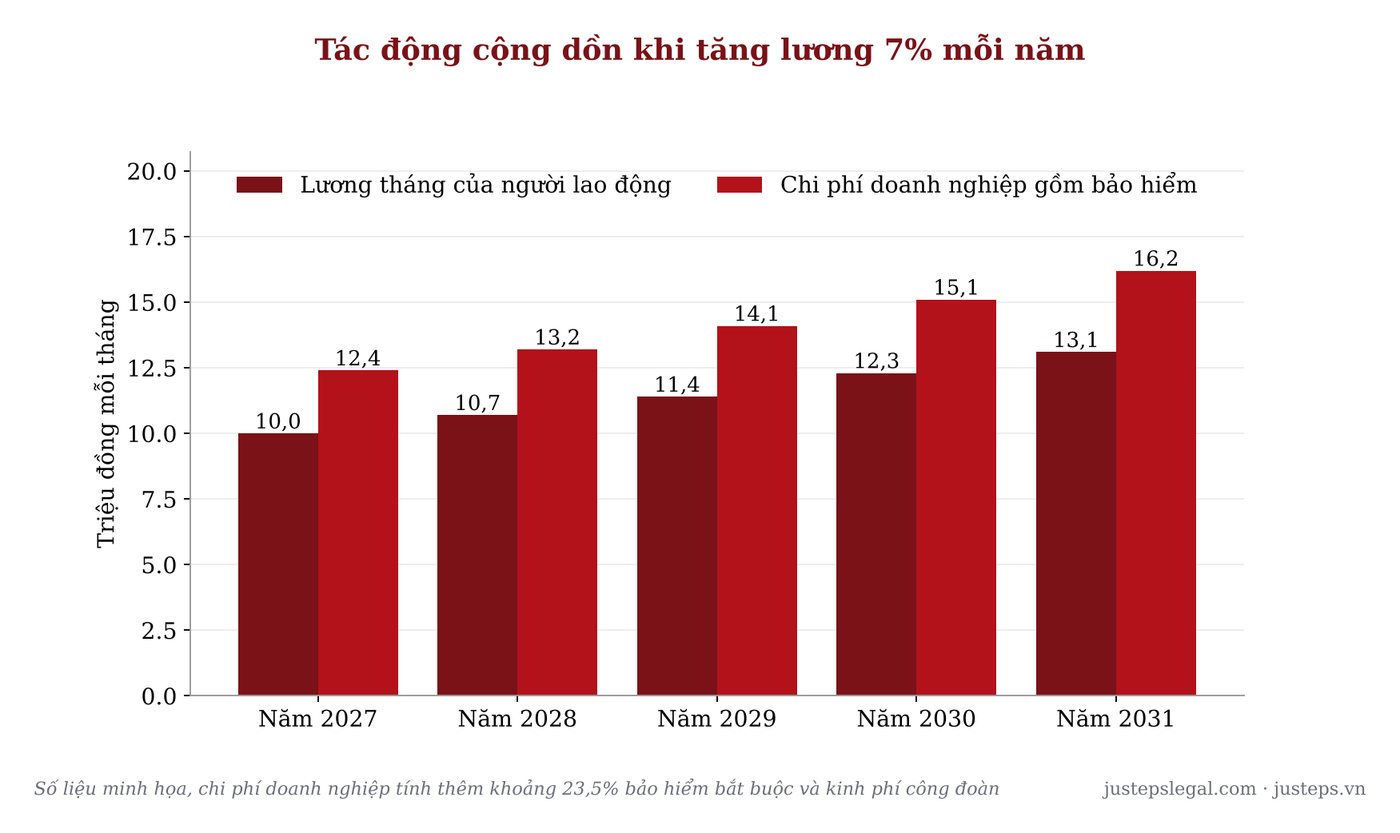
The compounding effect of a 7% annual pay rise on wages and the cost to the business
The chart illustrates a position paid VND 10 million a month in 2027 that receives a 7% increase each year. After four adjustments, the monthly wage for this position reaches about VND 13.1 million, an increase of more than 31% on the starting point rather than the 28% suggested by simple addition. If the roughly 23.5% of wages that the business pays in compulsory insurance contributions and trade union fees is added, the actual cost of this position rises from about VND 12.4 million to about VND 16.2 million a month. These figures show why the board of directors should view the pay rise budget within a three- to five-year financial plan.
The third reason is the need for fairness and transparency. Employers must ensure equal pay, without discrimination on grounds of gender, for employees doing work of equal value[3]. When each employee’s increase is decided individually by each department head, unexplained differences easily arise between people in the same position with the same performance. A written process with criteria and a cross-review step is the most effective way for a business both to control total spending and to justify each decision when an employee asks questions.
The criteria for determining the size of the adjustment
The regional minimum wage is the mandatory floor
The wage based on the job or title paid to an employee who works normal working hours in full must not be lower than the minimum wage[3]. In 2026 the monthly minimum wage for Region I is VND 5,310,000, and from 1 January 2027 the new rates are VND 5,700,000 in Region I, VND 5,080,000 in Region II, VND 4,450,000 in Region III and VND 4,040,000 in Region IV[4]. This is the only mandatory criterion discussed in this article, so the business must check it first, before any consideration of the market or performance.
The check must be done location by location and not only for the head office, because a business with branches, shops or factories in several places must apply the minimum wage of the area where each employee works. Following the reorganisation of administrative units in 2025, some communes and wards have been reassigned to different regions, so the list of locations in an older wage regulation may no longer be accurate. When the minimum wage rises, the business is only required to raise wages that fall below the new rate; wages already above it need not increase, unless the contract, collective agreement or internal regulations provide otherwise. Even so, if only the lowest grade is raised while the next grade stays the same, the gap between the two grades may shrink to the point of becoming meaningless, so businesses usually adjust a whole group of adjacent grades.
Market rates, performance and affordability
The second criterion is the market pay level for each group of positions and the rise in the cost of living. A business may use salary survey reports from recruitment organisations, data from positions filled during the year or information from employees who have recently left to estimate the gap between its own pay and the prevailing market rate. The result of this comparison should be expressed as the midpoint of the pay range for each grade and step, to serve as the reference point for the merit matrix discussed below.
The third criterion is the result of the year’s performance appraisal. This criterion can only be used if the business already has appraisal regulations with clear criteria and the appraisal round has been completed before pay is reviewed. If ratings are inflated, for example where more than half of employees are rated excellent, the merit matrix loses its power to differentiate and the budget will be exceeded at the proposal stage.
The final criterion is the business’s results and its ability to pay. The board of directors should set the overall budget on the basis of next year’s revenue and profit plan and the ratio of staff costs to revenue that the business considers acceptable. Where affordability is limited, the business may prioritise increases for positions paid below the market and for strong performers, while moving part of the reward into one-off bonuses under the bonus regulations[5], since bonuses do not create a fixed cost for later years.
Setting the budget and the merit matrix
The pay rise budget should be set as a percentage of the current year’s basic payroll and fixed before department heads propose increases for individual employees. For example, a business with an annual basic payroll of VND 12 billion that chooses a 7% budget will have VND 840 million a year available for pay rises, excluding the additional insurance the business must pay. Of that amount, the business should hold back about 1.5% to 2% of the payroll for promotions, changes of position and adjustments for employees paid well below the market, and only allocate the remainder according to performance.
The merit matrix is the tool for allocating the performance-based part of the budget. It combines two factors: the employee’s performance rating and the position of their current wage within the pay range for their grade and step, measured as the ratio of current wage to the midpoint of the range. Under this approach, a strong performer currently paid below the midpoint receives the largest increase, while someone with similar results whose pay is already close to the top of the range receives less, because they are already well paid for the position.
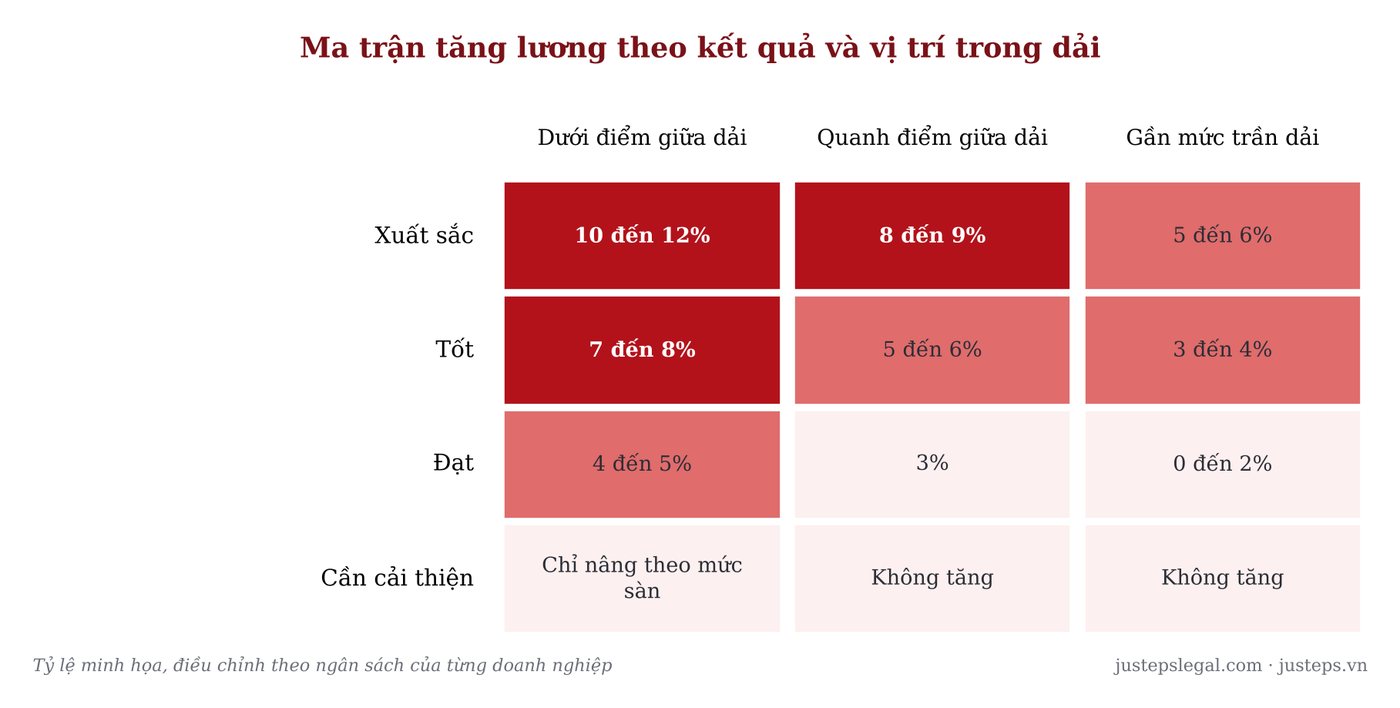
Example of a merit matrix based on performance rating and position in the pay range
In the example, an employee rated excellent and paid below the midpoint of the range is proposed an increase of 10% to 12%, while an employee with the same rating whose pay is close to the top of the range receives only 5% to 6%. Employees rated as needing improvement receive no performance-based increase, unless their wage has to be raised so that it does not fall below the new regional minimum wage. After applying the matrix to the full list, the HR department adds up the total increase and compares it with the budget; if it is over, the business reduces every cell by the same factor rather than cutting a few individuals, so that the matrix remains fair.
The table below suggests how to allocate a budget of 7% of the basic payroll, assuming the business has no group of positions requiring urgent adjustment because of the market:
| Item | Share of payroll | How it is used |
|---|---|---|
| Performance-based increases | About 5%, equivalent to VND 600 million on a payroll of VND 12 billion. | Allocated through the matrix to employees rated satisfactory or above. |
| Promotions and changes of position | About 1.2%, equivalent to VND 144 million. | Applied when an employee is appointed to a higher grade or step or takes on additional management responsibilities. |
| Market adjustments | About 0.8%, equivalent to VND 96 million. | Reserved for positions paid clearly below the market and for grades that must be raised in line with the regional minimum wage. |
| Additional insurance cost | About 23.5% of the part of the increase that falls within the insurance contribution base. | Not allocated to employees, but must be included in the year’s cost plan. |
Apart from the budget, the business should set some control rules to prevent arbitrary exceptions, for example that no individual increase may exceed 15% in a single review, except for a promotion separately approved by the director. Any proposal outside the matrix must be accompanied by written reasons and reviewed by a higher level of approval. After allocation, the HR department should compare the average increase for men and women in the same group of positions with the same rating, so that differences without an objective reason are identified early.
The steps in the pay review process
A complete annual pay review process usually has six steps, starting around September or October so that new wages can apply from the beginning of the following year, when the regional minimum wage changes. The flowchart below shows the order of the steps, the main person responsible and the points to check before moving on to the next step.
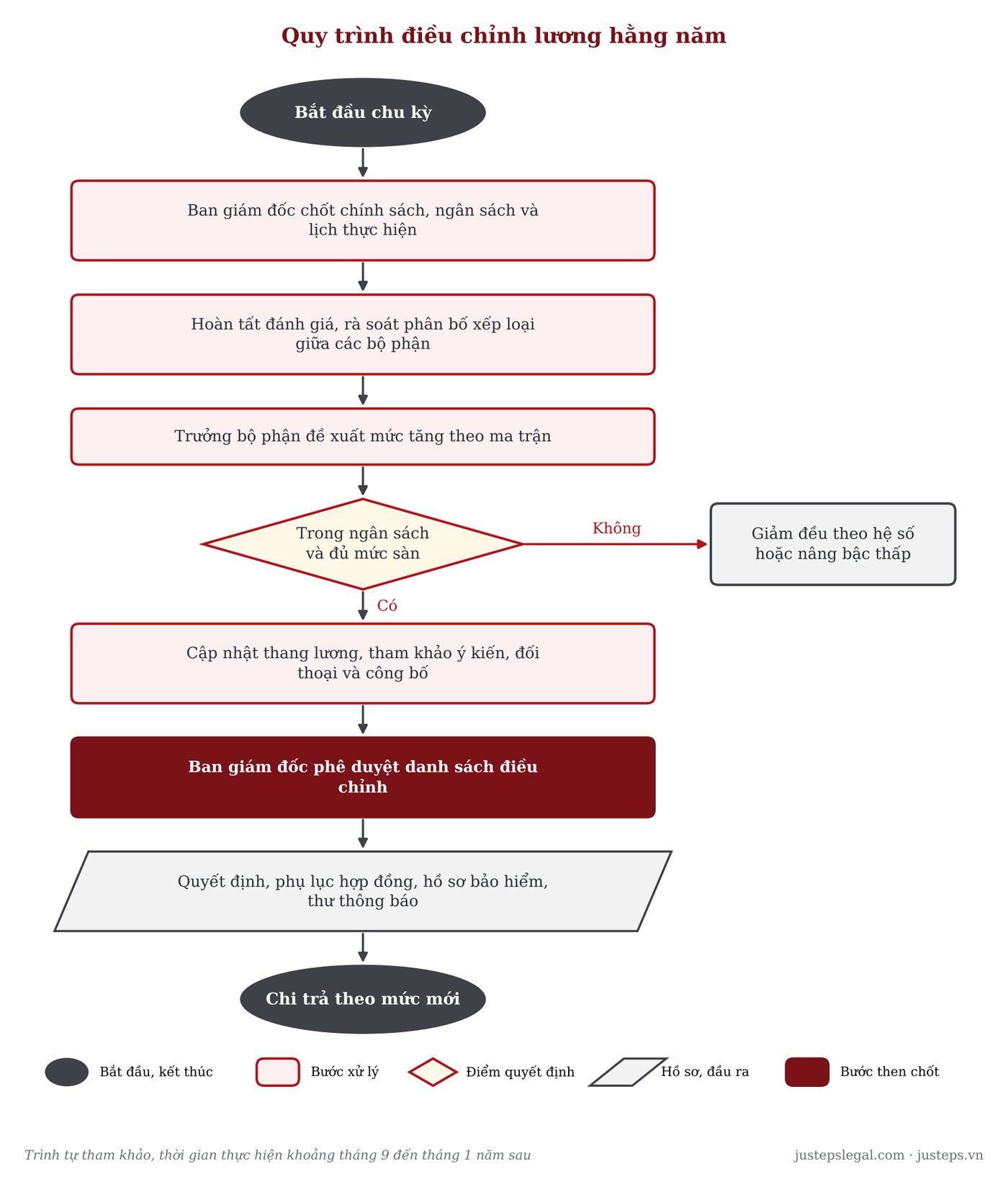
The six steps of the annual pay review process
The first step is for the board of directors to fix the policy, budget and timetable, including the budget percentage, the control rules, the cut-off date for the list of eligible employees and the date on which new wages take effect. The second step is to complete the performance appraisal and review the distribution of ratings across departments, so as to eliminate cases where one department rates far more generously than another. The third step is for department heads to propose increases according to the matrix, using a spreadsheet prepared by the HR department that is already filled in with each employee’s current wage, pay range and rating.
The fourth step is for the HR department to consolidate the proposals, check them against the budget and the minimum wage floor, and then update the pay scale and pay table if pay ranges or grades have changed. The fifth step is for the board of directors to approve the list and for the business to complete the legal documents, including the adjustment decision, the employment contract annexes and the file adjusting insurance contributions. The final step is to notify each employee and pay at the new rate from the first pay period after the effective date. In businesses with 50 or more employees, each step should have a named person responsible and a completion deadline in the plan, because a single department submitting its proposals late is enough to push back the whole timetable.
Pay scales, pay tables and the duty to consult
Employers must develop pay scales and pay tables as the basis for recruiting and employing staff, agreeing the wage stated in the contract and paying employees[6]. When developing or amending a pay scale or pay table, the business must consult the employee representative organisation at the workplace, where one exists, and must publish the scale or table at the workplace before implementing it[6]. Accordingly, if the pay review changes the wage for any grade or the width of any pay range, the business must complete the consultation and publication before the effective date; it may not apply the changes first and publish them afterwards.
The Labour Code also requires employers to hold a dialogue at the workplace on matters relating to the development of pay scales, pay tables and bonus regulations[7]. In practice, a business may combine the consultation and the dialogue in a single meeting with the executive committee of the grassroots trade union or the employee representatives, with minutes recording the views expressed and the points the business has accepted or explained. These minutes are an important document when the labour authority carries out an inspection or when employees question the validity of the new pay scale.
Publishing the pay scale and pay table must be distinguished from disclosing each individual’s wage. The law requires the pay scale, pay table and regulations to be published, but an individual’s specific wage is information linked to an identified person and therefore falls within the scope of personal data that must be protected[8]. The business should only allow the HR department, payroll accountants and the direct manager to access the pay rise proposal sheet, and should not send these spreadsheets through shared chat groups.
Legal documents after approval
The wage is a mandatory term of the employment contract, so each change of wage is an amendment to the contract. Under the Labour Code, once the parties agree on an amendment, it is made by signing an annex to the employment contract or entering into a new employment contract[2]. For an ordinary pay rise, signing an annex is the simplest approach, stating the old wage, the new wage, any changes to allowances and the effective date. Some businesses only issue a pay adjustment decision without signing an annex; this still serves as evidence where pay increases, but it may cause disputes if the adjustment changes the structure of allowances or reduces any item.
Alongside the annex, the business must adjust the wage used as the basis for compulsory social insurance contributions. The contribution base comprises the wage based on the job or title, wage allowances and other supplementary amounts agreed to be paid regularly and consistently in each pay period[9]. If the wage actually paid has risen but the insurance contribution base stays the same, the business may be found to have underpaid its contributions, required to pay the arrears and subjected to administrative penalties. The new wage also changes the amount of personal income tax to be withheld each month, so the payroll accountant must update it in the very first pay period[10].
The following table summarises the documents the business needs to complete after the adjustment is approved, who prepares each one and when it should be finalised:
| Document | Main content | Prepared by and timing |
|---|---|---|
| Adjustment decision | List of employees whose pay is adjusted, the new wages, the effective date and the regulatory basis. | Prepared by the HR department and signed by the director before the effective date. |
| Pay scale and pay table | Grades and pay ranges after adjustment, with minutes of the consultation and dialogue. | Prepared by the HR department and published at the workplace before the effective date. |
| Contract annex | Old wage, new wage, any changes to allowances and the effective date. | Prepared by the HR department and signed by both parties before or during the month of application. |
| Insurance file | Adjustment of each employee’s insurance contribution base. | Submitted by the insurance team to the social insurance authority in the month of application. |
| Notification letter | The increase, the effective date and a short reason linked to the appraisal result. | Discussed by the direct manager and sent formally by the HR department. |
Communicating the outcome and paying at the new rate
How the outcome is communicated affects employees’ perception as much as the size of the increase. The pay adjustment letter should state the old wage, the new wage, the percentage increase, the effective date and one or two sentences explaining the basis, such as the annual appraisal result and the employee’s position in the pay range. The direct manager should speak privately with each employee before the letter is sent, especially those receiving a small increase or none at all, to explain the reasons and agree objectives for the coming year.
In the first pay period at the new rate, the employer must provide employees with a payslip showing the wage, overtime pay, night work pay and the nature and amount of any deductions[11]. The payslip also allows employees to check that their new wage has been applied correctly, and helps the business spot errors before the insurance file is submitted. If the effective date falls in the middle of a pay period, the accountant must calculate pay at two rates for the two parts of the period, and this method should be stated in the adjustment decision to avoid misunderstanding.
The Law amending and supplementing a number of articles of the Labour Code, passed by the National Assembly on 21 November 2026 and taking effect on 1 March 2027, adds 27 July and 24 November as fully paid public holidays[12]. This change does not directly alter wage levels, but it increases the number of paid days off in the year and affects the calculation of overtime pay on public holidays. Businesses preparing their 2027 staff cost budget should provide for this cost together with the pay rise budget.
Common mistakes and how to avoid them
The most common mistake is to give every employee the same percentage increase. This may look fair, but in reality it makes strong performers feel they are being treated like average performers, and it fails to close the gap with the market for positions that are hard to fill. If the business wants a general increase to offset inflation, that element should be kept separate and small, with the remainder still allocated through the matrix.
The second mistake is to adjust only the wages actually paid on the payroll spreadsheet without updating the pay scale, pay table, contract annexes and insurance file. When a dispute arises or the social insurance authority cross-checks the records, these documents contradict one another and the business struggles to prove which wage was agreed. The way to avoid this is to include every document in the table above in the checklist for the fifth step, and only move on to payment once all the documents are complete.
The third mistake is to combine bonuses and pay rises in a single decision without distinguishing their nature. Bonuses are decided by the employer on the basis of business results and the degree to which employees complete their work, under bonus regulations published after consulting the employee representative organisation, if there is one[5]. By keeping bonuses in separate regulations, the business can adjust bonus levels flexibly according to each year’s results without increasing fixed costs. Businesses that need to align their pay scale, pay rise regulations and bonus regulations may refer to Justeps’ pay scale and wage and bonus regulations service; for issues arising during implementation, businesses may use our labour, payroll and insurance advisory service.
How Justeps can help
Justeps helps businesses design and run an annual pay review process that complies with the law and keeps costs under control through the following services:
- Pay scales and wage and bonus regulations. Justeps designs pay ranges, merit matrices, pay rise regulations and bonus regulations suited to the size of the business.
- Labour, payroll and insurance advisory. Justeps prepares the pay adjustment documents, including the decision, contract annexes and notification letters, and guides the adjustment of insurance contributions.
- Internal regulations and work rules. Justeps drafts performance appraisal regulations to serve as the basis for pay reviews and checks their consistency with the internal labour regulations.
- Labour, payroll and insurance training for HR teams. Justeps trains HR teams and department heads to apply the merit matrix, prepare the documents and discuss outcomes with employees.
Frequently asked questions
Is a business required to raise employees’ pay every year?
The law does not require pay rises on an annual cycle; pay rises are agreed by the parties in the contract or collective agreement or set out in the business’s internal regulations[1]. If the regulations already commit to an annual pay review, the business must honour that commitment or amend the regulations through the proper procedure before suspending it.
When the regional minimum wage rises, must the business raise everyone’s pay?
The business is only required to raise wages that fall below the new regional minimum wage applying from 1 January 2027[4]. Wages already above that level need not increase, but the business should review the gaps between adjacent grades so that the pay scale remains coherent.
Does a pay rise require an annex to the employment contract?
The wage is a term of the employment contract, so a change of wage is made by an annex or a new contract once the parties have agreed[2]. Signing an annex keeps the pay, insurance and tax records consistent with one another.
Must changes to the pay scale or pay table be registered with a state authority?
The 2019 Labour Code does not require pay scales or pay tables to be registered with the labour authority. The business must consult the employee representative organisation, if there is one, and publish them at the workplace before implementing them[6].
May a business reduce the pay of a poor performer?
A business cannot unilaterally reduce the wage stated in the contract, because amendments require the agreement of both parties; if no agreement is reached, the existing contract continues to apply[2]. For a poor performer, the appropriate course is to award no increase in that review and apply an improvement plan under the appraisal regulations.
When in the year should the new wages take effect?
Many businesses choose 1 January so that the change coincides with the change in the regional minimum wage and with the tax finalisation period, which reduces the number of times records must be amended. Businesses whose financial year differs from the calendar year may choose the first month of their financial year, provided they have checked the minimum wage floor.
Should each employee’s pay rise be disclosed within the business?
The business should publish its policy, the matrix and the pay scale and pay table, but should not disclose each individual’s wage, because this is personal data that must be protected[8]. Each employee is informed of their own increase individually and may ask their direct manager for an explanation.
Related articles
- Five common pay models and how a business can choose the right one for each group of positions
- How businesses should organise periodic performance appraisals that can be relied on for pay, bonuses and people management
- Building a job title and grade framework so that pay scales have a sound basis and employees can see their career path
- Applying OKRs in small and medium-sized enterprises, from the annual business plan to a weekly tracking rhythm
Notes
[1] Article 103 of the Labour Code No. 45/2019/QH14 dated 20 November 2019.
[2] Article 33 of the Labour Code No. 45/2019/QH14.
[3] Clauses 2 and 3 of Article 90 of the Labour Code No. 45/2019/QH14.
[4] Government Decree No. 293/2025/ND-CP on minimum wages for employees working under employment contracts, applicable until 31 December 2026; Decree No. 399/2026/ND-CP on minimum wages applicable from 1 January 2027.
[5] Article 104 of the Labour Code No. 45/2019/QH14.
[6] Clauses 1 and 3 of Article 93 of the Labour Code No. 45/2019/QH14.
[7] Point c of Clause 2 of Article 63 of the Labour Code No. 45/2019/QH14.
[8] The Law on Personal Data Protection No. 91/2025/QH15 and Decree No. 363/2026/ND-CP.
[9] Article 31 of the Law on Social Insurance No. 41/2024/QH15 dated 29 June 2024.
[10] The Law on Personal Income Tax No. 109/2025/QH15.
[11] Clause 3 of Article 95 of the Labour Code No. 45/2019/QH14.
[12] The Law amending and supplementing a number of articles of the Labour Code, passed by the National Assembly on 21 November 2026 and effective from 1 March 2027.
This article is for reference and reflects the regulations in force at the time of publication. Please consult Justeps for advice tailored to your company’s records and situation.
For further information, please contact:
📩 Email: info@justeps.vn
🌐 Website: https://justepslegal.com · https://justeps.vn
🌐 Page: Justeps
☎️ Hotline (Zalo): 096 172 2607
📍 Thanh Xuan Office: 12th Floor, Licogi 13 Tower, 164 Khuat Duy Tien Street, Thanh Xuan Ward, Hanoi, Vietnam
📍 Ha Dong Office: LK06B, No.10, Dong Dua Area, Ha Dong Ward, Hanoi, Vietnam
📍 Ho Chi Minh City Branch: 528 Le Van Sy, Ho Chi Minh City, Vietnam
📍 Hai Phong Office: Truong Thinh Village, Ha Dong Commune, Hai Phong, Vietnam
📍 Quang Ninh Office: Van Don Special Zone, Quang Ninh Province, Vietnam





