
Key takeaways
- A business must itself prove the employee's fault before imposing discipline, so a planned internal investigation with complete records is the foundation of any disciplinary decision that will withstand a complaint.
- The investigation should be led only by someone without a conflict of interest, and the direct manager of the person under suspicion should not be the one who concludes the case.
- Evidence should be preserved before interviews take place, and access to work email and work data must stay within the scope that employees have been notified of under the law on personal data protection.
- Temporary suspension from work is a tool to support verification, not a form of discipline, and the employee is paid full wages for that period if no discipline is ultimately imposed.
- Every step of the investigation must fall within the statutory limitation period for discipline, because a correct conclusion reached too late still renders the disciplinary decision unlawful.
A distribution company discovered that its warehouse stock was short by almost two hundred million dong after its quarterly stocktake. That same afternoon, the director called in the storekeeper for questioning, the storekeeper denied any wrongdoing, and the company issued a dismissal decision based solely on the fact that this person was the only one assigned to manage the warehouse. A few months later, the employee challenged the decision because the company could not prove who had taken the goods, had not held a disciplinary meeting in accordance with the procedure and had no record of the employee's explanation. At another business, the HR department received a harassment complaint from a new employee but left the head of the accused person's department to deal with it, and the complainant resigned before any conclusion was reached.
This article guides businesses on organising an internal misconduct investigation in a clear sequence, from receiving the information to passing the results on to the labour discipline procedure or the procedure for compensation for damage. It focuses on the legal limits that the investigation must respect, how to form an investigation team, how to preserve evidence and conduct interviews, temporary suspension from work, and the set of records that should be kept. The article suits businesses that have internal labour rules and employ several dozen people or more, and its main readers are directors, HR managers and those in charge of legal affairs and internal control.
When a business needs to open an internal investigation
Not every breach requires an investigation. Where the conduct takes place in front of a manager and objective data exist, for example an employee leaving their post during a shift as recorded by the timekeeping system and the production area cameras, the business makes a record of the breach at the time it is discovered and moves on to the disciplinary procedure. The decree guiding the Labour Code also distinguishes between these two situations, under which a breach discovered as it happens is recorded in minutes, whereas for a breach discovered after it occurred the employer must collect evidence proving the employee's fault[1]. This very obligation to prove fault is the reason a business needs an investigation procedure backed by records, rather than relying on oral statements or assumptions.
Based on Justeps' consulting experience, a business should open a formal investigation when at least one of the following signs appears:
- The business has seen consequences such as missing goods, lost money or leaked information but has not yet identified who was responsible.
- The person under suspicion denies the conduct, or the accounts of those involved contradict one another.
- The information comes from a whistleblowing channel, a customer or a partner, and the business has not yet verified the reliability of the source.
- The conduct could lead to dismissal, a large claim for compensation or shows signs that it should be reported to the police.
- The case involves sexual harassment, discrimination or a person holding a managerial position.
The source through which a breach is detected directly affects how the business makes its initial assessment, because information from stocktakes or reconciliations usually comes with ready evidence, whereas information from whistleblowing needs more careful verification. The chart below illustrates the breakdown of detection sources for one hundred cases at a trading company with around five hundred employees.
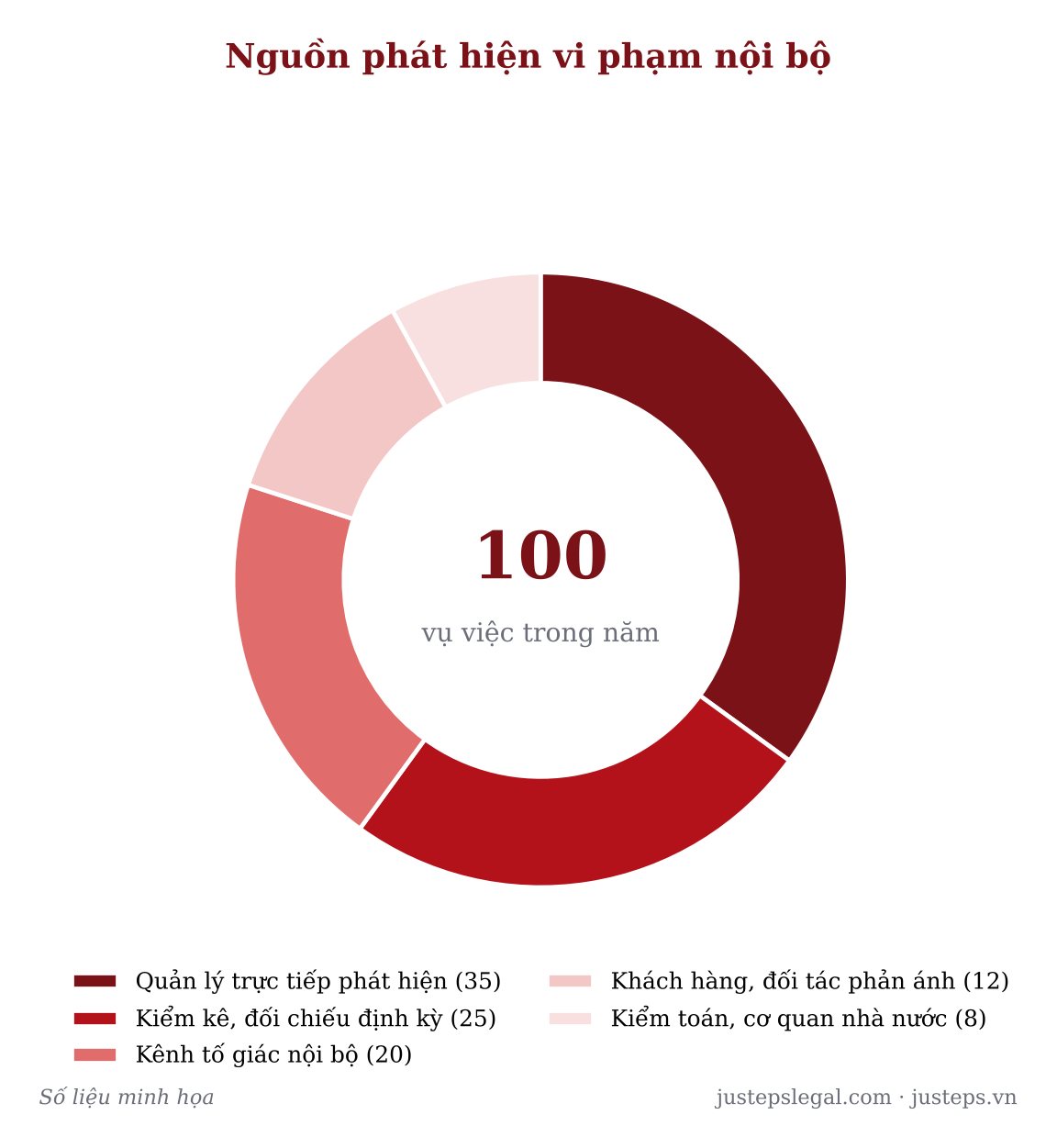
Breakdown of the sources through which internal breaches were detected at a trading company
In this example, about sixty per cent of cases were detected through direct managers or through periodic stocktakes and reconciliations, which are sources whose information quality the business can control. About one fifth of cases came from the whistleblowing channel, and this group needs to be received confidentially, recorded in full and assessed independently before anyone is questioned. The figures are illustrative, and a business should compile its own annual statistics on detection sources to see which channels are working effectively. The threshold for opening an investigation should also be written into the internal procedure, so that the decision whether or not to open an investigation does not depend on the instinct of individual managers.
The legal limits that the investigation must respect
The obligation to prove fault and the limitation period
The Labour Code places the obligation to prove the employee's fault on the employer, and requires that disciplinary handling involve the grassroots employee representative organisation of which the employee is a member, that the employee be present and that the employee have the right to defend themselves or ask another person to defend them[2]. The limitation period for labour discipline is six months from the date of the breach, and twelve months for conduct directly related to finance, assets, or the disclosure of technological or business secrets[2]. Accordingly, the date of the conduct is the first milestone that the investigation team must establish, because if a case is discovered close to the end of the limitation period, the whole investigation plan must be shortened to match. An accurate conclusion reached after the limitation period has expired cannot serve as the basis for a disciplinary decision.
Conduct must be regulated in advance, and the periods in which discipline may not be imposed
Labour law prohibits disciplining an employee for conduct not provided for in the internal labour rules, the signed employment contract or labour legislation, and also prohibits fines or wage deductions in place of disciplinary handling[2]. The internal labour rules must contain provisions on the protection of assets and business secrets, on the prevention of sexual harassment together with the procedure for handling such conduct, a list of breaches with the corresponding forms of discipline, and the persons competent to impose discipline[3]. Therefore, right at the initial assessment stage, the investigation team needs to compare the suspected conduct with a specific provision of the internal rules, and where the rules do not cover it, the business can only learn from the case and supplement the rules for future cases. A business reviewing its internal rules to cover new types of conduct, such as sharing customer data through personal messaging applications, may refer to the Justeps service internal labour rules and disciplinary handling.
The Labour Code also sets out certain periods during which an employee may not be disciplined, including sick leave, convalescence leave, leave approved by the employer, periods of temporary detention or custody, the period awaiting the verification results of a competent authority for certain serious breaches, and periods when a female employee is pregnant or on maternity leave or an employee is raising a child under twelve months of age[2]. The investigation may still proceed during these periods in order to collect and preserve evidence, but the disciplinary meeting must wait until those periods have ended. The investigation team should therefore check the status of the person under suspicion with the HR department before scheduling the meeting, to avoid issuing a decision during a period in which the law protects the employee.
Personal data and privacy
An internal investigation almost always touches on personal data, from work email and software access logs to camera footage. The Law on Personal Data Protection requires that employees be clearly informed when technological and technical measures are applied to manage them[4]. This means the business should access only those systems which the internal rules, the regulations on the use of IT assets or the employment contract have announced as being subject to monitoring, and it may not require employees to hand over their personal phones or social media accounts. A business that does not yet have regulations on monitoring work systems should issue them before a case arises, and may refer to the Justeps service personal data protection and cybersecurity.
Forming the investigation team and allocating roles
An investigation earns trust when the person leading it is independent of the case and each member clearly understands their own part of the work. The decision to open an investigation should be issued by the person competent to impose discipline under the internal rules, stating the case, the composition of the investigation team, the scope, the deadline and the duty of confidentiality. The table below suggests how to allocate roles in an investigation team of three to five people at a medium-sized business.
| Role | Usually held by | Points to note when assigning |
|---|---|---|
| Decision-maker | The director or the person competent to impose discipline under the internal rules. | Decides to open the investigation, approves the plan and receives the report, but does not conduct interviews directly. |
| Team leader | The head of HR, legal affairs or internal control. | Does not belong to the same department as the person under suspicion and has no family relationship with them. |
| Specialist member | Accounting, warehouse or IT staff depending on the case. | Takes part only in the specialist work and signs a confidentiality undertaking on the case information. |
| Secretary | An HR or administrative officer. | Takes minutes and manages the evidence list and the deadline tracking log. |
| External expert | An independent consulting or forensic examination organisation where needed. | Used when the case involves senior management or requires data analysis. |
The most important principle is that anyone with a conflict of interest must step down from the team, even if that person holds a senior position. The direct manager of the person under suspicion may provide information and evidence but should not act as team leader, because this person may both be affected by the conclusion and usually already holds a view in advance. For sexual harassment cases, the guiding decree requires that complaints and denunciations be handled promptly and in a timely manner while protecting the confidentiality, honour, dignity and safety of the harassed person, the person making the denunciation and the person denounced alike[5], so the investigation team should include at least one member of the same gender as the complainant. A small business without enough independent staff may engage an external expert as team leader under a service contract containing confidentiality provisions.
A five-step investigation sequence
An internal investigation can be divided into five steps, from receiving the information to producing the concluding report. The flowchart below describes the reference sequence and the points at which the business must decide whether to stop or continue.
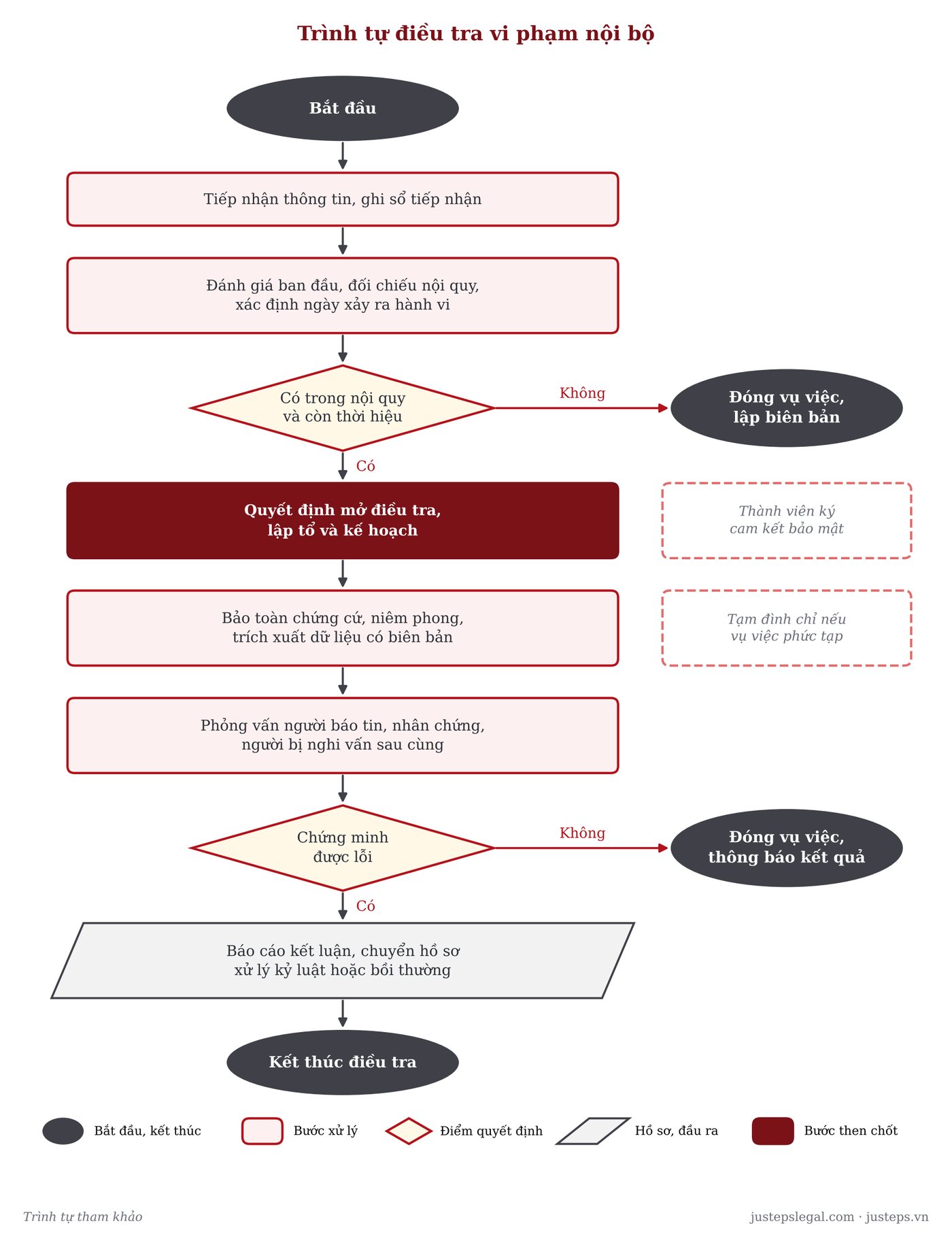
Sequence for investigating internal misconduct from receipt of information to referral for disciplinary handling
Under the flowchart, after receiving the information, the business checks two conditions before opening an investigation, namely whether the conduct is regulated in the internal rules or by law and whether the limitation period for handling it is still running. If either condition is not met, the case is closed with minutes stating the reason clearly, and the business turns to other management measures such as a reminder, training or amending the internal rules. Where the conditions are met, the investigation team preserves evidence, conducts interviews and prepares a report; if the report cannot prove fault, the case is likewise closed and the person under suspicion is informed of the outcome. Only when the report proves fault is the file passed on to the procedure for a disciplinary meeting or for compensation for damage.
Receipt and initial assessment
All information about a breach should be entered in an intake log showing the date received, the source, a summary of the content and the person who received it, even where the informant asks to remain anonymous. Within two to three working days, the person who received the information makes a preliminary assessment of its seriousness, compares it with the relevant provision of the internal rules, establishes the date of the conduct in order to calculate the limitation period and proposes whether or not to open an investigation. The initial assessment is based only on documents already available and does not yet involve interviewing the person under suspicion, so as to avoid disclosing information before the evidence has been preserved.
Decision to open the investigation and planning
The decision to open an investigation should be accompanied by a short plan setting out the questions to be answered, the expected sources of evidence, the list of people to be interviewed and the completion deadline, usually ten to twenty working days for an ordinary case. The questions to be answered usually include whether a breach occurred, who committed it, which provision of the internal rules it breached, the degree of fault and the value of any damage. This plan prevents the investigation team from widening the scope arbitrarily and also serves as evidence that the business conducted an organised and objective investigation.
Preserving evidence
Evidence needs to be preserved before the person under suspicion learns that they are being investigated. Depending on the case, the investigation team backs up data on work systems, temporarily locks the right to delete or edit data, seals filing cabinets or warehouse areas, extracts camera footage and takes an inventory of the assets concerned. Each sealing, extraction or inventory must be recorded in minutes stating the time, the person who carried it out, the witnesses and the condition of the documents, after which each item of evidence is numbered in a single evidence list. Screenshots without a clear time, a clear source or anyone to confirm them are the kind of evidence that is easily rejected, so the investigation team should give priority to data extracted directly from the system together with minutes.
Interviews
A sensible order of interviews is to start with the person who discovered or reported the matter, then the witnesses, and to interview the person under suspicion last, once the investigation team has enough information to ask focused questions. Each interview should be attended by two members of the investigation team, who use open and neutral questions, do not suggest answers and make no promises or threats to obtain statements. The interview minutes record the start and end times and the interviewee's account in their own meaning, and are signed by the interviewee on every page; if the interviewee refuses to sign, the minutes state that refusal clearly. The person under suspicion needs to be told which conduct is being examined and allowed to write a written explanation, because this is their first opportunity to explain before the business reaches a conclusion.
Conclusion
The concluding report answers each of the questions in the plan in turn, refers to the numbered evidence and clearly separates facts that have been proven from the opinions of the investigation team. The report also states the provision of the internal rules that was breached, the degree of fault, any damage, mitigating circumstances and a proposed course of action for the competent person to decide. Where the evidence is not sufficient to conclude that there was fault, the investigation team should say so clearly rather than reaching a conclusion that goes against the employee, because the burden of proof lies with the business. If the investigation reveals signs of a criminal offence such as embezzlement or theft of property, the business may report the matter to the investigating authority under the law on criminal procedure[6], and the disciplinary handling of that conduct should be weighed against the progress of the business's work with that authority.
Temporary suspension from work during verification
Where a case involves complex circumstances and allowing the employee to continue working could hinder verification, the Labour Code permits the employer to temporarily suspend the employee from work after consulting the grassroots employee representative organisation of which the employee is a member[2]. The suspension may not exceed fifteen days, or ninety days in special cases, and during this period the employee receives an advance of fifty per cent of the wages they earned before the suspension[2]. When the period ends, the employee must be allowed to return to work; if the employee is disciplined, they do not have to repay the advance, and if not, they are paid full wages for the period of suspension[2].
Temporary suspension is most suitable for cases where the person under suspicion holds access rights to the relevant systems, documents or assets, for example a cashier, a storekeeper or a purchasing officer. The suspension decision should clearly state the reason, the duration, the wage advance and the requirement that the employee attend when invited, and it must not describe the employee as being at fault. Alongside this decision, the business should temporarily revoke system access and hand over unfinished work to another person under handover minutes. The business should not use suspension as a substitute for discipline, because a prolonged suspension without a conclusion both incurs wage costs and readily gives rise to disputes.
Passing the investigation results on to disciplinary handling and compensation
The concluding report is not yet a disciplinary decision. To impose discipline, the employer must hold a meeting within the limitation period and notify those required to attend of the content, time, venue, the full name of the person being disciplined and the breach at least five working days before the meeting[7]. The content of the meeting must be recorded in minutes, approved before the meeting closes and signed by those attending; where someone does not sign, the minute-taker records their full name and the reason[7]. After the meeting, the competent person issues the disciplinary decision within the limitation period and sends it to those required to attend[8].
The timeline below illustrates the milestones of a case involving assets, from the date of the conduct to the issue of the decision. The example assumes that the conduct took place on 10 March, was discovered through a stocktake on 5 June and that the business applies the twelve-month limitation period.
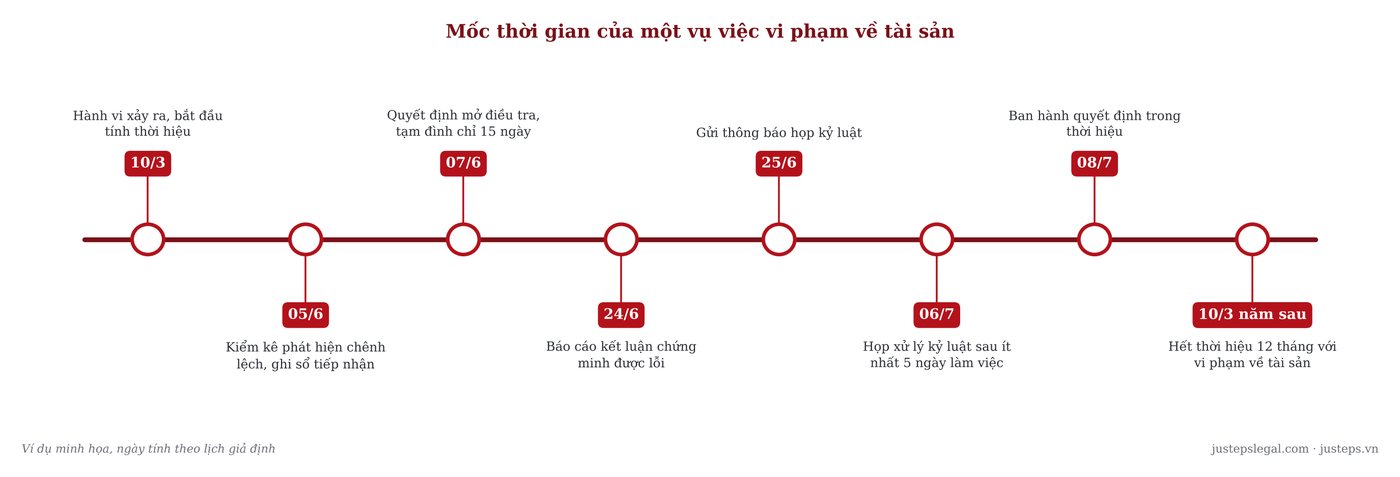
Timeline of a breach involving assets
In this example, the business still has more than nine months of the limitation period left when the breach is discovered, so it has enough time to investigate thoroughly over about three weeks and to suspend the storekeeper for fifteen days. The milestone most easily missed is the date of sending the meeting notice, because the notice must reach those attending at least five working days before the meeting. For conduct unrelated to finance, assets or business secrets, the limitation period is only six months, so a case discovered three to four months late leaves little time for the investigation.
Where the conduct causes damage to property, the business may handle compensation in parallel with discipline but under a separate procedure, in which the employee writes an explanation, the meeting is notified at least five working days in advance, minutes are taken and a compensation decision is issued stating the extent of the damage, its cause, and the amount, deadline and method of compensation[9]. The limitation period for handling compensation for damage is six months from the date of the conduct that caused the damage[10], which is shorter than the twelve-month limitation period for discipline applicable to conduct involving assets. A business that handles discipline or compensation for damage in breach of the prescribed order, procedure or limitation period may face administrative penalties, and the fine applicable to an organisation is twice the fine for an individual[11]. If the employee disagrees with the decision, the dispute is resolved under the labour dispute resolution procedure, so the investigation file needs to be kept in full so that the business can present its own case or pass it to a legal practitioner of its choice.
Records to keep and common mistakes
The file for an internal investigation should be kept separately, with an index, and only authorised persons should have access to it. At a minimum, the file includes the intake log or intake form, the decision to open the investigation with its plan, confidentiality undertakings from the investigation team members, the evidence list, minutes of sealing, inventories and data extractions, interview minutes, the written explanation of the person under suspicion, the suspension decision if any, and the concluding report. When the case moves on to discipline, the file is supplemented with the meeting notice, the meeting minutes and the disciplinary decision. The retention period for the file should be set out in the internal regulations, taking into account the limitation period for resolving labour disputes and the requirement to delete or destroy personal data once it is no longer needed.
In the cases Justeps has helped businesses review, a number of mistakes recur quite frequently and are often the reason a disciplinary decision is annulled or has to be renegotiated:
- The business calls in the person under suspicion for questioning first, so that evidence is deleted or witnesses are influenced before the investigation team can begin its work.
- A manager asks an employee to unlock a personal phone or social media account to check messages without any basis in the internal rules.
- Interview minutes do not record the time, are not signed on every page, or are rewritten after the interview from the interviewer's memory.
- The business holds a disciplinary meeting while the employee is on sick leave or is raising a child under twelve months of age.
- The conclusion relies mainly on screenshots supplied by the whistleblower without comparing them with the original data on the system.
- The business disciplines the whistleblower for supposedly false information even though the internal rules do not clearly regulate the making of false denunciations.
All of these mistakes can be prevented with an investigation procedure issued in advance, a standard set of forms and a short training session for department heads. The procedure should sit alongside the internal labour rules and the regulations on receiving whistleblowing reports, so that employees know which channel to use and managers know what they may and may not do when they detect a breach. The business should review the procedure after each major case in order to add situations that had not been anticipated.
How Justeps can help
Justeps supports businesses in building an internal investigation procedure and handling breaches in accordance with the law through the following services:
- Internal labour rules and disciplinary handling. Justeps drafts internal labour rules, an internal investigation procedure and a set of forms from the intake form to the disciplinary decision.
- Management of labour disputes and termination of employment contracts. Justeps assesses the investigation file, reviews the evidence and advises on negotiation and conciliation when an employee challenges a disciplinary decision.
- Personal data protection and cybersecurity. Justeps drafts regulations on monitoring work systems so that the extraction of email and data during an investigation stays within the notified scope.
- Internal financial control system. Justeps designs controls over the warehouse, cash and purchasing so that breaches are detected early and evidence is readily available for comparison.
- HR, labour and internal compliance training. Justeps trains department heads and investigation teams in interviewing skills, taking minutes and preserving evidence.
Frequently asked questions
Is a business required to form an investigation team before imposing discipline?
The law does not require an investigation team, but the business must be able to prove the employee's fault[2]. For a breach discovered after it occurred, the employer must collect evidence[1], so a planned investigation team is the safest approach.
May a business check an employee's work email during an investigation?
The business should check only within the scope of the internal rules or regulations already notified, because employees must be clearly informed of the technological measures used to manage them[4]. The extraction should be recorded in minutes and limited to data relevant to the case.
What should be done if the person under suspicion refuses to sign the interview minutes?
The investigation team records the refusal to sign and the reason, if any, with the signatures of the team members and a witness. The minutes remain an item of evidence but should be compared with other evidence.
What is the maximum period of temporary suspension and how are wages paid?
The period may not exceed fifteen days, or ninety days in special cases, and the employee receives an advance of fifty per cent of their wages[2]. If no discipline is imposed, the employee is paid full wages for the period of suspension.
Can a business still impose discipline after the limitation period has expired?
No. The limitation period for discipline is six months, or twelve months for conduct relating to finance, assets or secrets[2]. Compensation for damage has its own six-month limitation period[10], so the business needs to track both deadlines.
What principles apply to handling a sexual harassment complaint?
The complaint must be handled promptly and in a timely manner while protecting the confidentiality, honour and safety of those involved[5]. The internal rules must contain a separate procedure for handling this conduct[3].
Must a business stop its internal investigation when it finds signs of a criminal offence?
The business may report the matter to the investigating authority[6] and should keep the evidence intact for handover. Whether to continue the internal investigation should be weighed so as not to interfere with the work of the competent authority.
Related articles
- Resolving labour disputes through internal conciliation before referring them to a labour conciliator
- Personal data protection in the HR department under the 2025 Law on Personal Data Protection
- How Vietnamese garment exporters should prepare for an international buyer’s labour compliance audit
- Monthly labour and payroll compliance checklist for the HR department
Notes
[1] Clause 1, Article 70 of Decree No. 145/2020/ND-CP dated 14 December 2020 of the Government detailing and guiding the implementation of a number of articles of the Labour Code on working conditions and labour relations.
[2] Labour Code No. 45/2019/QH14 dated 20 November 2019 (provisions on labour discipline, limitation periods and temporary suspension from work), as amended and supplemented by the Law amending and supplementing a number of articles of the Labour Code and certain other laws passed by the National Assembly on 21 November 2026.
[3] Points d, dd, g and i, Clause 2, Article 69 of Decree No. 145/2020/ND-CP.
[4] Point a, Clause 3, Article 25 of the Law on Personal Data Protection No. 91/2025/QH15 dated 26 June 2025.
[5] Clause 2, Article 85 of Decree No. 145/2020/ND-CP.
[6] Criminal Procedure Code No. 101/2015/QH13 (provisions on receiving crime reports and denunciations).
[7] Clauses 2 and 3, Article 70 of Decree No. 145/2020/ND-CP.
[8] Clause 4, Article 70 of Decree No. 145/2020/ND-CP.
[9] Article 71 of Decree No. 145/2020/ND-CP.
[10] Clause 1, Article 72 of Decree No. 145/2020/ND-CP.
[11] Point dd, Clause 2, Article 25 and Clause 1, Article 7 of Decree No. 283/2026/ND-CP dated 15 July 2026 on administrative penalties in the fields of labour and social insurance.
This article is for reference and reflects the regulations in force at the time of publication. Please consult Justeps for advice tailored to your company’s records and situation.
For further information, please contact:
📩 Email: info@justeps.vn
🌐 Website: https://justepslegal.com · https://justeps.vn
🌐 Page: Justeps
☎️ Hotline (Zalo): 096 172 2607
📍 Thanh Xuan Office: 12th Floor, Licogi 13 Tower, 164 Khuat Duy Tien Street, Thanh Xuan Ward, Hanoi, Vietnam
📍 Ha Dong Office: LK06B, No.10, Dong Dua Area, Ha Dong Ward, Hanoi, Vietnam
📍 Ho Chi Minh City Branch: 528 Le Van Sy, Ho Chi Minh City, Vietnam
📍 Hai Phong Office: Truong Thinh Village, Ha Dong Commune, Hai Phong, Vietnam
📍 Quang Ninh Office: Van Don Special Zone, Quang Ninh Province, Vietnam





