
Key takeaways
- Each day of leave needs to be given its correct name as soon as it is requested, because annual leave, paid personal leave, unpaid leave and sick leave have different legal bases, payers and supporting documents.
- The annual leave schedule should be drawn up at the beginning of the year after consulting employees, together with a register tracking each person’s leave entitlement, leave taken and leave remaining.
- Sick days supported by valid documents are paid by the social insurance fund under the sickness benefit regime, so the business may not deduct them from annual leave and must prepare the employee’s file on time.
- Approving leave through personal messages without recording it in the timekeeping sheet is a common cause of disputes when an employee leaves or when the business wishes to deal with unauthorised absence.
- A business may not take disciplinary action against, or unilaterally terminate the contract of, an employee who is on sick leave as prescribed by a medical examination and treatment facility, except in the cases provided by law.
A distribution company of about eighty-five people let each head of department approve leave through a group chat, while the HR department only learned who had been absent when it checked the timekeeping machine at the end of the month. When a warehouse employee left, the two sides could not agree on how many days of leave the person had remaining, because some days off had been approved orally by the warehouse manager without anyone recording them. At the same time, three sales staff who took sick leave with hospital certificates had the days deducted from their annual leave, and their sickness benefit files were never prepared because the HR department did not receive the documents.
This article guides businesses in building a procedure for managing annual leave and sick leave in the order in which it is carried out, covering the classification of types of leave and sources of payment, how annual leave is calculated and scheduled, the request and approval sequence, sickness benefit files, the leave register and payment for untaken leave, and the limits on the business when dealing with absence. The main readers are directors, HR managers and payroll accountants of businesses with several dozen employees or more, especially businesses working in shifts or with many branches. The article does not go into maternity and occupational accident benefits in depth, as these have their own files and deadlines.
Classifying types of leave and sources of payment
The starting point of any procedure is giving each day off its correct name. Each type of leave has its own legal basis, its own payer and its own type of documents, so if a leave request merely states a request for two days off, the HR department will not know whether to deduct annual leave, pay wages or prepare an insurance file. The internal labour regulations must contain provisions on working hours and rest periods[1], so detailed rules on types of leave, notice periods and approvers should be set out in the internal labour regulations or in a separate regulation to which the internal labour regulations refer. The table below summarises the four most common groups of leave in a business.
| Type of leave | Payer | Required documents |
|---|---|---|
| Annual leave | The business pays full contractual wages for the days taken within the entitlement. | A request form or system request with approval, updated in the leave register. |
| Paid personal leave | The business pays full wages for marriage, a child’s marriage or the death of a relative as prescribed by law. | A request with documents proving the event if the internal labour regulations so require. |
| Unpaid leave | Nobody pays, unless the two parties agree otherwise. | A written agreement or an approved request stating the period clearly. |
| Sick leave, leave to care for a sick child | The social insurance fund pays sickness benefit if the conditions are met, and the business does not pay wages for these days. | A certificate of leave entitled to social insurance benefits or a hospital discharge paper issued by a medical facility. |
As regards personal leave, the Labour Code allows employees to take leave on full pay for three days on their marriage, one day on the marriage of their natural or adopted child, and three days on the death of their own parent or their spouse’s parent, their spouse or their child; employees may also take one day of unpaid leave on the death of a grandparent or sibling, or on the marriage of a parent or sibling, and must notify the employer[2]. Outside these cases, unpaid leave only arises where the two parties agree. A business may provide more paid leave than the statutory level, but not less, and should state this clearly in the internal labour regulations so that line managers do not each apply their own approach.
Public holidays do not belong to the above groups, since all employees are off according to a common calendar and the business continues to pay wages. The Law amending and supplementing the Labour Code passed by the National Assembly on 21 November 2026 adds two public holidays on 27 July and 24 November, effective from 1 March 2027[3]. Businesses need to update their 2027 working calendar, the calculation of pay for work on public holidays and the shift rosters of continuously operating departments, and also check whether any annual leave has been scheduled on the two new public holidays.
Annual leave, calculating the number of days and scheduling
Number of days of entitlement
An employee who has worked twelve full months for one employer is entitled to annual leave on full pay of twelve working days under normal conditions, fourteen days for minor employees, employees with disabilities or those in heavy, hazardous or dangerous occupations or jobs, and sixteen days for especially heavy, hazardous or dangerous occupations or jobs[4]. An employee who has worked less than twelve months is entitled to leave in proportion to the number of months worked, and for every five full years of work for one employer the annual leave entitlement increases by one day[5]. Annual leave is counted in working days, so a week of leave for someone working five days a week only uses five days and does not use Saturday and Sunday.
When counting months of work, many businesses only count the months in which the employee was actually present, which results in too little leave being calculated. Under Decree No. 145/2020/ND-CP, certain periods are still treated as working time for calculating annual leave, such as the probation period if the employee continues working afterwards, paid personal leave, unpaid leave agreed by the employer but not exceeding one month in total in the year, sick leave not exceeding two months in total in the year and maternity leave under the social insurance law[6]. Timekeeping software should be configured according to these rules, rather than leaving the accountant to count by hand at the end of the year.
Scheduling leave and notification
The employer has the right to set the annual leave schedule after consulting employees and must notify employees in advance; employees may agree with the employer to take annual leave in several instalments or to combine up to three years of leave at once[4]. In practice, an effective approach is for the HR department to send a provisional request form in the first month of the year, for each department to consolidate and balance the requests so that no more than a certain proportion of staff are off at the same time, and for the head of department to finalise and announce the schedule. The schedule is not rigid and employees may still ask to change dates, but having a schedule from the start of the year helps the business avoid leave piling up in the last quarter.
When taking annual leave, employees may receive a wage advance as prescribed, and if they travel by road, rail or waterway and the travelling time for the round trip exceeds two days, additional travelling time is counted from the third day onwards, applicable once a year[4]. The regulation should specify how employees request travelling time and the supporting documents, since this point is often overlooked for employees whose home towns are far from their workplace. The business should also clearly state whether untaken annual leave may be carried over to the following year, up to how many days and within what period, because the Labour Code only requires payment when an employee leaves or loses his or her job.
The leave request and approval procedure
The leave request procedure should be the same for every department, whether the request is submitted on a paper form, by email or through HR software. Each request needs to state the type of leave, the start date, the end date, the person taking over the work and the reason if it is personal leave or unpaid leave. The notice period is set by the business in the internal labour regulations, for example three working days for one or two days of leave and ten working days for longer leave, except in emergencies such as the death of a relative. The flowchart below describes the sequence from when the employee submits a request to when the leave is entered in the timekeeping sheet.
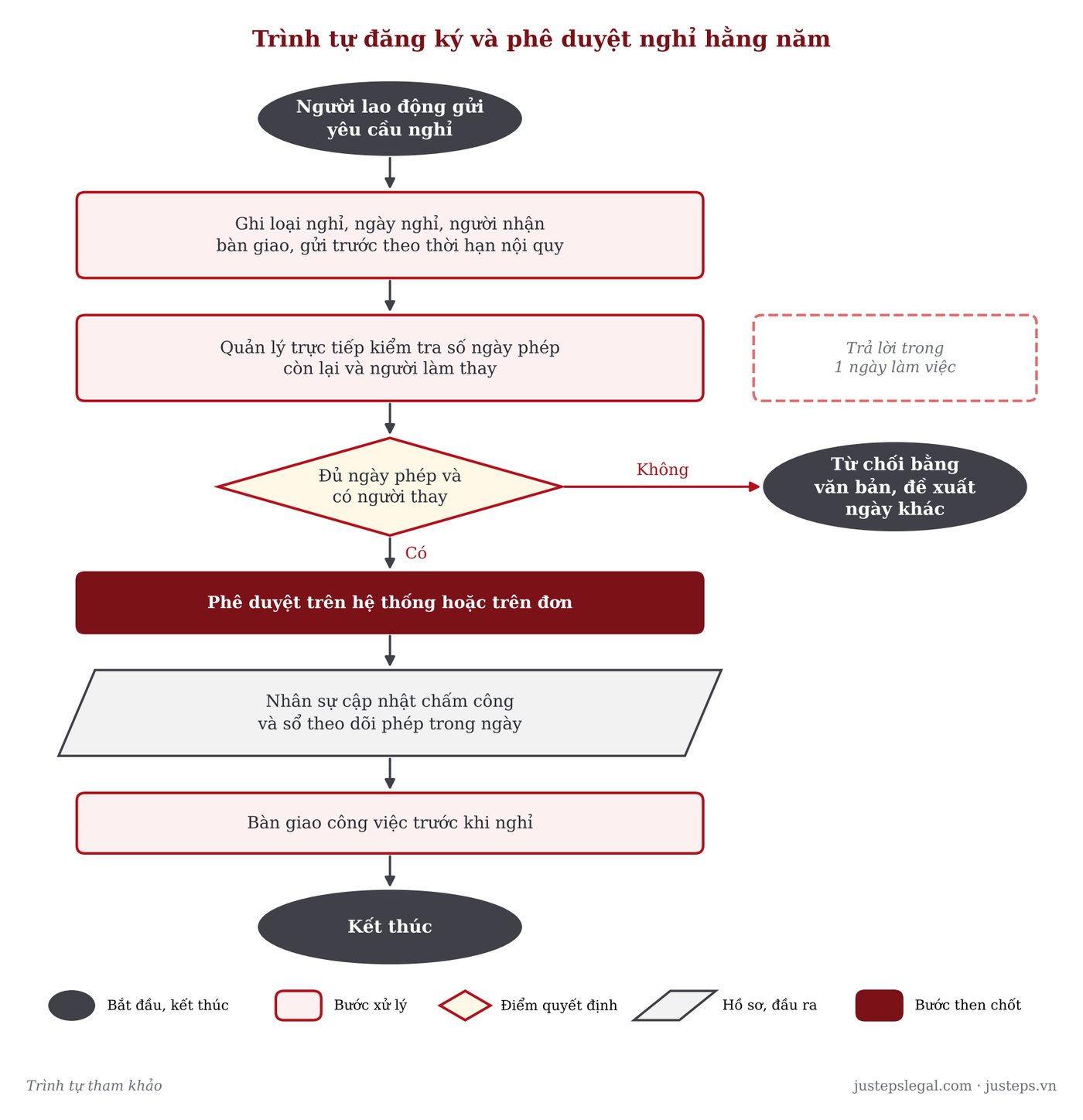
Sequence for requesting and approving annual leave
According to the flowchart, after receiving the request, the line manager checks the remaining leave in the register and whether someone can cover the work while the employee is absent. If there is not enough leave or no cover can be arranged, the manager replies in writing and proposes other dates or another form of leave such as unpaid leave by agreement, and the original request ends there. If the conditions are met, the manager approves within one working day, the HR department updates the timekeeping sheet and the leave register on the same day, and the employee hands over work before going on leave. Every decision to approve or refuse must be recorded on the system or on the form, and must not remain at the level of oral statements or personal messages.
The approval hierarchy needs to be clearly stated so that a long absence is not approved by a team leader alone. Normally, the line manager approves annual leave and short personal leave, while the head of department or the director approves leave of five working days or more, unpaid leave and leave for managers themselves. In businesses working in shifts, the approver needs to look at the shift roster as well to ensure minimum staffing, and the HR department should be able to see all pending requests in order to send reminders when they become overdue. A request not answered within the period set by the regulation should be escalated automatically to the next level, so that the employee is not left unsure whether leave has been granted.
Sick leave and the sickness benefit file
Conditions, duration and benefit level
Employees covered by compulsory social insurance are entitled to sickness benefit when they have to stop work because of illness or an accident other than an occupational accident, with confirmation from a medical examination and treatment facility, or when they have to stop work to care for a sick child under seven years of age[7]. Sickness benefit is not granted in certain cases, such as illness caused by self-harm or drug use, or where the sick leave coincides with annual leave, personal leave or unpaid leave under labour law. The last point has practical significance, because an employee who falls ill during approved annual leave will not receive sickness benefit for the overlapping days, unless the business agrees to convert those days from annual leave to sick leave before timekeeping is finalised.
The duration of sickness benefit in a year is counted in working days, excluding public holidays and weekly rest days, and depends on the number of years of social insurance contributions and the working conditions. Employees working under normal conditions are entitled to a maximum of thirty days if they have contributed for less than fifteen years, forty days if they have contributed for fifteen to less than thirty years, and sixty days if they have contributed for thirty years or more; employees in heavy, hazardous or dangerous occupations or jobs, or working in places with a regional allowance coefficient of 0.7 or more, are entitled to forty, fifty and seventy days respectively[7]. An employee taking leave to care for a sick child is entitled to a maximum of twenty working days a year for each child under three and fifteen working days for each child aged from three to under seven. The chart below shows the maximum number of sick days under the two sets of working conditions.
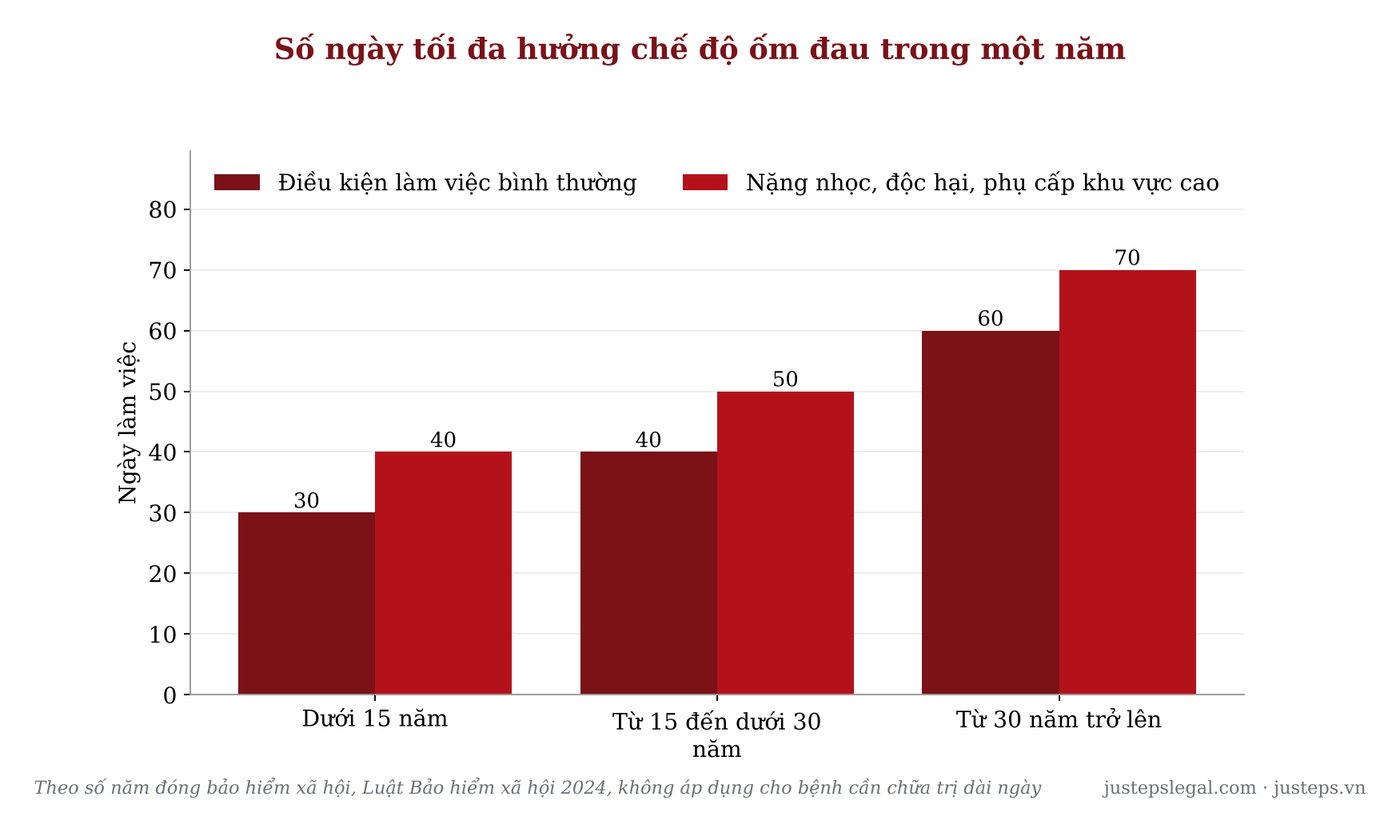
Maximum number of working days of sickness benefit in a year
The chart shows that the maximum number of days rises with the length of social insurance contributions, from thirty to forty and sixty days under normal conditions, and that employees in heavy or hazardous work or in areas with a high regional allowance receive an additional ten days at each level. Employees with illnesses on the Ministry of Health’s list of diseases requiring long-term treatment are covered by a separate regime with a longer duration, so the HR department needs to track these cases separately in the register. The ordinary sickness benefit is seventy-five per cent of the wage on which social insurance contributions were based in the month immediately preceding the month of leave. After a long illness, an employee who returns to work without having fully recovered may take convalescence leave of up to ten, seven or five days depending on the case, with a daily benefit equal to thirty per cent of the reference level.
Reporting absence, submitting documents and deadlines
The sick leave procedure differs from the annual leave procedure in that the employee usually cannot request it in advance. The internal labour regulations should therefore specify through which channel and by what time on the first day of absence the employee or a relative must inform the line manager, for example by eight in the morning by telephone or through the company’s messaging app, after which the manager records it on the system so that the HR department can mark it as sick leave pending documents. On returning to work, the employee submits the certificate of leave entitled to social insurance benefits for outpatient treatment or the hospital discharge paper for inpatient treatment; many medical facilities now send certificate data electronically, but the HR department still needs to check the information before preparing the file.
The Law on Social Insurance gives employees forty-five days from the date of returning to work to submit their file to the employer; the employer is responsible for preparing the list of benefit claims and submitting it to the social insurance authority within seven working days of receiving a complete file, and the social insurance authority processes and pays within seven working days of receiving a complete file[8]. Detailed procedures and forms are set out in the decree detailing the Law on Social Insurance on compulsory social insurance and in the documents of the social insurance authority[9]. The timeline below summarises these milestones, together with the internal milestone Justeps recommends the business sets so that files do not pile up close to the deadline.
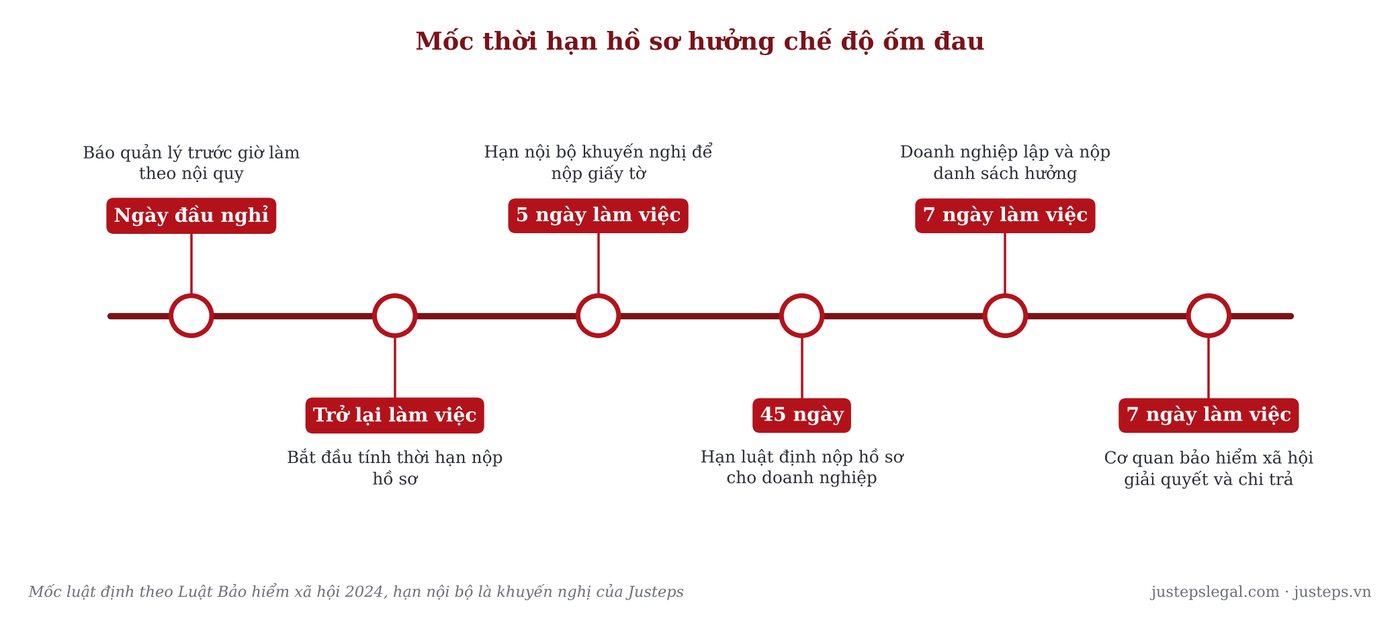
Deadlines for the sickness benefit file
According to the timeline, the first day of absence is the milestone for reporting the absence, while the date of returning to work starts the forty-five-day period for submitting the file. Justeps recommends that businesses set an internal deadline of five working days after the return to work for employees to submit their documents, because documents submitted early are easier to check and to correct if there are errors in names, dates or signatures. The HR department prepares the list within seven working days of receiving a complete file, after which the social insurance authority has a further seven working days to process and pay. A business that fails to prepare the list and file, or submits them late, may be subject to administrative penalties under the decree on penalties in the fields of labour and social insurance[10], and employees receiving their money late are a common source of complaints. Businesses needing comprehensive support with files and benefits can refer to Justeps’ advisory service on compulsory social insurance and employee benefits.
The leave register, timekeeping and payment for untaken leave
Each employee’s leave register is the document that allows the business to answer immediately how many days of leave that person has remaining and how many sick days he or she has taken in the year. The register should have columns for the annual entitlement, additional days for seniority, days carried over from the previous year if the regulation allows, days taken in each period and days remaining, and a separate section recording days of sick leave and leave to care for a sick child for which benefits were received. The data in the register must match the timekeeping sheet used for payroll, as the timekeeping sheet is the basis for paying wages for paid leave and for excluding sick days from the payroll.
Each type of leave should have its own code on the timekeeping sheet, for example AL for annual leave, PL for paid personal leave, UL for unpaid leave, S for sick leave and CS for leave to care for a sick child. The sick leave code is only finalised once documents have been received; if the employee has not submitted them by the internal deadline, the HR department sends a written reminder and keeps the pending code, without converting the days on its own initiative into annual leave or unauthorised absence. The timekeeping sheet and leave register contain information on employees’ health, which is sensitive personal data under the law on personal data protection[11], so only those with a need to do so may see diagnostic details, while the line manager only needs to know the dates of the sick leave.
When an employee leaves or loses his or her job without having taken all or part of the annual leave entitlement, the employer must pay wages for the untaken days[4]. The wage used as the basis for payment is the contractual wage of the month immediately preceding the month in which the employee leaves, divided by the number of normal working days in that month and multiplied by the number of untaken days[12]. This amount is paid together with the other amounts on termination of the employment contract within the statutory period, so if the register is unclear, the business both struggles to agree with the employee and risks late payment. For years in which the employee continues working, whether to pay for or carry over unused leave is set by the business in its regulation, and that rule must be applied uniformly to everyone.
As regards tax, wages paid for annual leave days and untaken leave are income from salaries and wages of the employee, while sickness benefit paid by the social insurance fund is a social insurance allowance not included in income subject to personal income tax[13]. The payroll accountant therefore needs to separate these two amounts in the payroll and in the payment documents. Where the business voluntarily pays an additional portion of wages for sick days on top of the fund’s benefit, this additional payment should be provided for in the pay and bonus regulation and taxed as income from salaries and wages.
Unreported absence and the limits on the business
A rigorous leave management procedure also provides the basis for the business to deal with unauthorised absence. An employee who is absent without permission for a total of five days within thirty days, or a total of twenty days within three hundred and sixty-five days from the first day of absence, without a legitimate reason may be dismissed; legitimate reasons include natural disasters, fire, illness of the employee or a family member confirmed by a competent medical facility and other cases provided for in the internal labour regulations[14]. An absence should therefore only be recorded as unauthorised once the business has contacted the employee, reminded him or her to submit documents and the deadline has passed without a reason; sick days supported by valid documents are not counted as days of unauthorised absence.
Where a business suspects that a sick leave certificate is not genuine, it has no right to examine the employee’s medical records itself or to require the employee to be examined at a facility designated by the business. The appropriate approach is to check the information on the certificate against electronic data where available, ask the social insurance authority or the medical facility to verify it when there are signs of irregularity, and only take disciplinary action once fraud has been proven following the correct procedure, provided the internal labour regulations define such conduct. While an employee is on sick leave, convalescence leave or leave agreed by the employer, the business may not handle labour discipline[14].
Nor may the business unilaterally terminate the employment contract while the employee is ill or undergoing treatment or convalescence as prescribed by a competent medical facility, except where the employee has been treated for twelve consecutive months under an indefinite-term contract, six consecutive months under a contract of twelve to thirty-six months, or more than half the term of a contract of less than twelve months, and his or her working capacity has not recovered[15]. Even in this exceptional case, the business must give the statutory notice and should discuss with the employee the possibility of suitable work once his or her health recovers. Rules on dealing with absence, legitimate reasons and the disciplinary procedure should be reviewed together when the business amends its internal labour regulations, for which it can refer to Justeps’ service for drafting internal labour regulations and handling discipline.
Building the procedure into internal regulations and organising implementation
A leave management procedure is only binding when it is set out in documents that have been communicated to employees. General matters such as the types of leave, notice periods, legitimate reasons for absence and the consequences of unauthorised absence should be in the internal labour regulations; detailed matters such as forms, the approval hierarchy, how unused leave is carried over and internal deadlines for documents can be placed in a regulation on working hours and rest periods issued by the director. A business employing ten or more employees must have written internal labour regulations registered with the provincial labour authority, so amendments to provisions on rest periods require re-registration.
To ensure that the procedure is applied consistently in all departments and to have evidence if a dispute arises, the minimum set of documents should include the following documents and forms:
- A regulation on working hours and rest periods clearly stating the types of leave, notice periods, approval levels and deadlines for documents.
- A paper or electronic leave request form with a box for selecting the type of leave, the person taking over the work and the approver’s signature.
- Each department’s annual leave schedule announced at the beginning of the year.
- Each employee’s leave register, including the days of entitlement, days taken, days remaining and days of sickness benefit.
- A register of sickness benefit files recording the date documents were received, the date of submission to the social insurance authority and the payment result.
- A table of timekeeping codes agreed between the HR department, accounting and the departments.
As regards allocation of responsibilities, employees are responsible for requesting the correct type of leave and submitting documents on time, line managers approve requests and arrange cover, the HR department updates the register, prepares insurance files and chases overdue requests, and the payroll accountant checks the timekeeping sheet before calculating pay. Each quarter, the HR department should report to the board of management on outstanding leave by department, the number of sickness files submitted and pending, and the number of absences without a clear reason. This report helps the business detect early which departments are leaving leave until the end of the year or have unusual sick leave rates, so that it can adjust work schedules, staffing or working conditions. The regulation should be reviewed once a year and immediately when the law changes, such as the addition of two public holidays from 1 March 2027.
How Justeps can help
Justeps helps businesses build a procedure for managing annual leave and sick leave and carry out the related procedures through the following services:
- Advisory on compulsory social insurance and employee benefits. Justeps reviews files, guides the preparation of sickness benefit claim lists and deals with cases of refusal or late payment.
- Internal labour regulations and disciplinary handling. Justeps drafts provisions on types of leave, legitimate reasons for absence and the procedure for dealing with unauthorised absence, and supports the registration of the internal labour regulations.
- Labour and payroll compliance management. Justeps sets up rest period rules, a table of timekeeping codes and a leave register consistent with the payroll.
- Training on compulsory social insurance under the 2024 Law on Social Insurance. Justeps trains the HR department on the conditions, deadlines and files for sickness and maternity benefits.
Frequently asked questions
May sick days supported by a hospital certificate be deducted from annual leave?
They should not be. Sick days supported by valid documents are dealt with under the sickness benefit regime of the social insurance fund[7], and sick leave not exceeding two months in total in the year is still treated as working time for calculating annual leave[6].
Is an employee who has worked for five months entitled to annual leave?
Yes. An employee who has worked less than twelve months is entitled to annual leave in proportion to the number of months worked[4]. The business should state in its regulation how the number of days is rounded so that it is applied consistently.
Must a business pay for annual leave not taken each year?
The Labour Code requires payment when an employee leaves or loses his or her job without having taken all the leave due[4]. For employees still working, the business sets out in its regulation whether unused leave is paid or carried over to the following year, and applies this consistently.
Is an employee who submits a sick leave certificate late still entitled to benefits?
The deadline for submitting the file to the employer is forty-five days from the date of returning to work[8]. The business should set a shorter internal deadline and send written reminders so that this deadline is not missed.
How should illness during annual leave be handled?
Sickness benefit is not granted for periods coinciding with annual leave under labour law[7]. If the employee reports promptly and submits documents, the business may agree to convert those days to sick leave and restore the annual leave before timekeeping is finalised.
May an employee who is absent for many days without notice be dismissed?
Possibly, if the employee is absent without permission for a total of five days within thirty days or a total of twenty days within three hundred and sixty-five days without a legitimate reason[14]. The business must prove that it made contact, sent reminders and handled the discipline following the correct procedure.
May the line manager know the specific illness of an employee on sick leave?
Health information is sensitive personal data[11], so the line manager only needs to know the period of leave. Documents containing a diagnosis should only be accessed by the person preparing the insurance file and kept under controlled conditions.
Related articles
- Monthly labour and payroll compliance checklist for HR departments
- Practical lessons in building an employee handbook for a small business that is concise, practical and consistent with the internal labour regulations
- Practical guidance on dealing with an employee who quits without notice or handover while staying within labour law
- The annual pay review process, from criteria, budget and merit matrix to records and employee notification
Notes
[1] Clause 2, Article 69 of Government Decree No. 145/2020/ND-CP dated 14 December 2020 detailing and guiding the implementation of a number of articles of the Labour Code on working conditions and labour relations.
[2] Labour Code No. 45/2019/QH14 dated 20 November 2019, as amended and supplemented by the Law amending and supplementing a number of articles of the Labour Code and certain laws passed by the National Assembly on 21 November 2026 (provisions on personal leave and unpaid leave).
[3] The Law amending and supplementing a number of articles of the Labour Code, the Law on Archives, the Law on Gender Equality, the Law on Red Cross Activities and the Law on Employment, passed by the National Assembly on 21 November 2026 and effective from 1 March 2027.
[4] Labour Code No. 45/2019/QH14 dated 20 November 2019, as amended and supplemented by the Law amending and supplementing a number of articles of the Labour Code and certain laws passed by the National Assembly on 21 November 2026 (provisions on annual leave).
[5] Labour Code No. 45/2019/QH14 dated 20 November 2019, as amended and supplemented by the Law amending and supplementing a number of articles of the Labour Code and certain laws passed by the National Assembly on 21 November 2026 (provisions on additional annual leave according to length of service).
[6] Article 65 of Decree No. 145/2020/ND-CP.
[7] Law on Social Insurance No. 41/2024/QH15 dated 29 June 2024, as amended and supplemented by the Law amending and supplementing a number of articles of the Law on Social Insurance passed by the National Assembly on 21 November 2026 (provisions on the conditions, duration and level of sickness benefit).
[8] Law on Social Insurance No. 41/2024/QH15 dated 29 June 2024, as amended and supplemented by the Law amending and supplementing a number of articles of the Law on Social Insurance passed by the National Assembly on 21 November 2026 (provisions on the file and processing of sickness benefit claims).
[9] Government Decree No. 158/2025/ND-CP dated 25 June 2025 detailing a number of articles of the Law on Social Insurance on compulsory social insurance.
[10] Government Decree No. 283/2026/ND-CP dated 15 July 2026 on administrative penalties in the fields of labour and social insurance.
[11] The Law on Personal Data Protection No. 91/2025/QH15 dated 26 June 2025 (provisions on sensitive personal data).
[12] Article 67 of Decree No. 145/2020/ND-CP.
[13] The Law on Personal Income Tax No. 109/2025/QH15 dated 10 December 2025, as amended and supplemented (provisions on income from salaries and wages and amounts not included in taxable income).
[14] Labour Code No. 45/2019/QH14 dated 20 November 2019, as amended and supplemented by the Law amending and supplementing a number of articles of the Labour Code and certain laws passed by the National Assembly on 21 November 2026 (provisions on the application of dismissal and periods during which labour discipline may not be handled).
[15] Labour Code No. 45/2019/QH14 dated 20 November 2019, as amended and supplemented by the Law amending and supplementing a number of articles of the Labour Code and certain laws passed by the National Assembly on 21 November 2026 (provisions on the employer’s right to unilaterally terminate the employment contract and the cases in which unilateral termination is not permitted).
This article is for reference and reflects the regulations in force at the time of publication. Please consult Justeps for advice tailored to your company’s records and situation.
For further information, please contact:
📩 Email: info@justeps.vn
🌐 Website: https://justepslegal.com · https://justeps.vn
🌐 Page: Justeps
☎️ Hotline (Zalo): 096 172 2607
📍 Thanh Xuan Office: 12th Floor, Licogi 13 Tower, 164 Khuat Duy Tien Street, Thanh Xuan Ward, Hanoi, Vietnam
📍 Ha Dong Office: LK06B, No.10, Dong Dua Area, Ha Dong Ward, Hanoi, Vietnam
📍 Ho Chi Minh City Branch: 528 Le Van Sy, Ho Chi Minh City, Vietnam
📍 Hai Phong Office: Truong Thinh Village, Ha Dong Commune, Hai Phong, Vietnam
📍 Quang Ninh Office: Van Don Special Zone, Quang Ninh Province, Vietnam





