
Key takeaways
- Restructuring during growth aims to enable the organisation to cope with its new scale, and most restructuring exercises do not require any employee to be dismissed.
- A business should proceed in the order of organisational model, delegation of authority, processes and only then people; replacing managers before redrawing the structure usually just moves the bottleneck to the newcomer.
- Creating, merging or splitting departments is an internal matter, whereas changing the legal representative, opening a branch or dividing or splitting the company requires filings with the business registration authority.
- Where the jobs of many employees are affected, the business must prepare a labour usage plan, consult the employees’ representative organisation and give 30 days’ notice before any dismissal.
- After the new structure is issued, the business should re-measure its indicators within about 90 days to adjust delegation rather than treating the signing of decisions as the end of the project.
When revenue doubles within two or three years, many businesses realise that their organisation still runs as it did when they had only a few dozen people. Every payment request still waits for the director’s signature, one department head directly manages more than twenty people, and new departments have been added while tasks that fall between departments are overlooked. Management costs grow faster than revenue, and the most capable people spend most of their time firefighting. In such cases, restructuring the business is intended to enable the organisation to cope with its new scale, and its main objective is not to cut headcount.
This article analyses the signs that a business needs to restructure, the four layers of a restructuring exercise and the order in which to address them, a six-step sequence from diagnosis to measuring results, the procedures under the Law on Enterprises when the legal representative or the corporate model changes, and how to redeploy employees in compliance with the Labour Code. It is written mainly for owners, members’ councils, boards of directors, executive management and HR managers of fast-growing businesses, typically with between 50 and several hundred staff. The article does not cover mergers and acquisitions with other businesses, which require a separate analysis.
Signs that the organisation can no longer keep pace with its scale
Rapid growth does not in itself require restructuring, but growth tends to expose weaknesses that a small business could offset through the commitment of a few key people. From its diagnostic projects, Justeps usually groups these signs into the four categories shown in the table below. When a business observes two or more of these categories persisting for several months, it is time to begin a structured review:
| Category of sign | Typical symptoms | Simple measure |
|---|---|---|
| Decisions stuck at the top | Files wait days for the director’s signature, including small payments and weekly routine matters. | Count the files awaiting signature and the average waiting days in a month. |
| Span of control too wide | One manager directly supervises so many staff that nobody can be coached or properly appraised. | Count the direct reports of each department head and deputy head. |
| Overlaps and gaps | Two departments perform the same task, while work between two departments is handled by no one. | Count recurring incidents where departments still dispute who is responsible. |
| Costs outpacing revenue | Management overheads grow faster than revenue over several consecutive periods. | Compare the annual growth rate of management costs with that of revenue. |
Beyond these signs, certain events are also a good moment to review the organisation, such as opening a new branch or factory, adding a product line, receiving investment or preparing to hand over management to the next generation. Investors often require a business to have a clear organisational structure and delegation of authority before disbursing funds, so restructuring early makes their due diligence smoother. The chart below illustrates the fourth sign at a hypothetical business.
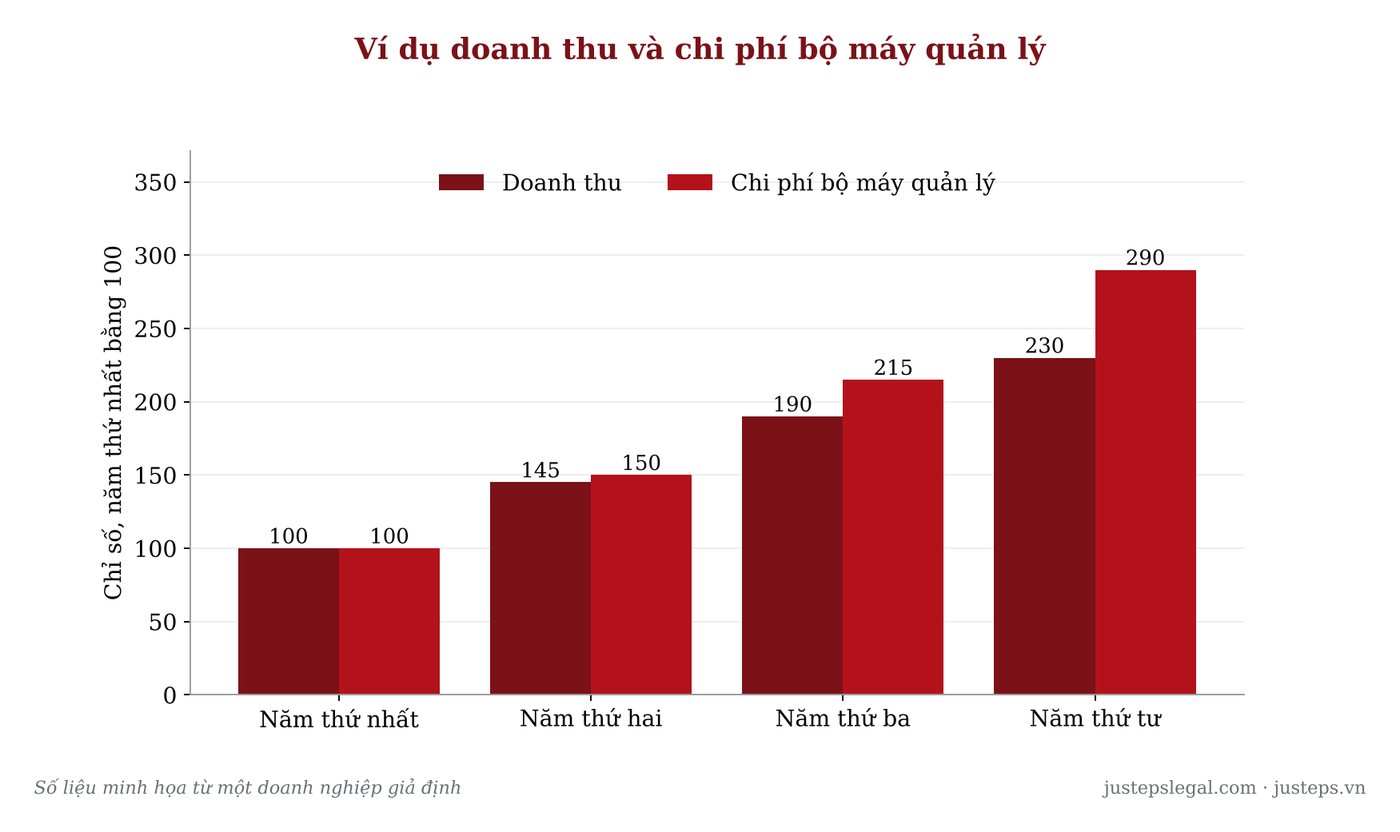
Example of the growth of revenue and management overhead costs over four years
In the example, taking the first year as a base of 100, revenue rises to 145, then 190 and 230 after three years, while management overhead costs rise to 150, 215 and 290. In the first two years the two indices move closely together, but from the third year management costs grow markedly faster, showing that the business is handling growth by adding managers instead of delegating authority and standardising processes. When this gap persists for two consecutive periods, management should look for the causes in the organisational structure before deciding to recruit more staff.
The four layers of a restructuring exercise and the order in which to address them
A complete restructuring exercise has four layers, each answering a different question. The organisational model layer determines whether the business is organised by function, by product, by region or by a combination, and how many levels of management it has. The delegation layer determines who may decide what, and up to which value. The process layer determines how work flows between departments, while the people layer determines who fills which position and what training they need.
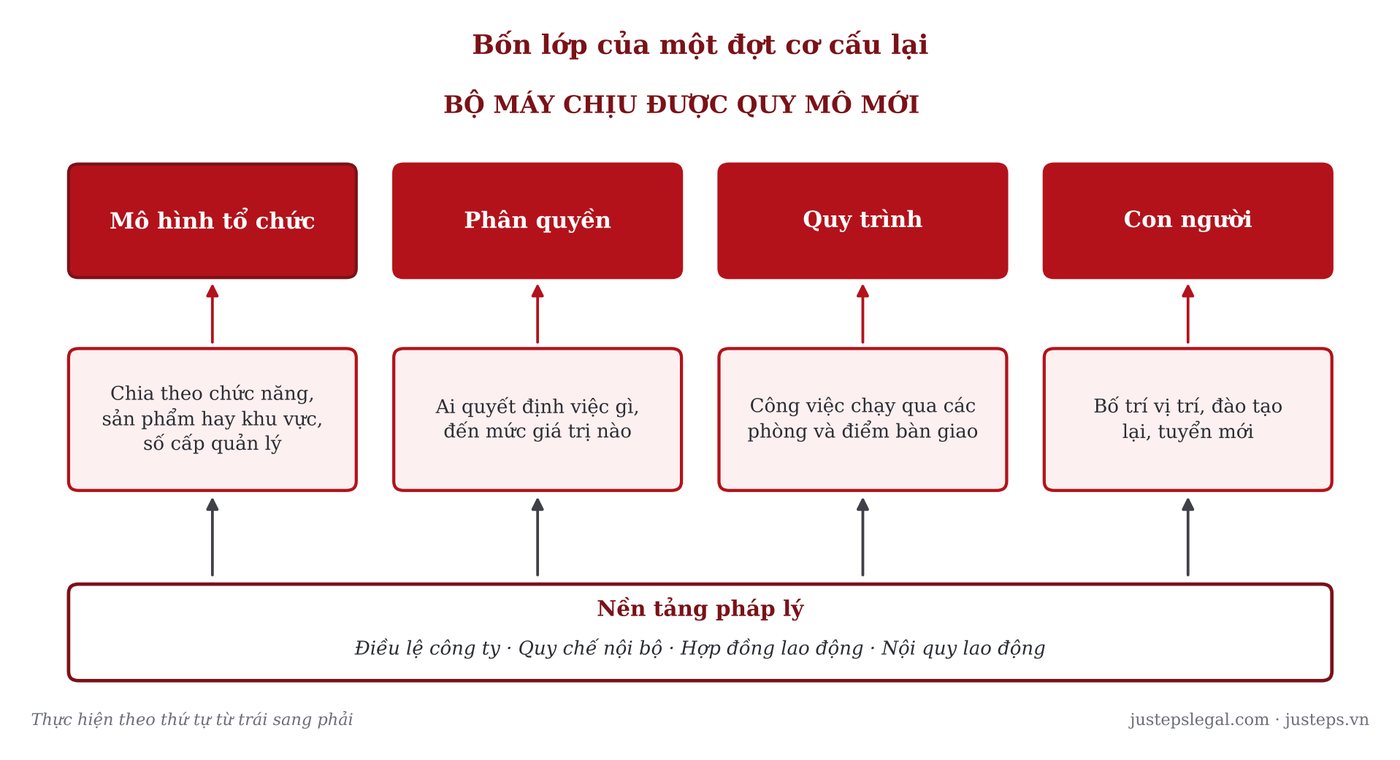
The four layers of a restructuring exercise and the legal foundation they require
The four layers should be addressed in order from model to people, because each layer depends on the one before it. If a business replaces a department head before redrawing the organisation chart and the delegation of authority, the newcomer is placed in a role that has not been clearly defined and meets exactly the same bottlenecks as the predecessor. All four layers rest on a common foundation of the company charter, internal regulations and employment contracts, so every change in the four layers must be checked to see whether the foundational documents also need amending.
A six-step sequence from diagnosis to measuring results
A restructuring exercise at a business of several hundred people usually takes three to six months, excluding the monitoring period after the new structure is issued. The roadmap below sets out the six steps over time and can be shortened for smaller businesses or extended where there are many branches.
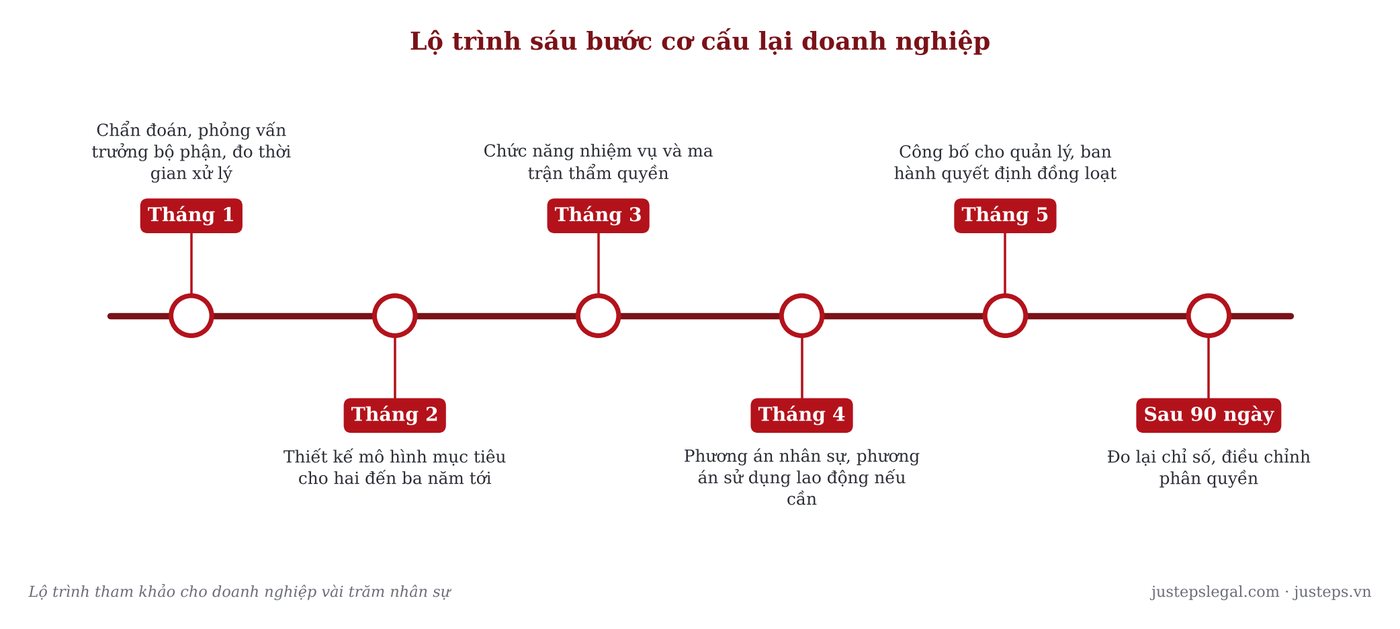
A six-step roadmap for restructuring a business over time
The diagnostic step involves interviewing heads of department, measuring the processing time of a few key processes such as order to cash, and counting the files awaiting approval. Based on the diagnosis, the project team designs a target model for the scale expected over the next two to three years, rather than only for the current scale, to avoid continual restructuring. The third step is to define the functions and duties of each department and an authority matrix with value-based approval thresholds, and the fourth step is to prepare the staffing plan. The final two steps are communication, issuing the decisions and re-measuring the indicators after about 90 days.
At the communication step, the business should brief its management team first, so that they can answer employees’ questions, and then issue all decisions together on a single day. Issuing decisions piecemeal over several weeks easily breeds rumours and causes good people to leave before they learn their new position. Each decision should be explained with a specific business reason, because these reasons also serve as the basis on which the business can prove that the structural change was genuine if a labour dispute later arises.
Delegation of authority and procedures under the Law on Enterprises
Delegation is the part most easily overlooked
Many businesses draw a new organisation chart and add departments but keep signing authority unchanged, so every document still lands on the director’s desk as before. Delegation needs to be set out in a regulation on delegation of authority, with specific value thresholds for each type of matter such as purchasing, discounts, recruitment and signing contracts, and in letters of authorisation for those who must sign with third parties. Once a business is large enough, the Law on Enterprises allows limited liability companies and joint stock companies to have more than one legal representative, with the number, titles, rights and obligations of each set out in the charter[1]. If the charter does not clearly divide their powers, each legal representative may represent the business in every transaction, so the business should amend its charter before adding a legal representative. Businesses may refer to Justeps’ financial regulations and delegation of authority service to design suitable approval thresholds.
Which changes require filings with state authorities
Most changes in a restructuring exercise are internal matters and do not need to be registered with state authorities. However, some changes concern the contents of the enterprise registration or the legal form of the business, and must therefore be filed within the statutory time limits[2]. The table below summarises the common cases:
| Type of change | Legal procedure | Practical notes |
|---|---|---|
| Creating, merging or splitting departments | No registration is required, only a decision by the person with authority under the charter. | Update the functions and duties, internal labour rules and related job descriptions. |
| Changing the legal representative | Register the change in enterprise registration contents within 10 days of the change. | Revoke previous authorisations and update signatories with banks and counterparties. |
| Changing a Director who is not the legal representative | No registration is required, but the appointment or dismissal decision must be made by the competent body. | Review the newcomer’s employment contract and delegated powers. |
| Opening a branch or representative office | Register its operation with the business registration authority where the branch or office is located. | Define the powers of the head of the branch by a letter of authorisation. |
| Division, split or conversion of company type | Follow the procedures for reorganising an enterprise under the Law on Enterprises. | Deal with the transfer of employment contracts, tax obligations and assets. |
When a business grows into a group of companies, dividing or splitting off a unit into a separate company, or converting a limited liability company into a joint stock company to raise capital, are all forms of enterprise reorganisation under the Law on Enterprises[3]. These forms entail the transfer of rights, obligations, contracts and employees, and should therefore be prepared as a separate project involving the finance and tax functions. When transferring employee and customer data between legal entities within the group, the business must also comply with personal data protection rules, including notifying data subjects and transferring only what is necessary[4].
Redeploying employees in compliance with the Labour Code
Most restructuring exercises during growth involve only adjustments to the model, delegation and staff transfers, without dismissing anyone. Even so, every change to an employee’s job, workplace or wages must go through a procedure proportionate to the extent of the change. The flowchart below helps the HR department identify the procedure for each person in the staffing plan.
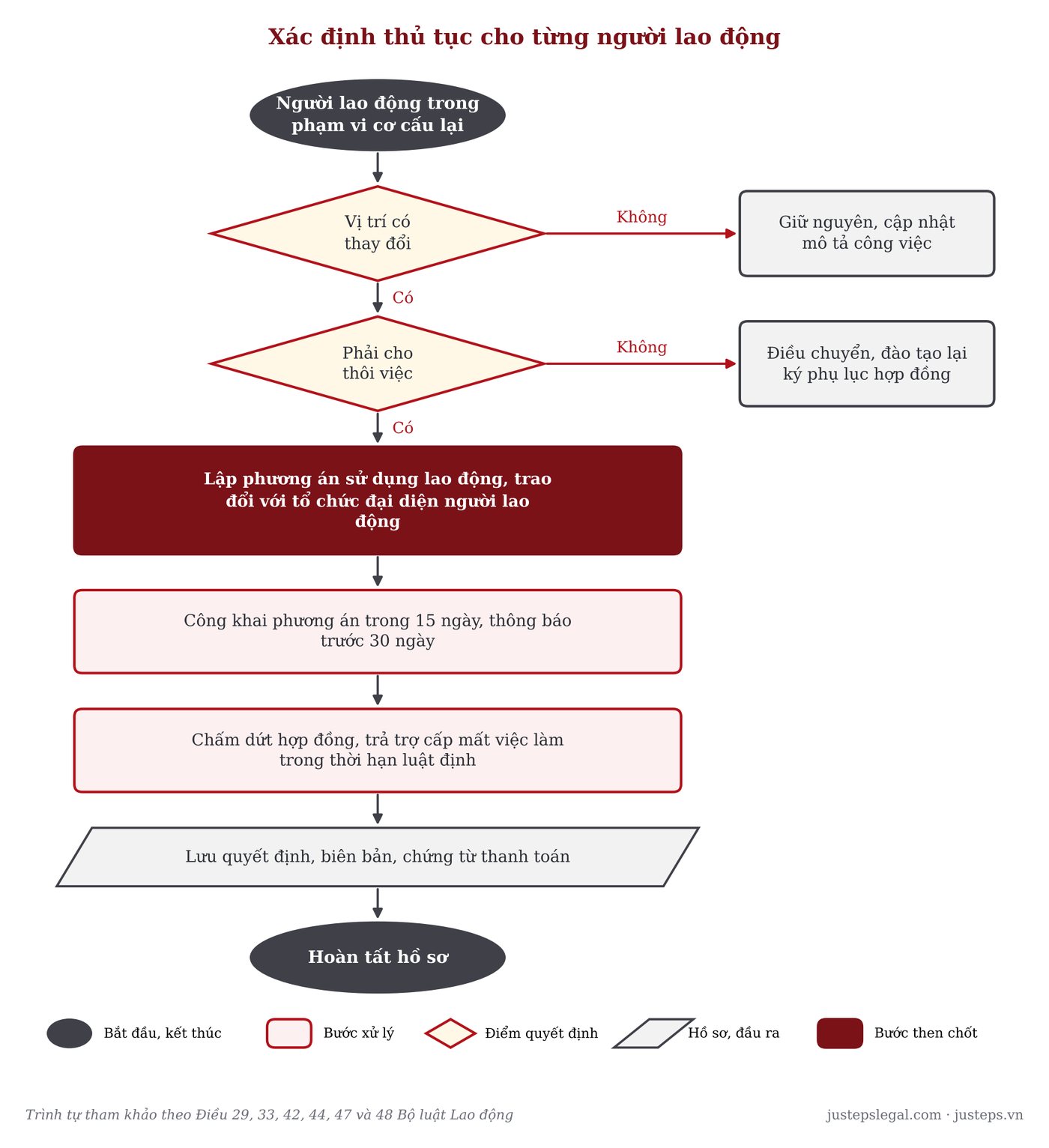
How to identify the procedure for each employee affected by restructuring
The first question is whether the employee’s position changes. If a suitable new position exists, the business should prioritise transfer or retraining and sign a contract annex where the job, wages or workplace change. If no suitable position remains and the jobs of many people are affected, the business must prepare a labour usage plan, consult the employees’ representative organisation and give 30 days’ notice before it may dismiss employees and pay job-loss allowance. Each branch of the flowchart ends with a file of records, comprising decisions, contract annexes or minutes, so that the business can prove that it followed the correct procedure.
Transfers and amendments to employment contracts
When assigning an employee to a new position on a long-term basis, the business must agree an amendment to the employment contract, and the party proposing the amendment must notify the other party at least 3 working days in advance of the content to be amended[5]. If the employee does not agree, the contract continues to be performed on its existing terms, so the business should explain the reasons for and the benefits of the new position rather than issuing a unilateral decision. A temporary transfer due to production or business needs may only be made in the circumstances set out in the internal labour rules, for no more than 60 cumulative working days in a year unless the employee agrees in writing, and the wage for the new job must be no less than 85% of the wage for the previous job[6]. Consequently, a temporary transfer cannot replace a contract amendment when the new position is long-term.
Labour usage plans and dismissal due to structural change
The Labour Code treats changes to the organisational structure and the reorganisation of labour as a case of structural change[7]. Where such a change affects the jobs of many employees, the business must prepare a labour usage plan covering matters such as the list of employees who will continue working, those to be retrained, those moving to part-time work, those whose contracts will be terminated, and the financial resources for implementation[8]. In preparing the plan, the business must consult the grassroots employees’ representative organisation, if any, and must publish the plan to employees within 15 days of its approval[8]. Dismissals affecting many employees may only proceed after consulting the employees’ representative organisation and giving 30 days’ notice to the provincial People’s Committee and the employees concerned[7].
Employees who have worked regularly for 12 months or more and lose their jobs due to structural change are entitled to a job-loss allowance of one month’s wages for each year of service, subject to a minimum of two months’ wages[9]. The period of service for calculating the allowance is the total actual working time less any period of unemployment insurance participation and any period for which an allowance has already been paid, and the wage used is the average wage of the six consecutive months before the job loss[9]. The business must settle all related amounts in full within 14 working days of the termination, and this period may be extended to no more than 30 days where the termination is due to structural change[10]. Eligible employees may receive unemployment benefits under the Law on Employment[11], so the business should guide them through the procedure and return their social insurance books on time.
Dismissing employees before preparing the plan, or without giving the full 30 days’ notice, may be treated as unlawful unilateral termination of the employment contract. In that case, the business may have to reinstate the employee, pay wages for the days the employee was unable to work and pay additional compensation under the Labour Code, as well as facing administrative penalties. For this reason, transfer and retraining are generally safer from a legal standpoint and, in many cases, less costly than dismissing employees and recruiting new ones. Businesses needing help to prepare a staffing plan may refer to Justeps’ organisational restructuring and workforce streamlining service.
Common mistakes and how to measure results after implementation
The most common mistake is designing around individuals, that is, creating a department or an extra management level to retain one person, so that the organisation chart swells while the bottleneck remains. The second mistake is announcing changes orally and transferring employees without a decision or contract annex, leading to disputes when wages or job titles change. The third mistake is forgetting to update the accompanying documents, such as the wage scales and pay tables built by position[12], the internal labour rules and the functions and duties of each department. Finally, many businesses treat the signing of decisions as the end of the project without re-measuring the results.
A business should choose three to five indicators linked directly to the original signs, such as the average number of days awaiting approval, the number of direct reports per manager, the number of recurring incidents and the ratio of management costs to revenue, and then re-measure them after about 90 days. If the indicators have not improved, the cause usually lies in the delegation layer, so the first step is to review the approval thresholds and letters of authorisation before considering changes of personnel. The file for a restructuring exercise should include the diagnostic report, the new organisation chart, the headcount plan, the issuing decisions, the authority matrix, the appointment and transfer decisions, the contract annexes, the labour usage plan where applicable and the monitoring dashboard.
How Justeps can help
Justeps helps fast-growing businesses restructure their organisation through the following services:
- Organisational restructuring and workforce streamlining. Justeps diagnoses the organisation, designs the target model and prepares a labour usage plan in compliance with the Labour Code.
- Business model and corporate structure advisory. Justeps assesses options for opening branches, spinning off companies or converting the company type as the business expands.
- Financial regulations and delegation of authority. Justeps builds the authority matrix, approval thresholds and letters of authorisation for the new structure.
- Wage scales, pay tables and remuneration policies. Justeps reviews wage scales, pay tables and bonus policies for the new positions after restructuring.
Frequently asked questions
Does restructuring a business necessarily mean dismissing employees?
The law does not require a business to dismiss employees when it restructures. Most restructuring exercises during growth involve only adjustments to the model, delegation and staff transfers, together with amendments to employment contracts where the job changes[5].
How often should a business restructure?
The law sets no fixed cycle. In Justeps’ experience, businesses growing by more than 30% a year usually need to adjust their organisation after about 18 to 24 months, while businesses with steady growth can conduct a review alongside their three- to five-year strategic plan.
Do changes to departments have to be registered with the business registration authority?
Creating, merging or splitting departments is an internal matter and does not need to be registered. A business only needs to file when it changes the contents of its enterprise registration, such as the legal representative, when it opens a branch or when it reorganises the enterprise[2].
May a business transfer an employee to another position without signing a contract annex?
A business may only make a temporary transfer in the circumstances set out in the internal labour rules and for no more than 60 cumulative working days in a year if the employee does not agree[6]. If the new position is long-term, the parties must agree an amendment to the contract, usually by way of an annex.
Whom must a business notify when dismissing employees due to structural change?
The business must consult the grassroots employees’ representative organisation, if any, and give 30 days’ notice to the provincial People’s Committee and the employees[7]. The labour usage plan must also be published within 15 days of its approval[8].
How is the job-loss allowance calculated?
Each year of service is paid at one month’s wages, subject to a minimum of two months’ wages, calculated on the average wage of the six consecutive months before the job loss[9]. Periods of unemployment insurance participation are not counted towards the period of service for the allowance.
Who should lead a restructuring project within the business?
The project should be led by a member of senior management with decision-making authority, working closely with the HR and finance functions. An external consultant can support an objective diagnosis and review the procedures, but the final decision rests with the person who holds authority under the charter.
Related articles
- Analysing bottlenecks when a business grows beyond 50 employees
- How to choose an organisation chart model that fits the size of a business and the way it generates revenue
- Lawful workforce reductions due to structural or technological change, the procedure and the documents required
- The powers of the General Director, delegation of executive authority and limits under the charter and internal regulations
Notes
[1] Article 12 of the Law on Enterprises No. 59/2020/QH14 dated 17 June 2020, as amended and supplemented by Law No. 03/2022/QH15 and Law No. 76/2025/QH15.
[2] Articles 30, 31 and 45 of the Law on Enterprises No. 59/2020/QH14; Decree No. 168/2025/ND-CP on enterprise registration, as amended by Decree No. 296/2026/ND-CP.
[3] Articles 198 to 202 of the Law on Enterprises No. 59/2020/QH14, as amended and supplemented by Law No. 76/2025/QH15.
[4] Law on Personal Data Protection No. 91/2025/QH15 and Decree No. 363/2026/ND-CP.
[5] Articles 22 and 33 of the Labour Code No. 45/2019/QH14 dated 20 November 2019.
[6] Article 29 of the Labour Code No. 45/2019/QH14.
[7] Article 42 of the Labour Code No. 45/2019/QH14.
[8] Article 44 of the Labour Code No. 45/2019/QH14.
[9] Article 47 of the Labour Code No. 45/2019/QH14.
[10] Clause 1 of Article 48 of the Labour Code No. 45/2019/QH14.
[11] Law on Employment No. 74/2025/QH15.
[12] Article 93 of the Labour Code No. 45/2019/QH14.
This article is for reference and reflects the regulations in force at the time of publication. Please consult Justeps for advice tailored to your company’s records and situation.
For further information, please contact:
📩 Email: info@justeps.vn
🌐 Website: https://justepslegal.com · https://justeps.vn
🌐 Page: Justeps
☎️ Hotline (Zalo): 096 172 2607
📍 Thanh Xuan Office: 12th Floor, Licogi 13 Tower, 164 Khuat Duy Tien Street, Thanh Xuan Ward, Hanoi, Vietnam
📍 Ha Dong Office: LK06B, No.10, Dong Dua Area, Ha Dong Ward, Hanoi, Vietnam
📍 Ho Chi Minh City Branch: 528 Le Van Sy, Ho Chi Minh City, Vietnam
📍 Hai Phong Office: Truong Thinh Village, Ha Dong Commune, Hai Phong, Vietnam
📍 Quang Ninh Office: Van Don Special Zone, Quang Ninh Province, Vietnam





