
Key takeaways
- A small or medium-sized enterprise does not need a dedicated risk management department, but it does need a written risk register that is updated every quarter.
- Each risk should be written as a single sentence stating its cause and consequence, scored on a common scale and assigned to only one principal owner.
- A response is only of value if it states clearly what must be done, who will do it, by when, and a measurable early warning indicator.
- Compliance risks relating to tax, labour, social insurance and personal data are often rated low because the business has never been inspected, even though the penalties in these areas have become heavier.
- The risk register should be linked to the delegation of authority regulations, the standard contract terms and the insurance policies so that responses are actually carried out.
In many small and medium-sized enterprises, risks are only discussed after an incident has already happened. A customer accounting for 40% of revenue suddenly extends its payment terms by a further 90 days, the only accountant resigns and nobody knows the password to the accounting software, or the warehouse lease expires right in the peak season. All of these situations could have been foreseen, but the information about them exists only in the memory of the owner or of a few heads of department. While the business has fewer than 20 people this may be just about sufficient, but once it grows to 30 or 50 people the information becomes scattered and nobody has the full picture.
This article explains how to organise lean risk management for small and medium-sized enterprises, covering the legal basis for risk control, how to identify and score risks, how to choose responses linked to contracts and insurance, the division of roles between levels, the records to be kept and common mistakes. It applies to limited liability companies and joint stock companies with roughly 20 to 200 staff that do not yet have an internal audit function or a dedicated risk management team. It is written mainly for directors, members of the Members’ Council or the Board of Directors, chief accountants and heads of department.
The legal basis and when risks should be managed in writing
Vietnamese law has no single instrument requiring every small business to keep a risk register, but many provisions impose obligations to control risk to varying degrees. The Law on Accounting provides that an accounting entity that is an enterprise shall establish an internal control system, and defines internal control as the internal organisation of mechanisms, policies and procedures to prevent, detect and promptly deal with risks[1]. Accordingly, identifying risks is the first step in knowing where controls need to be placed, and the risk register is the evidence that the business has carried out this step.
At the level of managers, the Law on Enterprises requires members of the Members’ Council, the Director and members of the Board of Directors to exercise their rights and perform their duties honestly, prudently and in the best manner to protect the maximum lawful interests of the company[2]. Where the business suffers a loss from a risk that showed clear warning signs which the managers failed to address, capital-contributing members or shareholders have grounds to question whether this duty of care was met. A risk register supported by minutes of periodic reviews helps managers show that they identified the risk, considered it and made an informed decision.
Certain sectors impose more specific risk assessment requirements. Production and business establishments must assess occupational safety and health hazards and risks and take measures to eliminate or reduce them[3], while personal data controllers and processors must apply protection measures appropriate to the level of risk of their processing activities[4]. Therefore, even without a general register, the business is already performing parts of risk management under sector-specific laws, and the general register is where those parts are brought together.
Signs that a business should start a register now
A business should move from managing risks from memory to a written register when any of the following signs appears:
- The business has three or more departments and heads of department have been authorised to approve payments or sign contracts within set limits.
- A single customer or supplier accounts for more than 25% of revenue or of the value of purchases.
- The business has suffered an incident and only realised afterwards that there had been warning signs which nobody was monitoring.
- The business is preparing to borrow, raise capital or be assessed by a major partner before being placed on its list of approved suppliers.
These thresholds are not legal requirements but practical experience, because they mark the point at which the Director can no longer see every transaction directly. Banks, investors and major customers increasingly ask which risks a business has identified and how it controls them, so having a register ready also shortens the time needed to answer due diligence questionnaires.
A five-step risk management process
Risk management in a small business should be organised as a simple cycle repeated every quarter, rather than a one-off project that is completed and then filed away. The cycle consists of five consecutive steps, and the results of each review become the input for the next round of identification.
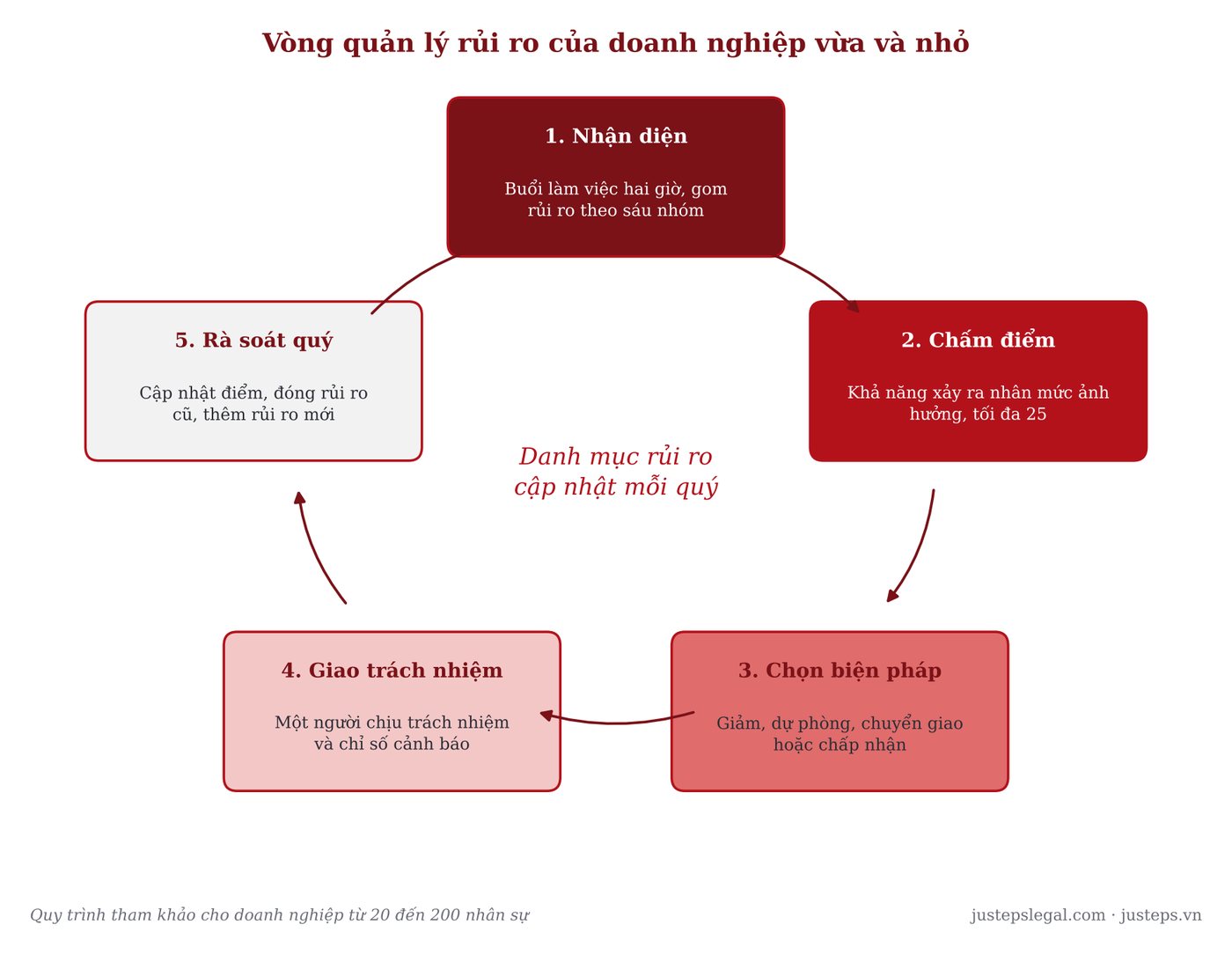
The five steps of the risk management cycle repeated every quarter
The cycle begins with identifying risks by group, then scoring their likelihood and impact to rank them, and then choosing responses for the priority risks. The fourth step is assigning each risk to an owner together with an early warning indicator, and the final step is a quarterly review meeting to update scores, close risks that have been dealt with and add new ones. The business does not need to carry out all five steps in great detail from the start, but can begin with the 8 to 12 largest risks and expand gradually over the following quarters.
Identifying risks across six groups
The most effective way to identify risks is to hold a working session of about two hours between the Director and the heads of department, in which each person is asked to name events that could cause the business to lose money, lose customers or be penalised over the next 12 months. To avoid omissions, the risks are grouped into six categories, namely revenue, cash flow, supply chain, personnel, legal compliance and data. In practice, the compliance and data groups are usually raised least often because sales and operations heads have little contact with these rules, so the chief accountant or the person responsible for legal matters should be invited to take part.
Each risk must be written as one sentence stating its cause and consequence, for example customer A paying more than 60 days late leaves the business short of cash to pay wages and taxes in the peak month. General descriptions such as financial risk or personnel risk do not tell anyone what to do and cannot be scored consistently. Some compliance risks commonly found in small businesses are payments of VND 5 million or more made in cash, which are therefore not treated as deductible expenses for corporate income tax purposes[5], and social insurance contributions paid on less than the salary actually paid, which may be treated as evasion and require back payment together with interest[6].
Scoring and ranking risks on a common scale
Once the list is complete, each risk is scored for likelihood and impact on a scale from 1 to 5, and the risk score is the product of the two, with a maximum of 25. For the scoring to be meaningful, all departments must use one common scale defined in numerical terms and approved by the Director before scoring begins. Without a common scale, the head of sales may regard an overdue debt of VND 200 million as minor while the chief accountant regards it as serious, and the ranking will reflect the personalities of those scoring rather than the actual level of risk.
The table below suggests how to define three typical levels on the impact scale and the likelihood scale, and the business should adjust the figures to suit its own size:
| Score | Impact | Likelihood |
|---|---|---|
| Score 5 | A loss of more than 10% of annual profit, a stoppage of more than one week, criminal liability or suspension of operations. | It has occurred in the past 12 months or is almost certain to occur in the coming year. |
| Score 3 | A loss of 2% to 5% of annual profit, an administrative penalty or the loss of a medium-sized customer. | It has occurred at businesses in the same sector or may occur about once every two to three years. |
| Score 1 | An insignificant loss that the department can deal with within the day using its existing resources. | It has never occurred and is unlikely to occur unless business conditions change significantly. |
On the basis of the scores, the business divides risks into three treatment zones. Risks scoring 15 or more must have a response and an owner within the quarter, risks scoring 8 to 14 are reviewed every quarter, and risks scoring below 8 only need to be monitored and revisited once a year. The threshold of 15 means that a risk is only given priority when it has both a significant likelihood and a major impact, which prevents resources from being concentrated on rare risks that merely sound alarming.
The chart below illustrates the scoring results at an equipment distribution company with about 60 staff, with risks scoring 15 or more shown in a darker colour.
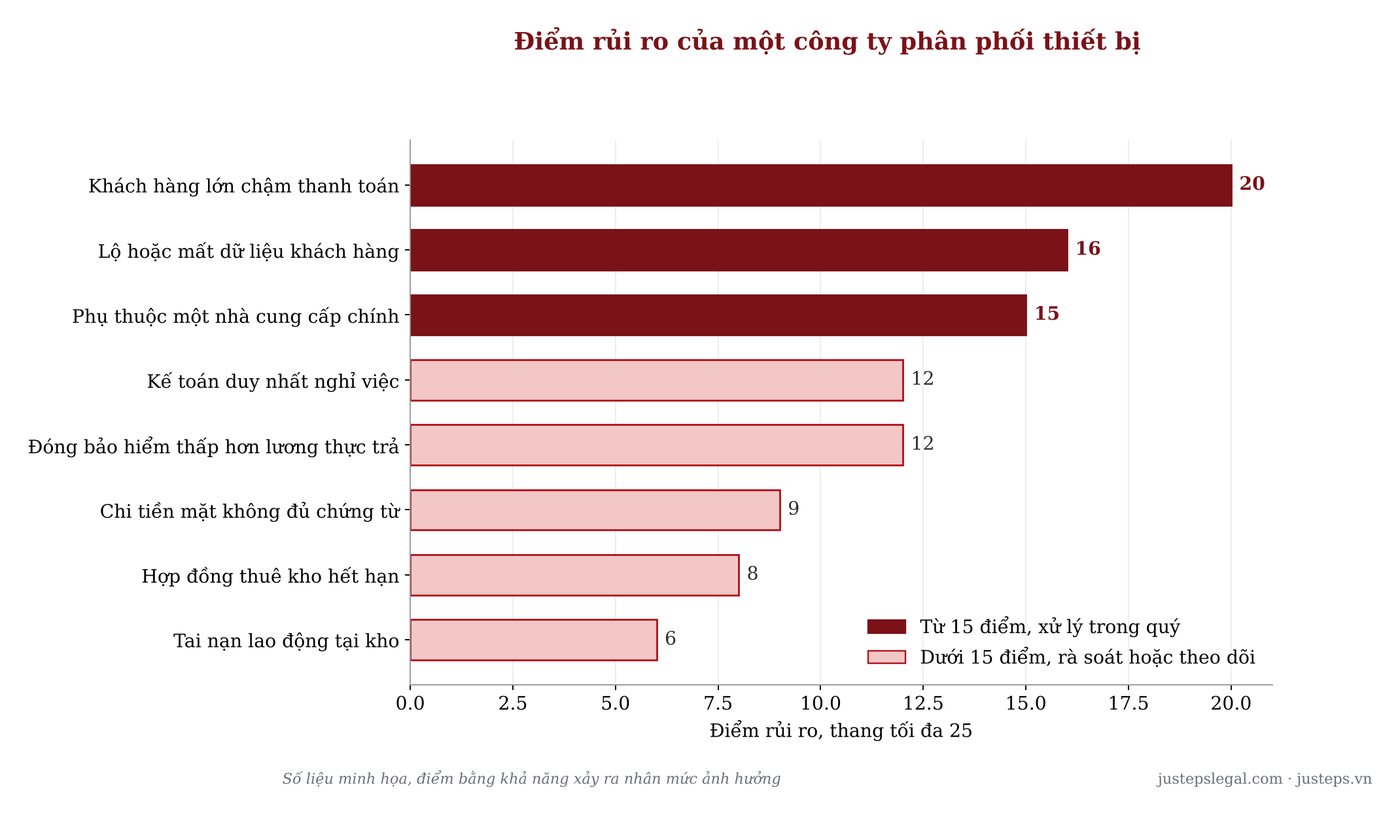
Risk scores of an equipment distribution company with about 60 staff
The risk of a major customer paying late ranks first with 20 points, because it is highly likely in the distribution sector and directly affects the ability to pay wages and taxes. The risk of losing customer data and the risk of depending on one main supplier also exceed the 15-point threshold, so all three must have a response plan within the quarter. Risks such as the only accountant resigning or cash payments without adequate supporting documents fall in the middle zone, are assigned to someone to monitor and are revisited at the quarterly meeting. The scoring results also show that compliance risks are not at the bottom of the list, as many directors still assume.
Choosing responses and transferring risk through contracts and insurance
For each priority risk, the business has four possible responses, namely reducing the likelihood through procedures and controls, reducing the impact through contingency plans, transferring part of the loss to another party through a contract or insurance, and accepting the risk where the cost of treatment exceeds the expected loss. A risk may be treated in several ways at once; for a major customer paying late, for example, the business may set a credit limit, require a payment guarantee and arrange a standby short-term loan facility. The essential condition is that each response states clearly what must be done, who will do it and by when, rather than general phrases such as strengthening monitoring.
Transferring risk through contract terms
Contracts are the cheapest tool for transferring risk, but they are often overlooked because small businesses tend to sign on their counterparty’s standard form. In commercial relationships, the parties may agree on penalties for breach, but the total penalty for multiple breaches may not exceed 8% of the value of the breached part of the contractual obligation, except in certain cases where the law provides otherwise[7]. In addition to the penalty, the aggrieved party may claim compensation for actual damage if it can prove the damage and the causal link, so the business’s standard contracts should state clearly that both remedies may be claimed at the same time.
For risks arising from objective events such as natural disasters, epidemics or changes in policy, the Civil Code contains provisions on force majeure events and on the performance of contracts upon a fundamental change of circumstances[8]. However, these provisions only apply when strict conditions are met, so the business should define in the contract itself which events are treated as force majeure, the obligation to give notice within a specific period and a price adjustment mechanism when input costs fluctuate beyond a set threshold. The risk register provides the basis for deciding which terms should be included in the standard contract and which terms must not be conceded during negotiations.
Transferring risk through insurance
Insurance is suited to risks with a low likelihood but a large potential loss, such as fire or explosion at a warehouse, damage to goods in transit or liability towards third parties. Some types of insurance are compulsory under sector-specific laws, for example compulsory fire and explosion insurance for establishments within the prescribed categories, while others are left to the business to consider under the law on insurance business[9]. When buying insurance, the business should compare the scope of cover and the exclusions with the description of the risk in the register, because in many cases it only discovers that the actual risk falls outside the cover when it submits a claim.
Businesses that want an independent assessment of the legal risks in their contracts, labour practices and compliance may consider the legal risk due diligence and assessment service of Justeps.
Division of roles and the reporting mechanism when a risk exceeds its threshold
The most important principle in dividing roles is that each risk has only one principal owner, usually the head of the department where the risk arises, even when several departments take part in dealing with it. The owner carries out the response, updates its status before each quarterly meeting and reports immediately when the early warning indicator exceeds its threshold. Assigning a risk to a whole department or to two people jointly is the surest way to ensure that nobody takes responsibility when an incident occurs.
Alongside the owners, the business needs a coordinator, usually the chief accountant or the Director’s assistant, who keeps the latest version of the register, sends reminders about the review schedule and compiles reports. The coordinator should not also own too many risks, so as to preserve their role as an independent cross-check. The Director approves the register and allocates resources, while the Members’ Council or the Board of Directors decides the acceptable level of risk for matters within its authority, such as large loans, guarantees or new investments.
The reporting mechanism for when an early warning indicator exceeds its threshold should be set out in advance, so that the person who detects it knows whom to report to and within what time.
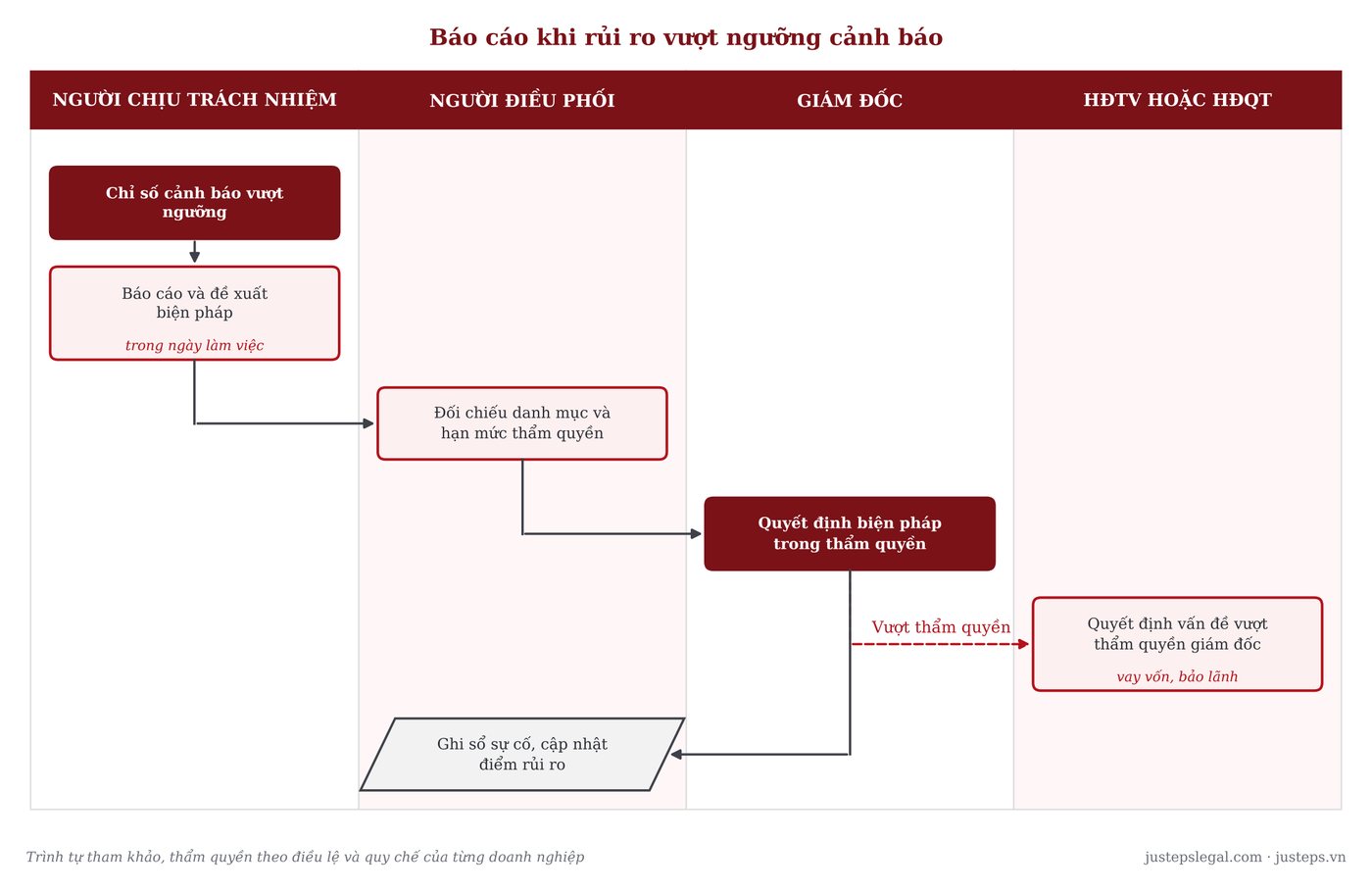
The reporting and response sequence when a risk’s early warning indicator exceeds its threshold
When an early warning indicator exceeds its threshold, for example when overdue receivables exceed 15% of total receivables, the owner reports to the coordinator within the working day and proposes a response. The coordinator checks the register to determine whether the response falls within the head of department’s limits or requires a decision by the Director. If the response exceeds the Director’s authority, for example where additional borrowing or legal action against a major customer is needed, the Director submits the matter to the Members’ Council or the Board of Directors. After the matter has been dealt with, the coordinator records it in the incident log and updates the risk score for the next quarterly meeting.
A risk register only works when it is linked to the delegation of authority regulations, because many responses, such as stopping deliveries to a customer with overdue debts or refusing a cash payment, require a person with decision-making power and a rule to rely on. The business should review its financial regulations, approval limits and reconciliation procedures at the same time as it builds the register, which can be done through the internal financial control system service of Justeps.
Records, the review schedule and common mistakes
Risk management in a small business does not require specialist software, but it does require a minimum set of records kept at the head office together with other internal regulations and decisions under the business’s document retention regime[10]. The following table gives three example rows from the risk register of the distribution company mentioned above, showing the level of detail required:
| Risk | Response and owner | Early warning indicator |
|---|---|---|
| A major customer pays late | Set a credit limit and stop deliveries when debts are 30 days overdue; the head of sales is the owner. | Overdue receivables exceed 15% of total receivables. |
| The only accountant resigns | Keep passwords in a sealed envelope and sign a standby accounting services contract in advance; the Director is the owner. | The accountant submits a resignation or is absent for more than three consecutive days. |
| Cash payments without adequate documents | The accountant refuses cash payments of VND 5 million or more; the chief accountant is the owner. | A cash payment voucher of VND 5 million or more appears during the month. |
In addition to the register, the set of records should include the following documents, so that if the coordinator changes, the new person can continue the work:
- A likelihood and impact scoring scale approved by the Director and applied uniformly across all departments.
- Minutes of each quarterly review meeting recording the risks added and closed and the decisions on resources.
- An incident log recording the actual loss, the cause and the lessons learned.
- A one-page contingency plan for the three highest risks, setting out what must be done in the first 24 hours and who the contact persons are.
The most common mistake is making the register too long, sometimes with 50 or 60 risks, so that none of them is dealt with properly. The second mistake is rating compliance risks low simply because the business has never been inspected, even though penalties for labour and social insurance violations under Decree 283/2026/ND-CP[11] and sanctions relating to personal data have increased considerably. The third mistake is updating the register only according to the schedule and not when events occur, such as the loss of a key customer, a change of managers or a new legal requirement. The Law amending and supplementing the Labour Code, passed on 21 November 2026, taking effect on 1 March 2027 and adding two fully paid days off[12], is an example of a change that should be brought to the next review meeting to assess its impact on personnel costs and production plans.
A reasonable review schedule for a small or medium-sized enterprise is a meeting of about 90 minutes each quarter, in which each owner reports on the status of their risks in a few minutes and the meeting discusses in depth only those risks whose scores have changed or which have exceeded their thresholds. Once a year, the Director should hold a fresh identification session from scratch rather than merely updating the old register, because the business and legal environment changes faster than the business adjusts on its own. The results of the annual review are also a good input for preparing the budget and business plan for the following year.
How Justeps can help
Justeps helps small and medium-sized enterprises build and maintain a lean, compliant risk management system through the following services:
- Legal risk due diligence and assessment. Justeps runs the risk identification session with the management team, scores the risks and independently assesses risks relating to contracts, labour, tax and data.
- Internal financial control system. Justeps designs control points linked to the priority risks, including credit limits, the payment approval procedure and periodic reconciliations.
- Financial regulations and delegation of authority. Justeps drafts the delegation of authority regulations so that risk owners have sufficient authority to carry out the responses.
- Contract term review and risk control. Justeps reviews standard contracts and counterparties’ contracts so that risk is transferred through penalty, compensation and force majeure terms.
- Legal risk management training for company leadership. Justeps trains the leadership team and heads of department to identify, score and report risks according to a common standard.
Frequently asked questions
Does a business with 20 staff need a risk register?
The business should have a short register of the 5 to 8 largest risks, because a single incident involving cash flow or key personnel can bring a small business to a standstill. A short register still needs a scoring scale, named owners and a review schedule, just as in a larger business.
How often should the risk register be reviewed?
The business should review it every quarter and hold a fresh identification session from scratch every year. Outside the regular schedule, the register should be updated immediately upon the loss of a key customer, a change of managers or a new legal requirement affecting operations.
Who should own a risk that involves several departments?
The business should still assign one principal owner, usually from the department that suffers the loss directly or the department with the best tools to deal with it. The other departments are named as supporting parties and must provide information when asked.
Can risk management replace internal control?
Risk management does not replace internal control but helps determine where controls need to be placed. The actual control tools remain the procedures, delegation of authority, reconciliations and segregation of duties that the Law on Accounting requires businesses to establish[1].
May a business agree on high contractual penalties to limit its risk?
In commercial contracts, the total penalty for breach may not exceed 8% of the value of the breached part of the obligation, unless the law provides otherwise[7]. The business should combine penalties with the right to claim compensation for damage and with security measures such as deposits and payment guarantees.
Should personal data risks be included in the register?
A business that processes the data of customers or employees should include this risk in the register, because the law requires protection measures proportionate to the level of risk of the processing activities[4]. Typical risks are data leaks through chat groups, departing employees taking customer lists with them and sending data to third parties without an agreement in place.
Should a business engage an outside provider to prepare its risk register?
An outside provider is well suited to running the first identification session, building the scoring scale and independently assessing legal risks that internal staff are less familiar with. Quarterly monitoring and review must still be carried out by people within the business, because they are the first to see the early warning indicators.
Related articles
- The risks of an owner-director signing every transaction personally and how to delegate authority to keep control
- Which indicators a monthly management report needs and how a business should organise its preparation
- An annual periodic legal review covering 12 areas that companies should check themselves
- Building internal financial regulations for a limited liability company, from approval authority to advances and their settlement
Notes
[1] Article 39 of the Law on Accounting No. 88/2015/QH13 dated 20 November 2015.
[2] Articles 71 and 165 of the Law on Enterprises No. 59/2020/QH14 dated 17 June 2020, as amended and supplemented by Law No. 76/2025/QH15.
[3] Article 77 of the Law on Occupational Safety and Health No. 84/2015/QH13 dated 25 June 2015.
[4] The Law on Personal Data Protection No. 91/2025/QH15 and Decree No. 363/2026/ND-CP detailing its implementation.
[5] Article 9 of Government Decree No. 320/2025/ND-CP dated 15 December 2025 detailing the Law on Corporate Income Tax No. 67/2025/QH15.
[6] The Law on Social Insurance No. 41/2024/QH15 dated 29 June 2024, provisions on late payment and evasion of compulsory social insurance contributions.
[7] Article 301 of the Commercial Law No. 36/2005/QH11 dated 14 June 2005.
[8] Clause 1 of Article 156, Clause 2 of Article 351 and Article 420 of the Civil Code No. 91/2015/QH13 dated 24 November 2015.
[9] The Law on Insurance Business No. 08/2022/QH15 dated 16 June 2022.
[10] Article 11 of the Law on Enterprises No. 59/2020/QH14.
[11] Decree No. 283/2026/ND-CP on administrative penalties in the fields of labour and social insurance, effective from 10 September 2026.
[12] The Law amending and supplementing a number of articles of the Labour Code, passed by the National Assembly on 21 November 2026 and taking effect on 1 March 2027.
This article is for reference and reflects the regulations in force at the time of publication. Please consult Justeps for advice tailored to your company’s records and situation.
For further information, please contact:
📩 Email: info@justeps.vn
🌐 Website: https://justepslegal.com · https://justeps.vn
🌐 Page: Justeps
☎️ Hotline (Zalo): 096 172 2607
📍 Thanh Xuan Office: 12th Floor, Licogi 13 Tower, 164 Khuat Duy Tien Street, Thanh Xuan Ward, Hanoi, Vietnam
📍 Ha Dong Office: LK06B, No.10, Dong Dua Area, Ha Dong Ward, Hanoi, Vietnam
📍 Ho Chi Minh City Branch: 528 Le Van Sy, Ho Chi Minh City, Vietnam
📍 Hai Phong Office: Truong Thinh Village, Ha Dong Commune, Hai Phong, Vietnam
📍 Quang Ninh Office: Van Don Special Zone, Quang Ninh Province, Vietnam





