
Key takeaways
- The law allows the owner of a single-member limited liability company to act as director and sign every transaction personally, but once the volume of documents exceeds what one person can review, the signature becomes a mere formality and the owner becomes the business’s bottleneck.
- An individual owner must keep their own assets and spending separate from those of the company; withdrawing capital in breach of the rules may make the owner jointly liable for the company’s debts[5].
- Transactions between the company and its owner or the owner’s related persons must be recorded and kept as separate records, even where the owner is the person signing[8].
- The lasting way to reduce risk is to draw up an authority matrix by value threshold, issue letters of authorisation with a fixed term, separate the roles of proposing, checking and approving, and shift the owner’s role from signing individual documents to reading reports.
In many single-member limited liability companies and family businesses, the owner is at the same time the director, the legal representative and the holder of the bank account, and personally signs every contract, payment request and payment voucher. This gives the owner peace of mind, because no money leaves the company without their knowledge. However, once the company has several dozen staff and hundreds of documents a month, this very concentration slows down operations, causes the company’s assets and the owner’s personal assets to become mixed, and removes almost every mechanism of cross-checking.
This article analyses the legal basis of the owner-director model, five groups of risk that arise when one person signs every transaction, how to quantify the cost of the centralised model and a roadmap for delegating authority to reduce risk. It is written mainly for the owners of single-member limited liability companies owned by individuals, and is also relevant to limited liability companies with two or more members and to family joint stock companies in which major shareholders run the business directly. Chief accountants and those in charge of finance may also use the article to propose changes to the business owner.
The owner-director model from a legal perspective
In principle, a single-member limited liability company owned by an individual has a Company Chairperson and a Director or General Director, with the owner acting as Company Chairperson and being able either to hold the post of Director concurrently or to hire someone else as Director[1]. Nor does the law require the company to delegate signing authority to anyone else. The Law on Accounting, which prohibits managers, executives and relatives of the legal representative from working as accountants in the same entity, makes an exception for private enterprises and limited liability companies owned by one individual[2]. Accordingly, a model in which one person owns the business, runs it and controls its cash flow is lawful.
Owners usually want to sign everything themselves because they wish to control every item of expenditure, have no one sufficiently trustworthy, have no delegation rules yet, or have previously had staff abuse signing authority. While the company has fewer than about 15 staff and a few dozen documents a month, this model is reasonable because the owner can still read each document before signing. Problems arise only when the workload exceeds what one person can review, at which point the signature is no longer the result of a check but merely a procedural step, while all the risk is still concentrated on one person.
In limited liability companies with two or more members and in joint stock companies, the risk is even greater because those running the business are accountable to the other members or shareholders. Contracts and transactions between the company and its members, managers or their related persons must be approved by the Members’ Council, the Board of Directors or the General Meeting of Shareholders in accordance with the statutory procedure[3], so one person signing every transaction can easily lead to this approval step being skipped.
Operational bottlenecks and dependence on one person
The most obvious risk is that the speed of the whole company depends on the director’s diary. When the director is busy meeting customers, travelling on business or ill, documents awaiting signature pile up, suppliers are not paid on time, the company loses early payment discounts and its reputation with partners gradually declines. Staff also lose the habit of taking responsibility, because everything ultimately waits for the director’s decision.
This dependence also has legal consequences. The business must ensure that it always has at least one legal representative residing in Vietnam, and where there is only one legal representative, that person must authorise another individual residing in Vietnam in writing to exercise their rights and perform their obligations while they are abroad[4]. Many owners overlook this requirement, so during their absence no one has authority to sign contracts, receive documents or deal with state authorities. The situation is even more serious if the owner falls seriously ill or suffers a sudden incident, because banks, partners and the tax authority deal only with a person holding valid authority. The business can reduce this risk by amending the charter to provide for an additional legal representative, or by preparing a standing letter of authorisation with a clearly defined scope and term.
Mixing company assets with personal assets
When the owner both proposes and approves expenditure, the boundary between the company’s money and personal money tends to blur. Items such as family car fuel, holidays and personal shopping are paid from the company account, and at times the owner uses personal funds to pay the company’s debts without any supporting documents. The Law on Enterprises requires the owner to identify and separate their own assets from those of the company, and an individual owner must separate the spending of the individual and their family from spending in the capacity of Company Chairperson or Director[5].
The consequences of mixing assets are far more serious than accounts that are hard to reconcile. The owner may withdraw capital only by transferring part or all of the charter capital, and if contributed capital is withdrawn in any other form, the owner and the organisations and individuals involved must be jointly liable for the company’s debts and other property obligations; the owner also may not withdraw profits while the company has not paid all its debts that have fallen due[5]. In this way, the advantage of the limited liability company model, namely liability limited to the charter capital[6], may be partly lost at precisely the moment the owner needs it most, when the company is in financial difficulty.
As regards tax, expenditure for personal purposes is not incurred for the business’s operations and is therefore disallowed when corporate income tax is finalised. In addition, invoiced expenditure of VND 5 million or more without non-cash payment documents is not treated as a deductible expense[7]. When the director pays out cash personally, the accountant finds it very hard to refuse, and the consequences come to light only when the company undergoes a tax inspection or the auditor proposes adjustments.
Related-party transactions and the lack of cross-checking
One group of risks that is often overlooked concerns transactions between the company and its owner, the owner’s relatives or other businesses in which the owner has invested. The Law on Enterprises requires contracts and transactions between a single-member limited liability company owned by an individual and its owner or the owner’s related persons to be recorded and kept as separate records of the company[8]. When the person who benefits is the person signing, these records are rarely kept, transaction prices are not compared with market prices and the documents are insufficient to justify the position when the tax authority examines related-party transactions or when the company becomes insolvent.
More broadly, one person proposing, approving and checking runs counter to the basic principle of internal control. The Law on Accounting defines internal control as establishing and organising the implementation of internal mechanisms, policies and procedures to ensure that assets are safe and not misused and that transactions are approved and fully recorded[9]. Without a second person involved, errors by the owner, input errors by the accountant or fraud by staff taking advantage of the director signing in bulk all go undetected. Businesses wishing to redesign their control mechanisms may consider Justeps’ service on internal financial control systems.
Quantifying the cost of centralised signing authority
The cost of the centralised model does not usually appear in the financial statements and is therefore easily underestimated. Consider a hypothetical company with 30 staff, revenue of about VND 4 billion a month, purchases of about VND 1.5 billion a month and around 250 documents requiring signature. If each document takes an average of 4 minutes to read and sign, the director spends about 16.7 hours a month, or about 200 hours a year, on signing alone, compared with about 4.5 hours a month if they sign only items above the threshold.
Suppose suppliers offer a 1% discount for early payment. When documents wait for signature, only about 60% of invoice value qualifies for the discount in time, so the company misses out on about VND 72 million a year, compared with about VND 18 million when authority is delegated and 90% of invoices qualify. If about VND 8 million of personal spending is mixed into company expenses each month, a total of VND 96 million a year will be disallowed on finalisation, and at the 17% rate applicable to businesses with annual revenue of no more than VND 50 billion[10], the company must pay about VND 16.32 million in additional tax, before late payment interest and penalties if this is discovered on inspection.
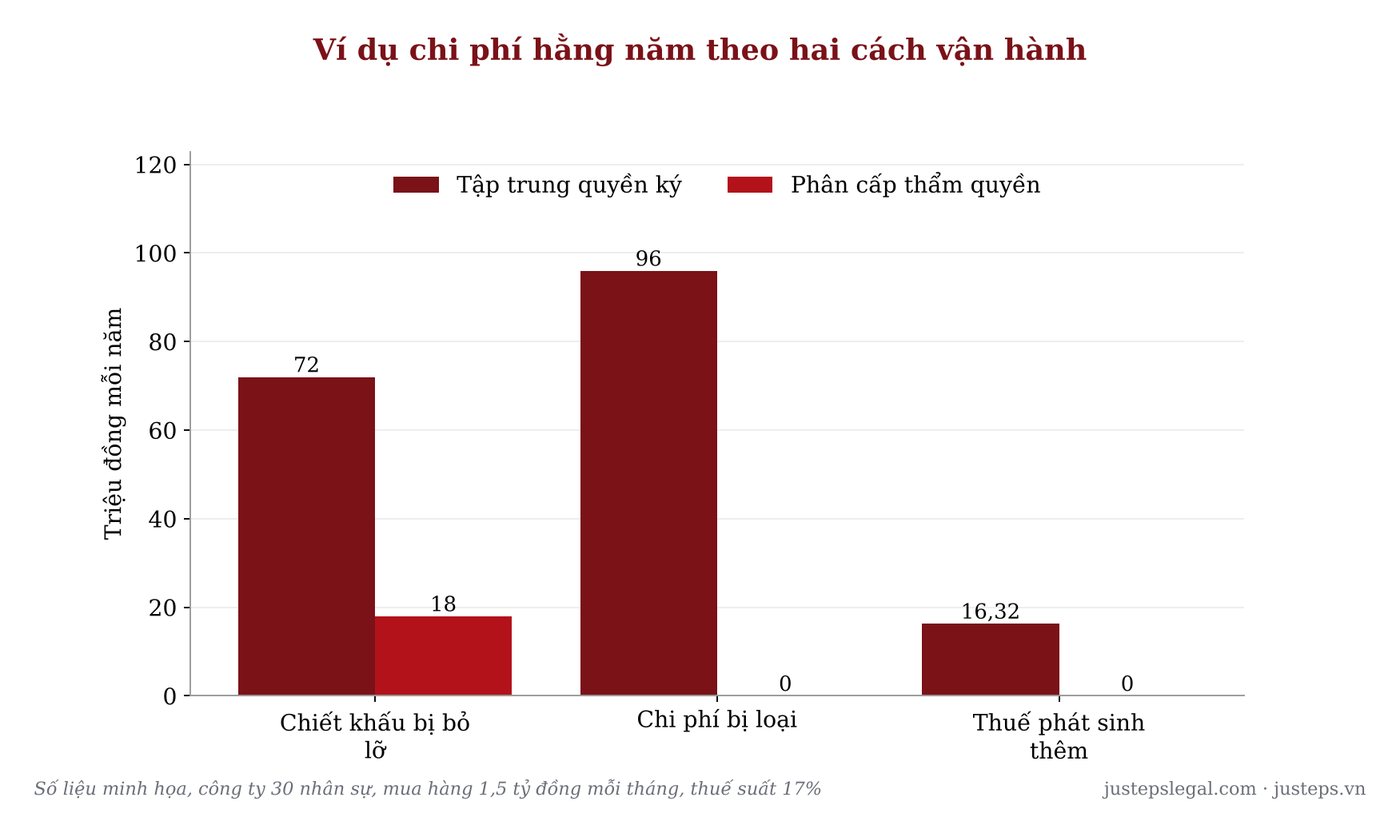
Example of the annual cost of centralised signing authority compared with delegated authority
The chart compares three costs measurable in money under the two ways of operating. Under the centralised model, the largest item is personal expenditure disallowed on finalisation, followed by missed discounts and additional tax, while under the delegated model missed discounts fall to about VND 18 million and disallowed expenses and additional tax all but disappear because personal spending has been separated from the company account. The largest cost does not appear on the chart at all, namely the roughly 200 hours a year the director does not spend on major customers, negotiations and recruiting key people. Businesses should replace the assumptions in the example with their own actual figures in order to decide whether delegation is needed.
A roadmap for delegating authority to reduce risk
A business should start delegating when any of the following signs appear: more than about 100 documents a month, an average wait for signature of more than two days, the opening of a branch, warehouse or shop elsewhere, frequent long business trips by the director, capable middle managers who have not yet been given authority, or a bank or investor requiring governance and financial rules. Delegation does not cause the owner to lose control, because the owner moves from signing individual documents to designing rules and monitoring results. The transition should be divided into short phases, as in the indicative roadmap below.
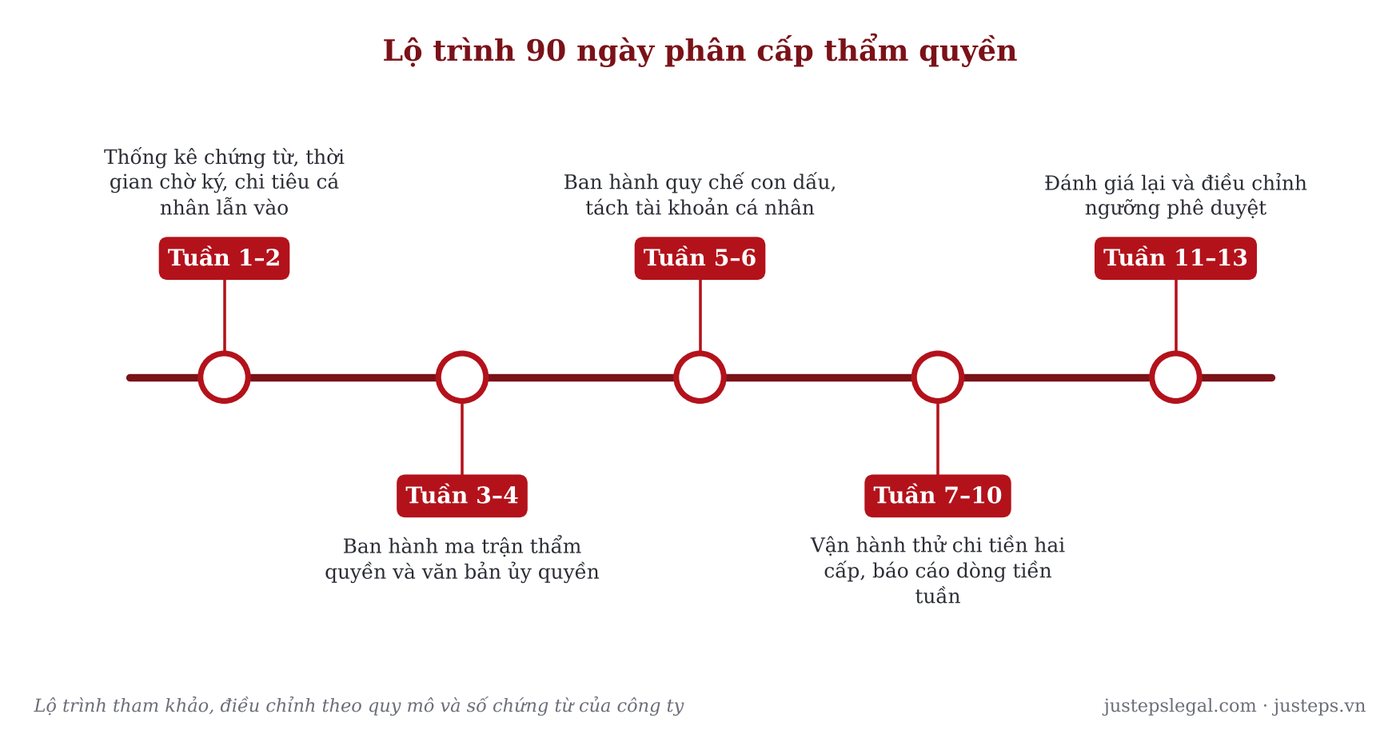
Indicative 90-day roadmap for moving from signing every transaction personally to delegated authority
The first two weeks are spent compiling statistics on documents, waiting times for signature and expenditure mixed with personal spending, as these data form the basis for setting reasonable thresholds. From the third to the sixth week, the business issues the authority matrix, the letters of authorisation and the seal management rules and separates personal accounts from company accounts. The next phase pilots the two-level payment procedure and weekly cash flow reporting, and by the end of the third month the owner and the chief accountant review the results and adjust the thresholds.
Drawing up an authority matrix by type and value of transaction
The first step is to determine who may decide which types of transaction, and up to what amount. The owner should retain decision-making power over matters with long-term effects, such as borrowing, guarantees, the purchase or sale of high-value fixed assets, transactions with related persons and the recruitment of managers, while routine expenditure within the budget is delegated to subordinates. The table below is an example of an authority matrix for a company with around 30 to 50 staff:
| Type of transaction | Approver | Accompanying conditions |
|---|---|---|
| Routine expenditure below VND 20 million | Chief accountant or the head of the department concerned. | The expenditure is within the approved budget and fully documented. |
| Expenditure from VND 20 million to VND 200 million | Deputy director or a person holding a standing authorisation. | A request from the department and confirmation of the budget by the accountant. |
| Expenditure above VND 200 million | The owner-director. | Accompanied by comparative quotations or a reviewed contract. |
| Loans, guarantees and fixed assets | The owner, with no delegation. | A financing plan and an assessment of the effect on cash flow. |
| Transactions with related persons | The owner, with the opinion of the chief accountant. | Entered in a separate register with a comparison against market prices. |
Written authorisation and separating the roles of proposing, checking and approving
An authority matrix takes effect only when it is reflected in valid letters of authorisation. The legal representative may authorise another person to enter into and perform transactions in the name of the company, but the authorised person may act only within the scope of the authorisation, and a transaction exceeding that scope does not create obligations for the company in respect of the excess unless the company consents[11]. The business should distinguish between standing authorisations with a fixed term and value limits and one-off authorisations used for a business trip or a specific contract. Rules on the management and use of the company seal should be issued at the same time, because the Law on Enterprises leaves this matter to the charter or the company’s internal rules[12].
At the same time, each item of expenditure should involve at least two people, namely the person proposing it and the person approving it, with the accountant acting as an independent checker before payment. In online banking, the business should set up a two-level mechanism in which one person creates a payment order and another approves it, and make every payment of VND 5 million or more by bank transfer. The procedure below illustrates how an item of expenditure passes through these roles.
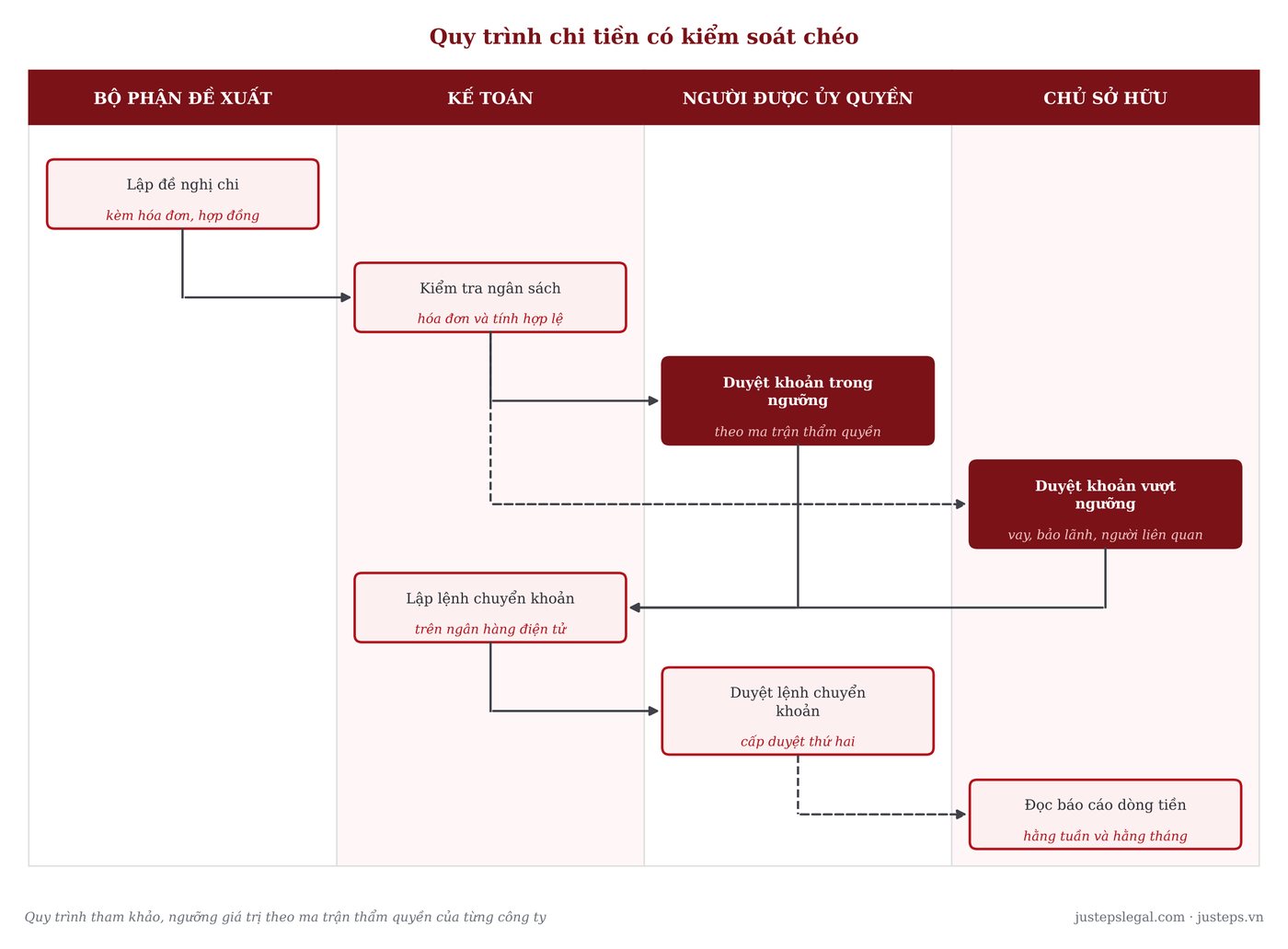
Payment procedure with cross-checking between the requesting department, the accountant, the authorised person and the owner
Under this procedure, the department with the need prepares a payment request with supporting documents, and the accountant checks the budget, the invoice and its validity before passing it to the person with authority according to the value threshold. Once it is approved, the accountant creates the transfer order and the authorised person approves the order in online banking, so no single person both decides on a payment and transfers the money. The owner is directly involved only in items above the threshold, and otherwise receives a weekly cash flow report and a monthly report on receivables, payables and large items of expenditure, exercising control by exception.
Separating accounts and keeping a register of related-party transactions
The owner should use a separate personal account for their own and their family’s spending and receive income from the company through clear channels, such as a salary under a contract, profits distributed after the company has paid all debts that have fallen due, or a loan under a contract with an interest rate. Every transaction between the company and the owner’s relatives or related businesses should be covered by a contract, compared with market prices and entered in a separate register. To develop a consistent authority matrix, letters of authorisation and financial regulations, businesses may consider Justeps’ service on financial regulations and delegation of authority.
Certain mistakes commonly render delegation ineffective, such as giving authorisation orally, transferring money on the strength of a text message from the director, handing the company seal to an employee without any rules, or delegating on paper while the director still intervenes in every delegated item. The minimum set of documents comprises the delegation rules and authority matrix, standing and one-off letters of authorisation, the seal management rules, the financial regulations with the payment approval procedure, and a register of transactions with the owner and related persons. After three to six months of operation, the business should measure again the waiting time for signature, the rate at which discounts are obtained and the number of disallowed expenses on finalisation in order to adjust the thresholds accordingly.
How Justeps can help
Justeps helps owner-directors delegate authority and control finances through the following services:
- Financial regulations and delegation of authority. Justeps develops an authority matrix, letters of authorisation and financial regulations consistent with the company’s charter.
- Internal financial control systems. Justeps designs a procedure for requesting, checking, approving and paying with cross-checking between the different roles.
- Review of deductible expenses and corporate income tax finalisation. Justeps reviews expenditure mixed with personal spending and the payment documents before the finalisation period.
- Succession planning and transfer of management. Justeps prepares a plan to reduce dependence on the owner and to prepare a successor to run the business.
Frequently asked questions
May the owner of a single-member limited liability company also act as director?
Yes. An individual owner is at the same time the Company Chairperson and may either hold the post of Director concurrently or hire someone else as Director[1].
What must an owner-director do before travelling abroad?
If the company has only one legal representative, that person must authorise another individual residing in Vietnam in writing to exercise their rights and perform their obligations while they are abroad[4]. The letter of authorisation should state clearly the scope, the value limit and the term.
May the owner’s relatives work as the company’s accountant?
The Law on Accounting prohibits relatives of the legal representative from working as accountants in the same entity, but makes an exception for private enterprises and limited liability companies owned by one individual[2]. Even though it is lawful, this arrangement reduces the independence of the checking function.
May the owner use company money for personal spending and repay it later?
The owner must separate personal spending from the company’s spending and may withdraw capital only in the ways permitted by law[5]. If company money needs to be used, the safe approach is to enter into a loan agreement with an interest rate, a term and complete supporting documents.
What records are needed for transactions between the company and another company owned by the owner’s relatives?
Such transactions must be recorded and kept as separate records of the company[8]. The business should attach the contract, quotations compared with market prices and bank transfer payment documents.
Is an oral authorisation to sign valid?
In internal management, an oral authorisation is almost impossible to prove in terms of scope and term if a dispute arises. The authorised person may act only within the scope of the authorisation[11], so the business should issue a letter of authorisation stating these matters clearly.
Related articles
- The authority of the General Director and how to delegate executive powers within the limits of the charter and internal rules
- Building internal financial regulations for a limited liability company, from approval authority to advances and their settlement
- How far the legal liability of directors, members of the Board of Directors and chief accountants extends within a company
- Management bottlenecks when a business grows beyond 50 staff and a six-month roadmap for resolving them
Notes
[1] Article 85 of the Law on Enterprises No. 59/2020/QH14.
[2] Clauses 3 and 4 of Article 52 of the Law on Accounting No. 88/2015/QH13 dated 20 November 2015.
[3] Articles 67 and 167 of the Law on Enterprises No. 59/2020/QH14.
[4] Article 12 of the Law on Enterprises No. 59/2020/QH14.
[5] Clauses 3, 5 and 6 of Article 77 of the Law on Enterprises No. 59/2020/QH14 dated 17 June 2020, as amended and supplemented by Law No. 76/2025/QH15.
[6] Clause 1 of Article 74 of the Law on Enterprises No. 59/2020/QH14.
[7] Government Decree No. 320/2025/ND-CP detailing the implementation of the Law on Corporate Income Tax, on non-cash payment documents for expenditure of VND 5 million or more.
[8] Clause 6 of Article 86 of the Law on Enterprises No. 59/2020/QH14.
[9] Clauses 1 and 2 of Article 39 of the Law on Accounting No. 88/2015/QH13.
[10] Clause 3 of Article 10 of the Law on Corporate Income Tax No. 67/2025/QH15.
[11] Articles 138, 141 and 143 of the Civil Code No. 91/2015/QH13 dated 24 November 2015.
[12] Article 43 of the Law on Enterprises No. 59/2020/QH14.
This article is for reference and reflects the regulations in force at the time of publication. Please consult Justeps for advice tailored to your company’s records and situation.
For further information, please contact:
📩 Email: info@justeps.vn
🌐 Website: https://justepslegal.com · https://justeps.vn
🌐 Page: Justeps
☎️ Hotline (Zalo): 096 172 2607
📍 Thanh Xuan Office: 12th Floor, Licogi 13 Tower, 164 Khuat Duy Tien Street, Thanh Xuan Ward, Hanoi, Vietnam
📍 Ha Dong Office: LK06B, No.10, Dong Dua Area, Ha Dong Ward, Hanoi, Vietnam
📍 Ho Chi Minh City Branch: 528 Le Van Sy, Ho Chi Minh City, Vietnam
📍 Hai Phong Office: Truong Thinh Village, Ha Dong Commune, Hai Phong, Vietnam
📍 Quang Ninh Office: Van Don Special Zone, Quang Ninh Province, Vietnam





