Many companies selling on e-commerce platforms look at the amount the platform pays out and treat it as revenue. Only at tax finalisation do they find that declared revenue is below the selling price, invoices do not match order counts and thousands of returned orders lack adjustment documents.
From 1 July 2026, the Law on E-commerce No. 122/2025/QH15 and the Law on Tax Administration No. 108/2025/QH15 both took effect, and platform transaction data is increasingly connected to the authorities. This article covers four operational tasks that companies and household businesses selling on platforms must get right: invoices, tax, returns and complaint handling.
Selling on e-commerce platforms, who bears which obligations
Two groups of sellers must be distinguished. Companies selling on platforms declare and pay tax themselves as for ordinary sales; the platform is just a sales channel and a service provider (fixed fees, commission, payment fees, advertising). For household businesses and individuals selling on platforms with a payment function, the platform withholds and pays tax on their behalf under tax administration law, but the household or individual remains responsible for the accuracy of registered information and for obligations on off-platform revenue.
Under the 2025 Law on E-commerce, sellers must be identified on the platform and provide truthful product information. The shop profile (company name, tax code, address, licences for conditional goods) should therefore be checked once by legal or accounting and updated whenever the enterprise registration changes.
Invoices, every successful order needs a document
Selling companies must issue e-invoices under Decree No. 123/2020/ND-CP (as amended by Decree No. 70/2025/ND-CP)[3], even where the buyer is an individual who does not request an invoice. A common approach is to connect the invoicing software to the order management system so that the invoice is issued when an order is marked delivered; the specific method should be checked against current rules on the timing of sales invoices.
The invoice price is the price charged to the customer after discounts borne by the seller. Platform-funded vouchers do not reduce the seller's revenue because the platform reimburses them. Conversely, fixed fees, commission and payment fees are the seller's expenses, recorded on the basis of the platform's invoices, and may not be netted off against revenue. This is the most common error causing revenue to be under-declared.
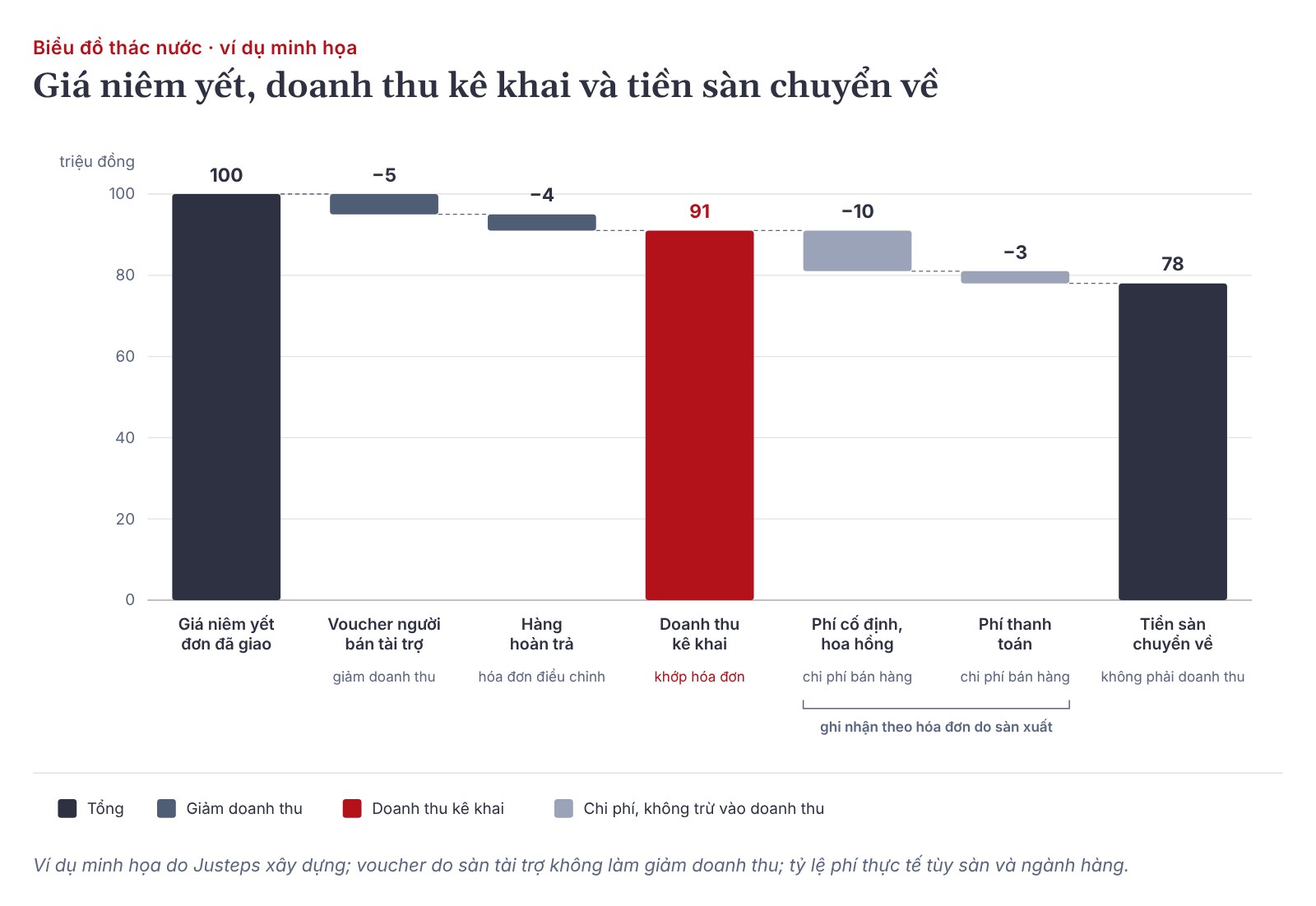
Figure 01. Waterfall chart from VND 100 million list price to declared revenue and the platform payout
Illustrative example prepared by Justeps; actual fees vary by platform and product category
Only seller-funded vouchers and returns reduce revenue (red bar, VND 91 million); platform and payment fees (light grey bars) are expenses booked on the platform's invoices, so the VND 78 million payout is not revenue.
Monthly reconciliation and tax filing
Accounting should close a reconciliation for each platform every month using three sources: the order report, the platform payout report and issued invoice data. Every difference must be explained before the VAT return is filed.
| Item | Data source | Treatment | Responsible |
|---|---|---|---|
| Sales revenue | Report of delivered orders | Revenue at selling price, matching issued invoices | Sales accountant |
| Vouchers, promotions | Platform promotion report | Separate seller-funded and platform-funded portions | Accountant and marketing lead |
| Platform and payment fees | Service invoices issued by the platform | Selling expenses, input VAT deductible if eligible | Payables accountant |
| Returns, cancellations | Return report | Adjustment or replacement invoice, goods back to stock | Accountant and warehouse |
| Platform payouts | Bank statements | Collection of receivables from the platform | Treasury accountant |
On incentives, companies with annual revenue not exceeding VND 10 billion are entitled to a 30% reduction of CIT payable for the 2026 and 2027 tax periods; resident individuals and household businesses with annual revenue not exceeding VND 10 billion are entitled to a 30% reduction of PIT on business income (under Articles 2 and 3 of Decree No. 398/2026/ND-CP). Revenue for the threshold includes both on- and off-platform sales, so accurate reconciliation is a precondition for applying the reduction correctly. From the 2027 tax period, the Law amending and supplementing certain articles of the Law on CIT, the Law on Non-agricultural Land Use Tax and the Law on PIT raises the revenue threshold for choosing the tax calculation method from VND 3 billion to VND 10 billion.
Return policy, publish clearly, apply consistently
The Law on Consumer Rights Protection No. 19/2023/QH15 requires sellers to provide complete and truthful information and honour their commitments to consumers; in distance transactions, consumers are entitled to know the return conditions before ordering. Companies should have a single return policy across all channels, stating the period, conditions for returnable goods, who pays shipping, refund timelines and items excluded for hygiene or safety reasons.
The policy on each platform must not fall below the platform's minimum policy and must not conflict with the policy on the company's website. When the policy changes, record the effective date and keep the old version to handle orders placed before the change.
Complaint handling, response times and approval limits
Customer service should have a written procedure with response times for each type of complaint and refund approval limits: staff approve up to a set amount, team leads approve higher amounts, and suspected fraud or product safety cases go to management and legal. Every complaint should be logged with the order code, cause and outcome for periodic analysis.
Customer data obtained through platforms may only be used for delivery, customer care and complaint handling, under the Law on Personal Data Protection No. 91/2025/QH15. Exporting customer lists from a platform to send marketing through other channels is a risk under both platform terms and personal data law.
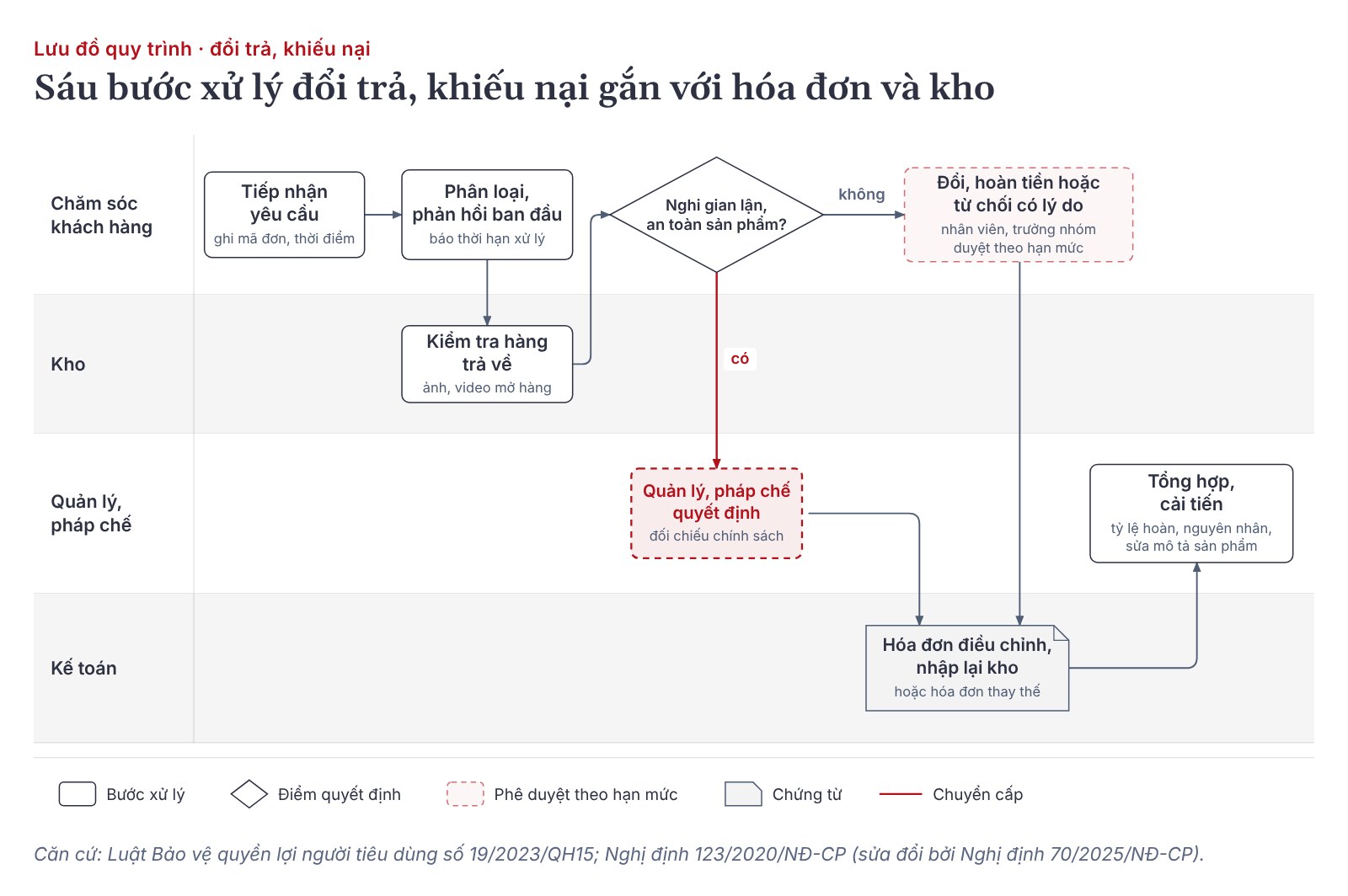
Figure 02. Flowchart of the six steps for returns and complaints, linked to invoice and inventory adjustments
Basis: Law on Consumer Rights Protection No. 19/2023/QH15; Decree 123/2020/ND-CP (amended by Decree 70/2025/ND-CP)
Dashed boxes are approvals within authority limits; the red arrow shows suspected fraud or product safety cases escalated to management and legal. Every branch ends with accounting adjusting the invoice and inventory.
Legal basis and sources
- Law on E-commerce No. 122/2025/QH15, effective 1 July 2026.
- Law on Tax Administration No. 108/2025/QH15, effective 1 July 2026; Decree No. 252/2026/ND-CP.
- Decree No. 123/2020/ND-CP on invoices and documents, as amended by Decree No. 70/2025/ND-CP.
- Decree No. 398/2026/ND-CP on PIT and CIT reductions, effective 29 October 2026, applicable to the 2026 and 2027 tax periods.
- Law amending and supplementing certain articles of the Law on CIT, the Law on Non-agricultural Land Use Tax and the Law on PIT, passed 20 November 2026, effective 1 January 2027.
- Law on Consumer Rights Protection No. 19/2023/QH15.
- Law on Personal Data Protection No. 91/2025/QH15, effective 1 January 2026.
How Justeps supports businesses
- Reviewing invoice and tax obligations and the application of tax reductions for platform sellers through Tax, Customs & International Trade.
- Setting up reconciliation, returns and complaint procedures with approval limits through Operations setup.
- Drafting return policies, terms of sale and personal data policies through Advisory and regulatory compliance.
- Advising on channel expansion and entity structure as revenue grows through Business growth.
Contact Justeps for advice tailored to your business.
Frequently asked questions
Is declared revenue the platform payout or the selling price?
It is the selling price after seller-borne discounts. Platform and payment fees are separate expenses recorded on the platform's invoices.
Must an invoice be issued if an individual customer does not ask for one?
Yes. Selling companies must issue e-invoices under Decree No. 123/2020/ND-CP as amended, even if the buyer does not request one.
If the platform has withheld tax for a household business, does it still need to file?
Revenue on platforms with a payment function is withheld and paid by the platform. Off-platform revenue or revenue on channels without withholding must still be self-declared.
How are invoices handled for returned goods?
Issue an adjustment or replacement invoice under invoice rules and return goods to stock, matching the platform's return report.
Can a company selling on platforms get the 30% CIT reduction?
Yes, if total annual revenue, on and off platforms, does not exceed VND 10 billion, under Article 3 of Decree No. 398/2026/ND-CP.
Related articles
- Export garment manufacturers: preparing for buyers' labour compliance audits
- Converting an agricultural processing cooperative into an enterprise: choosing the model and restructuring
- Running a private preschool in Vietnam: HR, child safety and operating records
This article is for reference and reflects the regulations in force at the time of publication. Please consult Justeps for advice tailored to your company’s records and situation.
For further information, please contact:
📩 Email: info@justeps.vn
🌐 Website: https://justepslegal.com · https://justeps.vn
🌐 Page: Justeps
☎️ Hotline (Zalo): 096 172 2607
📍 Thanh Xuan Office: 12th Floor, Licogi 13 Tower, 164 Khuat Duy Tien Street, Thanh Xuan Ward, Hanoi, Vietnam
📍 Ha Dong Office: LK06B, No.10, Dong Dua Area, Ha Dong Ward, Hanoi, Vietnam
📍 Ho Chi Minh City Branch: 528 Le Van Sy, Ho Chi Minh City, Vietnam
📍 Hai Phong Office: Truong Thinh Village, Ha Dong Commune, Hai Phong, Vietnam
📍 Quang Ninh Office: Van Don Special Zone, Quang Ninh Province, Vietnam