
Key takeaways
- A joint stock company is the more suitable form where the founders plan to raise capital and reserve shares for employees, because a limited liability company may not issue shares.
- Vietnamese law has no specific regime under which founders earn their shares gradually over their period of service; a founder vesting mechanism must be built through a shareholders’ agreement, the charter and a right to buy back shares when someone leaves.
- Source code written by a founder before the company is established continues to belong to the individual author until it is assigned or contributed to the company as capital in writing.
- Every employee, contractor and outsourcing provider involved in writing code should have a contract making clear that the economic rights in the source code belong to the company.
- Records of capital contributions, the register of shareholders and the chain of title to the source code should be completed within the first year, before investors begin due diligence.
Most technology start-ups are incorporated once the product already has a prototype, the founding team has worked together for many months and several engineers have been promised a share of the equity by word of mouth. These verbal arrangements usually reveal their problems only when a founder leaves the team, when an investor asks to conduct due diligence, or when the company needs to prove that it owns the software it is exploiting. Correcting the capital structure and ownership records at that stage costs far more than getting them right at incorporation.
This article analyses the legal decisions to be made when setting up a technology start-up company in Vietnam, including choosing the type of company, dividing capital among the founders, building a share programme for employees and ensuring that the company owns its source code. It is written mainly for the founding team, the chief financial officer and the head of HR of software companies, digital platforms and technology solution providers that are at the stage before or just after their first funding round.
Choosing a type of company that fits the fundraising plan
The two forms usually considered are the limited liability company and the joint stock company. A limited liability company with two or more members has a lean structure, but it may not issue shares except for the purpose of converting into a joint stock company, and any transfer of a capital contribution must first be offered to the remaining members[1]. A joint stock company has its charter capital divided into shares, may issue several classes of shares and may offer shares to employees or new investors[2]. Accordingly, if the founding team already plans to raise capital or reserve an ownership stake for employees within the next one to two years, a joint stock company is usually the sensible choice from the outset.
Some founding teams choose to place a parent company abroad to facilitate international fundraising, with the Vietnamese company operating as a foreign-invested subsidiary. This structure entails outward investment procedures for founders who are Vietnamese citizens, inward investment procedures under the Law on Investment No. 143/2025/QH15 and the question of which company is recorded as owning the source code[3]. The founding team should decide on the structure before most of the code is written and before employment contracts are signed, because transferring intellectual property between entities later may give rise to tax obligations and transfer procedures.
Designing the founders’ capital structure
Charter capital, contributed assets and the contribution deadline
The charter capital of a technology company need not be large, but it must accurately reflect the cash and assets the founders actually contribute. Shareholders must pay in full for the shares they have subscribed for within 90 days from the date on which the enterprise registration certificate is issued[4]. After that period, any unpaid shares cease to belong to the subscriber and the company must register an adjustment to its charter capital, so founders should not register capital above their ability to contribute merely to create an impression.
Founders may contribute capital in cash, in intellectual property rights or in technology, but only a person who is the lawful owner of the asset or holds the lawful right to use it may use that asset as a capital contribution[5]. Non-cash assets must be valued by consensus among the founding shareholders or by a valuation organisation, and if an asset is valued above its actual value, the founding shareholders must jointly contribute the difference and are jointly liable for any resulting loss. For a technical founder wishing to contribute capital in the form of code already written, the prudent approach is to value it at a level that can be justified, prepare valuation minutes and a clear instrument of transfer, rather than recording a large figure that is hard to explain during investor due diligence.
Preferential voting shares and transfer restrictions
The Law on Enterprises allows founding shareholders to hold preferential voting shares, but this preference is effective only for three years from the date on which the company is issued its enterprise registration certificate, after which the shares automatically convert into ordinary shares[6]. Because of this short period, preferential voting shares are rarely an effective tool for protecting long-term control. Founders usually achieve that objective more effectively through the charter and the shareholders’ agreement, for example by setting higher voting thresholds for certain key matters or by granting the right to nominate members of the board of directors.
During the first three years, founding shareholders’ ordinary shares may be freely transferred to other founding shareholders, but may be transferred to other persons only with the approval of the general meeting of shareholders[7]. Outside this period, the charter may still impose restrictions on the transfer of shares, provided those restrictions are clearly stated on the share certificates. These rules help keep the founding team stable, but they do not by themselves resolve the situation where a founder leaves early while keeping all of their shares.
Founder vesting mechanisms
Vietnamese law has no specific regime under which founders earn their shares gradually over their period of service (vesting). An equivalent mechanism is built through the shareholders’ agreement, under which each founder’s shares are divided into a vested portion and an unvested portion according to a schedule, typically four years with no shares vesting during the first year. If a founder leaves the company before the end of that period, the remaining shareholders or the company have the right to buy back the unvested portion at a pre-agreed price. Where the company is the buyer, the transaction must comply with conditions on authority, limits on the number of shares and solvency after the buy-back[8], so agreements usually give priority to the remaining shareholders’ purchase right.
The shareholders’ agreement should also distinguish between a founder who leaves for good reason, such as illness or being released by the company through no fault of their own, and one who leaves in breach of their obligations or to work for a competitor, and apply different buy-back prices. For this provision to be effective in practice, the charter must contain corresponding transfer restrictions and the shareholder records must accurately reflect the agreement. Companies may refer to Justeps’ shareholders’ agreement and founder capital contribution services to prepare a shareholders’ agreement and charter that are consistent with each other.
To show how these tools fit together, the chart below illustrates the ownership structure of a hypothetical technology company immediately after incorporation, where the founders have already reserved a portion for employees.
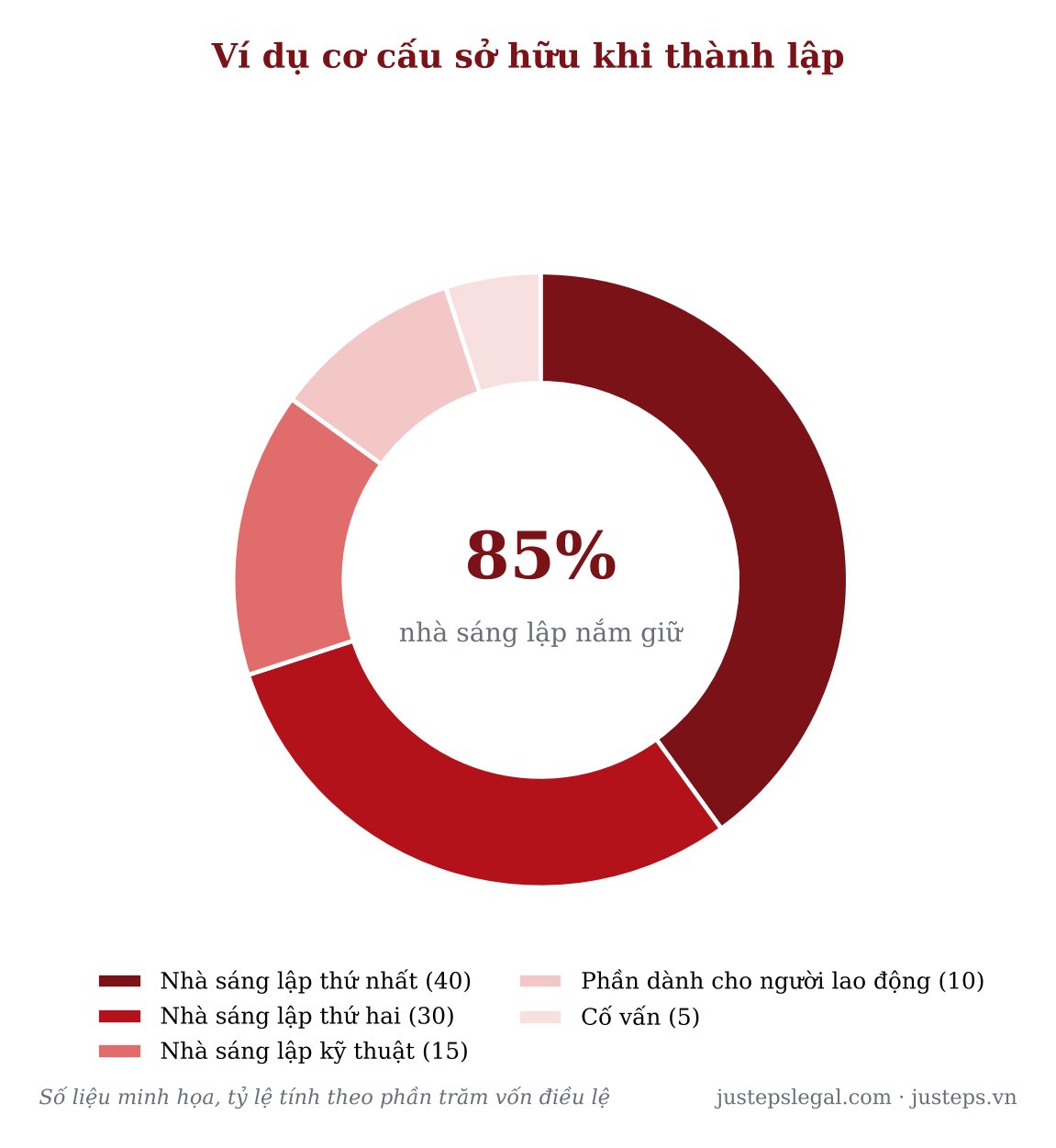
Example ownership structure of a technology company at incorporation
In the example, the three founders hold 85% of the shares in total, of which the technical founder holds 15% because they joined later than the other two. The 10% reserved for the employee share programme is set aside from the outset, so that later funding rounds do not alter the commitments already made to key staff. Advisers receive 5% tied to a specific schedule of contributions, and this portion is also subject to the buy-back mechanism if an adviser stops providing support before the end of the term.
Building a share programme for employees
An employee share ownership programme (ESOP) is a tool for retaining key engineers and managers while the company cannot yet afford to pay market salaries. For a non-public joint stock company, shares for employees are usually issued by way of a private placement, with the general meeting of shareholders approving the plan and the board of directors implementing it[9]. After each issuance, the company must register the change in its charter capital and update its register of shareholders[10].
A well-designed programme should have its own rules, adopted by the general meeting of shareholders or the board of directors according to their respective powers, setting out the eligible participants, selection criteria, the maximum number of shares, the purchase price, the vesting schedule, transfer restrictions and the buy-back right when an employee leaves. These rules should be kept separate from the employment contract, because shareholding is a relationship between the shareholder and the company, whereas the employment contract governs the employment relationship. When an employee leaves, the rules determine which shares they may keep and which they must sell back, thereby avoiding disputes over promises that were never recorded.
Besides issuing new shares, the company may choose other forms depending on its type and on how ready the founding team is. The table below compares the forms commonly used to share value with employees.
| Form | How it works | Points to note |
|---|---|---|
| Issuing new shares | The joint stock company makes a private placement to employees under a plan approved by the general meeting of shareholders. | The increase in charter capital must be registered, and employees become shareholders with voting rights. |
| Transfer from founders | A founder sells or gives part of their own shares to employees. | Approval of the general meeting of shareholders is needed in the first three years, and the transferor incurs tax obligations. |
| Right to buy shares in the future | The company undertakes to let employees buy shares at a predetermined price once they meet the conditions. | The undertaking must be recorded in the programme rules and the contract to be binding. |
| Bonus linked to share value | Employees receive a cash bonus calculated on the increase in the company’s value without becoming shareholders. | Suitable for limited liability companies, and the bonus is taxed as employment income. |
On tax, the Law on Personal Income Tax No. 109/2025/QH15, effective from 1 July 2026, governs both income from salaries and wages and income from capital transfers[11]. When employees must pay tax and how their income is determined depend on the form of the programme, the purchase price relative to the value of the shares and the timing of any transfer, so the plan should be checked against the implementing guidance before it is adopted. In addition, once the number of shareholders and the charter capital reach the thresholds for a public company under securities legislation, the company will become subject to registration and disclosure obligations[12], so the programme should take into account the number of participants.
Each funding round dilutes the ownership of existing shareholders, and investors often require the portion reserved for employees to be expanded before they invest. The following chart illustrates the change in ownership percentages over two funding rounds for the hypothetical company described above.
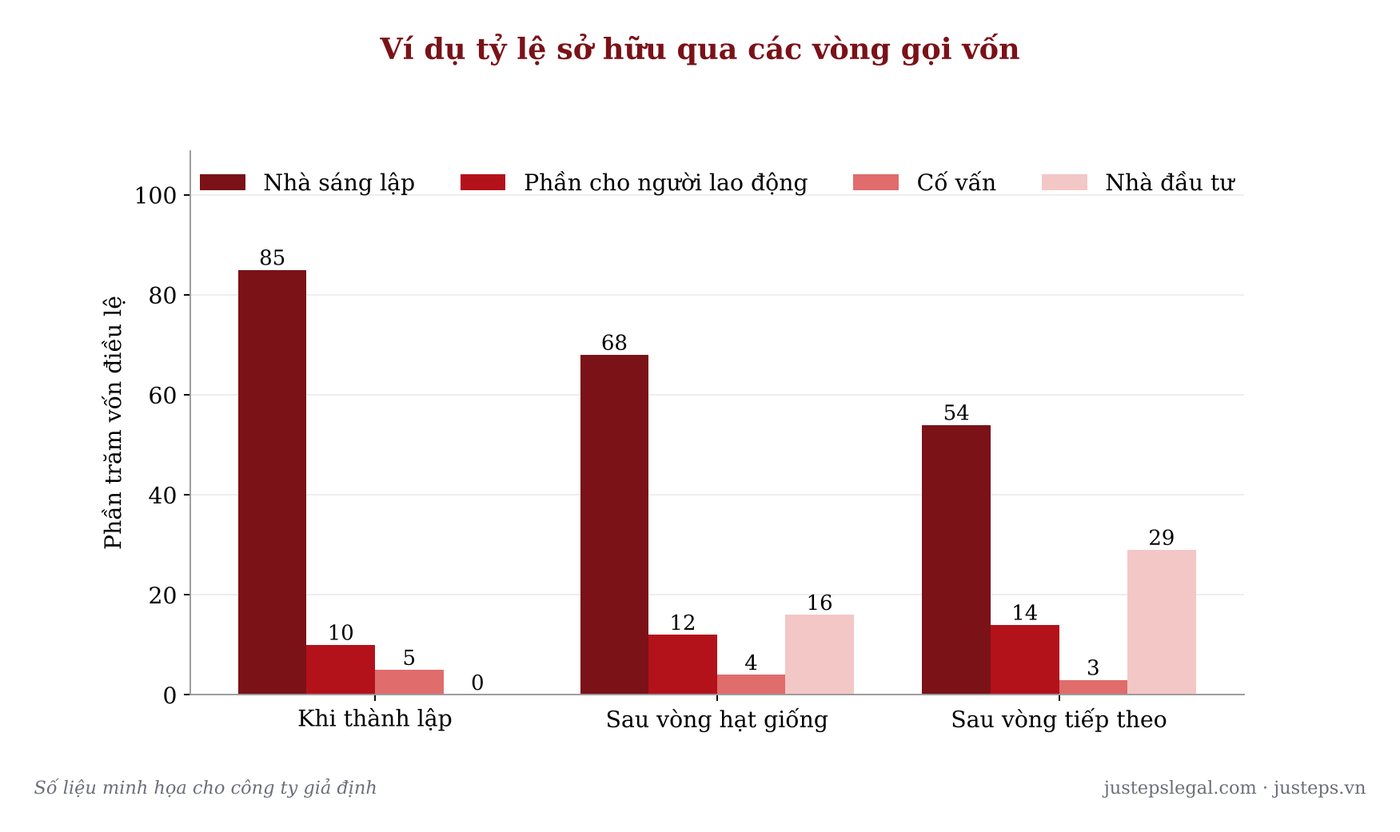
Example ownership percentages of each shareholder group over two funding rounds
After the seed round, investors hold 16% and the employee portion is increased to 12%, so the founders’ combined stake falls from 85% to 68%. By the next round, the founders hold 54%, still a majority but no longer enough to pass on their own resolutions that require a higher voting threshold. When negotiating the employee portion, the founding team should therefore project its own stake over several funding rounds rather than looking only at the next one.
Ensuring that the company owns the source code
Computer programs are protected as literary works, whether expressed as source code or object code, and copyright arises when the work is created without any need for registration[13]. This means that every line of code has an author and an owner from the moment it is written, and the question to be answered is whether that owner is the company. Where a work is created in the course of assigned duties or under a contract, the organisation assigning the duties or the contracting party is the copyright owner, unless otherwise agreed[14]. The author still retains moral rights such as the right to be named, so a contract can transfer only the economic rights.
The flowchart below helps determine what needs to be done with each part of the source code before the company asserts that it is the owner.
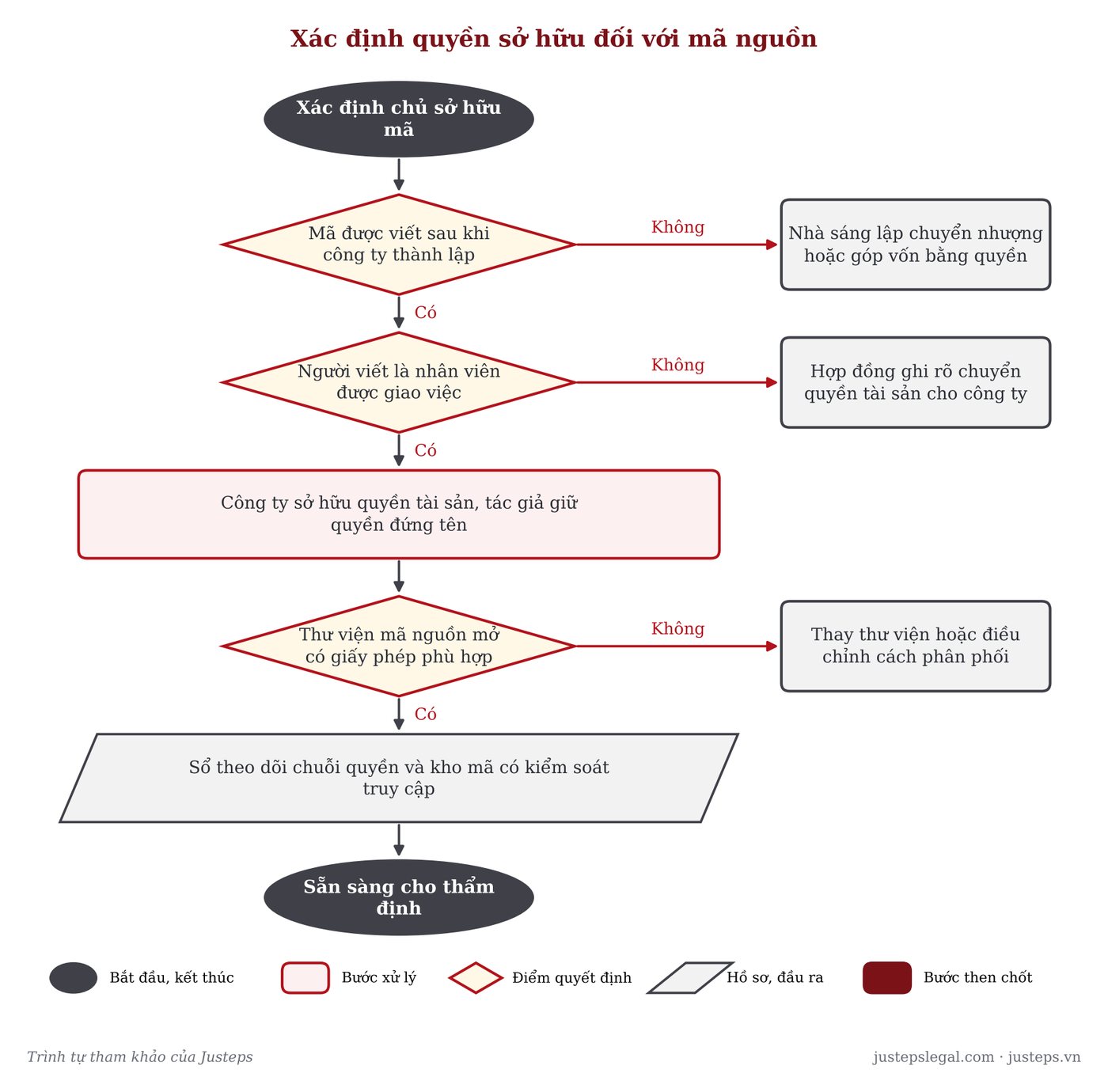
How to determine and secure ownership of each part of the source code
The first question is whether a given part of the code was written before or after the company was established. Code written before belongs to the individual founder and must therefore be assigned to the company in writing or contributed as capital following the procedure for contributing intellectual property. For code written after incorporation, if the author is an employee acting under assigned duties the company is the owner, whereas if the author is a contractor, an outsourcing provider or a freelancer, the contract must expressly provide for the transfer of the economic rights to the company. Next, the company checks the open-source libraries in use; if a library’s licence is incompatible with the way the company distributes its product, the library must be replaced or the distribution model adjusted. The end result is a chain-of-title register and a code repository with access controls, sufficient to present to investors during due diligence.
Contracts with contractors and outsourcing providers
Many start-ups engage freelancers or external providers to write part of the product but communicate only through messages and invoices. Without a written agreement, the company will struggle to prove that the economic rights were transferred to it, given that a copyright assignment agreement must be made in writing[14]. The contract should state clearly that the deliverables include both the source code and the documentation, that rights pass on payment, that the provider will not use third-party code unlawfully and that the provider must sign any further documents the company needs to register or prove its rights.
Open-source code and data for training artificial intelligence
Open-source code is widely used, but each library comes with a licence carrying its own conditions. Some licences require the source code of derivative products to be published when they are distributed, so using them in software sold to customers may force the company to open its own source code. For products that use artificial intelligence, Law No. 131/2025/QH15 amending the Law on Intellectual Property, effective from 1 April 2026, has added provisions on the use of published works to train artificial intelligence systems, provided this does not unreasonably prejudice the legitimate rights and interests of authors[15]. The company should record the origin of its training data and the terms of use for each source so that it can account for them when asked.
Protecting source code as a trade secret and managing employees
In addition to copyright, unpublished source code, algorithms and data may be protected as trade secrets if they are not common knowledge, confer a business advantage and are kept confidential by the owner through necessary measures[16]. The last condition is often overlooked, because start-ups tend to grant everyone broad access in order to work quickly. Without confidentiality measures, the company will find it difficult to seek protection if a former employee takes the source code elsewhere.
The Labour Code allows the employer to agree with the employee on the content and duration of protection of business and technology secrets, and on the employee’s entitlements and compensation in the event of a breach[17]. The company should include this agreement in the employment contract or in a separate document, grant access to the code repository according to role, keep access logs and lay down a handover procedure when an employee leaves, including revoking accounts, recovering devices and obtaining confirmation that copies have been deleted. If the product processes users’ data, the company must also comply with the Law on Personal Data Protection regarding the legal basis for processing, notification and protective measures[18], as investors usually examine this alongside ownership of the source code.
In parallel, the company should consider registering a trade mark for the product name and registering copyright in key versions of its software. A copyright registration certificate is not a condition for protection, but it helps prove ownership in the event of a dispute. Companies may refer to Justeps’ technology transfer and digital intellectual property protection services to review the chain of title and complete their registration files.
Records to complete before investor due diligence
When conducting due diligence on a technology company, investors usually focus on three groups of records. The first group concerns capital, including the charter, the shareholders’ agreement, evidence of capital contributions, the register of shareholders and resolutions on the issue and transfer of shares. The second concerns ownership of the source code, including the founders’ instruments of transfer, employment contracts and outsourcing contracts containing provisions on economic rights, and the list of open-source libraries with their accompanying licences. The third concerns employees, including the employee share programme rules, any commitments made and confidentiality agreements.
The company must also declare information on its beneficial owners under the amended Law on Enterprises of 2025 and the decree on enterprise registration, particularly where the structure includes a parent company abroad or where someone holds shares on behalf of another person[19]. Having another person hold shares as a nominee for a founder, even for initial convenience, becomes a major risk in due diligence and should be resolved before the funding round.
The tasks described in this article can be organised along the indicative roadmap below for the first year of operation, with the timing adjusted to each company’s fundraising plan.
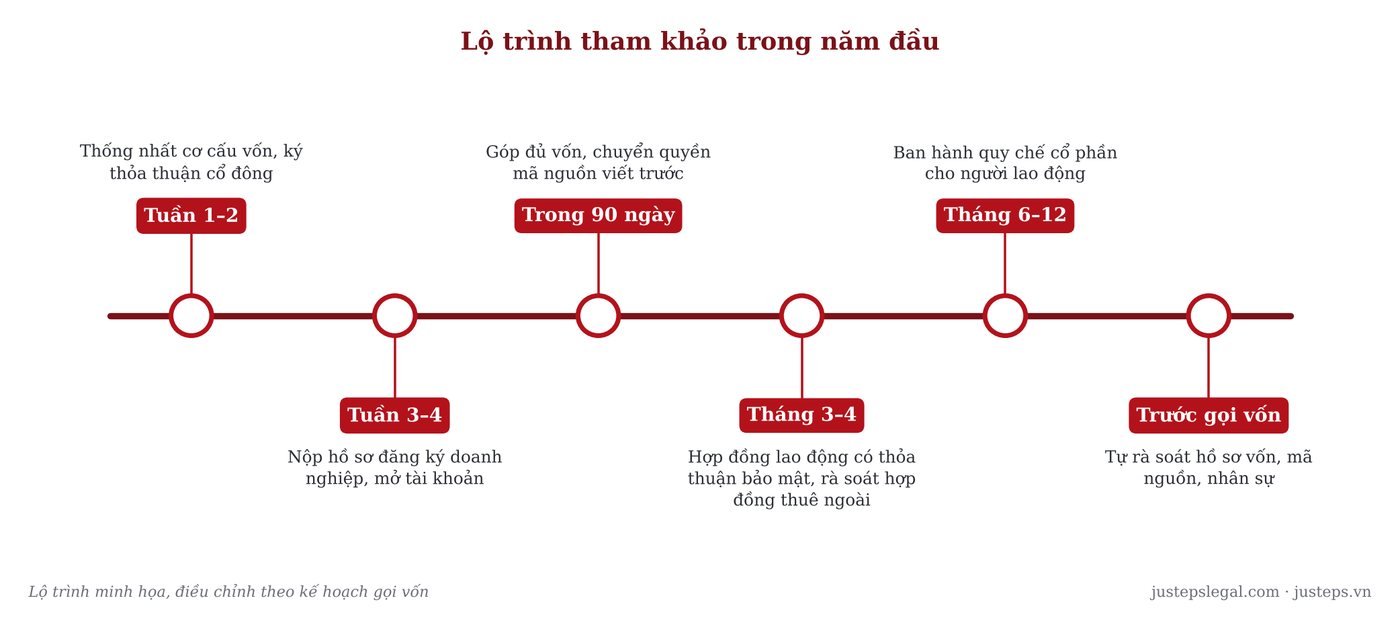
Indicative roadmap for completing capital and source code ownership records in the first year
The first two weeks are spent agreeing the capital structure and signing the shareholders’ agreement before the enterprise registration application is filed, because amending the agreement after registration usually requires additional procedures. Within 90 days of the certificate being issued, the founders pay in their capital in full and complete the instruments transferring code written before incorporation. From the third month, the company signs employment contracts containing confidentiality provisions and reviews its outsourcing contracts, then adopts the employee share programme rules once the core team has stabilised. Before each funding round, the company should review all of its records itself against the three groups above, so that it can explain any issues proactively rather than waiting for investors to find them.
How Justeps can help
Justeps helps technology start-ups design their capital structure, employee share programmes and protection of source code ownership through the following services:
- Shareholders’ agreements and founder capital contributions. Justeps drafts shareholders’ agreements, vesting mechanisms and share buy-back rights consistent with the company’s charter.
- Fundraising and private placement of shares. Justeps prepares share issuance plans for employees, due diligence files and capital increase applications.
- Technology transfer and digital intellectual property protection. Justeps reviews the chain of title to source code and prepares instruments of transfer and copyright registration files.
- Software and technology transfer contracts. Justeps drafts software development outsourcing contracts with provisions on the transfer of economic rights and delivery of source code.
- Ongoing legal advice for innovative start-ups. Justeps supports founding teams with decisions on capital, personnel and contracts during the first year of operation.
Frequently asked questions
Can a limited liability company reserve shares for employees?
A limited liability company may not issue shares except for the purpose of converting into a joint stock company[1]. The company may admit employees as contributing members or use a bonus linked to company value, but if it wants a true share programme it should convert into a joint stock company.
How is source code already written by a founder valued when contributed as capital?
Non-cash assets contributed as capital are valued by the founding shareholders by consensus or by a valuation organisation[5]. If the valuation exceeds the actual value, the founding shareholders must jointly contribute the difference, so the value needs a clear justification.
Do preferential voting shares help founders retain long-term control?
The voting preference of founding shareholders is effective only for three years from the date on which the company is issued its enterprise registration certificate[6]. For long-term control, founders should rely on the charter and the shareholders’ agreement.
Must a founder who leaves the company early sell back their shares?
The law does not impose a sell-back automatically, so this obligation arises only where the shareholders’ agreement and the charter provide for a right to buy back the unvested shares. Where the company is the buyer, the transaction must meet the conditions for share buy-backs under the Law on Enterprises[8].
Who owns code written by an engineer during working hours?
Where an employee writes code under assigned duties, the company owns the copyright unless otherwise agreed[14]. The employment contract or job description should expressly mention software development duties to avoid disputes over scope.
Is copyright registration for software mandatory?
It is not mandatory, because copyright arises when the program is created[13]. Nevertheless, a registration certificate makes it easier for the company to prove its rights in a dispute or during investor due diligence.
What can a company do if a departing employee takes the source code?
The company may claim compensation under the signed agreement on protection of trade secrets[17] and demand that the infringement of copyright cease. The strength of its position depends heavily on whether it has applied confidentiality measures and retained evidence of access.
Related articles
- What a founders’ shareholders agreement should provide on governance, vesting, veto rights and exit
- The procedure for a private placement of shares and registration of a charter capital increase by a non-public joint stock company
- What a software development contract should provide on acceptance, warranty and ownership of source code
- How to choose a business form between a household business, a limited liability company and a joint stock company
Notes
[1] Clause 3 of Article 46 and Article 52 of the Law on Enterprises No. 59/2020/QH14 dated 17 June 2020, as amended and supplemented by Law No. 76/2025/QH15.
[2] Articles 111 and 114 of the Law on Enterprises No. 59/2020/QH14.
[3] The Law on Investment No. 143/2025/QH15, effective from 1 March 2026.
[4] Article 113 of the Law on Enterprises No. 59/2020/QH14.
[5] Articles 34 and 36 of the Law on Enterprises No. 59/2020/QH14.
[6] Article 116 of the Law on Enterprises No. 59/2020/QH14.
[7] Clause 3 of Article 120 and Clause 1 of Article 127 of the Law on Enterprises No. 59/2020/QH14.
[8] Articles 133 and 134 of the Law on Enterprises No. 59/2020/QH14.
[9] Articles 125 and 138 of the Law on Enterprises No. 59/2020/QH14.
[10] Articles 30 and 122 of the Law on Enterprises No. 59/2020/QH14.
[11] The Law on Personal Income Tax No. 109/2025/QH15, effective from 1 July 2026.
[12] The Law on Securities No. 54/2019/QH14 dated 26 November 2019, as amended and supplemented, provisions on public companies.
[13] Articles 6 and 22 of the Law on Intellectual Property No. 50/2005/QH11, as amended and supplemented in 2009, 2019, 2022 and 2025.
[14] Articles 19, 20, 39, 45 and 46 of the Law on Intellectual Property No. 50/2005/QH11, as amended and supplemented.
[15] Law No. 131/2025/QH15 amending and supplementing a number of articles of the Law on Intellectual Property, effective from 1 April 2026.
[16] Article 84 of the Law on Intellectual Property No. 50/2005/QH11, as amended and supplemented.
[17] Clause 2 of Article 21 of the Labour Code No. 45/2019/QH14 dated 20 November 2019.
[18] The Law on Personal Data Protection No. 91/2025/QH15 and Decree No. 363/2026/ND-CP.
[19] Law No. 76/2025/QH15 amending and supplementing a number of articles of the Law on Enterprises; Decree No. 168/2025/ND-CP on enterprise registration, as amended and supplemented by Decree No. 296/2026/ND-CP.
This article is for reference and reflects the regulations in force at the time of publication. Please consult Justeps for advice tailored to your company’s records and situation.
For further information, please contact:
📩 Email: info@justeps.vn
🌐 Website: https://justepslegal.com · https://justeps.vn
🌐 Page: Justeps
☎️ Hotline (Zalo): 096 172 2607
📍 Thanh Xuan Office: 12th Floor, Licogi 13 Tower, 164 Khuat Duy Tien Street, Thanh Xuan Ward, Hanoi, Vietnam
📍 Ha Dong Office: LK06B, No.10, Dong Dua Area, Ha Dong Ward, Hanoi, Vietnam
📍 Ho Chi Minh City Branch: 528 Le Van Sy, Ho Chi Minh City, Vietnam
📍 Hai Phong Office: Truong Thinh Village, Ha Dong Commune, Hai Phong, Vietnam
📍 Quang Ninh Office: Van Don Special Zone, Quang Ninh Province, Vietnam





