
Key takeaways
- The organisation of a small company should be designed from a list of functions, each with one person ultimately responsible, before people are assigned to those functions.
- Combining several roles in one person is normal in a company with fewer than 10 staff, but the person who prepares a payment and the person who approves it must be different, and the cashier must not also act as accountant.
- Tax accounting, payroll, insurance and legal matters are usually best outsourced in the first year, provided that an internal contact person keeps the original documents and checks the results.
- A Director who receives a salary is subject to compulsory social insurance, and the company must declare its use of labour within 30 days of commencing operations.
- Once it employs 10 or more workers, the company must issue written internal labour regulations and register them with the provincial labour authority.
In a newly incorporated company, the organisation usually takes shape out of habit rather than by design. The Director sells, approves payments and holds the digital signature; an outsourced accountant prepares the tax returns, but nobody in the company keeps the original documents; and when a delivery is late or a payment is sent to the wrong account, nobody can say who is responsible. These gaps rarely cause harm while the company has three people, but they become a real risk once headcount rises to seven or eight and the volume of transactions grows with it.
This article analyses how to set up the organisation of a new company with fewer than 10 staff, covering the difference between the management structure required by law and the executive organisation, the principles for dividing functions, combining roles with proper controls, choosing what to outsource, the labour obligations that arise on hiring the first employee and the milestones at which the organisation should be adjusted. It applies mainly to small limited liability companies and joint stock companies established under the Law on Enterprises 2020 as amended in 2025. It is written mainly for founders, directors and the people responsible for administration, HR and accounting in new businesses.
The statutory management structure and the executive organisation are two different layers
The Law on Enterprises prescribes a management structure for each type of company; for example, a limited liability company with two or more members has a Members’ Council, a Chairperson of the Members’ Council and a Director or General Director, while a joint stock company may choose between a model with a Supervisory Board and a model with an Audit Committee[1]. This is the governance layer, which determines who has the power to decide matters such as increasing charter capital, amending the charter, appointing the Director or approving major transactions. The second layer is the day-to-day executive organisation, comprising functions such as sales, operations, purchasing, finance and accounting, and HR and administration, which the law leaves the business to organise itself. New companies often confuse these two layers, ending up with many titles on paper but nobody actually in charge of a specific function.
On that basis, setting up the organisation should begin by recording clearly in the charter or an internal decision who holds which statutory management position, and only then dividing the executive functions. In a single-member limited liability company owned by an individual, the owner usually also serves as Company Chairperson and Director, so the boundary between the owner’s decisions and executive decisions needs to be recorded in writing all the more. This approach ensures that important transactions have a sufficient basis of authority when a bank, a counterparty or the tax authority asks to see it.
The legal representative and authorisation during absence
A business must ensure that it always has at least one legal representative residing in Vietnam. Where the company has only one legal representative, that person must authorise another individual residing in Vietnam in writing to exercise their rights and perform their obligations while they are abroad[2]. In a small company, the Director is often also the sole legal representative and travels abroad frequently, so signing contracts, approving payment orders or receiving documents from state authorities can easily be interrupted. The company should prepare a template letter of authorisation stating the scope, the value limits and the term, so that it only needs to be signed whenever the Director is away rather than drafted in a hurry at the last minute.
Where the company has two or more members contributing capital, the charter may provide for several legal representatives and divide powers among them. However, if the charter does not draw a clear division, each representative has full power to represent the business before third parties, so having two representatives does not replace an internal control mechanism. The signing authority of each person should therefore be set out in the charter or internal rules and notified to the bank so that the correct specimen signatures and limits are applied.
Designing the organisation by function before assigning people
The first principle is to list all the functions the business needs to perform and only then assign people to each function. A small trading or services company usually has six basic functions, namely general management, sales and customer care, operations or service delivery, purchasing, finance and accounting, and HR and administration. If it starts from the people, the company easily overlooks functions nobody wants to take on, such as record keeping, monitoring receivables or contract management, and these tasks are remembered only once something has gone wrong.
The second principle is that each function has only one person ultimately responsible, even when several people take part in the work. For example, sales staff, the accountant and the Director are all involved in collecting money from customers, but the company needs to designate one person responsible for the ageing of receivables and for chasing payment. When responsibility is recorded by a person’s name rather than a department’s name, the Director can check results every week without having to ask each person again.
The table below suggests how functions may be allocated at two common sizes of new company, assuming the company does not yet have separate departments:
| Function | Company of 3 to 5 people | Company of 6 to 9 people |
|---|---|---|
| General management | The Director manages directly and also handles sales to major customers. | The Director focuses on planning, signing and control, and assigns sales to dedicated staff. |
| Sales | The Director and one salesperson share the work, with the Director responsible for sales revenue. | A sales team leader is responsible for the revenue and receivables of the customers the team handles. |
| Operations and delivery | One person handles deliveries or performs the service and reports directly to the Director. | Two to three people, one of whom coordinates schedules and quality. |
| Finance and accounting | An outsourced accounting service, with an administrative employee keeping original documents and tracking receipts and payments. | An outsourced accounting service or an in-house accountant, with the person holding cash kept separate from the person keeping the books. |
| HR and administration | Handled by the administrative employee alongside other duties, with payroll and insurance outsourced. | A dedicated HR and administration employee, with an outside specialist engaged to review contracts and internal rules. |
This allocation is only a starting point, since each sector has its own specific functions, such as warehousing for distributors or project management for construction businesses. Once the allocation table is settled, the company should present the result as a one-page functional chart and a short job description for each person, stating their main tasks, decision rights and the person they report to. Businesses needing support at this step may consider Justeps’ service on organisational design for start-ups.
Combining roles with proper controls and separating financial authority
In a company with fewer than 10 staff, it is unavoidable that one person takes on two or three jobs, but certain pairs of tasks should not be given to the same person. Under the Law on Accounting, a person who is a manager or executive, a storekeeper, a cashier or a person who regularly buys and sells assets may not work as an accountant in the same entity, except in private enterprises and limited liability companies owned by one individual[3]. Beyond this rule, the minimum principle of internal control is that the person who prepares a payment request and the person who approves it must be different, the person holding cash does not keep the books, and the person receiving goods is not also the person placing orders with the same supplier.
The greatest risk in a small company is that one person simultaneously holds the company seal, the digital signature, the online banking account and the authority to approve payments. If that person leaves suddenly or acts improperly, the company may lose access to its accounts, have incorrect tax returns filed or fail to detect irregular payments for many months. A simple solution is to register two-tier online banking, in which the accountant or an administrative employee prepares the payment order and the Director approves it, and to keep the digital signature login details in a sealed envelope held by the owner.
Every payment should go through a fixed sequence, even when the company has only a few people, so that the supporting documents are complete and the approver has sufficient information before giving approval.
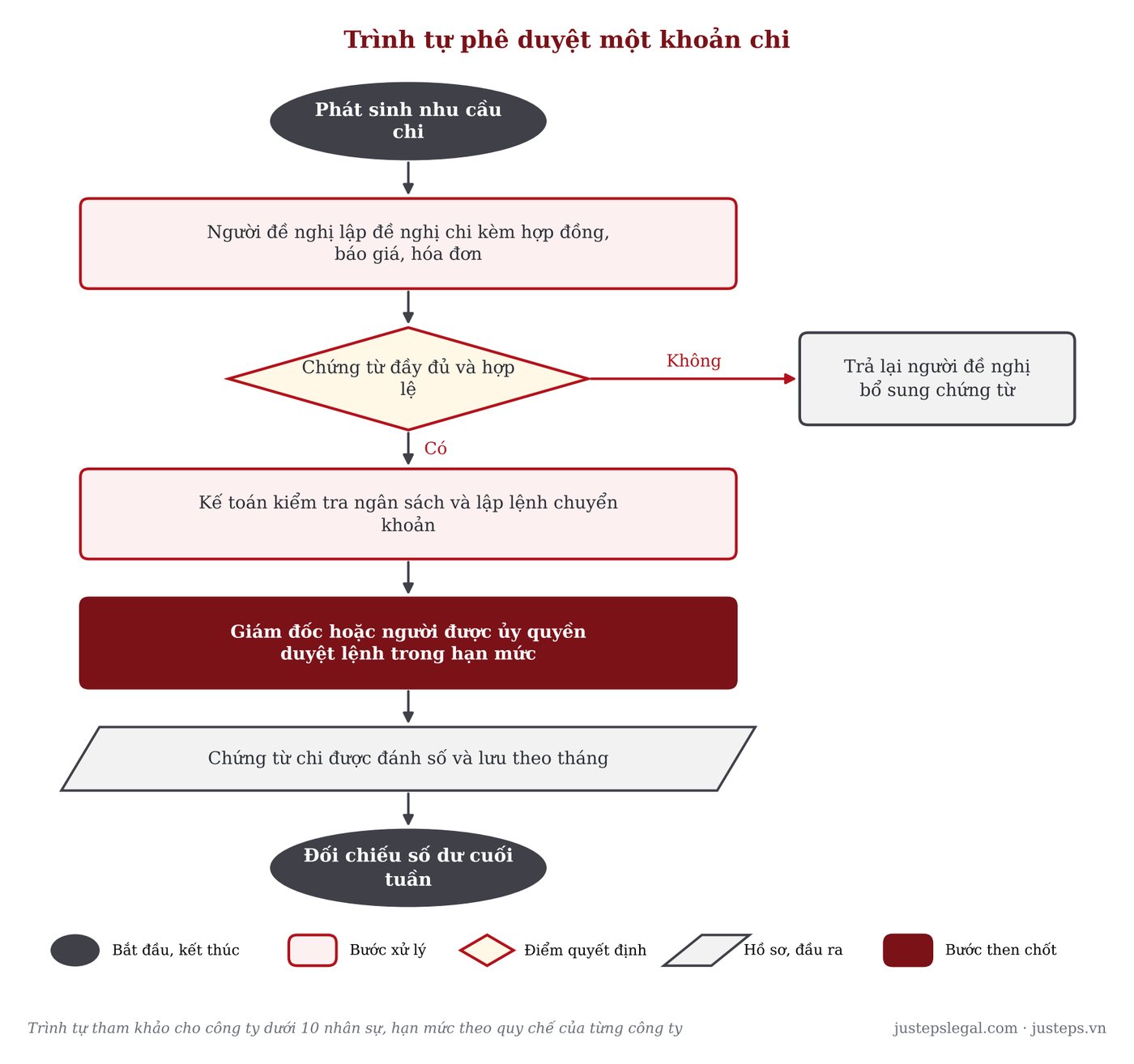
Sequence for requesting, checking and approving a payment in a small company
The sequence begins when the person with the need prepares a payment request together with the contract, quotation or invoice, and the accountant checks the validity of the documents before preparing the transfer order. If the documents are incomplete, the request is returned for supplementing rather than being approved first and regularised afterwards, as the latter practice is the source of many payments that cannot be treated as deductible expenses when the tax return is finalised. The key step is approval of the order on the online banking system by the Director or an authorised person within the limits that have been issued. At the end of each week, the accountant reconciles the account balance with the receipts and payments ledger and reports to the Director any payments still lacking documents.
Approval limits should be put in writing from the first month; for example, payments below VND 5 million may be approved by a team leader, payments from VND 5 million to VND 50 million by the Director, and larger payments, loans or guarantees require the opinion of the owner or the Members’ Council. These figures are examples and should be adjusted to the size of transactions, but they must be consistent with the authority that the Law on Enterprises and the charter confer on each level. Businesses may standardise these arrangements through Justeps’ service on financial regulations and delegation of authority.
Accounting, tax and the functions that should be outsourced
The Law on Accounting allows an accounting entity to engage an enterprise or an individual meeting the conditions to practise to provide accounting services and chief accountant services[4]. For a new company with few transactions, engaging a service provider is usually cheaper than hiring a full-time accountant, while ensuring that tax returns and financial statements are prepared by a qualified person. However, outsourcing does not transfer the business’s legal responsibility to the service provider, so the legal representative remains responsible for the accuracy of the accounting data and for tax obligations.
The condition for effective outsourcing is that the company has an internal contact person who keeps the original documents, monitors receivables and payables and sends materials to the service provider according to an agreed schedule. The accounting services contract should state clearly the scope of work, the deadline for delivering returns ahead of the filing deadline, liability for compensation where penalties result from the provider’s error and the obligation to hand over all data on termination of the contract. Many companies discover the lack of a data handover clause only when they change provider, by which time the books are interrupted and have to be rebuilt from scratch.
Not every function should be outsourced, and what is appropriate changes as the company grows. The following chart suggests the extent to which each function should be given to an outside provider at two sizes of company.
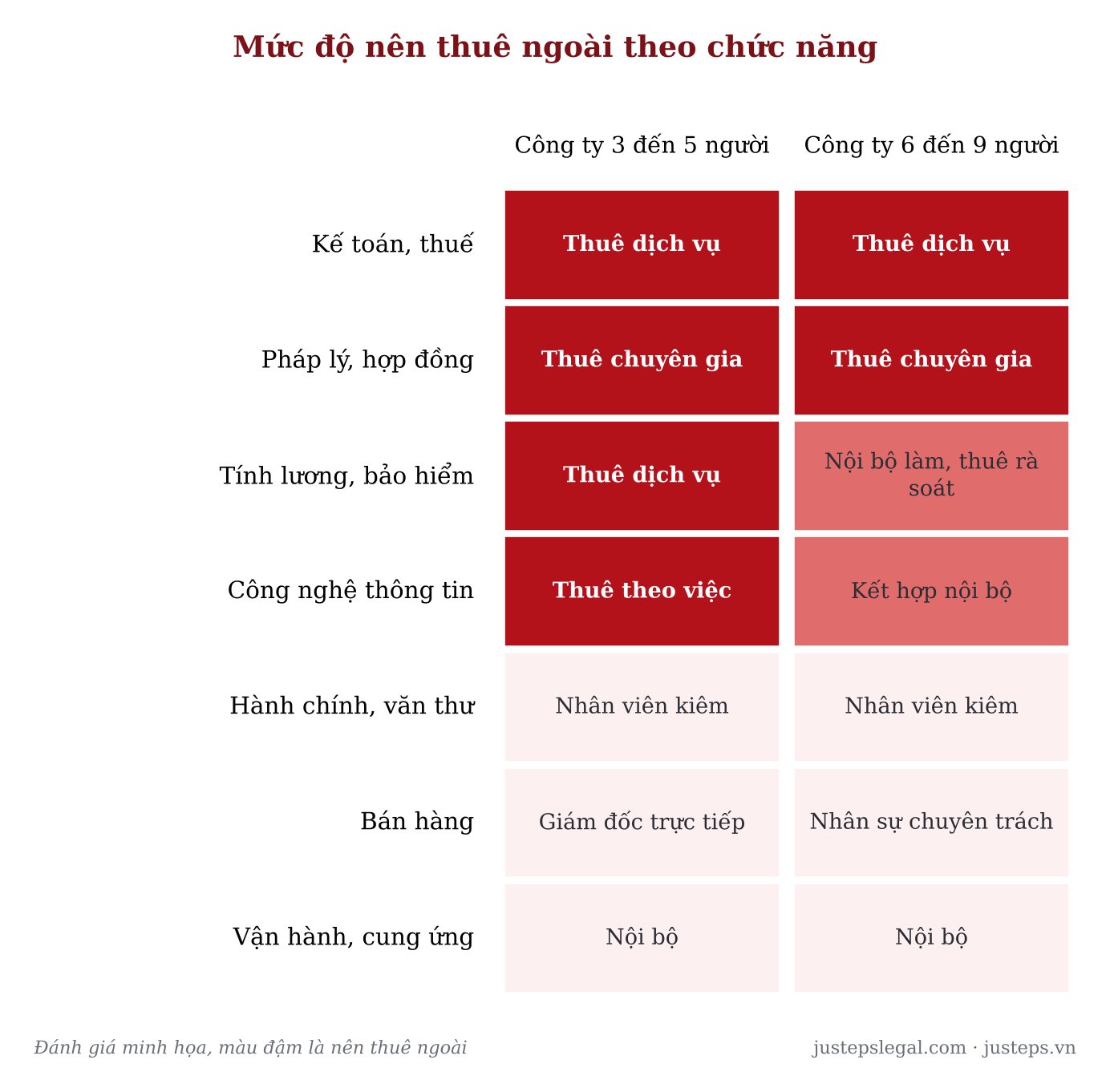
Extent to which each function should be outsourced, by company size
Tax accounting and contract-related legal work are the two functions that should be outsourced at both sizes, because they require deep expertise while the workload is not yet enough to justify a full-time hire. Payroll and insurance can be fully outsourced while the company has fewer than five people, but from six people upwards they are better handled internally, with a specialist engaged only for periodic reviews. By contrast, sales and operations are core capabilities and should always be handled by the company’s own people. When the cost of outsourcing a function exceeds the cost of hiring an in-house employee of equivalent ability, that is a sign the function should be brought in-house.
Recruitment and entitlements for the first employees
Employment contracts, probation and wages
An employment contract must be concluded in writing, except for contracts with a term of less than one month in certain cases, and may be concluded by electronic means in the form of a data message[5]. The company may agree on a probationary period of no more than 180 days for a business manager, no more than 60 days for work requiring a college qualification or higher, no more than 30 days for work requiring an intermediate vocational qualification and no more than 6 working days for other work. Probationary wages are agreed by the parties but must be at least 85% of the wage for the job[6]. A common mistake is to put an employee on probation several times in succession or beyond the permitted period, in which case the company may be fined and must pay the full wage for the excess period.
Wages paid to an employee working full normal hours must not be lower than the regional minimum wage. In 2026, the monthly minimum wage for Region I is VND 5,310,000, and from 1 January 2027 it rises to VND 5,700,000 in Region I, VND 5,080,000 in Region II, VND 4,450,000 in Region III and VND 4,040,000 in Region IV[7]. A company recruiting at the end of 2026 should set the wage in the contract with the new level in mind, to avoid having to sign an adjustment appendix just a few weeks later.
Social insurance and the declaration of labour use
Persons working under an employment contract of one full month or more and business managers who receive a salary are all subject to compulsory social insurance[8]. Accordingly, a Director paid by the company, even where the Director is also a capital-contributing member, must still have social insurance contributions paid on that salary. In addition to the employee’s share, the company must contribute about 21.5% of the wage used as the contribution base for social insurance, health insurance and unemployment insurance, plus 2% for the trade union fee, so this cost must be added to the agreed wage when preparing the staffing budget.
The Labour Code requires employers to keep a labour management register and to declare their use of labour within 30 days of the date they commence operations[9]. Failing to declare, or declaring late, may result in an administrative penalty under Decree No. 283/2026/ND-CP[10]. The file of the first employee should be complete from the outset, including the contract, job description, wage decision and insurance registration form, because it will serve as the template for those hired later.
Personnel files contain personal data such as identity card numbers, bank accounts and health status, so the company must inform employees of the purpose of processing and restrict access to the files[11]. In a small company, only one person should be assigned to manage personnel files, stored in a folder with access controls rather than sent through shared chat groups. This also prepares the company for when it has to provide files to the insurance authority or a labour inspection team.
The minimum set of organisational documents and the milestones for adjustment
A small organisation runs smoothly only when decisions on assignments are recorded in writing and updated whenever there is a change. The following table lists the minimum documents a new company should have, together with the person responsible for preparing them:
| Document | Main content | Prepared and approved by |
|---|---|---|
| Functional chart | A single page showing the functions, the persons responsible and the reporting lines. | Prepared by the Director and adopted by the owner or the Members’ Council. |
| Job descriptions | Main tasks, decision rights, appraisal criteria and reporting line for each position. | Prepared by the direct manager and approved by the Director. |
| Approval limits table | Who may approve payments, contracts and recruitment, and up to what value. | Proposed by the Director and issued by the competent body under the charter. |
| Employment contracts | Templates for probation contracts, employment contracts and confidentiality agreements. | Prepared by HR and administration and signed by the Director. |
| Wage rules | Wage levels by position, allowances, bonuses and method of payment. | Issued by the Director after consulting employees. |
| Outsourcing contracts | Scope of services, delivery deadlines, liability for errors and data handover. | Signed by the Director, with the internal contact person monitoring performance. |
The organisation also needs periodic review, because changes in size bring new legal obligations. The most important milestone is when the company employs 10 or more workers, at which point the internal labour regulations must be issued in writing and the registration file submitted to the provincial labour authority within 10 days of issue[12]. The Law amending and supplementing the Labour Code, passed by the National Assembly on 21 November 2026 and taking effect on 1 March 2027, adds 27 July and 24 November as fully paid public holidays[13], so internal regulations and wage rules drafted during this period should anticipate that change.
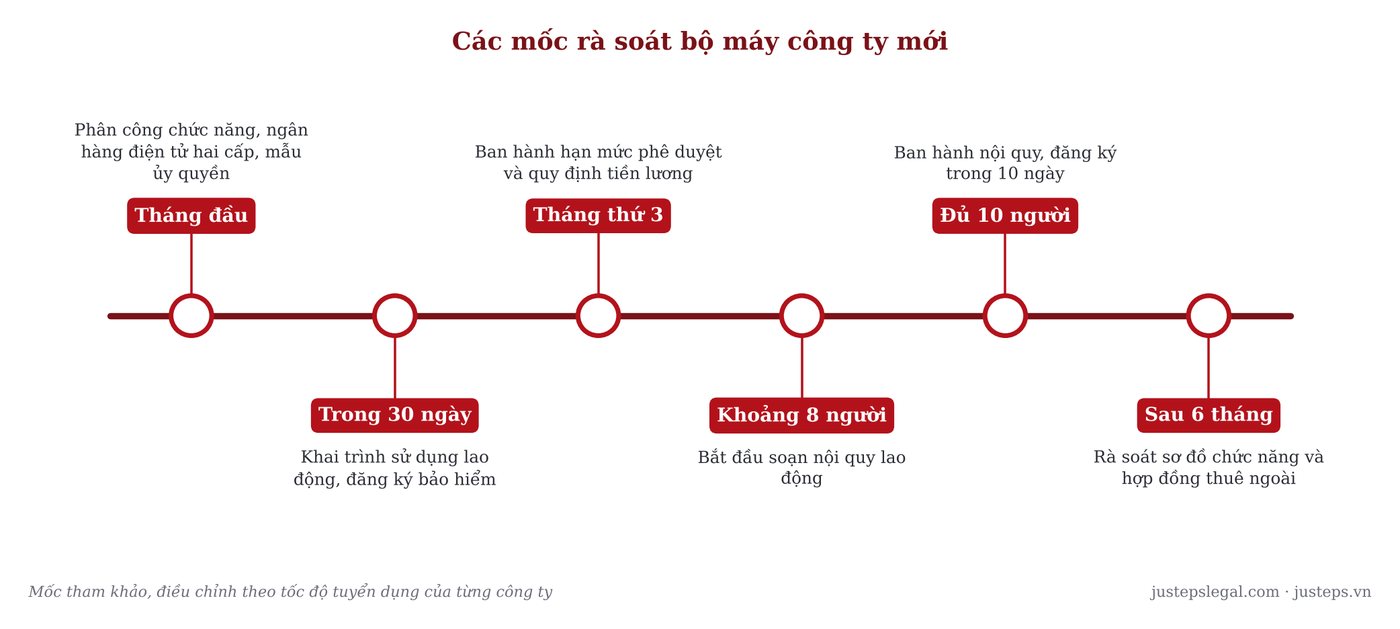
Time and headcount milestones for reviewing the organisation of a new company
In the first month, the priorities are to assign functions, register two-tier online banking and prepare a template letter of authorisation for the legal representative. Within 30 days of commencing operations or signing the first employment contract, the company completes its declaration of labour use and its insurance registration. When headcount reaches about eight people, the company should start drafting its internal labour regulations so that they can be registered as soon as it reaches 10 people, rather than missing the deadline. After six months of operation, or when headcount has grown by about 30%, the Director should review the functional chart, the approval limits and the outsourcing contracts.
Apart from these quantitative milestones, certain signs indicate that the organisation needs adjusting earlier than planned. The clearest signs are that the Director spends more than half of their time dealing with day-to-day incidents, that payments wait several days for approval, or that the company opens a new sales point, warehouse or office. In that case, the company should turn a combined function into a dedicated position, update the approval limits table and, if it opens a new location, assess whether to register a branch or business location under the enterprise registration rules[14].
How Justeps can help
Justeps helps newly incorporated companies set up a lean organisation with clear responsibilities that complies with the law through the following services:
- Organisational design for start-ups. Justeps prepares the functional chart, the plan for combined roles and the job description for each position in a new company.
- Financial regulations and delegation of authority. Justeps drafts the approval limits table, the payment request procedure and the access rights arrangements for online banking.
- Labour, payroll and insurance services for start-ups. Justeps drafts employment contracts and wage rules and guides the declaration of labour use and insurance registration for the first employees.
- Internal labour regulations and disciplinary procedures. Justeps drafts the internal labour regulations and prepares the registration file when the company reaches 10 employees.
- Organising the accounting function and documentation. Justeps designs the working arrangements between the internal contact person and the outsourced accounting provider and reviews the outsourcing contract.
Frequently asked questions
Does a company with fewer than 10 staff need an organisation chart?
The company does not need a multi-level chart, but it should have a one-page functional chart stating who is responsible for each function. This chart tells new employees whom they report to and helps the Director spot functions that nobody is yet in charge of.
Must a company with fewer than 10 staff have internal labour regulations?
Employers must issue internal labour regulations, but they are only required to be in writing and registered when the employer uses 10 or more workers[12]. Smaller companies should still set out basic rules on working hours, leave and discipline in the contract or in an internal notice.
Must a Director who is also the owner pay social insurance?
If the Director receives a salary from the company, they are subject to compulsory social insurance as a business manager[8]. Where the owner receives no salary and only takes profits, the position should be assessed on the basis of the company’s specific records.
May the cashier also act as accountant in a small company?
In principle, the cashier may not work as an accountant in the same entity, except in private enterprises and limited liability companies owned by one individual[3]. Even where the exception applies, the company should still separate the person holding cash from the person keeping the books to limit errors.
Should a company hire an in-house accountant or engage an accounting service in its first year?
For a company with fewer than 10 staff and few transactions, engaging an accounting service is usually more economical[4]. However, the company still needs an internal employee to keep original documents, monitor receivables and payables and check returns before they are filed.
Who signs contracts when the Director travels abroad?
If the Director is the sole legal representative, they must authorise another person residing in Vietnam in writing before leaving the country[2]. The letter of authorisation should state the scope, value limits and term clearly so that counterparties and banks will accept it.
How often should the organisation be reviewed?
A new company should review it after six months of operation or when headcount has grown by about 30%, whichever comes first. The review covers the functional chart, approval limits, outsourcing contracts and whether internal labour regulations need to be issued.
Related articles
- Estimating a new company’s operating costs in its first year and how to build a realistic budget
- How to choose an organisation chart model that fits the size of a business and the way it generates revenue
- What to do in the first 90 days after setting up a business so that no obligation or deadline is missed
- Setting up a company in Hanoi: documents required, processing time and what to do immediately after registration
Notes
[1] Articles 54 and 137 of the Law on Enterprises No. 59/2020/QH14 dated 17 June 2020, as amended and supplemented by Law No. 76/2025/QH15.
[2] Clause 3 of Article 12 of the Law on Enterprises No. 59/2020/QH14.
[3] Article 52 of the Law on Accounting No. 88/2015/QH13 dated 20 November 2015.
[4] The Law on Accounting No. 88/2015/QH13 and Government Decree No. 174/2016/ND-CP dated 30 December 2016 detailing a number of articles of the Law on Accounting, on engaging accounting services and chief accountant services.
[5] Article 14 of the Labour Code No. 45/2019/QH14 dated 20 November 2019; Decree No. 337/2025/ND-CP on electronic employment contracts.
[6] Articles 25 and 26 of the Labour Code No. 45/2019/QH14.
[7] Decree No. 293/2025/ND-CP on minimum wages applicable until 31 December 2026; Decree No. 399/2026/ND-CP on minimum wages applicable from 1 January 2027.
[8] Points a and i of Clause 1 of Article 2 of the Law on Social Insurance No. 41/2024/QH15 dated 29 June 2024.
[9] Clauses 1 and 2 of Article 12 of the Labour Code No. 45/2019/QH14.
[10] Decree No. 283/2026/ND-CP on administrative penalties in the fields of labour and social insurance.
[11] The Law on Personal Data Protection No. 91/2025/QH15 and Decree No. 363/2026/ND-CP.
[12] Clause 1 of Article 118 and Article 119 of the Labour Code No. 45/2019/QH14.
[13] The Law amending and supplementing a number of articles of the Labour Code, passed by the National Assembly on 21 November 2026 and effective from 1 March 2027.
[14] Government Decree No. 168/2025/ND-CP dated 30 June 2025 on enterprise registration, as amended and supplemented by Decree No. 296/2026/ND-CP.
This article is for reference and reflects the regulations in force at the time of publication. Please consult Justeps for advice tailored to your company’s records and situation.
For further information, please contact:
📩 Email: info@justeps.vn
🌐 Website: https://justepslegal.com · https://justeps.vn
🌐 Page: Justeps
☎️ Hotline (Zalo): 096 172 2607
📍 Thanh Xuan Office: 12th Floor, Licogi 13 Tower, 164 Khuat Duy Tien Street, Thanh Xuan Ward, Hanoi, Vietnam
📍 Ha Dong Office: LK06B, No.10, Dong Dua Area, Ha Dong Ward, Hanoi, Vietnam
📍 Ho Chi Minh City Branch: 528 Le Van Sy, Ho Chi Minh City, Vietnam
📍 Hai Phong Office: Truong Thinh Village, Ha Dong Commune, Hai Phong, Vietnam
📍 Quang Ninh Office: Van Don Special Zone, Quang Ninh Province, Vietnam





