
Key takeaways
- The enterprise registration certificate is only the starting point; in the first few months the company must still complete capital contributions, tax, invoicing, accounting, labour, insurance and internal policies.
- The order of implementation matters more than speed, because many workstreams depend on one another; for example, without a digital signature and a bank account, the company cannot yet use electronic invoices or pay social insurance.
- Each workstream should have a deliverable and a measurable acceptance criterion, such as a document that has been issued, a procedure accepted by the state authority or a process that has been successfully test-run.
- The company should appoint a single point of contact to take delivery and sign acceptance records phase by phase rather than accepting everything at once at the end of the package.
After receiving the enterprise registration certificate, many business owners consider the legal side finished and focus all their efforts on sales. In practice, the first months are when the most obligations arise, from contributing capital in full and on time, registering for electronic invoices, filing the first tax returns, signing employment contracts and paying social insurance, to issuing the minimum set of policies that employees and accountants need as a basis for their work. When these tasks are handled piecemeal according to immediate needs, companies often miss deadlines, incur late payment penalties or have to redo their files a few years later.
A turnkey operations set-up service is designed to solve that problem by bringing all of the work on building the legal and governance foundations into a single plan with a sequence, owners and clear acceptance criteria. This article analyses the workstreams usually included in a package, the legal basis for each workstream, a sensible order of implementation and how to sign off the results. It is written mainly for owners of newly incorporated companies, companies converted from household businesses, foreign-invested enterprises that have just been licensed and operating companies wishing to put their structure back on a standard footing.
The scope of a business operations set-up package
An operations set-up package differs from a company formation service in that it begins once the company already has legal personality and ends when the company can run its basic legal, tax, accounting and HR processes by itself. The precise scope depends on four factors, namely the type of enterprise, whether its lines of business are conditional, the expected headcount in the first year and whether the company has foreign investors. A five-person trading company and a foreign-invested factory with two hundred workers will need two very different packages, even if they go by the same name.
The first step in every package is therefore to survey the company and draw up a list of workstreams tailored to it. The results of the survey should be recorded in a scope of work appendix, in which each workstream has a description, a deliverable, a deadline and an acceptance criterion. The table below summarises the common groups of workstreams and how to set acceptance criteria for each group:
| Workstream group | Main deliverables | Acceptance criterion |
|---|---|---|
| Legal foundations | Charter, register of members or shareholders, capital contribution certificates, file on the legal representative. | Capital has been contributed in full on time and all information in the registers matches the enterprise registration. |
| Tax and invoicing | Digital signature, e-tax account, registration to use electronic invoices, tax calendar. | The tax authority has accepted the invoice registration and the company has successfully issued a test invoice. |
| Accounting | Decision selecting the accounting regime, appointment of the person in charge of accounting, chart of accounts and document templates. | The accounting software has correctly recorded the transactions of the first month. |
| Labour and insurance | Employment contract templates, pay scales and payrolls, internal labour rules where required, insurance registration file. | Employees have signed contracts and been issued social insurance numbers on time. |
| Internal governance | Financial regulations, delegation of authority, purchasing and payment procedures, commercial contract templates. | Documents have been signed and issued by the authorised person and communicated to those who apply them. |
| Sector-specific compliance | Licences, certificates, documents confirming business eligibility, personal data protection files. | Documents have been issued or files have been received by the competent authority. |
What these criteria have in common is that each can be verified by documents or by a test run, rather than by general phrases such as completed satisfactorily or meets requirements. The more specific the criteria, the less argument there will be over acceptance and phased payment of service fees. The following sections analyse the legal content of each group of workstreams in the order in which the company should implement them.
Completing the legal and corporate governance foundations
The first task after receiving the certificate is to ensure that the charter capital is contributed in full, in the type of assets committed, within 90 days of the date of issue of the enterprise registration certificate[1]. If members or shareholders have not contributed in full by the deadline, the company must register an adjustment of its charter capital and ownership ratios to reflect the capital actually contributed; otherwise it will be penalised, and members will remain liable to the extent of the capital they committed. Cash contributions should pass through the company’s bank account, while contributions in other assets must be valued and their ownership transferred to the company.
Immediately after the enterprise registration certificate is issued, the company must establish a register of members or a register of shareholders, keep it at the head office and issue capital contribution certificates or share certificates once members or shareholders have contributed in full[2]. Since the Law on Enterprises was amended in 2025, companies must also collect, retain and provide information on their beneficial owners, meaning the individuals who actually own or control the company[3]. For companies with several layers of ownership, beneficial owners should be identified carefully from the outset, because banks and state authorities will check this information in many later procedures.
The company decides for itself the type, number, form and content of its seal, and the management and use of the seal must follow the charter or regulations issued by the company[4]. The set-up package should include a document specifying who keeps the seal, who may sign which documents and how authority is delegated when the legal representative is absent. For foreign-invested enterprises, this group of workstreams also covers opening a direct investment capital account, transferring capital through that account and complying with the investment reporting regime under the Law on Investment[5].
Tax, electronic invoices and organising the accounting function
The enterprise code is also the tax identification number, so the company does not need a separate tax registration, but it must immediately put in place the tools needed to perform its tax obligations electronically. A sensible sequence is to obtain a digital signature, open a bank account, activate the e-tax transaction account and then register with the tax authority to use electronic invoices[6]. The company may issue invoices only after the tax authority has accepted the registration, so this workstream must be completed before the first sale, even if that is only a small contract.
The Law on Tax Administration No. 108/2025/QH15 took effect on 1 July 2026[7], bringing changes to many implementing regulations on tax filing, tax payment and electronic transactions. A new company needs to determine its VAT calculation method, tax periods and payment deadlines under the implementing regulations currently in force, and then build them into a tax calendar for the whole year. The business licence fee was abolished from 1 January 2026[8], so companies incorporated from 2026 no longer need to declare or pay it.
Organising the accounting function
The company must organise its accounting function and appoint a chief accountant or a person in charge of accounting who meets the statutory requirements, or engage accounting services from a qualified organisation or individual[9]. The company must also choose an accounting regime suited to its size and then build its chart of accounts, document templates and filing arrangements. The current enterprise accounting regime is set out in Circular No. 99/2025/TT-BTC[10], while small and medium-sized enterprises may opt for the accounting regime designed for them under the regulations. A common error is letting the owner pay expenses from a personal account in the early months, which makes the supporting documents invalid and the expenses non-deductible for corporate income tax purposes. Financial regulations and payment procedures should therefore be issued early, before any large expenditure is incurred.
Labour, wages and social insurance
As soon as it hires its first employee, the company must enter into an employment contract containing the minimum content required by the Labour Code, which may be concluded electronically in the form of a data message[11]. The set-up package should provide a set of templates for employment contracts, probation contracts, confidentiality agreements and recruitment decisions suited to the expected positions. The company must also develop pay scales, payrolls and labour norms as the basis for recruitment and pay, consult the workers’ representative organisation where one exists and publish them at the workplace before applying them[12].
Wages in the pay scale must not fall below the regional minimum wage, and from 1 January 2027 the monthly minimum wage is VND 5,700,000 in Region I, VND 5,080,000 in Region II, VND 4,450,000 in Region III and VND 4,040,000 in Region IV[13]. The company registers employees for compulsory social insurance within the statutory period from the date the employment contract takes effect, on the basis of wages comprising the basic wage, wage allowances and other supplements paid regularly and consistently[14]. Late registration or contributions based on less than the wages actually paid may be treated as late payment or evasion, so the design of the pay structure must go hand in hand with the insurance formalities.
Once it employs 10 or more employees, the company must issue written internal labour rules and register them with the provincial labour authority[15]. The company must also submit periodic reports on its use of labour as required[16]. If it employs foreign nationals, the set-up package must also cover obtaining a work permit or confirmation of exemption from a work permit under Decree No. 219/2025/ND-CP before the person starts work[17]. From 1 March 2027, employees will have two additional fully paid days off on 27 July and 24 November[18], so working calendars and holiday pay calculations should be updated within the first year of operation.
Internal policies, template contracts and personal data protection
The minimum set of policies for a new company usually comprises financial regulations, rules on delegation of approval authority, purchasing and payment procedures and contract management regulations. The delegation of authority document should state clearly who may approve expenditure up to what limit, who may sign contracts of what value, and which transactions must be approved by the Members’ Council, the Board of Directors or the owner under the Law on Enterprises. The policies must be consistent with the charter and issued by decision of the authorised person, stating the effective date and the person responsible for implementation. Companies may consider Justeps’ internal governance policy and procedure development services to build this set of documents.
Alongside its policies, the company should have a set of template contracts for recurring transactions, such as purchase contracts, sales contracts, service contracts and non-disclosure agreements. Templates allow the sales team to sign contracts on its own without waiting for each one to be reviewed, while ensuring that key terms such as payment, contractual penalties and dispute resolution remain consistent. For high-value contracts or those that depart from the templates, the contract management regulations should require a legal review before signing.
Most companies process the personal data of employees and customers from their first day of operation. The 2025 Law on Personal Data Protection and Decree No. 363/2026/ND-CP require companies to identify the legal basis for processing, notify data subjects, apply appropriate protection measures and prepare impact assessment files in the cases specified by law[19]. The set-up package should include a data processing notice for employees, a data protection policy for customers and internal rules on data access rights.
The order in which workstreams should be implemented
The workstreams in the package depend on one another, so doing them in the right order saves more time than running everything in parallel. The legal foundations must come first, because the information in the register of members, the charter and the details of the legal representative feed into the banking, tax and insurance procedures. The digital signature and bank account must be in place before registering for electronic invoices and paying social insurance, and pay scales must exist before employment contracts are signed in large numbers. Internal policies should be drafted once the company has a clear picture of its organisational structure and cash flows, usually from the second month. The following roadmap is an example for a small or medium-sized company without any particular conditional line of business.
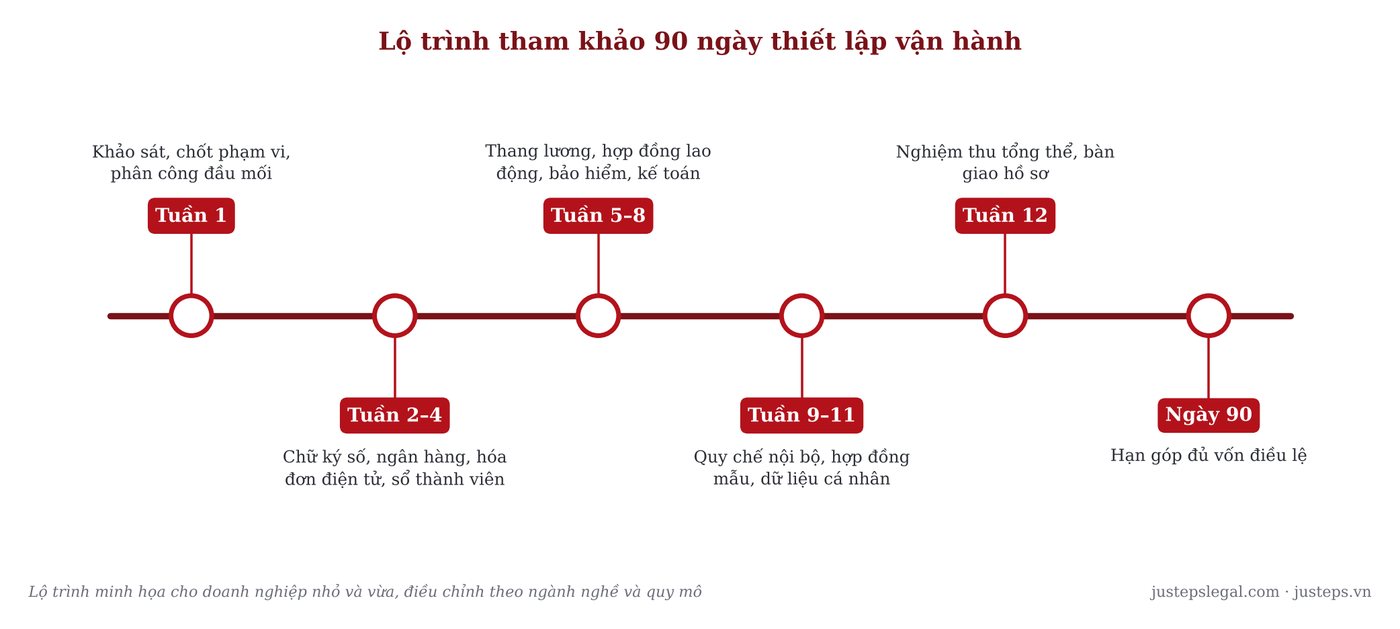
Indicative 90-day operations set-up roadmap for a newly incorporated company
The first week is devoted to the survey, fixing the scope and assigning points of contact between the company and the consulting firm. From the second to the fourth week, the company completes its digital signature, bank account, electronic invoices and register of members or shareholders, and begins work on its pay scales. The second month focuses on labour, insurance and the accounting function, while the third month is set aside for internal policies, template contracts, personal data and overall acceptance. The 90-day deadline for full capital contribution falls within this roadmap and needs to be tracked separately because it is a hard statutory deadline.
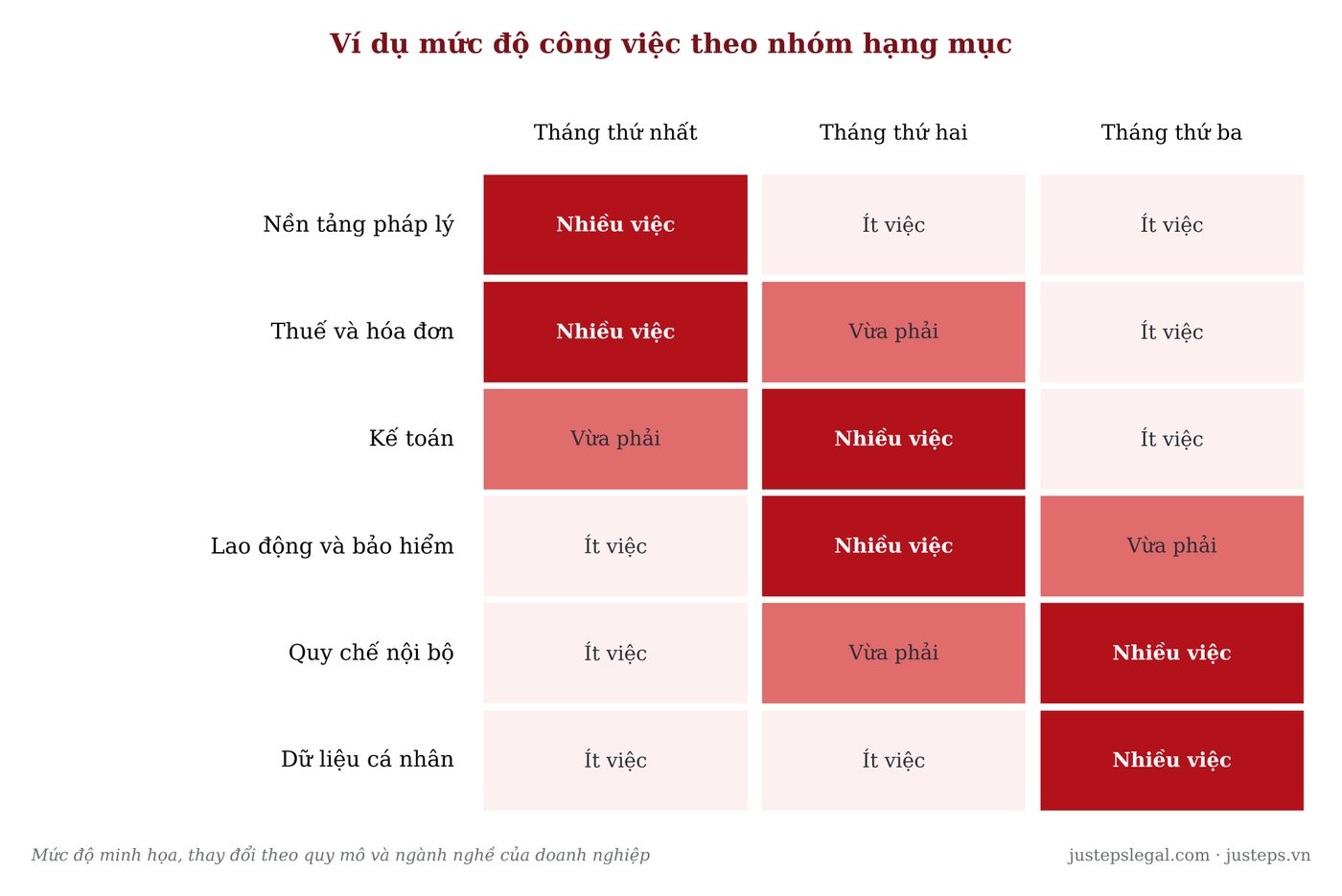
The workload is not spread evenly across the months, so the company needs to know in advance which department will be busiest in which month in order to assign people to work alongside the consultants. The following chart illustrates the level of involvement of each group of workstreams over the first three months.
Example of the workload of each group of workstreams over the first three months
In this example, the legal foundations, tax and invoicing are concentrated in the first month, while labour, insurance and accounting peak in the second month when the company recruits in large numbers. Internal policies and personal data protection carry the heaviest workload in the third month because they need to build on the results of the earlier workstreams. Companies with conditional lines of business should bring the sector-specific compliance group forward to the first month, because many licences must be obtained before operations can begin.
Acceptance criteria and handover
In essence, an operations set-up package is a service contract under which the service provider performs work for the service user and the service user pays the service fee[20]. The service user has the right to require the work to be performed in accordance with the agreed quality, quantity and timing, and the right to terminate the contract unilaterally if the service provider seriously breaches its obligations[20]. The contract should therefore include a scope of work appendix and an acceptance criteria appendix detailed down to each workstream, rather than simply referring to a turnkey operations set-up.
Acceptance should be organised in phases, with each phase ending in a record of the results delivered, any outstanding issues to be remedied and the deadline for remedying them. The following flowchart describes the acceptance sequence for a single workstream.
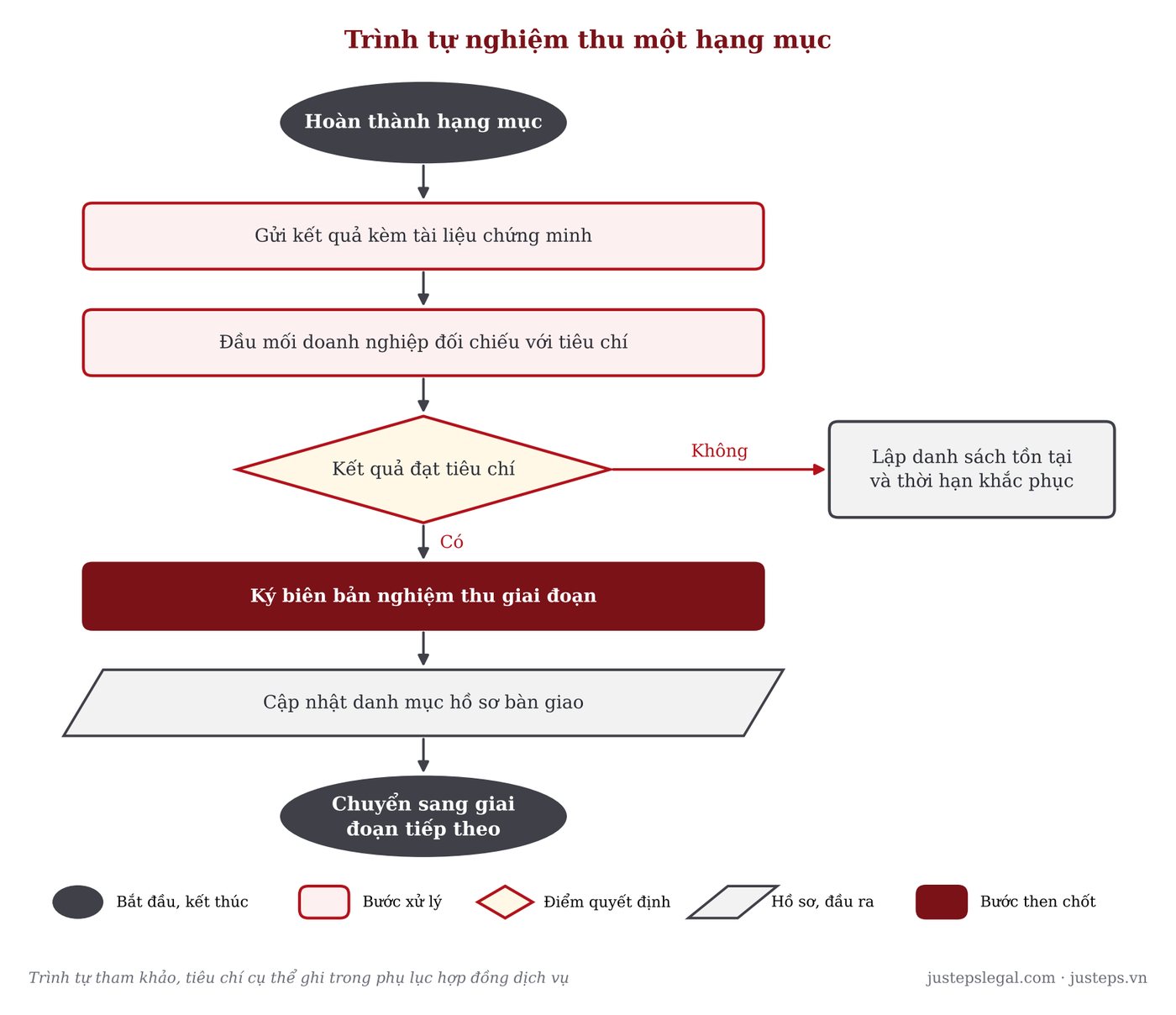
Acceptance sequence for a single workstream in an operations set-up package
The consulting firm submits the result together with supporting evidence, such as a signed decision, an acceptance notice from the tax authority or a log of a test run. The company’s point of contact checks the result against the criteria in the appendix and, if it falls short, draws up a list of outstanding issues for the consulting firm to complete within the agreed time frame. Once the result meets the criteria, both parties sign the phase acceptance record, update the handover document list and move on to the next phase. This approach brings shortcomings to light early and avoids discovering only at the end of the package that an important procedure has not been carried out.
At the end of the package, the company should receive an operations file containing every document issued, the accounts and passwords whose management has been transferred, a calendar of recurring tax, insurance and reporting obligations, and implementation guidance for each position. The period of post-handover support, usually one to three months, should be stated in the contract so that the company can obtain answers when it handles its first tax filing and insurance payment periods on its own. Interested companies may consider Justeps’ turnkey business operations set-up service.
How Justeps can help
Justeps supports companies in building and signing off their operating structure from the very first months through the following services:
- Turnkey business operations set-up. Justeps surveys the company, defines the scope of work, implements the workstreams in sequence and conducts phased acceptance together with the company.
- First 90 days operations file set-up. Justeps prepares the obligations calendar and the legal, tax and labour files that must be completed within the first 90 days after incorporation.
- Internal governance policy and procedure development. Justeps drafts financial regulations, delegation of authority, purchasing procedures and contract management rules consistent with the charter.
- Organising the accounting function and documentation. Justeps advises on choosing an accounting regime, appointing the person in charge of accounting, the document system and the expenditure approval flow.
- Labour files and employment contracts. Justeps drafts employment contract templates, pay scales and internal labour rules and guides the social insurance formalities for the first employees.
Frequently asked questions
Must a newly incorporated company have a chief accountant?
The company must appoint a chief accountant or a person in charge of accounting, or engage accounting services from a qualified organisation or individual[9]. Small companies often choose to outsource to save costs, but they still need someone in-house to manage supporting documents and approve expenditure.
What must a company do if capital has not been contributed in full within 90 days?
The company must register an adjustment of its charter capital and ownership ratios to reflect the capital actually contributed within the statutory period[1]. A late adjustment may attract administrative penalties and give rise to disputes between members.
Must a company register internal labour rules as soon as it is incorporated?
The obligation to issue written internal labour rules and register them arises when the company employs 10 or more employees[15]. Companies with fewer than 10 employees need not register them but should still agree disciplinary matters in their employment contracts.
Must a company incorporated in 2026 pay the business licence fee?
No, because the business licence fee was abolished from 1 January 2026[8]. The company must still meet its other tax filing obligations according to the tax calendar it has prepared.
How long does an operations set-up package take?
For a small or medium-sized company without any special lines of business, the package is usually implemented over about 60 to 90 days. Foreign-invested companies, companies with conditional lines of business and those recruiting many employees at once usually need longer.
What should the company do if a deliverable does not meet the acceptance criteria?
The company records the outstanding issues in the acceptance record, requires them to be remedied within the agreed time frame and pays the fee for that phase only once the result meets the criteria. The service user has the right to require performance to the agreed quality and to claim compensation for any loss[20].
Does a company with only a few employees need a personal data protection policy?
Yes, because the company processes its employees’ personal data as soon as it signs their contracts and registers them for insurance[19]. Small size affects only the level of detail of the files, not the obligation to notify and protect data.
Related articles
- Setting up a company in Hanoi: documents required, processing time and what to do immediately after registration
- Which documents make up the minimum set of internal governance rules for a company with 50 to 200 staff
- Building a business conditions map to control conditional business lines before the launch date
- What companies must satisfy when moving to electronic employment contracts and how those contracts should be stored
Notes
[1] Clause 2 of Article 47, Clause 2 of Article 75 and Clause 1 of Article 113 of the Law on Enterprises No. 59/2020/QH14 dated 17 June 2020, as amended and supplemented by Law No. 76/2025/QH15.
[2] Articles 47, 48 and 122 of the Law on Enterprises No. 59/2020/QH14, as amended and supplemented by Law No. 76/2025/QH15.
[3] Law No. 76/2025/QH15 amending and supplementing a number of articles of the Law on Enterprises, and Decree No. 168/2025/ND-CP on enterprise registration, as amended by Decree No. 296/2026/ND-CP.
[4] Article 43 of the Law on Enterprises No. 59/2020/QH14.
[5] Law on Investment No. 143/2025/QH15, effective from 1 March 2026.
[6] Government Decree No. 123/2020/ND-CP dated 19 October 2020 on invoices and documents, as amended and supplemented by Decree No. 70/2025/ND-CP.
[7] Law on Tax Administration No. 108/2025/QH15, effective from 1 July 2026.
[8] Resolution No. 198/2025/QH15 of the National Assembly dated 17 May 2025 on a number of special mechanisms and policies for the development of the private economy.
[9] Law on Accounting No. 88/2015/QH13 dated 20 November 2015, provisions on the organisation of the accounting function, chief accountants and accounting services.
[10] Circular No. 99/2025/TT-BTC of the Ministry of Finance providing guidance on the enterprise accounting regime.
[11] Articles 14 and 21 of the Labour Code No. 45/2019/QH14 dated 20 November 2019; Decree No. 337/2025/ND-CP on electronic employment contracts.
[12] Article 93 of the Labour Code No. 45/2019/QH14.
[13] Decree No. 399/2026/ND-CP on minimum wages applicable from 1 January 2027.
[14] Law on Social Insurance No. 41/2024/QH15 dated 29 June 2024, provisions on registration and on the wages used as the basis for compulsory social insurance contributions.
[15] Articles 118 and 119 of the Labour Code No. 45/2019/QH14.
[16] Government Decree No. 145/2020/ND-CP dated 14 December 2020 detailing and guiding the implementation of a number of articles of the Labour Code on working conditions and labour relations.
[17] Government Decree No. 219/2025/ND-CP on foreign workers working in Vietnam.
[18] Law amending and supplementing the Labour Code, passed by the National Assembly on 21 November 2026, effective from 1 March 2027.
[19] Law on Personal Data Protection No. 91/2025/QH15 and Decree No. 363/2026/ND-CP.
[20] Articles 513, 515, 518 and 520 of the Civil Code No. 91/2015/QH13 dated 24 November 2015.
This article is for reference and reflects the regulations in force at the time of publication. Please consult Justeps for advice tailored to your company’s records and situation.
For further information, please contact:
📩 Email: info@justeps.vn
🌐 Website: https://justepslegal.com · https://justeps.vn
🌐 Page: Justeps
☎️ Hotline (Zalo): 096 172 2607
📍 Thanh Xuan Office: 12th Floor, Licogi 13 Tower, 164 Khuat Duy Tien Street, Thanh Xuan Ward, Hanoi, Vietnam
📍 Ha Dong Office: LK06B, No.10, Dong Dua Area, Ha Dong Ward, Hanoi, Vietnam
📍 Ho Chi Minh City Branch: 528 Le Van Sy, Ho Chi Minh City, Vietnam
📍 Hai Phong Office: Truong Thinh Village, Ha Dong Commune, Hai Phong, Vietnam
📍 Quang Ninh Office: Van Don Special Zone, Quang Ninh Province, Vietnam





