
Key takeaways
- An employee handbook is a voluntary management document and does not replace the internal labour regulations; a business with 10 or more employees must still issue written regulations and register them within 10 days.
- Employees may only be disciplined for conduct set out in the internal labour regulations, the employment contract or labour law, so the handbook should only repeat and cross-refer, not create new offences.
- The handbook of a business with fewer than 50 employees should be kept to about 15 to 25 pages and written from the questions employees have actually asked in recent months.
- Every figure on working hours, leave and benefits in the handbook must match the internal labour regulations, the contract and the wage and bonus regulations; fines must not be stated, because the law prohibits fines in place of disciplinary action.
- The new public holidays from 1 March 2027 are an occasion for the business to review the internal labour regulations first and then update the handbook to the same version.
In a small business, the HR department often spends a lot of time answering the same set of questions over and over again, such as which day wages are paid, how much notice is needed for annual leave, whether working from home is allowed or who approves sick leave. When the business opens another shop or branch, each location handles late arrival or shift swaps in its own way, because the rules are only passed on verbally through managers. Some businesses even list disciplinary offences in the induction material for new staff, but those offences have never been included in the internal labour regulations, so there is no basis for action when it is needed. A concise, practical employee handbook that is consistent with the legally binding documents helps to resolve all three problems.
This article shares practical lessons in building an employee handbook for a small business, covering how to distinguish the handbook from the internal labour regulations, when to prepare one, a suitable structure, how to write it, the issuing procedure and the mistakes to avoid. It is aimed mainly at businesses with anywhere from a few employees to about 50, including businesses that have just passed the 10-employee threshold and are preparing to register their internal labour regulations. It is written for business owners, directors and the people in charge of administration and HR.
How an employee handbook differs from the internal labour regulations
Internal labour regulations are a mandatory document under the Labour Code. Employers must issue internal labour regulations, and if they employ 10 or more workers the regulations must be in writing[1]. The regulations must cover the main matters prescribed by law, namely working hours, rest periods, order at the workplace, occupational safety and hygiene, prevention of sexual harassment, protection of assets and trade secrets, disciplinary offences and penalties, liability for material damage and the persons authorised to impose discipline[1][2]. Before issuing or amending them, the business must consult the employee representative organisation at the workplace, if there is one, notify employees of the regulations and display their main content at the workplace[1].
A business with 10 or more employees must register its internal labour regulations with the specialised labour authority of the provincial People’s Committee where it is registered, within 10 days of issuing them[3]. The regulations take effect 15 days after that authority receives a complete file; for a business with fewer than 10 employees that issues written regulations, the effective date is decided by the employer and stated in the regulations[4]. A business with a branch or establishment in another province must also send the registered regulations to the labour authority where that branch or establishment is located[3].
An employee handbook is different. It is a management document that the business prepares voluntarily, does not have to register with any state authority and is intended to explain how the business operates and guide employees through everyday tasks. The handbook may repeat some content from the internal labour regulations to make it easier to read, but it cannot replace them and does not create any new basis for discipline. The table below compares the two documents against the criteria that businesses most often confuse:
| Criterion | Internal labour regulations | Employee handbook |
|---|---|---|
| Mandatory nature | Must be issued; must be in writing where the employer has 10 or more employees. | Not mandatory; the business decides whether to prepare one. |
| Registration | Must be registered with the provincial labour authority within 10 days of issue. | Need not be registered with any state authority. |
| Main content | The matters prescribed by law, focusing on labour discipline and liability for material damage. | Culture, ways of working, internal procedures, benefits and support channels. |
| Style | An internal normative document, divided into articles and clauses, with precise wording. | Guidance written in a friendly tone, with examples and possibly illustrations. |
| Basis for discipline | One of the bases for imposing labour discipline. | Not a basis for discipline; it only repeats and cross-refers to the internal labour regulations. |
The most important distinction lies in the last row of the table. The Labour Code prohibits disciplining an employee for conduct that is not set out in the internal labour regulations, not agreed in the employment contract or not provided for by labour law[5]. Accordingly, if a type of conduct appears only in the handbook and not in the internal labour regulations or the contract, the business cannot discipline an employee for it, even if the employee has signed to confirm having read the handbook.
Businesses with fewer than 10 employees
A business with fewer than 10 employees is not required to issue written internal labour regulations, but under the implementing decree the parties must agree on labour discipline and liability for material damage in the employment contract[2]. In practice, many small businesses choose to include a short chapter of workplace rules in the handbook and cross-refer to it in the employment contract, so that they have a basis for discipline while managing only one document. This approach works while the business is small, but when headcount is about to reach 10, the business should turn that chapter into separate internal labour regulations so that it can issue and register them on time.
When a small business should prepare a handbook
Not every business needs a handbook in its first year. For a company of three to five people sharing an office, an internal notice on working hours, annual leave and pay arrangements is usually enough. A handbook starts to be useful when one of the following signs appears:
- The business recruits about five or more new people a year and whoever handles induction has to explain the same things to each of them.
- The business opens another branch or shop or has a remote team, so the rules are easily applied differently from one place to another.
- The rules are scattered across emails, group chats and notices on the wall, and nobody knows which version is still in force.
- The business is about to issue or amend its internal labour regulations, which gives it the chance to review all its employee-facing documents at the same time.
If none of these signs is present, the business should give priority to completing its employment contracts, wage regulations and internal labour regulations, because these are the documents with direct legal effect. A handbook prepared afterwards will be easier to keep consistent, because there are already sources to quote and cross-refer to.
A concise structure for businesses with fewer than 50 employees
A small business’s handbook should be kept to about 15 to 25 pages, short enough for a new employee to read in full on the first day. The most effective way to decide on the content is to collect the actual questions employees have sent to the HR department and managers over the last three to six months and group them by topic. The topics asked about most often should come first and be written in the greatest detail.
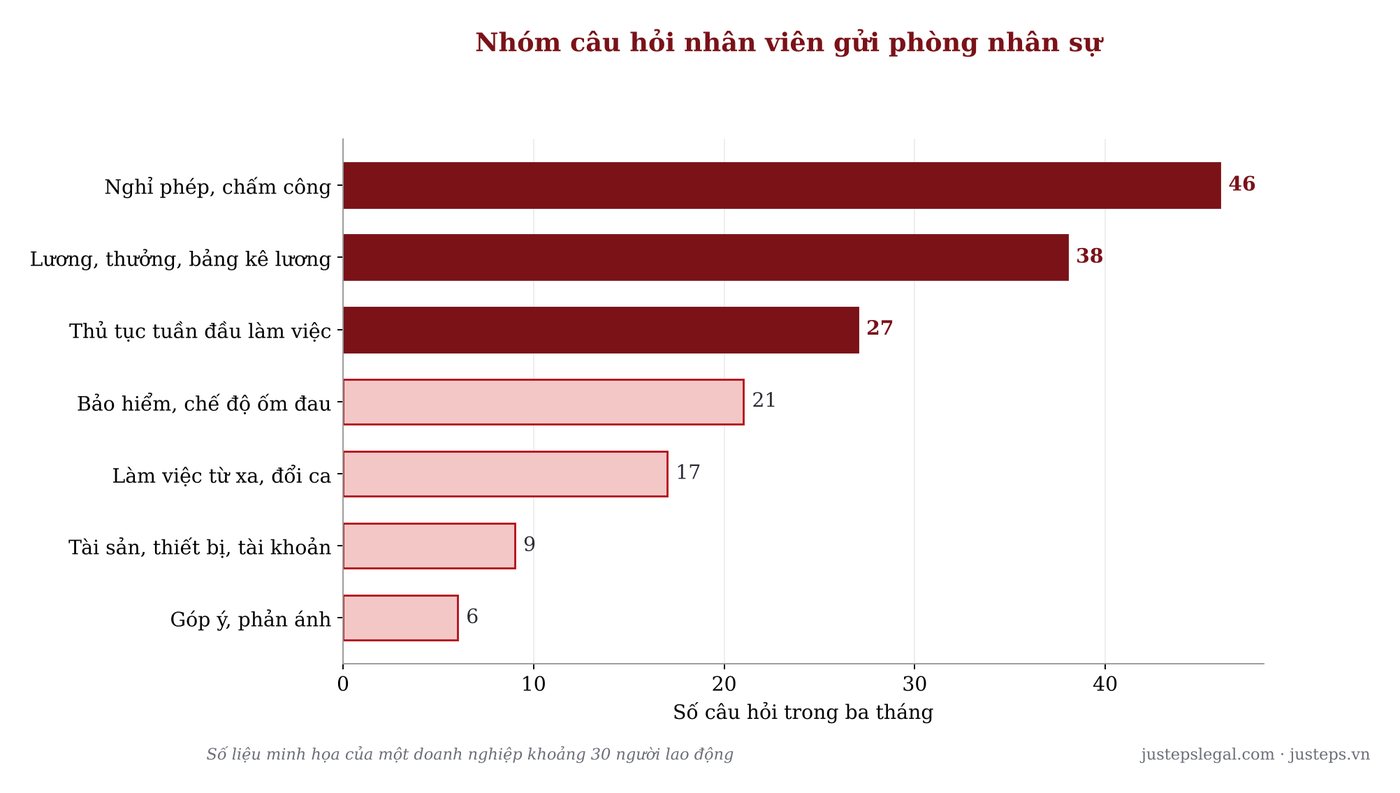
Groups of questions employees sent to the HR department over three months at a small business
In the example, questions about leave and timekeeping are the most numerous, followed by questions about pay and bonuses and the procedures in the first week of work. These topics should be written as step-by-step instructions, with the name of the person in charge and the processing time, for example that leave requests are submitted through the software at least three working days in advance and approved within one working day. Less frequently raised topics, such as rules on assets and confidentiality, still need to be in the handbook, but can be written briefly with a cross-reference to the internal labour regulations or a separate policy.
Based on this approach, a structure suitable for most small businesses usually has six parts, arranged in the order in which new employees need the information, from their first day until they are settled in:
- An introduction to the company and how it works, setting out its mission, core values and a few concrete examples of behaviour for each value.
- A section on the new employee’s first week, explaining what to do on the first day, who the mentor is, work accounts and documents to be submitted.
- A section on working hours, leave and timekeeping, setting out working hours, shifts and how to request leave, which must match the internal labour regulations exactly.
- A section on pay, bonuses and benefits, explaining pay day, how to read the payslip and insurance, with a cross-reference to the wage and bonus regulations.
- A section on assets, information and confidentiality, explaining the use of equipment, accounts and customer data, with a cross-reference to the corresponding provisions of the internal labour regulations.
- A section on conduct, feedback and prevention of harassment, setting out the reporting channels, the person who receives reports and the handling procedure under the internal labour regulations.
In the section on working hours and rest, the business needs to be particularly careful with figures. Normal working hours must not exceed 8 hours a day or 48 hours a week[6], and an employee who has worked for a full 12 months is entitled to 12 working days of annual leave for work in normal conditions[7]. The Law amending and supplementing a number of articles of the Labour Code, passed by the National Assembly on 21 November 2026 and taking effect on 1 March 2027, adds 27 July and 24 November as fully paid public holidays[8], so the list of public holidays in any handbook prepared from now on must be updated accordingly. The business may grant more annual leave than the statutory minimum as a benefit, but that figure must be stated consistently in the internal labour regulations, the contract and the handbook.
Writing so that employees read it and follow it
The handbook should be written in short sentences and a guiding tone, with each section answering a specific employee question and ending with the name of the person or department to contact. Instead of stating in general terms that employees must keep to working hours, the handbook should state clearly the start and finish times, how to clock in, how to report late arrival and the consequences under the internal labour regulations. Terms such as working day, standard working days and the insurance contribution wage should be explained briefly when they first appear, because new employees are often unfamiliar with them.
Each section of the handbook needs a department or person responsible for its content, for example the accounting department for the pay section and the IT department for the accounts and security section. The HR department controls the versions, ensuring that no two sections contradict each other and that every change is recorded. Before issuing the handbook, the business should ask two or three new employees to read the draft and note anything they do not understand, as this is the quickest way to find unclear wording.
The section on pay, bonuses and benefits needs to be written more carefully than the others. The handbook should not state the wage for each position, but only explain the principles and pay periods, with a cross-reference to the wage and bonus regulations that have been issued. For voluntary benefits such as company trips, health checks or holiday gifts, the wording should make clear that they are provided under each year’s policy and may be adjusted, so as not to create a fixed commitment that the business would find hard to honour in difficult times.
Issuing, acknowledgement and version control
The handbook should be issued through a clear sequence linked to the review of the internal labour regulations, so that the two documents always go together. The flowchart below shows the sequence from collecting questions to issuing the handbook and including it in the induction programme for new employees.
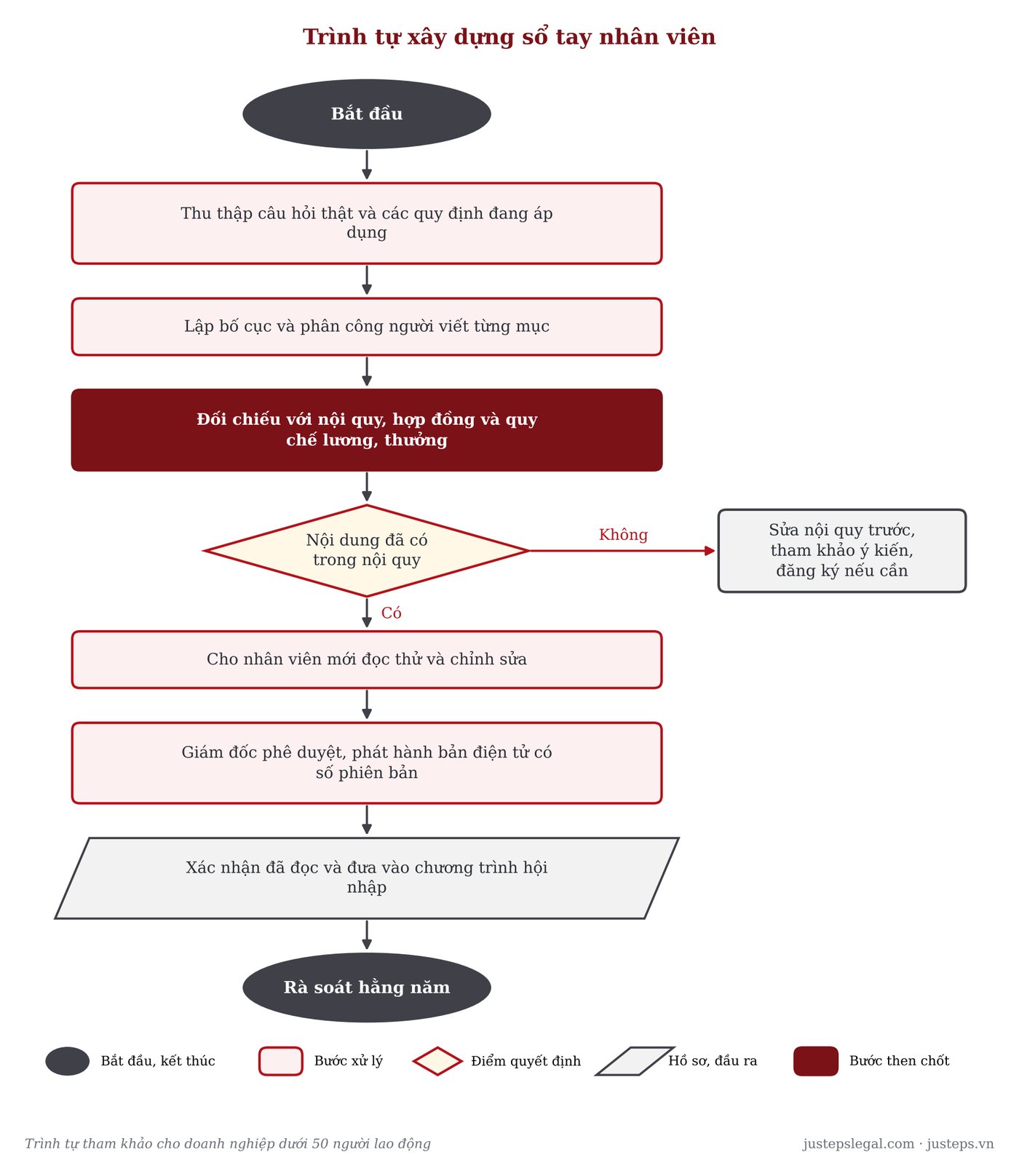
The sequence for drafting, checking and issuing an employee handbook
The first step is to collect questions and the rules currently applied, then draw up the structure and assign authors for each section. The key step is to check the draft against the internal labour regulations, employment contracts and the wage and bonus regulations; if any content not yet in the internal labour regulations is to be used as a basis for discipline, it must first be added to those regulations, going through the full consultation and registration procedure. After trial reading and revision, the director approves the handbook, and the HR department publishes the electronic version and obtains each employee’s acknowledgement that they have read it.
Acknowledgement may be given by signature on paper or by a confirmation step in the HR software, provided that the time and identity of the person confirming are recorded. It should be noted that acknowledging the handbook does not replace the obligation to notify employees of the internal labour regulations and display their main content at the workplace[1]. Each version of the handbook should state its version number, effective date and a summary of changes from the previous version; the business should maintain only one link to the current version to prevent employees from using an old one.
The handbook and acknowledgement records contain employee information such as names, job titles and the time of acknowledgement. When storing them in software or shared folders, the business must control access rights and inform employees of the purpose for which this information is processed[9]. The part of the handbook that guides employees on handling customer data should also be written consistently with the business’s personal data protection policy.
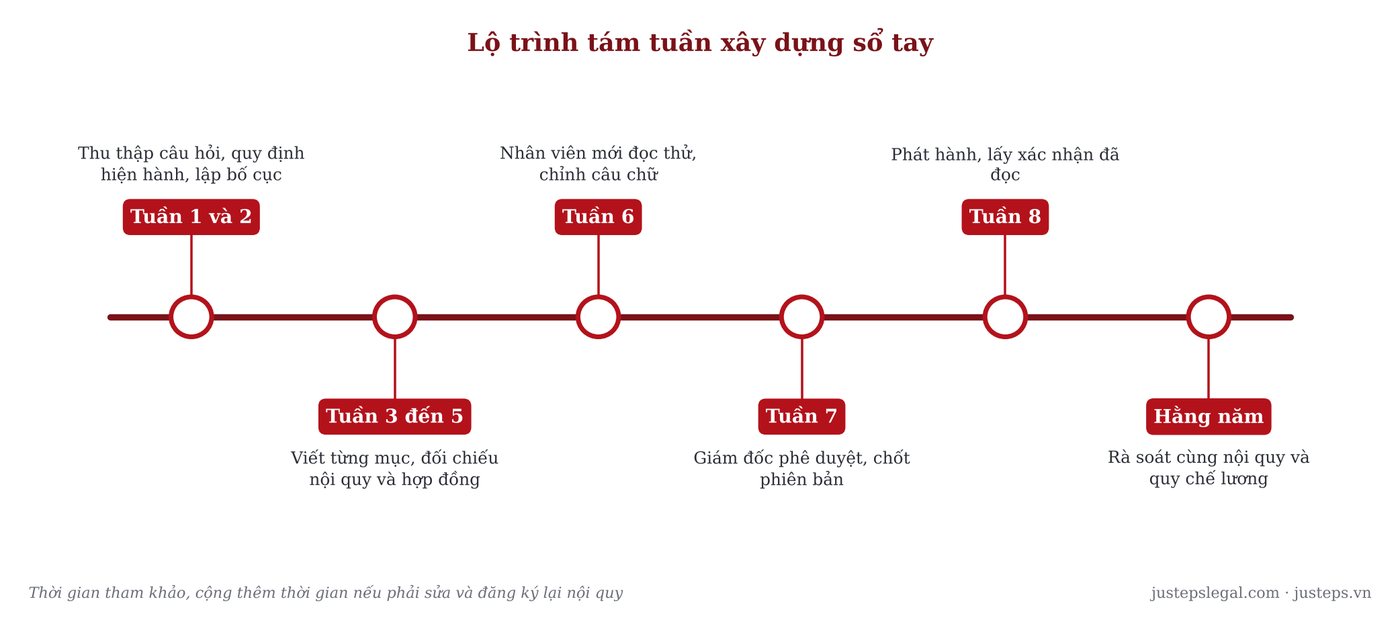
An indicative eight-week timeline for building and issuing a handbook
For a business with fewer than 50 employees, the whole process usually takes about eight weeks if the internal labour regulations do not need significant amendment. The first two weeks are spent collecting questions and drawing up the structure, the next three weeks on writing and cross-checking, followed by trial reading, approval and publication. Where the internal labour regulations must be amended, the business needs to allow additional time for consulting the employee representative organisation and for the regulations to take effect after registration.
Common mistakes
The first common mistake is to copy the handbook of a large company, resulting in a document of more than 60 pages with many procedures that a small business does not have, so employees do not read it and managers do not apply it. The second mistake is to set fines for arriving late, forgetting to clock in or breaching the dress code. The Labour Code prohibits fines and wage deductions in place of labour discipline[5], so such rules have no legal effect and may even expose the business to administrative penalties.
The third mistake is that the leave entitlement, working hours or overtime rules in the handbook do not match the internal labour regulations and the contract, usually because the handbook has been updated but the regulations have not, or vice versa. When a dispute arises, the employee will rely on whichever document is more favourable to them, and the business will find it hard to explain why two of its own documents differ. The fourth mistake is that the business has passed the 10-employee threshold but still has only a handbook and has not issued and registered internal labour regulations, so it lacks a sufficient basis when discipline is needed.
To avoid these mistakes, the business should schedule a review of the handbook at least once a year and whenever the internal labour regulations, the wage and bonus regulations or labour law change. The order of updating is always the internal labour regulations and contracts first, the handbook second. Businesses that need to draft or review their internal labour regulations and registration file may refer to Justeps’ internal labour regulations and disciplinary procedures service; businesses wishing to align their handbook with their other internal regulations may use our internal regulations and work rules service.
How Justeps can help
Justeps helps small businesses build a concise, practical employee handbook that is consistent with their legally binding documents through the following services:
- Internal labour regulations and disciplinary procedures. Justeps drafts and reviews internal labour regulations and prepares the registration file when the business employs 10 or more people.
- Internal regulations and work rules. Justeps drafts the employee handbook based on how the business actually operates and checks it against employment contracts, internal labour regulations and other internal rules.
- Pay scales and wage and bonus regulations. Justeps develops wage and bonus regulations to serve as the reference for the pay, bonus and benefits section of the handbook.
- HR, labour and internal compliance training. Justeps trains managers and HR teams to apply the handbook and internal labour regulations consistently in day-to-day management.
Frequently asked questions
Must an employee handbook be registered with a state authority?
An employee handbook does not need to be registered. Only the internal labour regulations of a business with 10 or more employees must be registered with the provincial specialised labour authority within 10 days of issue[3].
Can the employee handbook be used as a basis for disciplinary action?
It should not be, because the law prohibits disciplining employees for conduct not set out in the internal labour regulations, the employment contract or labour law[5]. The handbook should only repeat and cross-refer to the corresponding provisions of the internal labour regulations.
Does a business with fewer than 10 employees need internal labour regulations?
The business must still issue internal labour regulations, but they need not be in writing; where there are no written regulations, the parties must agree on labour discipline and liability for material damage in the employment contract[2]. Many small businesses include a short chapter of workplace rules in the handbook and cross-refer to it in the contract.
How many pages should an employee handbook be?
For a business with fewer than 50 employees, about 15 to 25 pages is appropriate so that new employees can read it in full on their first day. Long, specialised content such as wage regulations or business travel policies should be kept in separate documents and cross-referenced.
May the handbook set fines for arriving late?
No, because the Labour Code prohibits fines and wage deductions in place of labour discipline[5]. Late arrival can only be dealt with through the disciplinary penalties set out in the internal labour regulations and in accordance with the statutory procedure.
How often should the handbook be updated?
The business should review it at least once a year and whenever the internal labour regulations, the wage and bonus regulations or labour law change. The amendments to the Labour Code taking effect on 1 March 2027 are a good time to review the list of public holidays[8].
If employees have signed to confirm they have read the handbook, does the business still need to notify them of the internal labour regulations?
Yes, because employees must be notified of the internal labour regulations and their main content must be displayed in the necessary places at the workplace[1]. The business may obtain acknowledgement for both documents at the same time, but must identify each document clearly.
Related articles
- Building an HR department from scratch once a business passes 30 employees
- Building a 30-60-90 day onboarding programme for new employees aligned with the probationary period
- The procedure for issuing internal documents in a company, from drafting to archiving and monitoring their validity
- Building a remote work and flexible working hours policy that complies with the Labour Code
Notes
[1] Clauses 1, 2, 3 and 4 of Article 118 of the Labour Code No. 45/2019/QH14 dated 20 November 2019.
[2] Clauses 1 and 2 of Article 69 of Government Decree No. 145/2020/ND-CP dated 14 December 2020 detailing and guiding the implementation of a number of articles of the Labour Code on working conditions and labour relations.
[3] Clauses 1, 2 and 4 of Article 119 of the Labour Code No. 45/2019/QH14.
[4] Article 121 of the Labour Code No. 45/2019/QH14.
[5] Clauses 2 and 3 of Article 127 of the Labour Code No. 45/2019/QH14.
[6] Clause 1 of Article 105 of the Labour Code No. 45/2019/QH14.
[7] Point a of Clause 1 of Article 113 of the Labour Code No. 45/2019/QH14.
[8] The Law amending and supplementing a number of articles of the Labour Code, passed by the National Assembly on 21 November 2026 and effective from 1 March 2027.
[9] The Law on Personal Data Protection No. 91/2025/QH15 and Decree No. 363/2026/ND-CP.
This article is for reference and reflects the regulations in force at the time of publication. Please consult Justeps for advice tailored to your company’s records and situation.
For further information, please contact:
📩 Email: info@justeps.vn
🌐 Website: https://justepslegal.com · https://justeps.vn
🌐 Page: Justeps
☎️ Hotline (Zalo): 096 172 2607
📍 Thanh Xuan Office: 12th Floor, Licogi 13 Tower, 164 Khuat Duy Tien Street, Thanh Xuan Ward, Hanoi, Vietnam
📍 Ha Dong Office: LK06B, No.10, Dong Dua Area, Ha Dong Ward, Hanoi, Vietnam
📍 Ho Chi Minh City Branch: 528 Le Van Sy, Ho Chi Minh City, Vietnam
📍 Hai Phong Office: Truong Thinh Village, Ha Dong Commune, Hai Phong, Vietnam
📍 Quang Ninh Office: Van Don Special Zone, Quang Ninh Province, Vietnam





