
Key takeaways
- The structure of a sales department should be designed from the revenue target and the way customers buy, rather than copying another business’s chart or starting from the number of people already employed.
- Each organisational model, whether by territory, customer segment, product or function in the sales process, needs an accompanying customer ownership rule to prevent disputes over commission.
- The number of salespeople is calculated from the revenue target, the average contract value and actual productivity, and only then are team leaders and support staff added.
- Salespeople working under employment contracts must receive a wage rate for the job of not less than the regional minimum wage, so their entire income cannot be paid as commission.
- Targets used as a basis for pay must be reasonable and announced in advance, while bonus regulations are decided by the business and published after consulting the employee representative organisation if there is one.
An office equipment distribution company has twelve salespeople, all of whom report directly to the director. Each of them looks for customers in any territory, so some customers receive quotations from three salespeople at three different prices, while existing customers are left with almost no one looking after them once the contract has been signed. At the end of the year, two salespeople dispute the commission on the same large contract, the director has to settle the matter personally, and one of them leaves, taking the customer list with them. Revenue is still growing, but the director spends most of their time dealing with issues that a clear structure would have resolved.
This article sets out how to build the structure of a sales department in the order in which the work is carried out, covering how to recognise when reorganisation is needed, choosing a model, calculating headcount and span of control, delegation of authority and customer ownership rules, targets and pay, and the internal documents to be issued. The content suits trading, service and manufacturing businesses with a sales team of around five to several dozen people. The main readers are directors, sales directors and heads of human resources.
When a business needs to rebuild the structure of its sales department
A sales department usually takes shape naturally according to need, with the founder selling directly and adding one person at a time as the customer base grows. This approach works in the early stage, but beyond a certain size the lack of structure begins to reduce productivity and increase risk. A business should review its structure when one or more of the following signs appear:
- The number of salespeople reporting directly to one person exceeds roughly eight to ten, leaving the manager without enough time to coach and check their work.
- Customers report being contacted by several people at once or having no one to look after them after signing a contract.
- The business expands into a new territory, a new product line or an online sales channel for which the current team has no one in charge.
- Sales staff turnover is high and each departure costs the business part of its customer base.
- Disputes over commission or over who is in charge of a customer occur frequently.
These signs share a common root cause, namely that responsibilities and entitlements have not been clearly allocated. Rebuilding the structure therefore goes beyond drawing a new chart and must be accompanied by headcount planning, job descriptions, customer ownership rules and a matching pay mechanism. If only the chart is changed while the old commission method is kept, the team’s behaviour will remain almost unchanged.
Organisational models for a sales department
There are four common ways of dividing a sales department, namely by geographical territory, by customer segment, by product line and by function in the sales process. Each model suits a particular type of market and brings its own management requirements. The matrix below compares how well the four models fit against several criteria that are commonly considered.
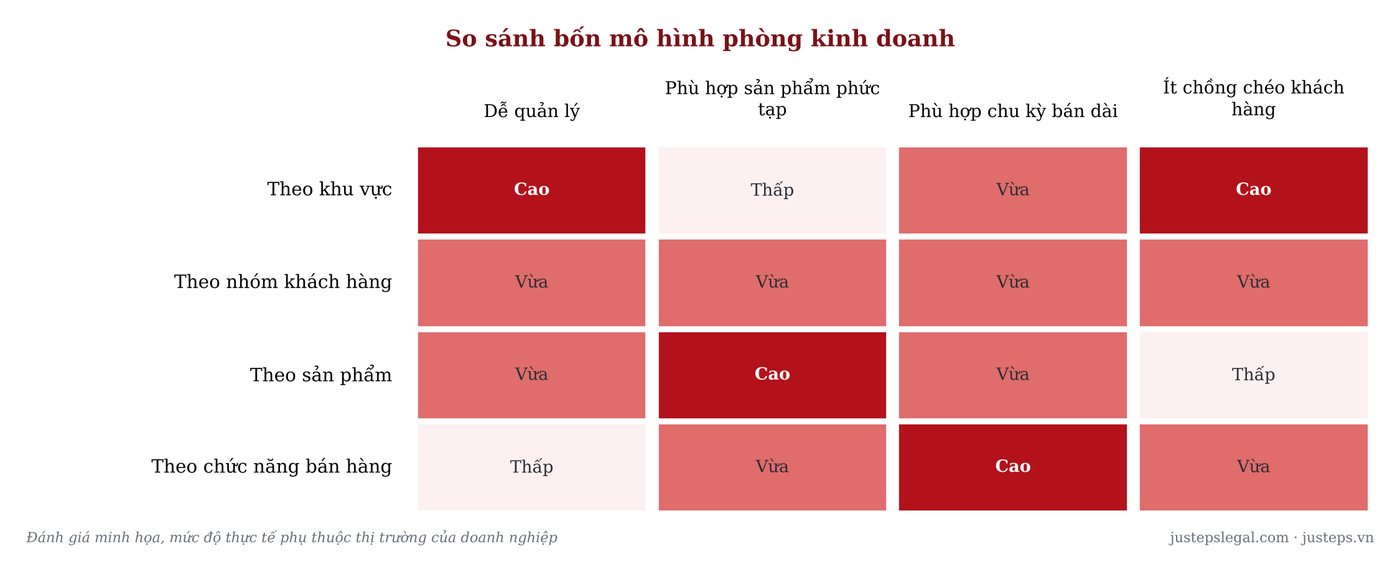
How well the four organisational models for a sales department fit
According to the matrix, the territory model is easy to manage and suits distribution and dealer networks, but is less flexible when large customers have branches in many locations. The customer segment model, for example dividing between large enterprises, small and medium-sized enterprises and individual customers, suits services and technology because each segment buys in a different way. The product model suits complex products that require deep expertise, but easily leads to several teams contacting the same customer. The functional model, in which one team finds prospective customers, another closes contracts and a third provides after-sales care, suits long sales cycles but requires a handover procedure and a fair way of sharing commission.
Combining models once the team is large enough
When the sales department has around fifteen people or more, the business may combine two models, for example dividing first by territory and then, within each territory, by customer segment. This combination draws on the strengths of both models but increases the number of management levels and the cost. With a smaller team, combining models often produces groups of only one or two people, making it difficult to cover when someone leaves. The general principle is to choose one main axis that reflects how customers buy, and to add a second axis only when the main axis is fully staffed.
Calculating headcount and span of control
The number of salespeople should be calculated backwards from the revenue target rather than from the number of people currently employed. A simple calculation has three steps, namely determining the number of contracts to be signed from the revenue target and the average contract value, determining the productivity of an experienced salesperson from previous years’ data, and then dividing the first figure by the second and adding a buffer for new hires and departures. The table below illustrates the calculation for a business with a target of 60 billion dong in revenue from new contracts.
| Calculation step | How it is determined | Illustrative result |
|---|---|---|
| Contracts to be signed | Divide the revenue target by the previous year’s average contract value. | 60 billion dong divided by 300 million dong gives 200 contracts. |
| Productivity per person | Take the average number of contracts an experienced salesperson signs in a year. | Around 18 contracts per person per year. |
| Salespeople needed | Divide the number of contracts to be signed by the productivity per person. | Around 11 salespeople. |
| Buffer | Add 10% to 15% to cover the ramp-up time of new hires and departures. | A headcount of 12 to 13 salespeople. |
| Management and support | One team leader for around 6 to 8 people and one support staff member for 8 to 12 people. | Two team leaders, one head of department and one support staff member. |
The span of control of a sales team leader is usually narrower than in other departments because the team leader has to accompany staff to customer meetings, approve quotations and coach newcomers. Sales support staff prepare quotations, draft contracts from templates and follow up deliveries and receivables, allowing salespeople to spend their time with customers. The figures in the table are only an example, and the business should update actual productivity every year rather than relying on estimates. Once the headcount has been approved, each position needs its own job description, and the business may refer to Justeps’ service on organisational structure, functions and duties, and job descriptions to complete this part.
Delegation of authority and customer ownership rules
As regards authority, the Law on Enterprises No. 59/2020/QH14, as amended by Law No. 76/2025/QH15, specifies which management titles are appointed by the Members’ Council or the Board of Directors and which are appointed by the Director or General Director[1]. The charter and internal regulations of the business should state clearly who has the authority to appoint the sales director and the head of the sales department, to avoid disputes when personnel change. Besides appointment authority, the sales department needs an authority matrix for everyday decisions such as the maximum discount, the payment terms that may be accepted and the contract value that each level may sign or submit for signature.
The customer ownership rule is a document that receives little attention but has the greatest effect on internal disputes. This rule determines when a customer belongs to a salesperson, for example from the time the customer is recorded in the customer management system with evidence of contact, how long that right lasts if there is no transaction, and how matters are handled when a customer moves to another territory or segment. The rule must also specify how commission is shared when several people take part in a contract and how customers are handed over when a salesperson leaves or changes position. Under the product or functional model, the rule needs to designate one main point of contact for each customer so that the customer is not contacted by several people at once.
Protecting customer data
The customer list is an asset of the business, and an employment contract may contain an agreement on protecting business secrets, together with the related entitlements and compensation if the employee commits a breach[2]. Personal customer data in the customer management system is also governed by the law on personal data protection, so the business needs to grant access by role and revoke it as soon as an employee leaves[3]. Salespeople should not store customer lists on personal devices or accounts, and this rule should be written into the internal labour rules or the confidentiality regulations.
Targets and pay arrangements
Sales targets should be allocated from the company’s overall target down to each team and each person on the basis of sales data by territory or customer segment, the seniority of staff and seasonality, rather than being divided equally. The sum of individual targets is usually set around 10% to 15% higher than the company target to make up for those who fall short. For new staff, targets should increase gradually over the first few months, and the chart below illustrates a common ramp-up path.
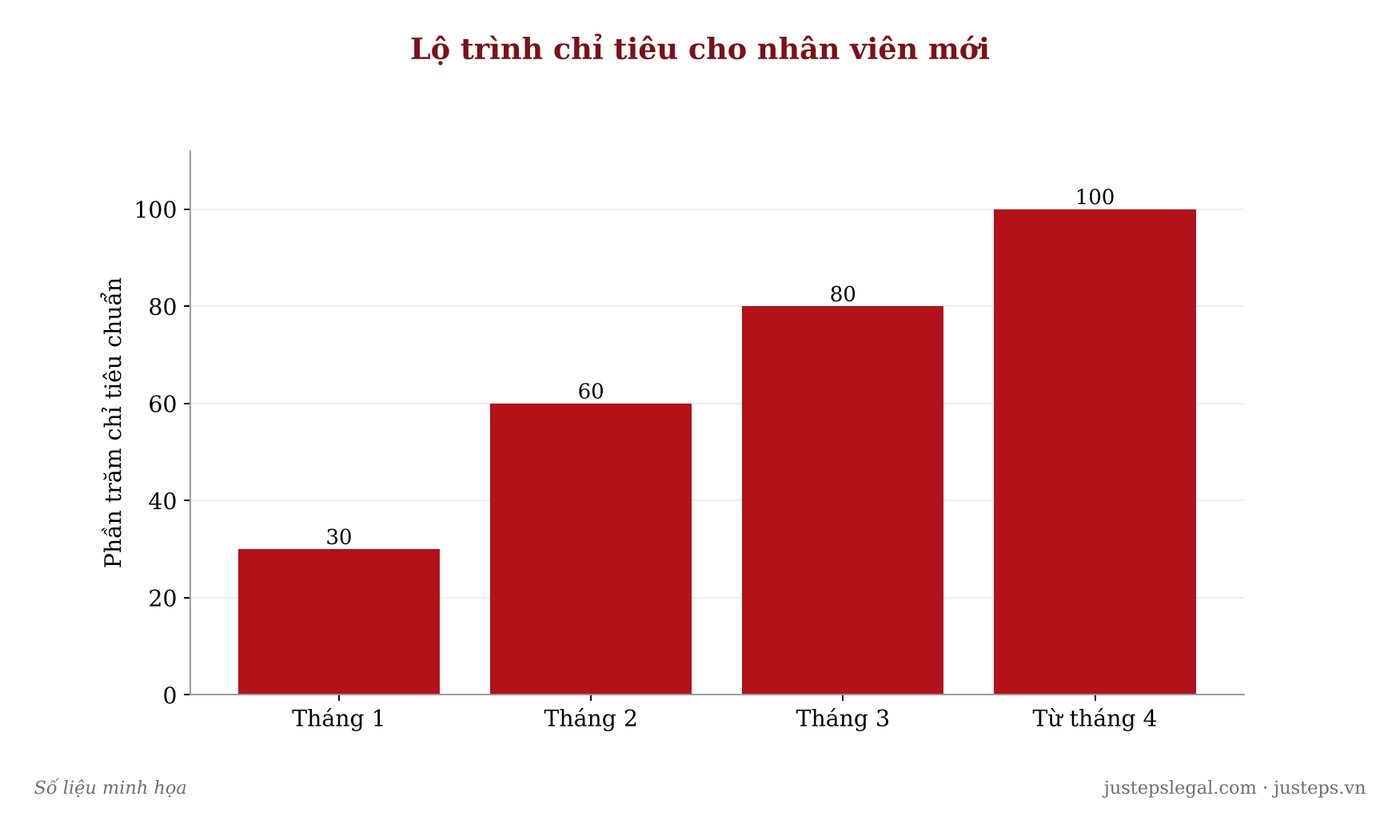
Example of gradually increasing targets for a new salesperson
In the example, a new salesperson receives 30% of the standard target in the first month, 60% in the second month, 80% in the third month and the full 100% from the fourth month. This path reflects the time needed for the salesperson to learn the products, build a list of prospective customers and complete their first transactions. If these targets are used as a basis for paying wages or assessing job performance, the business must ensure that the target is an average level that the majority of employees can achieve and that it is announced before it is applied[4].
The income structure of salespeople
The income of salespeople usually consists of a fixed wage and a variable part based on results, such as commission or sales bonuses. For persons working under employment contracts, the wage rate for the job may not be lower than the minimum wage[5], and from 1 January 2027 the Region I minimum wage is 5,700,000 dong per month[6]. A business may choose to pay wages by time, by product or by lump-sum assignment[7], but must still guarantee this floor, so the entire income of an employee cannot be paid as commission. Sales bonuses should be set out in bonus regulations decided by the business and published at the workplace after consulting the grassroots employee representative organisation, if there is one[8].
A principle worth applying is to calculate commission on revenue actually collected rather than on contracts signed, so that salespeople have an incentive to follow up receivables and the business avoids paying commission on contracts for which no money is collected. Each position should also have no more than four evaluation indicators, because more indicators dilute focus and are hard to explain to employees. Businesses wishing to link targets with their overall evaluation system may refer to Justeps’ service on building a KPI and performance evaluation system.
Freelance collaborators and agents
Many businesses expand their sales force by engaging commission-based freelance collaborators instead of hiring more employees. This relationship may be established through a service contract under the Civil Code[9], but if its content shows paid work, wages and management, direction and supervision by the business, it is still treated as an employment contract even though it bears a different name[10]. In that case, the business must fully comply with its obligations on the minimum wage, insurance and other entitlements. For genuine freelance collaborators, the business must still withhold personal income tax on their fees under the Law on Personal Income Tax No. 109/2025/QH15 and its guiding documents[11].
The sequence for building the structure and the documents to be issued
Building the structure of a sales department should follow a clear sequence, with the participation of the sales director, the human resources department and the accounting team. The flowchart below describes a reference sequence from setting the target to issuing and applying the documents.
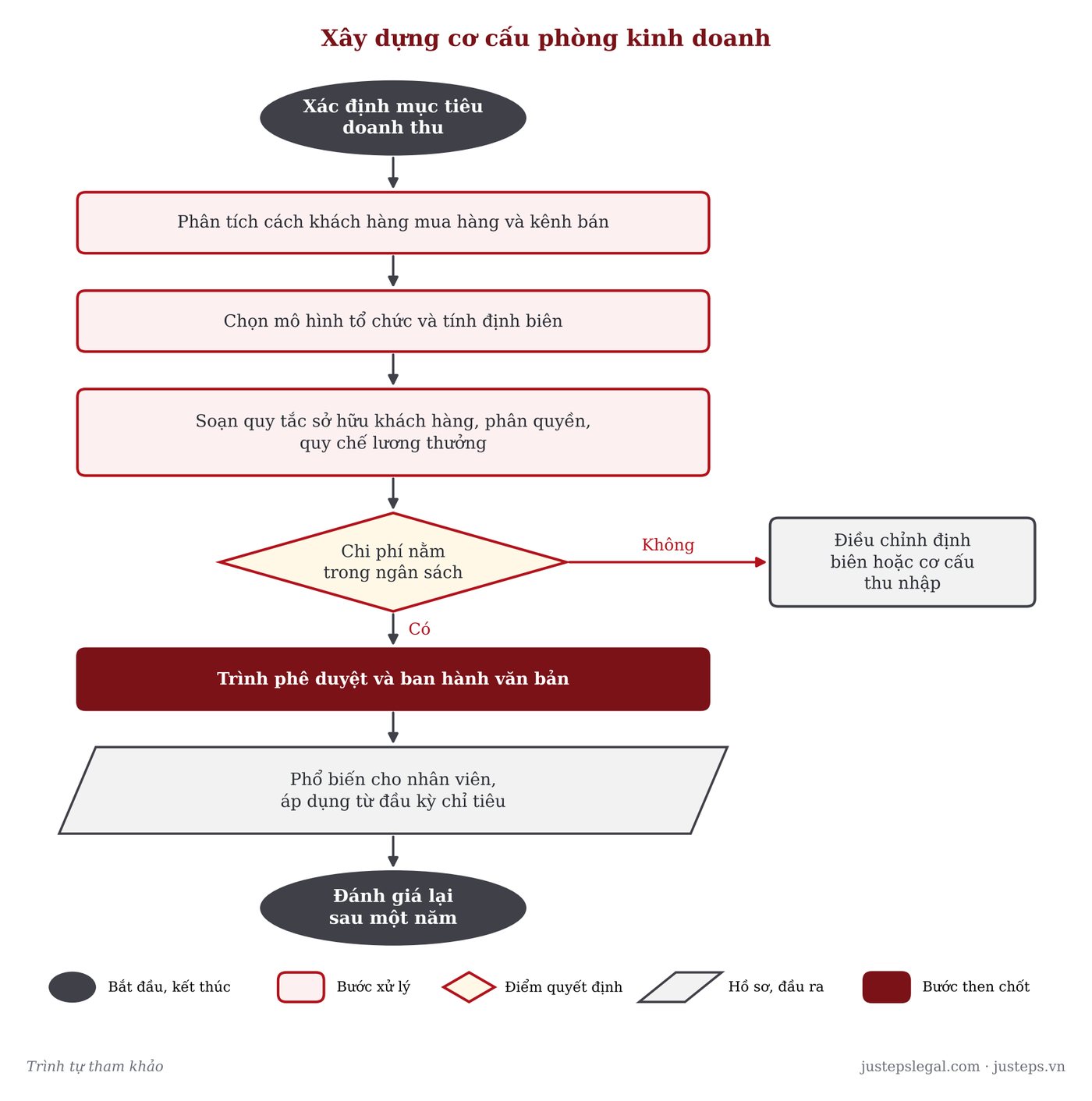
Sequence for building the structure of a sales department
The sequence starts with the revenue target and an analysis of how customers buy, followed by choosing the model and calculating headcount. Before submission for approval, the accounting team should check the total cost of sales personnel against the budget, including fixed wages, expected commission, insurance and support costs. If the cost exceeds the budget, the business goes back to adjust the headcount or the income structure instead of making arbitrary cuts after recruitment. Once approved, the documents are issued at the same time and explained to staff before they apply from the start of a target period.
A structure only works when it is set out in documents that everyone in the department understands and applies consistently. The minimum set of documents for a sales department with a clear structure comprises the following:
- An organisational chart showing the headcount of each position and the reporting lines.
- Job descriptions for salespeople, team leaders, the head of department and support staff.
- A customer ownership rule covering how customers are recorded, how long ownership lasts, how commission is shared and how customers are handed over on departure.
- An authority matrix for discounts, payment terms and the contract values that may be signed.
- An annual target plan allocated by quarter, by team and by person.
- Regulations on wages, commission and sales bonuses, together with a standard weekly report template.
Common errors in building the structure include hiring additional salespeople before there are enough prospective customers, letting the head of department keep the largest customers instead of focusing on management, and lacking a customer ownership rule so that commission becomes a source of disputes. Businesses also often adjust targets every month, which makes it hard for staff to plan, whereas a quarterly review is usually enough to reflect market changes. One year after the structure is introduced, the business should reassess productivity, staff turnover and customer satisfaction in order to adjust the structure for the following year.
How Justeps can help
Justeps supports businesses in building the structure of their sales department and the related operating documents through the following services:
- Organisational structure, functions and duties, and job descriptions. Justeps designs the chart, headcount and job descriptions for each position in the sales department.
- Building a KPI and performance evaluation system. Justeps develops targets, ramp-up targets for new staff and evaluation methods linked to business results.
- Development of salary scales and pay and bonus regulations. Justeps drafts regulations on wages, commission and sales bonuses that guarantee the minimum wage and ensure transparency.
- Developing internal governance regulations and procedures. Justeps drafts the customer ownership rule, the authority matrix and the customer handover procedure.
- Labour records and employment contracts. Justeps reviews salespeople’s employment contracts, freelance collaborator contracts and customer information confidentiality agreements.
Frequently asked questions
When should a sales team leader position be created?
A business should consider creating a team leader position when around eight or more salespeople report to one person. A team leader usually manages around six to eight people effectively.
Can salespeople be paid entirely by commission?
Not if they work under employment contracts, because the wage rate for the job may not be lower than the minimum wage[5]. Commission and sales bonuses are paid on top of this wage.
Should commission be calculated on contracts signed or on revenue collected?
The law does not prescribe a particular method. Calculating on revenue collected encourages staff to follow up receivables and avoids paying commission on contracts for which no money is collected, but the method must be stated clearly in the regulations[8].
Do sales targets need to be announced in advance?
If targets are used as a basis for pay or evaluation, the business should announce them before applying them and ensure that the majority of employees can achieve them[4]. Targets should also be reviewed quarterly rather than changed every month.
Can a freelance sales collaborator contract be treated as an employment contract?
It can, if its content shows paid work under the management, direction and supervision of the business[10]. In that case, the business must fulfil the same obligations as towards its employees.
How can a business keep its customers when a salesperson leaves?
The business should manage customers on a shared system, have a handover rule for departures and include an agreement on protecting business secrets in the employment contract[2]. Access to the data should be revoked as soon as the employee leaves.
When should customer care be separated from sales?
A business should consider this when each salesperson is responsible for around fifty or more active customers. At that point, after-sales care begins to take up the time needed to find new customers.
Related articles
- Building a headcount plan based on the workload of each department
- Restructuring a fast-growing business so that its organisation keeps pace with its new scale
- Organisational structure of a trading and distribution company
- Building a job title and grade framework so that pay scales have a sound basis and employees can see their career path
Notes
[1] Law on Enterprises No. 59/2020/QH14 dated 17 June 2020, as amended and supplemented by Law No. 76/2025/QH15.
[2] Clause 2, Article 21 of the Labour Code No. 45/2019/QH14 dated 20 November 2019.
[3] Law on Personal Data Protection No. 91/2025/QH15.
[4] Article 93 of the Labour Code No. 45/2019/QH14.
[5] Clause 2, Article 90 of the Labour Code No. 45/2019/QH14.
[6] Decree No. 399/2026/ND-CP on the minimum wage for employees working under employment contracts.
[7] Clause 1, Article 96 of the Labour Code No. 45/2019/QH14.
[8] Clause 2, Article 104 of the Labour Code No. 45/2019/QH14.
[9] Article 513 of the Civil Code No. 91/2015/QH13 dated 24 November 2015.
[10] Clause 1, Article 13 of the Labour Code No. 45/2019/QH14.
[11] Law on Personal Income Tax No. 109/2025/QH15.
This article is for reference and reflects the regulations in force at the time of publication. Please consult Justeps for advice tailored to your company’s records and situation.
For further information, please contact:
📩 Email: info@justeps.vn
🌐 Website: https://justepslegal.com · https://justeps.vn
🌐 Page: Justeps
☎️ Hotline (Zalo): 096 172 2607
📍 Thanh Xuan Office: 12th Floor, Licogi 13 Tower, 164 Khuat Duy Tien Street, Thanh Xuan Ward, Hanoi, Vietnam
📍 Ha Dong Office: LK06B, No.10, Dong Dua Area, Ha Dong Ward, Hanoi, Vietnam
📍 Ho Chi Minh City Branch: 528 Le Van Sy, Ho Chi Minh City, Vietnam
📍 Hai Phong Office: Truong Thinh Village, Ha Dong Commune, Hai Phong, Vietnam
📍 Quang Ninh Office: Van Don Special Zone, Quang Ninh Province, Vietnam





