
For a main contractor, most of the risk on site lies not in the work it performs itself but in the work it subcontracts. When a subcontractor falls behind schedule, builds off-design, causes an accident or issues an invalid invoice, it is still the main contractor that has to answer to the employer, the tax authority and the labour inspectors.
Subcontractor management in a construction company therefore needs to be run as a process with a clear owner, from selecting the subcontractor to releasing the last retention payment. This article follows that sequence: selection, contract, acceptance and payment.
Subcontractor management starts with the main contractor's liability
Under Construction Law No. 135/2025/QH15 (effective 1 July 2026) and the guiding regulations on construction contracts, the main contractor is responsible to the employer for the entire quantity, quality and schedule of the package, including the part performed by subcontractors. A subcontract binds only its two signatories, so the employer has no obligation to wait until the main contractor recovers from its subcontractor.
Construction law also restricts subcontracting the main part or the whole of the work, and requires subcontractors not named in the bid to be approved by the employer. In practice this is the point most often missed: site teams hire extra crews to catch up on schedule without going through the contracts department, and the employer only finds out during a site inspection.
Selecting subcontractors, an approved list instead of personal connections
The company should keep an approved subcontractor list managed by the planning or procurement department and reviewed at least once a year. Only listed subcontractors are invited to quote; exceptions require joint approval by the project director and the chief accountant.
The minimum file for listing includes: enterprise registration, a construction capability certificate or practising certificate suited to the work, a list of similar projects, the latest financial statements, confirmation that the tax code is active, and safety training records for key personnel. For crews that are household businesses or individuals, decide from the outset how invoices will be issued and tax withheld, since this is the largest source of tax risk at settlement.
| Criterion | Evidence to keep | Checked by |
|---|---|---|
| Legal status | Enterprise registration certificate, tax code status check | Contracts department |
| Technical capability | Capability certificate, practising certificate, similar projects | Engineering department |
| Financial capacity | Financial statements, ability to provide advance guarantee | Chief accountant |
| Occupational safety | Training records, protective equipment, safety plan | Safety officer |
| Track record | Post-project evaluation, incidents, disputes | Project director |
The subcontract, mirror the main contract and pass on the right risks
The key principle is that the subcontract must be back-to-back with the main contract on critical points. If the main contract imposes a delay penalty of 0.1% per day and the subcontract has no matching clause, the main contractor bears the penalty alone. Subcontracts are governed by the Civil Code No. 91/2015/QH14, the Commercial Law No. 36/2005/QH11 (where both parties are traders) and construction law.
Clauses to review carefully include: scope and applicable drawings; a detailed schedule with interim milestones; quality standards and acceptance procedure; conditions for advances, advance guarantees and performance guarantees; payment conditions linked to whether the employer has paid; penalties and damages; warranty; occupational safety and environmental responsibility; the right to terminate unilaterally and replace the subcontractor; and a dispute resolution mechanism aligned with the main contract.
A pay-when-paid clause needs to be drafted clearly and in a balanced way. An overly one-sided clause invites challenge in a dispute, while fixed payment deadlines not linked to the employer's cash flow can leave the main contractor short of cash.
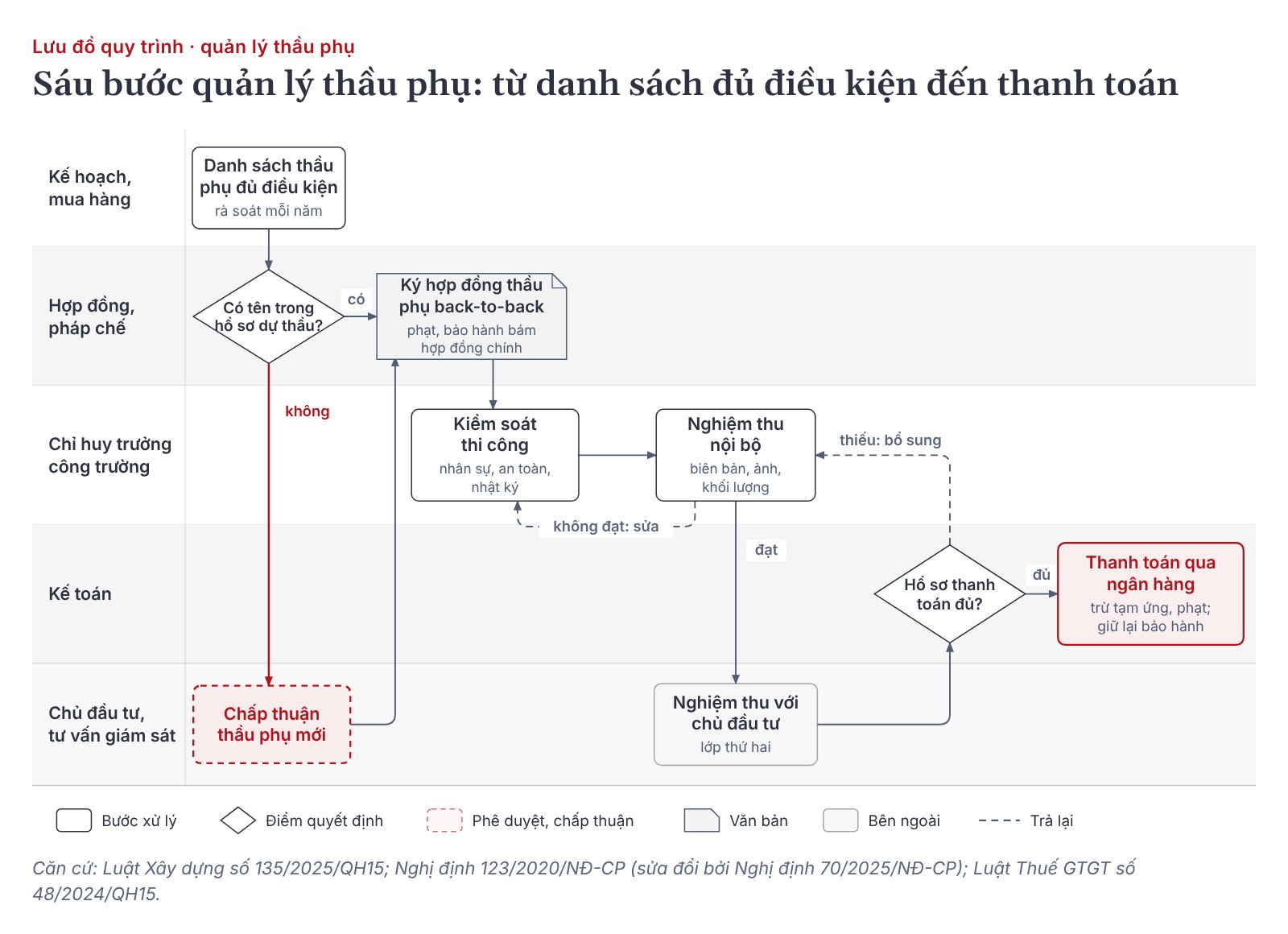
Figure 01. Flowchart of the six subcontractor management steps: selection, approval, contract, site control, acceptance and payment
Basis: Construction Law No. 135/2025/QH15; Decree 123/2020/ND-CP (amended by Decree 70/2025/ND-CP); VAT Law No. 48/2024/QH15
Each horizontal lane is the responsible department. The red dashed box is the employer's approval of a new subcontractor, the step most often skipped; dashed arrows show where defects must be fixed or documents supplemented before moving on.
On-site control and two-layer acceptance
During construction, the site manager is the daily control point for subcontractors: personnel entering the site, the construction log, incoming materials and occupational safety. Under the Law on Occupational Safety and Hygiene No. 84/2015/QH13, subcontractor workers on the main contractor's site must still be trained and equipped with protective gear; the main contractor should require the list and training records before granting site access.
Acceptance should have two layers. The first is internal acceptance between the main contractor and the subcontractor, with minutes, site photos and confirmed quantities. Only after this layer is passed should acceptance with the supervision consultant and the employer be held. This lets defects be fixed before the employer sees them and creates evidence to deduct payment or penalise the subcontractor if the defect is theirs.
Paying subcontractors, pay only against a complete file
Each payment needs a standard file: payment request, quantity acceptance minutes, value calculation, a valid e-invoice under Decree No. 123/2020/ND-CP (as amended by Decree No. 70/2025/ND-CP)[7], and deductions for advances and penalties. Payment must go through a bank; the Law on Value-Added Tax No. 48/2024/QH15 requires non-cash payment documents to deduct input VAT for transactions from VND 5 million.
Retention money and advances are the two points where leakage is most common. Payables accountants should track each contract separately: how much has been advanced, how much recovered in each instalment, how much is retained and when it falls due. For individual crews, personal income tax must be withheld or invoices obtained according to the applicable tax method, under the Law on Tax Administration No. 108/2025/QH15.
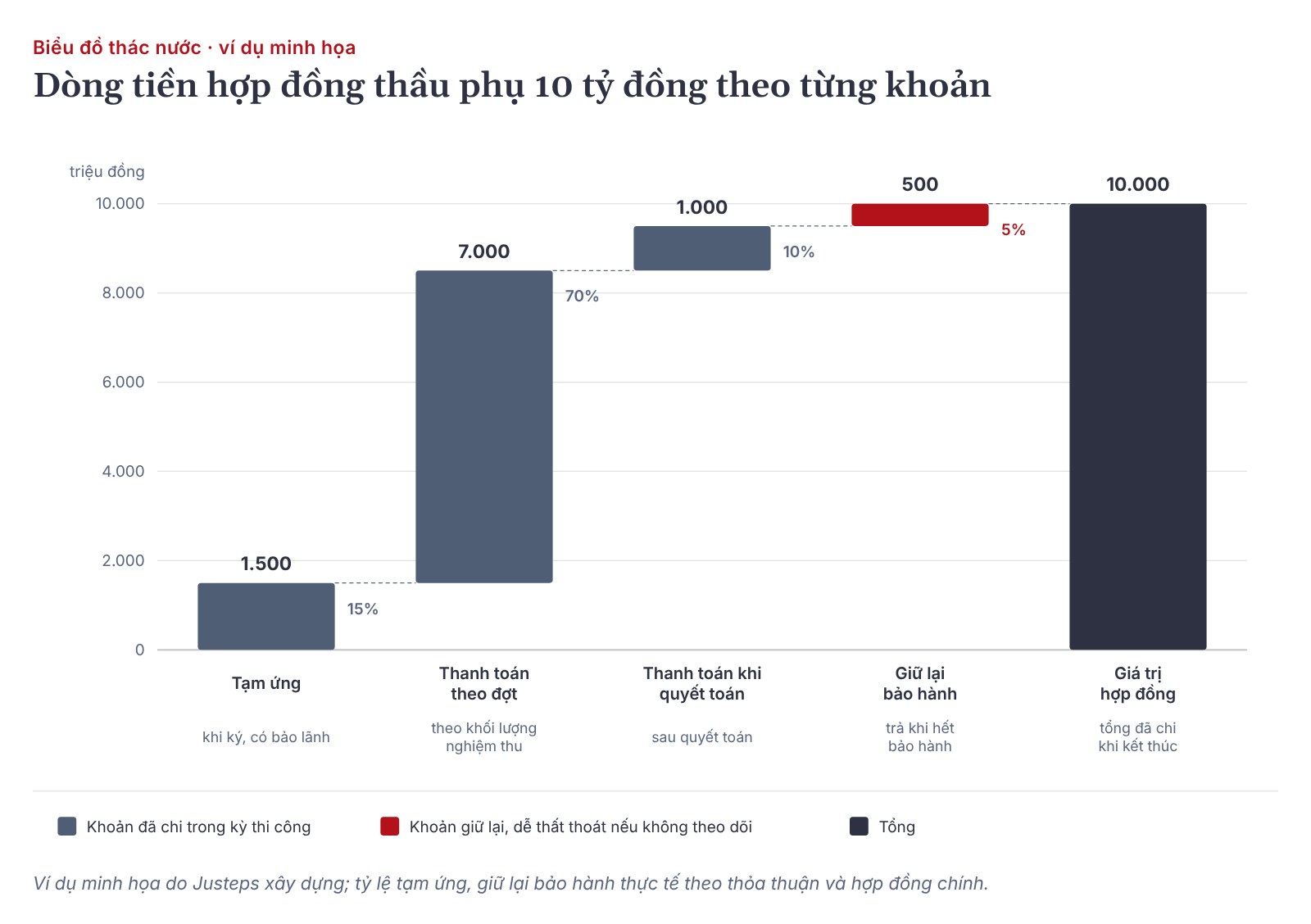
Figure 02. Waterfall chart of the cash flow of a VND 10 billion subcontract by component (VND million)
Illustrative example prepared by Justeps; actual ratios depend on the agreement and the main contract
Bars accumulate from the advance to the contract value of VND 10,000 million; the red bar is the warranty retention, which is easily lost unless accounting tracks it per contract.
Who does what in subcontractor management
A lean allocation could be as follows. Planning or procurement manages the subcontractor list and runs quotations. The contracts or legal department drafts and reviews contracts from a standard template and checks employer approval requirements. The site manager controls construction, safety and internal acceptance. Accounting checks payment files and invoices and tracks advances and retention. The project director evaluates subcontractors after each project to update the list.
The company should issue these rules as a subcontractor management regulation with a set of forms: capability assessment sheet, template contract, internal acceptance minutes, payment request and post-project evaluation. Once the regulation exists, periodic checks and handling of exceptions become much simpler.
Legal basis and sources
- Construction Law No. 135/2025/QH15, effective 1 July 2026, and its guiding decrees on construction contracts.
- Civil Code No. 91/2015/QH14.
- Commercial Law No. 36/2005/QH11.
- Law on Occupational Safety and Hygiene No. 84/2015/QH13.
- Law on Value-Added Tax No. 48/2024/QH15.
- Law on Tax Administration No. 108/2025/QH15, effective 1 July 2026; Decree No. 252/2026/ND-CP.
- Decree No. 123/2020/ND-CP on invoices and documents, as amended by Decree No. 70/2025/ND-CP.
How Justeps supports businesses
- Building a subcontractor management regulation and forms through our Operations setup service.
- Drafting back-to-back template subcontracts and reviewing each contract before signing through Advisory and regulatory compliance.
- Designing approval workflows and authority split between site and head office through Governance standardisation.
- Reviewing invoice and withholding risks with crews and household businesses through Tax, Customs & International Trade.
- Training site managers and project accountants on acceptance and payment files through In-house training.
Contact Justeps for advice tailored to your company.
Frequently asked questions
Does the main contractor need employer approval for every subcontractor?
Subcontractors already named in the bid or main contract usually do not need re-approval. New subcontractors need employer approval under construction law and the terms of the main contract.
Should we use a pay-when-paid clause?
It can be used, but the waiting period should be capped and the case where the employer pays late because of the subcontractor's fault should be addressed. Overly one-sided clauses are easily disputed.
How should crews without invoices be handled?
Determine whether they are household businesses, individuals or employees in order to choose the right contract form, withholding or invoicing. Do this before signing, not at settlement.
Is the main contractor liable if a subcontractor causes a workplace accident?
The main contractor manages the site and is responsible for overall safety organisation. The subcontract should set out responsibilities, insurance and indemnities between the parties.
How often should the subcontractor list be reviewed?
At least once a year and after each project, based on the project director's evaluation.
Related articles
- Warehousing and logistics contracts: liability for goods and warehouse operating structure
- Software development contracts: acceptance, warranty and source code ownership
- Running a private preschool in Vietnam: HR, child safety and operating records
This article is for reference and reflects the regulations in force at the time of publication. Please consult Justeps for advice tailored to your company’s records and situation.
For further information, please contact:
📩 Email: info@justeps.vn
🌐 Website: https://justepslegal.com · https://justeps.vn
🌐 Page: Justeps
☎️ Hotline (Zalo): 096 172 2607
📍 Thanh Xuan Office: 12th Floor, Licogi 13 Tower, 164 Khuat Duy Tien Street, Thanh Xuan Ward, Hanoi, Vietnam
📍 Ha Dong Office: LK06B, No.10, Dong Dua Area, Ha Dong Ward, Hanoi, Vietnam
📍 Ho Chi Minh City Branch: 528 Le Van Sy, Ho Chi Minh City, Vietnam
📍 Hai Phong Office: Truong Thinh Village, Ha Dong Commune, Hai Phong, Vietnam
📍 Quang Ninh Office: Van Don Special Zone, Quang Ninh Province, Vietnam





