
In manufacturing companies, the Tet bonus is the first thing workers ask about and the thing they compare most closely. This year the Lunar New Year of Dinh Mui falls on 6 February 2027, which means the bonus table must be finalised and paid in January 2027, just as the company closes its books and the factory is still running year-end orders. If the criteria are only discussed then, complaints are almost certain.
This article suggests how to build a Tet bonus policy tight enough to control cost and clear enough that workers understand how much they get and why, with a rollout timeline, personal income tax handling and communication.
The Tet bonus is the employer's decision, but it needs a policy
Labour law does not mandate a specific Tet bonus. A bonus is money, property or another form that the employer awards to employees based on business results and the level of job performance; the bonus regulation is decided by the employer and published at the workplace after consulting the grassroots employee representative organisation where one exists (under Article 104 of Labor Code No. 45/2019/QH14).
Two operational consequences follow. First, the company may pay different bonuses to different groups, provided the criteria are written into the policy. Second, if employment contracts, the collective bargaining agreement or earlier announcements promised a fixed bonus (for example a "13th-month salary"), that becomes an obligation and cannot be cut unilaterally when results are weak. HR should review these documents before drafting the policy.
Setting the bonus pool from profit
A common approach is to allocate a percentage of estimated pre-tax profit for the year, with a floor and a cap. For example, the company estimates 2026 pre-tax profit at VND 20 billion and the board or owner approves 10%, giving a pool of VND 2 billion. If profit falls short of plan, the pool may shrink but not below the announced floor, for instance a guaranteed 0.5 month's salary for workers who meet requirements.
Accounting should provide the profit estimate in early December, accepting some margin of error. Where total bonuses calculated by coefficient exceed the pool, the policy should already contain an adjustment formula: multiply every bonus by the same ratio (pool divided by total demand). This keeps the gaps between ratings intact and avoids any group feeling singled out.
From a corporate income tax perspective, bonus expenses are generally deductible only when the conditions and amounts are stated in the employment contract, the collective bargaining agreement or the company's bonus regulation. That is one more reason to issue the policy in writing rather than decide verbally.
Criteria and amounts by performance and seniority
For production workers, criteria should be measurable from existing data: output norm completion, defect rate, actual working days and compliance with occupational safety. Avoid subjective criteria such as "positive attitude" unless there is a concrete scoring method. Each team leader scores on the same form, the shop manager approves, and HR checks the distribution so that no team rates everyone A.
| Rating | Suggested criteria | Bonus coefficient | Expected share of workers | Example with VND 8,000,000 salary |
|---|---|---|---|---|
| A | Above output norm, no quality defects, full attendance | 1.5 months' salary | 10–15% | VND 12,000,000 |
| B | Meets or slightly exceeds norm, low defect rate | 1.2 months' salary | 30–40% | VND 9,600,000 |
| C | Meets norm, complies with work rules | 1.0 month's salary | 40–50% | VND 8,000,000 |
| D | Below norm or frequent unexcused absence | 0.5 month's salary | under 10% | VND 4,000,000 |
Seniority can add to the coefficient, for example plus 0.1 month from three full years and plus 0.2 month from five full years. Workers with less than 12 months are paid pro rata to months actually worked in the year. The policy should also state when there is no bonus or a reduced one, such as leaving before the payment date or contract suspension for the whole year. Reductions must rest on the published evaluation criteria and must not be used as a monetary fine instead of labour discipline, because the Labor Code prohibits fines or wage cuts in place of disciplinary action (under Article 127 of Labor Code No. 45/2019/QH14).
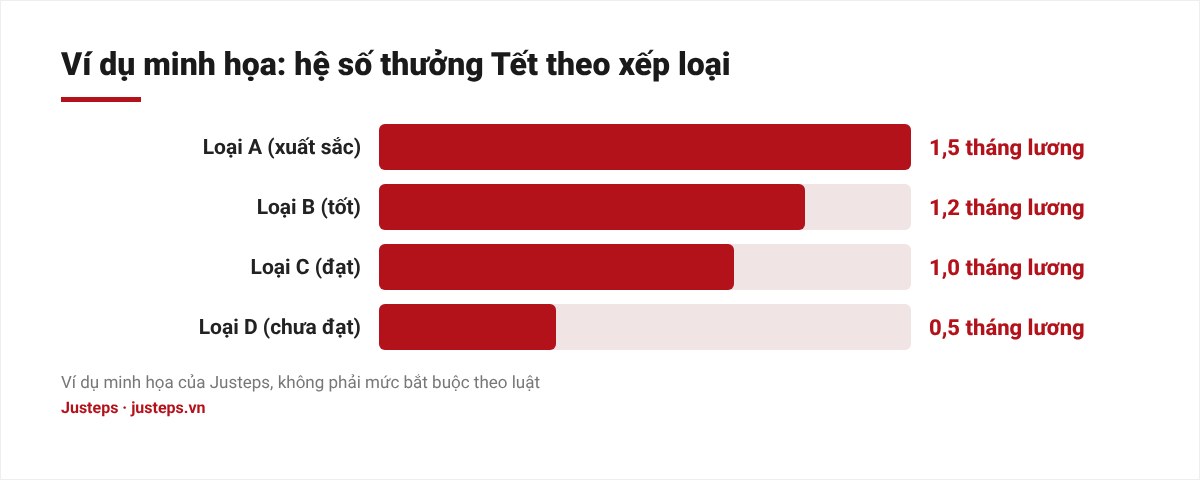
Illustrative Tet bonus coefficients by rating A/B/C/D; actual levels are set by each company in its policy.
The salary base for the bonus must also be defined: contract salary, basic salary or average total income. From 1 January 2027 the regional minimum wage rises under Decree No. 399/2026/ND-CP (Region I is VND 5,700,000 per month), so companies adjusting their pay scales should decide whether the bonus uses the salary before or after the adjustment.
Timeline before Tet Dinh Mui
With Tet on 6 February 2027, a reasonable timeline for a manufacturer is as follows. In early December 2026, accounting estimates profit and proposes the pool. In mid-December, HR drafts the policy and sends it to the grassroots trade union for consultation. In late December, the director signs, issues and publishes it. Evaluation data closes on 31 December 2026 and team leaders score within the first ten days of January. Around 15 January 2027 the bonus table is approved, and payment is made around 25–30 January 2027, before the holiday so workers travel home with money in hand.
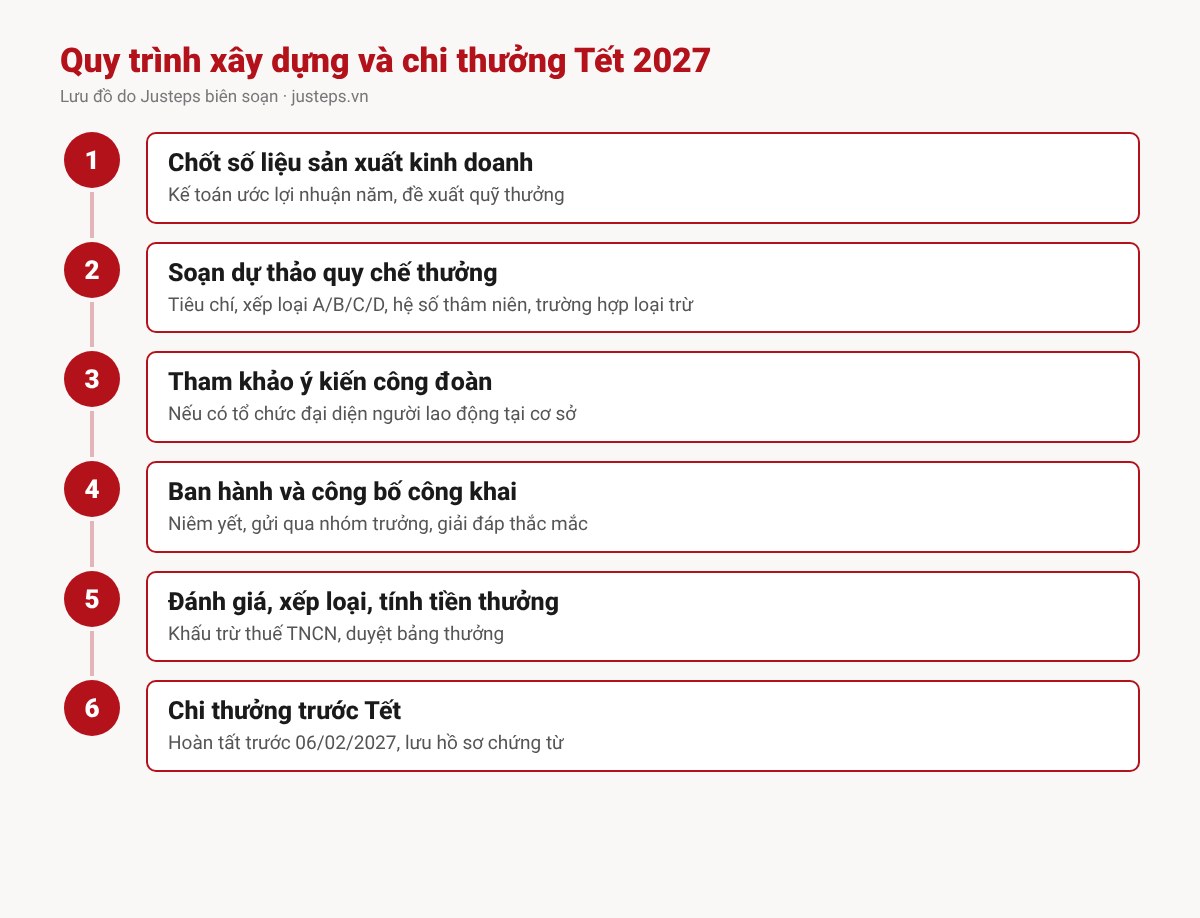
Process for building the policy and paying the 2027 Tet bonus in a manufacturing company.
Personal income tax on the bonus
A cash Tet bonus is employment income subject to personal income tax. The company withholds tax at the time of payment, adding it to the income of the month the bonus is paid. A bonus paid in January 2027 is 2027 income, unlike one paid in December 2026, which affects each person's annual tax finalisation.
Because it is combined with the monthly salary, many workers see an unusually high tax that month and assume the company miscalculated. HR should print bonus slips showing the bonus amount and the tax withheld separately, with a short note that the tax will be recalculated at year-end finalisation. For workers without contracts or on contracts under three months, withholding works differently and accounting should check separately.
Publishing and communicating with workers
Publication is a legal requirement, but how it is done determines acceptance. Post the policy on the shop-floor notice board, send a one-page summary to team groups, and have team leaders explain it at shift handover. Each worker receives a slip showing rating, coefficient, seniority and amount. The policy should provide a complaint channel within three to five working days of receiving the slip, naming who handles it and how quickly they respond.
Records to keep include: the signed bonus policy, the minutes or letter of union consultation, team scoring sheets, the approved bonus table, payment vouchers and tax withholding documents. This file serves labour inspections, tax finalisation and any dispute resolution.
Legal basis
- Labor Code No. 45/2019/QH14, effective 1 January 2021 (Article 104 on bonuses, Article 127 on prohibited acts in labour discipline).
- Decree No. 399/2026/ND-CP on minimum wages for employees under employment contracts, applicable from 1 January 2027, replacing Decree No. 293/2025/ND-CP.
- Current personal income tax and corporate income tax legislation and guiding documents.
How Justeps can help
- Drafting bonus regulations, pay and bonus policies and union consultation files, through the services of Justeps.
- Building new pay scales in line with the regional minimum wage from 1 January 2027.
- Designing performance evaluation regulations used as the basis for bonus ratings.
- Reviewing employment contracts and collective bargaining agreements to identify existing bonus commitments.
- Ongoing advice on labour and personal income tax for manufacturing companies.
Frequently asked questions
Must a loss-making company pay a Tet bonus?
No, unless the employment contract, collective agreement or policy commits to a fixed bonus. Bonuses depend on business results and job performance under Article 104 of the Labor Code.
Must the trade union be consulted before issuing the bonus policy?
Where a grassroots employee representative organisation exists, the company must consult it. The final decision still rests with the employer.
Do workers who leave before Tet get a bonus?
It depends on the policy. If it requires being "employed on the payment date", those who have left are not entitled; this condition must be published in advance.
Is the Tet bonus subject to social insurance contributions?
A bonus under Article 104 of the Labor Code, paid according to business results and job performance, is generally not part of the monthly salary for social insurance. If a fixed amount is paid every month under the name "bonus", the insurance authority may treat it as salary.
Can the bonus be paid in kind, such as Tet gift baskets?
Yes, bonuses may be in money, property or other forms. The value of in-kind items still needs to be considered when calculating taxable personal income.
Related articles
- Penalty and damages clauses: drafting so you can actually collect
- Controlling advertising content: a pre-publication approval process
- Two new public holidays on 27 July and 24 November from 2027: what businesses need to update
- Pay scales for F&B chains with outlets in several minimum wage regions
Contact Justeps
Email: info@justeps.vn · Hotline/Zalo: 096 172 2607 · Website: justeps.vn
Office network
- Thanh Xuan Office: 12th Floor, Licogi 13 Tower, 164 Khuat Duy Tien, Thanh Xuan Ward, Hanoi
- Ha Dong Office: LK06B, No.10, Dong Dua Area, Ha Dong Ward, Hanoi
- Ho Chi Minh City Branch: 528 Le Van Sy, Nhieu Loc Ward, HCMC (formerly Ward 14, District 3)
- Hai Phong Office: Truong Thinh Village, Ha Dong Commune, Hai Phong
- Quang Ninh Office: Van Don Special Zone, Quang Ninh





