
From 2027, employees in Vietnam get two more fully paid public holidays: 27 July (Day of National Gratitude – War Invalids and Martyrs Day) and 24 November (Vietnam Culture Day). The change is part of the Law Amending and Supplementing a Number of Articles of the Labor Code, the Law on Archives, the Law on Gender Equality, the Law on Red Cross Activities and the Law on Employment, passed by the National Assembly on 21 November 2026 and effective from 1 March 2027. The total number of fully paid public holidays rises from 11 to 13 days.
The same law removes the license requirement for labor leasing and replaces it with a deposit and an activity notification. For HR teams, these two changes trigger a list of tasks that must be completed before March 2027: the annual holiday calendar, internal labor regulations, shift plans, the holiday pay budget and contracts with labor leasing providers. Below is each task in the order it should be done.
Public holidays before and after the amendment
Article 112 of Labor Code No. 45/2019/QH14 currently provides 11 fully paid public holidays. The amending law keeps all of them and adds two new days. Foreign employees working in Vietnam continue to receive one additional day for their traditional New Year and one for their National Day as provided in Article 112. The table below lets HR check the list quickly when building the calendar.
| Public holiday | Days | Before 01/3/2027 | From 01/3/2027 |
|---|---|---|---|
| New Year (1 January) | 1 | Yes | Yes |
| Lunar New Year (Tet) | 5 | Yes | Yes |
| Hung Kings Commemoration (10th day of the 3rd lunar month) | 1 | Yes | Yes |
| Victory Day (30 April) | 1 | Yes | Yes |
| International Labor Day (1 May) | 1 | Yes | Yes |
| National Day (2 September and 1 adjacent day) | 2 | Yes | Yes |
| Day of National Gratitude – War Invalids and Martyrs Day (27 July) | 1 | No | Yes (new) |
| Vietnam Culture Day (24 November) | 1 | No | Yes (new) |
| Total | 11 days | 13 days |
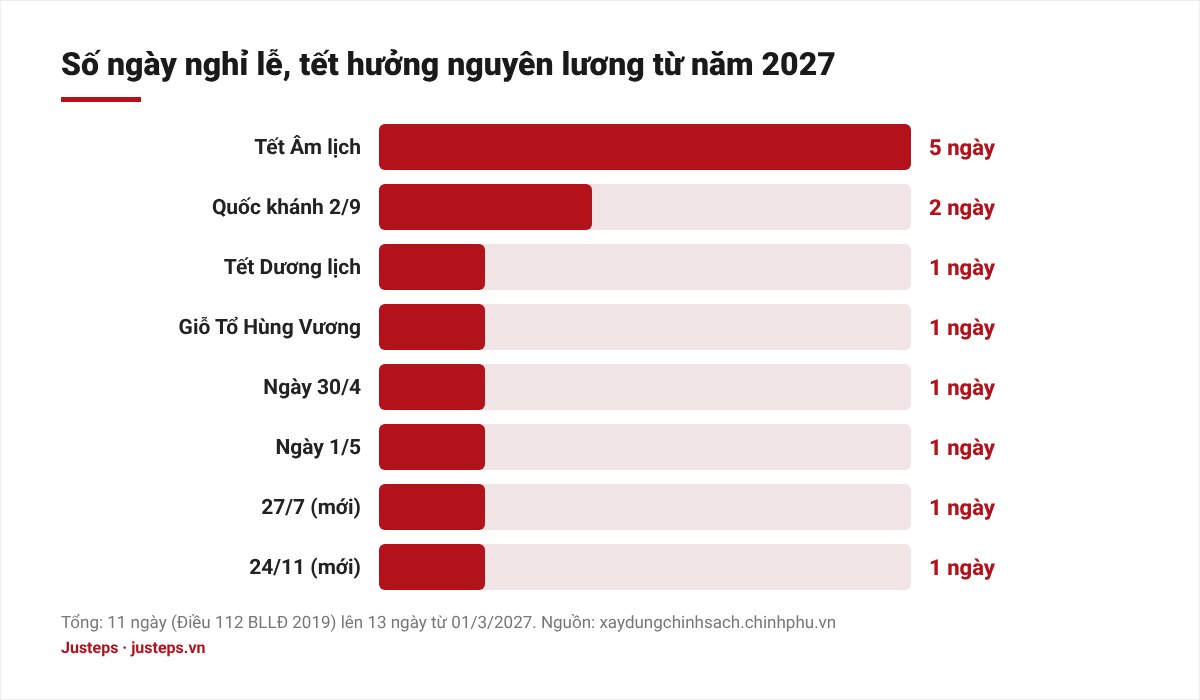
The 13 fully paid public holidays applicable from 1 March 2027.
Updating the 2027 holiday calendar
The law takes effect on 1 March 2027, before both new holidays, so in 2027 businesses must already give employees 27 July (Tuesday) and 24 November (Wednesday) off. Any 2027 holiday calendar issued in late 2026 should be reissued with an internal notice so that departments can plan their work.
The step most often missed is on the payroll side. Companies paying by actual working days must reduce the standard working days of July and November by one day. Items tied to working days, such as attendance bonuses, meal allowances and transport allowances, should also be reviewed so employees are not wrongly docked for a public holiday. In later years, if 27 July or 24 November falls on a weekly rest day, employees take a compensatory day off on the next working day (under Clause 3, Article 111 of the Labor Code), so the calendar should be built year by year rather than copied from the previous year.
A business that wants to bridge a holiday with the weekend can use annual leave or agree on a make-up working day, but should announce it in writing and observe working-time limits when scheduling the make-up day.
Reviewing internal labor regulations and related policies
Internal labor regulations must cover working hours and rest periods (under Article 118 of the Labor Code). Many sets of regulations list the 11 holidays explicitly; left unchanged, they will conflict with the law from 1 March 2027. The cleanest fix is to rewrite the holiday clause to refer to "the provisions of labor law" and attach the current list as an appendix, so the next change does not require amending the whole document.
When amending the regulations, the employer consults the grassroots employee representative organization (if any) and, if it employs 10 or more employees, registers them with the provincial labor authority (under Article 119 of the Labor Code). In the same round, it is worth reviewing the pay and bonus policy, the collective labor agreement and employment contract templates, especially clauses on holiday duty allowances or holiday bonuses tied to a fixed list of dates.
Shift planning for 24/7 operations
Continuous-line factories, retail chains, hotels, healthcare facilities and warehouses cannot close on public holidays. Two new holidays mean two more days of costly shifts and likely staff shortages. Operations teams should do the following four things.
- Identify the positions that must be kept running and the minimum headcount per shift; for retail and hotels, forecast higher customer traffic to decide whether extra shifts are needed.
- Working on a public holiday is overtime: it requires the employee's consent and must stay within the monthly and annual overtime limits (under Article 107 of the Labor Code). Consent should be recorded on a form or in the timekeeping app.
- Set a rotation rule across the 13 holidays so holiday shifts do not fall on the same group, avoiding complaints and breaches of the overtime cap.
- Finalize the duty roster at least two weeks before each holiday, with a standby list in case employees decline or are suddenly absent.
Budgeting holiday work pay
Employees working on a public holiday are paid at least 300% of their wage, excluding the holiday pay itself (under Article 98 of the Labor Code); night work attracts an additional premium under the same article. For monthly-paid employees, holiday pay is already included in the monthly salary, so the additional cost is the payment for hours actually worked.
Take a factory that keeps 300 workers on duty each public holiday with an average daily wage of VND 450,000. The pay for actual work on one holiday alone is 300 × 450,000 × 300% = VND 405 million, so the two new days add about VND 810 million a year, before night-shift allowances. Regional minimum wages also rise from 1 January 2027 under Decree No. 399/2026/ND-CP (Region I to VND 5,700,000 per month), lifting the wage base, so the budget should use the adjusted wages. If a business gives all staff the day off, the cost lies in lost output, which must be built into the production and delivery plan from the start of the year.
Contracts with labor leasing providers
Under the amending law, labor leasing companies no longer need a license; instead they make a deposit and notify their activities. Companies that already hold a license or have already notified do not need to notify again. More importantly for client companies, the law makes the hiring party responsible for requiring the leasing company to pay wages in full when that company is in breach. Procurement and legal should review contracts in force on the following points.
- Replace references to "labor leasing license No. ..." with an obligation to provide evidence of the deposit and activity notification, and update the supplier assessment file.
- Add a monthly obligation to send payroll and payment records for leased workers, with the right to withhold payment or terminate the contract if unpaid wages are found.
- Agree clearly who bears the cost of holiday work by leased workers on the two new days, how unit prices are adjusted and the deadline for requesting holiday staffing.
The amending law also changes rules on collective bargaining, the National Wage Council and strikes; details will become clearer once guiding documents are issued, and businesses should keep track for further updates.
Responsibilities and timeline
These tasks span several departments, so one HR focal point should track progress and report to management. The suggested allocation below can be adjusted to the size of the business.
| Task | Lead department | Suggested deadline |
|---|---|---|
| Update the 2027 holiday calendar and standard working days for July and November | HR, payroll | December 2026 |
| Amend internal labor regulations and pay/bonus policy; consult the employee representative organization; register the regulations | HR, legal | Before 01/3/2027 |
| Prepare shift plans for 27 July and 24 November | Production, store and hotel operations managers | At least 2–4 weeks before each holiday |
| Budget holiday work pay | Finance, HR | When finalizing the 2027 budget |
| Sign contract annexes with labor leasing providers | Procurement, legal | Q1/2027 |
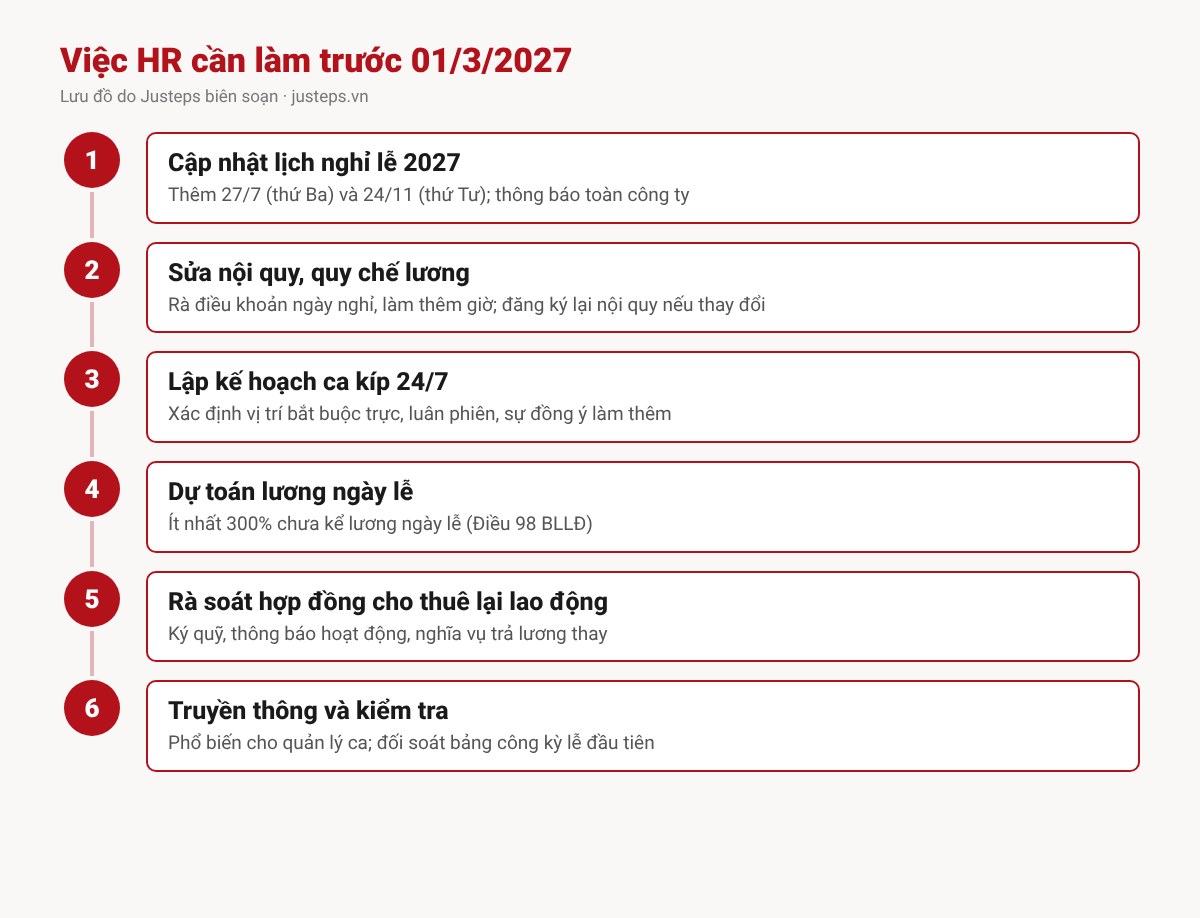
Six steps HR should complete before the two new public holidays take effect.
Legal basis
- Labor Code No. 45/2019/QH14, effective from 1 January 2021.
- Law Amending and Supplementing a Number of Articles of the Labor Code, the Law on Archives, the Law on Gender Equality, the Law on Red Cross Activities and the Law on Employment, passed by the National Assembly on 21 November 2026, effective from 1 March 2027.
- Decree No. 145/2020/ND-CP detailing and guiding a number of articles of the Labor Code on working conditions and labor relations.
- Decree No. 399/2026/ND-CP on minimum wages for employees working under employment contracts, applicable from 1 January 2027.
How Justeps can help
- Reviewing, amending and preparing the registration file for internal labor regulations under the new law, through the services of Justeps.
- Building pay and bonus policies, wage scales and methods for calculating holiday and night-shift pay.
- Reviewing and drafting annexes to labor leasing contracts, adding controls over wage payment.
- Ongoing labor law advice for HR teams, with updates when guiding documents are issued.
Frequently asked questions
Do employees get 27 July and 24 November off in 2027?
Yes. The amending law takes effect on 1 March 2027, before both holidays, so in 2027 employees are entitled to fully paid leave on 27 July and 24 November.
What if a new holiday falls on a weekly rest day?
Employees take a compensatory day off on the next working day under Clause 3, Article 111 of the Labor Code. In 2027 the two days fall on a Tuesday and a Wednesday, so no compensatory day arises.
How are employees paid for working on 27 July or 24 November?
They receive at least 300% of their wage for the hours worked, excluding holiday pay (under Article 98 of the Labor Code). Night work carries an additional premium under the rules on night work.
Do licensed labor leasing companies need to redo any procedure?
No. Under the transitional provisions, companies already licensed or that have already notified their labor leasing activities do not need to notify again.
Are leased workers entitled to the two new holidays?
Yes. They are employees of the leasing company and enjoy full holiday entitlements. The client company should agree in advance with the provider on duty rosters and holiday work costs.
Related articles
- Controlling advertising content: a pre-publication approval process
- Fire safety records for business premises under the new law: annual tasks
- Building a Tet Dinh Mui 2027 bonus policy for manufacturing companies
- Pay scales for F&B chains with outlets in several minimum wage regions
Contact Justeps
Email: info@justeps.vn · Hotline/Zalo: 096 172 2607 · Website: justeps.vn
Office network
- Thanh Xuan Office: 12th Floor, Licogi 13 Tower, 164 Khuat Duy Tien, Thanh Xuan Ward, Hanoi
- Ha Dong Office: LK06B, No.10, Dong Dua Area, Ha Dong Ward, Hanoi
- Ho Chi Minh City Branch: 528 Le Van Sy, Nhieu Loc Ward, HCMC (formerly Ward 14, District 3)
- Hai Phong Office: Truong Thinh Village, Ha Dong Commune, Hai Phong
- Quang Ninh Office: Van Don Special Zone, Quang Ninh





