
Key takeaways
- Merging or dissolving departments is a change of organisational structure under the Labour Code, so where it affects the jobs of many employees, the business must prepare a labour utilisation plan before implementing it.
- The correct sequence is to diagnose workloads, design the new structure, prepare the labour utilisation plan, consult and announce it, and only then issue decisions and re-sign contracts.
- Employees who are retained but moved to a different job or pay level must sign an appendix or a new contract, because a transfer decision may only be used for temporary situations.
- Only when no new job can be arranged may the business let employees go; it must give 30 days’ notice to the state authority and to the employees, and pay the job loss allowance within the statutory time limit.
- The allowance fund, the list of each employee group and the selection criteria should be prepared before the new structure is announced, in order to retain good people and limit disputes.
A service company saw its revenue fall by almost a third over two consecutive quarters. Its projects department still had six people but almost no new work, while the sales department and the customer care department duplicated each other in preparing quotations and following up contracts. The board of directors decided to merge the three departments into one and announced it verbally at a routine management meeting. Within the following month, three people resigned, including the person managing the relationship with the largest customer, and two others claimed that they had been dismissed unlawfully because they had not been consulted beforehand.
This situation shows that streamlining the organisation is more complex than redrawing the organisation chart. This article sets out the signs that a business needs to streamline, the authority to decide on the new structure, the step-by-step roadmap, the labour utilisation plan, how to arrange each group of employees, the cost of allowances and the records required. The content applies to limited liability companies and joint stock companies with several dozen employees or more, and it is written mainly for directors, heads of HR, chief accountants and those responsible for legal affairs.
When a business needs to streamline its organisation
Organisations tend to grow during periods of expansion, when each new line of business is given its own department, and they are rarely reviewed when activity slows down. A business should consider streamlining when it sees one of the following signs:
- A department is left with only its head and one or two staff after a line of business has been scaled back.
- Overhead costs have risen faster than revenue for three to four consecutive quarters without a corresponding expansion plan.
- Two or more departments perform the same task, report different figures and blame each other when errors occur.
- The business discontinues a product line, closes a branch or outsources a stage of its operations.
From a legal perspective, changing the organisational structure or reorganising labour is treated by the Labour Code as a case of structural change, together with changes in processes and technology and changes in products or product structure[1]. In addition, economic crisis or recession and the implementation of State policies when restructuring the economy are treated as economic reasons[2]. Identifying the correct ground matters, because if the business later has to let employees go, that decision will stand only if the business can prove that the change was genuine and that the records were prepared in the correct order.
Designing the new structure and the approval authority
Before deciding which departments to merge or dissolve, the business needs to diagnose its workloads. The HR department, together with the heads of departments, lists the tasks, estimates the monthly working hours for each task and marks the tasks that are duplicated or no longer needed. The result is a picture of which departments have too many people, which have too few, and which tasks can be moved to another department or outsourced. At this stage, the business should not yet draw up a list of people to be let go, because a list prepared too early is easily leaked and unsettles employees.
On the basis of the diagnosis, the board of directors chooses one of three options, namely merging two or more departments into one, dissolving a department entirely, or keeping a department but moving part of its functions to another department. The output of this step consists of the new organisation chart, a statement of the functions and duties of each department after the reorganisation and a headcount plan for each department. The approval authority depends on the type of business and its charter. In a multi-member limited liability company, the Members’ Council decides on the company’s management structure, while in a joint stock company the Board of Directors decides on the organisational structure and the internal management regulations[3]. The Director or General Director usually proposes the plan, so the submission should include the full diagnostic data and a cost estimate.
The business also needs to review the internal documents tied to the old structure, including the regulation on signing and approval authority, the pay and bonus regulation, the internal labour regulations and any authorisations currently in force. If the new structure changes who is authorised to sign documents or contracts, the authorisations must be updated on the same day the new structure takes effect, to avoid any gap in authority.
A five-step roadmap for streamlining
The most common mistake is to announce the decision to merge departments first and only then work out how to arrange the people. The correct order follows five consecutive steps, in which the labour utilisation plan must be completed before the new structure is officially announced. The flowchart below describes a reference sequence for small and medium-sized businesses.
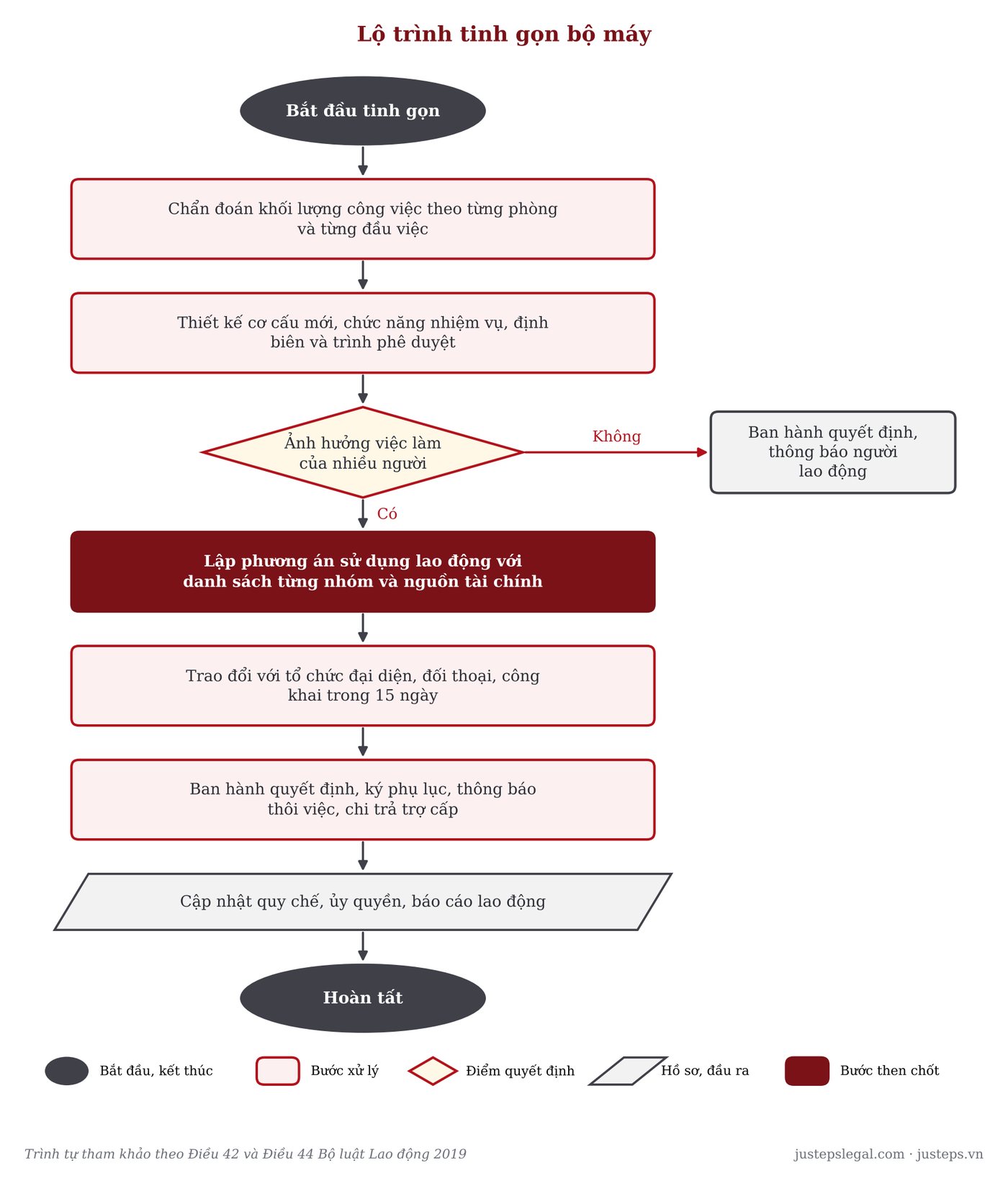
Five-step roadmap for streamlining the organisation
The flowchart begins with diagnosing workloads and ends with updating records and regulations. The key branching point comes after the structure has been designed, when the business determines whether the change affects the jobs of many people. If everyone keeps the same job and pay and only the name of the department or the direct manager changes, the business can issue the decision on the new structure and notify employees. If anyone has to change jobs, have their hours reduced or leave, the business must go through the steps of preparing a labour utilisation plan, consulting and announcing it, as analysed in the following section.
The labour utilisation plan, consultation and dialogue
Where a structural change affects the jobs of many employees, the employer must develop and implement a labour utilisation plan, and must give priority to retraining employees so that they can continue to be employed where new jobs are available[4]. The plan must set out the list and number of employees who will continue to be employed or retrained, those who will retire, those who will move to part-time work and those whose employment contracts must be terminated, together with the rights and obligations of the parties and the measures and financial resources for implementing the plan[5]. The table below suggests how to handle each group in the plan.
| Group in the plan | How to handle it and supporting documents |
|---|---|
| Continued employment | Those who keep the same job only need to be notified of their new department, while those whose job or pay changes must sign an appendix or a new contract. |
| Retraining | The business prepares a training plan with a specific duration and content, linked to the position expected after the training. |
| Retirement | Applies to those who already qualify for a retirement pension, with records coordinated with the social insurance authority. |
| Part-time work | The two parties agree new working hours and pay in writing, stating clearly how social insurance contributions will be paid. |
| Contract termination | Applies only when no new job can be arranged, with a job loss allowance calculation for each person. |
When developing the plan, the business must consult the grassroots employee representative organisation, where one exists, and the plan must be publicly announced to employees within 15 days from the date on which it is adopted[6]. The Labour Code also requires dialogue to be held at the workplace when the employer implements a labour utilisation plan under the provisions on structural change[7]. A business without a grassroots trade union must still announce the plan publicly and should hold a dialogue with representatives of the affected group of employees, with minutes recording their views and how the business has taken them into account.
The criteria for selecting who stays, who changes position and who leaves should be written down and announced together with the plan. Common criteria include performance appraisal results for the two most recent periods, how well a person’s skills fit the new position, and length of service. Selecting people on impressions or personal relationships is the main cause of complaints, and it makes the good people who remain lose confidence in the board of directors. The business must take care with female employees who are pregnant, on maternity leave or raising a child under 12 months of age, because the law restricts the termination of contracts with this group[8], so their cases should be considered separately.
Arranging the employees who are retained
Most employees in a streamlining exercise are usually retained but work in a new department, under a new manager or with a broader scope of work. For temporary needs, the business may temporarily assign an employee to work different from that in the contract, but for no more than 60 cumulative working days in a year unless the employee agrees, and it must give at least 03 working days’ notice[9]. A transfer decision is therefore not a suitable tool for a long-term change after departments have been merged.
Where a change in job, title, place of work or pay is long-term, the two parties must amend or supplement the employment contract. The party requesting the amendment must notify the other party of the proposed changes at least 03 working days in advance, the amendment is made by an appendix or by concluding a new contract, and if no agreement is reached the two parties continue to perform the contract already concluded[10]. Where an employee does not agree to change position while the old position no longer exists after the department has been dissolved, that person may be placed in the contract termination group in the labour utilisation plan and receive a job loss allowance.
Alongside re-signing contracts, the new manager should hold a clear work assignment meeting with each person, accompanied by an updated job description. People who manage relationships with major customers, hold core technical knowledge or are in charge of unfinished projects should be spoken to individually before the announcement, because this is the group most likely to leave when rumours spread faster than the official announcement.
Letting employees go and the cost of job loss allowances
Where no new job can be found and employees have to be let go, the employer must pay a job loss allowance[11]. If many employees are to be let go, the business may do so only after consulting the grassroots employee representative organisation of which the employees are members, and must give 30 days’ prior notice to the provincial People’s Committee and to the employees[12]. These deadlines should be put in the calendar as soon as the plan is adopted, because missing one milestone can push back the whole process.
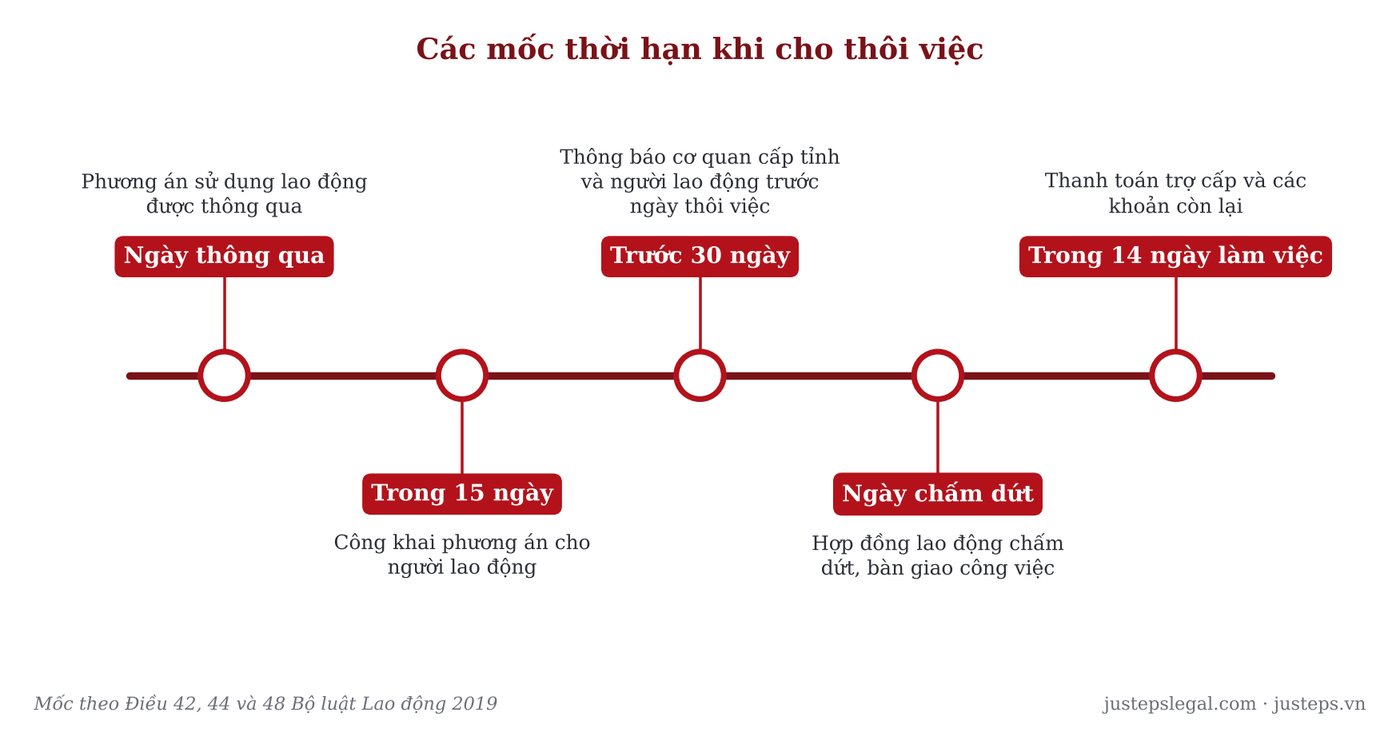
Key deadlines when letting employees go because of structural change
These milestones show that it usually takes around six to eight weeks from the adoption of the plan until the allowances have been paid in full. The business should build this period into its cash flow plan and its work handover plan, instead of expecting costs to fall in the very month of the announcement.
An employee who has worked regularly for 12 months or more and loses their job because of structural change is entitled to a job loss allowance of 01 month’s wage for each year of work, but no less than 02 months’ wages[13]. The working period used to calculate the allowance is the total time actually worked minus the time during which the employee participated in unemployment insurance and the time for which a severance or job loss allowance has already been paid, while the wage used to calculate the allowance is the average wage under the contract for the 06 consecutive months before the employee lost their job. For example, if an employee has worked for 8 years, 5 of which were covered by unemployment insurance, and their average wage over the last 6 months is VND 15 million, the working period for the allowance is 3 years and the allowance is VND 45 million.
Amounts relating to the employee’s entitlements, including unpaid wages, pay for untaken annual leave and the job loss allowance, must be paid in full within 14 working days from the date the contract is terminated, and this period may be extended, but not beyond 30 days, only in certain cases provided by law, such as where the business changes its structure[14]. The chart below compares the estimated cost of three streamlining options for an eight-person department over one year, to illustrate the trade-off between short-term cost and retaining experienced people.
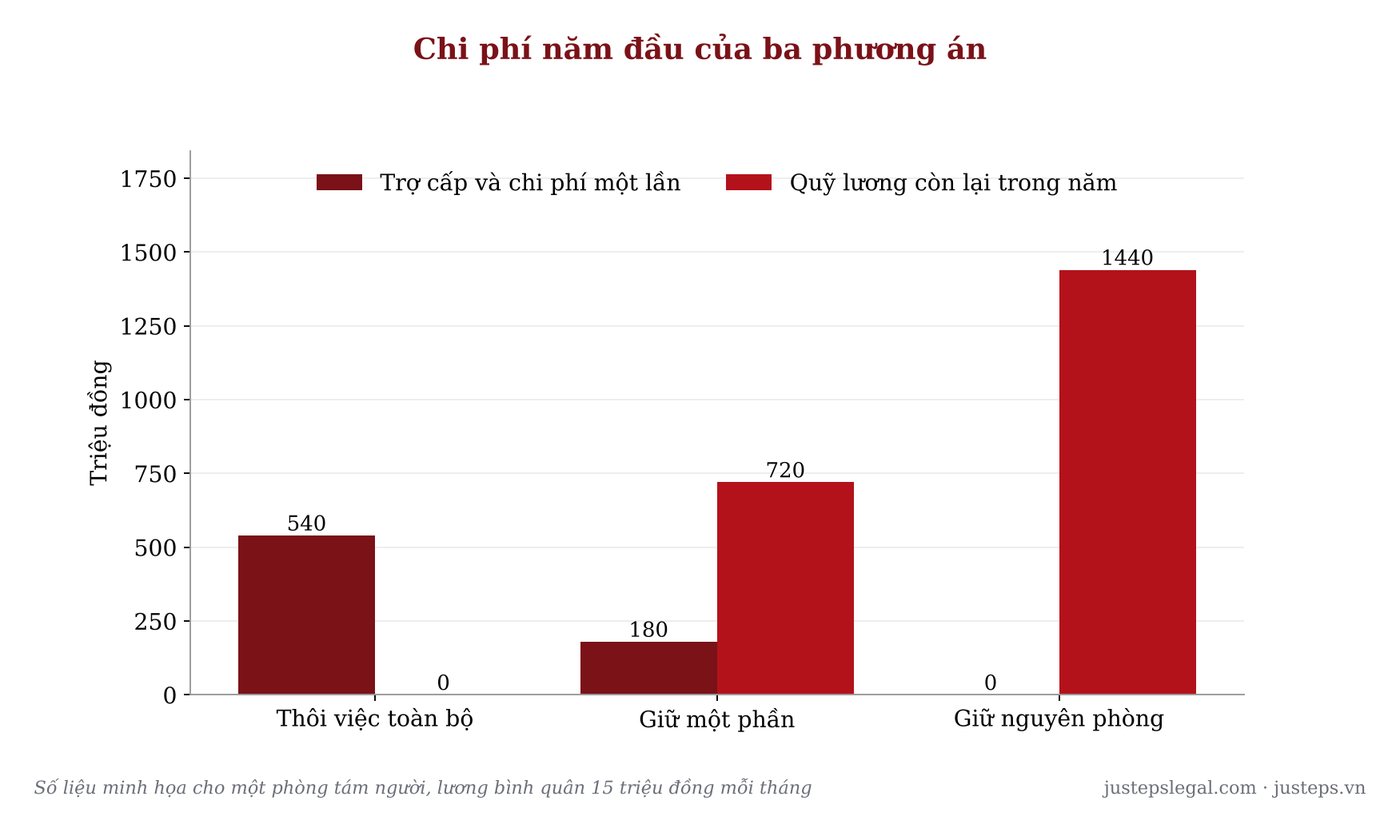
Estimated first-year cost of three streamlining options
In the example, the option of letting the whole department go has the lowest first-year cost but requires a large allowance payment immediately and loses all the experienced staff, so when activity recovers the business has to recruit and train from scratch. The option of keeping part of the team and retraining costs more in the first year but preserves core capability, while keeping the department unchanged has the highest cost and does not solve the shortage of work. The actual figures will differ for each business, but the accountant should prepare a similar comparison for each option so that the board of directors can decide on the basis of data. Businesses that need help diagnosing their structure and preparing the plan may refer to Justeps’ service for organisational restructuring and workforce streamlining.
Records required and common mistakes
A streamlining exercise carried out in the correct order leaves a set of records proving each step that was taken. The minimum set of records comprises the following documents:
- A workload diagnostic report proving that the structural change is genuine.
- The decision on the new organisational structure issued by the competent body, together with the statement of functions and duties and the headcount plan.
- The labour utilisation plan with the list of each group, the selection criteria and the financial resources for implementation.
- Minutes of consultation with the employee representative organisation, minutes of dialogue and evidence that the plan was publicly announced.
- Notices sent to the provincial state authority and to employees at least 30 days in advance when many employees are let go.
- Appendices or new contracts for those who change position, allowance calculations and decisions terminating the contracts of those who leave.
Common mistakes include announcing the decision to merge departments before a labour utilisation plan is in place, choosing who to cut on impressions, using a transfer decision instead of a contract appendix when the change is long-term, and failing to budget for the allowance fund so that payments are made late. After completion, the business must also report the reduction in employees participating in social insurance, update the labour management register and report changes in the workforce as required[15]. Businesses wishing to review all labour records before and after the streamlining exercise may refer to Justeps’ service for labour and payroll compliance management.
When an employee does not agree with the decision to let them go, the business should first discuss the matter directly, explaining the grounds and how the allowance was calculated, and if necessary invite a labour mediator so that the two sides can negotiate. Complete records prepared in the sequence described above are the best basis for the business to defend its own decision, and they also help the employee understand that the decision was made on clear grounds.
How Justeps can help
Justeps supports businesses in streamlining their organisation in the correct order and keeping their teams stable through the following services:
- Organisational restructuring and workforce streamlining. Justeps diagnoses workloads, proposes the new structure and drafts the labour utilisation plan together with the minutes and notices.
- Organisational structure, functions and duties, and job descriptions. Justeps drafts the statement of functions and duties of the merged departments and updates the job description for each position.
- Labour and payroll compliance management. Justeps reviews contracts, appendices, allowance calculations and the notice and reporting deadlines during the streamlining exercise.
- Salary scales and pay and bonus regulations. Justeps adjusts the salary scales and the pay and bonus regulation to fit the new structure and job titles.
Frequently asked questions
Is a labour utilisation plan mandatory when merging two departments?
It is mandatory where the merger affects the jobs of many employees[4]. If everyone keeps the same job and pay, the business only needs a decision on the new structure and a notice to employees.
Whom should a business without a trade union consult?
The consultation obligation applies to the grassroots employee representative organisation, where one exists. The business must still announce the plan publicly within 15 days of its adoption[6] and should hold a dialogue with representatives of the affected employees.
What if an employee does not agree to move to a new position?
If no agreement is reached on amending the contract, the two parties continue to perform the existing contract[10]. Where the old position no longer exists after the department has been dissolved, that person may be placed in the contract termination group in the plan and paid a job loss allowance.
Can a transfer decision be used instead of a contract appendix?
Only for temporary situations, for up to 60 cumulative working days in a year unless the employee agrees to a longer period[9]. Long-term changes to the job or pay must be recorded in an appendix or a new contract.
How is the job loss allowance calculated?
Each year of work is paid at 01 month’s wage, with a minimum of 02 months’ wages, on the working period after deducting time covered by unemployment insurance[13]. The wage used for the allowance is the average contractual wage for the 06 consecutive months before the job loss.
How soon must the business pay the allowance?
Within 14 working days from the date the contract is terminated, which may be extended to no more than 30 days in certain cases provided by law[14]. The accountant should prepare the allowance fund as soon as the plan is adopted.
Who has the authority to decide on the new organisational structure?
It depends on the type of business and its charter, but it is usually the Members’ Council in a multi-member limited liability company and the Board of Directors in a joint stock company[3]. The Director or General Director proposes the plan and organises its implementation.
Related articles
- Restructuring a fast-growing business so that its organisation keeps pace with its new scale
- Practical lessons on cutting operating costs in a business
- How to write department functions and duties so that every task in a business has someone accountable for it
- Building a headcount plan based on the workload of each department
Notes
[1] Clause 1 of Article 42 of the Labour Code No. 45/2019/QH14 dated 20 November 2019.
[2] Clause 2 of Article 42 of the Labour Code No. 45/2019/QH14.
[3] Articles 55 and 153 of the Law on Enterprises No. 59/2020/QH14 dated 17 June 2020, as amended and supplemented by Law No. 76/2025/QH15.
[4] Clause 3 of Article 42 of the Labour Code No. 45/2019/QH14.
[5] Clause 1 of Article 44 of the Labour Code No. 45/2019/QH14.
[6] Clause 2 of Article 44 of the Labour Code No. 45/2019/QH14.
[7] Point c, Clause 2 of Article 63 of the Labour Code No. 45/2019/QH14.
[8] Clause 3 of Article 137 of the Labour Code No. 45/2019/QH14.
[9] Clauses 1 and 2 of Article 29 of the Labour Code No. 45/2019/QH14.
[10] Article 33 of the Labour Code No. 45/2019/QH14.
[11] Clause 5 of Article 42 of the Labour Code No. 45/2019/QH14.
[12] Clause 6 of Article 42 of the Labour Code No. 45/2019/QH14.
[13] Article 47 of the Labour Code No. 45/2019/QH14.
[14] Clause 1 of Article 48 of the Labour Code No. 45/2019/QH14.
[15] Article 12 of the Labour Code No. 45/2019/QH14 and the Law on Social Insurance No. 41/2024/QH15.
This article is for reference and reflects the regulations in force at the time of publication. Please consult Justeps for advice tailored to your company’s records and situation.
For further information, please contact:
📩 Email: info@justeps.vn
🌐 Website: https://justepslegal.com · https://justeps.vn
🌐 Page: Justeps
☎️ Hotline (Zalo): 096 172 2607
📍 Thanh Xuan Office: 12th Floor, Licogi 13 Tower, 164 Khuat Duy Tien Street, Thanh Xuan Ward, Hanoi, Vietnam
📍 Ha Dong Office: LK06B, No.10, Dong Dua Area, Ha Dong Ward, Hanoi, Vietnam
📍 Ho Chi Minh City Branch: 528 Le Van Sy, Ho Chi Minh City, Vietnam
📍 Hai Phong Office: Truong Thinh Village, Ha Dong Commune, Hai Phong, Vietnam
📍 Quang Ninh Office: Van Don Special Zone, Quang Ninh Province, Vietnam





