
Key takeaways
- Pre-packaged processed food, food additives, processing aids, and utensils and packaging materials in direct contact with food are subject to self-declaration, except for groups that must register their declaration, such as health supplements.
- A business may only produce and trade in a product after it has been self-declared, so the internal procedure must lock the sales code until the quality department confirms that the file is complete.
- The test report in the file must be issued within twelve months before the date of submission by a designated testing laboratory or one accredited to ISO 17025.
- The product label must match the self-declared content and comply with Decree 37/2026/ND-CP, which replaced the former labelling regulations from 23 January 2026.
- A change to the product name, origin or composition requires a new self-declaration, while other changes only require written notification, so every proposal to change a formula or packaging must go through the quality department first.
A snack manufacturer with about forty employees developed a new flavour of dried nuts in time for the Lunar New Year season. The sales department took samples from the factory, photographed them, listed the product on an e-commerce platform and delivered goods to distributors while the quality department was still waiting for the test report. Three weeks later, an inter-agency inspection team took samples at a distributor and found that the product had no self-declaration and that the ingredients on the label differed from the final formula. The company had to stop sales, recall goods from its distributors, reprint the labels and pay a penalty, by which time the main selling season had passed.
This article guides food businesses in building an internal procedure so that every product is sold only after the self-declaration procedure has been completed, in the following order: the applicable legislation, classifying products from the concept stage, testing and the self-declaration file, labels and advertising content, the control gate before a sales code is opened, handling product changes, and keeping records in preparation for post-market inspection. The main readers are directors, heads of quality, product research and development teams and sales departments of businesses that manufacture, import or outsource the production of pre-packaged food. The article does not go into detail on the procedure for registering the declaration of health supplements and medical nutrition foods, which are appraised in advance by state authorities.
The applicable legislation and the principle of post-market inspection
The procedure for declaring food products is still carried out under the 2010 Law on Food Safety and Decree 15/2018/ND-CP. Decree 46/2026/ND-CP and Resolution 66.13/2026/NQ-CP on the declaration and registration of food products were issued at the beginning of 2026 but have since been suspended by the Government, and during the suspension, Decree 15/2018/ND-CP and its guiding documents continue to apply until the amended Law on Food Safety and its implementing decree take effect[1]. The draft amended Law on Food Safety was discussed by the National Assembly at its November 2026 session but was not passed at that session, so businesses need to follow developments in order to update their procedures once the new law is enacted.
The self-declaration mechanism is based on the principle that the business takes responsibility itself and the state authorities inspect afterwards. Immediately after self-declaring a product, organisations and individuals are entitled to produce and trade in the product and bear full responsibility for its safety[2]. This has two consequences for internal management. First, there is no licence from a state authority acting as a checkpoint, so if the business does not set up its own control gate, a product may reach the market before the file is complete. Second, when the authorities carry out post-market inspection, full responsibility for the accuracy of the file, the test results and the label rests with the business.
Classifying products from the concept stage
Classification should be carried out as soon as the research and development team proposes a new product, without waiting until finished samples exist. Under Decree 15/2018/ND-CP, organisations and individuals producing and trading in food self-declare pre-packaged processed food, food additives, food processing aids, food containers and packaging materials in direct contact with food[3]. Products and raw materials produced or imported solely for the production or processing of export goods or for internal production, and not sold on the domestic market, are exempt from the self-declaration procedure[3]. Certain product groups may not be self-declared and must instead have their declaration registered with the competent state authority before being placed on the market[4].
The table below summarises the three product groups, typical examples of each group and the consequences for the launch plan that the sales department needs to know early on.
| Product group | Examples | Consequences for the launch plan |
|---|---|---|
| Self-declaration | Confectionery, dried nuts, soft drinks, packaged seasonings, additives on the permitted list, packaging in direct contact with food. | The business prepares the file itself and may sell immediately after self-declaration; the timing depends mainly on testing. |
| Registration of declaration | Health supplements, medical nutrition foods, foods for special diets, nutritional products for children up to thirty-six months of age. | A state authority appraises the file, and sales may begin only after a registration receipt is issued, so more time is needed. |
| Exempt from declaration | Raw materials and products used only for the production or processing of export goods or for internal production. | No self-declaration is required, but there must be records proving the intended use, and the goods may not be sold on the domestic market. |
The result of the classification should be recorded in the product development form, signed by the head of quality, together with the reasons for the classification and the legal basis relied on. Borderline products, such as drinks fortified with micronutrients or products making health claims, need careful consideration, because stating a health benefit on the label may cause the product to be treated as belonging to the group requiring registration. Where there is uncertainty, the business should seek the views of the regulatory authority or a consulting expert before investing in packaging. For outsourced products, the processing contract must state clearly which party will self-declare in its own name, which party will provide the technical file and the test report, and which party will be responsible if errors occur.
Testing and the self-declaration file
The self-declaration file comprises the product self-declaration using the form issued with Decree 15/2018/ND-CP and a food safety test report for the product issued within twelve months before the date of submission, by a designated testing laboratory or a testing laboratory accredited to ISO 17025[2]. Documents in the file must be in Vietnamese; documents in a foreign language must be translated into Vietnamese and notarised, and must be valid at the time of self-declaration[2]. The test parameters are determined by the national technical regulations, the Ministry of Health regulations on contamination limits or the standards applied by the business, so the quality department should draw up a list of parameters before sending samples, to avoid having to repeat the tests.
The sample sent for testing must be a product made according to the final formula, process and packaging, not a trial sample from the development stage. If the formula is still changed after the test report has been issued, the test results may no longer accurately reflect the product being sold, and this is an error commonly detected in post-market inspections. The quality department should keep, together with the test report, information on the sample batch, production date, formula applied and the person who sent the sample, in order to prove that the tested sample and the goods sold are the same product. The chart below illustrates the expected time for each step in preparing the file for a product subject to self-declaration at a medium-sized business.
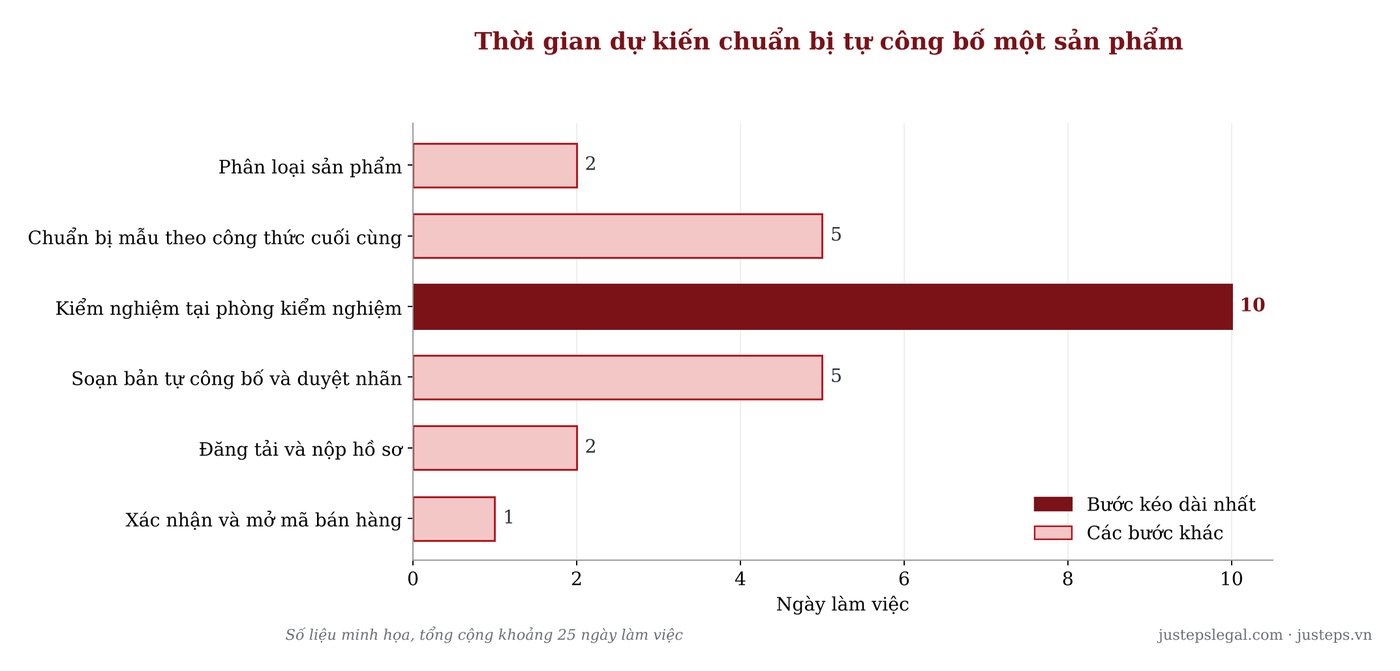
Expected time for each step in preparing the self-declaration of one product
In the example, testing takes the most time at ten working days, followed by preparing samples according to the final formula and drafting the self-declaration and label, at five working days each. Classifying the product and publishing and submitting the file take two working days each, while activating the sales code after confirmation by the quality department takes only one day. The total is about twenty-five working days, or more than a calendar month, so the launch plan should set the date for sending samples for testing at least six to eight weeks before the planned sales date. The figures are illustrative; the actual time depends on the number of test parameters, the testing laboratory’s schedule and the number of times the label has to be amended.
As to the sequence, organisations and individuals publish the self-declaration in the mass media or on their own website, and at the same time submit one copy by post or directly to the competent state regulatory authority designated by the provincial People’s Committee[2]. A business with two or more production facilities manufacturing the same product may choose to submit the file to the regulatory authority in any one locality where it has a production facility, and subsequent self-declarations must be submitted to the authority chosen. The quality department should keep evidence of the publication date and submission date, such as time-stamped screenshots of the website, postal receipts or acknowledgements on the system, because these mark the time from which the business may begin selling.
Labels and advertising content must match the file
The label is what the authorities and consumers see first, so all information on the label must be consistent with the self-declaration, including the product name, ingredients, main quality parameters, shelf life, storage instructions and the name and address of the responsible organisation. Labelling of goods is currently governed by Decree 37/2026/ND-CP detailing the Law on Product and Goods Quality, effective from 23 January 2026, which replaced Decree 43/2017/ND-CP and Decree 111/2021/ND-CP[5]. Labels and packaging that comply with the former regulations and were printed before Decree 37/2026/ND-CP took effect may only continue to be used during a transitional period of no more than two years, so businesses with stocks of old packaging need to plan to use them up or replace them before that period ends.
The internal procedure should require the quality department to sign off the final label design before it is sent for printing, checking each line against the self-declaration and the test report. Common errors include ingredients on the label differing from the formula after adjustment, health benefit claims for which the product has no sufficient basis, and the use of a product name different from the self-declared name. Advertising content, product descriptions on e-commerce platforms and materials for distributors must also be consistent with the self-declared file, must not advertise ordinary food as having a curative effect, and must comply with the law on advertising[6]. The sales department should send product descriptions to the quality department for review before publishing them, rather than writing them itself on the basis of trial samples.
The control gate before a sales code is opened
The most effective way to avoid selling before declaration is to link completion of the file with the creation of the product code in the sales, warehouse and accounting systems. In this way, the sales department cannot create a sales order, the warehouse cannot release goods and the accountant cannot issue an invoice for a product that has not been confirmed by the quality department. Samples used for sales presentations, display or evaluation by partners before declaration should be managed under a separate code, clearly marked as samples not for sale and limited in quantity. The flowchart below shows this control gate.
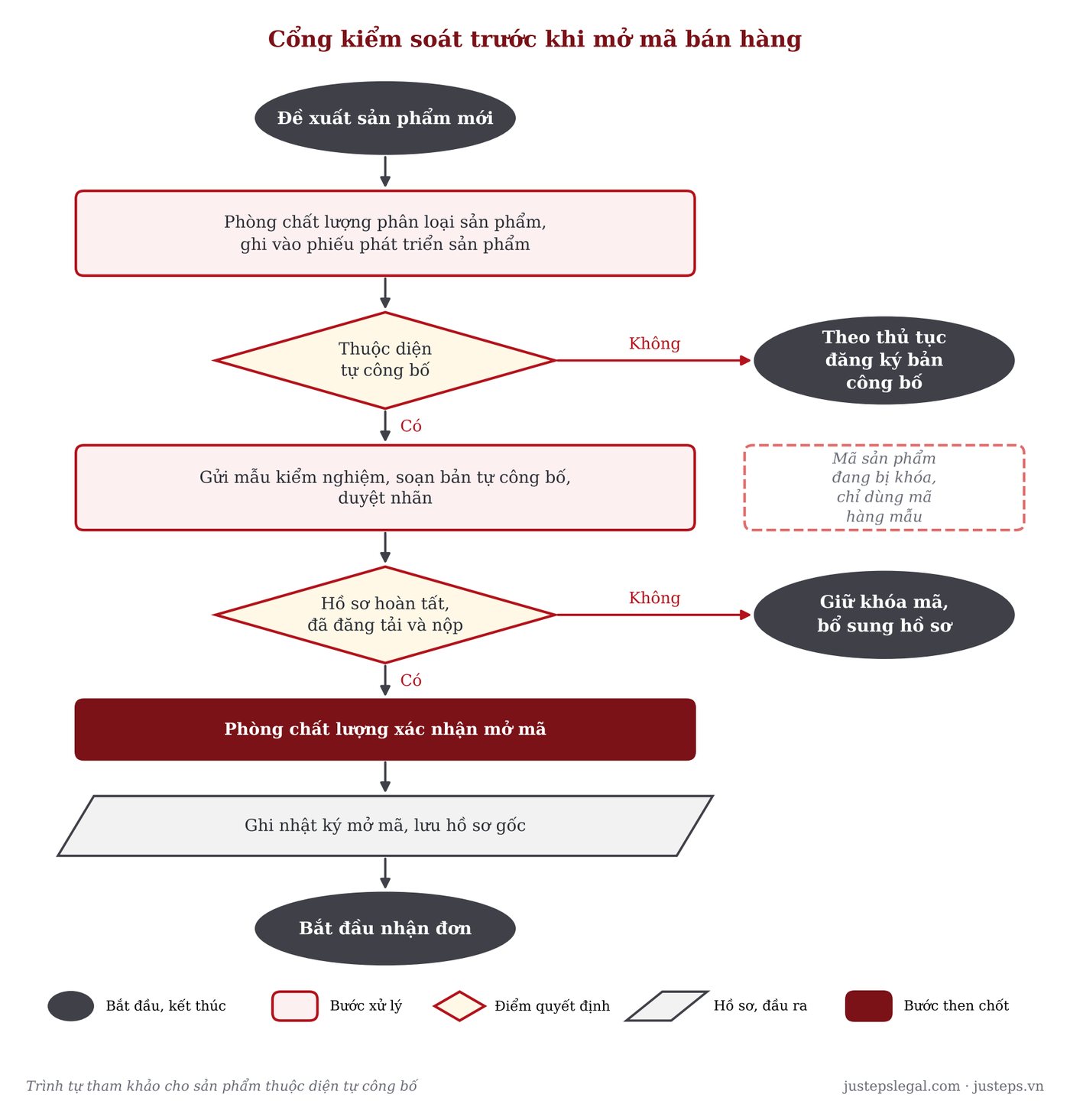
The control gate before a sales code is opened
According to the flowchart, the research and development team proposes the product and the quality department classifies it; depending on the result, the product follows either the self-declaration route or the registration route. Once the test report, the self-declaration and the approved label are available, the quality department checks whether the file is complete; if it is not, the product code remains locked and the sales department may not accept orders, but may only use samples under their separate code. If the file is complete and has been published and submitted as required, the quality department sends confirmation in writing or on the system, the data administration team opens the sales code and the sales department begins accepting orders. Each opening of a code is logged with the date, time and person confirming it, so that the business can prove that the product was only sold after the procedure had been completed.
Roles in the procedure must be clear so that the control gate is not bypassed when sales pressure increases. Three departments take part, each responsible for one layer of control and all relying on the product’s master file, as shown in the diagram below.
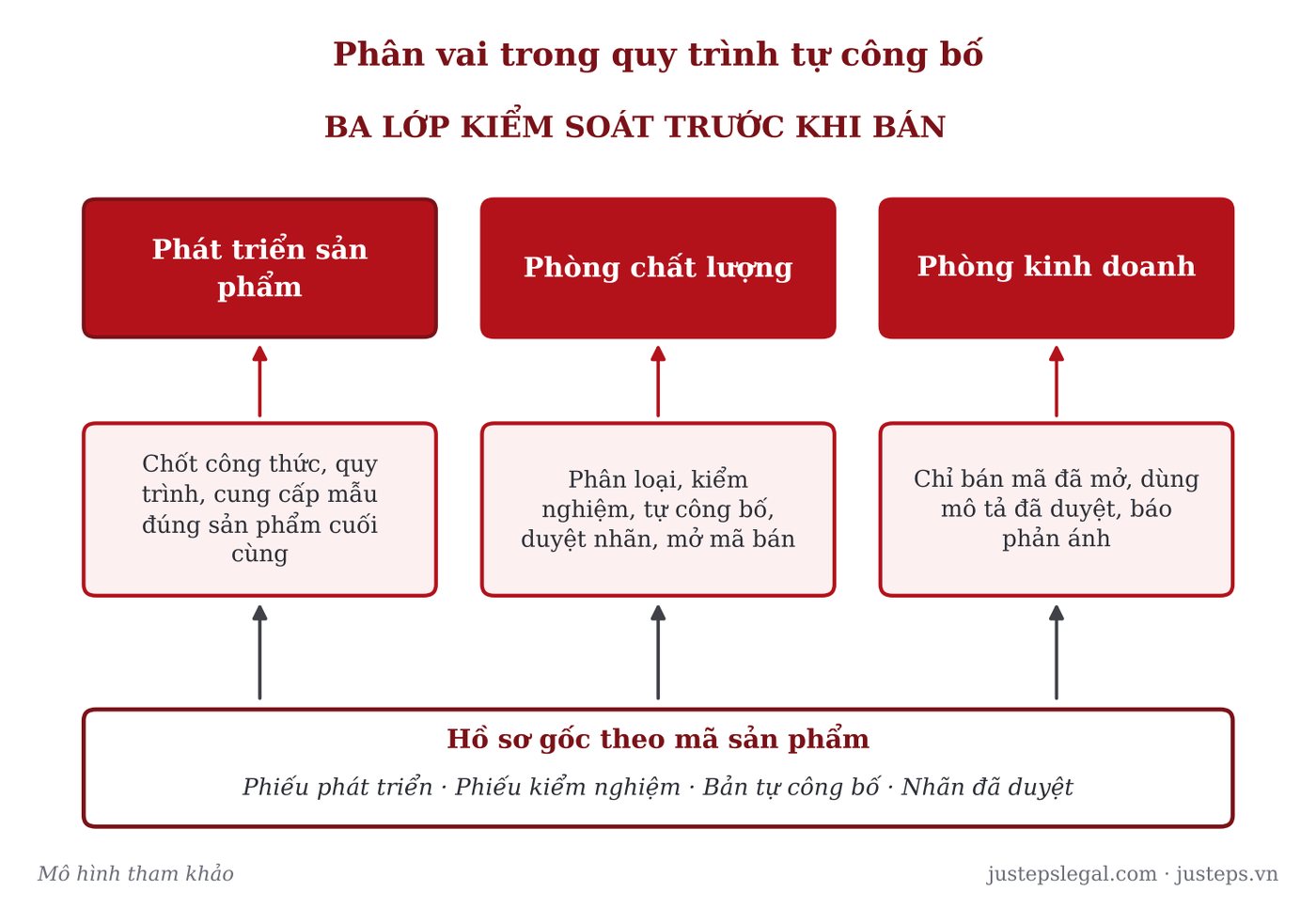
Allocation of roles among three departments in the self-declaration procedure
According to the diagram, the research and development team is responsible for finalising the formula and production process and for providing samples of the actual final product. The quality department classifies the product, sends samples for testing, prepares the self-declaration, approves the label and is the only department entitled to confirm the opening of the sales code. The sales department accepts orders only for products whose codes have been opened, uses approved descriptions and reports customer feedback on the product to the quality department immediately. All three layers rely on the master file, comprising the product development form, test report, self-declaration and approved label, kept centrally under the product code. Businesses that need to standardise this procedure into a regulation with forms may refer to Justeps’ service of building internal procedures and regulations for food businesses.
Product changes and keeping records for post-market inspection
New self-declaration or notification only
Food products are often adjusted after launch, for example by changing raw material suppliers, packaging specifications, improving the formula or changing the trade name. Under Decree 15/2018/ND-CP, where there is a change to the product name, origin or composition, organisations and individuals must self-declare the product again; for other changes, they notify the competent state regulatory authority in writing of the changes and may produce and trade in the product immediately after sending the notification[2]. The internal procedure should therefore require every proposal to change the formula, raw materials, place of production, packaging or name to be assessed by the quality department before it is implemented.
The quality department determines whether the change belongs to the group requiring a new self-declaration, the group requiring notification only or the group not affecting the file, records the result in the change request form and updates the label if necessary. While the new self-declaration is pending, the product made to the new formula must have its own code and be locked like a new product, while the product made to the old formula may be sold until stock runs out if there is no safety issue. The test report is also a date to monitor, because when self-declaring again, the business must use a test report issued within twelve months before the date of submission.
Keeping records and responsibility in post-market inspection
The file for each product should be kept by product code and by version, comprising the product development form, formula, test report, self-declaration, evidence of publication and submission, approved label, change notifications and periodic test results, if any. When the authorities carry out post-market inspection, this is the basis on which the business proves that the product has been sold in accordance with the declared content. Producing or trading in products that have not been self-declared, self-declaring incorrectly or labelling inconsistently with the declared content may result in administrative penalties, together with measures requiring the product to be recalled or destroyed[7]. When a product is found to be unsafe, the business is responsible for organising its recall and handling under the law on food safety[8].
To keep the procedure working, the quality department should maintain a summary tracking sheet of all products on sale, showing the self-declaration date, the most recent test date, the label version in use and any pending changes. Each quarter, the quality department compares the list of codes open in the sales system with the list of self-declared products and reports any mismatches to the director. The procedure also needs to be reviewed as soon as the amended Law on Food Safety and its implementing decree take effect, because the declaration procedure, the receiving authority and the file requirements may change. Businesses that need a point of contact to track legal changes and review product files periodically may refer to Justeps’ service of ongoing legal advisory for food processing businesses.
How Justeps can help
Justeps helps food businesses build a self-declaration procedure and control product files through the following services:
- Ongoing legal advisory for food and beverage processing businesses. Justeps classifies products, reviews self-declaration files and labels, and provides updates on changes to food safety law.
- Internal procedures and regulations for food businesses. Justeps drafts the product development procedure, the control gate for opening sales codes and the change management procedure, together with forms.
- Organisational structure design for food businesses. Justeps defines the functions and powers of the quality department, the product development team and the sales department.
- Business registration and sector-specific licences. Justeps prepares self-declaration files, declaration registration files and documents on the eligibility of production facilities.
Frequently asked questions
How soon after self-declaration may goods be sold?
The business may produce and trade in the product immediately after self-declaring it in accordance with the prescribed sequence[2]. The business should keep evidence of the publication date and the submission date as the starting point for sales.
How long is the test report used for the self-declaration file valid?
The test report must be issued within twelve months before the date of submission by a designated testing laboratory or one accredited to ISO 17025[2].
Does a change of packaging design require a new self-declaration?
Only a change to the product name, origin or composition requires a new self-declaration; other changes only require written notification to the regulatory authority[2]. The new label must still comply with the current labelling regulations[5].
Do goods produced solely for export need to be self-declared?
Products and raw materials used solely for the production or processing of export goods and not sold domestically are exempt from self-declaration[3]. If part of the goods is later sold on the domestic market, the business must self-declare before selling.
May health supplements be self-declared?
No. Health supplements belong to the group whose declaration must be registered with the competent state authority[4], and they may only be placed on the market after a registration receipt has been issued.
Does Decree 46/2026/ND-CP change the self-declaration procedure?
This decree has been suspended, so the self-declaration procedure is still carried out under Decree 15/2018/ND-CP until the amended Law on Food Safety and its implementing decree take effect[1].
Which party self-declares an outsourced product?
The law allows organisations and individuals producing and trading in food to self-declare[3], so the two parties need to agree in the processing contract which of them will declare in its own name. The contract should clearly state responsibility for providing the technical file and test report and for handling a product recall.
Related articles
- Preparing food safety documents for a restaurant before opening day on a twelve-week roadmap
- Internal procedures and regulations for food and beverage processing businesses
- Ongoing legal advisory for food and beverage processing businesses
- Service for advertising permits, confirmation of advertising content and advertising notification
Notes
[1] Government Resolution No. 15/2026/NQ-CP dated 6 April 2026 suspending Decree No. 46/2026/ND-CP dated 26 January 2026 and Resolution No. 66.13/2026/NQ-CP dated 27 January 2026; during the suspension, Decree No. 15/2018/ND-CP dated 2 February 2018 and its guiding documents continue to apply.
[2] Article 5 of Government Decree No. 15/2018/ND-CP dated 2 February 2018 detailing a number of articles of the Law on Food Safety, as amended and supplemented by Decree No. 155/2018/ND-CP.
[3] Article 4 of Government Decree No. 15/2018/ND-CP dated 2 February 2018 detailing a number of articles of the Law on Food Safety.
[4] Article 6 of Government Decree No. 15/2018/ND-CP dated 2 February 2018 detailing a number of articles of the Law on Food Safety.
[5] Government Decree No. 37/2026/ND-CP dated 23 January 2026 detailing the Law on Product and Goods Quality, effective from 23 January 2026, replacing Decree No. 43/2017/ND-CP and Decree No. 111/2021/ND-CP on the labelling of goods.
[6] The Law on Advertising and the laws amending and supplementing it (provisions on the content of food advertising).
[7] Government Decree No. 115/2018/ND-CP dated 4 September 2018 on administrative penalties for food safety violations, as amended and supplemented by Decree No. 124/2021/ND-CP.
[8] Article 55 of the Law on Food Safety No. 55/2010/QH12 dated 17 June 2010.
This article is for reference and reflects the regulations in force at the time of publication. Please consult Justeps for advice tailored to your company’s records and situation.
For further information, please contact:
📩 Email: info@justeps.vn
🌐 Website: https://justepslegal.com · https://justeps.vn
🌐 Page: Justeps
☎️ Hotline (Zalo): 096 172 2607
📍 Thanh Xuan Office: 12th Floor, Licogi 13 Tower, 164 Khuat Duy Tien Street, Thanh Xuan Ward, Hanoi, Vietnam
📍 Ha Dong Office: LK06B, No.10, Dong Dua Area, Ha Dong Ward, Hanoi, Vietnam
📍 Ho Chi Minh City Branch: 528 Le Van Sy, Ho Chi Minh City, Vietnam
📍 Hai Phong Office: Truong Thinh Village, Ha Dong Commune, Hai Phong, Vietnam
📍 Quang Ninh Office: Van Don Special Zone, Quang Ninh Province, Vietnam





