
Many small and medium-sized software companies set KPIs for their B2B sales team with a single revenue number. The usual result is that staff rush to close deals at quarter end, accept unfavourable payment terms, and nobody takes responsibility for receivables or renewals.
This article explains how to select metrics, set weights, link KPIs to salary and commission, and get the legal points right so that the KPI system does not become a source of labor disputes.
Choose metrics that reflect the B2B sales cycle
Selling software to businesses involves long cycles, several decision makers, and revenue that often spans years as subscriptions or maintenance fees. KPIs should therefore cover inputs, results and revenue quality. Five metrics suit most small and medium companies: new contract revenue, pipeline, conversion rate, receivables collection and customer retention.
New contract revenue is the main outcome metric. Pipeline shows whether a salesperson has enough opportunities for the coming quarters. Conversion rate measures selling skill. Receivables collection makes staff care about payment terms and stay close to the customer after signing. Retention matters for subscription models, where keeping an existing customer usually costs far less than winning a new one.
Each metric needs a clear definition and data source. For example, is "new contract revenue" measured by pre-tax contract value or first-year value, and does it include renewals? Without agreement upfront, disputes between sales and accounting will arise at period end.
Setting weights
Weights express the company's priorities for the period. A reference allocation for a salesperson focused on new customers is shown in the chart below.
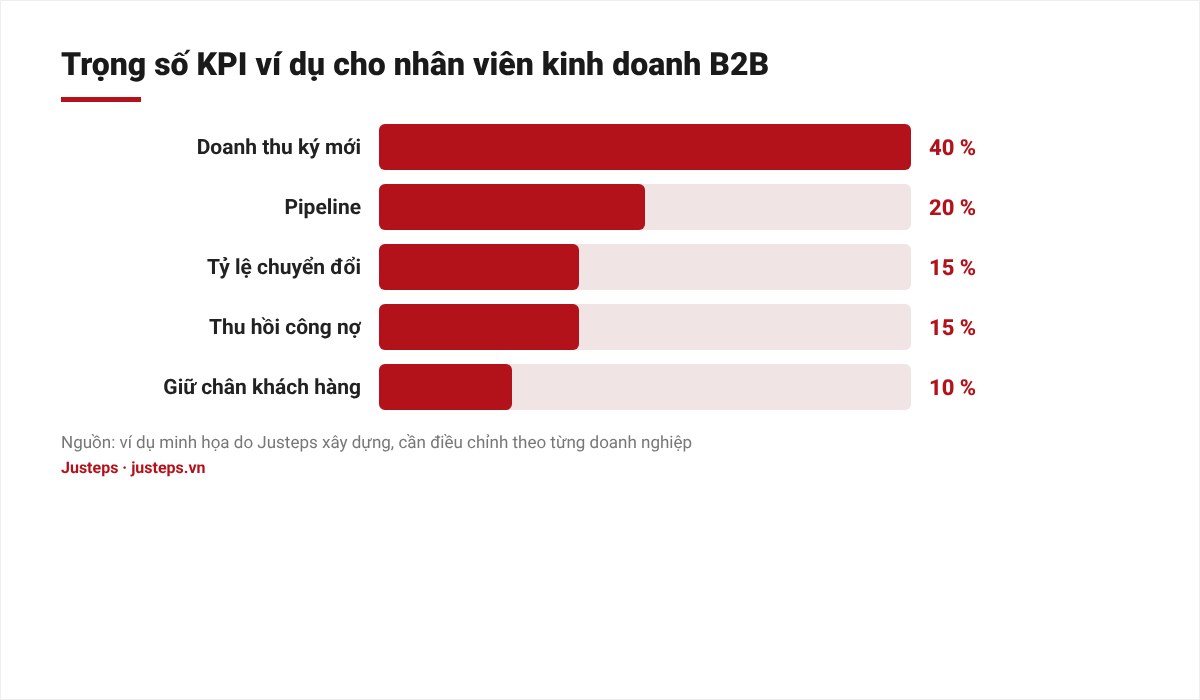
Example KPI weights for a B2B salesperson at a small or medium software company.
Weights should differ by role. A new-business hunter may carry 40–50% on new contract revenue; an account manager for existing customers should carry more weight on retention and upselling. No metric should fall below 10%, as staff will then practically ignore it. A KPI set should also have no more than 5–6 metrics.
Sample KPI sheet
The KPI sheet issued at the start of each period should state the metric, measurement method, weight, target and data source, and be signed by the employee and their direct manager.
| Metric | How measured | Weight | Quarterly target (example) | Data source |
|---|---|---|---|---|
| New contract revenue | Value of new contracts signed in the period (excluding VAT) | 40% | VND 1.5 billion | Signed contracts, CRM |
| Pipeline | Value of qualified opportunities at proposal stage or later | 20% | 3 times the new revenue target | CRM |
| Conversion rate | Contracts signed / opportunities with proposals sent | 15% | 25% | CRM |
| Receivables collection | Cash collected on time / receivables due from own accounts | 15% | 90% | Accounting receivables ledger |
| Customer retention | Rate of customers renewing subscriptions or maintenance | 10% | 85% | Renewal contracts, accounting |
| Total | 100% |
Each metric's score equals the achievement rate multiplied by its weight. Companies should set a floor (for example, below 70% of target the metric scores zero) and a cap (for example, a maximum of 150%) so that one outstanding metric cannot offset all the others.
Linking KPIs to base salary and commission
A common structure has three parts. Base salary is stated in the employment contract, provides stable income and must not be lower than the regional minimum wage; from 1 January 2027, the monthly minimum wage for Region I is VND 5,700,000 under Decree No. 399/2026/ND-CP. Commission is a percentage of revenue and should be calculated on cash actually collected rather than contract value, to tie it directly to receivables. A KPI bonus, paid quarterly or annually, equals the target bonus multiplied by the total KPI score.
The ratio between fixed and variable pay depends on strategy, but a base that is too low makes it hard to retain good people in slow quarters. The policy should also address common situations: deals handled jointly by two people, customers cancelling after commission has been paid, and employees leaving before a contract has been fully paid.
Legal points to get right
Wages include the salary for the job or title, wage allowances and other supplementary amounts (under Clause 1, Article 90 of the Labor Code No. 45/2019/QH14). Employers must develop salary scales, payrolls and labor norms as the basis for recruitment, agreeing salaries in employment contracts and paying wages (under Article 93 of the Labor Code No. 45/2019/QH14). Bonuses are decided by the employer based on business results and the employee's level of work completion; the bonus policy must be publicly announced at the workplace after consulting the grassroots employee representative organization, where one exists (under Article 104 of the Labor Code No. 45/2019/QH14).
In practice, companies should document KPIs and commission at two levels. The salary and bonus policy (with a commission policy) sets out principles, formulas and payment timing. The employment contract or its annex states the base salary and refers to the policy for commission and bonus. The KPI sheet issued each period is the implementing document, acknowledged by the employee.
The biggest risk is unilaterally cutting salary when an employee misses KPIs. The salary agreed in the contract may only be changed when both parties agree to amend or supplement the contract (under Article 33 of the Labor Code No. 45/2019/QH14). Companies should avoid clauses such as "missing KPIs reduces base salary by 20%"; instead, keep the variable portion in commission and bonus, which depend on results by design. Changes to commission or bonus formulas should also be announced in advance and applied to the next period, not retroactively to a period already assigned.
The KPI operating cycle
A KPI system only works when it is tracked regularly, not just opened at quarter end.
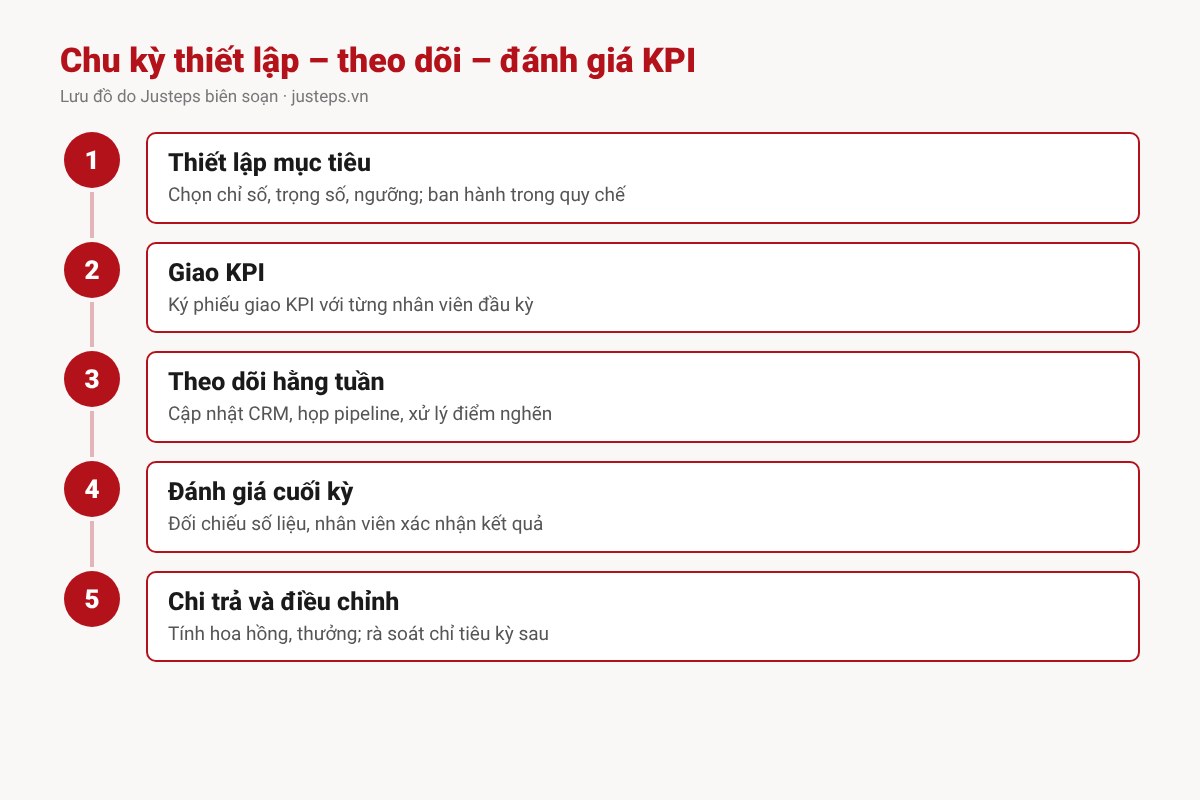
The cycle of setting, tracking and evaluating KPIs for a B2B sales team.
At the start of the period, the sales director proposes targets, the management board approves them and HR issues KPI sheets. Each week, the sales team updates the CRM and holds a pipeline review. At period end, accounting provides reconciled revenue and receivables data; employees can review and confirm results before commission and bonus are calculated. Any dispute over figures should be resolved within a short deadline set out in the policy.
Legal basis
- Labor Code No. 45/2019/QH14, effective from 1 January 2021 (Article 33, Clause 1 of Article 90, Article 93, Article 104).
- Decree No. 145/2020/ND-CP detailing and guiding the implementation of certain articles of the Labor Code on working conditions and labor relations.
- Decree No. 399/2026/ND-CP on minimum wages for employees working under employment contracts, applicable from 1 January 2027, replacing Decree No. 293/2025/ND-CP.
How Justeps can help
- Developing salary and bonus policies and commission policies for sales teams – Justeps.
- Building salary scales, payrolls and role-based KPI sets – Justeps.
- Reviewing employment contracts, contract annexes and KPI sheets – Justeps.
- Advising on disputes over commission, bonuses and changes to pay policies – Justeps.
- Ongoing legal advisory on labor and HR management – Justeps.
Frequently asked questions
Can base salary be reduced when an employee misses KPIs?
It should not be. The salary in the contract only changes by mutual agreement. KPI results should affect commission, bonuses and salary review, not the committed base salary.
Must KPIs be written into the employment contract?
Individual targets need not be listed. The contract should state the base salary and refer to the salary and bonus policy and the commission policy; specific targets go in the KPI sheet for each period.
Should commission be calculated on contract value or cash collected?
For software companies, calculating on cash collected reduces the risk of paying commission on contracts that are never paid. It can be split into instalments following the customer's payment schedule.
How is commission handled for unpaid contracts when an employee resigns?
The policy should specify this from the outset, for example continuing to pay commission on amounts collected within a set period after departure, or only on amounts collected up to the last working day.
How often should KPI weights be adjusted?
Usually once a year, or when strategy changes significantly. Mid-period changes easily erode trust and lead to disputes.
Related articles
- Fire safety records for business premises under the new law: annual tasks
- Controlling advertising content: a pre-publication approval process
- Building a Tet Dinh Mui 2027 bonus policy for manufacturing companies
- Organizational structure for private dental clinics with one to three locations
Contact Justeps
Email: info@justeps.vn · Hotline/Zalo: 096 172 2607 · Website: justeps.vn
Office network
- Thanh Xuan Office: 12th Floor, Licogi 13 Tower, 164 Khuat Duy Tien, Thanh Xuan Ward, Hanoi
- Ha Dong Office: LK06B, No.10, Dong Dua Area, Ha Dong Ward, Hanoi
- Ho Chi Minh City Branch: 528 Le Van Sy, Nhieu Loc Ward, HCMC (formerly Ward 14, District 3)
- Hai Phong Office: Truong Thinh Village, Ha Dong Commune, Hai Phong
- Quang Ninh Office: Van Don Special Zone, Quang Ninh





