
Key takeaways
- The law does not require a business to set up an HR department, but from around 30 employees the volume of obligations on contracts, wages, insurance and internal rules usually exceeds what a director or accountant can handle alongside other duties.
- The HR department must be given authority in writing, particularly the power to sign employment contracts under an authorisation from the legal representative; otherwise the title of HR manager exists only on paper.
- The core set of documents, comprising registered internal labour regulations, the wage scale and wage table, the wage and bonus rules and template contracts, should be completed within the first three months, before processes are optimised.
- The first hire should be an HR generalist with a sound grasp of labour and insurance law, while a dedicated payroll and benefits role need only be added when headcount approaches 80.
- The law amending the Labour Code, passed on 21 November 2026 and effective from 1 March 2027, is an opportunity for a new HR department to review its internal labour regulations and wage rules as they are being drafted.
In a business with fewer than 20 people, HR work is usually done by the Director personally or handed to the accountant as an extra duty. The Director conducts interviews, the accountant prepares the payroll and the insurance declarations, and employment contracts are adapted from an old template whenever someone joins. This works tolerably while only one person joins or leaves each month, but once the business passes about 30 people errors begin to accumulate, such as expired contracts that are not renewed, payroll sheets with allowances that only one person understands, or internal labour regulations that remain unregistered even though the business has had more than 10 employees for a long time.
This article analyses how to build an HR department from scratch for a business with roughly 30 to 80 employees, covering when a dedicated department is needed, the legal obligations the department must master, the scope of its work, how to recruit and delegate authority, the core processes, a six-month roadmap and the minimum set of records. It applies to private-sector limited liability companies and joint stock companies, including small foreign-invested enterprises. It is written chiefly for directors, founders and those placed in charge of HR for the first time.
When a business needs its own HR department
Labour law does not require a business to have an HR department, nor does it set a headcount threshold above which a dedicated HR officer becomes mandatory. The 30-person mark is a practical threshold, arising from the volume of recurring work rather than from any specific rule. At this size, a business typically has several people joining and leaving each month, a payroll with many types of allowance, a few contracts due for renewal and questions on pay, leave and discipline that need consistent answers.
Apart from headcount, certain signs indicate that a business should separate the HR function into its own department earlier than planned. The clearest signs are that the Director spends many hours a week on recruitment and on employees’ questions, that the accountant often has to recalculate pay because timekeeping data is missing, or that the business has received complaints about pay, bonuses or discipline without having any procedure for handling them. Once these signs appear, the cost of not having a dedicated person usually exceeds the cost of hiring an HR officer, not to mention the risk of penalties or labour disputes.
The legal obligations the HR department must master from day one
The first task of a new HR department is to take over the obligations the business has already incurred, since most obligations do not depend on whether or not the business has an HR department. The employer must prepare, update and manage a labour register, declare its use of labour when it commences operations and report periodically on changes in its workforce to the labour authority[1]. The HR department should check immediately whether the business has made its declaration, whether the labour register is complete, and draw up a schedule for the periodic reports due during the year.
The second group of obligations concerns wages. The employer must establish a wage scale, a wage table and labour norms as the basis for recruitment, agreeing wages and paying wages, consulting the employees’ representative organisation at the workplace if there is one, and publish them at the workplace before applying them[2]. The wage for a job or position paid to an employee working full normal hours must not be lower than the regional minimum wage, which from 1 January 2027 is VND 5,700,000 in Region I, VND 5,080,000 in Region II, VND 4,450,000 in Region III and VND 4,040,000 in Region IV[3]. An HR department set up at the end of 2026 should immediately review the lowest wage levels in the wage table so that they can be adjusted in time for the new rates.
The third group of obligations is tied to the 10-employee threshold. An employer with 10 or more employees must issue written internal labour regulations and file them for registration with the specialised labour agency of the provincial People’s Committee within 10 days of issuing them[4]. The employer must also hold periodic dialogue at the workplace at least once a year[5] and implement grassroots democracy at the workplace in accordance with the Government’s guidance[6]. A 30-person business without registered internal labour regulations or that has never held a workplace dialogue is fairly common, and these are usually the first two matters the HR department must deal with.
The final group of obligations concerns insurance and data. People working under employment contracts of one month or more are subject to compulsory social insurance[7], and employees working under contracts of one month or more are also subject to unemployment insurance under the Law on Employment[8]. Personnel files contain a great deal of personal data, including health data and financial information, so the HR department must ensure that the data is processed on a lawful basis, that employees are notified and that access is restricted[9].
In addition to the current obligations, the Law amending and supplementing a number of articles of the Labour Code was passed by the National Assembly on 21 November 2026 and takes effect from 1 March 2027, adding 27 July and 24 November as fully paid days off[10]. An HR department drafting internal labour regulations and wage rules during this period should draft them in line with the rules that will apply, rather than issuing them under the old rules and having to amend them a few months later. The other provisions of the amending law should be checked once the official text is published.
The scope of work of an HR department at 30 to 80 employees
The scope of work of the HR department should be defined before anyone is hired, to avoid the recruit doing only recruitment or only administration. At 30 to 80 employees, the HR department usually covers six areas of work at different frequencies, as summarised in the table below:
| Area of work | Main tasks | Frequency |
|---|---|---|
| Recruitment | Planning against the approved headcount, posting vacancies, screening, coordinating interviews and sending offer letters. | In rounds, peaking before the busy season. |
| Records and contracts | Drafting, signing and filing contracts and annexes, and monitoring contract and probation end dates. | Weekly. |
| Payroll and insurance | Compiling timesheets, preparing the payroll, declaring insurance changes and withholding personal income tax. | Monthly. |
| Internal rules and discipline | Communicating the internal labour regulations, recording breaches and holding disciplinary meetings in the proper sequence. | As they arise. |
| Training | Preparing the annual training plan, running mandatory training and signing training contracts when the business bears the cost. | Quarterly. |
| Labour relations | Holding periodic dialogue and employee conferences, and receiving and resolving complaints. | At least annually. |
Of these six areas, training is the one most often neglected in small businesses, even though the Labour Code requires employers to draw up an annual plan and allocate funds for training and for improving employees’ qualifications and vocational skills[11]. Where the business bears the cost of an employee’s training, including training abroad, the two parties must sign a vocational training contract stating the period for which the employee commits to work after training and the responsibility for reimbursing the costs[12]. Without such a contract, the business has almost no basis for demanding reimbursement if the trained employee leaves early.
The HR department’s time is not divided evenly between these areas. The chart below illustrates a typical breakdown of working time for a two-person HR department in its first year, while the business is both recruiting and standardising its records.
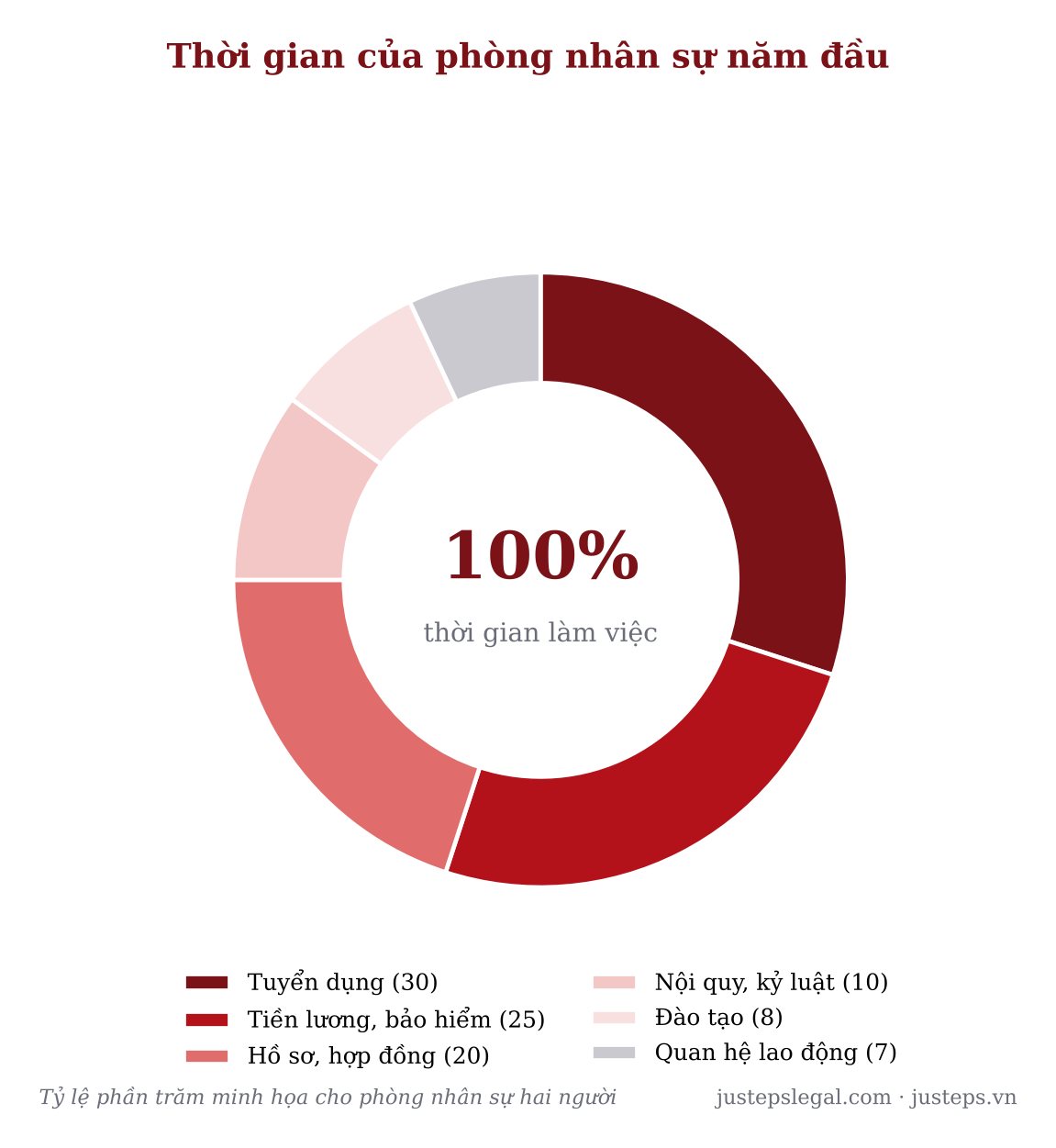
Breakdown of the HR department’s working time in its first year
Recruitment, together with payroll and insurance, takes up more than half of the time, because these two areas have fixed deadlines and a direct impact on business operations. Records and contracts take about one fifth of the time in the first year, mainly because old files have to be reviewed, and this share will fall once templates have been standardised. The remainder goes to internal rules and discipline, training and labour relations, which are less urgent but determine the risk of disputes later on. If the HR department has no time for this group of tasks, the Director should consider outsourcing payroll to free up time for the in-house team.
Whom to hire first and how to delegate authority
The first member of the HR department should be an HR generalist with practical experience of employment contracts, payroll and insurance, rather than a recruitment specialist. The reason is that recruitment can be outsourced position by position, whereas errors in contracts, pay and insurance accumulate over time and are hard to put right. For a business of 30 to 50 people, one generalist is usually sufficient, combined with engaging outside specialists to review documents from time to time. When headcount approaches 80, or the payroll involves several different methods of payment, the business should add a dedicated payroll and benefits officer.
Hiring someone only makes sense if that person is given clear authority. On the employer’s side, the person who enters into employment contracts is the legal representative of the business or a person authorised in accordance with the law, and the authorised person may not delegate that authority to anyone else[13]. Therefore, if the business wants the HR manager to sign employment contracts, annexes or decisions terminating contracts, the Director must issue a written authorisation stating the types of document that may be signed, the groups of positions covered and the term of the authorisation.
As regards the power to issue internal rules, the Director of a limited liability company with two or more members has the power to issue internal management rules unless the company charter provides otherwise, and a similar rule applies to the Director or General Director of a joint stock company[14]. The HR department drafts, consults on and submits rules for signature, but it is not the issuing authority, so all HR rules must be signed by the person with authority under the charter. A sensible division of authority is usually for the Director to decide policy and dismissals, for heads of department to choose candidates within the approved headcount, and for the HR department to decide procedural matters and ensure that records comply with the law.
Designing the core HR processes
A new HR department does not need many processes, but it does need three that run reliably, namely the recruitment and onboarding process, the monthly payroll process and the leaving process. Each process must state clearly who does what, who approves, the deadline for each step and the resulting records. The diagram below illustrates the recruitment and onboarding process across the four units involved.
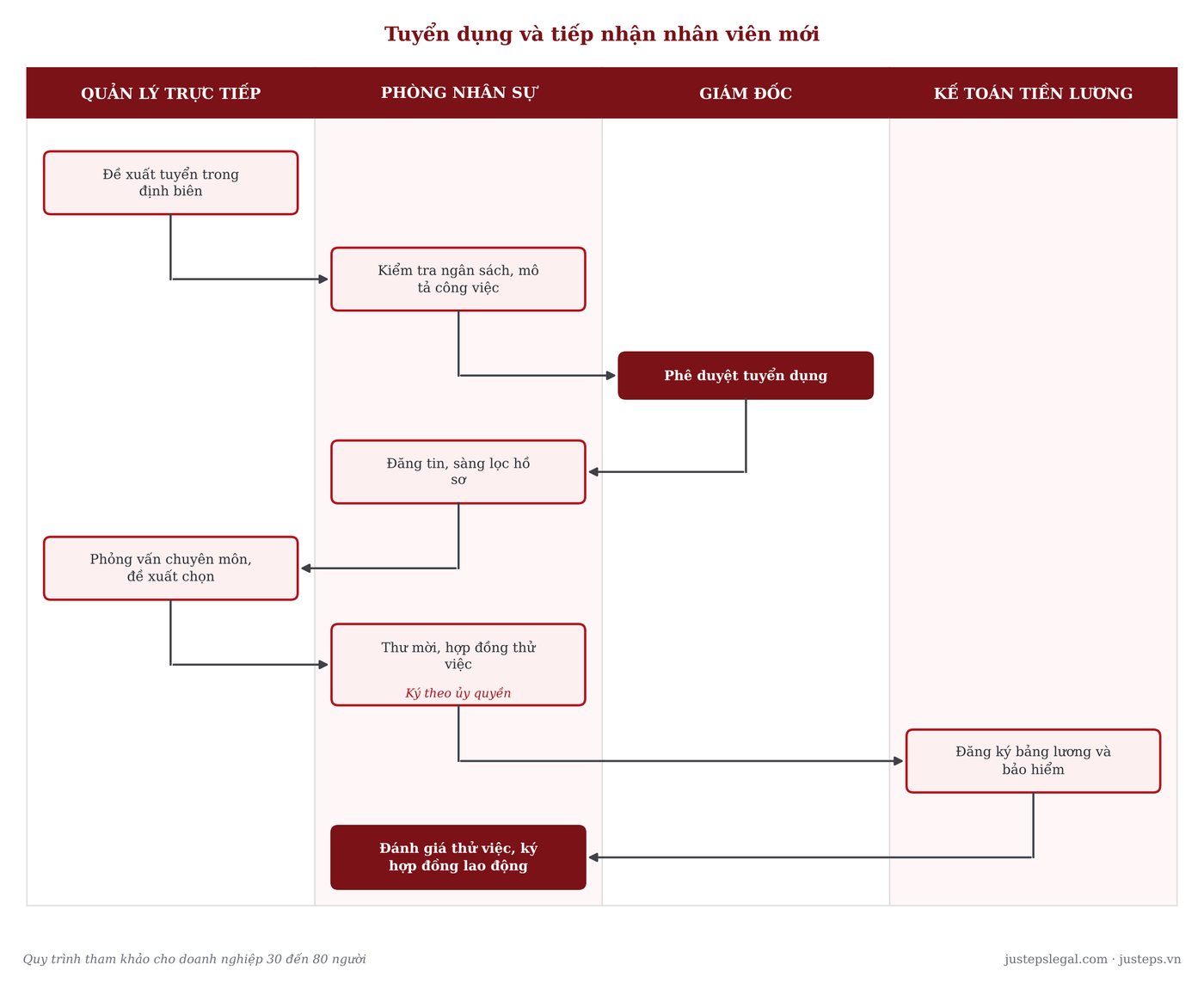
Recruitment and onboarding process by responsible unit
The process starts when the line manager proposes a hire within the approved headcount, after which the HR department checks the budget and the job description before submitting the request to the Director. The pivotal step is the Director’s approval of the hire, since this is the control point for staff costs and prevents recruitment outside the plan. The HR department posts the vacancy and screens applications, the line manager conducts the technical interview and proposes the chosen candidate, and the HR department then sends the offer letter and signs the probation contract under its authorisation. The payroll accountant adds the new employee to the payroll and insurance records, and at the end of probation the HR department compiles the assessment so that an employment contract can be signed or the employee notified that the probation was unsuccessful.
The payroll process should fix the timesheet cut-off date, the date for line managers’ confirmation, the date for the accountant’s check and the pay date, so that employees receive their payslips before being paid and have time to report errors. The leaving process needs a checklist for returning assets, documents and access accounts, together with deadlines for settling related payments and returning documents to the employee as required by law. These three processes should be issued as short written procedures with forms, kept in a shared folder with access controls so that every line manager can consult them.
A six-month roadmap for building the HR department
Building an HR department should follow a roadmap, because the business must continue operating normally while it standardises. The six-month roadmap below deals with legal risks first, and only then turns to optimising processes and measuring performance.
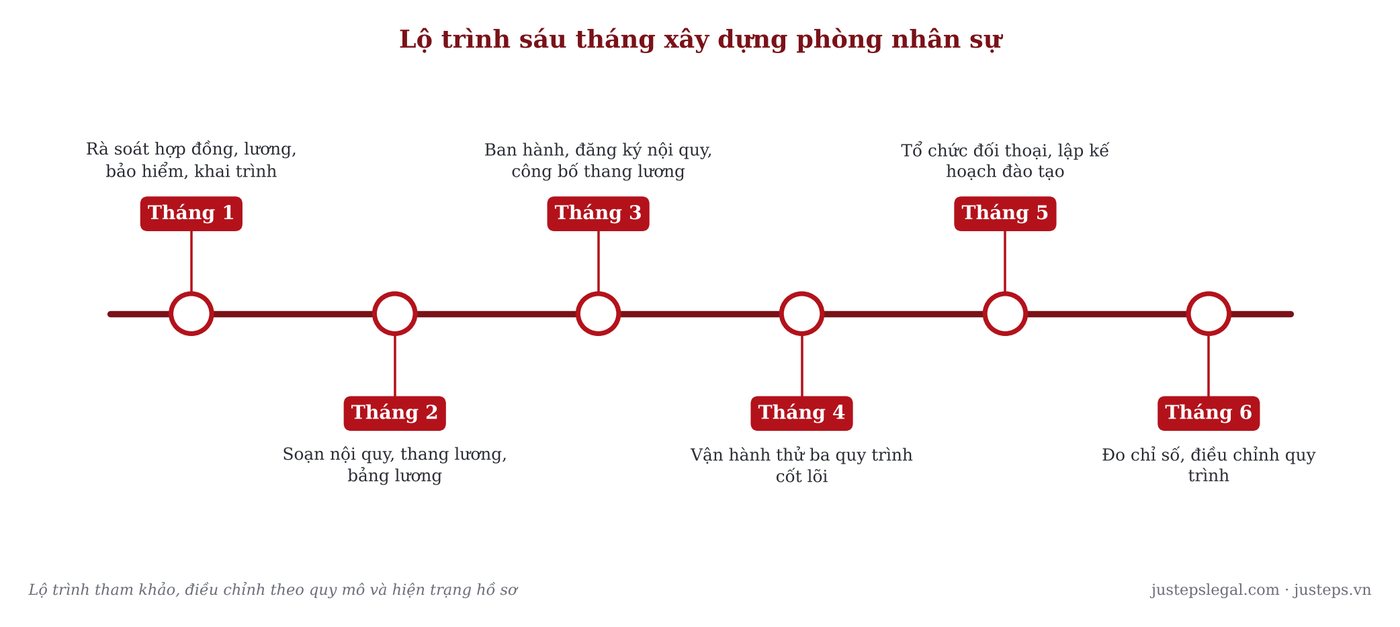
Six-month roadmap for building the HR department
The first month is devoted to reviewing the current position, including a list of employees without contracts or with expired contracts, cases where the wage actually paid differs from the contract, and the status of insurance contributions. The second and third months focus on drafting and issuing the core documents, with the internal labour regulations having to cover matters such as working hours, rest periods, order at the workplace and forms of disciplinary action[4]. From the fourth to the sixth month, the HR department pilots the three core processes, records difficulties so that they can be adjusted, and begins tracking indicators such as the average time to fill a position and the rate of departures within the first three months.
This roadmap assumes that the business has one full-time HR officer and that the Director takes part in the approval steps. If the business engages outside specialists to draft the core documents, the second stage can be shortened to about three to four weeks. Businesses that need to draft internal labour regulations and prepare the registration file may refer to the Justeps service internal labour regulations and disciplinary procedures, while the wage scale and wage table can be developed through the service wage scales, wage tables and wage and bonus rules.
Common errors and the minimum set of records
From its experience of supporting businesses in building their HR function, Justeps has found certain errors that recur in the early stages, all of which can be prevented if they are identified early:
- The business gives someone the title of HR manager but neither authorises them to sign contracts nor gives them access to payroll data, so everything still has to wait for the Director.
- Rules are copied from another company and do not fit the business’s sector, method of paying wages or actual organisational structure.
- Internal labour regulations have been drafted and communicated but not filed for registration, so they do not provide a sufficient basis for disciplinary action when a breach occurs.
- HR data is scattered across many spreadsheets and chat groups, with no access controls and no way of telling which version is correct.
To avoid these errors, the HR department should complete a minimum set of records within the first six months, each with a clearly identified preparer and approval level, as suggested below:
| Record | Main content | Approval level |
|---|---|---|
| Organisation chart | Departments, reporting lines and headcount for each department, with a job description for each position. | Submitted by the Director and approved by the management body under the charter. |
| Internal labour regulations | Working hours, rest, order, safety, breaches and forms of discipline, duly registered. | Signed by the Director after consulting the employees’ representative organisation, if any. |
| Wage scale and wage table | Wage grades and steps by position, wage and bonus rules and allowances. | Issued by the Director and published before being applied. |
| Template contracts | Probation contract, employment contract, annexes, training contract and confidentiality agreement. | Drafted by the HR department, with the templates approved by the Director. |
| Letter of authorisation | Scope of the HR manager’s authority to sign contracts and HR decisions, and the term of the authorisation. | Signed by the legal representative. |
| Process forms | Hiring request, onboarding and leaving checklists and dialogue minutes. | Issued internally by the HR manager. |
Once the set of records is complete, the HR department should schedule a review at least once a year, or as soon as labour law changes significantly, as with the amendments to the Labour Code taking effect in 2027. Regular reviews ensure that the records always reflect how the business actually operates, and they give the business a sound basis for dealing confidently with labour inspections or with disputes with employees.
How Justeps can help
Justeps helps businesses build an HR department, from reviewing the current position to completing the documents and processes, through the following services:
- Labour and payroll compliance management. Justeps reviews existing labour records, contracts, payroll and insurance and prepares a list of remedial actions for the new HR department.
- Internal labour regulations and disciplinary procedures. Justeps drafts the internal labour regulations, prepares the registration file and guides the disciplinary procedure.
- Wage scales, wage tables and wage and bonus rules. Justeps designs the wage scale, wage table, wage and bonus rules and allowances in line with the new minimum wage.
- Labour records and employment contracts. Justeps drafts templates for probation contracts, employment contracts, training contracts, confidentiality agreements and letters of authorisation to sign.
- Personal data protection compliance. Justeps prepares data processing notices and rules on access rights to personnel files.
Frequently asked questions
Must a business with 30 employees set up an HR department?
The law does not require a business to set up an HR department. However, at this size the business already has many obligations, such as registered internal labour regulations, a wage scale and wage table, periodic dialogue and labour reporting, so it needs at least one dedicated person.
May the HR manager sign employment contracts?
Yes, if there is a written authorisation from the legal representative of the business[13]. The authorised person may not delegate that authority to anyone else, so when the HR manager is absent the Director must sign personally or authorise another person.
Can all HR work be outsourced?
A business can outsource payroll, insurance declarations or recruitment for particular positions. Decisions on policy, selection and discipline should remain with people inside the business, because they are bound up with the employer’s responsibilities.
What happens if internal labour regulations have been issued but not registered?
A business with 10 or more employees must file its internal labour regulations for registration within 10 days of issuing them[4]. Failure to register may lead to penalties and weakens the basis for disciplining employees.
Must a small business hold dialogue at the workplace?
Yes. The employer must hold periodic dialogue at the workplace at least once a year[5]. The HR department should record minutes of the dialogue and keep them with the labour relations records.
When may a business require an employee to reimburse training costs?
When the business has borne the cost of training and the two parties have signed a vocational training contract stating the committed period of work and the responsibility for reimbursement[12]. Without a training contract, the business will find it hard to justify a demand for reimbursement.
How does the 2026 law amending the Labour Code affect a new HR department?
The law was passed on 21 November 2026 and takes effect from 1 March 2027, adding 27 July and 24 November as fully paid days off[10]. The HR department should update its internal labour regulations, leave calendar and pay calculations under the new rules as soon as it drafts its documents.
Related articles
- Setting up the organisation of a newly incorporated company with fewer than 10 staff so that roles, authority and cash flow are under control
- Hiring the first employees of a newly established company, from the order of positions to contracts and insurance
- Practical lessons in building an employee handbook for a small business that is concise, practical and consistent with the internal labour regulations
- A monthly labour and payroll compliance checklist for HR departments
Notes
[1] Article 12 of the Labour Code No. 45/2019/QH14 dated 20 November 2019.
[2] Article 93 of the Labour Code No. 45/2019/QH14.
[3] Government Decree No. 399/2026/ND-CP on minimum wages for employees working under employment contracts, applicable from 1 January 2027.
[4] Article 118 and Clause 1 of Article 119 of the Labour Code No. 45/2019/QH14.
[5] Point a of Clause 2 of Article 63 of the Labour Code No. 45/2019/QH14.
[6] Government Decree No. 145/2020/ND-CP dated 14 December 2020 detailing and guiding the implementation of a number of articles of the Labour Code on working conditions and labour relations.
[7] Point a of Clause 1 of Article 2 of the Law on Social Insurance No. 41/2024/QH15 dated 29 June 2024.
[8] The Law on Employment No. 74/2025/QH15.
[9] The Law on Personal Data Protection No. 91/2025/QH15 and Decree No. 363/2026/ND-CP.
[10] The Law amending and supplementing a number of articles of the Labour Code, passed by the National Assembly on 21 November 2026 and effective from 1 March 2027.
[11] Clause 1 of Article 60 of the Labour Code No. 45/2019/QH14.
[12] Article 62 of the Labour Code No. 45/2019/QH14.
[13] Clauses 3 and 5 of Article 18 of the Labour Code No. 45/2019/QH14.
[14] Point d of Clause 2 of Article 63 and Article 162 of the Law on Enterprises No. 59/2020/QH14 dated 17 June 2020, as amended and supplemented by Law No. 76/2025/QH15.
This article is for reference and reflects the regulations in force at the time of publication. Please consult Justeps for advice tailored to your company’s records and situation.
For further information, please contact:
📩 Email: info@justeps.vn
🌐 Website: https://justepslegal.com · https://justeps.vn
🌐 Page: Justeps
☎️ Hotline (Zalo): 096 172 2607
📍 Thanh Xuan Office: 12th Floor, Licogi 13 Tower, 164 Khuat Duy Tien Street, Thanh Xuan Ward, Hanoi, Vietnam
📍 Ha Dong Office: LK06B, No.10, Dong Dua Area, Ha Dong Ward, Hanoi, Vietnam
📍 Ho Chi Minh City Branch: 528 Le Van Sy, Ho Chi Minh City, Vietnam
📍 Hai Phong Office: Truong Thinh Village, Ha Dong Commune, Hai Phong, Vietnam
📍 Quang Ninh Office: Van Don Special Zone, Quang Ninh Province, Vietnam





