
Key takeaways
- Standard operating procedures turn ways of working that exist only in the experience of a few people into documents that a newcomer can follow and a manager can check.
- A business should begin with five to seven procedures that are performed frequently, carry high risk or involve several departments, rather than trying to write every procedure at once.
- Each procedure needs a procedure owner, should be piloted before issuance and should be reviewed at least once a year or as soon as the law or the organisation changes.
- Standard operating procedures explain how work is done, whereas disciplinary action for non-compliance must have a basis in the internal labour rules, the employment contract or the law.
A materials distribution company with around eighty employees ran smoothly for many years thanks to a long-serving warehouse accountant who knew exactly how to receive goods, count them, prepare receipts and reconcile with suppliers. When this person left, the company needed almost three months for the replacement to settle in, during which inventory figures were repeatedly wrong and two defective consignments were taken into stock without anyone noticing. The former employee’s way of working had never been written down, so the newcomer had to ask each department in turn and received a different answer from each person. This situation shows the risk of leaving operational knowledge in the heads of a few individuals instead of in the documents of the business.
This article explains how to build standard operating procedures (SOPs) in the order in which the work is done, including identifying when standardisation is needed, choosing priority procedures, structuring a procedure document, the steps of surveying, piloting and issuance, the relationship with the internal labour rules and internal regulations, and common mistakes. The content suits trading, service and manufacturing businesses with from around twenty to several hundred employees. The main readers are chief executives, heads of department, the human resources department and the person responsible for the internal document system.
When a business needs standard operating procedures
In its early stage, a business usually operates through direct conversation, the founder takes part in most of the work and people learn how to do things by watching one another. This approach is flexible but works only while the team is small and the work is not highly repetitive. When the business grows, opens new branches or hires many new people in a short time, the lack of consistency begins to cause errors, delays and disputes over responsibility. A business should begin to standardise when one or more of the following signs appear:
- The same task is performed differently by each person, each shift or each branch, with different results.
- Newcomers need several months to become productive because there is no written guidance and they have to ask each colleague in turn.
- Some tasks are known by only one person, so the business is disrupted whenever that person takes leave or resigns.
- Errors recur at the handover points between departments, for example between sales and the warehouse or between the warehouse and accounting.
- Customers, partners or inspection teams ask the business to demonstrate how it controls a particular activity.
In this article, a standard operating procedure means a document describing the sequence of steps for performing a repetitive task, together with the persons responsible, time limits, forms and criteria for assessing the result. Such a document differs from internal management regulations in that regulations set out principles, authority and powers, whereas a procedure gives specific instructions on how the work is done. The law does not require private businesses to have standard operating procedures for every activity, but certain areas such as occupational safety, accounting and personal data protection impose requirements that a business can meet only when it has clear procedures. Standard operating procedures are therefore both a management tool and evidence that the business has organised the performance of its legal obligations.
Choosing priority procedures to standardise first
The most common mistake at the outset is trying to write all of the business’s procedures at once, resulting in dozens of hastily drafted documents that no one reads and no one updates. A more effective approach is to list the repetitive tasks of each department and then score them to select a small group to be standardised first. Each task may be scored from one to five points against three criteria, namely how often it is performed, the level of risk if it is done wrongly and the number of departments involved. The task with the highest total score is the one that should be standardised first, because that is where errors occur most often and cause the greatest loss.
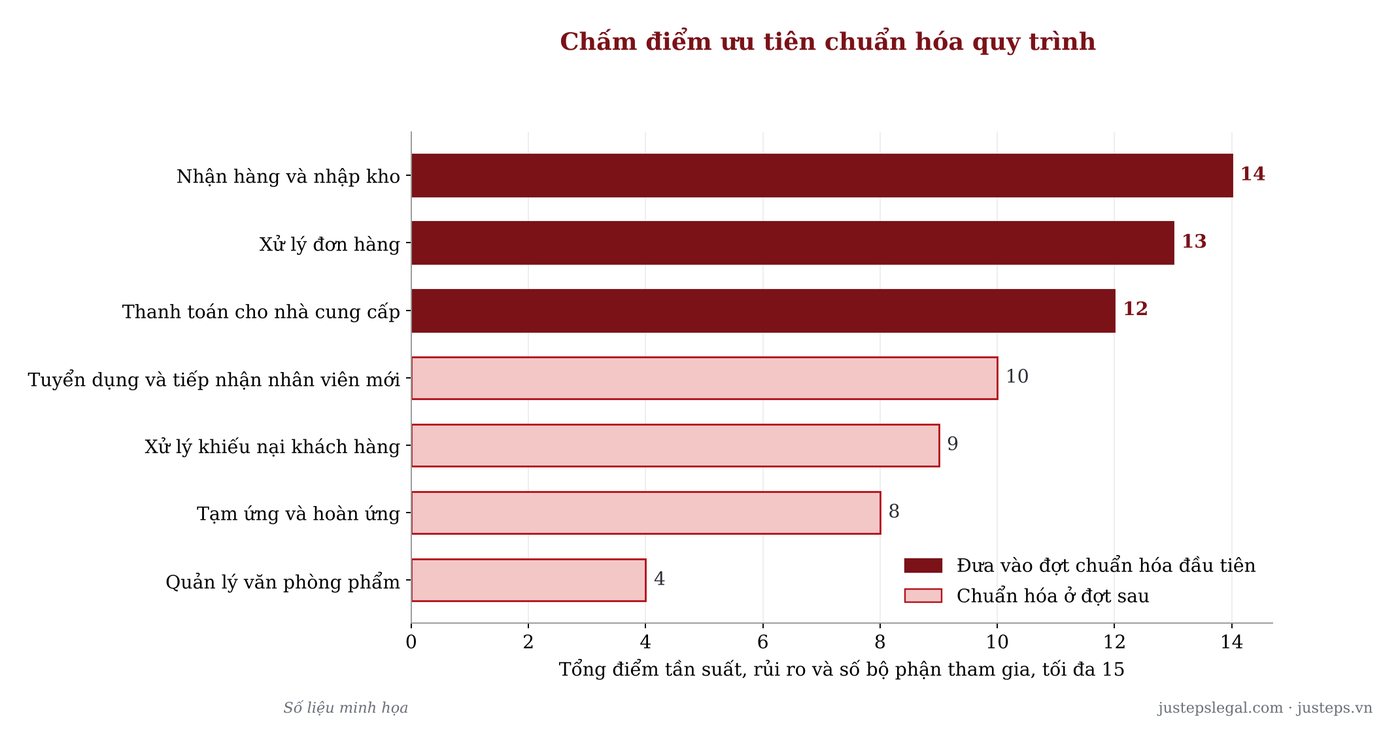
Example of priority scoring for procedures to be standardised
In the example of a distribution company, the procedures for receiving goods and taking them into stock, processing orders and paying suppliers have the highest total scores and should be included in the first round of standardisation. Procedures such as managing office supplies or booking meeting rooms score low because they carry little risk, and may be covered by brief guidance or left for later. For a business with around eighty to one hundred people, five to seven procedures in the first quarter is a suitable number, allowing the team to learn how to write, pilot and review procedures as it goes. The scores in the chart are only an illustrative example, and each business needs to score its own tasks according to its sector and its actual error data.
Procedures tied to legal obligations
Besides management criteria, a business should give priority to procedures directly tied to legal obligations, because errors there can lead to penalties or disputes. For work subject to strict occupational safety and health requirements, the employer must organise training and issue safety cards to employees before assigning them to that work[1], so the equipment operating procedure and the training procedure need to be written clearly. For activities involving the processing of personal data of customers or employees, the business must apply appropriate data protection measures[2], and procedures are the way those measures are expressed in day-to-day work. Procedures relating to money, such as receipts and payments, supplier payments and the settlement of advances, should also be given priority because they are tied to accounting vouchers and the personal responsibility of the approver.
The structure of a standard operating procedure
A good procedure is usually short, around two to five pages, and has the same structure across departments so that readers become used to finding information in it. An overly long document is often a sign that the procedure combines several different tasks or describes situations that rarely occur. In that case, the business should move the exceptions into separate guidance or split the large procedure into sub-procedures. The table below lists the components that each procedure should contain.
| Component | Content to be shown |
|---|---|
| Control information | Procedure code, version number, effective date, drafter, approver and revision history. |
| Purpose and scope | Which task and which department the procedure applies to, and which cases fall outside its scope. |
| Responsibilities | The procedure owner, the performer, the checker and the approver at each step. |
| Steps | The sequence of work, the time limit for each step and the conditions for moving to the next step. |
| Flowchart | A diagram summarising the steps, decision points and handover points between departments. |
| Forms and records | The list of forms used, where they are stored, who stores them and for how long. |
| Control indicators | One to three indicators measuring results, for example processing time or error rate. |
Of the components above, responsibilities and control indicators are the ones most often omitted. When a procedure does not specify who checks the result of each step, everyone assumes that someone else has checked it, and errors pass through several stages without being detected. Control indicators let the procedure owner know whether the procedure is working well without having to supervise every transaction personally. Steps should be written with action verbs and specific actors, for example the storekeeper counts the quantity actually received and signs the delivery record, rather than general phrases such as carry out an inspection of the goods.
Handover points between departments
Most operational errors do not occur within a single department but at the point where work passes from one department to another. Each handover point needs to state clearly what information and documents the handing department must pass on, in what form and within what time limit, and whether the receiving department may refuse an incomplete file. For procedures that pass through three or more departments, the business should draw a swimlane flowchart in which each lane represents a department, so that everyone can see where their own work sits in the overall chain. A flowchart is also a good tool for detecting duplicated checks or unnecessary waiting steps.
Steps for building and issuing a procedure
A standard operating procedure is valuable when it reflects a way of working that is feasible in the actual conditions of the business, not an ideal method copied from a template. Building a procedure should therefore start from observing the work as it is currently done, and only then move on to standardisation, piloting and issuance. The flowchart below describes a reference sequence for one procedure.
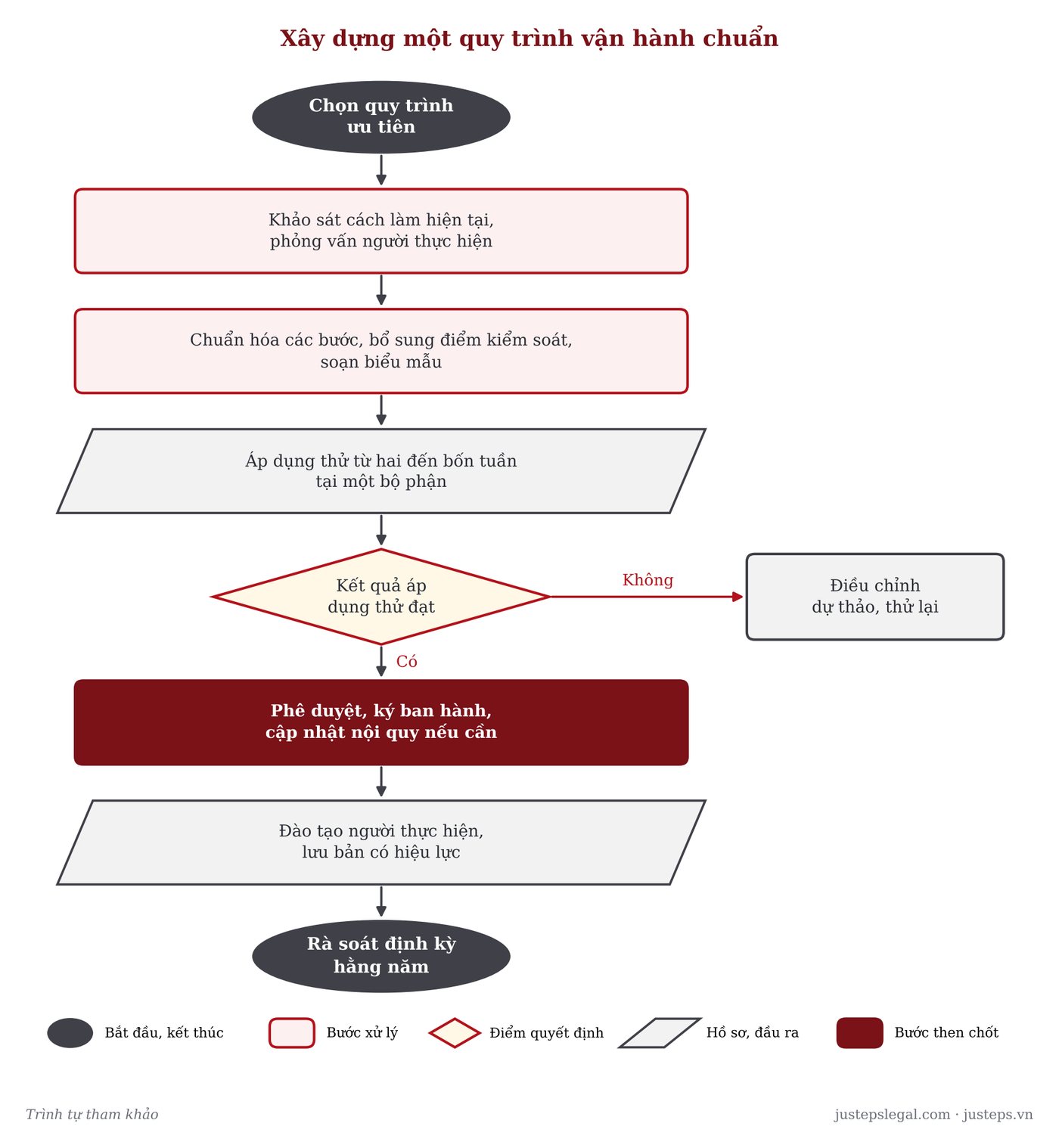
Sequence for building and issuing a standard operating procedure
The sequence begins with a survey of current practice through interviews with the people who actually perform the work and on-site observation, because managers often describe a procedure as they imagine it rather than as staff actually carry it out. At the standardisation step, the drafter removes unnecessary steps, combines duplicated checks and adds missing control points. The draft is then piloted for around two to four weeks in one department or one branch, with difficulties and result indicators being recorded. If the pilot results are unsatisfactory, the procedure is adjusted and piloted again rather than issued immediately, because a procedure that meets resistance from the start will be very difficult to enforce later.
Authority to issue
In principle, the authority to issue procedures depends on the type of business and the company charter. In a limited liability company, the Director or General Director has the power to issue internal management regulations, unless the company charter provides otherwise[3]. On that basis, the business should specify in its regulations on issuing internal documents which types of document are adopted by the Members’ Council or the Board of Directors, which are signed by the Director and which are issued by heads of department within their delegated authority. A purely operational procedure of one department can usually be approved by the head of that department, while procedures involving several departments or money and assets should be signed by the Director.
Where a procedure sets norms for time or volume of work and those norms are used to pay or assess employees, the business needs to observe the rules on labour norms. Under those rules, a norm must be an average level that the majority of employees can achieve, must be piloted before it is officially issued, and the business must consult the grassroots employee representative organisation, if any, and publish the norm before applying it[4]. The piloting described above therefore also has legal significance, beyond its management purpose. The pilot record and the comments received should be kept with the issuance file as evidence in case of complaints about the norms.
Roles in drafting and issuance
Building a procedure requires the participation of several people with different roles, and a clear division of roles prevents a situation in which one person drafts everything but no one is responsible for running it. The diagram below describes the division of roles commonly found in medium-sized businesses.
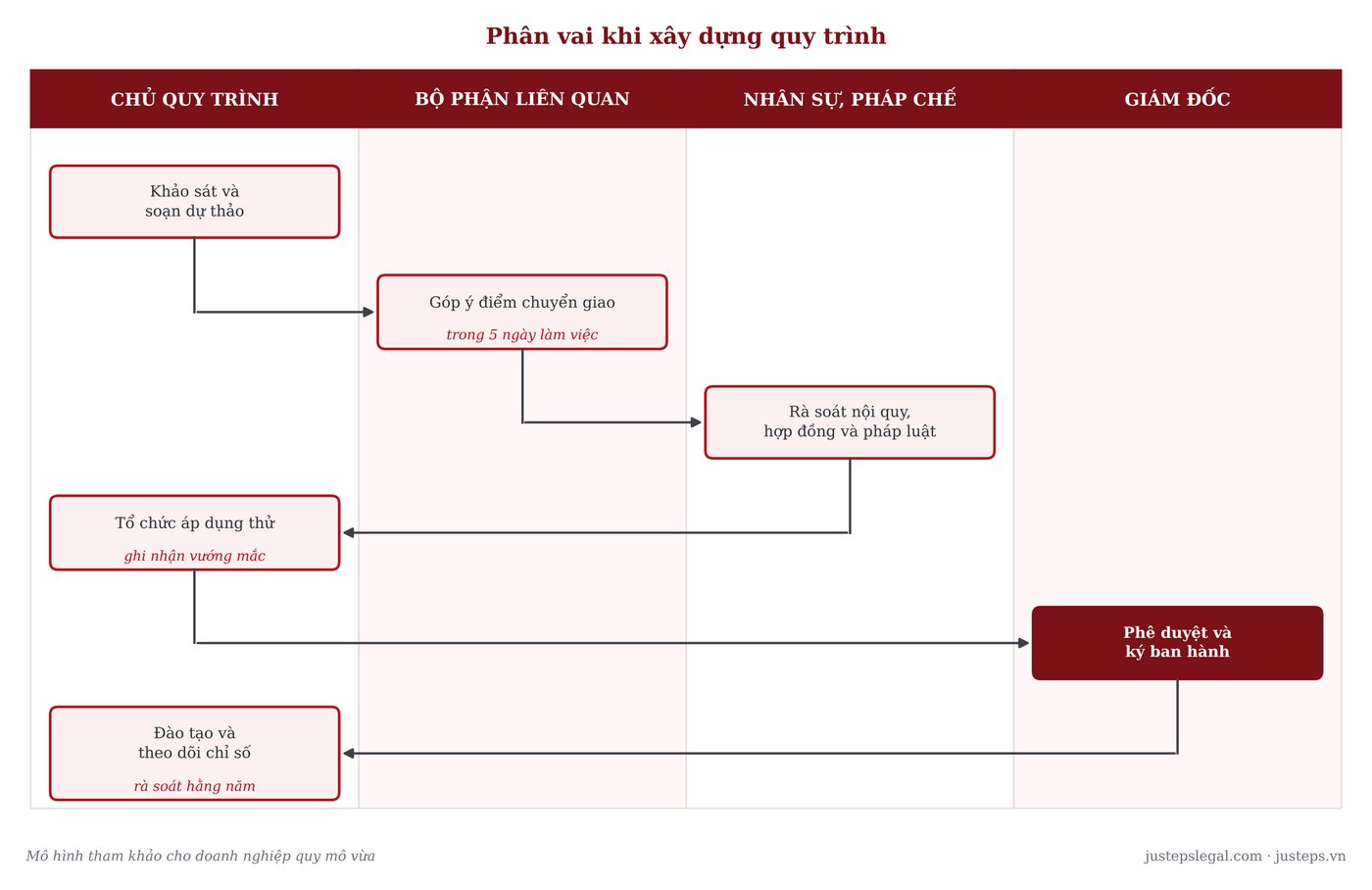
Division of roles among the parties when drafting, commenting on and issuing a procedure
According to the diagram, the procedure owner, usually the head of the department that mainly performs the work, is responsible for drafting and organising the pilot. The departments concerned comment on the handover points, while the human resources or legal function checks consistency with the internal labour rules, employment contracts and the law. The Director approves and signs the procedure, after which the procedure owner organises training and monitors the control indicators. A business without an in-house legal function may assign this review step to a consulting firm, for example through Justeps’ service on building internal governance regulations and procedures.
The relationship between standard operating procedures, regulations and internal labour rules
A business usually has three groups of internal documents with different purposes and issuance procedures, and confusing them has significant consequences when a violation occurs. The table below compares these three groups of documents.
| Document | Purpose | Issuance procedure |
|---|---|---|
| Standard operating procedure | Guides the sequence, method and result criteria of a repetitive task. | Approved by the person authorised under the internal regulations, with no registration with a state authority. |
| Internal management regulations | Set out principles, authority and approval levels for an area of management. | Issued by the Director or the management body under the Law on Enterprises and the company charter. |
| Internal labour rules | Govern labour discipline, violations, disciplinary measures and material liability. | Require consultation with the employee representative organisation and registration with the labour authority when 10 or more employees are used. |
An employer must issue internal labour rules, and where it employs ten or more employees, the rules must be in writing[5]. The rules contain main contents such as working hours, order at the workplace, occupational safety and health, protection of assets and business secrets, and acts violating labour discipline together with the disciplinary measures[6]. A business employing ten or more employees must register its internal labour rules with the provincial labour authority within ten days from the date of issuance[7], and the rules take effect fifteen days after that authority receives a complete file[8]. In addition, the rules must be communicated to employees and their main contents posted at the necessary places in the workplace[9].
The basis for action when a procedure is not followed
Labour law prohibits disciplining an employee for an act that is not specified in the internal labour rules, the signed employment contract or the labour legislation[10]. Consequently, if a standard operating procedure is issued only as a decision of the Director and the internal labour rules contain no corresponding provision, the business will lack a basis for disciplinary action when an employee deliberately fails to follow it. The appropriate solution is to add to the internal labour rules a provision on failure to comply with procedures and regulations that have been issued and communicated, together with the level of the violation and the corresponding disciplinary measure. When amending the internal labour rules, the business must repeat the consultation and registration procedures as for new rules, and may refer to Justeps’ service on internal labour rules and disciplinary action to review this part.
Even when the internal labour rules provide a basis, the business still needs to prove that the employee was informed of the procedure and understood how to carry it out. Training records signed by attendees, a short test after training or a read confirmation in the internal system are forms of evidence that should be kept. For errors made by employees who are not yet proficient, retraining is usually more effective than discipline, and disciplinary action should be considered only for deliberate acts or acts repeated after a reminder.
Training, implementation and periodic review
A procedure has value only when the people who carry it out know about it and follow it, so issuance must be accompanied by a specific training plan for each group of users. Those who perform the work directly need step-by-step guidance, checkers and approvers need to understand the control points, and new recruits need to learn the procedure as part of their induction programme. Procedure documents should be stored in a single location, with access rights assigned and only the version in force displayed, so that staff do not use old copies saved on their personal computers. Where a procedure includes forms, the forms must also carry version numbers and be withdrawn together with the old version of the procedure.
A business should review each procedure at least once a year and immediately upon events such as a change in organisational structure, a change of management software, a change in the relevant law or a serious incident. The procedure owner compiles the control indicators, the comments of those performing the work and the errors recorded, and then proposes to keep, amend or repeal the procedure. Each amendment should be entered in the version history, with the reason and the effective date, so that in the event of a dispute the business can determine which procedure was in force when the incident occurred. The years 2026 and 2027 bring many legal changes in labour, tax, data and business registration, so procedures relating to human resources, payroll and customer data should be reviewed earlier than the usual cycle.
Common mistakes and the records to keep
In our advisory practice, the following mistakes appear in many businesses when they build standard operating procedures for the first time. Most of them lie not in the wording of the document but in the way the implementation is organised:
- The business writes too many procedures in one round, leaving the people who perform the work without enough time to read, pilot and comment on them.
- The procedure describes an ideal method taken from a template that does not fit the business’s actual staffing and software.
- The procedure has no specific owner, so no one is responsible for updating it when the organisation or the law changes.
- The procedure lacks handover points between departments, so errors still occur precisely where control is most needed.
- The business uses the procedure as a basis for discipline while the internal labour rules contain no corresponding provision.
- Several versions exist at the same time on personal computers and in chat groups, so staff do not know which version is in force.
To demonstrate that its procedure system has been built and operated seriously, a business should keep a set of records comprising the list of procedures in force, the issuance decisions, the pilot records, the comments of departments, the training materials and records, the periodic review reports and the version history. This set of records is useful when dealing with inspection teams, when investors or partners carry out due diligence on the business, and when it is necessary to prove in a disciplinary case that the employee had been informed of the procedure. A small business may start with a simple tracking sheet and move to document management software as the number of procedures grows.
How Justeps can help
Justeps supports businesses in building, issuing and maintaining a system of standard operating procedures through the following services:
- Building internal governance regulations and procedures. Justeps surveys operations, lists priority procedures and drafts procedures, flowcharts and forms that reflect how the business actually works.
- Internal labour rules and disciplinary action. Justeps reviews the internal labour rules, adds provisions on compliance with procedures and prepares the registration file.
- Organisational structure, functions and duties, and job descriptions. Justeps clarifies the functions of each department and the responsibilities of each position so that every procedure has a specific owner.
- Financial regulations and delegation of authority. Justeps builds an approval authority matrix that serves as the framework for procedures relating to money and assets.
- Training on building and implementing internal regulations. Justeps trains procedure owners on how to write, pilot, communicate and review procedures.
Frequently asked questions
Does a small business need standard operating procedures?
The law does not require private businesses to have standard operating procedures for every activity. However, a small business should still standardise a few tasks that are highly repetitive or high-risk, in order to reduce dependence on one individual and shorten the time needed to train newcomers.
How many pages should a standard operating procedure be?
A procedure should usually be around two to five pages long, with a flowchart and forms. If it is longer, the business should split it into sub-procedures or move the exceptions into separate guidance.
Who has the authority to issue procedures in a limited liability company?
The Director or General Director of a limited liability company has the power to issue internal management regulations, unless the charter provides otherwise[3]. The business should specify in its regulations on issuing documents which types of procedure may be approved by heads of department.
Can an employee be disciplined for not following a procedure?
A business may discipline an employee only for acts specified in the internal labour rules, the employment contract or the labour legislation[10]. The internal labour rules therefore need a provision on failure to comply with issued procedures, and the business must prove that the employee was informed of them.
Must standard operating procedures be registered with a state authority?
Standard operating procedures are internal management documents and do not need to be registered. Only the internal labour rules of a business employing ten or more employees must be registered with the provincial labour authority[7].
How long should a procedure be piloted?
A pilot period of two to four weeks is common, long enough for the procedure to be carried out several times and for difficulties to emerge. Where the procedure contains norms used for pay or assessment, piloting before issuance is also a requirement of labour law[4].
How often should procedures be reviewed?
A business should review them at least once a year and immediately when there is a change in organisational structure, software or the law, or when a serious incident occurs. Each amendment should be entered in the version history.
Related articles
- The procedure for issuing internal documents in a company, from drafting to archiving and monitoring their validity
- A minimum set of internal governance regulations for businesses with 50 to 200 staff
- The purchasing procedure and supplier selection, from purchase request to acceptance and payment
- Building a customer complaint handling procedure that complies with the law, sets clear authority and leaves an audit trail
Notes
[1] Clause 2, Article 14 of the Law on Occupational Safety and Health No. 84/2015/QH13 dated 25 June 2015.
[2] Law on Personal Data Protection No. 91/2025/QH15 dated 26 June 2025.
[3] Point d, Clause 2, Article 63 of the Law on Enterprises No. 59/2020/QH14 dated 17 June 2020, as amended and supplemented by Law No. 76/2025/QH15.
[4] Article 93 of the Labour Code No. 45/2019/QH14 dated 20 November 2019.
[5] Clause 1, Article 118 of the Labour Code No. 45/2019/QH14.
[6] Clause 2, Article 118 of the Labour Code No. 45/2019/QH14.
[7] Article 119 of the Labour Code No. 45/2019/QH14.
[8] Article 121 of the Labour Code No. 45/2019/QH14.
[9] Clause 4, Article 69 of Decree No. 145/2020/ND-CP dated 14 December 2020 detailing and guiding the implementation of certain articles of the Labour Code on working conditions and labour relations.
[10] Clause 3, Article 127 of the Labour Code No. 45/2019/QH14.
This article is for reference and reflects the regulations in force at the time of publication. Please consult Justeps for advice tailored to your company’s records and situation.
For further information, please contact:
📩 Email: info@justeps.vn
🌐 Website: https://justepslegal.com · https://justeps.vn
🌐 Page: Justeps
☎️ Hotline (Zalo): 096 172 2607
📍 Thanh Xuan Office: 12th Floor, Licogi 13 Tower, 164 Khuat Duy Tien Street, Thanh Xuan Ward, Hanoi, Vietnam
📍 Ha Dong Office: LK06B, No.10, Dong Dua Area, Ha Dong Ward, Hanoi, Vietnam
📍 Ho Chi Minh City Branch: 528 Le Van Sy, Ho Chi Minh City, Vietnam
📍 Hai Phong Office: Truong Thinh Village, Ha Dong Commune, Hai Phong, Vietnam
📍 Quang Ninh Office: Van Don Special Zone, Quang Ninh Province, Vietnam





